
Modern Trade Retail Market Summary:
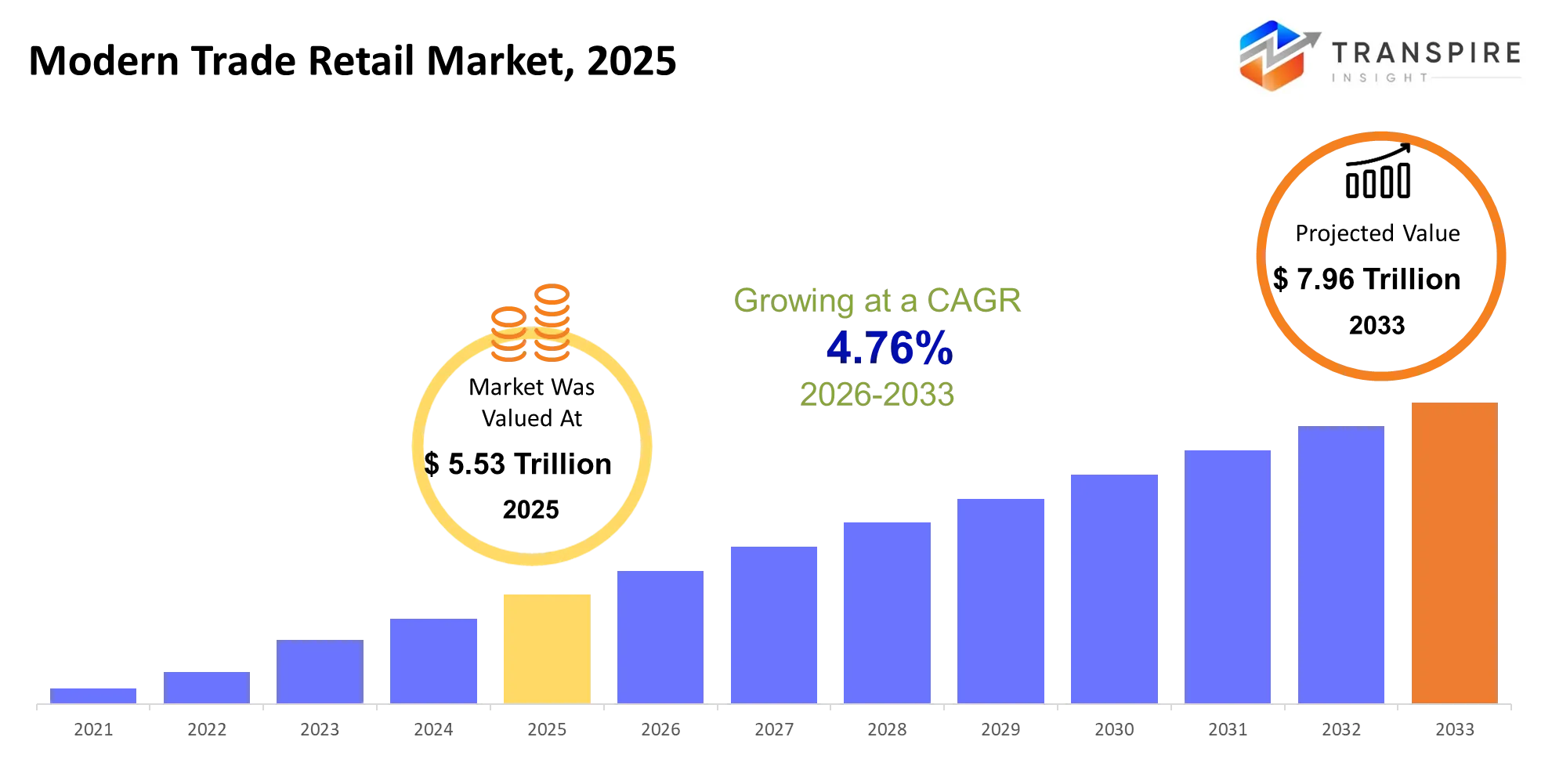
As per the Transpire Insight, The Modern Trade Retail Market size is estimated at USD 5.53 trillion in 2025 and is anticipated to reach USD 7.96 trillion by 2033, growing at a CAGR of 4.76% from 2026 to 2033.
The current modern trade retail industry helps consumers buy products such as Food, daily essentials, electronics, apparel, lifestyle, etc by giving access to products in organised stores and technology-led shopping interfaces. The modern trade retail industry has shifted over the past 5 years from retail stores to synchronized stock management, auto fulfilment, etc. As a structural transformation, retailers started aligning their traditional brick-and-mortar retail chain with online buying interfaces, resulting in live inventory check options, etc. Covid pandemic era led towards digital payments, doorstep delivery, and buy online-pickup offline methods thus changing consumer shopping expectations. Now retailers have started investing in warehouses, captive brands and automated stock refills, thereby reducing the cost of operations, increased product availability, etc. Additionally, improving urban infrastructure, formalisation of retail, and pricing transparency are encouraging organised retail. Through this, businesses make incremental profit on an increased no of daily transactions, higher inventory rotation, and more point-of-sale options.
Modern Trade Retail Market Size & Forecast:
- Market Size 2025: USD 5.53 trillion
- Expected Market Value (2033): USD 7.96 trillion
- Forecast CAGR (2026–2033): 4.76%
- Leading Region in 2025: Asia Pacific
- Fastest Growing Region: Africa
- Key Company Profiles: Walmart, Carrefour, Costco, Aldi, Lidl, Tesco, Kroger, Target, Amazon, Aeon, Reliance Retail, Schwarz Group, Ahold Delhaize, Seven & i Holdings, Auchan.
Key Modern Trade Retail Market Insights:
The retail trade of the modern era is moving away from traditional store selling and towards a comprehensive commerce ecosystem that integrates automated inventory, digital payments, and personalised shopping. Retailers are focusing on operational efficiency, private label development, and flexible fulfilment as key areas to improve profitability.
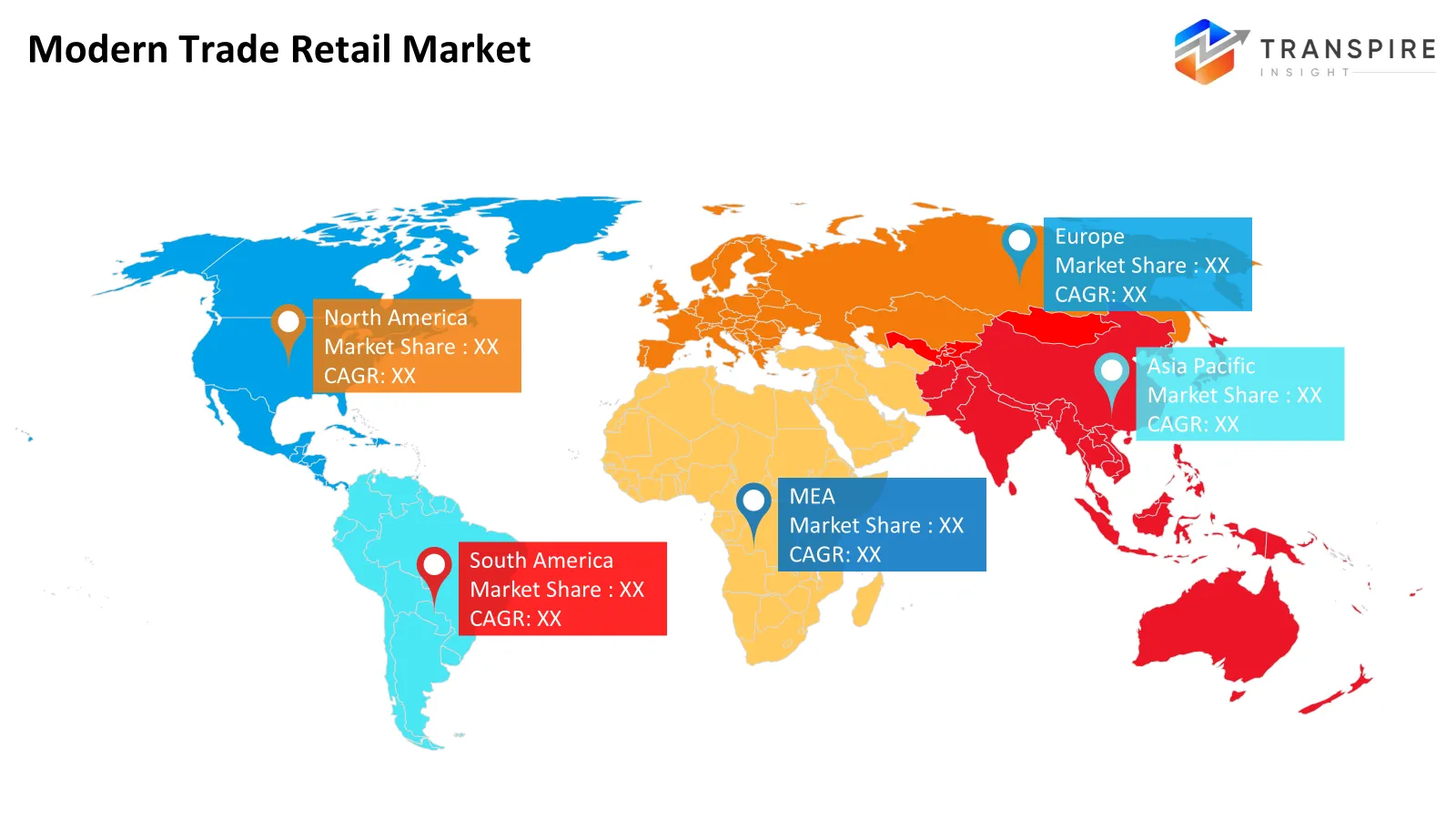
- Asia Pacific holds a dominant position with a share of 37.10% due to the growth of organised grocery, digital commerce, and private label assortments by Reliance Retail in India.
- Europe accounts for 27.5% of the market, with Ahold Delhaize expanding AI-powered services, loyalty customisation and omnichannel store revamps.
- North America represents 24.0%, with Walmart's marketplace, membership and fulfilment networks strengthening to drive in-store traffic to recurring digital sales.
- The Latin America region accounts for 6.5%, and Carrefour has been expanding retail media in the region with Unlimitail in Brazil and Argentina.
- The Middle East & Africa account for 4.9% of the market, while Africa is the fastest-growing region at 12.03% CAGR, driven by the replacement of traditional, fragmented trade with formal retail.
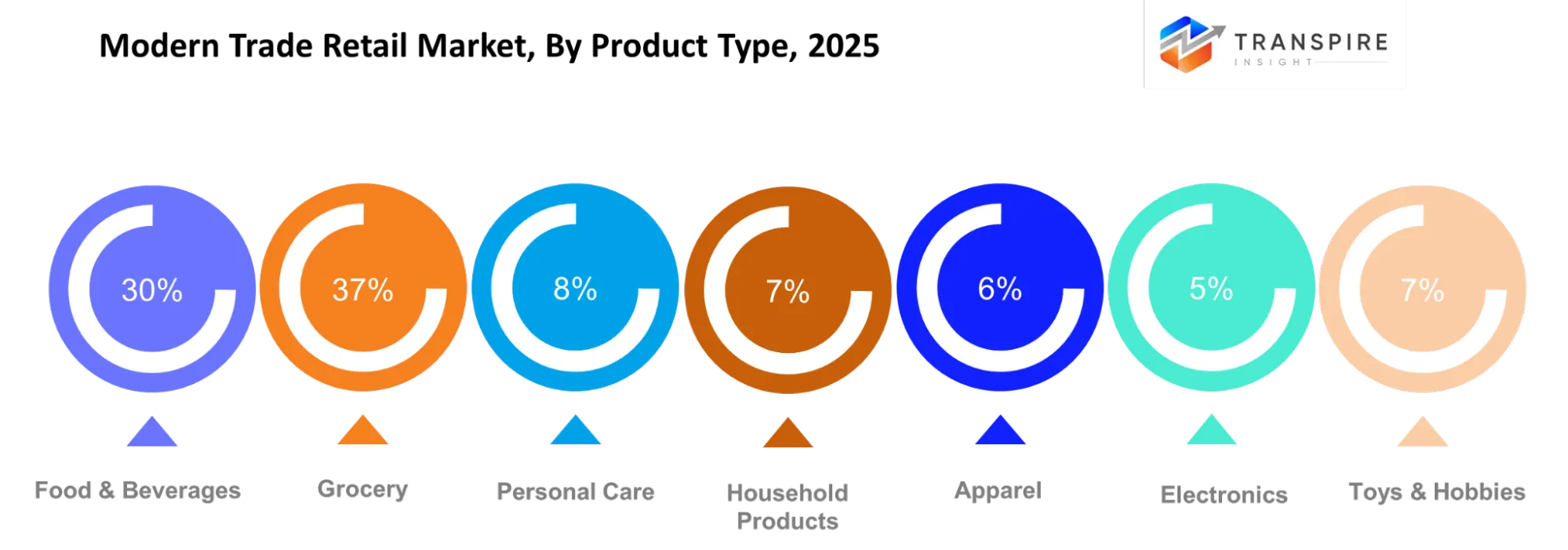
- The commercial anchors of loyalty programmes and delivery economics are Food & Beverages 30.0% and Grocery 36.85%.
- Private label products are more than 80% of Lidl's sales, indicating discount retailers' reliance on own brands to protect price leadership and margin.
- Smart-home, gaming and premium electronics adoption are expected to boost the CAGR of toys and hobby & appliances at 12.74%.
- Ahold Delhaize aims to boost its own-brand food share to between 45% and 50% and increase its omnichannel loyalty-sales penetration to 80% by 2028, and connect data, private label and retention.
What are the Key Drivers, Restraints, and Opportunities in the Modern Trade Retail Market?
Driver:
The expansion of digitally connected retail infrastructure is accelerating market growth as consumers increasingly expect consistent pricing, product availability, and convenient fulfilment across shopping channels. Widespread adoption of digital payments, electronic shelf labels, and automated inventory systems enables retailers to process transactions faster and reduce stockouts. Urban development and organized grocery investments are supporting supermarket expansion, particularly across Asia Pacific and emerging economies. These improvements increase customer retention, basket values, and store productivity.
Restraint:
Thin operating margins persist because food retail combines high labor intensity, perishability, cold-chain costs, rent, energy, and promotional price competition. These constraints are structural: frequent replenishment, shrink, and waste cannot be eliminated simply by opening more stores, while discounters and rapid-delivery platforms intensify pricing pressure. This limits the pace at which retailers can fund automation and store modernization.
Opportunity:
AI-enabled merchandising, micro-fulfilment centres, and private-label expansion present opportunities for profitable growth. Retailers can deploy predictive replenishment systems and automated warehouses to improve inventory efficiency. Investments in secondary cities across India, Southeast Asia, and Africa can unlock underserved consumer markets. Partnerships with financial technology providers can introduce embedded payments, loyalty financing, and personalized promotions, creating additional revenue streams.
Driver Impact Analysis for Modern Trade Retail Market
|
Driver |
Relative Impact on Growth (%) |
Geographic Relevance |
Impact Timeline |
Demand Strength |
Growth Mechanism |
Key Beneficiaries |
Major Constraint |
|
Expansion of Organised Retail Chains and Urban Store Networks |
28% |
Asia-Pacific, Middle East, Latin America |
Medium-term (2–4 years) |
High |
New supermarket and hypermarket openings expand consumer accessibility. |
Retail chains, FMCG manufacturers, commercial property developers. |
High real estate costs and fragmented retail competition. |
|
Omnichannel Retail Integration and Digital Commerce Adoption |
24% |
North America, Europe, Asia-Pacific |
Short-term (≤2 years) |
High |
Unified inventories and click-and-collect increase purchasing frequency. |
Omnichannel retailers, e-commerce platforms, retail technology providers. |
Integration complexity and expensive last-mile delivery operations. |
|
Rising Urbanization, Disposable Income, and Convenience-Oriented Shopping |
20% |
Asia-Pacific, Middle East, Africa |
Long-term (≥4 years) |
High |
Urban households increasingly prefer standardized, convenient shopping formats. |
Supermarkets, convenience stores, packaged food and beverage manufacturers. |
Inflationary pressures and persistent consumer price sensitivity. |
|
AI-Driven Retail Automation and Supply Chain Modernization |
16% |
North America, Europe, China, Japan |
Medium-term (2–4 years) |
High |
AI forecasting, automated replenishment, and checkout improve profitability. |
Retail technology vendors, logistics providers, large retail chains. |
High implementation costs and legacy infrastructure integration challenges. |
|
Private-Label Expansion, Sustainable Retailing, and Regulatory Compliance |
12% |
Europe, North America, Asia-Pacific |
Medium-term (2–4 years) |
Medium |
Affordable private labels and sustainable packaging strengthen loyalty. |
Private-label manufacturers, organised retailers, sustainable packaging suppliers. |
Compliance expenses and limited sustainable sourcing availability. |
|
Total |
100% |
Global |
Short- to Long-term |
High |
Combined drivers accelerate organized retail market expansion. |
Retailers, suppliers, technology vendors, logistics providers. |
Cost pressures, infrastructure gaps, and regulatory complexity. |
What Has the Impact of Artificial Intelligence Been on the Modern Trade Retail Market?
The essence of AI is to shift the focus from reactive merchandising in modern trade to outcome-predictive merchandising. Retailers are using machine learning for demand forecasting, automated replenishment, dynamic pricing, shrinkage optimization, and route planning to help ensure availability and minimize excess, wastage, and fulfillment costs. On the customer side, recommendation engines, generative AI shopping assistants, chatbots, and offer personalization make discovery easier and facilitate returns or order amendments both in-store and online.
The operational benefits are measurable: AI-powered inventory planning improves sales precision and responsiveness to demand shifts to directly support margins and service levels; Zalando's AI models increased items in shopping bags by 13%, while the size-and-fit model reduced size-and-fit-driven returns by over 8%. This offers further upside for conversion rates and reverse-logistics economics. The main obstacle is cost and integration; many retailers remain on a fragmented POS, online, warehouse, and loyalty system landscape, making it hard to derive an accurate up-to-the-second view. AI is only as good as the quality of input data on past sales, inventory, and customers; inaccurate inputs will lead to inaccurate forecasts. Plus, it raises hurdles around compliance. The EU AI Act, which came into force in August 2024, sets out harmonized standards for 'trustworthy AI'.
In July 2026, Zalando joined the Sereact Series B funding round as a strategic investor, growing the round to $116 million to scale physical AI robotics for automated warehouse picking and returns processing. This investment helps accelerate automated physical operations in e-commerce logistics centers.
https://corporate.zalando.com/en/investor-relations/zalando-full-year-2025-results
Key Modern Trade Retail Market Trends:
Retail has become smart and connected, and retail stores are becoming sales points and fulfilment centres. Increasingly, retailers place greater emphasis on inventory visibility, operational automation and measurable customer convenience over aggressive store expansion.
- Unified commerce is taking the place of simple omnichannel pilots, enabling the sharing of inventory, apps, checkout, delivery and returns.
- Physical stores are being shifted from being sales outlets to click-and-collect, same-day delivery and returns fulfilment centres.
- Demand forecasting using AI is now mainstream for fresh food availability, replenishment, markdown control and supply route planning.
- Private labels are moving from a low-price alternative to a strategic margin and differentiation platform.
- Retail media networks are transforming shopper behaviour data and loyalty into a new revenue stream for retailers.
- Consumers are buying more often, on the spur of the moment, for immediate use, and convenience and proximity formats are becoming more significant.
- A trend of price sensitivity is driving value-seeking behaviour, which is growing discount, membership and bulk-buy formats.
- Assortment, packaging and reverse logistics are being impacted by sustainability regulation, as are product compliance with EU extended producer responsibility and ecodesign rules.
- Social commerce and mobile-first discovery are driving retail beyond owned sites to creator-led and platform-based buying.
Modern Trade Retail Market Segmentation
Store Format:
Supermarkets dominate organised retail through frequent household purchases, competitive pricing, and extensive product availability. Hypermarkets attract bulk shoppers seeking convenience and value, while convenience stores benefit from urban accessibility and quick transactions. Department stores offer diversified merchandise, whereas speciality stores focus on category expertise and personalised experiences. Discount stores attract price-sensitive consumers, and cash-and-carry formats serve institutional buyers. Other formats address localized purchasing requirements. Future investments increasingly favour compact store layouts, digital integration, and flexible fulfilment capabilities to improve profitability.
Product Type:
The grocery segment contributes the largest market share in the modern trade retail market at 36.85%, followed by Food and Beverages at 30.0%, collectively accounting for 66.85% of the total, driven by households' regular consumption demand. Personal Care contributes 8.0% growth via preferences for branded products; Household Products share 7.0%; Apparel covers 6.0%, which generally rises due to seasonal fashion collection trends; and the Electronics segment stands at 5.0% through technological evolutions. Toys and Hobbies hold a 4.0% share, and other categories contribute 3.15%. Toys, Hobbies, and Appliances, on the other hand, are expected to grow at the highest CAGR of 12.74%, powered by experiential, discovery-oriented shopping, innovation in merchandise, and growing interest in lifestyle.
Ownership:
Retail chains maintain a competitive advantage through centralized procurement, economies of scale, and standardized operations. Independent retailers differentiate through localized assortments and personalized customer relationships, while franchise stores support geographic expansion with lower capital requirements. Cooperative stores strengthen collective purchasing power, whereas private equity-owned retailers prioritize operational efficiency and profitability. Government-owned outlets improve essential product accessibility, and joint ventures facilitate international market entry. Other ownership structures serve specialized consumer groups, supporting diversified investment strategies and technology adoption across organized retail networks.
Distribution Channel:
Physical stores remain the primary shopping destination, supported by immediate product availability and direct customer engagement. Online channels expand geographic reach, while omnichannel platforms integrate digital and offline purchasing experiences. Mobile commerce enables convenient transactions, and click-and-collect services reduce delivery costs. Home delivery supports time-sensitive consumers, whereas marketplaces provide broader product selections without extensive inventory ownership. Other channels address specialized purchasing requirements. Retailers increasingly invest in integrated fulfilment infrastructure, real-time inventory visibility, and automated logistics to strengthen competitiveness and profitability.
Consumer Type:
Mass-market shoppers represent a substantial customer base, prioritizing affordability, product availability, and promotional value. Premium consumers seek differentiated products and personalised experiences, while middle-income consumers balance quality with competitive pricing. High-income consumers favour exclusive assortments and premium services, whereas families emphasise convenience and household savings. Young adults increasingly prefer digital engagement and flexible fulfilment, while seniors value accessibility and reliable service. Other consumer groups require specialised offerings, encouraging retailers to develop localized assortments, targeted loyalty programs, and customer-centric shopping experiences.
Business Model:
Supermarkets generate recurring revenue through essential household purchases, while hypermarkets consolidate multiple product categories under one location. Discount retailers compete through competitive pricing and operational efficiency, whereas speciality retail emphasises product expertise and differentiated assortments. Convenience retail benefits from accessibility and quick purchasing, while membership retail strengthens customer retention through exclusive benefits. Cash-and-carry models support wholesale purchasing and institutional customers, and other formats introduce hybrid retail approaches. Future competitiveness increasingly depends on private-label development, digital integration, and efficient inventory management.
What are the Key Use Cases Driving the Modern Trade Retail Market?
The core use case is daily grocery replenishment through supermarkets, hypermarkets, and convenience stores. Food & Beverages and Grocery together represent 66.85% of the market, making fresh food availability, private-label value packs, promotions, and rapid top-up shopping the primary revenue engine.
Expanding applications include click-and-collect, app-based ordering, home delivery, and store-based fulfilment for household, personal-care, and electronics categories. Retailers increasingly use loyalty data to personalize offers, automate replenishment, and convert stores into pickup and return hubs.
Emerging use cases include AI-guided assortment planning, cashier-less and mobile checkout, retail media monetization, and sustainable packaging or reverse-logistics services. These applications link grocery scale with higher-margin data, advertising, and compliance-led services.
|
Report Metrics |
Details |
|
Market size value in 2025 |
USD 5.53 trillion |
|
Market size value in 2026 |
USD 5.75 trillion |
|
Revenue forecast in 2033 |
USD 7.96 trillion |
|
Growth rate |
CAGR of 4.76% from 2026 to 2033 |
|
Base year |
2025 |
|
Historical data |
2021 - 2024 |
|
Forecast period |
2026 - 2033 |
|
Report coverage |
Revenue forecast, competitive landscape, growth factors, and trends |
|
Regional scope |
United States; Canada; Mexico; United Kingdom; Germany; France; Italy; Spain; Denmark; Sweden; Norway; China; Japan; India; Australia; South Korea; Thailand; Brazil; Argentina; South Africa; Saudi Arabia; United Arab Emirates |
|
Key companies profiled |
Walmart, Carrefour, Costco, Aldi, Lidl, Tesco, Kroger, Target, Amazon, Aeon, Reliance Retail, Schwarz Group, Ahold Delhaize, Seven & i Holdings, Auchan. |
|
Customization scope |
Free report customization (country, regional & segment scope). Avail customized purchase options to meet your exact research needs. |
|
Report Segmentation |
Store Format (Supermarkets, Hypermarkets, Convenience Stores, Department Stores, Specialty Stores, Discount Stores, Cash & Carry, Others)Product Type (Food & Beverages, Grocery, Personal Care, Household Products, Apparel, Electronics, Toys & Hobbies, Others)Ownership (Retail Chains, Independent Retailers, Franchise Stores, Cooperative Stores, Private Equity-Owned, Government-Owned, Joint Ventures, Others)Distribution Channel (Physical Stores, Online Channels, Omnichannel, Mobile Commerce, Click-and-Collect, Home Delivery, Marketplace, Others)Consumer Type (Mass Market, Premium Consumers, Middle-Income Consumers, High-Income Consumers, Families, Young Adults, Seniors, Others)Business Model (Supermarket Model, Hypermarket Model, Discount Model, Specialty Retail, Convenience Retail, Membership Retail, Cash & Carry, Others). |
Which Regions are Driving the Modern Trade Retail Market Growth?
Asia Pacific has a 37.10% share of the modern trade retail market, as growing populations, expanding middle class, and urbanization levels drive sustained demand for organised grocery, convenience, and value formats. Asia Pacific has a robust logistics infrastructure, mobile payment adoption, and rising digital consumption that enables retailers to merge their brick-and-mortar channels with app-based ordering and delivery. Reliance Retail's meteoric expansion in India demonstrates the speed and scale organised retail can achieve by blending neighbourhood stores, modern trade, and digital commerce.
In August 2026, Reliance Retail completed the all-cash acquisition of Furrl, a Bengaluru-based AI-powered fashion discovery platform. The integration absorbs Furrl's advanced styling engine and its entire engineering team directly into Reliance Retail’s digital operations.
Europe, with a 27.5% share, is mature compared to APAC but still has a large share of growth for improved efficiency, private label, and omnichannel investments. North America, with a 24.0% share, favours competition with large supply chains, membership channels, marketplace ecosystems, and quick fulfilment speed over increases in store count. Both regions demonstrate sustainable demand, as consumers are already used to organized retail; with inflation, discount retailers, private brands, and personalisation are more appealing thanks to a high degree of customer loyalty.
In October 2026, Walmart launched a $120-a-year membership bundle that combines its standalone Walmart+ and Sam’s Club Plus subscriptions. This action directly targets value-conscious consumers ahead of the holiday season by offering a combined discount of nearly $100 compared to buying the two subscriptions separately, enabling the retailer to capture deeper consumer data and drive loyalty across its broader marketplace ecosystem.
Africa is also the fastest-expanding region with a CAGR of 12.03%, although the Middle East and Africa account for just 4.9% of revenue globally today. Formal retail has entered these more traditional, lower-income markets over the last decade, facilitated by progress in urban infrastructure, rising disposable income and increased investment in supply chains. Growth will come from the scaling of tight micro-supermarkets, new cash and carry offers, mobile-first formats and local private label ranges that are relevant to affordability and availability.
In January 2026, Carrefour announced a strategic franchise and supply partnership with Queens Supermarket PLC (a subsidiary of Midroc Investment Group). This milestone agreement launches the French retail giant into Ethiopia, one of Africa's largest consumer markets, to support its capital-light international growth strategy.
https://www.carrefour.com/en/news/2026/carrefour-enters-ethiopia
Who are the Key Players in the Modern Trade Retail Market, and how do they compete?
The competition today is no longer store numbers and the extent of store presence – it is the ability to combine value pricing, private labels, data to deliver personalization and one-to-many offerings/zero marginal cost fulfilment. Among the largest players, the physical network is used as a delivery, click-and-collect, advertising and loyalty tool rather than a route-to-market.
Costco focuses on a membership/ value proposition via a bulk/spiral SKU proposition, supported by a Kirkland Signature private-label range and expansion into the Asian markets. Lidl and Aldi are low-cost operators that have recently penetrated the US and Eastern Europe respectively, with Lidl's private-label penetration more than 80%. Tesco differentiates itself through club-card-based personalisation, online AI-supported product recommendations and value ranges, whilst Carrefour combines hypermarket presence and scale with sustainability efforts, local sourcing, click-and-collect, and retail media offering through Unlimitail. Ahold Delhaize distinguishes itself through omnichannel loyalty, AI-supported store efficiency, and acquisitions such as Profi, whilst the Schwarz Group deploys Lidl, Kaufland, own-label manufacturing, and a proprietary digital ecosystem.
Key Players are:
- Walmart
- Carrefour
- Costco
- Aldi
- Lidl
- Tesco
- Kroger
- Target
- Amazon
- Aeon
- Reliance Retail
- Schwarz Group
- Ahold Delhaize
- Seven & i Holdings
- Auchan
Modern Trade Retail Market — Enhanced Competitive Benchmarking
|
Company |
Est. Revenue Share Range |
Key Offerings |
Strategic Positioning |
Geographic Strength |
Technology Focus |
|
Walmart Inc. |
Estimated 6–9% |
Supercenters, Walmart Neighbourhood Markets, Sam's Club, Walmart.com |
scale leadership through everyday low-price retailing. |
North America, Latin America, Asia Pacific |
AI forecasting, automated fulfilment, omnichannel inventory integration. |
|
Costco Wholesale Corporation |
Estimated 2–4% |
Membership warehouses, Kirkland Signature, bulk groceries, Costco.com |
Membership-driven warehouse retailing with high inventory turnover. |
North America, Asia Pacific, Europe |
Automated distribution, inventory analytics, digital membership platforms. |
|
Schwarz Group |
Estimated 2–4% |
Lidl discount supermarkets, Kaufland hypermarkets, private-label groceries, Kaufland Marketplace |
Cost leadership through vertically integrated discount retailing. |
Europe, North America |
Cloud infrastructure, logistics automation, digital retail platforms. |
|
Aldi (Aldi Nord and Aldi Süd) |
Estimated 2–4% |
Discount supermarkets, private-label groceries, fresh foods, household essentials |
Limited-assortment discounting with operational efficiency and value. |
Europe, North America, Asia Pacific |
Automated logistics, demand forecasting, electronic shelf labels. |
|
Carrefour SA |
Estimated 1–2% |
Hypermarkets, supermarkets, Carrefour Market, Carrefour private labels |
Multiformat retailing emphasizing food leadership and localization. |
Europe, Latin America |
AI merchandising, retail media, omnichannel grocery platforms. |
|
Ahold Delhaize |
Estimated 1–2% |
Food Lion, Stop & Shop, Albert Heijn, Delhaize |
Local grocery leadership through diversified regional banners. |
North America, Europe |
Customer analytics, digital loyalty, automated grocery fulfillment. |
|
Tesco PLC |
Estimated 0.8–1.5% |
Tesco Extra, Tesco Superstores, Tesco Express, Clubcard |
Grocery leadership supported by loyalty-driven customer retention. |
Europe |
Clubcard analytics, personalized pricing, automated distribution systems. |
|
Seven & i Holdings Co., Ltd. |
Estimated 0.8–1.5% |
7-Eleven convenience stores, private-label foods, ready-to-eat meals |
Convenience retail specialization through dense neighborhood networks. |
Asia Pacific, North America |
POS analytics, automated replenishment, digital payment integration. |
|
REWE Group |
Estimated 0.8–1.5% |
REWE supermarkets, PENNY discount stores, REWE delivery, private labels |
Regional supermarket strength combining discount and convenience. |
Europe |
Digital grocery ordering, warehouse automation, inventory optimization. |
|
AEON Co., Ltd. |
Estimated 0.8–1.5% |
AEON supermarkets, AEON Style, MaxValu, private-label products |
Integrated Asian retail ecosystem spanning multiple store formats. |
Asia Pacific |
Digital payments, customer data analytics, smart retail. |
Recent Development News
- In September 2026, Carrefour partnered with Apparel Group to launch its flagship hypermarket in Greater Noida, India, spanning more than 50,000 square feet and offering over 15,000 product SKUs. The partnership strengthens international retailer participation in India's organized retail sector while expanding product accessibility, local sourcing opportunities, and omnichannel retail infrastructure. https://www.globenewswire.com/news-release/2026/09/04/3356479/0/en/apparel-group-redefines-india-s-retail-landscape-with-carrefour-s-ambitious-entry.html
- In October 2026, TreviPay expanded the availability of its Pay By Invoice solution for eligible Walmart Business customers, introducing integrated invoicing, dedicated credit facilities, and 30-day payment terms across online and in-store purchasing channels. The launch strengthens B2B retail payment flexibility, supports business purchasing efficiency, and accelerates digital financial integration within modern retail operations. https://www.sttinfo.fi/tiedote/72431833/trevipay-expands-pay-by-invoice-availability-for-walmart-business-customers
- In October 2026, LuLu Group expanded its modern retail network in India by opening a 40,000-square-foot LuLu Daily store in Bengaluru and a 100,000-square-foot hypermarket in Greater Noida, bringing its Indian retail footprint to 23 outlets. The expansion strengthens organized retail penetration, improves access to modern grocery formats, and supports regional supply chain development. https://www.indiaretailing.com/lulu-group-takes-india-retail-network-to-23-outlets-eyes-wider-multiformat-expansion
What Strategic Insights Define the Future of the Modern Trade Retail Market?
The future of modern trade is an integrated commercial infrastructure, where bricks, digital, and robotic fulfilment operate through shared inventory intelligence. Long-term competitive advantage will increasingly depend on execution effectiveness, customer data, and local assortment policies rather than mere aggressive geographic expansion. An unseen hazard lies in the underappreciated dependency on integrated technology partners, leaving retailers exposed to cybersecurity threats, system failures, and ballooning costs of integration. Meanwhile, agentic AI commerce will enable automation of product discovery, replenishments, and personalized offers. Walmart's launch of AI shopping-agent infrastructure in October 2026 illustrates this emerging evolution. Vendors should prioritise interoperability of technology architectures, partnering for regional fulfillment, and designing profitable private labels. Investment in secondary urban markets and modernization of cold-chain logistics will open markets and protect margins. Those who lead with technology innovation and operational rigour will be best positioned to lead sustainable growth.
Key Segmentations are:
Store Format
- Supermarkets
- Hypermarkets
- Convenience Stores
- Department Stores
- Specialty Stores
- Discount Stores
- Cash & Carry
- Others
Product Type
- Food & Beverages
- Grocery
- Personal Care
- Household Products
- Apparel
- Electronics
- Toys & Hobbies
- Others
Ownership
- Retail Chains
- Independent Retailers
- Franchise Stores
- Cooperative Stores
- Private Equity-Owned
- Government-Owned
- Joint Ventures
- Others
Distribution Channel
- Physical Stores
- Online Channels
- Omnichannel
- Mobile Commerce
- Click-and-Collect
- Home Delivery
- Marketplace
- Others
Consumer Type
- Mass Market
- Premium Consumers
- Middle-Income Consumers
- High-Income Consumers
- Families
- Young Adults
- Seniors
- Others
Business Model
- Supermarket Model
- Hypermarket Model
- Discount Model
- Specialty Retail
- Convenience Retail
- Membership Retail
- Cash & Carry
- Others
By Regional Analysis
North America
- US
- Canada
- Mexico
Europe
- Germany
- UK
- France
- Italy
- Spain
- Russia
- Rest of Europe
Asia Pacific
- China
- Japan
- India
- South Korea
- Australia
- Rest of Asia Pacific
South America
- Brazil
- Argentina
- Rest of South America
Middle East & Africa
- UAE
- Saudi Arabia
- Qatar
- South Africa
- Rest of the Middle East & Africa
Frequently Asked Questions
Find quick answers to common questions.
The modern trade retail market size was valued at USD 5.53 trillion in 2025 and is poised to reach USD 7.96 trillion by 2033, expanding at a 4.76% CAGR.
Key segments for the modern trade retail market are Store Format (Supermarkets, Hypermarkets, Convenience Stores, Department Stores, Specialty Stores, Discount Stores, Cash & Carry, Others)Product Type (Food & Beverages, Grocery, Personal Care, Household Products, Apparel, Electronics, Toys & Hobbies, Others)Ownership (Retail Chains, Independent Retailers, Franchise Stores, Cooperative Stores, Private Equity-Owned, Government-Owned, Joint Ventures, Others)Distribution Channel (Physical Stores, Online Channels, Omnichannel, Mobile Commerce, Click-and-Collect, Home Delivery, Marketplace, Others)Consumer Type (Mass Market, Premium Consumers, Middle-Income Consumers, High-Income Consumers, Families, Young Adults, Seniors, Others)Business Model (Supermarket Model, Hypermarket Model, Discount Model, Specialty Retail, Convenience Retail, Membership Retail, Cash & Carry, Others).
Growth is primarily driven by expanding organised retail networks, rapid urbanization, increasing digital payment adoption, omnichannel shopping integration, AI-powered inventory management, private-label expansion, and investments in automated supply chains and modern retail infrastructure.
The modern trade retail market is led by major retailers, including Walmart, Carrefour, Costco, Aldi, Lidl, Tesco, Kroger, Target, Amazon, Aeon, Reliance Retail, Schwarz Group, Ahold Delhaize, Seven & i Holdings, and Auchan.
Asia Pacific dominates the modern trade retail market with a 37.10% share, supported by rapid urbanisation, expanding supermarket and hypermarket networks, widespread digital payment adoption, growing middle-income consumption, and significant investments in organised retail infrastructure across China, India, and Southeast Asia.
Key opportunities include AI-driven retail automation, private-label expansion, omnichannel fulfilment, smart shelving, micro-fulfilment centres, retail media monetisation, and organised retail expansion across emerging economies.
- Walmart
- Carrefour
- Costco
- Aldi
- Lidl
- Tesco
- Kroger
- Target
- Amazon
- Aeon
- Reliance Retail
- Schwarz Group
- Ahold Delhaize
- Seven & i Holdings
- Auchan
About the Authors

Mayur Shinde
I am Mayur Shinde, a Senior Research Analyst at Transpire Insight, specializing in the Automotive & Transportation and Information & Communication Technology (ICT) Industry. My work focuses on analyzing emerging market trends, technological advancements, competitive landscapes, and industry developments to deliver accurate, data-driven insights. I am passionate about transforming complex market information into clear, actionable content that helps businesses, professionals, and decision-makers stay informed and make confident strategic decisions.

Chakradhar Khansole
Chakradhar serves as the Research Director at Transpire Insight, bringing over 8 years of experience in technology, innovation, and strategic market intelligence. He specializes in transforming complex market data into actionable business insights that enable organizations to make informed, growth-oriented decisions. Recognized for his strategic vision and analytical expertise, Chakradhar leads high-impact research initiatives, delivering comprehensive market assessments, competitive intelligence, and forward-looking industry analysis.
Recently Published Reports
-
Apr 2026
3D Optical Profiler Market
3D Optical Profiler Market Size, Share & Analysis Report By Type (Desktop 3D Optical Profiler, and Portable 3D Optical Profiler), By Technology (Confocal Technology, and White Light Interference), By End-Use Industry (Manufacturing, Research Institutions, Automotive, Aerospace and Defense, Medical Devices, and Other), and Geography (North America, Europe, Asia-Pacific, Middle East and Africa, South and Central America), 2021 - 2031
-
Apr 2026
Depth Sensor Market
Depth Sensor Market Size, Share & Analysis Report By Type (Infrared Depth Sensors, Time-of-Flight (ToF) Sensors, Stereo Vision Sensors, Structured Light Sensors, Ultrasonic Depth Sensors), By Application (Automotive, Robotics, Gaming, Consumer Electronics, Industrial Automation, Healthcare, Security & Surveillance, Others), By End Users (Automotive Manufacturers, Consumer Electronics Companies, Healthcare Providers, Industrial Companies, Security Agencies, Gaming Companies, Robotics Companies, Others), and Geography (North America, Europe, Asia-Pacific, Middle East and Africa, South and Central America), 2021 – 2031
-
Apr 2026
Digital Manufacturing Market
Digital Manufacturing Market Size, Share & Analysis Report By Component (Hardware, Software, and Services), By Technology (Robotics, 3D Printing, Internet of Things (IoT), and Others), By Application (Automotive and Transportation, Aerospace and Defense, Consumer Electronics, Industrial Machinery, and Others), By Process Type (Computer-Based Designing, Computer-Based Simulation, Computer 3D Visualization, Analytics, and Others), and Geography (North America, Europe, Asia-Pacific, Middle East and Africa, South and Central America), 2021 – 2031
-
Apr 2026
Digital Visa Services Market
Digital Visa Services Market Size, Share & Analysis Report By Type (Individual Travelers, Group Travelers), By Application (Tourism, Business Travel, Others), and Geography (North America, Europe, Asia-Pacific, Middle East and Africa, South and Central America), 2021 – 2031