
Food & Beverage Market Summary:
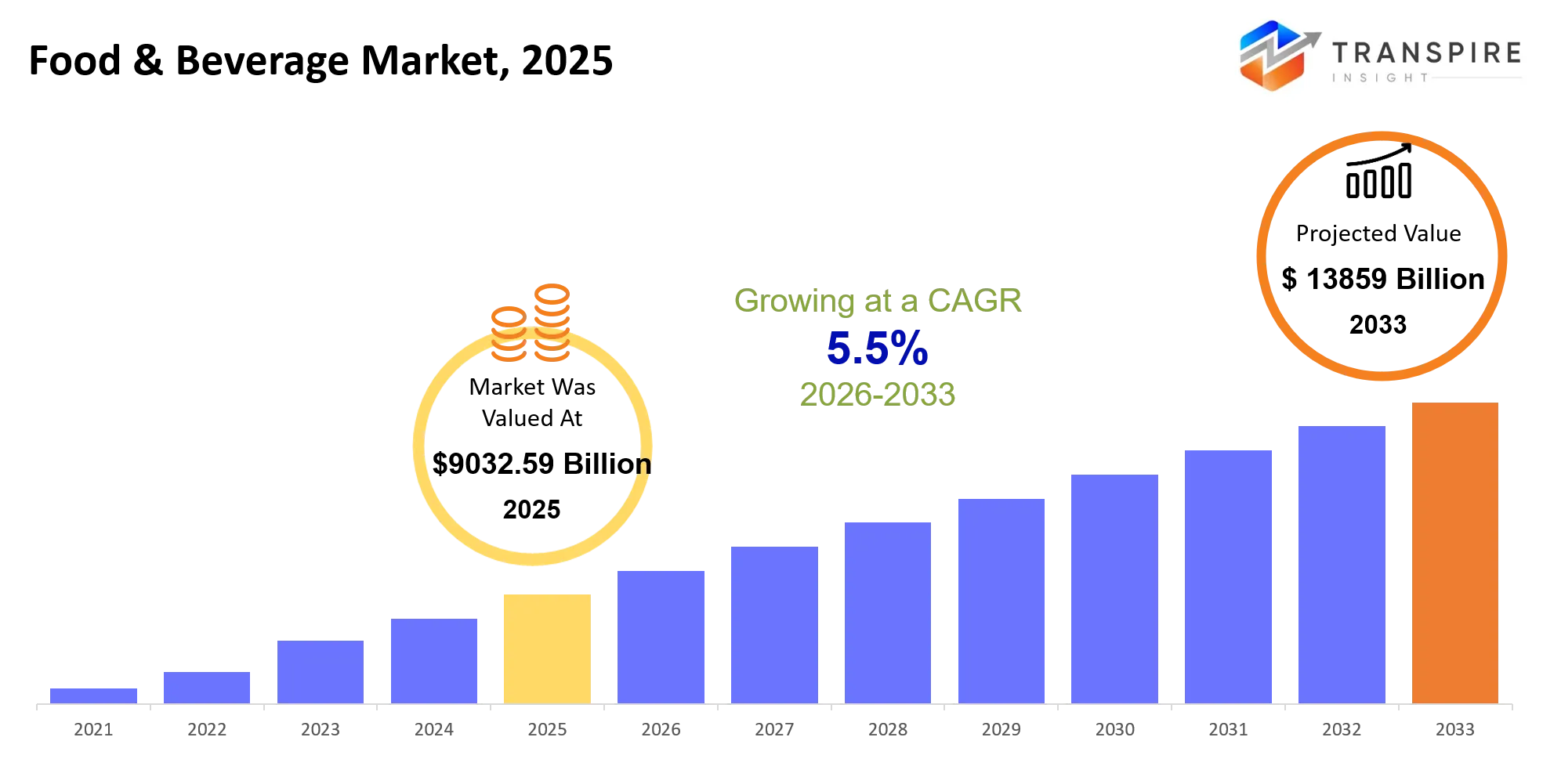
As per Transpire Insight Analysis, theFood & Beverage Market size is estimated at USD 9032.59 billion in 2025 and is anticipated to reach USD 13859 billion by 2033, growing at a CAGR of 5.5% from 2026 to 2033.
Thefood and beverage market has shifted from buying more toward focusing on convenience, health, affordability and quicker product updates. over the next three to five years, e-commerce in grocery shopping, ready-to-eat meals, products with additional features and efficient supply chains will revolutionize the processes of production, sales and replenishment of food and beverages by companies. The significant development is the increasing use of technology in the production, transportation and marketing of foods and beverages. Consumers purchase food at home using internet, and price inflation has increased their search for bargains and more value for their money. Now growth will be driven not only by convenience but by innovation in products: producers create products based on different ingredients which can provide additional features, and deliver them to consumers faster, and retailers are using e-commerce to increase contact with consumers. This creates new opportunities for the sale of food and drinks and revenue generation outside the traditional packaged foods segments.
Food & Beverage Market Size & Forecast:
- Market Size 2025: USD 9032.59 Billion
- Expected Market Value (2033): USD 13859 Billion
- Forecast CAGR (2026–2033): 5.5%
- Leading Region in 2025: Asia Pacific
- Fastest Growing Region: Middle East & Africa
- Key Company Profiles: Nestlé, PepsiCo, Coca-Cola, Danone, Mondelez International, Unilever, Mars, Kraft Heinz, General Mills, Tyson Foods, JBS, Cargill, Kellogg, Conagra Brands, Archer Daniels Midland
Key Market Insights:
market is moving towards convenience, healthy food items, online shopping, and efficient supply chain management. Processed Food is growing steadily, but functional and health food is witnessing the highest growth rate.
- The market share of Processed Food holds 35.60%, reflecting the trend of consumers' increasing preference for convenient, packaged, and shelf-life foods.
- Functional & Health Food's growth rate accounts for 8.10% CAGR, due to the increased demand for functional and healthy food products.
- Household regular food consumption and foodservice demands comprise 39.00% of the segment breakdown.
- The category of Beverages represents 21.00%, due to the increased production of functional, low-sugar, ready-to-drink products that reflect consumer preferences.
- The category of Dairy Products represents 11.00%, and manufacturers are working on fortified, convenient, and value-added dairy formats.
- The category of Bakery & Confectionery accounts for 7.00% and comprises the efforts of manufacturers to improve premium, speciality, and portion-controlled products.
What are the Key Drivers, Restraints, and Opportunities in theFood & Beverage Market?
Drivers
Growth is fueled by convenience, well-being and value-focused offerings. It is the busy lifestyles, upsurge in nutritional consumer interest and also the exponential rise of e-commerce grocery & food service channels that have been solid growth factor for these categories. This will also translate to a higher of new product opportunities for manufacturers as a result.
Restraints
Input cost volatility is an ongoing challenge since food companies rely on agricultural inputs, energy, packaging, transportation, and cold chain. Weather interference, political events, and inflation can drive up the costs of inputs and logistics rapidly. The problem continues to be there since food supply chains continue to be exposed to regional crop performance and poor infrastructure, even though demand from retailers is stable.
Opportunities
The opportunity is functional and customised food, due to improved product information, e-retailing and formulation. The firms can use AI, consumer insights, and automation technologies to detect demand trends and to speed up the innovation cycle. Expansion into the Asia Pacific region and the Middle East and Africa provides the scope for developing local products, modern retail and digital distribution solutions, especially in view of growing urbanisation. Alongside that, increasing requirements from the retailers for product visibility and availability will encourage suppliers to improve sourcing, forecasting and warehousing.
What Has the Impact of Artificial Intelligence Been on theFood & Beverage Market?
The use of artificial intelligence has been facilitated and is now a realistic means of operations within the entire food and beverage value chain. Firms have used artificial intelligence in activities like demand forecasting, stock control, route planning, customer service, product development, and product inspection. For instance, PepsiCo has upgraded their artificial intelligence capabilities by using Google Cloud to facilitate better supply chain management, scenario planning, go-to-market strategy formulation, and increased efficiency in its workforce. PepsiCo Nestlé has employed the use of Salesforce Agentforce for effective management of field operations, customer experience, stock control, and sales process management. PepsiCo Nestlé has also used generative artificial intelligence from IBM Research to detect high-barrier packaging material that will simplify the assessment of sustainable packaging options. NestléAI can also help organisations predict equipment malfunctions, waste management, optimisation of recipes, and adaptation to changes in consumer tastes. The implementation of artificial intelligence in food manufacturing comes with certain limitations despite its benefits. These limitations include technology cost, data quality, system integration, cybersecurity, and competent workers.
Instance
In July 2025, Nestlé and IBM created a generative AI that can detect new high-barrier packaging materials. This will aid in developing sustainable food and beverage packaging. This AI technology can study material properties and generate new packaging material designs that suit food safety and functionality.
https://www.nestle.com/about/research-development/news/ibm-ai-powered-sustainable-packaging
Key Market Trends:
The market trend is towards convenience, nutrition, digital access and efficient supply chain management. Business entities are adopting technologies to boost sales and improve formulations, forecasting, manufacturing, and customer interactions.
- Businesses have shifted from conventional products to products that are lower in sugar content, high in protein and fibre and functional formulations.
- Online discovery of food and beverage products and repeat purchase have evolved from being secondary channels to important channels.
- Consumers are opting for products that need less preparation time, such as chilled, frozen, packaged and ready-to-consume products.
- Beverage manufacturers are tying their beverages to benefits like hydration, energy, gut health, protein and wellness.
- There is always a consistent desire for premium experience and price and pack size value-consciousness among consumers.
Food & Beverage MarketSegmentation
By Product Type
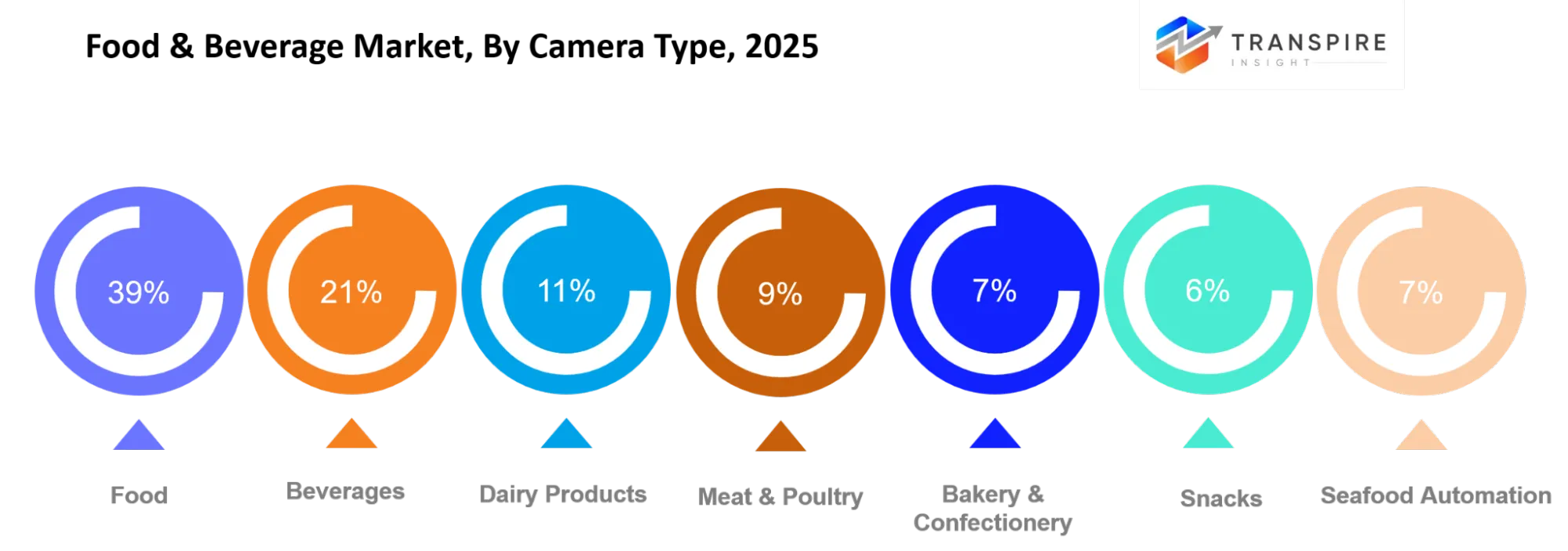
Food constitutes 39.00% of the market share, which is the highest among all the product type segments. The above-mentioned status is justified by constant household consumption, food service demand, and wide array of products that can be sold through retailing. Beverages constitute 21.00% of the market, while Dairy Products have 11.00% market share. Meat & Poultry constitute 9.00%, Bakery & Confectionery 7.00%, Snacks 6.00%, Seafood 4.00%, and Processed Foods 3.00%. Future growth in the above-mentioned product type segments will depend upon convenience, nutrition, innovation, and regional preferences.
By Category
The processed food segment is identified as the dominant segment, frozen food accounting for 35.60% due to the significant position of convenient and longer shelf-life products in recent consumption. There are six types of fresh, frozen, canned, ready-to-eat, organic, speciality, and functional products, each with its distinct purchasing occasion and consumer need. Functional & Health Food is recognised as the fastest-growing segment with a CAGR of 8.10%, owing to the increasing trend towards nutrition-driven products. This change opens up opportunities for manufacturers to integrate the convenience and functional value with cleaner positioning of the product.
By Distribution Channel
Supermarkets & Hypermarkets are still significant due to their wide range of products and high volumes of shoppers, and Convenience Stores are significant for their convenience and quickness in shopping. Specialty Stores, Foodservice, Wholesale, Direct Sales and Vending cater to more specific consumption needs. Online Retail is becoming increasingly strategic as the consumer is getting more comfortable in ordering groceries and packaged products online. The future distribution environment is likely to be a combination of brick-and-mortar outlets, foodservice distribution and online-buying platforms.
By End User
Households represent a large consumer segment because there are still many products of food and beverages which are bought regularly. The Restaurants, Hotels, Cafes, and Catering business meet their demands by cooking meals, providing beverages, and buying in bulk. Demand is created by Institutions and Food Manufacturers, who buy on an organized basis and for the ingredients, and by Retailers, who need assortments and merchandising. Future openings will lie increasingly in the hands of suppliers who can supply both domestic market and institutional customers effectively.
By Processing Type
Fresh, Chilled, Frozen, Dried, Canned, Fermented, Processed and Ready‑to‑Eat options are made to fit needs such as how long they stay on a shelf, how easy they are to use how they can be stored and how they are prepared. Ready‑to‑Eat and Processed items are useful because people want fast meal choices, while Chilled and Frozen items give a balance between use and good quality. There are also opportunities in fermented products in the health-oriented and speciality categories. Manufacturers are expected to invest in processing technology to ensure better preservation, safety, quality and production efficiency.
By Package Type
Bottles, cans, pouches, cartons, bags, trays, jars and bulk packages are selected depending on the type of product, how it needs to be stored, how it will be transported and how it will be used. Pouches and smaller packages are often chosen for their portability and ease of use. Bottles and cans remain common for beverages because they are familiar and trusted. Cartons, trays, jars and bulk packages serve needs in retail and foodservice settings. Looking ahead the future of package development may focus on using materials protecting the product better making packages easier to recycle and improving how easy they are to use.
What are the Key Use Cases Driving theFood & Beverage Market?
In thefood and beverage use case are Processed and convenient foods are used when people want items that longer are easy to prepare and stay the same in quality. This use case lets us make ready‑to‑eat meals, frozen meals, snacks, bakery products and other foods that people eat a lot. New projects are coming in places such as foods, healthier beverages, online groceries, institutional catering and foodservice delivery. These platforms help companies reach people who want nutrition, convenience and faster buying choices. New use cases are also forming in areas like personalised nutrition, AI‑driven product development, smart packaging, automation and digital cold chain management. These use cases link technology with food manufacturing and distribution.
|
Report Metrics |
Details |
|
Market size value in 2025 |
USD 9032.59 Billion |
|
Market size value in 2026 |
USD 9529.87 Billion |
|
Revenue forecast in 2033 |
USD 13859 Billion |
|
Growth rate |
CAGR of 5.5% from 2026 to 2033 |
|
Base year |
2025 |
|
Historical data |
2021 - 2024 |
|
Forecast period |
2026 - 2033 |
|
Report coverage |
Revenue forecast, competitive landscape, growth factors, and trends |
|
Regional scope |
United States; Canada; Mexico; United Kingdom; Germany; France; Italy; Spain; Denmark; Sweden; Norway; China; Japan; India; Australia; South Korea; Thailand; Brazil; Argentina; South Africa; Saudi Arabia; United Arab Emirates |
|
Key company profiled |
Nestlé, PepsiCo, Coca-Cola, Danone, Mondelez International, Unilever, Mars, Kraft Heinz, General Mills, Tyson Foods, JBS, Cargill, Kellogg, Conagra Brands, Archer Daniels Midland |
|
Customization scope |
Free report customization (country, regional & segment scope). Avail customized purchase options to meet your exact research needs. |
|
Report Segmentation |
Product Type (Food, Beverages, Dairy Products, Meat & Poultry, Seafood, Bakery & Confectionery, Snacks, Processed Foods); Category (Fresh Food, Frozen Food, Canned Food, Ready-to-Eat Food, Functional Food, Organic Food, Convenience Food, Specialty Food); Distribution Channel (Supermarkets & Hypermarkets, Convenience Stores, Specialty Stores, Foodservice, Online Retail, Wholesale, Direct Sales, Vending); End User (Households, Restaurants, Hotels, Cafes, Catering, Institutions, Food Manufacturers, Retailers); Processing Type (Fresh, Chilled, Frozen, Dried, Canned, Fermented, Processed, Ready-to-Eat); Packaging Type (Bottles, Cans, Pouches, Cartons, Bags, Trays, Jars, Bulk Packaging) |
Which Regions are Driving theFood & Beverage MarketGrowth?
North America
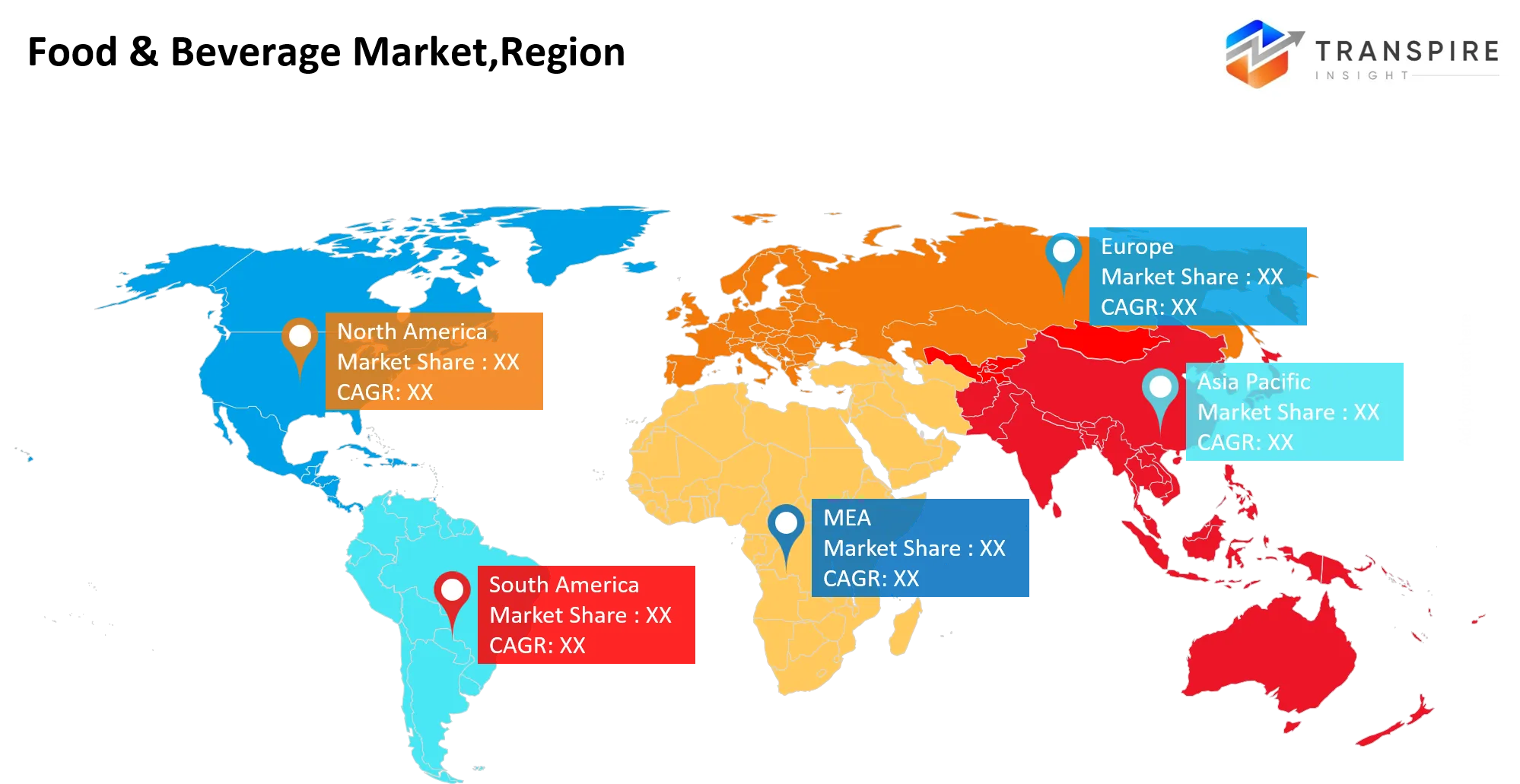
North America accounts for 24.00% share of the total market and represents an important trading zone for food and beverages. The region has a sophisticated infrastructure of retailing, an advanced food service industry, as well as a developed structure of digital commerce. Therefore, food manufacturing can capitalise on existing investments in automation, product and production process development, and logistical infrastructure. Hence, the strength of the region depends on innovations and effective delivery from producers to end users.
In January 2025, Nestlé USA built a new beverage factory and distribution facility in Arizona, bolstering its manufacturing operations in the U.S. and allowing the company to manufacture beverages for consumers.
https://www.nestleusa.com/media/pressreleases/new-beverage-factory-dc-az
Europe
Europe represents 27.00% of the market and ranks first among the regions supplied in terms of market shares provided. Europe has existing capacities for food processing, developed retailing infrastructure, and a focus on the quality and sustainability of the products. Also, the regulatory framework requires manufacturers to invest in improving the ingredients, labelling, packaging, and processes. Therefore, stability is ensured while fostering innovations in food.
In June 2025, the regulatory authorities approved the joint venture between AGRANA and Ingredion in Romania, helping with the development of the starch industry and food ingredients manufacturing in Europe.
https://ir.ingredionincorporated.com/node/28131
Asia Pacific
The Asia Pacific region is the dominant region, holding a 39.20% market share, due to its huge consumer base, urban population growth, manufacturing facilities, and modern retail penetration. The region is also witnessing the increasing adoption of e-commerce and packaged food products owing to changing consumption trends. Investments in the food processing and distribution system are generating new business opportunities for both international and local players. While the provided data points out that the Middle East & Africa region is the fastest-growing region with a 7.10% CAGR, it is still the dominant regional market.
In September 2025, JBT Marel launched itsProduction Centre in Pune, India, and improved its food processing facilities and services to help meet the increased demand for food processing solutions in India and the Asia Pacific region.
Who are the Key Players in theFood & Beverage Marketand how do they compete?
Thefood and beverage market is competitive on the basis of brand strength, innovation, distribution, pricing, and quick responsiveness to changing consumer preferences. Big players are now trying to balance their portfolio by adding functional, convenient, and health products along with their traditional high-volume products. Digitalisation, automation, and regional expansion are also becoming important strategies for big players to sustain their margins and attract new consumers.PepsiCo and Nestlé focus heavily on innovation, nutrition, digitalisation, and portfolio management with the help of technology in their product development and operations. Nestléand Unilever is focusing on powerful brands, technology, an efficient supply chain, and scalable AI as an integral part of their growth strategy. Differentiation is becoming dependent on a combination of powerful brands with faster innovation, efficient distribution, local products, and technology-based decision-making.
Food & Beverage Marketcompanies
- Nestlé
- PepsiCo
- Coca-Cola
- Danone
- Mondelez International
- Unilever
- Mars
- Kraft Heinz
- General Mills
- Tyson Foods
- JBS
- Cargill
- Kellogg
- Conagra Brands
- Archer Daniels Midland
Recent Development News
In April 2026, PepsiCo has partnered with Google Cloud in a multi-year agreement to increase the use of AI in supply chain management, go-to-market execution, workforce operations, and business decision-making. This will help PepsiCo boost the speed of operations and reduce costs through the use of artificial intelligence.
In August 2025, Celsius Holdings and PepsiCo have enhanced their strategic alliance by making Alani Nu a part of the U.S. and Canadian distribution network of PepsiCo, with the acquisition of Rockstar Energy drink by Celsius in both countries.
What Strategic Insights Define the Future of theFood & Beverage Market?
The future of the food and beverage market across the globe will depend on convenience, functional nutrition, e-commerce, automation, and supply chain management. Companies that are able to connect consumer data with fast product development will have an edge in anticipating trends before they become mainstream. The fundamental risk facing companies will be that of margin compression due to the volatility of costs associated with agriculture, energy, packaging, transportation, and disruption in the supply chain due to climate change. However, there are prospects in the area of functional foods, personalised nutrition, use of artificial intelligence to formulate products, sustainable packaging, and digitally controlled transport. Asia Pacific will remain a strategic option in terms of economies of scale, while the Middle East & Africa region will be another high-growth market.
Product Type
- Food
- Beverages
- Dairy Products
- Meat & Poultry
- Seafood
- Bakery & Confectionery
- Snacks
- Processed Foods
Category
- Fresh Food
- Frozen Food
- Canned Food
- Ready-to-Eat Food
- Functional Food
- Organic Food
- Convenience Food
- Specialty Food
Distribution Channel
- Supermarkets & Hypermarkets
- Convenience Stores
- Specialty Stores
- Foodservice
- Online Retail
- Wholesale
- Direct Sales
- Vending
End User
- Households
- Restaurants
- Hotels
- Cafes
- Catering
- Institutions
- Food Manufacturers
- Retailers
Processing Type
- Fresh
- Chilled
- Frozen
- Dried
- Canned
- Fermented
- Processed
- Ready-to-Eat
Packaging Type
- Bottles
- Cans
- Pouches
- Cartons
- Bags
- Trays
- Jars
- Bulk Packaging
Frequently Asked Questions
Find quick answers to common questions.
Thefood & beverage market size was valued at USD 9032.59 Billion in 2025 and is poised to reach USD 13859 Billion by 2033, expanding at a 5.5% CAGR.
Key segments for thefood & beverage market are Product Type (Food, Beverages, Dairy Products, Meat & Poultry, Seafood, Bakery & Confectionery, Snacks, Processed Foods); Category (Fresh Food, Frozen Food, Canned Food, Ready-to-Eat Food, Functional Food, Organic Food, Convenience Food, Specialty Food); Distribution Channel (Supermarkets & Hypermarkets, Convenience Stores, Specialty Stores, Foodservice, Online Retail, Wholesale, Direct Sales, Vending); End User (Households, Restaurants, Hotels, Cafes, Catering, Institutions, Food Manufacturers, Retailers); Processing Type (Fresh, Chilled, Frozen, Dried, Canned, Fermented, Processed, Ready-to-Eat); Packaging Type (Bottles, Cans, Pouches, Cartons, Bags, Trays, Jars, Bulk Packaging)
Growth is primarily driven by increasing disposable income, urbanization, change in consumer lifestyles, increasing demand for convenience and packaged foods, growth of online food retailing, and increased interest in healthy and functional food products
Themarket is led by major manufacturers including Nestlé, PepsiCo, Coca-Cola, Danone, Mondelez International, Unilever, Mars, Kraft Heinz, General Mills, Tyson Foods, JBS, Cargill, Kellogg, Conagra Brands, Archer Daniels Midland
The Asia Pacific region constitutes 39.20% of the world’s food & beverage market due to its vast population, high disposable income levels, urbanisation, food processing industry, and increasing demand for packaged and convenience foods
Commercial opportunities present in the international food and beverage industry include an increasing need for health foods and functional foods, growth in e-commerce in food sales, consumption of convenience foods and prepared foods, increasing demand for organic food and plant-based foods, and commercial opportunities for premium foods in emerging countries.
- Nestlé
- PepsiCo
- Coca-Cola
- Danone
- Mondelez International
- Unilever
- Mars
- Kraft Heinz
- General Mills
- Tyson Foods
- JBS
- Cargill
- Kellogg
- Conagra Brands
- Archer Daniels Midland
About the Authors

Chetan Dhatrak
I’m Chetan Dhatrak, a Senior Research Analyst at Transpire Insight, specializing in the Consumer Goods, Foods and Beverages industry. I focus on analyzing market trends, consumer behavior, competitive landscapes, and industry developments to deliver accurate, data-driven insights. My research at Transpire Insight is built on credible sources and in-depth analysis, helping businesses and readers better understand market dynamics, emerging opportunities, and evolving consumer preferences. I’m committed to creating reliable, well-researched content that supports informed decision-making and reflects the latest developments in the consumer goods and food & beverage sectors.

Chakradhar Khansole
Chakradhar serves as the Research Director at Transpire Insight, bringing over 8 years of experience in technology, innovation, and strategic market intelligence. He specializes in transforming complex market data into actionable business insights that enable organizations to make informed, growth-oriented decisions. Recognized for his strategic vision and analytical expertise, Chakradhar leads high-impact research initiatives, delivering comprehensive market assessments, competitive intelligence, and forward-looking industry analysis.
Recently Published Reports
-
Apr 2026
Baby Infant Formula Market
Baby Infant Formula Market Size, Share & Analysis Report By ype (Infant Milk, Follow On Milk, Specialty Baby Milk, Growing-Up Milk), By Ingredient (Carbohydrate, Fat, Protein, Minerals, Vitamins, and Others), By Product Form (Powder, Liquid, and Ready-to-feed), By Distribution Channels (Supermarket/Hypermarket, Specialty Store, Pharmacies, Online Retail, and Others), and Geography (North America, Europe, Asia-Pacific, Middle East and Africa, South and Central America), 2021 - 2031
-
Apr 2026
Edible Insects for Animal Feed Market
Edible Insects for Animal Feed Market Size, Share & Analysis Report By Type (Insect Powder, Insect Meal, Insect Bar, Insect Paste, Insect Oil, and Others), By Insect Type (Beetles, Cricket, Caterpillar, Hymenoptera, Orthoptera, Tree Bugs, and Others), By Application (Livestock, Pet Food, and Aquaculture), By Livestock Type (Poultry, Swine, and Others), and Geography (North America, Europe, Asia-Pacific, Middle East and Africa, South and Central America), 2021 - 2031
-
Apr 2026
Food Industry Disinfection and Bacterial Control Market
Food Industry Disinfection and Bacterial Control Market Size, Share & Analysis Report By Type (Chemical Disinfectants, Physical Disinfectants, and Biocides and Antimicrobials), By Application (Food Processing Equipment Surface Disinfection, Food Preparation Areas Surface Disinfection, Storage Areas Surface Disinfection, Anti-microbial Coatings Food Preservation, and Preservative Solutions Food Preservation), By End User (Meat and Poultry Processing, Dairy Processing, Seafood Processing, Bakery and Confectionery, Restaurants and Commercial Kitchens, and Food Service Providers), By Sales Channel (Online, Offline), and Geography (North America, Europe, Asia-Pacific, Middle East and Africa, South and Central America), 2021 - 2031
-
May 2026
Freeze Dried Food Market
Freeze Dried Food Market Size, Share & Analysis Report By Product Type (Fruits, Vegetables, Freeze-Dried Dairy Products, Freeze-Dried Meat and Seafood, Freeze-Dried Pet Food, and Prepared Meal), By Nature (Organic, and Conventional), By Form (Powdered, Granules, and Diced), By End Use (Breakfast Cereals, Dairy Products, Bakery & Confectionery, Nutritional Bars & Supplements, Powdered Beverages, Snacks, and Retail (Household)), and Geography (North America, Europe, Asia-Pacific, Middle East and Africa, South and Central America), 2021 - 2031