

Snack Food Market Summary:
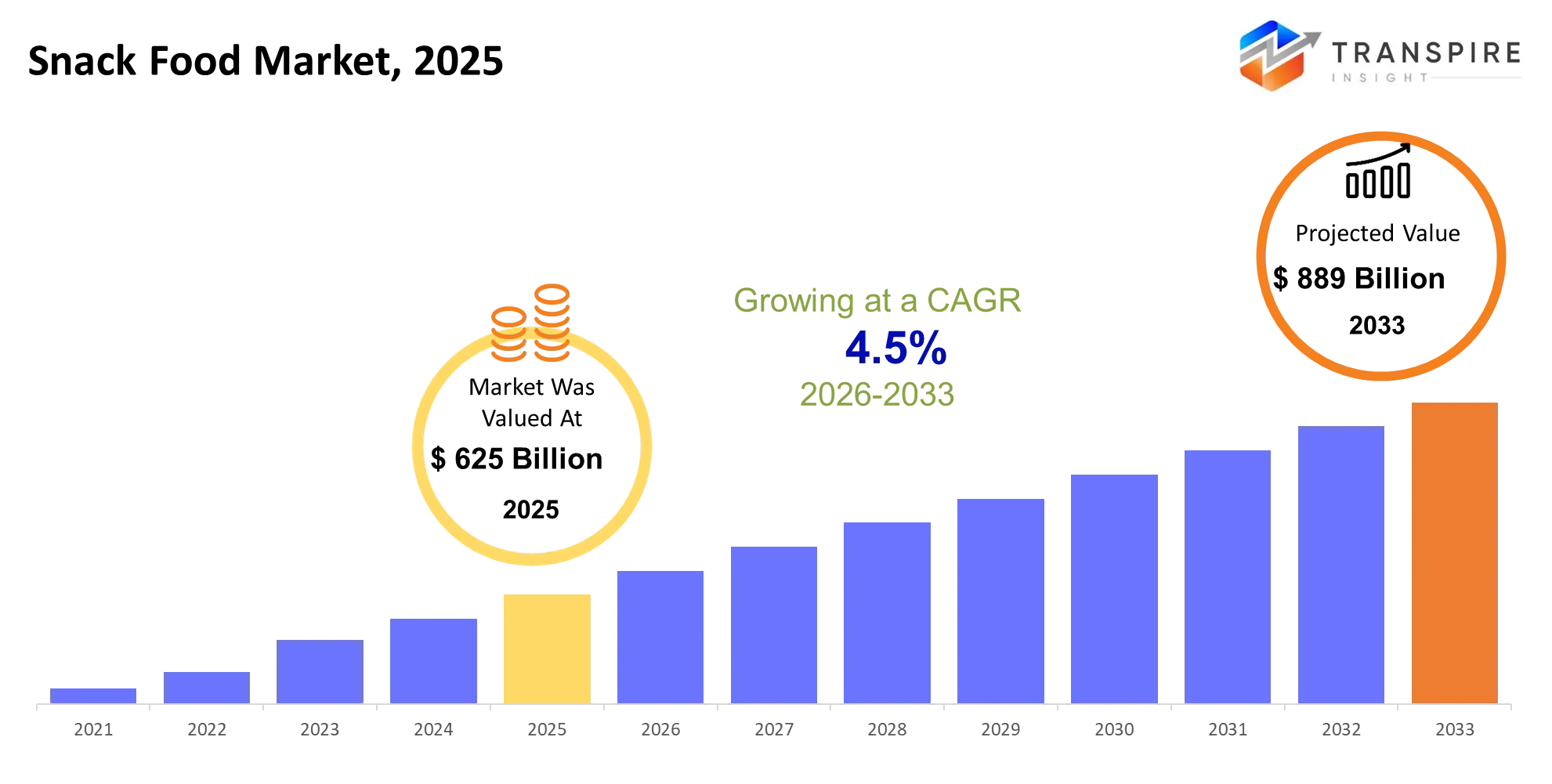
As per Transpire Insight, the Snack Food Market size is estimated at USD 625 billion in 2025 and is anticipated to reach USD 889 billion by 2033, growing at a CAGR of 4.5% from 2026 to 2033.
The snack food market is changing. People are no longer just buying snacks on impulse. They want snacks that're easy to carry, convenient to eat and come in many different flavours. There is also interest in snacks that offer better nutrition. In the past three to five years, companies have started moving beyond traditional snacks like chips and candy. They now offer snacks with added protein, fibre, organic ingredients, gluten-free options and even functional benefits. One big change has been how products are developed. Companies are using tools to understand what consumers like. This helps them test ideas faster and make changes quickly. Manufacturing has become more flexible too. That means brands can respond to trends immediately. At the same time, inflation has made people more careful with their money. Households are watching prices closely. Consumers compare their worth before purchase. Due to that fact, snack companies need to come up with innovations in order to ensure affordability of the pack sizes. They cannot depend on costly products. Consumption of snacks is increasing due to the fact that snacks fit into certain parts of people’s daily activities, such as while travelling, working, studying, traveling, or even while being entertained. In some cases, snacks can be used as alternatives to meals. As a result, people keep buying snacks. With many options and different lifestyles, innovations play a vital role nowadays.
Snack Food Market Size & Forecast:
- Market Size 2025: USD 625 Billion
- Expected Market Value (2033): USD 889 Billion
- Forecast CAGR (2026–2033): 4.5%
- Leading Region in 2025: North America
- Fastest Growing Region: Asia Pacific
- Key Company Profiles: PepsiCo, Mondelez International, Nestlé, Kellogg Company, General Mills, Conagra Brands, Calbee, ITC, Grupo Bimbo, The Hain Celestial Group, Blue Diamond Growers, Utz Brands, Herr Foods, Intersnack Group, Link Snacks
Key Market Insights
The market is shifting to savoury products owing to the prevalence of savoury products and the associated functional nutrition trend. The manufacturers are taking advantage of their popular snack brands by incorporating protein, fibre, convenience, and digital products.
- Savoury Snacks account for 52.40% as there is higher consumption of known snacks because of their convenience, while new flavours and packaging are introduced by the manufacturers regularly.
- Healthy & Functional Snacks are growing at a CAGR of 7.90% because of the rising popularity of protein, fibre and nutritional aspects.
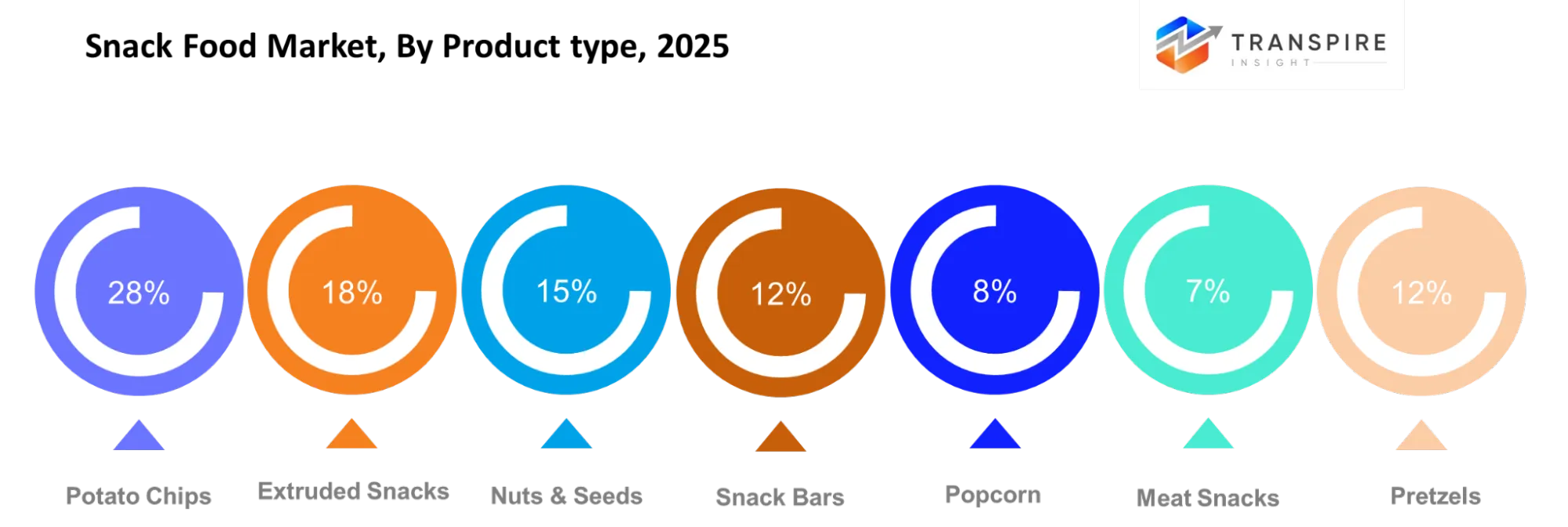
- Potato Chips account for 28.00% and constitute the largest product type category due to new and innovative seasonings, limited editions and portion sizes.
- Extruded Snacks account for 18.00% as they have a unique texture, strong flavour and an easy mass production process.
- Nuts & Seeds account for 15.00% as there is an increasing consumer interest in snacks that are convenient and contain protein and nutrients.
- Snack Bars account for 12.00% with an increase in production of protein, fibre and portable snacks by manufacturers for working, travelling, and physical activities.
What are the Key Drivers, Restraints, and Opportunities in the Snack Food Market?
Drivers:
The development of this industry is stimulated by increased consumption of snack foods throughout the day. There is an increased demand for portable snacks that can be eaten while at work, in schools, during travel, and during leisure time, while manufacturers have developed individual packets, resealable packages, protein-rich snacks, and light snacks. This means that there will be many opportunities for buying and consuming packaged snacks, and therefore stimulating retail sales.
Restraints:
The restraints are cost pressure, particularly on raw material costs, packing costs, energy costs, logistics, and labour costs. There is no doubt that snack producers have to work within large-volume supply chains, and hence, volatility in costs will create margin pressure or price pressure. This is due to the nature of the business.
Opportunities:
Opportunities for growth include better-for-you snack options. Proteins, fibres, clean labels, and portioned packaging provide brands with the ability to cater to people who are looking for convenience but not willing to totally abandon their snack traditions. As we can see from recent product launches like those from PepsiCo, even big brands are able to utilise their current distribution channels in order to move into these high-margin markets. Asia Pacific region can also accommodate some growth, as new retail concepts and flavours open more doors for packaged snacks.
What Has the Impact of Artificial Intelligence Been on the Snack Food Market?
The use of artificial intelligence has become useful for snack food manufacturing, supply chain planning, consumer analysis, and product development. It becomes possible to combine sales data, consumer feedback, demand signals, and production data to discover patterns, which become complicated for manual management. The technology will help to forecast demand better, plan inventories, choose assortments, and target product development. AI can also be used together with the digital twin to simulate the factory layout and changes in it before making physical modifications to reduce disruption and compare different production scenarios. PepsiCo joined Siemens and NVIDIA in using applications based on AI and digital twin technologies for their plants and the supply chain management process, and some pilot implementations have already started in the United States. AI and digital twin technology could assist in production planning by means of simulating processes and analysing real-time data. Using AI analytics, it would be easier for producers of snack foods to know about changes in consumer preferences regarding taste, nutrition, and purchasing. However, some limitations of the application of AI and digital twin technology exist. High expenses, data integration, cybersecurity requirements, and differences between the model results and actual processes could become barriers to adoption, particularly for small businesses.
Instance:
In April 2026, PepsiCo entered into a strategic partnership with Google Cloud for increased application of artificial intelligence using Google's Gemini Enterprise Agent Platform. The partnership seeks to enhance decision-making, supply chain management, and go-to-market efforts to enable more data-driven operations at PepsiCo Food Company globally.
Key Market Trends:
The snack food industry is evolving from the usual notion of indulgence to create snack products that offer taste along with convenience and functionality. At the same time, companies in the snack food industry are leveraging technology and other means to react to changing consumption trends.
- Consumers are moving from indulgent treats alone to treats that not only have great taste but also some health benefits such as protein or fibre.
- Bold flavours, spicy flavours, combinations of sweet and savoury, and international flavours are being used as marketers seek ways to grab consumer attention.
- Limited editions are being introduced to provide trial, social media engagement, and impulse purchases by shoppers.
- Consumption of snacks is moving away from just being an interstitial activity to being part of streaming, gaming, travelling, working, and social events.
- Online sales of snacks are becoming increasingly relevant as manufacturers seek additional access to convenience buyers.
- Marketers are expanding snack brands into food service occasions to provide more opportunities to consume snacks.
Snack Food Market Segmentation
By Product Type:
Potato Chips take the lead with 28.00%, followed by Extruded Snacks with 18.00% and Nuts & Seeds with 15.00%. Snack Bars come next with 12.00%, Popcorn accounts for 8.00%, Meat Snacks with 7.00%, Pretzels with 5.00% and Other Snacks with 7.00%. Potato chips have wide consumer appeal along with widespread retail availability, whereas protein-based nuts, seeds, meat snacks, and snack bars offer avenues for niche-oriented nutritional requirements.
By Categories:
Savoury Snacks dominate the category with a 52.40% share, with growing consumption of chips, extruded products, nuts and other salty products. Sweet Snacks keep catering to indulgence-oriented purposes, while Healthy Snacks, Organic Snacks, Gluten-Free Snacks, Protein Snacks and Functional Snacks are forming newer areas for product differentiation. Healthy & Functional Snacks represent the highest growth category with a 7.90% CAGR as the industry is moving towards nutritious convenience food.
By Packaging:
Pouches and Bags continue to be relevant due to their utility in storage, portability, and shelf presentation. Cans, Boxes, Trays, and Jars have their own application depending on the needs of the product and its consumption. Single-Serve Packs cater to individual occasions like travelling, commuting, schools, and offices. Bulk Packs continue to be relevant in homes, parties, and food service venues.
By Distribution Channel:
Supermarkets and hypermarkets continue to be relevant in terms of making the products visible and for bulk purchases. Convenience Stores cater to instant and impulse consumption of products. Speciality Stores cater to premium, organic, and health-based products, while Online Retailing is gaining traction in terms of increasing visibility of the product and home deliveries. Vending Machines, Food Service, Wholesale, and Others are additional distribution channels.
By End User:
Households constitute an important segment because snacks are usually bought for day-to-day use, packed lunches, leisure purposes, and celebrations within families. Further, other end-user segments like Restaurants, Hotels, Cafes, Schools, Offices, Travel and Transportation, and Institutional Users offer another source of consumption through food service. The increase in such occasions provides an opportunity for manufacturers to make different packaging for varied serving sizes and storage conditions.
By Flavor:
Salted & Cheese flavours are traditionally popular, while Barbecue, Spicy, Sour Cream, Sweet, and Herb and Spice flavours give scope for creating variation in products based on regional differences. Innovation of flavor is especially significant nowadays as brands try to attract consumers through trying and buying the same type of product. There can be various other flavours that give scope for localising the taste of snacks, special launches, and limited editions
What are the Key Use Cases Driving the Snack Food Market?
The use case of the snack foods industry revolves around convenience and regular usage of savoury snacks such as potato chips, extruded snacks, nuts, and seeds. This type of product is well-suited for breaks, relaxation, travel and socialising purposes, which leads to the prevalence of savoury snacks in the market. Use cases are expanding with the involvement of superstores, convenience stores, online businesses, vending machines, the food service industry, and the work environment. Individual packs are used for personal consumption, whereas larger size packs target families and social events. Some new use cases in the industry include protein snacks for hectic consumers, fibre-filled snacks for health-conscious consumers and functional snacks that can fill the gap between snack and meal.
|
Report Metrics |
Details |
|
Market size value in 2025 |
USD 625 Billion |
|
Market size value in 2026 |
USD 653.13 Billion |
|
Revenue forecast in 2033 |
USD 889 Billion |
|
Growth rate |
CAGR 4.5% from 2026 to 2033 |
|
Base year |
2025 |
|
Historical data |
2021 - 2024 |
|
Forecast period |
2026 - 2033 |
|
Report coverage |
Revenue forecast, competitive landscape, growth factors, and trends |
|
Regional scope |
United States; Canada; Mexico; United Kingdom; Germany; France; Italy; Spain; Denmark; Sweden; Norway; China; Japan; India; Australia; South Korea; Thailand; Brazil; Argentina; South Africa; Saudi Arabia; United Arab Emirates |
|
Key company profiled |
PepsiCo, Mondelez International, Nestlé, Kellogg Company, General Mills, Conagra Brands, Calbee, ITC, Grupo Bimbo, The Hain Celestial Group, Blue Diamond Growers, Utz Brands, Herr Foods, Intersnack Group, Link Snacks |
|
Customization scope |
Free report customization (country, regional & segment scope). Avail customized purchase options to meet your exact research needs. |
|
Report Segmentation |
Product Type (Potato Chips, Extruded Snacks, Nuts & Seeds, Meat Snacks, Popcorn, Pretzels, Snack Bars, Other Snacks); Category (Savory Snacks, Sweet Snacks, Healthy Snacks, Organic Snacks, Gluten-Free Snacks, Protein Snacks, Functional Snacks); Packaging (Pouches, Bags, Cans, Boxes, Trays, Jars, Single-Serve Packs, Bulk Packs); Distribution Channel (Supermarkets & Hypermarkets, Convenience Stores, Specialty Stores, Online Retail, Vending Machines, Foodservice, Wholesale, Other Channels); End User (Households, Restaurants, Hotels, Cafes, Schools, Offices, Travel & Transportation, Institutional); Flavor (Salted, Cheese, Barbecue, Spicy, Sour Cream, Sweet, Herb & Spice, Other Flavors) |
Which Regions are Driving the Snack Food Market Growth?
North America:
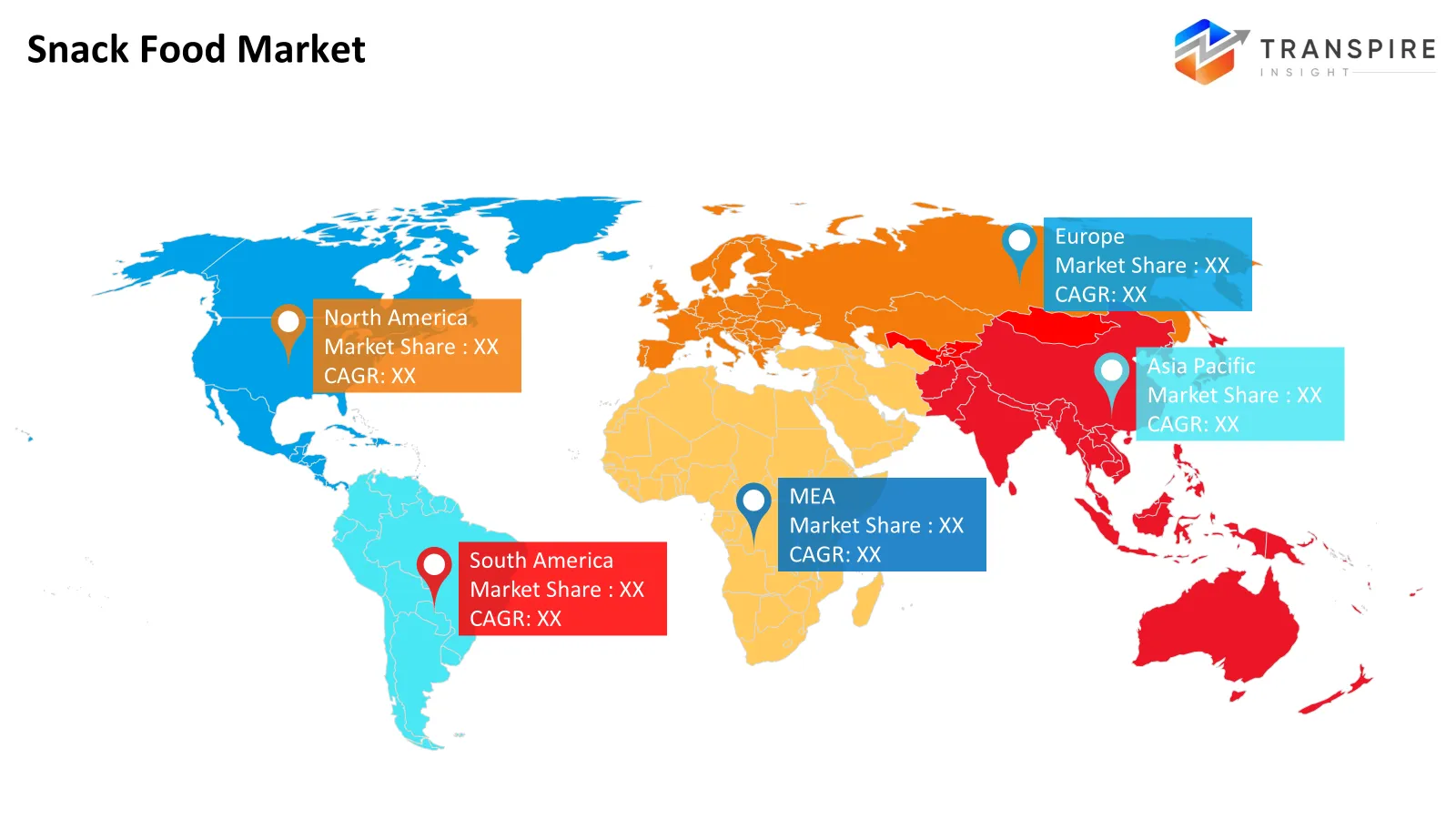
North America has the largest market share of 34.80% in the snack foods industry owing to the presence of well-known packaged foods companies, strong distribution networks, and high availability of products from the companies in the region. The region has an advanced infrastructure for supermarkets, convenience stores, food services, and online retail channels that help provide several avenues to reach out to consumers. Competition among companies and innovation drives the development of new product flavours and functionalities.
In May 2026, PepsiCo added PopCorners Protein to the existing line of PopCorners snacks, including three new flavours that contain 9 grams of protein per serving. This innovation is driven by the growing demand for snacks with functional and protein-based ingredients in North America.
Europe:
Europe holds 28.00% of the snack foods market and trails North America in terms of its share of the market, yet still maintains considerable regional dominance. The market in the region has well-established retail infrastructure, well-established food manufacturers, and varied tastes among consumers in different countries. Demand for premium, organic, natural and nutritional products creates additional business opportunities for manufacturers beyond traditional snack foods.
In April 2026, Mr Day, an Italian snack brand of Vicenzi Group, presented its new packaged Donuts in Strawberry and chocolate flavours. The new products have been presented in the grocery snack aisle in Italy and represent the expansion of the company's product range among young people.
https://www.vicenzi.it/en/mr-day-lancia-i-nuovi-donuts/
Asia-Pacific:
Asia-Pacific constitutes 25.00% of the market share and represents the most rapidly developing region, recording a 6.90% CAGR growth rate. Due to urbanisation, the rise in modern retail, the use of e-commerce platforms, and lifestyle changes, consumption of packaged snacks has been rising in many countries. At the same time, the products are being modified according to the taste of the local population.
In May 2026, Calbee Inc., a company based in Japan, launched its seasonal product called Natsu Potato, which comes in two flavours, Kishu Nanko Plum and Tsushima Hama Salt. The snacks feature potatoes harvested in Japan and will be offered nationally.
https://www.calbee.co.jp/newsrelease/260528.php
Who are the Key Players in the Snack Food Market, and how do they compete?
The competition in the market of snacks depends upon the strength of the brand, the reach of the company, pricing, innovations, and responsiveness to changes in consumer eating habits. While large companies are present in many segments of snacks, small companies focus on nutritional benefits, ingredients, flavours, or communities of consumers.PepsiCo uses the portfolio approach, where the mass brands coexist along with the innovations that are functional and healthier. The recent acquisition of Siete Foods has added to its portfolio of convenient foods. Doritos Protein, PopCorners Protein, and Good Warrior are some of the innovations made by PepsiCo that have helped it gain a place in the segment of protein-based snacks. The portfolio approach helps a company use its current reach of retailers and create a rationale for purchasing the famous brands. Mondelēz International is a part of the portfolio of chocolates, biscuits, and baked snacks because of product development and technology initiatives. Nine startups have been selected by the CoLab Tech initiative because of their innovations in sustainability, ingredients, consumer experience, and manufacturing process.
Snack Food Market Companies
- PepsiCo
- Mondelez International
- Nestlé
- Kellogg Company
- General Mills
- Conagra Brands
- Calbee
- ITC
- Grupo Bimbo
- The Hain Celestial Group
- Blue Diamond Growers
- Utz Brands
- Herr Foods
- Intersnack Group
- Link Snacks
Recent Development News
- In June 2025, General Mills launched Mott’s Soft Baked Apple Filled Bars in three flavours. Apple, Strawberry, and Blueberry. This product launch increased the range of Mott’s snack bars and was intended to serve lunchbox and on-the-go snacking needs. https://privacy.generalmills.com/news/press-releases/soft-baked-snackable-and-ready-for-backpacks-new-motts-apple-filled-bars
- In March 2026, PepsiCo introduced Good Warrior Beef Sticks, which is their newest protein snack product range, in selected US outlets. This snack offers 10 grams of protein per serving and helps increase the functionality of PepsiCo’s product range. https://www.pepsico.com/en/newsroom/press-releases/2026/introducing-good-warrior-pepsico-foods-new-protein-snack-brand-built-for-really-busy-humans
What Strategic Insights Define the Future of the Snack Food Market?
Snacks in the market are evolving towards a more inclusive definition where convenience will be increasingly balanced by nutrition, portability, affordability, and better taste sensations. Protein, fibre, improved ingredients, e-commerce capabilities, and small format snacks may continue to play important roles in portfolio growth. A hidden threat could be that a rapidly expanding product range may complicate manufacturing operations and result in excess inventories as consumer preferences and demand change quickly. In addition, there is a need for better demand sensing and flexibility in production processes instead of solely focusing on wide ranges of products. An opportunity that is gaining momentum relates to the development of snacks that will bring together a recognisable format and some health properties in protein, fibre, or nutrition-based products. Expansion into the Asia Pacific region may serve as a driver of growth due to retail modernisation and the availability of e-commerce. Overall, companies have to concentrate on flexible innovation, local flavours, optimised packaging, forecasting using data, and selective premiumisation while maintaining affordable products.
Key Segmentations are:
Product Type
- Potato Chips
- Extruded Snacks
- Nuts & Seeds
- Meat Snacks
- Popcorn
- Pretzels
- Snack Bars
- Other Snacks
Category
- Savory Snacks
- Sweet Snacks
- Healthy Snacks
- Organic Snacks
- Gluten-Free Snacks
- Protein Snacks
- Functional Snacks
Packaging
- Pouches
- Bags
- Cans
- Boxes
- Trays
- Jars
- Single-Serve Packs
- Bulk Packs
Distribution Channel
- Supermarkets & Hypermarkets
- Convenience Stores
- Specialty Stores
- Online Retail
- Vending Machines
- Foodservice
- Wholesale
- Other Channels
End User
- Households
- Restaurants
- Hotels
- Cafes
- Schools
- Offices
- Travel & Transportation
- Institutional
Flavor
- Salted
- Cheese
- Barbecue
- Spicy
- Sour Cream
- Sweet
- Herb & Spice
- Other Flavors
By Regional Analysis
North America
- US
- Canada
- Mexico
Europe
- Germany
- UK
- France
- Italy
- Spain
- Russia
- Rest of Europe
Asia Pacific
- China
- Japan
- India
- South Korea
- Australia
- Rest of Asia Pacific
South America
- Brazil
- Argentina
- Rest of South America
Middle East & Africa
- UAE
- Saudi Arabia
- Qatar
- South Africa
- Rest of the Middle East & Africa
Frequently Asked Questions
Find quick answers to common questions.
The snack food market size was valued at USD 625 Billion in 2025 and is poised to reach USD 889 billion by 2033, expanding at a 4.5% CAGR.
Key segments for the snack food market are Product Type (Potato Chips, Extruded Snacks, Nuts & Seeds, Meat Snacks, Popcorn, Pretzels, Snack Bars, Other Snacks); Category (Savory Snacks, Sweet Snacks, Healthy Snacks, Organic Snacks, Gluten-Free Snacks, Protein Snacks, Functional Snacks); Packaging (Pouches, Bags, Cans, Boxes, Trays, Jars, Single-Serve Packs, Bulk Packs); Distribution Channel (Supermarkets & Hypermarkets, Convenience Stores, Specialty Stores, Online Retail, Vending Machines, Foodservice, Wholesale, Other Channels); End User (Households, Restaurants, Hotels, Cafes, Schools, Offices, Travel & Transportation, Institutional); Flavor (Salted, Cheese, Barbecue, Spicy, Sour Cream, Sweet, Herb & Spice, Other Flavors).
Growth is primarily driven by increased demand for quick and convenient snacking, increased demand for healthy snacking, lifestyle changes, product innovations, growth in distribution channels, including online retailing, and increased demand for premium and functional snacking.
The market is led by major manufacturers including PepsiCo, Mondelez International, Nestlé, Kellogg Company, General Mills, Conagra Brands, Calbee, ITC, Grupo Bimbo, The Hain Celestial Group, Blue Diamond Growers, Utz Brands, Herr Foods, Intersnack Group, Link Snacks.
North America holds a 34.80% market share of the world’s snack foods because of the presence of great consumer demand, food producers, distribution networks, innovation of products, and the use of convenience and healthy snacks.
Opportunities in the snack foods industry due to increased demand for nutritious and high-protein snacks, the convenience of products being preferred, growth of e-commerce channels, innovations in taste and ingredients of products, and the use of eco-friendly packaging materials.
- PepsiCo
- Mondelez International
- Nestlé
- Kellogg Company
- General Mills
- Conagra Brands
- Calbee
- ITC
- Grupo Bimbo
- The Hain Celestial Group
- Blue Diamond Growers
- Utz Brands
- Herr Foods
- Intersnack Group
- Link Snacks
About the Authors

Chetan Dhatrak
I’m Chetan Dhatrak, a Senior Research Analyst at Transpire Insight, specializing in the Consumer Goods, Foods and Beverages industry. I focus on analyzing market trends, consumer behavior, competitive landscapes, and industry developments to deliver accurate, data-driven insights. My research at Transpire Insight is built on credible sources and in-depth analysis, helping businesses and readers better understand market dynamics, emerging opportunities, and evolving consumer preferences. I’m committed to creating reliable, well-researched content that supports informed decision-making and reflects the latest developments in the consumer goods and food & beverage sectors.

Chakradhar Khansole
Chakradhar serves as the Research Director at Transpire Insight, bringing over 8 years of experience in technology, innovation, and strategic market intelligence. He specializes in transforming complex market data into actionable business insights that enable organizations to make informed, growth-oriented decisions. Recognized for his strategic vision and analytical expertise, Chakradhar leads high-impact research initiatives, delivering comprehensive market assessments, competitive intelligence, and forward-looking industry analysis.
Recently Published Reports
-
Apr 2026
Baby Infant Formula Market
Baby Infant Formula Market Size, Share & Analysis Report By ype (Infant Milk, Follow On Milk, Specialty Baby Milk, Growing-Up Milk), By Ingredient (Carbohydrate, Fat, Protein, Minerals, Vitamins, and Others), By Product Form (Powder, Liquid, and Ready-to-feed), By Distribution Channels (Supermarket/Hypermarket, Specialty Store, Pharmacies, Online Retail, and Others), and Geography (North America, Europe, Asia-Pacific, Middle East and Africa, South and Central America), 2021 - 2031
-
Apr 2026
Edible Insects for Animal Feed Market
Edible Insects for Animal Feed Market Size, Share & Analysis Report By Type (Insect Powder, Insect Meal, Insect Bar, Insect Paste, Insect Oil, and Others), By Insect Type (Beetles, Cricket, Caterpillar, Hymenoptera, Orthoptera, Tree Bugs, and Others), By Application (Livestock, Pet Food, and Aquaculture), By Livestock Type (Poultry, Swine, and Others), and Geography (North America, Europe, Asia-Pacific, Middle East and Africa, South and Central America), 2021 - 2031
-
Apr 2026
Food Industry Disinfection and Bacterial Control Market
Food Industry Disinfection and Bacterial Control Market Size, Share & Analysis Report By Type (Chemical Disinfectants, Physical Disinfectants, and Biocides and Antimicrobials), By Application (Food Processing Equipment Surface Disinfection, Food Preparation Areas Surface Disinfection, Storage Areas Surface Disinfection, Anti-microbial Coatings Food Preservation, and Preservative Solutions Food Preservation), By End User (Meat and Poultry Processing, Dairy Processing, Seafood Processing, Bakery and Confectionery, Restaurants and Commercial Kitchens, and Food Service Providers), By Sales Channel (Online, Offline), and Geography (North America, Europe, Asia-Pacific, Middle East and Africa, South and Central America), 2021 - 2031
-
May 2026
Freeze Dried Food Market
Freeze Dried Food Market Size, Share & Analysis Report By Product Type (Fruits, Vegetables, Freeze-Dried Dairy Products, Freeze-Dried Meat and Seafood, Freeze-Dried Pet Food, and Prepared Meal), By Nature (Organic, and Conventional), By Form (Powdered, Granules, and Diced), By End Use (Breakfast Cereals, Dairy Products, Bakery & Confectionery, Nutritional Bars & Supplements, Powdered Beverages, Snacks, and Retail (Household)), and Geography (North America, Europe, Asia-Pacific, Middle East and Africa, South and Central America), 2021 - 2031