

E-commerce Warehouse Market Summary:
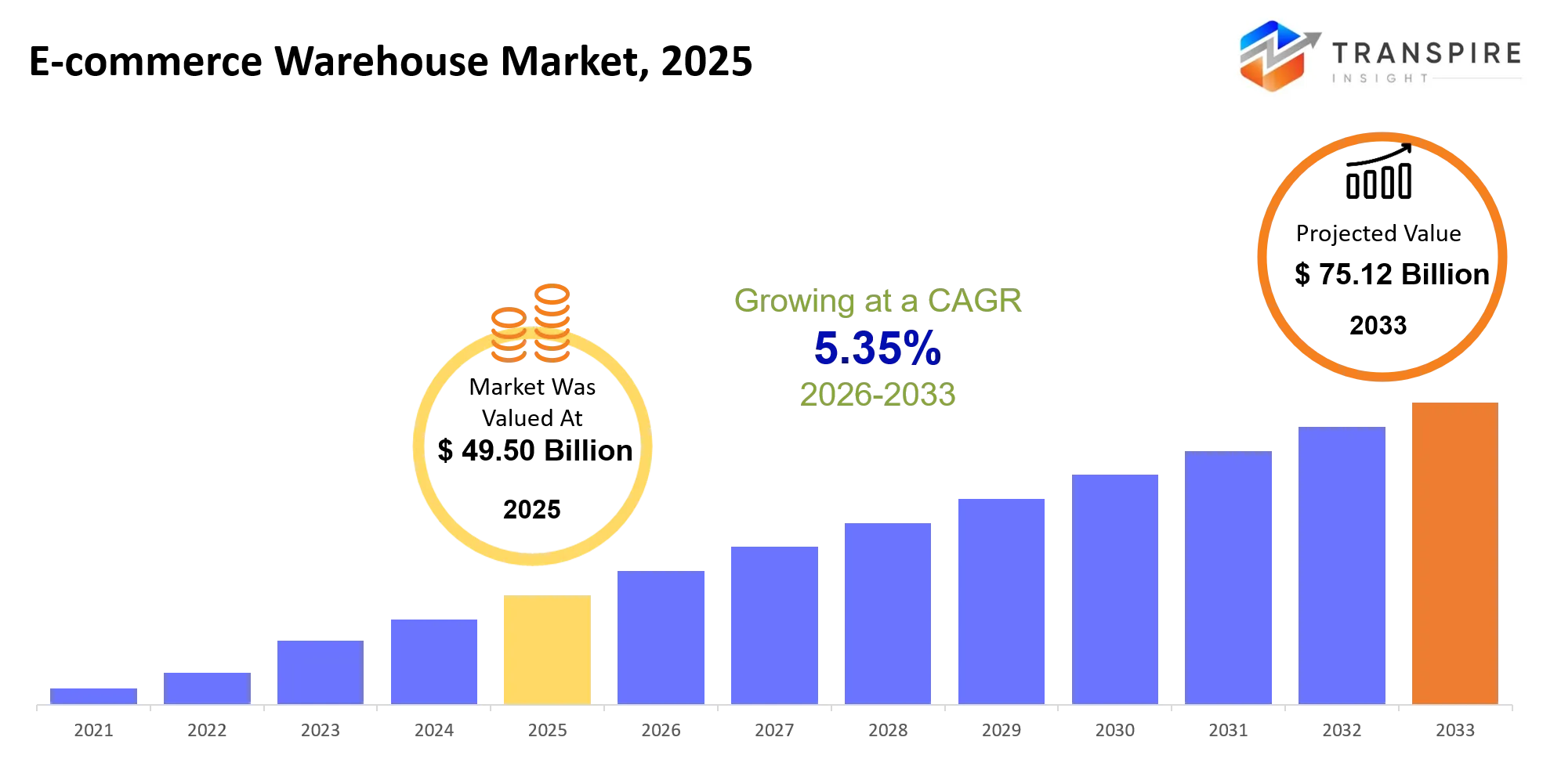
According to Transpire Insights, a detailed research report on the market reflects that the Global E-commerce Warehouse Market was valued at approximately USD 49.50 billion in 2025, is expected to reach USD 52.14 billion in 2026, and is estimated to reach approximately USD 75.12 billion by 2033, expanding at a CAGR of 5.35% during 2026–2033, making the market a significant contributor to global e-commerce logistics development, warehouse automation, advanced fulfillment infrastructure, expanding storage and distribution capabilities, and overall market growth dynamics.
Market Snapshot
- Market Value (2025): USD 49.50 Billion.
- Expected Market Value (2026): USD 52.14 Billion.
- Estimated Market Value (2033): USD 75.12 Billion.
- Forecast CAGR (2026–2033): 5.35%.
- Leading Region in 2025: Asia Pacific
- Second-largest Region: North America
- Fastest Growing Region: Europe
Introduction
The E-commerce Warehouse Market consists of specialized warehouses that store, track, pick, pack and distribute products that have been bought through online channels. Unlike traditional warehouses which are mainly focused on stock and pallet-based shipments, e-commerce warehouses cater to large volumes of orders and the need for more visibility, agility and fast order processing. These warehouses provide significant value by helping achieve faster deliveries, reduced cost of fulfillment and transportation, improved accuracy of inventories and seasonal variations in online sales. Some of the technologies that help e-commerce warehouses are Warehouse Management Systems (WMS), real-time inventory tracking, barcode and mobile scanning, cloud-based fulfillment platforms, automated storage and retrieval systems, Autonomous Mobile Robots (AMR) and Goods to Person solutions.
For instance:-
- North America: For example, investments in warehouses for e-commerce purposes are becoming more and more focused on automation, last-mile fulfillment centers, robotics, and strategically located sites for quick deliveries to consumer markets.
- Europe: For example, investors in Europe are focusing more and more on sustainable logistics facilities, warehouse acquisitions, flexibility and automation of the facilities for efficient operations and strict environmental standards.
Key Market Highlights: -
- Asia Pacific is expected to grow at a rapid CAGR in the E-commerce Warehouse Market by holding around42% of the share during the forecast period.
- North America is anticipated to hold roughly30.8% share of the E-commerce Warehouse Market over the predicted timeframe.
- Europe is anticipated to hold nearly 42.7%share of the E-commerce Warehouse Market over the predicted timeframe.
- By Warehouse Type, the Fulfillment Centers dominated the market and holds nearly 43.42% share in 2025 and is projected to grow at a substantial CAGR during the forecast period.
- By Service Type, the Storage & Warehousing dominated the market and holds close to 46% share in 2025 and is projected to grow at a substantial CAGR during the forecast period.
- By Automation Level, the Semi-automated dominated the market and holds about 61.48% share in 2025 and is projected to grow at a substantial CAGR during the forecast period.
- Logistics modernization efforts driven by governments, e-commerce exports facilities, digital commerce networks and warehouse infrastructure programs are improving fulfillment capacities and facilitating SME participation, cross border trade and local demand for e-commerce warehousing.
How is Technology Driving Growth in the E-commerce Warehouse Market?
Technological advancements have changed the way that traditional e-commerce warehouses are working by making them smarter and automated fulfillment centers that can efficiently process large numbers of individual orders. The use of technologies such as artificial intelligence (AI), machine learning, robotics, WMS, IoT, and analytics allows for faster order processing, enhanced accuracy of inventories, efficient use of space within the warehouse, and scalability of operations. Such technologies can help warehouse managers meet the needs of customers in terms of faster and reliable deliveries amid changing consumer expectations.
|
Report Metrics |
Details |
|
Market size value in 2025 |
USD 49.50 Billion |
|
Market size value in 2026 |
USD 52.14 Billion |
|
Revenue forecast in 2033 |
USD 75.12 Billion |
|
Growth rate |
CAGR of 5.35%from 2026 to 2033 |
|
Base year |
2025 |
|
Historical data |
2021 - 2024 |
|
Forecast period |
2026 - 2033 |
|
Report coverage |
Revenue forecast, competitive landscape, growth factors, and trends |
|
Regional scope |
United States; Canada; Mexico; United Kingdom; Germany; France; Italy; Spain; Denmark; Sweden; Norway; China; Japan; India; Australia; South Korea; Thailand; Brazil; Argentina; South Africa; Saudi Arabia; United Arab Emirates |
|
Key company profiled |
DHL Supply Chain, GXO Logistics, CEVA Logistics, DB Schenker, Kuehne+Nagel, FedEx Logistics, UPS Supply Chain Solutions, XPO, Ryder, NFI, Prologis, Amazon Logistics, JD Logistics, Cainiao, Delhivery |
|
Customization scope |
Free report customization (country, regional & segment scope). Avail customized purchase options to meet your exact research needs. |
|
Report Segmentation |
By Warehouse Type (Fulfillment Centers, Distribution Centers, Dark Stores, Micro-fulfillment Centers, Automated Warehouses, Cold-chain Warehouses, Bonded Warehouses, Others); By Service Type (Storage, Picking & Packing, Inventory Management, Order Fulfillment, Kitting & Assembly, Returns Management, Value-added Services, Others); By Automation Level (Manual, Semi-automated, Automated, Robotic, AI-enabled, Goods-to-person, Autonomous, Others); By End User (Apparel & Footwear, Consumer Electronics, Grocery & FMCG, Pharmaceuticals, Beauty & Wellness, Home Essentials, Automotive, Others); By Warehouse Size (Small, Medium, Large, Mega, Urban Micro-warehouse, Regional Hub, National Hub, Others) |
Market Drivers
The market for E-commerce Warehouse is fueled by increased investments in automated order fulfillment systems, strategically-placed distribution centers, and technologically advanced warehouse operations. The increase in labor costs, coupled with rising complexities in fulfilling orders, is making way for the use of autonomous mobile robots (AMRs), automated storage and retrieval systems, AI-based inventory management, and warehouse management systems (WMS). The growing presence of micro-fulfillment centers, dark stores, and urban warehouses is also enabling quicker deliveries of products in the form of last mile delivery and same day delivery.
For instance:-
- Asia-Pacific: For example, Asia-Pacific region is seeing investments being made in automated warehouses, micro-fulfillment centers, dark stores and logistics infrastructure to cope with fast growing ecosystems of e-commerce and quick-commerce.
- Latin America: For example, there is an increase in warehousing network for e-commerce purposes, localized fulfillment facilities and logistics infrastructure.
Restrain
The e-commerce warehouse market is constrained by high capital costs associated with land, facilities, automation, and robotics. Inadequate electricity infrastructure in developing countries might affect the operation of the automated warehouse and cause downtime. Security threats to the systems of the warehouse and technology that connects it might hinder its fulfillment process. Urban land use regulations can cause delays in expanding the facilities, and there may be a lack of manpower skilled in automation.
|
Driver |
Relative Impact on Growth (%) |
Geographic Relevance |
Impact Timeline |
Demand Strength |
Growth Mechanism |
Key Beneficiaries |
Major Constraint |
|
Driver 1: Rapid E-commerce Order Volumes and Faster Fulfillment Expectations |
28% |
North America, Asia-Pacific, Europe |
Short-term (≤2 years) |
High |
Expands fulfillment capacity for faster order processing. |
E-commerce retailers, 3PLs, warehouse operators, fulfillment providers |
High real-estate and labor costs constrain expansion. |
|
Driver 2: Warehouse Automation, Robotics, and AI Adoption |
25% |
North America, Europe, Asia-Pacific |
Medium-term (2–4 years) |
High |
Automates picking, sorting, storage, and inventory optimization. |
Robotics vendors, WMS providers, automation integrators, retailers |
High upfront automation costs slow smaller operators. |
|
Driver 3: Omnichannel Retail and Same-Day Delivery Expansion |
19% |
North America, Asia-Pacific, Europe |
Short-term (≤2 years) |
High |
Requires strategically located fulfillment and micro-warehousing networks. |
Retailers, last-mile providers, 3PLs, urban warehouse developers |
Urban land scarcity increases facility development costs. |
|
Driver 4: Digital Logistics Policies and Smart Warehousing Infrastructure |
15% |
Asia-Pacific, particularly India and China; Europe |
Medium-term (2–4 years) |
Medium |
Accelerates digitization, standardization, automation, and logistics connectivity. |
Warehouse developers, technology vendors, logistics providers, retailers |
Regulatory fragmentation and implementation gaps delay adoption. |
|
Driver 5: Sustainable Warehousing and Energy-Efficient Operations |
13% |
Europe, North America, Asia-Pacific |
Long-term (≥4 years) |
Medium |
Encourages energy-efficient facilities, renewable power, and green automation. |
Green warehouse developers, energy providers, technology vendors, retailers |
Sustainability investments can increase initial capital requirements. |
Analysis of Prices and Consumer Behaviour
The market of e-commerce warehouses consists of premium facilities characterized by automation and use of technologies (68% of total market – mainly because of the needs of online retail companies, third-party logistics providers and omnichannel fulfillment operations). The cost of a high-purity and highly automated warehouse facility will cost 35% more than other types, as the infrastructure will have high-level automation, quality-certified systems and continuous efficiency of operation. The share of flexible and scalable fulfillment warehouses among the demand of e-commerce warehouse unit will be around 45%. It is based on the flexibility of facilities in providing services for fulfilling orders, keeping inventories and fast distribution, which depends on changes in demand. E-commerce and omnichannel retail industry makes up 70% of demand of end-use sectors. The consumer behavior shows that 55% of consumers pay the most attention to warehouse automation, efficiency of operation, precision of fulfillment and integration of technologies. A further 33% of customers like to buy or contract warehouse space via bulk buying or long-term contracts so that they can minimize the cost of the fulfillment process and ensure consistent warehousing and distribution capabilities in all parts of the world.
|
Amazon |
Estimated 10–15% |
Fulfillment centers, Amazon FBA, Amazon Multi-Channel Fulfillment, sortation and delivery infrastructure |
Vertical integration with fulfillment ecosystem leadership |
North America, Europe, Asia-Pacific |
AI, warehouse robotics, computer vision, predictive inventory |
|
DHL Group |
Estimated 5–8% |
Contract logistics, e-commerce fulfillment, warehousing, returns management |
Global contract logistics and automation leadership |
Europe, North America, Asia-Pacific |
Robotics, IoT, AI, warehouse automation, smart devices |
|
Walmart |
Estimated 4–7% |
Walmart Fulfillment Services, e-commerce fulfillment centers, omnichannel distribution |
Omnichannel scale and vertically integrated fulfillment |
North America, Latin America |
AI, automation, inventory optimization, predictive fulfillment |
|
GXO Logistics |
Estimated 3–5% |
E-commerce fulfillment, contract warehousing, reverse logistics, distribution services |
Automation-led outsourced fulfillment specialization |
North America, Europe |
Robotics, AI, machine learning, warehouse orchestration |
|
Prologis |
Estimated 3–5% |
Distribution centers, fulfillment facilities, last-touch logistics properties |
Strategic logistics real-estate scale and location leadership |
North America, Europe, Asia-Pacific |
Smart buildings, energy systems, digital infrastructure, automation-ready facilities |
|
Kuehne+Nagel |
Estimated 2–4% |
E-commerce fulfillment, contract logistics, warehousing, returns management |
Integrated global fulfillment and contract-logistics differentiation |
Europe, Asia-Pacific, North America |
Robotics, automation, digital platforms, real-time inventory |
|
CEVA Logistics |
Estimated 2–4% |
E-commerce fulfillment, storage, order distribution, returns, cross-border logistics |
Flexible omnichannel fulfillment with global scalability |
Europe, North America, Asia-Pacific |
Automation, warehouse systems, fulfillment IT, robotics |
|
GEODIS |
Estimated 2–3% |
E-fulfillment, omnichannel fulfillment, warehousing, returns management |
End-to-end omnichannel fulfillment and service differentiation |
Europe, North America, Asia-Pacific |
WMS, robotics, automation, real-time inventory visibility |
|
UPS |
Estimated 1–3% |
Warehousing, e-commerce fulfillment, inventory management, returns |
Integrated fulfillment-to-delivery logistics ecosystem |
North America, Europe, Asia-Pacific |
Supply-chain visibility, automation, analytics, digital platforms |
|
FedEx |
Estimated 1–3% |
Fulfillment, warehousing, distribution, inventory and returns services |
Transportation-integrated fulfillment network expansion |
North America, Europe, Asia-Pacific |
Automation, data analytics, robotics, shipment visibility |
Who are the Key Players in the E-commerce Warehouse Market and how do they compete?
The competitiveness of the international E-commerce Warehouse Market requires companies focused on innovation and technologies, solutions for e-commerce fulfillment and creation of global distribution networks. Competing not on price, but through sophisticated warehousing infrastructure, technologies of automation, intelligence, connectedness, and integration with digital platforms and systems, such a way of competition contributes to continuous improvement of services provided and helps to reach increased efficiency and effectiveness of business processes.
Development of intelligent warehousing automation, fulfillment technologies, autonomous technologies, and logistics systems makes DHL Supply Chain competitive. Developing high-efficiency warehousing and fulfillment solutions designed specifically for e-commerce, order processing, inventory management, and distribution allows GXO Logistics to stand out among other companies in the market. Integrated e-commerce warehousing, fulfillment, automation and supply chain management solutions help CEVA Logistics to develop competitive advantages.
Top Companies in the E-commerce Warehouse Market
- DHL Supply Chain
- GXO Logistics
- CEVA Logistics
- DB Schenker
- Kuehne+Nagel
- FedEx Logistics
- UPS Supply Chain Solutions
- XPO
- Ryder
- NFI
- Prologis
- Amazon Logistics
- JD Logistics
- Cainiao
- Delhivery
|
Investment Factor |
Why It Matters to Investors |
Opportunity |
Investment Implication |
|
E-commerce Fulfillment Infrastructure Expansion |
Rising order complexity requires scalable, strategically located fulfillment capacity. |
Develop regional fulfillment centers, distribution hubs, and urban facilities. |
Why it is attractive: Scalable infrastructure supports sustained fulfillment demand. |
|
AI, Robotics and Warehouse Automation |
Automation improves throughput, labor productivity, inventory accuracy, and operating consistency. |
Invest in robotic picking, AS/RS, AI orchestration, computer vision, and automated sorting. |
Why it is attractive: Automation creates measurable productivity and cost advantages. |
|
Omnichannel and Same-Day Fulfillment |
Retailers increasingly require integrated inventory across online and physical channels. |
Build micro-fulfillment, last-mile warehouses, and flexible omnichannel facilities. |
Why it is attractive: Faster fulfillment supports premium logistics service models. |
|
Third-Party Logistics and Fulfillment Services |
Outsourcing reduces infrastructure burdens for rapidly scaling online merchants. |
Expand contract warehousing, fulfillment-as-a-service, returns, and value-added logistics. |
Why it is attractive: Outsourced models create recurring service-based revenue. |
|
Asia-Pacific and Emerging E-commerce Markets |
Expanding digital commerce requires localized warehousing and distribution networks. |
Target India, Southeast Asia, China, and other developing fulfillment corridors. |
Why it is attractive: Underpenetrated markets offer substantial infrastructure expansion. |
|
Sustainable and Energy-Efficient Warehousing |
Energy costs and sustainability requirements increasingly influence facility economics. |
Develop renewable-powered warehouses, efficient automation, and intelligent building systems. |
Why it is attractive: Efficient facilities can improve long-term operating economics. |
Airport Quick Service Restaurant (QSR) Market Segmentation
The E-commerce Warehouse Market share is divided into five categories: By Warehouse Type, By Service Type, By Automation Level, By End User, By Warehouse Size.
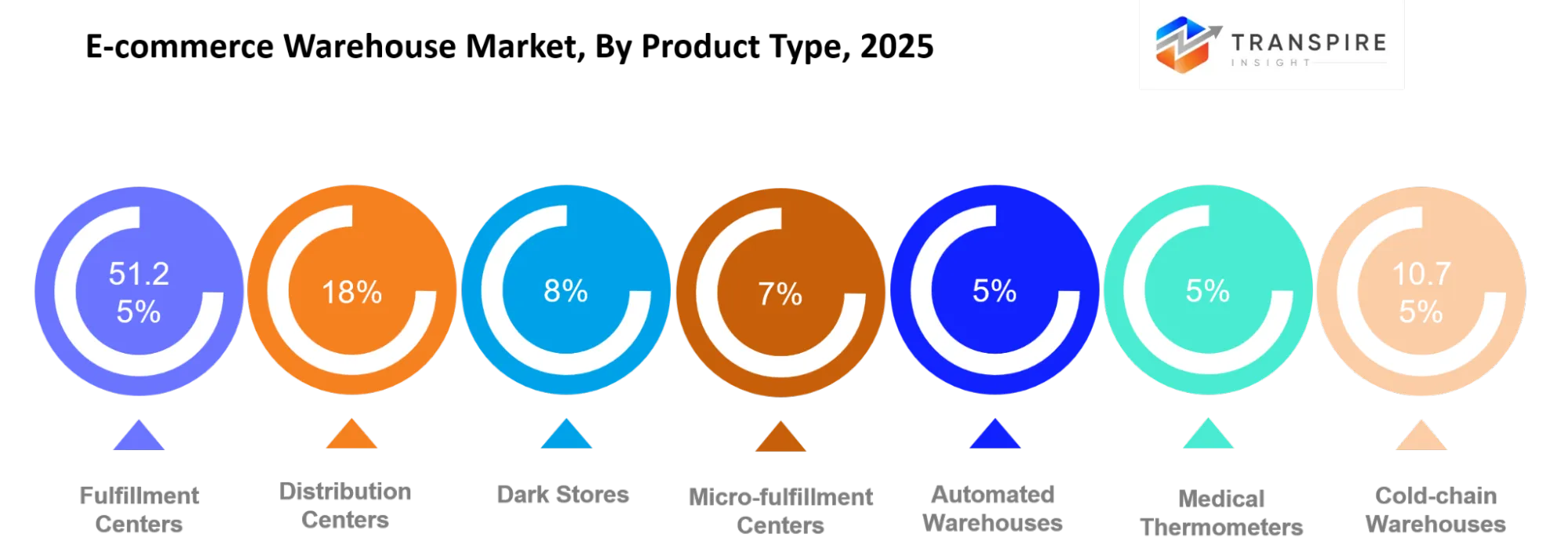
The Fulfillment Centers dominated the market, accounting for nearly 43.42% in 2025 and is expected to rise at a significant CAGR during the forecast period.
The E-commerce Warehouse Market is by warehouse type into fulfillment centers, distribution centers, dark stores, micro-fulfillment centers, automated warehouses, cold-chain warehouses, bonded warehouses, others. Among these, the Fulfillment Centers dominated the market, accounting for nearly 43.42% in 2025 and expected to increase at a significant CAGR during the forecast period. Fulfillment centers dominate because of growing demands from online orders, quick deliveries, inventory management, scalability of automation, and efficient order processing.
The Storage & Warehousing dominated the market, accounting for close to 46% in 2025, and is expected to rise at a significant CAGR during the forecast period
The E-commerce Warehouse Market is segmented by service type into storage, picking & packing, inventory management, order fulfillment, kitting & assembly, returns management, value-added services, others. Among these, the Storage & Warehousing dominated the market, accounting for close to 46% in 2025 and expected to increase at a significant CAGR during the forecast period. Storage & Warehousing dominates because of growing demands for inventories, growing number of e-commerce fulfillment centers, scalability of storage, efficient inventory management, and growing demands for efficient warehousing infrastructure.
The Semi-automated dominated the market, accounting for about 61.48% in 2025 and is expected to rise at a significant CAGR during the forecast period.
The E-commerce Warehouse Market by automation level into manual, semi-automated, automated, robotic, ai-enabled, goods-to-person, autonomous, others. Among these, the Semi-automated dominated the market, accounting for about 61.48% in 2025 and expected to increase at a significant CAGR during the forecast period. Semi-automated Warehouses dominate because of balanced automation, lower costs, improved operational efficiency, flexibility in workflow, low dependence on manual labor, and scalability of e-commerce fulfillment operations.
Regional Segment Analysis of the E-commerce Warehouse Market
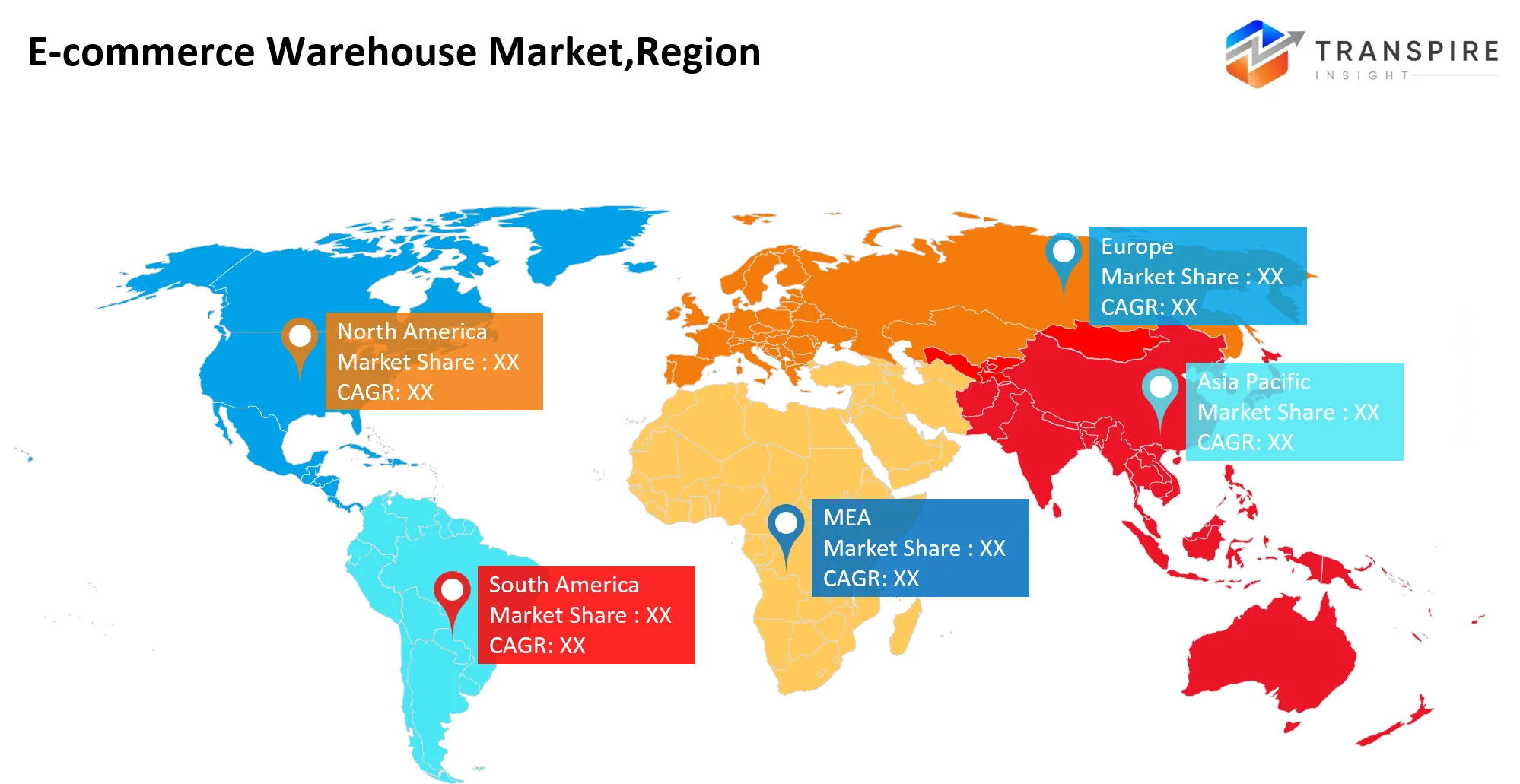
- Europe (Germany, France, U.K., Italy, Spain, Rest of Europe)
- North America (U.S., Canada, Mexico)
- Asia-Pacific (China, Japan, India, Rest of APAC)
- South America (Brazil and the Rest of South America)
- The Middle East and Africa (UAE, South Africa, Rest of MEA)
Asia Pacific is expected to grow at a rapid CAGR in the E-commerce Warehouse Market, holding around 42% of the share during the forecast period.
The Asia-Pacific region is forecasted to lead the E-commerce Warehouse Market owing to the fast growing penetration of e-commerce in the region, increasing online retail portals, increasing consumer demand for faster deliveries, and significant development of the logistics infrastructure. In countries like China, India, Japan, and South East Asian countries, there is increased warehouse automation, inventory management digitization, and logistics fulfillment centers. Increasing urbanization, increased internet usage, and increasing cross-border e-commerce also support warehousing in the region.
North America is the high-growth region in the E-commerce Warehouse Market during the period, holding roughly 30.8% share.
North America is a high growth region in the E-commerce Warehouse Market due to significant online retail penetration, good logistics infrastructure, and increasing demand for rapid fulfillment services. It benefits from increasing automation of warehouses, robotization, efficient warehousing management systems, and well-placed distribution centers. Increasing investments in omnichannel fulfillment services, same day delivery, micro-fulfillment centers, and third party logistics contribute to the development of the market.
Europe is the fastest-growing region in the E-commerce Warehouse Market during the period, holding nearly 42.7% share.
Europe has emerged as the highest-growing region within the E-commerce Warehouse Market owing to increasing online retailing, growing demand for faster deliveries, and rising investments in automation technologies. The region is increasingly adopting robotics, artificial intelligence, and warehouse management systems for greater operational efficiency. Increasing omnichannel retailing, urban fulfillment needs, sustainability efforts, and logistics investments continue to boost the need for e-commerce warehouses in the region.
Strategies for Market Growth in Non-Leading Regions:
The development of non-leading areas through the efficient use of e-commerce warehousing technologies will favor small and medium-size retailers and logistics operators. Development of regional fulfillment centers, distribution centers, and technologically equipped warehouses will help decrease reliance on far-flung logistics networks and lower fulfillment costs in total. Formation of strategic collaborations between regional retailers, e-commerce companies, logistics operators, and distributors will increase the market reach of e-commerce warehouse service providers. In order to raise the knowledge level regarding warehouse automation, inventory control, fulfillment processes, and e-commerce warehousing technologies, training and technical skills improvement will be necessary. Moreover, different financing solutions, long-term warehousing contracts, and fulfillment agreements will increase accessibility and promote adoption of e-commerce warehousing services. The formation of collaboration projects between government, logistics, and e-commerce projects and the use of digital sales and fulfillment platforms will increase accessibility to e-commerce warehousing services and will facilitate sustainable worldwide market development in developing regions.
Future Market Trends for the E-commerce Warehouse Market: -
Hyperlative Local Micro-Fulfillment: The e-commerce industry is setting up more micro-fulfillment facilities and urban warehouses that enable the placing of the inventories closer to customers, which results in quick delivery and quick commerce.
Warehouse Operations Driven by AI: AI technology, autonomous mobile robots, automated storage and retrieval systems, and robotic picking are revolutionizing the way warehouses operate through higher inventory accuracy and faster fulfillment among other benefits.
Sustainability and Omnichannel Warehousing: E-commerce warehouses of the future will be sustainable and efficient, thanks to energy efficiency, renewable energy, appropriately sized packaging, and an omnichannel fulfillment solution.
Recent Development
InMarch 2026 - DHL Alliance: DHL formed a partnership with Air France-KLM to provide ground-handling services at London Gatwick airport, thereby enhancing their air cargo logistics and integrating with e-commerce.
In March 2026 - FedEx AI Development: FedEx initiated an initiative to develop AI-based agent teams, which will help in bringing in end-to-end automation of logistics and warehousing operations.
In March 2026 - Shiprocket Warehouse Management Updates: Shiprocket rolled out updates to their warehouse management solution, with increased emphasis on computer vision, AI-driven quality control, and inventory intelligence.
In July 2026 - Colliers Industrial Warehousing Update: Colliers announced high leasing activities in the industrial and warehousing sector in major Indian cities, pointing toward growth in e-commerce fulfillment infrastructures.
Market Segment
This study forecasts revenue at global, regional and country levels from 2020 to 2033. Transpire Insights has segmented the E-commerce Warehouse Market based on the below-mentioned segments:
E-commerce Warehouse Market, By Warehouse Type
- Fulfillment Centers
- Distribution Centers
- Dark Stores
- Micro-fulfillment Centers
- Automated Warehouses
- Cold-chain Warehouses
- Bonded Warehouses
- Others
E-commerce Warehouse Market, By Service Type
- Storage
- Picking & Packing
- Inventory Management
- Order Fulfillment
- Kitting & Assembly
- Returns Management
- Value-added Services
- Others
E-commerce Warehouse Market, By Automation Level
- Manual
- Semi-automated
- Automated
- Robotic
- AI-enabled
- Goods-to-person
- Autonomous
- Others
E-commerce Warehouse Market, By End User
- Apparel & Footwear
- Consumer Electronics
- Grocery & FMCG
- Pharmaceuticals
- Beauty & Wellness
- Home Essentials
- Automotive
- Others
E-commerce Warehouse Market, By Warehouse Size
- Small
- Medium
- Large
- Mega
- Urban Micro-warehouse
- Regional Hub
- National Hub
- Others
E-commerce Warehouse Market, By Regional Analysis
North America
- US
- Canada
- Mexico
Europe
- Germany
- UK
- France
- Italy
- Spain
- Russia
- Rest of Europe
Asia Pacific
- China
- Japan
- India
- South Korea
- Australia
- Rest of Asia Pacific
South America
- Brazil
- Argentina
- Rest of South America
Middle East & Africa
- UAE
- Saudi Arabia
- Qatar
- South Africa
- Rest of the Middle East & Africa
Frequently Asked Questions
Find quick answers to common questions.
The market is projected to reach USD 75.12 billion by 2033, expanding at a 5.35% CAGR during 2026–2033.
Fulfillment Centers dominate the market, accounting for 43.42% share in 2025, supported by rapid order processing and delivery requirements
Semi-automated warehouses dominate with 61.48% share in 2025, offering balanced automation, operational efficiency, flexibility, and lower investment requirements.
Asia-Pacific is expected to lead, supported by expanding e-commerce penetration, logistics infrastructure, warehouse automation, urbanization, and cross-border online commerce.
Key trends include micro-fulfillment, AI-driven automation, robotics, sustainable warehousing, omnichannel integration, and technology-enabled inventory management across fulfillment networks.
- DHL Supply Chain
- GXO Logistics
- CEVA Logistics
- DB Schenker
- Kuehne+Nagel
- FedEx Logistics
- UPS Supply Chain Solutions
- XPO
- Ryder
- NFI
- Prologis
- Amazon Logistics
- JD Logistics
- Cainiao
- Delhivery
About the Authors

Mayur Shinde
I am Mayur Shinde, a Senior Research Analyst at Transpire Insight, specializing in the Automotive & Transportation and Information & Communication Technology (ICT) Industry. My work focuses on analyzing emerging market trends, technological advancements, competitive landscapes, and industry developments to deliver accurate, data-driven insights. I am passionate about transforming complex market information into clear, actionable content that helps businesses, professionals, and decision-makers stay informed and make confident strategic decisions.

Chakradhar Khansole
Chakradhar serves as the Research Director at Transpire Insight, bringing over 8 years of experience in technology, innovation, and strategic market intelligence. He specializes in transforming complex market data into actionable business insights that enable organizations to make informed, growth-oriented decisions. Recognized for his strategic vision and analytical expertise, Chakradhar leads high-impact research initiatives, delivering comprehensive market assessments, competitive intelligence, and forward-looking industry analysis.
Recently Published Reports
-
Apr 2026
ATV & UTV Market
ATV & UTV Market Size, Share & Analysis Report By Type (ATV, and UTV), By Variants (Less Than 400 CC, 400 CC To 800 CC, and More Than 800 CC), and Geography (North America, Europe, Asia-Pacific, Middle East and Africa, South and Central America), 2021 - 2031
-
Apr 2026
Automotive Central Gateway Module Market
Automotive Central Gateway Module Market Size, Share & Analysis Report By Type (Ethernet Central Gateway Module, CAN Central Gateway Module, LIN Central Gateway Module, and FlexRay), By Application (Powertrain Control, Body Control, Infotainment System, Advanced Driver Assistance Systems (ADAS), and Others), By End User (Passenger Vehicles, and Commercial Vehicles), and Geography (North America, Europe, Asia-Pacific, Middle East and Africa, South and Central America), 2021 - 2031
-
Apr 2026
Automotive Engine Oil Filter Market
Automotive Engine Oil Filter Market Size, Share & Analysis Report By Filter Type (Fuel Filter, Engine Oil Filter, Hydraulic Oil Filter, and Others), By Filter Media (Cellulose, Synthetic, and Micro), By Sales Channel (OEMs, and Aftermarket), By Vehicle Type (Passenger Cars, Light Commercial Vehicles, Heavy Duty Trucks, Buses and Coaches, and Off-road Vehicles), and Geography (North America, Europe, Asia-Pacific, Middle East and Africa, South and Central America), 2021 - 2031
-
Apr 2026
Automotive Parts Aluminium Die Casting Market
Automotive Parts Aluminium Die Casting Market Size, Share & Analysis Report By Production Process (Pressure Die Casting, Vacuum Die Casting, Squeeze Die Casting, Gravity Die Casting), By Application (Body Parts, Engine Parts, Transmission Parts, Battery And Related Components, Other Application Types), and Geography (North America, Europe, Asia-Pacific, Middle East and Africa, South and Central America), 2021 - 2031
Our Clients



