

E-commerce Fulfillment Market Summary:
According to Transpire Insight, a detailed research report on the E-commerce Fulfillment Market reflects that the shipping fulfillment services segment dominates the market, accounting for approximately 40.65% of the total market share in 2025, while the E-commerce Fulfillment Market was valued at approximately USD 87.6 billion in 2025 and is projected to reach USD 206.6 billion by 2032, expanding at a 13.0% CAGR during the forecast period. Amazon.com, Inc. leads the market with an estimated 18% market share, supported by its extensive fulfillment infrastructure, advanced warehouse automation, inventory management capabilities, integrated logistics network, and large-scale e-commerce ecosystem; the company reported approximately USD 716.9 billion in total net sales in 2025, making it a major contributor to e-commerce fulfillment market development, technological innovation, fulfillment-center expansion, automation adoption, delivery optimization, and overall market growth dynamics.
Market Snapshot
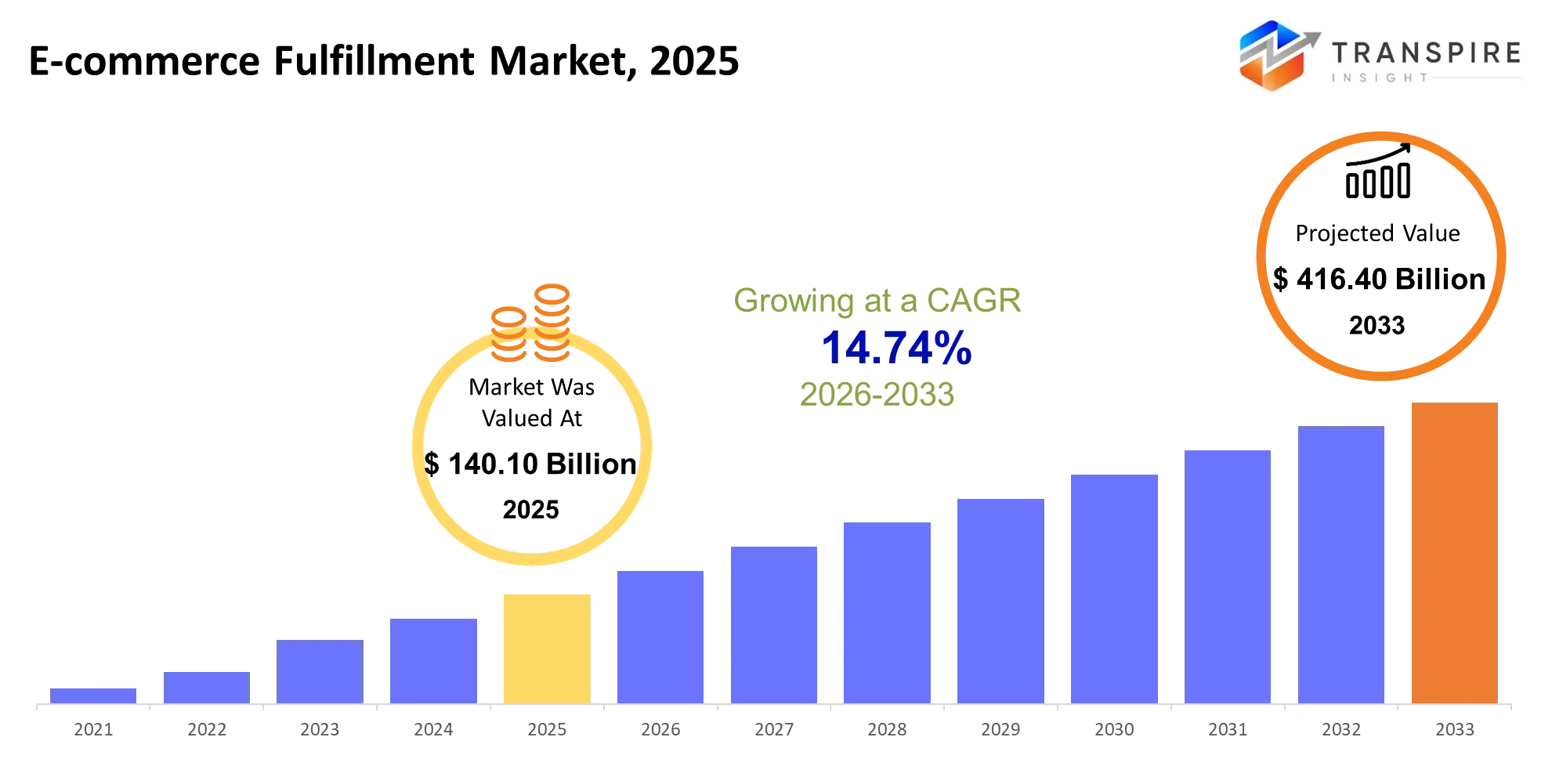
- Market Value (2025): USD 140.10 Billion.
- Expected Market Value (2026): USD 159.01 Billion.
- Estimated Market Value (2033): USD 416.40 Billion.
- Forecast CAGR (2026-2033): 14.74%.
- Leading Region in 2025: Asia Pacific
- Second-largest Region: North America
- Fastest Growing Region: Europe
Introduction
The e-commerce fulfillment market includes all services and infrastructure that are used for managing online orders in the process of receiving goods, warehousing, picking, packing, transporting, delivering, and processing returns. The e-commerce fulfillment companies provide help to retailers, brands, marketplaces, and direct-to-consumer businesses through their warehousing, inventory management, order processing, coordination of transport, and added value services. Third-party logistics (3PL), fourth-party logistics (4PL), micro-fulfillment centers, business-to-business (B2B), and business-to-consumer/direct-to-consumer (B2C/D2C) fulfillment solutions are included in the e-commerce fulfillment market that helps organizations to scale their operations and increase delivery efficiency. The adoption of automated warehouses, robotics, real-time inventory management, and digital fulfillment platforms transforms the operations in fulfillment. The main application sectors of this market are clothing and footwear, consumer electronics, beauty and personal care, home and kitchen, healthcare, and sports and leisure.
For instance:-
- North America: High level of e-commerce penetration, strong fulfillment capability, warehouse automation, and same day delivery channels can be used to develop technology enabled fulfillment centers and logistics services.
- Europe: High level of e-commerce penetration, cross-border trade, sustainability requirements, and advanced logistics infrastructure can be leveraged for developing automated fulfillment centers and distribution warehouses.
Key Market Highlights: -
- Asia Pacific is expected to grow at a rapid CAGR in the E-commerce Fulfillment Market by holding around 70% of the share during the forecast period.
- North America is anticipated to hold roughly 36% share of the E-commerce Fulfillment Market over the predicted timeframe.
- Europe is anticipated to hold nearly 27% share of the E-commerce Fulfillment Market over the predicted timeframe.
- By Service, the Shipping dominated the market and holds nearly 70% share in 2025 and is projected to grow at a substantial CAGR during the forecast period.
- By Fulfillment Model, the Third-Party Logistics (3PL) dominated the market and holds close to 59.25% share in 2025 and is projected to grow at a substantial CAGR during the forecast period.
- By Product Type, the Food & Beverage dominated the market and holds about 49.44% share in 2025 and is projected to grow at a substantial CAGR during the forecast period.
- Evolving framework of e-commerce exports in India can help to improve cross-border fulfillment capabilities using inventory-based exports, digital logistics infrastructure, and enabling MSMEs and customs process efficiency.
How is Technology Driving Growth in the E-commerce Fulfillment Market?
There is a rapid evolution happening in the E-commerce Fulfillment Market through technology that is driving productivity in the warehouse, accuracy in inventory, order orchestration, delivery, and returns. The use of artificial intelligence (AI) and machine learning helps with demand planning, inventory allocation, route optimization, and decision-making, whereas robotics, automated storage and retrieval systems, and picking technology speed up processes in the warehouse. Cloud-based WMS, TMS, API, and tracking enable connectivity between sales channels, inventory, warehouses, and carriers across a distributed network.
|
Report Metrics |
Details |
|
Market size value in 2025 |
USD 140.10 Billion |
|
Market size value in 2026 |
USD 159.01 Billion |
|
Revenue forecast in 2033 |
USD 416.40 Billion |
|
Growth rate |
CAGR of 14.74% from 2026 to 2033 |
|
Base year |
2025 |
|
Historical data |
2021 - 2024 |
|
Forecast period |
2026 - 2033 |
|
Report coverage |
Revenue forecast, competitive landscape, growth factors, and trends |
|
Regional scope |
United States; Canada; Mexico; United Kingdom; Germany; France; Italy; Spain; Denmark; Sweden; Norway; China; Japan; India; Australia; South Korea; Thailand; Brazil; Argentina; South Africa; Saudi Arabia; United Arab Emirates |
|
Key company profiled |
Amazon, DHL Supply Chain, FedEx, UPS, GXO Logistics, CEVA Logistics, XPO, Kuehne+Nagel, ShipBob, Radial, Fulfillment by Walmart, eFulfillment Service, ShipMonk, Red Stag Fulfillment, Rakuten Super Logistics |
|
Customization scope |
Free report customization (country, regional & segment scope). Avail customized purchase options to meet your exact research needs. |
|
Report Segmentation |
By Service (Warehousing, Order Processing, Pick & Pack, Inventory Management, Shipping, Returns Management, Kitting & Assembly, Others); By Fulfillment Model (In-house, 3PL, 4PL, Dropshipping, Crowdsourced, Hybrid, Marketplace Fulfillment, Others); By Product Type (Consumer Electronics, Apparel, Food & Beverage, Beauty & Personal Care, Healthcare, Home & Furniture, Automotive, Others); By Warehouse Type (Dedicated, Shared, Automated, Dark Stores, Micro-fulfillment Centers, Cold Storage, Distribution Centers, Others); By Technology (Robotics, AI, WMS, IoT, Automated Storage & Retrieval, RFID, Machine Vision, Others); By Order Type (B2C, B2B, D2C, Marketplace, Subscription, Same-day, Bulk, Others); By Enterprise Size (Large Enterprises, SMEs, Startups, Mid-sized Companies, Marketplaces, Retailers, Manufacturers, Others) |
Market Drivers
Drivers of the E-commerce Fulfillment Market include the continuous growth of online retailing, increased order volume, and increased digital commerce. Increased customer demands for faster delivery and delivery within 24 hours are motivating the development of a distributed network of fulfillment centers and better last-mile delivery capabilities. In addition, the advancements in AI, robotics, automation, and other intelligent technologies for warehouses increase efficiency, accuracy, and scalability of the process. Growth in omni-channel retailing and direct to consumer commerce creates additional demand for scalable technology-based e-commerce fulfillment infrastructure that can coordinate inventory across different market places, websites, retail stores, and distribution centers.
For instance:-
- Asia Pacific: High rate of growth in e-commerce and rise in consumer adoption coupled with development of third party logistics infrastructure can be used for building fulfillment centers, automation, and localized distribution channels.
- Latin America: Growth in online retailing and logistics infrastructure is creating demand for outsourced fulfillment centers and distribution infrastructure.
Restrain
There are numerous restraints that are faced by the market of e-commerce fulfillment because of increased operational cost, scarcity of labor, wage inflation, and higher transport cost. Scarcity of qualified warehouse and logistics workers might lead to increased hiring cost along with limitation in the capacity of fulfillment services. Maintaining several warehouses and distribution networks also result in increased cost of storage, transport, and infrastructure. Apart from that, disruptions in the supply chain, uncertainty in geopolitics, and problems in transport logistics might affect the availability of inventory and delivery.
|
Driver |
Relative Impact on Growth (%) |
Geographic Relevance |
Impact Timeline |
Demand Strength |
Growth Mechanism |
Key Beneficiaries |
Major Constraint |
|
Rapid Growth of Online Retail and Order Volumes |
28% |
North America, Asia-Pacific, Europe |
Short-term |
High |
Rising online orders increase fulfillment capacity requirements |
3PLs, fulfillment operators, warehouse developers, retailers |
High operating costs and capacity bottlenecks |
|
AI, Robotics, and Warehouse Automation Adoption |
24% |
North America, Europe, Asia-Pacific |
Medium-term |
High |
Automation accelerates picking, sorting, packing, inventory processing |
Robotics vendors, 3PLs, retailers, warehouse operators |
High upfront investment and integration complexity |
|
Same-Day, Next-Day, and Rapid Delivery Demand |
20% |
North America, Asia-Pacific, Europe |
Short-term |
High |
Faster delivery expectations expand localized fulfillment networks |
Last-mile providers, micro-fulfillment operators, retailers |
Delivery density and infrastructure costs |
|
Expansion of Micro-Fulfillment and Distributed Warehousing |
16% |
North America, Asia-Pacific, Europe |
Medium-term |
High |
Localized inventory placement reduces delivery distance and time |
Fulfillment providers, retailers, warehouse technology firms |
Real-estate costs and inventory fragmentation |
|
Sustainable Packaging and Fulfillment Requirements |
12% |
Europe, North America, Asia-Pacific |
Long-term |
Medium |
Packaging optimization reduces waste and supports regulatory compliance |
Sustainable packaging firms, fulfillment providers, retailers |
Higher sustainable-material costs and compliance complexity |
Analysis of Prices and Consumer Behaviour
The marketplace of e-commerce fulfillment is dominated by top-end fulfillment services (68% of the total market - due to demand from e-commerce, retail and direct-to-consumer industries). The price for the advanced fulfillment services based on technology is supposed to be 35% higher than that of other services, since these services will be implemented with automation, inventory control in real-time and consistency in order process efficiency. About 45% of all e-commerce fulfillment unit transactions take place via the technology-based fulfillment systems. The number of transactions is driven by versatile usage in online retail channels and scalability in digital fulfillment systems. E-commerce and direct-to-consumer industries form about 70% of demand from these industries. The purchasing behavior of businesses proves that 55% of businesses prioritize fulfillment speed, reliability and inventory accuracy. Another 33% of businesses prefer to purchase fulfillment services via bulk deals or long-term contracts in order to decrease their costs related to the fulfillment services and guarantee consistent supply of services capacity to their customers worldwide.
|
Company |
Est. Revenue Share Range |
Key Offerings |
Strategic Positioning |
Geographic Strength |
Technology Focus |
|
Amazon |
8-12% (Estimated) |
Multi-Channel Fulfillment, fulfillment centers, inventory management, pick-pack-ship, returns |
Vertically integrated fulfillment ecosystem leadership |
North America, Europe, Asia-Pacific |
AI, robotics, automation, inventory orchestration |
|
DHL Supply Chain |
6-9% (Estimated) |
E-commerce fulfillment, B2C/B2B fulfillment, returns, warehousing, distribution |
scale with integrated fulfillment solutions |
Europe, North America, Asia-Pacific |
AI, robotics, algorithms, warehouse management |
|
GXO Logistics |
4-7% (Estimated) |
Contract logistics, e-commerce fulfillment, warehousing, order management |
Technology-led contract logistics specialization |
North America, Europe, Asia-Pacific |
AI, warehouse robotics, automation, predictive analytics |
|
UPS |
3-5% (Estimated) |
E-commerce fulfillment, warehousing, multichannel fulfillment, returns |
Integrated fulfillment and transportation network |
North America, Europe, Asia-Pacific |
Distributed order management, automation, visibility platforms |
|
FedEx |
3-5% (Estimated) |
FedEx Fulfillment, warehousing, inventory management, returns |
Transportation-integrated fulfillment services |
North America, Europe, Asia-Pacific |
Cloud intelligence, robotics, APIs, tracking |
|
CEVA Logistics |
3-5% (Estimated) |
E-commerce fulfillment, storage, distribution, automation, returns |
Flexible omnichannel fulfillment provider |
Europe, North America, Asia-Pacific |
Automation, robotics, warehouse management, integration |
|
Maersk |
2-4% (Estimated) |
Warehousing, fulfillment, distribution, supply-chain management |
End-to-end logistics integration and expansion |
Europe, North America, Asia-Pacific |
Digital supply-chain platforms, visibility, automation |
|
GEODIS |
2-4% (Estimated) |
DTC fulfillment, omnichannel fulfillment, packaging, returns |
Omnichannel specialization and service differentiation |
Europe, North America, Asia-Pacific |
Cartonization, automation, inventory synchronization |
|
Kuehne+Nagel |
2-3% (Estimated) |
E-commerce fulfillment, order processing, inventory, packaging, returns |
Technology-driven customized fulfillment solutions |
Europe, Asia-Pacific, North America |
Automation, real-time inventory, platform integration |
|
ShipBob |
1-3% (Estimated) |
DTC fulfillment, inventory distribution, order fulfillment, returns |
Digital-first fulfillment for growing brands |
North America, Europe, Australia |
Cloud fulfillment, analytics, inventory optimization |
Who are the Key Players in the E-commerce Fulfillment Market and how do they compete?
Competitive advantage in international market E-commerce Fulfillment Market will be provided by companies that are engaged in development of technological innovation, fulfillment solutions tailored specifically for certain industries, and building of international distribution networks. Competing through provision of services that do not rely on price but on advanced fulfillment infrastructure, automation technology, connected and smart solutions, as well as integration with digital platforms and systems, this type of competition implies continuous development of services as well as improvement of productivity, efficiency, resource utilization, and visibility.
Through the creation of intelligent fulfillment network, warehousing automation solutions, omnichannel fulfillment services, and connected logistics technologies, Amazon achieves competitive advantage. By creating performance-oriented fulfillment services for order processing, warehousing, inventory management, shipping, returns, and other fulfillment services, DHL Supply Chain creates competitive advantage. FedEx provides competitive advantage by offering integrated solutions in the field of e-commerce fulfillment, warehousing, transportation, automation, and digital logistics, assisting retailers and brands to improve fulfillment productivity and efficiency.
Top Companies in the E-commerce Fulfillment Market
- Amazon
- DHL Supply Chain
- FedEx
- UPS
- GXO Logistics
- CEVA Logistics
- XPO
- Kuehne+Nagel
- ShipBob
- Radial
- Fulfillment by Walmart
- eFulfillment Service
- ShipMonk
- Red Stag Fulfillment
- Rakuten Super Logistics
|
Investment Factor |
Why It Matters to Investors |
Opportunity |
Investment Implication |
|
Outsourced Fulfillment Adoption |
Brands increasingly outsource complex fulfillment operations to specialized providers. |
Serve growing DTC, marketplace, and omnichannel merchants. |
Supports scalable recurring service revenues |
|
AI and Warehouse Automation |
Automation improves fulfillment speed, accuracy, labor productivity, and inventory utilization. |
Invest in robotics, AI orchestration, vision systems, and automated picking. |
Creates technology-led efficiency and differentiation |
|
Same-Day and Next-Day Delivery |
Faster delivery expectations require strategically distributed inventory and fulfillment infrastructure. |
Develop urban fulfillment centers and localized inventory networks. |
Expands infrastructure and premium-service opportunities |
|
Omnichannel and Multi-Node Fulfillment |
Merchants require coordinated fulfillment across websites, marketplaces, stores, and social-commerce channels. |
Provide integrated order management and distributed fulfillment services. |
Increases customer stickiness and revenue opportunities |
|
Emerging-Market Expansion |
E-commerce penetration and digital purchasing are expanding fulfillment requirements across developing economies. |
Build regional warehouses and technology-enabled logistics networks. |
Provides geographic diversification and expansion potential |
|
Returns and Reverse Fulfillment |
Higher online transaction volumes create substantial requirements for returns processing and inventory recovery. |
Develop automated returns, refurbishment, resale, and recovery solutions. |
Unlocks additional service revenues and operational efficiencies |
E-commerce Fulfillment Market Segmentation
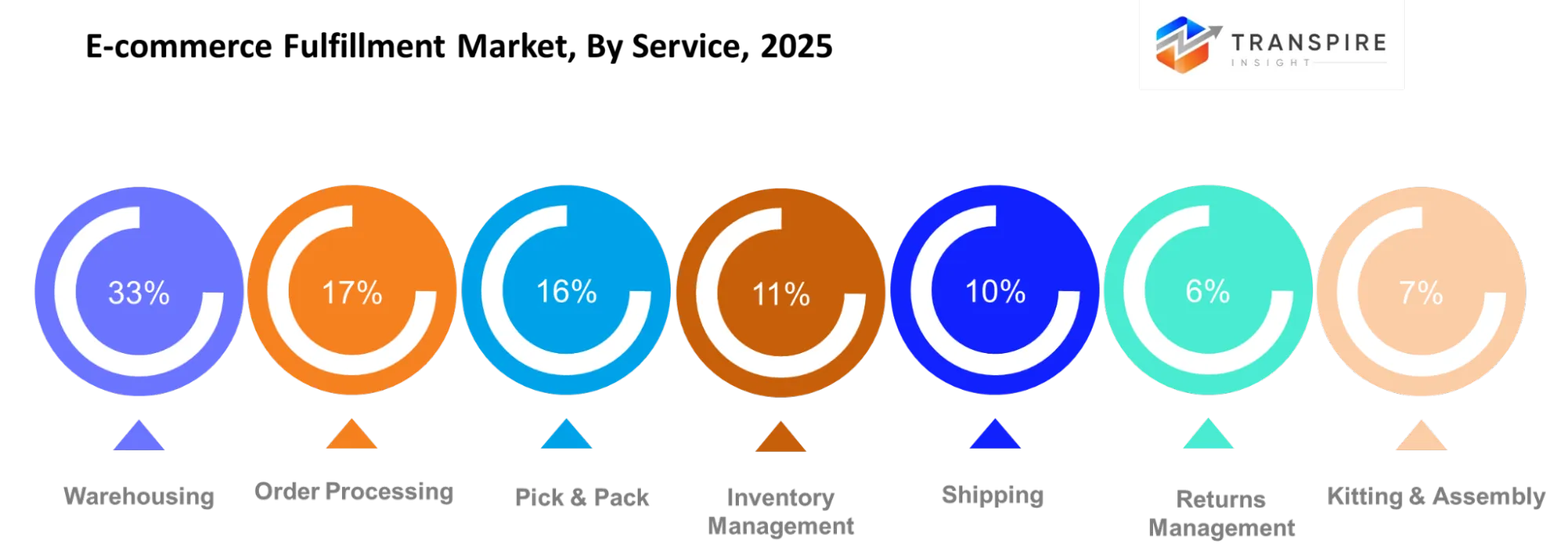
The E-commerce Fulfillment Market share is divided into seven categories: By Service, By Fulfillment Model, By Product Type, By Warehouse Type, By Technology, By Order Type, By Enterprise Size.
The Shipping dominated the market, accounting for nearly 70% in 2025 and is expected to rise at a significant CAGR during the forecast period.
The E-commerce Fulfillment Market is by service into warehousing, order processing, pick & pack, inventory management, shipping, returns management, kitting & assembly, others. Among these, Shipping dominated the market, accounting for nearly 70% in 2025 and expected to increase at a significant CAGR during the forecast period. Shipping led the market and accounted for almost 70% of the share in 2025, owing to increasing number of online orders, expansion of delivery channels and increasing demand for fast fulfillment services.
The Third-Party Logistics (3PL) dominated the market, accounting for close to 59.25% in 2025, and is expected to rise at a significant CAGR during the forecast period
The E-commerce Fulfillment Market is segmented by fulfillment model into in-house, 3pl, 4pl, dropshipping, crowdsourced, hybrid, marketplace fulfillment, others. Among these, the Third-Party Logistics (3PL) dominated the market, accounting for close to 59.25% in 2025 and expected to increase at a significant CAGR during the forecast period. 3PL led the market owing to increased outsourcing, scalability and cost-effectiveness, logistic expertise and increasing demand for omnichannel e-commerce fulfillment services.
The Food & Beverage dominated the market, accounting for about 49.44% in 2025 and is expected to rise at a significant CAGR during the forecast period.
The E-commerce Fulfillment Market by product type into consumer electronics, apparel, food & beverage, beauty & personal care, healthcare, home & furniture, automotive, others. Among these, theFood & Beverage dominated the market, accounting for about 49.44% in 2025 and expected to increase at a significant CAGR during the forecast period. Food & Beverage dominated the market owing to large number of online orders, high replenishment rate, special handling requirement and increasing demand for omnichannel grocery fulfillment.
Regional Segment Analysis of the E-commerce Fulfillment Market
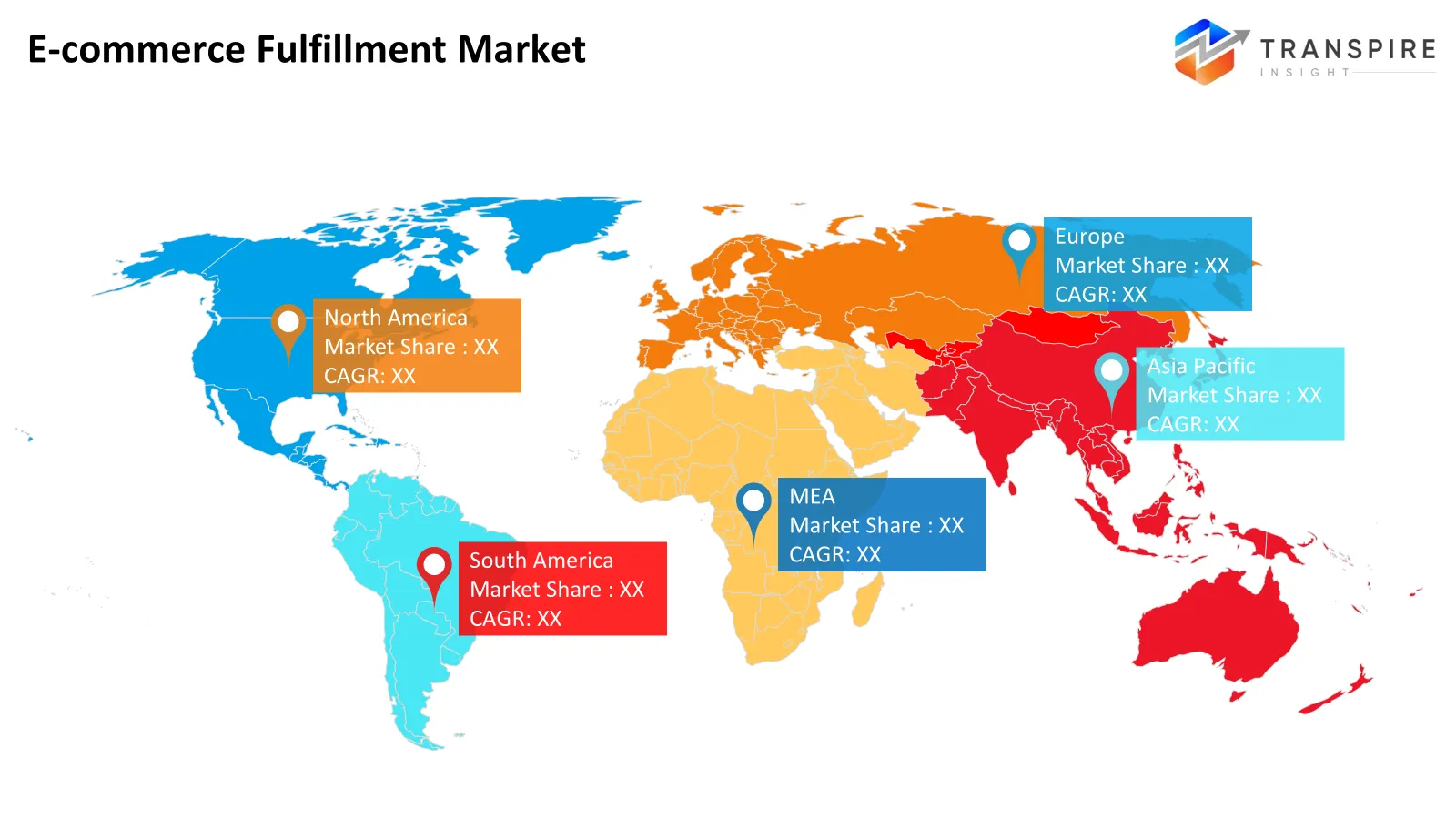
- Europe (Germany, France, U.K., Italy, Spain, Rest of Europe)
- North America (U.S., Canada, Mexico)
- Asia-Pacific (China, Japan, India, Rest of APAC)
- South America (Brazil and the Rest of South America)
- The Middle East and Africa (UAE, South Africa, Rest of MEA)
Asia Pacific is expected to grow at a rapid CAGR in the E-commerce Fulfillment Market, holding around 70% of the share during the forecast period.
E-commerce Fulfillment Market in Asia Pacific is poised for strong growth in coming years on account of increasing e-commerce, expansion of digital marketplaces, increasing number of smartphones and demand for quicker delivery services. Investments in warehousing, fulfillment centers, last-mile logistics and IT based inventory management are boosting the capability of the region. In addition, cross-border e-commerce, urbanization and presence of large online retailing companies in the region are driving demand for technology-based e-commerce fulfillment services.
North America is the high-growth region in the E-commerce Fulfillment Market during the period, holding roughly 36% share.
The high growth of the E-commerce Fulfillment Market in North America is attributed to the presence of extensive online shopping, logistics infrastructure, and adoption of omnichannel retailing in the region. The rising expectations of consumers about same-day and next-day deliveries have led to investments in distributed fulfillment centers, warehouse automation, and last mile deliveries. Moreover, existing 3PL companies, inventory management solutions, and increase in direct-to-consumer sales have been adding to the strength of the fulfillment capabilities of the region and the market growth.
Europe is the fastest-growing region in the E-commerce Fulfillment Market during the period, holding nearly 27% share.
Europe is the highest growing region in the E-commerce Fulfillment Market owing to growing online shopping, cross-border e-commerce, and need for efficient delivery services. The rise in the adoption of omnichannel commerce has encouraged retailers to make investments in distributed fulfillment centers, automated warehouses, and inventory management solutions. Sustainability needs, logistics infrastructure, and adoption of 3PL are enhancing regional fulfillment capabilities and efficiency, thereby contributing to the market growth in European nations.
Strategies for Market Growth in Non-Leading Regions:
Fulfillment technology innovations can help to develop non-leading regions in a cost-efficient and scalable manner for small to mid-size retailers and fulfillment service providers. Creating regional fulfillment centers, localized warehouses, and technology-powered distribution centers will lessen reliance on faraway fulfillment networks and lower the cost of logistics. Strategic collaboration with regional retailers, e-commerce platforms, logistics providers, and last mile delivery companies will enhance market reach for fulfillment service providers. Training and skills development will be needed to raise the level of understanding of warehouse automation, inventory management, order processing, and fulfillment optimization. Flexible financing, long term agreements, and contract fulfillment agreements will make fulfillment solutions for e-commerce more affordable and drive adoption by companies. Collaborative programs with governments, logistics operators, and e-commerce development projects, as well as usage of digital platforms, will make fulfillment services more accessible and enable sustainable market expansion in developing regions.
Future Market Trends for the E-commerce Fulfillment Market: -
- Warehouse automation and robotics: As there is increasing use of AMR, AI-enabled sorting processes and automated picking will result in better efficiency in terms of speed, precision, productivity and scalability.
- Micro-fulfillment and artificial intelligence: With micro-fulfillment centers along with the use of AI for optimizing inventory management, predicting demands and route planning, faster deliveries can be made.
- Fulfillment Sustainability and Cross-Border Delivery: Increasingly high standards of sustainability, sustainable packaging, electric delivery vehicles, and cross-border D2C business operations will create an efficient fulfillment network.
Recent Development
- In July 17, 2026: An e-commerce fulfillment services market report for the e-commerce marketplace was released, covering the areas of automation, digitization, and logistics visibility in fulfillment processes.
- In May 22, 2026: Amazon released Amazon Now, a new initiative offering 30-minute deliveries through localized fulfillment infrastructure.
- In February 2026: The ONDC and India Post released a warehousing model that offered shared fulfillment, packaging, and logistics infrastructures for MSMEs and local e-commerce merchants.
- In June 2026: The EU toughened its rules on packaging sustainability within PPWR, urging fulfillment facilities to cut down their use of packaging and increase operational efficiency.
Market Segment
This study forecasts revenue at global, regional and country levels from 2020 to 2033. Transpire Insight has segmented the E-commerce Fulfillment Market based on the below-mentioned segments:
E-commerce Fulfillment Market, By Service
- Warehousing
- Order Processing
- Pick & Pack
- Inventory Management
- Shipping
- Returns Management
- Kitting & Assembly
- Others
E-commerce Fulfillment Market, By Fulfillment Model
- In-house
- 3PL
- 4PL
- Dropshipping
- Crowdsourced
- Hybrid
- Marketplace Fulfillment
- Others
E-commerce Fulfillment Market, By Product Type
- Consumer Electronics
- Apparel
- Food & Beverage
- Beauty & Personal Care
- Healthcare
- Home & Furniture
- Automotive
- Others
E-commerce Fulfillment Market, By Warehouse Type
- Dedicated, Shared
- Automated
- Dark Stores
- Micro-fulfillment Centers
- Cold Storage
- Distribution Centers
- Others
E-commerce Fulfillment Market, By Technology
- Robotics
- AI
- WMS
- IoT
- Automated Storage & Retrieval
- RFID
- Machine Vision
- Others
E-commerce Fulfillment Market, By Order Type
- B2C
- B2B
- D2C
- Marketplace
- Subscription
- Same-day
- Bulk
- Others
E-commerce Fulfillment Market, By Enterprise Size
- Large Enterprises
- SMEs, Startups
- Mid-sized Companies
- Marketplaces
- Retailers
- Manufacturers
- Others
Non-Invasive Surgical Wound Closure Market, By Regional Analysis
North America
- US
- Canada
- Mexico
Europe
- Germany
- UK
- France
- Italy
- Spain
- Russia
- Rest of Europe
Asia Pacific
- China
- Japan
- India
- South Korea
- Australia
- Rest of Asia Pacific
South America
- Brazil
- Argentina
- Rest of South America
Middle East & Africa
- UAE
- Saudi Arabia
- Qatar
- South Africa
- Rest of the Middle East & Africa
Frequently Asked Questions
Find quick answers to common questions.
Rising online orders, faster delivery expectations, warehouse automation, omnichannel commerce, and expanding digital marketplaces are accelerating e-commerce fulfillment market growth.
Warehouse automation improves fulfillment speed, accuracy, productivity, scalability, and operational efficiency through robotics, AI-enabled sorting, and automated picking technologies.
Artificial intelligence optimizes inventory management, demand forecasting, route planning, order processing, and delivery operations, enabling faster and more efficient fulfillment.
Key trends include warehouse robotics, micro-fulfillment centers, artificial intelligence, sustainable packaging, electric delivery vehicles, and expanding cross-border D2C fulfillment networks.
Sustainability is encouraging eco-friendly packaging, electric delivery vehicles, efficient fulfillment networks, and environmentally responsible practices across e-commerce logistics operations.
- Amazon
- DHL Supply Chain
- FedEx
- UPS
- GXO Logistics
- CEVA Logistics
- XPO
- Kuehne+Nagel
- ShipBob
- Radial
- Fulfillment by Walmart
- eFulfillment Service
- ShipMonk
- Red Stag Fulfillment
- Rakuten Super Logistics
About the Authors

Mayur Shinde
I am Mayur Shinde, a Senior Research Analyst at Transpire Insight, specializing in the Automotive & Transportation and Information & Communication Technology (ICT) Industry. My work focuses on analyzing emerging market trends, technological advancements, competitive landscapes, and industry developments to deliver accurate, data-driven insights. I am passionate about transforming complex market information into clear, actionable content that helps businesses, professionals, and decision-makers stay informed and make confident strategic decisions.

Chakradhar Khansole
Chakradhar serves as the Research Director at Transpire Insight, bringing over 8 years of experience in technology, innovation, and strategic market intelligence. He specializes in transforming complex market data into actionable business insights that enable organizations to make informed, growth-oriented decisions. Recognized for his strategic vision and analytical expertise, Chakradhar leads high-impact research initiatives, delivering comprehensive market assessments, competitive intelligence, and forward-looking industry analysis.
Recently Published Reports
-
Apr 2026
3D Optical Profiler Market
3D Optical Profiler Market Size, Share & Analysis Report By Type (Desktop 3D Optical Profiler, and Portable 3D Optical Profiler), By Technology (Confocal Technology, and White Light Interference), By End-Use Industry (Manufacturing, Research Institutions, Automotive, Aerospace and Defense, Medical Devices, and Other), and Geography (North America, Europe, Asia-Pacific, Middle East and Africa, South and Central America), 2021 - 2031
-
Apr 2026
Depth Sensor Market
Depth Sensor Market Size, Share & Analysis Report By Type (Infrared Depth Sensors, Time-of-Flight (ToF) Sensors, Stereo Vision Sensors, Structured Light Sensors, Ultrasonic Depth Sensors), By Application (Automotive, Robotics, Gaming, Consumer Electronics, Industrial Automation, Healthcare, Security & Surveillance, Others), By End Users (Automotive Manufacturers, Consumer Electronics Companies, Healthcare Providers, Industrial Companies, Security Agencies, Gaming Companies, Robotics Companies, Others), and Geography (North America, Europe, Asia-Pacific, Middle East and Africa, South and Central America), 2021 – 2031
-
Apr 2026
Digital Manufacturing Market
Digital Manufacturing Market Size, Share & Analysis Report By Component (Hardware, Software, and Services), By Technology (Robotics, 3D Printing, Internet of Things (IoT), and Others), By Application (Automotive and Transportation, Aerospace and Defense, Consumer Electronics, Industrial Machinery, and Others), By Process Type (Computer-Based Designing, Computer-Based Simulation, Computer 3D Visualization, Analytics, and Others), and Geography (North America, Europe, Asia-Pacific, Middle East and Africa, South and Central America), 2021 – 2031
-
Apr 2026
Digital Visa Services Market
Digital Visa Services Market Size, Share & Analysis Report By Type (Individual Travelers, Group Travelers), By Application (Tourism, Business Travel, Others), and Geography (North America, Europe, Asia-Pacific, Middle East and Africa, South and Central America), 2021 – 2031