

Warranty Management Market Summary:
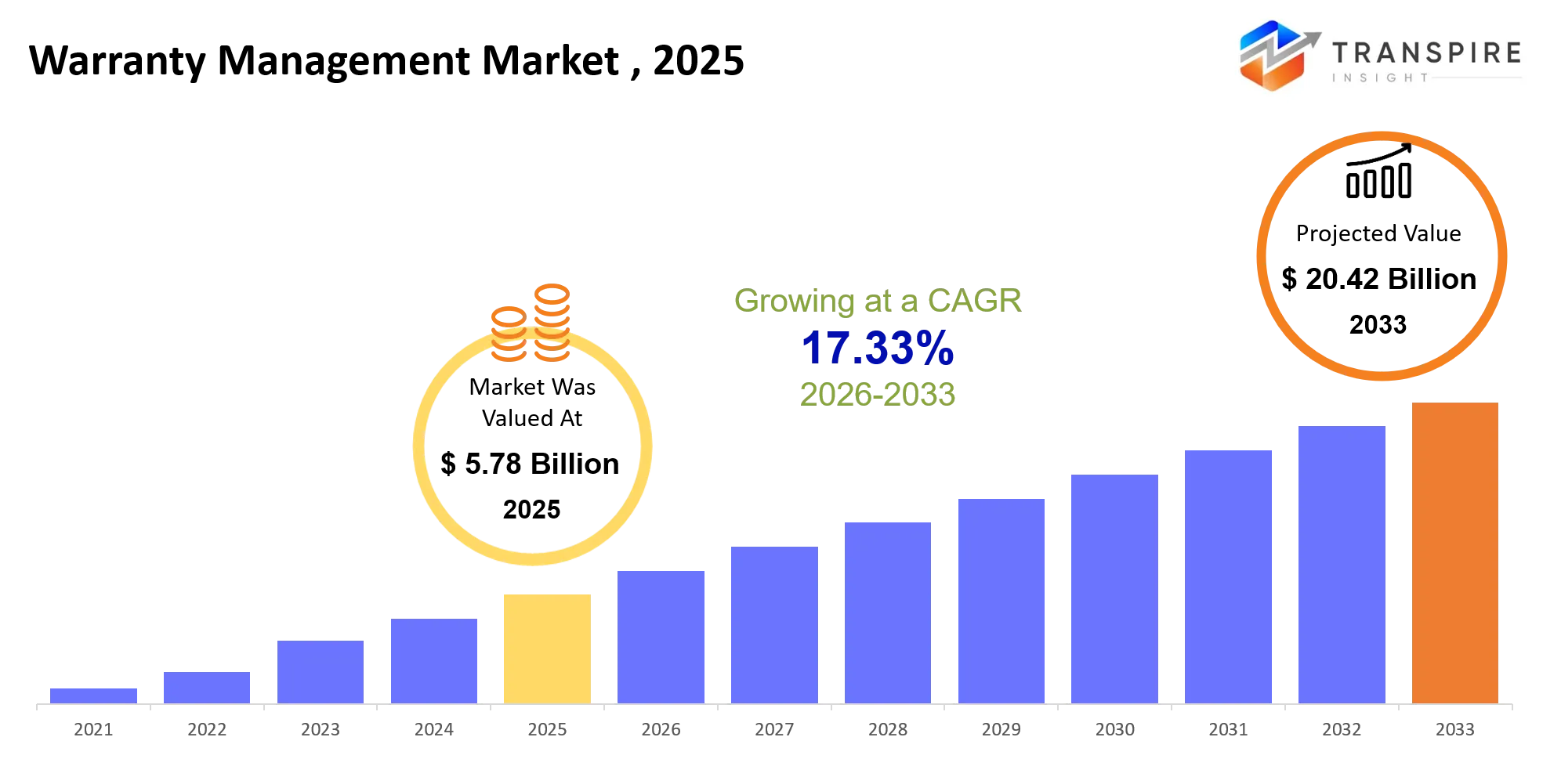
As per Transpire Insight Analysis, the Warranty Management Market size is estimated at USD 5.78 billion in 2025 and is anticipated to reach USD 20.42 billion by 2033, growing at a CAGR of 17.33% from 2026 to 2033.
The warranty management market is changing. Warranty management is moving away from back‑office claim handling and toward connected after‑sales operations. These operations help companies keep costs, recover money from suppliers and keep customers happy. Over the past three to five years, there have been several new innovations that have changed how warranty teams work. Things like cloud-based deployment, API integration, mobile service processes and advanced analytics have made a difference. These tools help teams manage claims and product information effectively. There’s also been a shift from using separate tools to a single platform. This platform connects manufacturers, dealers, suppliers, service centres, and customers. It brings everyone together in one place. As products become complex and service networks grow larger, it’s hard to check claims manually. Doing it by hand doesn’t work well at scale. That’s why companies now buy automation tools. These tools save time during claim validation. Also help spot patterns.
When a certain product keeps failing, automation can flag it. That information helps companies improve their products. It also helps them get money back from suppliers when needed. All of this adds up to quality and better support for customers.
Warranty Management Market Size & Forecast:
- Market Size 2025: USD 5.78 Billion
- Expected Market Value (2033): USD 20.42 Billion
- Forecast CAGR (2026–2033): 17.33%
- Leading Region in 2025: North America
- Fastest Growing Region: Asia Pacific
- Key Company Profiles: IBM, Oracle, SAP, Pegasystems, ServiceNow, Tavant, PTC, Infosys, Wipro, Accenture, Tata Consultancy Services, Capgemini, Salesforce, SAS, Genpact
Key Market Insights:
The market is moving from basic claims management to connected warranty management, where software, cloud computing, analytics, and services impact costs and customer retention.
- Software holds 54.30%, which shows the transition from manual warranting to automated claims and coverage verification.
- The cloud segment is growing at a 15.20% CAGR, indicating the increasing preference for flexible platforms which can help connect dealers, suppliers, and service providers across geographies.
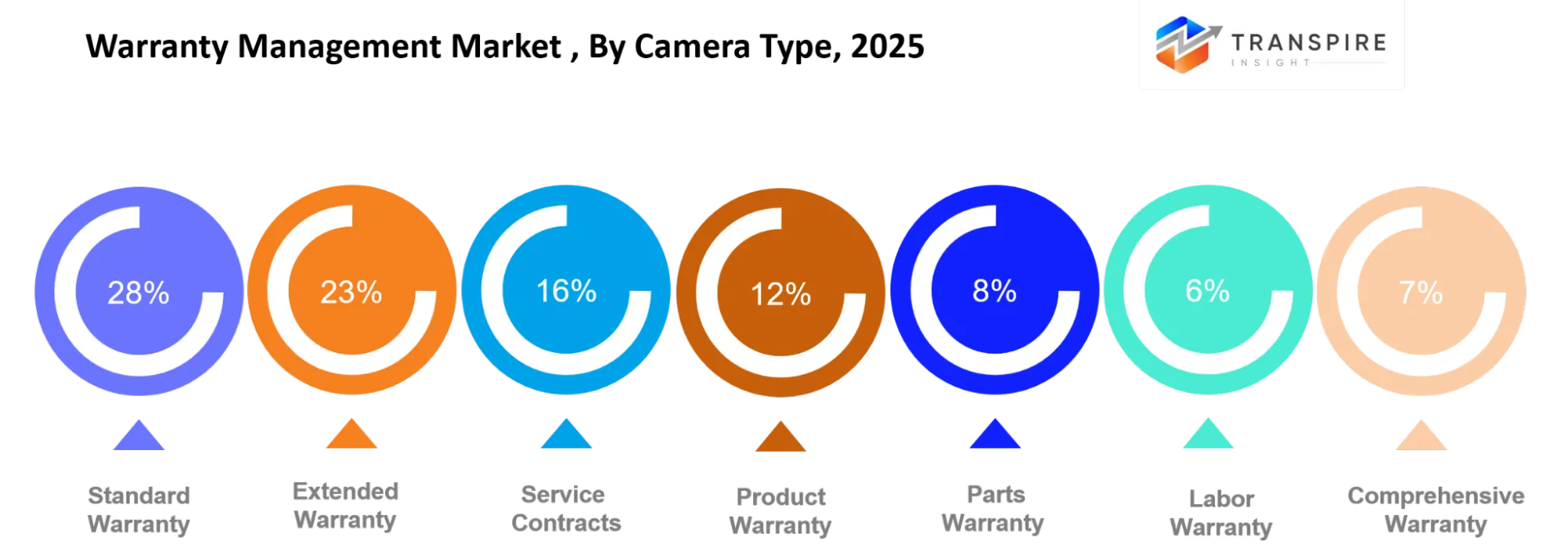
- Standard warranties have a share of 28.00%, which shows the importance of traditional manufacturing warranties despite the rise of the other coverage types.
- Extended warranties comprise 23.00%, owing to the rising demand among consumers as well as businesses seeking more protection time along with added post-service.
- Service contracts make up 16.00%, demonstrating the move from temporary warranty coverages to continuous services along with after sales income.
- Oracle offers supplier warranty functionality via its cloud maintenance solutions.
What are the Key Drivers, Restraints, and Opportunities in the Warranty Management Market?
Drivers
The growth is being driven by the transition from manual management of warranty to software-based claim processing. The biggest driver of growth is the increasing number and complexity of claims that come up with products, dealers, suppliers, and networks. When a warranty team automates the registration, coverage verification, approval, and routing of claims, then it is able to handle an increased number of claims without increasing the administrative effort. Adoption is improved since the financial value is clear in terms of reduced cost, faster reimbursement, increased recovery, and reduced inaccurate payments. The software component of the market share.
Restraints
There is a challenge of integration. As companies continue to use their legacy ERP, CRM, dealer, service, and product systems, linking warranty processes may involve data mapping, process redesign, and specialised help. This problem exists since warranty data is usually scattered among departments and partners, making it hard to standardize.
Opportunities
The opportunity is cloud-based warranty management solutions. It is the fastest-growing market segment, according to the provided market context. Companies can grow through providing API-first platforms, configurable workflows, analytics, and mobile claim applications that would integrate into current systems rather than replace them. This would be particularly useful for expanding service operations in Asia Pacific and developing countries.
What Has the Impact of artificial intelligence on the Warranty Management Market?
AI is changing the way warranty management works. It is helping warranty teams move away from doing things manually and using rules to make decisions faster. This technology can help with classifying claims, reading notes from service calls, finding details, checking if claims match the coverage rules and finding claims that need a person to look at them. AI can take care of repetitive tasks. This can help make the process faster. It can also look at claims, find unusual problems, guess how many claims might happen and find products or parts that might cost money in the future. All these things can help manufacturers make choices about quality, find suppliers, plan services and deal with customers. AI is also helpful in field work. The technology can be used to get information during inspections on mobile devices and for checking damage and finding fraud using machine learning models. The main benefit of this is consistency at dealerships and service centres, especially when there are a lot of claims.. Using AI is not easy. It might need money for preparing data, connecting systems, managing models and training people. Also, if the old data is not good, the models might not work well. So the market is moving towards using AI with humans involved.
Instance
In June 2026, Salesforce offered an AI-driven Warranty Claims Assistance functionality via Agentforce, which is capable of validating warranty eligibility, summarising claims, and delivering real-time claim status. The innovation showcases how the use of AI technology is becoming increasingly influential in the warranty management market all around the world by cutting down manual claim processing tasks.
https://www.salesforce.com/in/news/stories/summer-2026-product-release-announcement
Key Market Trends:
There is growing integration of the warranty management industry. The most dominant trend is the move from isolated claims management to platform-based approaches, integrating warranty, maintenance, field service, customer, and supply chain management information.
- Recovery is becoming a more important aspect of warranty administration as firms strive to recoup the cost of defective components from third parties.
- Warranty data is increasingly being utilised for product quality improvement rather than only for financial and claims management purposes.
- Extended protection is slowly being taken away from the point-of-sale model, as new platforms allow for purchase of extended protection after the sale.
- Artificial intelligence is moving from experimental use to real-life uses such as classification of claims, fraud detection, damage assessment, and decision support.
- APIs are becoming increasingly relevant as retailers and manufacturers integrate warranty management platforms with POS, ERP, CRM, e-commerce, and field service applications.
Warranty Management Market Segmentation
By Warranty type
Warranty type remains an effective tool for defining company coverage programs. Standard Warranty accounts for 28.00%, making it the largest segment in the provided segmentation data. Extended Warranty accounts for 23.00% because of the needs of consumers who would like to have more protection after the expiry date of the original warranty. Service Contracts make up 16.00% of all warranty types, as a result of their rising importance, whereas Product Warranty constitutes 12.00% of the total. Parts Warranty accounts for 8.00%, Labour Warranty for 6.00%, and Comprehensive Warranty for 7.00%.
By components
The largest component segment is the Software segment, which makes up 54.30% of the total market share. Increasing use of warranty claims processing, analytics and workflow optimisation through computer-based solutions is driving this trend towards the predominance of this segment. It is still essential to have hardware when working in a connected service environment. The key point of competitiveness lies in the ability to organise and analyse warranty data. Services help implement and maintain the system and provide consulting. Analytics help discover claim trends and identify cost drivers. The warranty platform's capability of integrating with ERP, CRM, dealer and service systems becomes increasingly important. Support & Consult also retains its significance since some processes require redesign and specialised configuration in order to create complex warranty programs.
By deployment
Cloud warranty management is the leading growth segment with a CAGR of 15.20% within the supplied market framework. Cloud warranty management allows manufacturers and service providers to integrate the system without significant investments into the company's IT systems. On-Premise systems cater to organisations that already have their IT infrastructure developed and do not wish to use another one. Hybrid warranty management provides an intermediary solution to those organisations that are moving
By end users
The automotive industry is an important domain since manufacturers, dealers, suppliers, and services handle large amounts of claims and component interdependencies. Consumer electronics companies need fast registration, claims handling, and customer support since their product life cycles are short. Industrial equipment companies are in need of a warranty management solution that would be integrated with asset information, service, and parts operations. Traceability and controlled maintenance processes are more important for the aerospace industry, while healthcare companies have the need for reliable warranty data of equipment and services. Protection programs for appliances and retail are also being expanded due to increased use of extended warranties.
By organisation size
Large corporations usually need robust warranty management platforms that could be used for several brands, geographic regions, suppliers, dealers, and service network management. SMEs have an opportunity to implement less complex cloud-based warranty management solutions without significant infrastructure expenses. OEM companies need control over warranty terms, claims, supplier recovery, and feedback about the quality of products. Dealers should have a tool that will allow them to efficiently register claims, submit them, and communicate with customers.
By application
Warranty Claims will continue to remain important because Warranty Claims involve capturing, verifying, approving, paying and tracking. Warranty Administration covers the management of policies, customer details and eligibility. Contract Management addresses issues related to long‑term cover. Fraud Prevention becomes more significant because of efforts to minimise errors and fraudulent transactions. Product Registration supplies the database that helps identify products and customers. Analytics turns claims data into information such as rates, costs and performance metrics. Customer Services adds Warranty data into the support process.
What are the Key Use Cases Driving the Warranty Management Market?
Warranty claims management is the use case, and warranty claims management ties closely to leading software. Organisations use steps to register products, check eligibility, route claims, approve them automatically and handle reimbursements. This reduces effort and saves time. I notice that warranty claims management can save a lot of time. Other use cases include contract management, product registration, customer service, analytics and fraud detection. Automotive, consumer electronics, industrial equipment, household appliances and healthcare companies can connect warranty data with service and customer data so warranty data shows the product life cycle more clearly. We find that warranty data can be linked to service data for visibility. Future use cases will focus on analytics, AI‑powered inspections, supplier recovery and mobile field processes. These tools help spot repeat failures, aid repair decisions, and turn claim data into insights about product quality and service.
|
Report Metrics |
Details |
|
Market size value in 2025 |
USD 5.78 Billion |
|
Market size value in 2026 |
USD 6.67 Billion |
|
Revenue forecast in 2033 |
USD 20.42 Billion |
|
Growth rate |
CAGR of 17.33% from 2026 to 2033 |
|
Base year |
2025 |
|
Historical data |
2021 - 2024 |
|
Forecast period |
2026 - 2033 |
|
Report coverage |
Revenue forecast, competitive landscape, growth factors, and trends |
|
Regional scope |
United States; Canada; Mexico; United Kingdom; Germany; France; Italy; Spain; Denmark; Sweden; Norway; China; Japan; India; Australia; South Korea; Thailand; Brazil; Argentina; South Africa; Saudi Arabia; United Arab Emirates |
|
Key company profiled |
IBM, Oracle, SAP, Pegasystems, ServiceNow, Tavant, PTC, Infosys, Wipro, Accenture, Tata Consultancy Services, Capgemini, Salesforce, SAS, Genpact |
|
Customization scope |
Free report customization (country, regional & segment scope). Avail customized purchase options to meet your exact research needs. |
|
Report Segmentation |
Warranty Type (Standard Warranty, Extended Warranty, Service Contracts, Product Warranty, Parts Warranty, Labor Warranty, Comprehensive Warranty); Component (Software, Hardware, Services, Analytics, Integration, Support, Consulting); Deployment (Cloud, On-Premise, Hybrid, SaaS, Private Cloud, Public Cloud, Hosted); End User (Automotive, Consumer Electronics, Industrial Equipment, Aerospace, Healthcare, Appliances, Retail); Organization Size (Large Enterprises, SMEs, OEMs, Dealers, Distributors, Service Providers, Manufacturers); Application (Warranty Claims, Warranty Administration, Contract Management, Fraud Detection, Product Registration, Analytics, Customer Service) |
Which Regions are Driving the Warranty Management Market Growth?
North America
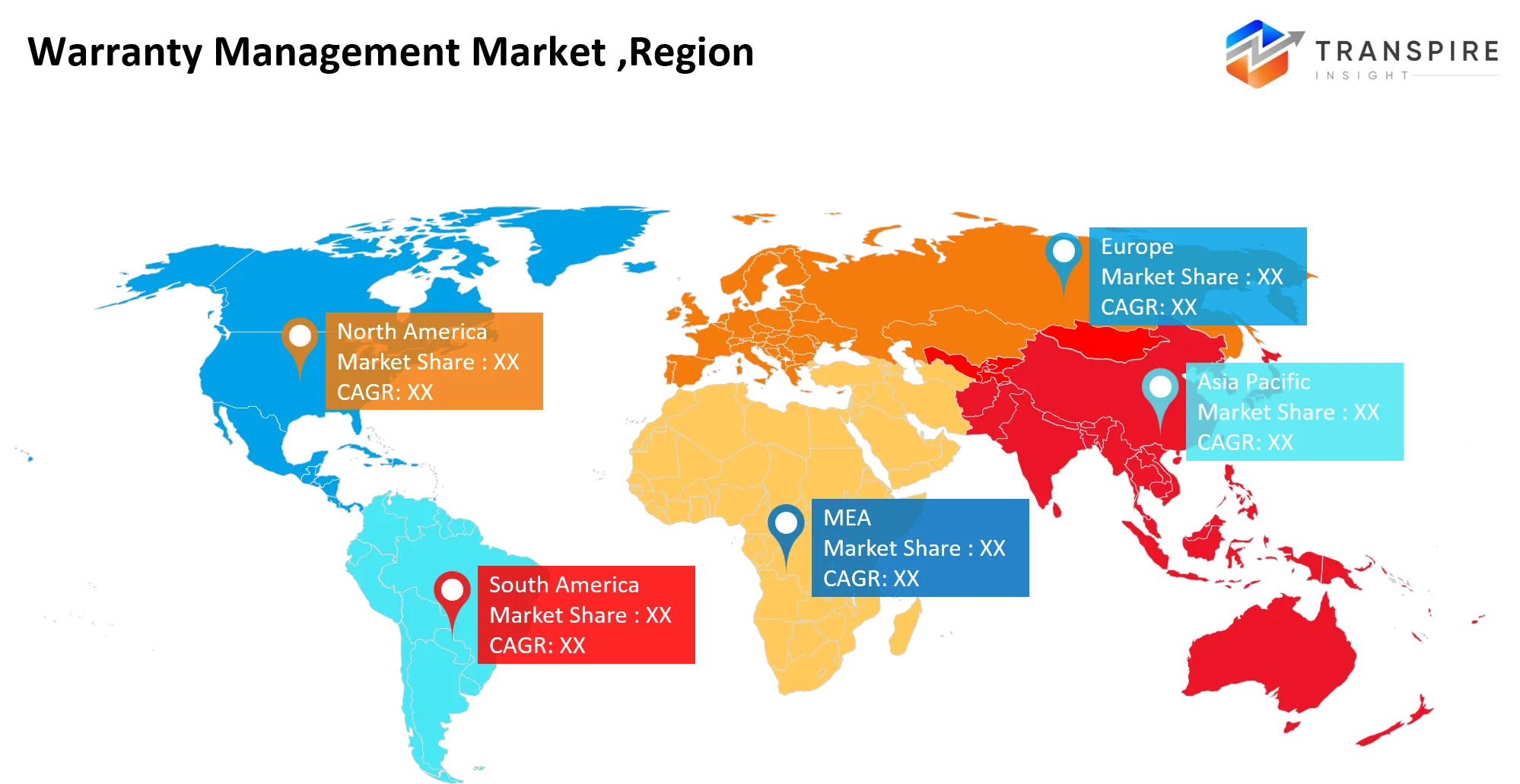
North America dominance of the warranty management market accounts 38.70% of regional shares of the market supplied. Its dominance has been built on a strong infrastructure of software, established OEMs/dealers networks, and large investments in interconnected after-sales services. There is an increasing trend among manufacturing/service providers in the region to adopt digital tools as the means of unifying claims process, monitoring warranty costs, and recovering suppliers’ money. Thus, high demand for warranty management in the region is due to the combination of enterprise infrastructure and high customer expectations for rapid services.
In June 2026, Salesforce released AI Warranty Claims Assistance, which would enable manufacturers and dealerships to automate the checking of warranty eligibility, claim status, and claim processing. This shows how the region is progressing in incorporating AI technology into its warranty management and after-sales services.
https://www.salesforce.com/in/news/stories/summer-2026-product-release-announcement
Europe
Europe represents 29.00% of the market and still represents the second-largest regional market contributor to the market. Europe has a well-developed manufacturing industry, service network and puts emphasis on product quality and lifecycle management. However, compared with the region of North America, Europe’s adoption has much stronger influences from cross-border processes.
In February 2026, SAP upgraded its Warranty Claim Processing capability in SAP S/4HANA 2025 FPS01, providing automated warranty processing, customer claims, and supplier refunds. It shows the ongoing trend towards digitisation of warranty processes in manufacturing and automotive sectors in Europe.
Asia-Pacific
Asia-Pacific constitutes 22.00% of the overall market share and is expected to grow at the fastest pace with 13.10% CAGR in the provided framework. Growth in the manufacturing, electronics, automobiles, and digitised services sector in recent years has created a requirement for scalable warranty management. Firms have begun searching for cloud-based platforms that would allow them to cater to their expanding dealer base without having to invest heavily in an on-premises infrastructure.
In December 2025, Asurion Japan K.K. and Kansai Electric Power Co., Inc. launched a digital device assurance service, which would cover smartphones, PCs, and home digital devices, with all services being handled under one support package.
https://www.asurion.jp/english/newsroom/asurion-japan-k-k-teams_kepco_newservice_20251202
Who are the Key Players in the Warranty Management Market and how do they compete?
In the warranty management market, competition is determined by automation, integration, analytics, and linking warranty data with service operations. Competitors differentiate themselves through their ability to serve manufacturing requirements and expand cloud capabilities. Syncron's key selling points include warranty workflow from end to end, claims automation, supplier recovery, and connected aftermarket services with the help of integrations like Syncron integration with TrueContext. PTC differentiates itself through warranty and contract management tied to service operations with claims, returns, supplier recovery, warranty analytics, and closed-loop product improvement. Oracle positions itself through an enterprise platform approach with supplier warranty capabilities built into Fusion Cloud Maintenance and extended API-based coverage management. Differentiation lies in connecting warranty management decisions with asset, maintenance, and work order processes.SAP has the advantage of its wider enterprise ecosystem, while specialists compete through fast deployment, customizable workflows, and proprietary protection programs. Expansion is heading towards connected platforms rather than standalone claim systems.
Warranty Management Market companies
- IBM
- Oracle
- SAP
- Pegasystems
- ServiceNow
- Tavant
- PTC
- Infosys
- Wipr
- Accenture
- Tata Consultancy Services
- Capgemini
- Salesforce
- SAS
- Genpact
Recent Development News
In July 2026, SureBright introduced SureBright Anywhere. The software provides consumers the opportunity to purchase coverage for their eligible items purchased from Amazon, Walmart, and over 1,000 additional retailers. AI technology analyses product details from receipts and helps extend warranty coverage beyond the point of sale.
In June 2025, Mulberry partnered with Appliance.io for the roll-out of an integrated product protection program. This API-based integration auto-enrols warranties on delivery of appliances, and it was found that participation in this program resulted in an increase of 80% in protection plan sales and 132% in warranty sales among the participating dealers.
https://www.getmulberry.com/press
What Strategic Insights Define the Future of the Warranty Management Market?
The future of warranty management globally involves the use of connected, cloud-oriented platforms in which the claims, service, contract, supplier recovery, and customer information are generated on a shared database. The provided segmentations support this trend: software, cloud-based warranty management is the fastest-growing segment. Future competitive advantage will be less about digitising claims and more about leveraging warranty information to make decisions regarding product quality, service costs, inventories, and customer relationships. One of the hidden risks is the problem of bad data quality. AI and analytics will provide biased insights if claims, product information, and service information from the past have low quality. The emerging opportunities include leveraging cloud workflow with AI-supported validation, prediction of failures, and mobile field data capture. Providers should focus on integrations, rules, data governance, and manual verification of complicated claims. Manufacturers should look for scalable solutions for their dealers and suppliers with improved claim processing, recovery, and service profitability.
Warranty Type
- Standard Warranty
- Extended Warranty
- Service Contracts
- Product Warranty
- Parts Warranty
- Labor Warranty
- Comprehensive Warranty
Component
- Software
- Hardware
- Services
- Analytics
- Integration
- Support
- Consulting
Deployment
- Cloud
- On-Premise
- Hybrid
- SaaS
- Private Cloud
- Public Cloud
- Hosted
End User
- Automotive
- Consumer Electronics
- Industrial Equipment
- Aerospace
- Healthcare
- Appliances
- Retail
Organization Size
- Large Enterprises
- SMEs
- OEMs
- Dealers
- Distributors
- Service Providers
- Manufacturers
Application
- Warranty Claims
- Warranty Administration
- Contract Management
- Fraud Detection
- Product Registration
- Analytics
- Customer Service
Frequently Asked Questions
Find quick answers to common questions.
The warranty management market size was valued at USD 5.78 billion in 2025 and is poised to reach USD 20.42 billion by 2033, expanding at a 17.33% CAGR
Key segments for the warranty management market are Warranty Type (Standard Warranty, Extended Warranty, Service Contracts, Product Warranty, Parts Warranty, Labor Warranty, Comprehensive Warranty); Component (Software, Hardware, Services, Analytics, Integration, Support, Consulting); Deployment (Cloud, On-Premise, Hybrid, SaaS, Private Cloud, Public Cloud, Hosted); End User (Automotive, Consumer Electronics, Industrial Equipment, Aerospace, Healthcare, Appliances, Retail); Organization Size (Large Enterprises, SMEs, OEMs, Dealers, Distributors, Service Providers, Manufacturers); Application (Warranty Claims, Warranty Administration, Contract Management, Fraud Detection, Product Registration, Analytics, Customer Service)
Growth is primarily driven by increased demand for automated warranty processing, use of cloud-based warranty solutions, increased sales of goods, and the necessity to cut costs associated with warranties and fraud.
The market is led by major manufacturers including IBM, Oracle, SAP, Pegasystems, ServiceNow, Tavant, PTC, Infosys, Wipro, Accenture, Tata Consultancy Services, Capgemini, Salesforce, SAS, Genpact
North America accounts for 38.70% of the worldwide warranty management market due to its flourishing automotive and consumer electronics industry, digital warranty systems, robust service network, and extensive use of automated claims and warranty analytics.
Opportunities associated with commercial use in the warranty management market include the use of AI-powered claim processing, cloud computing solutions, predictive warranty analysis, product monitoring, and tailored solutions for automakers, electronics companies, and industrial machinery manufacturers.
- IBM
- Oracle
- SAP
- Pegasystems
- ServiceNow
- Tavant
- PTC
- Infosys
- Wipr
- Accenture
- Tata Consultancy Services
- Capgemini
- Salesforce
- SAS
- Genpact
About the Authors

Mayur Shinde
I am Mayur Shinde, a Senior Research Analyst at Transpire Insight, specializing in the Automotive & Transportation and Information & Communication Technology (ICT) Industry. My work focuses on analyzing emerging market trends, technological advancements, competitive landscapes, and industry developments to deliver accurate, data-driven insights. I am passionate about transforming complex market information into clear, actionable content that helps businesses, professionals, and decision-makers stay informed and make confident strategic decisions.

Chakradhar Khansole
Chakradhar serves as the Research Director at Transpire Insight, bringing over 8 years of experience in technology, innovation, and strategic market intelligence. He specializes in transforming complex market data into actionable business insights that enable organizations to make informed, growth-oriented decisions. Recognized for his strategic vision and analytical expertise, Chakradhar leads high-impact research initiatives, delivering comprehensive market assessments, competitive intelligence, and forward-looking industry analysis.
Recently Published Reports
-
Apr 2026
3D Optical Profiler Market
3D Optical Profiler Market Size, Share & Analysis Report By Type (Desktop 3D Optical Profiler, and Portable 3D Optical Profiler), By Technology (Confocal Technology, and White Light Interference), By End-Use Industry (Manufacturing, Research Institutions, Automotive, Aerospace and Defense, Medical Devices, and Other), and Geography (North America, Europe, Asia-Pacific, Middle East and Africa, South and Central America), 2021 - 2031
-
Apr 2026
Depth Sensor Market
Depth Sensor Market Size, Share & Analysis Report By Type (Infrared Depth Sensors, Time-of-Flight (ToF) Sensors, Stereo Vision Sensors, Structured Light Sensors, Ultrasonic Depth Sensors), By Application (Automotive, Robotics, Gaming, Consumer Electronics, Industrial Automation, Healthcare, Security & Surveillance, Others), By End Users (Automotive Manufacturers, Consumer Electronics Companies, Healthcare Providers, Industrial Companies, Security Agencies, Gaming Companies, Robotics Companies, Others), and Geography (North America, Europe, Asia-Pacific, Middle East and Africa, South and Central America), 2021 – 2031
-
Apr 2026
Digital Manufacturing Market
Digital Manufacturing Market Size, Share & Analysis Report By Component (Hardware, Software, and Services), By Technology (Robotics, 3D Printing, Internet of Things (IoT), and Others), By Application (Automotive and Transportation, Aerospace and Defense, Consumer Electronics, Industrial Machinery, and Others), By Process Type (Computer-Based Designing, Computer-Based Simulation, Computer 3D Visualization, Analytics, and Others), and Geography (North America, Europe, Asia-Pacific, Middle East and Africa, South and Central America), 2021 – 2031
-
Apr 2026
Digital Visa Services Market
Digital Visa Services Market Size, Share & Analysis Report By Type (Individual Travelers, Group Travelers), By Application (Tourism, Business Travel, Others), and Geography (North America, Europe, Asia-Pacific, Middle East and Africa, South and Central America), 2021 – 2031