
Germany Process Mining Software Market Summary
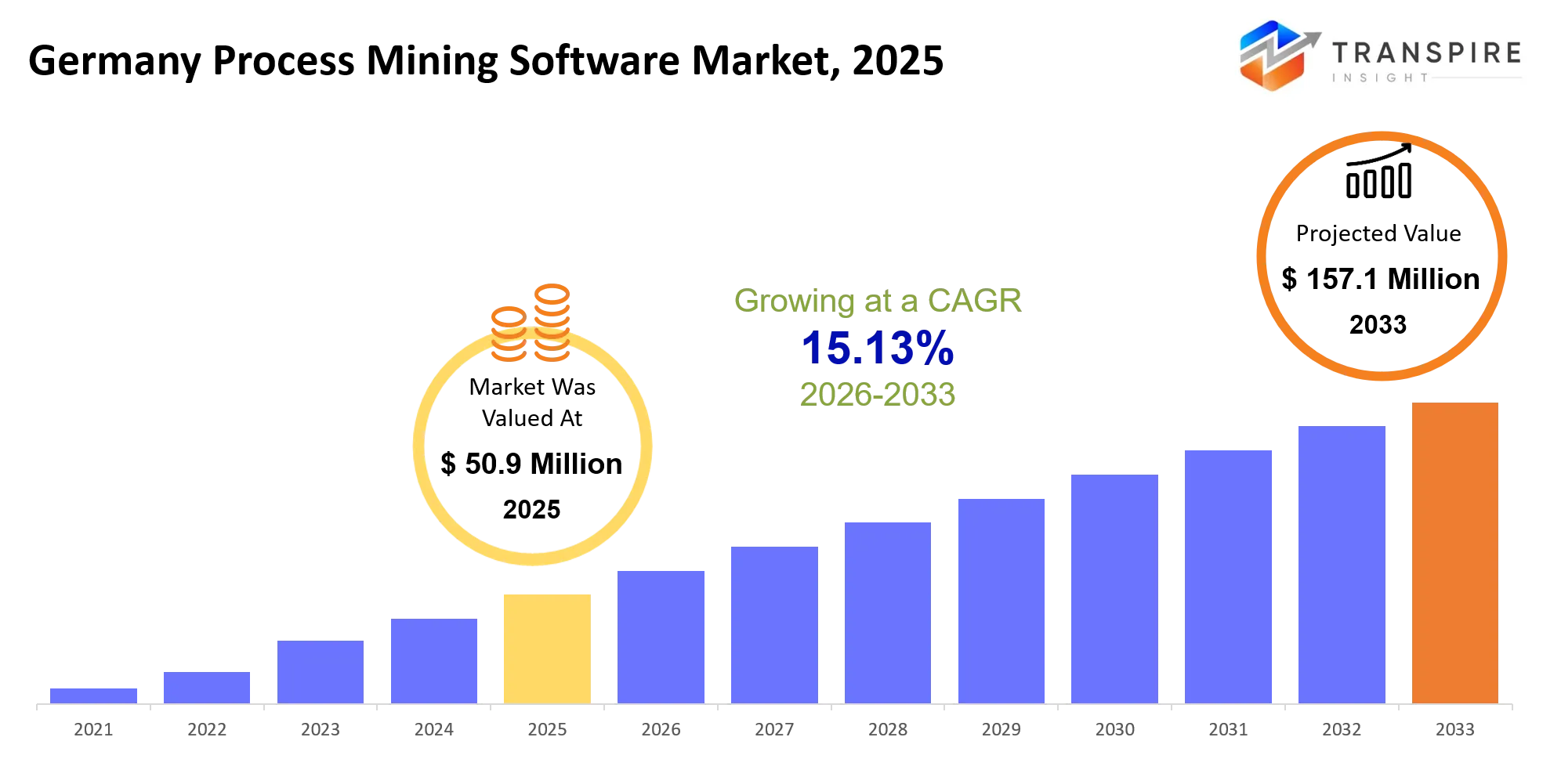
As per Transpire Insight Analysis theGermany Process Mining Software Market size is estimated at USD 50.9 Million in 2025 and is anticipated to reach USD 157.1 Million by 2033, growing at a CAGR of 15.13% from 2026 to 2033.
Germany’s process mining software market kind of helps organizations dig up inefficiencies that are hiding inside their enterprise workflows, by looking at digital event logs that show up from ERP, CRM, and supply chain systems. In real life, manufacturers, automotive companies, financial institutions, and logistics providers use these platforms to spot process slowdowns, lower operational expenses, reinforce compliance, and push faster digital transformation programs. Over the last five years, the whole market has moved away from only looking back at processes toward continuous process intelligence , with cloud deployment and AI guided suggestions becoming more normal. That shift got a lot stronger after the COVID-19 period, when weaknesses in production scheduling, procurement, and the global supply network became easier to see, so many German enterprises started working on better operational visibility.
Now, as companies link process mining with automation frameworks and other enterprise applications, the uptake of the software has moved past just huge corporations into mid sized businesses too. This wider usage is improving day to day output, supporting compliance with tighter governance rules, and it keeps generating ongoing revenue from both software licensing and related services throughout Germany.
Germany Process Mining Software Market Size & Forecast:
- Germany Process Mining Software Market Size 2025: USD 50.9 Million
- Expected Market Value 2033: USD 157.1 Million
- Forecast CAGR: 15.13%
- Leading region in 2025:
- Fastest Growing region:
- Key Profile: BMW Motorrad, Garmin, Continental AG, Bosch, Panasonic Automotive, DigiLens, Ride Vision, EyeLights, Sena Technologies, Nuviz, HUDWAY, Yamaha Motor, Honda Motor, Kawasaki Heavy Industries, Ducati
Key Market Insights
- Germany process mining software market hit USD 50.9 million in 2025, and it should start moving toward USD 157.1 million by 2033. This really shows solid enterprise software spending, even if some teams are pacing purchases slower than expected.
- Southern Germany was the leading region with about 38% market share during 2025, mainly because automotive manufacturing clusters stayed active, plus Industry 4.0 rollouts. Eastern Germany meanwhile, is the quickest mover through 2033 , with digital manufacturing budgets rising and broader technology modernization efforts
- Cloud based process mining platforms took roughly 62% of the market in 2025. Hybrid deployments stayed the next biggest segment, and AI powered analytics is still the fastest-growing part.
- By application, manufacturing use cases grabbed nearly 41% market share in 2025. Financial services also leaned in early, and it’s showing the quickest enterprise uptake, especially where compliance automation is involved.
- When we look at customers, large enterprises account for around 68% of market revenue. Yet mid-sized industrial companies are expected to show the strongest adoption across the forecast window.
- Celonis, SAP Signavio, Microsoft, IBM, ABBYY, and UiPath keep strengthening their positions, using AI powered analytics, workflow automation, and cloud partnerships that are a bit more strategic than before.
- Vendors are also blending process mining with ERP systems, RPA tooling, and business intelligence suites, so teams get continuous monitoring instead of waiting for periodic operational reviews. And AI enabled predictive process recommendations have apparently cut manual process analysis time by around 30–50% in multiple enterprise deployments.
- Subscription oriented SaaS licensing, plus scalable cloud infrastructure, continues lowering the entry threshold and that’s helping adoption across Germany’s Mittelstand manufacturers, gradually but consistently.
What are the Key Drivers, Restraints, and Opportunities in theGermany Process Mining Software Market?
Germany's accelerated industrial digitalization, and the Industry 4.0 efforts, are still the strongest momentum behind the Process Mining Software Market. Producers are more and more linking ERP, MES, and supply chain systems, trying to get an end-to-end operational view that is also meant to cut down production lags and compliance hazards. At the same time, SAP S/4HANA migration waves have pushed many organizations to rethink , and then optimize business processes before they start modernization initiatives. Since companies are chasing tangible efficiency improvements and quicker decisions, process mining platforms are no longer “just tools”, they are strategic investments that lift operational results while driving ongoing software, and consulting income.
Still, the biggest structural friction is enterprise integration, which is kinda complex. Many organizations keep running legacy ERP environments , they store data in different silos , and they rely on customized workflows, so the process mining part needs a lot of data prep before it can spit out anything trustworthy or useful. This kind of complexity tends to push implementation budgets up, stretches the rollout timelines, and it often reduces adoption because small and medium-sized businesses have limited IT bandwidth. Then those delays weaken near-term software revenue , plus they slow down the wider rollout across the enterprise.
Looking ahead, the strongest opportunity seems to be in combining process mining with generative AI, intelligent automation, and digital twins German manufacturers are funding predictive operational intelligence that can suggest workflow refinements on its own, not merely point out inefficiencies in hindsight. And as cloud adoption continues to spread through industrial firms and mid-sized producers, integrated AI-based process intelligence platforms are likely to open up new subscription revenue streams, while also enabling autonomous business
What Has the Impact of Artificial Intelligence Been on theGermany Process Mining Software Market?
Artificial intelligence has sort of shifted process mining software , from being just a diagnostic instrument into something closer to an intelligent platform for day-to-day operational optimization. Basically, AI algorithms automatically sift through millions of event records that come from ERP, CRM, procurement, production, and logistics systems, and then they spot process deviations, compliance risks, and operational bottlenecks… without needing a ton of manual digging. On top of that, machine learning models can foresee process delays, procurement disruptions, and production inefficiencies before they start hurting business performance, so organizations can step in earlier rather than later. There are also advanced analytics that suggest workflow redesigns, handle root-cause analysis in an automated way, and rank improvement ideas based on the expected financial effect.
Because of these features, many German manufacturers and service organizations have managed to cut process cycle times, strengthen operational compliance, raise automation rates, and use resources more wisely. And when you connect this setup with robotic process automation, repetitive administrative tasks can run automatically once AI has identified the right workflows that fit. AI-driven process intelligence also supports ERP transformation initiatives, by checking or validating redesigned business processes before they actually go live. Still, broad adoption isn’t fully smooth, since enterprise data usually sits across separated legacy systems with uneven quality. The high integration costs, the lack of standardized event data, and those complicated IT landscapes can lower AI model accuracy during early rollout phases, which often ends up stretching implementation timelines and pushing up project spending, even though the technology should pay off in the long run operationally.
Key Market Trends
- Cloud native deployments went up from less than 40% in 2020 to over 60% by 2025, which kinda helped teams roll out changes quicker and keep infrastructure costs lower.
- AI powered process suggestions have mostly swapped out traditional fixed dashboards , so instead of doing manual process reviews enterprises can aim for workflow optimization that runs almost by itself.
- SAP Signavio, Celonis, Microsoft, IBM, and UiPath added more AI hooks between 2023 and 2025, this kind of strengthened the whole enterprise automation scene.
- Manufacturing firms moved away from single, isolated process improvement initiatives, and leaned into continuous operational watching , in a lot of deployments this trimmed process bottlenecks by about 20–40%.
- German Mittelstand companies started using subscription based SaaS platforms more and more, after cloud security controls and stronger enterprise compliance features improved, quite notably.
- ERP modernization efforts also pushed process mining forward, because organizations tended to map and tune workflows first before migrating to next generation enterprise platforms.
- For financial institutions, process mining became wider than just “keeping things efficient”, it was also used for regulatory compliance, fraud detection, and refining the customer journey.
- Vendors increasingly mix process mining with robotic process automation plus predictive analytics, so the result is more autonomous workflow optimization, like an orchestration layer.
- Strategic alliances between enterprise software vendors and cloud providers shortened deployment times while also boosting scalability for multi site industrial operations.
- And then sustainability reporting, plus ESG compliance requirements , made many orgs pay attention to resource hungry business processes using data driven operational intelligence.
Germany Process Mining Software Market Segmentation
By Product Type
Helmet-Mounted HUD: Helmet mounted HUD solutions keep a solid foothold, mostly because direct visibility lets riders catch critical riding info , without having to shift focus away from the road. Compact displays help with navigation cues, speed readouts, and safety alerts while also keeping riding comfort steady for everyday commutes and long rides. Their strong fit with premium motorcycles has helped broaden commercial take-up across Germany , in a pretty noticeable way.
Windshield HUD, Smart Visor HUD, AR HUD, Bluetooth HUD, Projection HUD, and Others: Windshield HUD systems give a stable display zone for touring motorcycles, while Smart Visor HUD offerings lean into comfort with integrated visual data. AR HUD tech helps route guidance feel more intuitive by placing digital notes inside the rider’s field of view , almost like it belongs there. Bluetooth HUD solutions make smartphone linking easier for calls and navigation, which reduces friction day to day. Projection HUD products keep pushing for better readability across varying light conditions, and the other specialized categories handle more niche needs plus customized setups, depending on how the rider wants it arranged.
By Technology
Augmented Reality, LCD HUD, OLED HUD, Waveguide HUD, AI-Based HUD, Voice-Control HUD, and Others: kind of. Augmented Reality tech supports interactive navigation and hazard visualization so riding assistance becomes more practical, especially during complex road conditions. LCD HUD solutions still stay a pretty cost-effective option for entry-level needs, while OLED HUD technology gives brighter visuals, better color quality, and also lower power consumption for premium motorcycles. Waveguide displays shrink the hardware footprint without reducing visibility, AI-Based HUD systems give smarter riding recommendations using data analysis, and Voice-Control HUD technology enables hands free operation for added convenience. Other newer display ideas keep improving performance, connectivity, and the overall user experience across different motorcycle categories.
By Motorcycle Type
Sports bikes, Touring motorcycles, Cruiser motorcycles, Adventure bikes, Electric motorcycles, Scooters and Others all kind of blend together, but the split still matters. Sports bikes take a big portion of attention because performance oriented riders really want real-time riding data while they are moving fast, and they tend to care about what’s happening right now. Touring motorcycles also stay in a major role, mainly since route prompts, distance readouts, and rider comfort must stay consistent on those long stretches. Cruiser motorcycles, meanwhile, get a boost from built in display systems that keep things handy, and somehow still let the classic look stay pretty much intact.
Adventure bikes keep moving toward advanced display tech for off-road wayfinding and for reading the changing surface conditions. Electric motorcycles lean into digital cockpit integration which pairs well with connected mobility features, so it feels more like one system. Scooters are starting to add smaller HUD type solutions for inner city commuting, you know the kind that doesn’t take over the whole dash. And the remaining motorcycle groups still manage to open doors through tailored display setups and specific specialty uses, sort of niche but effective.
By Application
Navigation assistance, rider safety, speed monitoring, call & notification display, vehicle diagnostics, entertainment, and others all show up as the core suite… Navigation assistance still sits at the top, because good, accurate route guidance can make a trip smoother and faster, plus it helps reduce distractions while you’re riding, which is a big deal. Rider safety features cover collision alerts, blind-spot notifications, and various warning indicators, all of that supports smarter choices on busy roads.
Speed monitoring also helps riders stay aligned with regulatory rules, and it promotes safer vehicle handling in general. Call and notification display tools make communication easier, but they avoid that direct smartphone interaction you might otherwise need during travel. Vehicle diagnostics then add maintenance insight, so servicing can happen on time, and overall vehicle reliability improves. Entertainment options round things out for longer rides, using connected media functions for that extra comfort. Other applications keep growing too, especially as software integration gets more sophisticated.
By End User
Individual riders, Motorcycle OEMs, Fleet Operators, Police & Defense, Racing Teams, and Others: individual riders show up as the biggest customer group, largely because personal safety, navigation convenience, and those connected riding experiences stay the main buying reasons. Motorcycle OEMs, on the other hand, roll out HUD technology across their premium models so they can stand apart in the market and also lift perceived customer value, which matters. Fleet operators likewise see practical advantages, especially from better navigation support, and also through rider monitoring , in a more continuous way.
Police and defense organizations can get quick access to operational information when there’s an emergency response need . Racing teams use advanced display tech to keep an eye on performance measurements during races, meanwhile other end users keep moving toward specialized solutions for learning sessions, commercial operations, and customized mobility uses.
By Sales Channel
OEM , Aftermarket , Online Retail, Specialty Stores, Dealers, and Others: The OEM sales channel stays in front , mostly because factory-installed HUD systems offer smoother integration, solid warranty backing and a better fit with the vehicle lineup. Aftermarket items still pull in a lot of the same motorcycle owners who want a technology upgrade without going through the hassle of buying a brand-new bike . Online retail helps people find products faster, since there is a broader lineup across models and price competitiveness is usually higher.
Specialty stores give practical technical guidance and also handle professional installation services, this kind of support tends to make customers more confident before they commit. Dealers help drive adoption too through bundled vehicle packages and financing offers, whereas other routes widen coverage by working with regional distributors, commercial buyers, and smaller motorcycle communities that are focused on specific riding styles.
What are the Key Use Cases Driving theGermany Process Mining Software Market?
Manufacturing still seems like the main use case, because process mining software basically spots production bottlenecks, those workflow delays and resource inefficiencies, just from operational event data . Automotive manufacturers, industrial equipment producers and electronics companies then use what they find to shorten production cycles , raise quality, and support their digital transformation initiatives.
Lately financial institutions and healthcare organizations are also jumping into process intelligence platforms, to tighten compliance , strengthen customer service workflows , and cut down on processing delays. At the same time logistics providers apply process analysis to fine tune warehouse operations, transportation planning, and overall supply chain performance across those complicated distribution networks.
And there are newer, kinda emerging scenarios like sustainability reporting, ESG performance monitoring , and even AI-supported process optimization. Digital twin integration together with predictive business process management will probably open up more chances too, especially as German enterprises extend cloud based operations, and roll out intelligent automation across multiple business functions.
|
Report Metrics |
Details |
|
Market size value in 2025 |
USD 50.9 Million |
|
Market size value in 2026 |
USD 58.6 Million |
|
Revenue forecast in 2033 |
USD 157.1 Million |
|
Growth rate |
CAGR of 15.13% from 2026 to 2033 |
|
Base year |
2025 |
|
Historical data |
2021 - 2024 |
|
Forecast period |
2026 - 2033 |
|
Report coverage |
Revenue forecast, competitive landscape, growth factors, and trends |
|
Regional scope |
Germany |
|
Key company profiled |
BMW Motorrad, Garmin, Continental AG, Bosch, Panasonic Automotive, DigiLens, Ride Vision, EyeLights, Sena Technologies, Nuviz, HUDWAY, Yamaha Motor, Honda Motor, Kawasaki Heavy Industries, Ducati |
|
Customization scope |
Free report customization (country, regional & segment scope). Avail customized purchase options to meet your exact research needs. |
|
Report Segmentation |
By Product Type (Helmet-Mounted HUD, Windshield HUD, Smart Visor HUD, AR HUD, Bluetooth HUD, Projection HUD, Others); By Technology (Augmented Reality, LCD HUD, OLED HUD, Waveguide HUD, AI-Based HUD, Voice-Control HUD, Others); By Motorcycle Type (Sports Bikes, Touring Motorcycles, Cruiser Motorcycles, Adventure Bikes, Electric Motorcycles, Scooters, Others); By Application (Navigation Assistance, Rider Safety, Speed Monitoring, Call & Notification Display, Vehicle Diagnostics, Entertainment, Others); By End User (Individual Riders, Motorcycle OEMs, Fleet Operators, Police & Defense, Racing Teams, Others); By Sales Channel (OEM, Aftermarket, Online Retail, Specialty Stores, Dealers, Others) |
Which Regions are Driving theGermany Process Mining Software Market Growth?
Southern Germany is still the leading regional market , kinda stays that way cloud-based because the region has a dense cluster of auto makers, industrial equipment producers, and advanced manufacturing sites that keep pushing digital transformation . Bavaria and Baden-Württemberg really lean into Industry 4.0, they also show strong SAP adoption, and there’s this close cooperation between software developers, research institutes and industrial companies. On top of that, federal and state programs for digital manufacturing have basically nudged firms to refresh their workflows, and use data-driven operational intelligence more consistently. Because this tech environment is already pretty mature , it keeps generating repeat money from software licensing, consulting, and managed services .
Western Germany meanwhile becomes the second-largest contributor, but the momentum looks different . It’s more tied to financial services , logistics, chemicals , and the big enterprise headquarters. North Rhine-Westphalia and Hesse benefit from broader economic activity so software spending is less locked to one industrial niche. Companies across banking, insurance, retail, and logistics keep expanding process intelligence platforms, aiming for better compliance, improved operational efficiency, and broader enterprise-wide automation. Corporate tech budgets stay steady, plus the cloud migration programs stay on track , so the region keeps acting like a dependable source for revenue over the long run.
Eastern Germany is forecast to post the fastest growth between 2026 and 2033. The reason is pretty straightforward , manufacturing modernization and digital investment are ramping up across newer industrial strongholds.
Who are the Key Players in theGermany Process Mining Software Market and How Do They Compete?
Competition stays moderately concentrated since, on top of global motorcycle tech suppliers, there are specialist smart display developers also in the mix. In practice, technology innovation becomes the main fuel of competition, and businesses tend to set themselves apart less by price ,and more by things like augmented reality visualization, connectivity options, rider safety functions, display quality, and software integration. Meanwhile, the well-known motorcycle manufacturers are more and more blending connected vehicle ecosystems with advanced rider assistance, and the more specialized technology firms usually lean toward compact optical systems plus software capabilities.
BMW Motorrad, for example, differentiates by getting ConnectedRide products , motorcycles, and mobile applications to feel like one continuous system, so the riding experience is unified in a way that is hard for aftermarket rivals to imitate. Garmin leans heavily on navigation know-how, rugged hardware, and updated mapping capabilities aimed at touring and adventure riders, and it keeps broadening connected navigation features over time. Bosch, meanwhile, reinforces its stance by bundling rider-assistance electronics, sensors, and software into integrated safety solutions that are meant to support future intelligent motorcycle platforms.
Continental AG places extra weight on advanced human-machine interface technologies and digital cockpit development, combining connectivity with safety-related functions for OEM customers. DigiLens concentrates on waveguide optics and lightweight augmented reality displays, which in turn allow for compact head-up display design choices in upcoming motorcycle use cases. Overall, these firms keep pushing forward via technology partnerships, software development, connected mobility investments, and deeper integration with next-generation motorcycle platforms, all of which should improve both rider safety and digital experiences.
Company List
- BMW Motorrad• Garmin
• Continental AG
• Bosch
• Panasonic Automotive
• DigiLens
• Ride Vision
• EyeLights
• Sena Technologies
•Nuviz
• HUDWAY
• Yamaha Motor
• Honda Motor
• Kawasaki Heavy Industries
• Ducati
Recent Development News
In February 2026, Garmin launched the zūmo XT3 motorcycle GPS platform. The new navigation device added live lean-angle measurement, expanded mapping capabilities, and improved connected riding features, strengthening Garmin's position in premium motorcycle electronics.
In Summer 2025, BMW Motorrad introduced new ConnectedRide COM P1 GS communication products integrated with the new GS Rallye helmet range. The launch expanded BMW's connected riding ecosystem and enhanced compatibility across premium motorcycle equipment.
In 2026, BMW Motorrad expanded availability of the ConnectedRide COM P1 System 8 for System 8 helmet variants. The integrated communication solution improved navigation, connectivity, and rider communication through seamless interaction with the ConnectedRide ecosystem
What Strategic Insights Define the Future of theGermany Process Mining Software Market?
The Germany Process Mining Software Market is set to drift toward continuous process intelligence, not just that periodic, business process analysis, during the next five to seven years. In a way it kind of sounds obvious, but still, artificial intelligence plus cloud-native platforms and enterprise automation will pull the transition forward, letting organizations tune up workflows in real time rather than just wait and react after the inefficiencies show up.
There’s also a less obvious risk, like a quietly growing dependence on a narrow set of enterprise platform ecosystems, which could raise integration costs, and maybe even cut down flexibility for customers. Still, a real opportunity is likely to pop up when process mining is paired with digital twins and generative AI, enabling more autonomous business optimization across manufacturing and supply chain operations.
Market participants should, ideally, push for open integration architectures, plus industry focused AI models, because enterprises are increasingly looking for platforms that link up with their existing ERP, automation, and analytics setups, and do it in a way that actually proves operational improvements, not only promises them.
Germany Process Mining Software Market Report Segmentation
By Product Type
• Helmet-Mounted HUD
• Windshield HUD
• Smart Visor HUD
• AR HUD
• Bluetooth HUD
• Projection HUD
• Others
By Technology
• Augmented Reality
• LCD HUD
• OLED HUD
• Waveguide HUD
• AI-Based HUD
• Voice-Control HUD
• Others
By Motorcycle Type
• Sports Bikes
• Touring Motorcycles
• Cruiser Motorcycles
• Adventure Bikes
• Electric Motorcycles
• Scooters
• Others
By Application
• Navigation Assistance
• Rider Safety
• Speed Monitoring
• Call & Notification Display
• Vehicle Diagnostics
• Entertainment
• Others
By End User
• Individual Riders
• Motorcycle OEMs
• Fleet Operators
• Police & Defense
• Racing Teams
• Others
By Sales Channel
• OEM
• Aftermarket
• Online Retail
• Specialty Stores
• Dealers
• Others
Frequently Asked Questions
Find quick answers to common questions.
The expectedGermany Process Mining Software Market size for the market will be USD 3032.7 Million in 2033.
Key segments for the Germany Process Mining Software Market are By Component (Software, Consulting Services, Implementation Services, Support & Maintenance, Training Services, Managed Services, Others); By Deployment (Cloud-Based, On-Premise, Hybrid, SaaS, Private Cloud, Public Cloud, Others); By Application (Business Process Optimization, Compliance Management, Digital Transformation, Operational Intelligence, Customer Journey Analysis, Process Automation, Others); By End User (BFSI, Manufacturing, Healthcare, Retail, IT & Telecom, Government, Logistics, Others); By Enterprise Size (Large Enterprises, Medium Enterprises, Small Enterprises, SMEs, Others)
MajorGermany Process Mining Software Market players are Celonis, SAP Signavio, Microsoft, IBM, Software AG, UiPath, ABBYY, Apromore, QPR Software, Minit, ARIS, Fluxicon, Pegasystems, Kofax, MEHRWERK
the Germany Process Mining Software Market size is USD 846.4 Million in 2025.
the Germany Process Mining Software Market CAGR is 17.30% from 2026 to 2033
- BMW Motorrad• Garmin
• Continental AG
• Bosch
• Panasonic Automotive
• DigiLens
• Ride Vision
• EyeLights
• Sena Technologies
•Nuviz
• HUDWAY
• Yamaha Motor
• Honda Motor
• Kawasaki Heavy Industries
• Ducati
About the Authors

Mayur Shinde
I am Mayur Shinde, a Senior Research Analyst at Transpire Insight, specializing in the Automotive & Transportation and Information & Communication Technology (ICT) Industry. My work focuses on analyzing emerging market trends, technological advancements, competitive landscapes, and industry developments to deliver accurate, data-driven insights. I am passionate about transforming complex market information into clear, actionable content that helps businesses, professionals, and decision-makers stay informed and make confident strategic decisions.

Chakradhar Khansole
Chakradhar serves as the Research Director at Transpire Insight, bringing over 8 years of experience in technology, innovation, and strategic market intelligence. He specializes in transforming complex market data into actionable business insights that enable organizations to make informed, growth-oriented decisions. Recognized for his strategic vision and analytical expertise, Chakradhar leads high-impact research initiatives, delivering comprehensive market assessments, competitive intelligence, and forward-looking industry analysis.
Recently Published Reports
-
Apr 2026
3D Optical Profiler Market
3D Optical Profiler Market Size, Share & Analysis Report By Type (Desktop 3D Optical Profiler, and Portable 3D Optical Profiler), By Technology (Confocal Technology, and White Light Interference), By End-Use Industry (Manufacturing, Research Institutions, Automotive, Aerospace and Defense, Medical Devices, and Other), and Geography (North America, Europe, Asia-Pacific, Middle East and Africa, South and Central America), 2021 - 2031
-
Apr 2026
Depth Sensor Market
Depth Sensor Market Size, Share & Analysis Report By Type (Infrared Depth Sensors, Time-of-Flight (ToF) Sensors, Stereo Vision Sensors, Structured Light Sensors, Ultrasonic Depth Sensors), By Application (Automotive, Robotics, Gaming, Consumer Electronics, Industrial Automation, Healthcare, Security & Surveillance, Others), By End Users (Automotive Manufacturers, Consumer Electronics Companies, Healthcare Providers, Industrial Companies, Security Agencies, Gaming Companies, Robotics Companies, Others), and Geography (North America, Europe, Asia-Pacific, Middle East and Africa, South and Central America), 2021 – 2031
-
Apr 2026
Digital Manufacturing Market
Digital Manufacturing Market Size, Share & Analysis Report By Component (Hardware, Software, and Services), By Technology (Robotics, 3D Printing, Internet of Things (IoT), and Others), By Application (Automotive and Transportation, Aerospace and Defense, Consumer Electronics, Industrial Machinery, and Others), By Process Type (Computer-Based Designing, Computer-Based Simulation, Computer 3D Visualization, Analytics, and Others), and Geography (North America, Europe, Asia-Pacific, Middle East and Africa, South and Central America), 2021 – 2031
-
Apr 2026
Digital Visa Services Market
Digital Visa Services Market Size, Share & Analysis Report By Type (Individual Travelers, Group Travelers), By Application (Tourism, Business Travel, Others), and Geography (North America, Europe, Asia-Pacific, Middle East and Africa, South and Central America), 2021 – 2031