
South Korea Embedded Software Market Summary:
According to Transpire Insights, a detailed research report on the market reflects that the embedded software application segment dominates the South Korea Embedded Software Market, accounting for a significant share of the total market, driven by increasing adoption across automotive, consumer electronics, industrial automation, telecommunications, and connected devices. The South Korea Embedded System Market generated approximately USD 3.58 billion in 2024 and is projected to reach approximately USD 5.32 billion by 2030, registering a 6.9% CAGR from 2025 to 2030, making embedded software a leading contributor to market development, technological innovation, intelligent device integration, advanced embedded-system production, expanding software capabilities, and overall market growth dynamics.
Market Snapshot
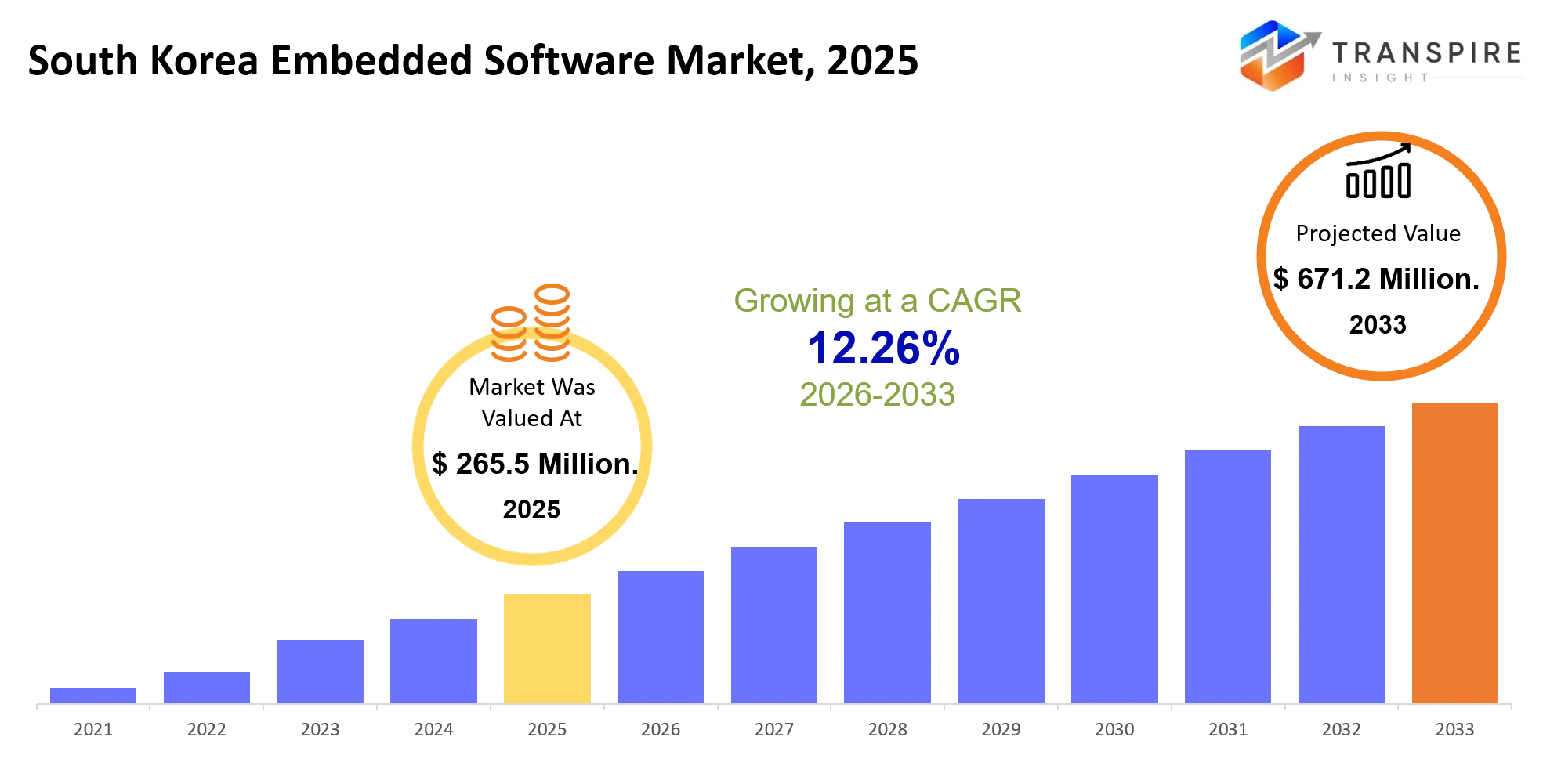
- Market Value (2025): USD 265.5 Million.
- Expected Market Value (2026): USD 298.7 Million.
- Estimated Market Value (2033): USD 671.2 Million.
- Forecast CAGR (2026–2033): 12.26%.
Introduction
The South Korea Embedded Software Market is experiencing fast-paced changes as the use of embedded computing becomes an increasingly vital component of automobiles, consumer electronics, industrial machinery, telecommunication and smart manufacturing. Embedded software is made up of specialized firmware, real-time operating system (RTOS), middleware and application software which is used to run specific hardware within performance, memory, power and real-time constraints. South Korea's high-end semiconductor and electronics ecosystem, digital infrastructure and ability to integrate hardware with software create conducive conditions for developing and using embedded software. Furthermore, Industry 4.0 trends in South Korea such as smart factories and connected technologies and innovations in the automobile sector contribute towards the growth of this market. Rising need for intelligent devices, edge computing, automation, cyber security and connected infrastructure has resulted in more secure, efficient and application-specific embedded software solutions.
Key Market Highlights: -
- By Component, the50–100 nm segmentdominated the market and holds approximately 44 % share in 2025 and is projected to grow at a substantial CAGR during the forecast period.
- By Platform, the Hardware dominated the market and holds approximately 57 % share in 2025 and is projected to grow at a substantial CAGR during the forecast period.
- By Application, the Consumer Electronics Manufacturers segment dominated the market and holds approximately 35 % share in 2025 and is projected to grow at a substantial CAGR during the forecast period.
- The embedded software sector in South Korea is developing due to the use of AI-based manufacturing, autonomous technologies, semiconductor developments, edge computing, and technology programs supported by the government.
How is Technology Driving Growth in the South Korea Embedded Software Market?
The growth of technology is helping the South Korea Embedded Software market by using the benefits of 5G, edge AI, Industry 4.0, automobiles, and semiconductors. 5G and edge computing technologies help perform real-time data analysis and provide better performance and response time for autonomous systems and logistics systems. Smart manufacturing helps integrate embedded software with robotic systems, sensors, IIoT systems, and automated manufacturing equipment to increase efficiency. In addition, connected cars and electric vehicles are driving demand for advanced automotive software.
Market Drivers
The South Korea Embedded Software Market is motivated by the fast adoption of Industry 4.0, automotive electronics, semiconductor advancements, and digitalization throughout the country. The development of smart manufacturing technologies is creating the need for embedded software capable of performing real-time monitoring, industrial IoT, robotics, automation, and AI-driven process optimization. Electric cars, connected vehicles, and ADAS are creating the need for embedded software such as RTOS, control software, and intelligent automotive systems. Investments in AI, smart factories, and modern digital infrastructure made by the government further support the adoption of technology. Moreover, the semiconductor ecosystem of South Korea is capable of integrating software into hardware for edge AI and connected devices.
Restrain
Restraints for the South Korea Embedded Software Market include high development and customization costs, lack of skilled embedded software engineers, and security issues. Compliance with data privacy and safety regulations increases the cost of development and certification of the software. Implementation of the software in existing industrial infrastructure systems will also take time. Incompatibility of hardware and software can also be a constraint to the growth of the market.
|
Driver |
Relative Impact on Growth (%) |
Geographic Relevance |
Impact Timeline |
Demand Strength |
Growth Mechanism |
Key Beneficiaries |
Major Constraint |
|
AI-enabled embedded systems and edge AI adoption |
25% |
Seoul Metropolitan Area, Gyeonggi, Daejeon |
Short-term |
High |
Expands real-time AI processing across connected embedded devices. |
AI vendors, semiconductor firms, device manufacturers, software developers |
Limited AI talent and computing-resource availability |
|
Automotive software and software-defined vehicle development |
23% |
Gyeonggi, Ulsan, Seoul |
Medium-term |
High |
Increases demand for automotive OS, AUTOSAR, ADAS, cybersecurity, and control software. |
Automotive OEMs, Tier-1 suppliers, semiconductor vendors, software providers |
Complex safety certification and development costs |
|
Smart manufacturing and Industry 4.0 adoption |
21% |
Gyeonggi, Ulsan, Changwon, Busan |
Medium-term |
High |
Drives embedded software deployment across robotics, sensors, automation, and connected machinery. |
Industrial manufacturers, automation vendors, robotics firms, system integrators |
Legacy-system integration and interoperability challenges |
|
Semiconductor and AI-chip ecosystem investment |
18% |
Gyeonggi, Seoul, Daejeon |
Long-term |
High |
Strengthens hardware-software integration and demand for optimized embedded operating environments. |
Semiconductor manufacturers, chip-design firms, embedded-software vendors, EDA providers |
High R&D expenditure and semiconductor-cycle volatility |
|
5G, IoT and connected-device expansion |
13% |
Seoul, Gyeonggi, major industrial cities nationwide |
Short-term |
Medium |
Connects embedded devices to edge networks, increasing software requirements for communication and security. |
Telecom operators, IoT vendors, electronics manufacturers, cloud-edge providers |
Cybersecurity risks and fragmented device architectures |
Analysis of Prices and Consumer Behaviour
The market share of embedded software is held by RTOS (68% of total market – mainly because of the requirements of the automotive industry, industrial automation, consumer electronics and connected devices). The cost of complex and high-performance embedded software is anticipated to be 35% higher compared to that of simple software since these products require a complicated development environment, cybersecurity, real-time processing and optimization of hardware and software. Almost 44% of all the implementations of embedded software relate to the cloud-connected and edge computing systems. The sales volume is determined by the versatility of embedded software in the automotive, manufacturing, telecommunication and consumer electronics industry as well as the usage of intelligent devices. The share of the automotive and industrial automation industries in the overall demand of these industries is about 70%. The customer buying behavior shows that 55% give the top priority to software reliability, cybersecurity, performance and compatibility with hardware. Another 33% of customers tend to buy the products under the terms of bulk licensing and long-term contracts because they want to save on software acquisition and ensure the access to embedded software solutions at all times.
|
Company |
Est. Revenue Share Range |
Key Offerings |
Strategic Positioning |
Geographic Strength |
Technology Focus |
|
Samsung Electronics |
8–12% (Estimated) |
Tizen OS, SmartThings, HARMAN digital cockpit, connected-device software |
Platform ecosystem and vertical integration |
Asia Pacific, North America, Europe |
AI, IoT, Tizen, connected devices, SDV |
|
LG Electronics |
6–9% (Estimated) |
webOS, ThinQ, vehicle software, smart-device platforms |
Connected-device and software diversification |
Asia Pacific, North America, Europe |
webOS, AI, IoT, automotive software |
|
Hyundai Mobis |
5–8% (Estimated) |
SDV software, vehicle platforms, ADAS software, infotainment |
Automotive software specialization and integration |
Asia Pacific, Europe, North America |
SDV, ADAS, AUTOSAR, vehicle OS |
|
Bosch |
4–7% (Estimated) |
Automotive software, vehicle computers, embedded mobility platforms, industrial software |
Engineering-led automotive technology leadership |
Europe, Asia Pacific, North America |
ADAS, embedded AI, vehicle computers, automation |
|
NXP Semiconductors |
4–6% (Estimated) |
Automotive MCUs, S32 platforms, V2X, embedded development ecosystem |
Automotive semiconductor-software ecosystem strategy |
Asia Pacific, Europe, North America |
MCUs, V2X, edge processing, automotive networking |
|
Renesas Electronics |
3–5% (Estimated) |
Automotive MCUs, R-Car platforms, embedded software, development tools |
Automotive compute and MCU specialization |
Asia Pacific, Europe, North America |
MCUs, SoCs, ADAS, embedded AI |
|
Infineon Technologies |
3–5% (Estimated) |
AURIX, TRAVEO, PSoC, Drive Core, automotive software tools |
Automotive MCU and software integration |
Europe, Asia Pacific, North America |
MCUs, SDV, cybersecurity, real-time software |
|
Siemens |
2–4% (Estimated) |
Capital embedded software, AUTOSAR, PAVE360, digital twins |
Engineering software and digital-twin differentiation |
Europe, Asia Pacific, North America |
AUTOSAR, digital twins, SDV, simulation |
|
Wind River |
2–4% (Estimated) |
VxWorks, Wind River Linux, Studio, Helix |
Safety-critical RTOS specialization and leadership |
North America, Europe, Asia Pacific |
RTOS, embedded Linux, DevSecOps, virtualization |
|
Elektrobit |
1–3% (Estimated) |
AUTOSAR Classic, AUTOSAR Adaptive, ADAS, HMI software |
Automotive software niche specialization |
Europe, Asia Pacific, North America |
AUTOSAR, ADAS, HMI, embedded connectivity |
Who are the Key Players in the South Korea Embedded Software Market and how do they compete?
South Korea Embedded Software Market is characterized by the presence of firms which are involved in technology innovation, industrial-specific solutions, as well as in developing distribution channels across the globe. Firms compete not only in terms of prices but due to the embedded technologies, reliable software platforms, smart solutions, connectivity and integration of digital platforms and systems. This type of competitive strategy implies constant development of software while allowing companies to become more productive, efficient, optimize resources, secure the company and increase operational visibility.
Through developing advanced embedded software, intelligent connected-device solutions, automotive technologies, as well as semiconductor-integrated platforms, Samsung Electronics builds up its competitive advantages in the market. Through developing high-performance embedded software designed for automotive systems, mobility, connected vehicles and advanced electronic platforms, Hyundai Mobis stands out from the rest of competitors. Siemens establishes its position through providing integrated solutions in embedded software, industrial automation, digital engineering, intelligent systems and smart manufacturing.
Top Companies in the South Korea Embedded Software Market
- Samsung Electronics
- LG Electronics
- Hyundai Mobis
- Bosch
- NXP Semiconductors
- Renesas Electronics
- Infineon Technologies
- STMicroelectronics
- Texas Instruments
- Qualcomm
- Siemens
- Wind River
- Green Hills Software
- Elektrobit
- Mentor Graphics/Siemens EDA
South Korea Embedded Software Market Segmentation
The South Korea Embedded Software Market share is divided into six categories: By Component, By Platform, By Application, By Deployment, By Technology, By End User.
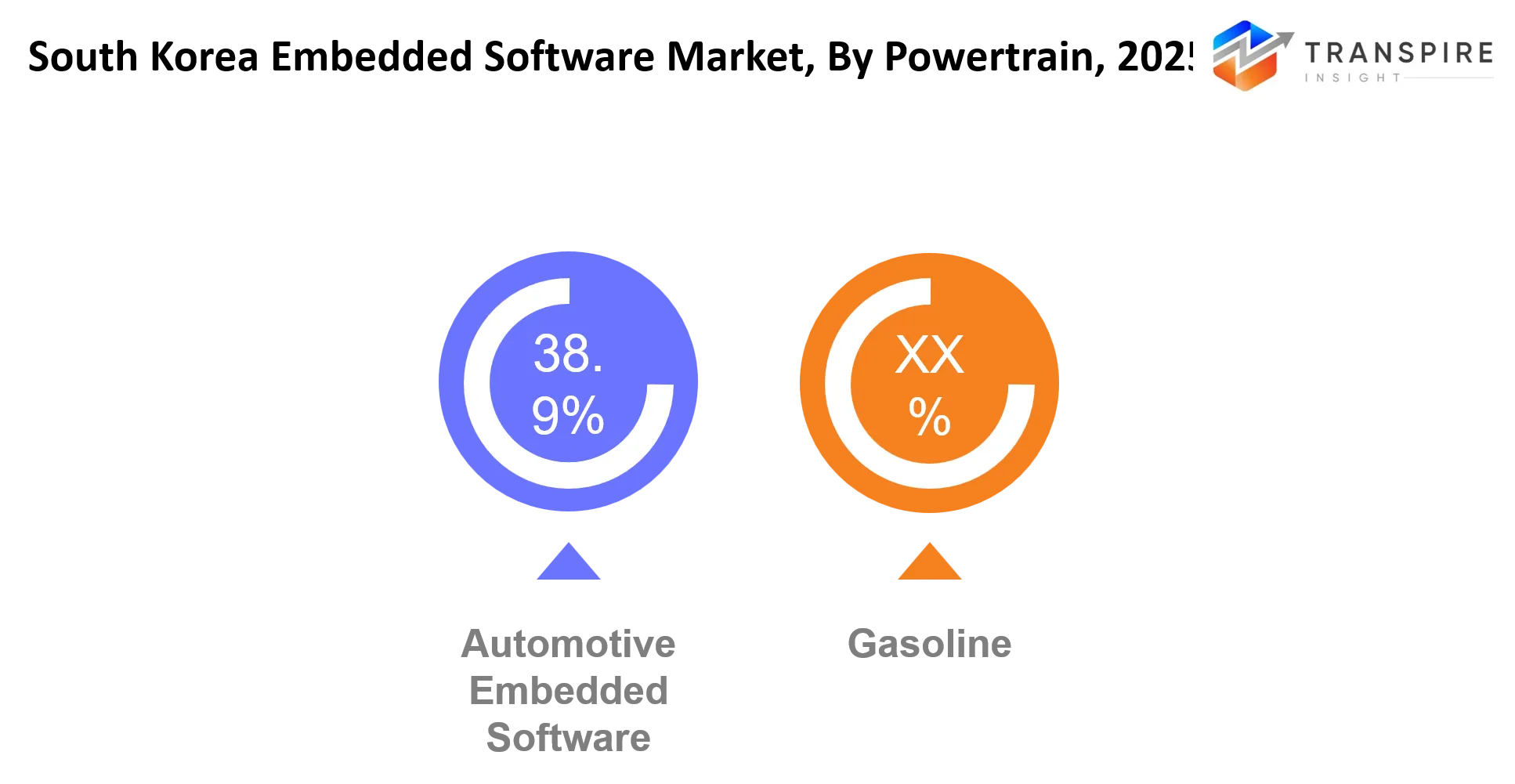
The Operating Systems dominated the market, accounting for nearly 44 % in 2025 and is expected to rise at a significant CAGR during the forecast period.
The South Korea Embedded Software Market Microcontrollers is segmented by component into operating systems, middleware, device drivers, embedded applications, development tools, security software, firmware, embedded databases. Among these, the Operating Systems dominated the market, accounting for nearly 44 % in 2025 and expected to increase at a significant CAGR during the forecast period. The Operating System led the South Korea Embedded Software Market in 2025, holding about 44% share of the market on account of high usage of RTOS in applications like automotive, industrial automation, consumer electronics, and connected devices.
The Hardware dominated the market, accounting for nearly 57% in 2025, and is expected to rise at a significant CAGR during the forecast period.
The South Korea Embedded Software Market is segmented by platform into microcontrollers, microprocessors, dsps, socs, fpgas, embedded boards, automotive ecus, iot devices. Among these, the Hardware dominated the market, accounting for nearly 57% in 2025 and expected to increase at a significant CAGR during the forecast period. The Hardware segment led the South Korea Embedded Software Market in 2025 due to high semiconductor manufacturing capabilities in the country along with increased connected devices, automotive electronics, industrial automation, and intelligent systems demand.
The Consumer Electronics dominated the market, accounting for nearly 35% in 2025 and is expected to rise at a significant CAGR during the forecast period.
The South Korea Embedded Software Market is segmentedby application into automotive, consumer electronics, industrial automation, healthcare, telecommunications, aerospace & defense, smart home, energy. Among these, the Consumer Electronics dominated the market, accounting for nearly 35% in 2025 and expected to increase at a significant CAGR during the forecast period. Consumer Electronics led the South Korea Embedded Software Market in 2025 due to increasing use of smart devices, IoT, connected appliances, and advanced display technologies.
Future Market Trends for the South Korea Embedded Software Market: -
AI-Enabled Embedded Software Systems: The growing usage of edge computing, machine learning, and real-time processing is fueling the need for intelligent embedded software in automotive, industrial, and consumer products.
Automotive Software Development: The increasing usage of electric vehicles, connected cars, and ADAS solutions is making it necessary to have safety-critical embedded software, real-time operating systems, security, and advanced vehicle control systems.
Industry 4.0 and Smart Manufacturing: The implementation of industry 4.0 and smart factory concepts has increased the usage of embedded software in industrial automation and robotics.
Recent Development
In September 8, 2026 – South Korea introduced its embedded analytics strategies aimed at enhancing manufacturing and automotive supply chains, focused on real-time decisions and alignment with national technology standards.
In September 10, 2026 – South Korea began its embedded board and module technology launches aimed at developing high-performance IoT applications and edge computing.
In September 2026 – South Korean technology suppliers released their embedded AI software solutions encompassing machine learning, electric vehicles technologies, industrial automation and real-time processing capabilities.
Market Segmentation
This study forecasts revenue at Japan, regional and country levels from 2020 to 2033. Transpire Insights has segmented the South Korea Embedded Software Market based on the below-mentioned segments:
South Korea Embedded Software Market, By Component
- Operating Systems
- Middleware
- Device Drivers
- Embedded Applications
- Development Tools
- Security Software
- Firmware
- Embedded Databases
South Korea Embedded Software Market, By Platform
- Microcontrollers
- Microprocessors
- DSPs
- SoCs
- FPGAs
- Embedded Boards
- Automotive ECUs
- IoT Devices
South Korea Embedded Software Market, By Application
- Automotive
- Consumer Electronics
- Industrial Automation
- Healthcare
- Telecommunications
- Aerospace & Defense
- Smart Home
- Energy
South Korea Embedded Software Market, By Deployment
- On-Device
- Edge
- Cloud-Connected
- Hybrid
- Real-Time
- Safety-Critical
- Distributed
- Networked
South Korea Embedded Software Market, By Technology
- RTOS
- Embedded Linux
- Android
- AUTOSAR
- AI/ML
- IoT
- Edge Computing
- Functional Safety
South Korea Embedded Software Market, By End User
- Automotive OEMs
- Electronics Manufacturers
- Industrial Companies
- Medical Device Companies
- Telecom Companies
- Aerospace Companies
- IoT Companies
- Semiconductor Companies
Frequently Asked Questions
Find quick answers to common questions.
AI, Industry 4.0, automotive innovation, semiconductor development, edge computing, and smart manufacturing are driving embedded software adoption.
Operating Systems dominate with nearly 44% share in 2025, supported by extensive RTOS adoption across automotive and industrial applications.
Edge computing, machine learning, and real-time processing are enabling intelligent embedded software solutions across automotive, industrial, and consumer application
Electric vehicles, connected cars, and ADAS are increasing demand for safety-critical software, RTOS, cybersecurity, and advanced vehicle control systems.
Smart factories and industrial automation are expanding embedded software deployment across robotics, connected equipment, real-time monitoring, and intelligent manufacturing systems.
- Samsung Electronics
- LG Electronics
- Hyundai Mobis
- Bosch
- NXP Semiconductors
- Renesas Electronics
- Infineon Technologies
- STMicroelectronics
- Texas Instruments
- Qualcomm
- Siemens
- Wind River
- Green Hills Software
- Elektrobit
- Mentor Graphics/Siemens EDA
About the Authors

Mayur Shinde
I am Mayur Shinde, a Senior Research Analyst at Transpire Insight, specializing in the Automotive & Transportation and Information & Communication Technology (ICT) Industry. My work focuses on analyzing emerging market trends, technological advancements, competitive landscapes, and industry developments to deliver accurate, data-driven insights. I am passionate about transforming complex market information into clear, actionable content that helps businesses, professionals, and decision-makers stay informed and make confident strategic decisions.

Chakradhar Khansole
Chakradhar serves as the Research Director at Transpire Insight, bringing over 8 years of experience in technology, innovation, and strategic market intelligence. He specializes in transforming complex market data into actionable business insights that enable organizations to make informed, growth-oriented decisions. Recognized for his strategic vision and analytical expertise, Chakradhar leads high-impact research initiatives, delivering comprehensive market assessments, competitive intelligence, and forward-looking industry analysis.
Recently Published Reports
-
Apr 2026
3D Optical Profiler Market
3D Optical Profiler Market Size, Share & Analysis Report By Type (Desktop 3D Optical Profiler, and Portable 3D Optical Profiler), By Technology (Confocal Technology, and White Light Interference), By End-Use Industry (Manufacturing, Research Institutions, Automotive, Aerospace and Defense, Medical Devices, and Other), and Geography (North America, Europe, Asia-Pacific, Middle East and Africa, South and Central America), 2021 - 2031
-
Apr 2026
Depth Sensor Market
Depth Sensor Market Size, Share & Analysis Report By Type (Infrared Depth Sensors, Time-of-Flight (ToF) Sensors, Stereo Vision Sensors, Structured Light Sensors, Ultrasonic Depth Sensors), By Application (Automotive, Robotics, Gaming, Consumer Electronics, Industrial Automation, Healthcare, Security & Surveillance, Others), By End Users (Automotive Manufacturers, Consumer Electronics Companies, Healthcare Providers, Industrial Companies, Security Agencies, Gaming Companies, Robotics Companies, Others), and Geography (North America, Europe, Asia-Pacific, Middle East and Africa, South and Central America), 2021 – 2031
-
Apr 2026
Digital Manufacturing Market
Digital Manufacturing Market Size, Share & Analysis Report By Component (Hardware, Software, and Services), By Technology (Robotics, 3D Printing, Internet of Things (IoT), and Others), By Application (Automotive and Transportation, Aerospace and Defense, Consumer Electronics, Industrial Machinery, and Others), By Process Type (Computer-Based Designing, Computer-Based Simulation, Computer 3D Visualization, Analytics, and Others), and Geography (North America, Europe, Asia-Pacific, Middle East and Africa, South and Central America), 2021 – 2031
-
Apr 2026
Digital Visa Services Market
Digital Visa Services Market Size, Share & Analysis Report By Type (Individual Travelers, Group Travelers), By Application (Tourism, Business Travel, Others), and Geography (North America, Europe, Asia-Pacific, Middle East and Africa, South and Central America), 2021 – 2031