

Resistant Starch Market Summary:
As per the Transpire Insight Analysis, the Resistant Starch Market size is estimated at USD 13.96 Billion in 2025 and is anticipated to reach USD 19.69 Billion by 2033, growing at a CAGR of 5.17% from 2026 to 2033.
The global resistant starch acts as a functional ingredient allowing food makers to boost fibre, reduce GI impact and improve mouthfeel without having to depart from the comfort zone of familiar formats-baked goods, snacks, dairy and nutrition bars. It has moved from a niche ingredient story over the last 3-5 years to a formulation story as food companies take marketing cues from gut-health claim opportunities, clean-label trends and reformulation needs around sugar and metabolic health. One major structural change has been the shift to manufactured RS varieties and multi-source formulations. A real trigger in the marketplace is the increased emphasis from consumers on metabolic health and gut health in their everyday purchasing decisions, as confirmed by the growth in demand for functional foods. This is now having a corresponding impact in the bakery, beverage and supplement markets, as manufacturers seek health credentials but without sacrificing flavour or texture.
Resistant Starch Market Size & Forecast:
- Global Market Size 2025: USD 13.96 Billion
- Expected Market Value (2033): USD 19.69 Billion
- Forecast CAGR (2026–2033): 5.17%
- Leading Region in 2025: North America
- Fastest Growing Region: Asia Pacific
- Key Company Profiles: Ingredion, Cargill, ADM, Tate & Lyle, Roquette, BENEO, Agrana, Emsland Group, MGP Ingredients, Südzucker, Avebe, Grain Processing Corporation, KMC, Matsutani Chemical Industry, Samyang Corporation

Key Resistant Starch Market Insights:
RS is transitioning from a nutrition claim to a formulation tool, with manufacturers leveraging its ability to retain taste while boosting fibre and gut health. The game is no longer about just supplying commodities; it's about source diversity, process control and positioning for the label.
- The native-granule functionality of RS2 is well-suited for bakery and cereal reformulation, maintaining its volume leadership at 35%.
- The drive for cleaner labels and higher heat-processing tolerance is helping RS3 gain 22%.
- RS4 at 16% indicates the company's progress in the field of controlled-modification systems, which increase consistency in large-scale plants.
- RS1 at 12% is still applicable, as long as the plant structure is maintained in ‘minimally processed' forms.
- The other is RS5, which at 9% is growing based on niche innovation in novel enzymatic or chemical conversion pathways.
- Blended resistant starch at 4% represents a shift towards tailored performance blends of resistant starch for texture and digestibility control.
- Others take 2% of the small-batch innovation from alternative botanical inputs and speciality formulations.
- Sourcing of corn and potato continues to be key due to manufacturers' need for consistent industrial-scale supply and functionality.
- Brands are looking for cleaner labels and regional sourcing flexibility, which is driving an increase in tapioca, banana, rice, and legume inputs.
What are the Key Drivers, Restraints, and Opportunities in the Resistant Starch Market?
Driver:
The main growth factor is the reformulation of conventional foods into fibre-dense, low GI offerings. Growing concerns about metabolic health and increased consumer focus on gut health have prompted manufacturers of bakery items, beverages, dairy, and supplements to incorporate higher levels of resistant starch into their products. The combination of benefiting nutritional profile and preserving product quality has led to increased adoption into conventional food applications, resulting in steady revenue increases for resistant starch manufacturers.
Restraint:
Growth is constrained by higher production expense and variable customer interpretation of " resistant starch" as opposed to generic fibre claims. It remains structurally difficult because large proportions of RS grades demand highly regulated processing, sourcing control, and certification, making volume buildup more difficult than commodity starches, and slower in price-sensitive marketplaces.
Opportunity:
A significant opportunity exists in delivering precision formulations and sourcing more broadly the botanicals, especially throughout the Asia Pacific and Europe regions, where functional food development and associated regulation support for fibre positioning with health continues to grow. Investment in an array of enzymatic, physical and fermentation-based processing technologies has enhanced resistant starch functionality, efficiencies, and scale-up potential to allow even more cost-effective clean-label ingredients and heightened bakery, dairy, supplement and personalised nutrition opportunities for ingredient suppliers and food processors.
What Has the Impact of Artificial Intelligence Been on the Resistant Starch Market?
AI is transforming resistant starch from an example of trial-and-error ingredient formulation to a new data-optimised formulation category. In R&D, machine learning and predictive models are being used to predict RS levels and elucidate interactions between sources, processing, and digestion characteristics, reducing development time and failed prototypes.
On the factory side, AI can be used to enhance process monitoring, predict yields, and improve batch-to-batch consistency by correlating key variables like temperature, pH, enzyme dosage, and raw-material characteristics with resulting properties. This is particularly useful in starch systems where the structure and heat-moisture history significantly affect final properties, and enabling predictive analytics helps to optimise quality control and commercial scale-up. The most significant challenge is integration; lower power processors generally do not have access to clean data, established laboratory protocols and the technical support teams to translate model outputs into robust commercial decisions. Nonetheless, the trend is evident: AI is becoming a practical tool for more rapid reformulation, tighter control and improved commercial reproducibility in resistant starch. In July 2026, Ingredion launched its conversational AI-powered formulation assistant, Ask Ingredion, at IFT FIRST 2026. This tool streamlines technical problem-solving and guides R&D teams faster from complex texture and functional ingredient challenges to optimised solutions.
Key Market Trends:
The market has shifted from specialty nutrition to general food reformulation, where function and sensory quality are as important as health claims. The manufacturers are moving toward less commodity dependence, process engineering, and cleaner labels to combat margin pressure.
- RS2 and RS3 continued to be the main commercial types, and RS4 was becoming more prominent as a type that was easier to process and formulate.
- Corn and potato sources continued to lead, but as processors seek clean-label differentiation, the other sources expanded.
- Bakery applications grew as manufacturers reworked bread, muffins and snack applications to maintain the texture and increase fibre as well.
- Demand for dairy and beverages grew as brands continued to shift to low-glycemic, gut-health claims in products that cause few taste disruptions.
- Consumer interest in general wellness slowly shifted to digestive and metabolic support, and nutraceutical uptake increased.
- When it comes to claims for prebiotics and fibre, regulatory and labelling requirements made it more challenging for companies to make claims than ever before.
- Ingredient suppliers began to look into blended and functional RS systems to achieve a balance between cost, stability and flexibility of application.
- Food manufacturing had grown in importance, and many cities in Asia Pacific were sensitive about the food they consumed and so were seeking starch feedstocks in the region.
- Processing innovation increasingly based on enzyme treatment, heat-moisture-control and physical modification, not just raw-material sourcing.
Resistant Starch Market Segmentation
By Type:
RS2 accounts for 35% of the market and remains the dominant resistant starch because its high natural resistant starch levels enable product reformulation on a larger scale while maintaining processing efficiency. RS3 comprises 22%, with better thermal stability for cooked foods and processed commodities resulting in a higher proportion in the overall mix. RS4 contributes 16%, with the fastest CAGR of 15.8% due to chemically modified grades achieving targeted functionality for industrial usage. RS1 comprises 12%, RS5 9%, while the Blended Resistant Starch sector constitutes 4%, and "Others" comprises 2%, indicating further product diversification for tailor-made nutritional formulations.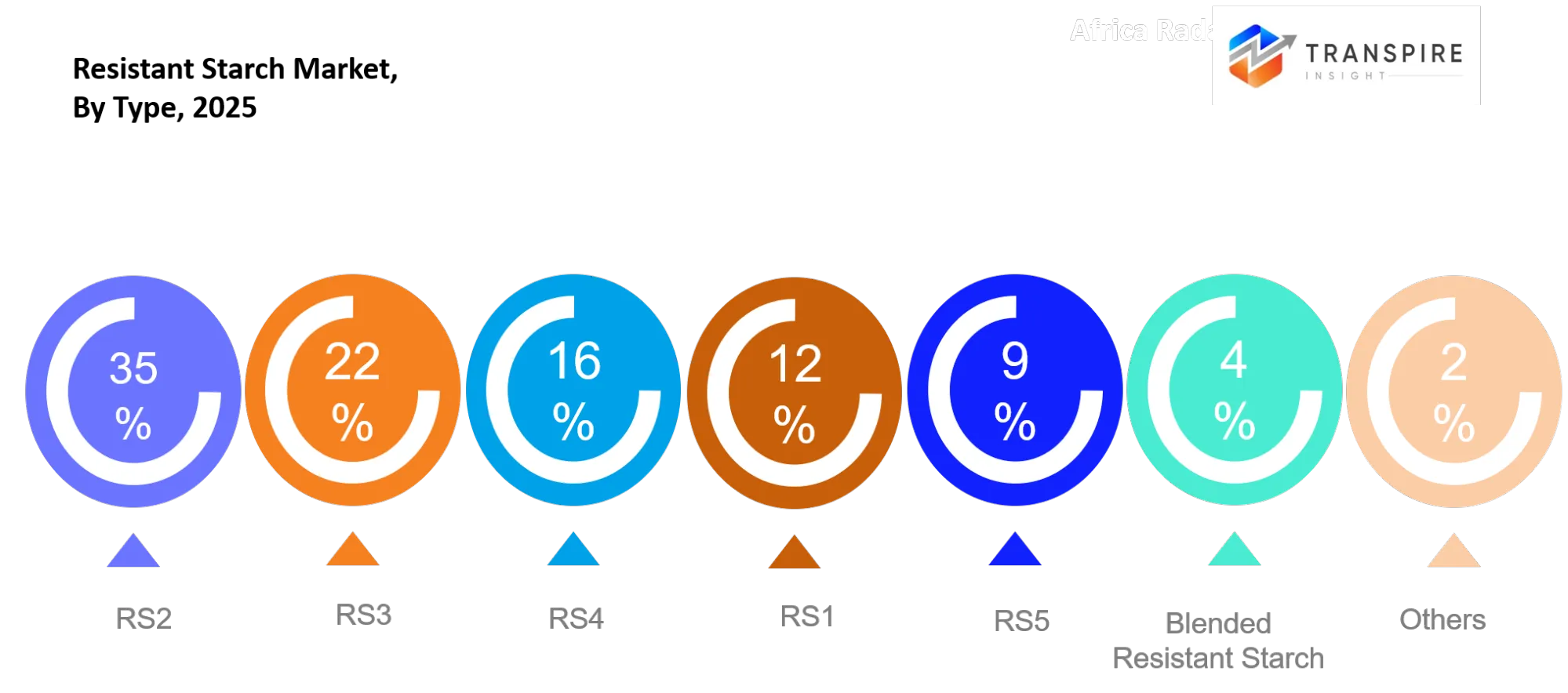
By Source:
Corn continues to be the main commercial feedstock given its easy availability worldwide, extensive processing infrastructure, and low market price. Potatoes and wheat are strong in the bread, bakery, and processed foods sectors. Tapioca and banana continue to grow in clean label and gluten-free sectors. Rice, leguminous plants, and other botanical sources are expanding as regional players diversify their raw materials palette and strengthen supply security.
By Application:
Bakery products continue to be the dominant category as resistant starch demonstrates fibre enrichment without textural defect. Functional foods and dietary supplements are still on the rise with their digestion and metabolic health positioning, as well as in dairy foods and beverage applications for nutrition fortification. Pharmaceuticals and animal feed also position for long-term growth by offering controlled-release formulations and enhanced digestive performance.
By End User:
Food manufacturers also remain the leaders in commercial usage, driving ongoing product reformulation efforts to produce higher fibre offerings with enhanced nutritional value. Nutraceutical and pharmaceutical companies are further widening usage through clinically orientated formulations, while animal feed producers and retail customers are also incorporating resistant starch as knowledge of digestive health, metabolic well-being and functional nutrition advances in various end-use industries.
By Distribution Channel:
High-volume industrial purchasing remains the dominant source of sales, with ingredient distributors facilitating regional penetration; online B2B companies and the use of specialty suppliers and wholesalers are helping to improve access and enable wider use of customized resistant starch ingredients across food, nutraceutical and pharmaceutical applications as well as emerging regional markets.
What are the Key Use Cases Driving the Resistant Starch Market?
The primary application remains in bakery and staple foods, where RS2 and RS3 enable companies to boost nutritional profile while maintaining desired qualities of texture, volume and flavour.
Growing opportunities can be seen in dairy, beverages and functional, health supplements, with resistant starch used to support claims for low-glycemic, digestive, or clean-label benefits with minimal reformulation concerns.
Newer applications are also emerging in pharma, pet foods and specialised nutrition, with RS4 and combination systems allowing for more precision with functionality, hunger-suppression and metabolic-health benefits. As the market faces increasing pressures to provide health advantages without compromising sensory attributes, resistant starch is evolving from an additive to a key formulation element in mainstream and premium systems.
|
Report Metrics |
Details |
|
Market size value in 2025 |
USD 13.16 Billion |
|
Market size value in 2026 |
USD 13.84 Billion |
|
Revenue forecast in 2033 |
USD 19.69 Billion |
|
Growth rate |
CAGR of 5.17% from 2026 to 2033 |
|
Base year |
2025 |
|
Historical data |
2021 - 2024 |
|
Forecast period |
2026 - 2033 |
|
Report coverage |
Revenue forecast, competitive landscape, growth factors, and trends |
|
Regional scope |
United States; Canada; Mexico; United Kingdom; Germany; France; Italy; Spain; Denmark; Sweden; Norway; China; Japan; India; Australia; South Korea; Thailand; Brazil; Argentina; South Africa; Saudi Arabia; United Arab Emirates |
|
Key companies profiled |
Ingredion, Cargill, ADM, Tate & Lyle, Roquette, BENEO, Agrana, Emsland Group, MGP Ingredients, Südzucker, Avebe, Grain Processing Corporation, KMC, Matsutani Chemical Industry, Samyang Corporation |
|
Customization scope |
Free report customisation (country, regional & segment scope). Avail customised purchase options to meet your exact research needs. |
|
Report Segmentation |
By Type (RS1, RS2, RS3, RS4, RS5, Blended Resistant Starch, Functional Resistant Starch, Others); By Source (Corn, Potato, Wheat, Tapioca, Banana, Rice, Legumes, Others); By Application (Bakery Products, Dairy Products, Functional Foods, Beverages, Dietary Supplements, Animal Feed, Pharmaceuticals, Others); By End User (Food Manufacturers, Nutraceutical Companies, Pharmaceutical Companies, Animal Feed Producers, Retail Consumers, Others); By Distribution Channel (Direct Sales, Ingredient Distributors, Online B2B Platforms, Specialty Suppliers, Wholesalers, Others) |
Which Regions are Driving the Resistant Starch Market Growth?
North America holds a 37% market share, due to high demand across functional foods, dietary supplements and low-GI reformulation. Its ecosystem is underpinned by robust food processing infrastructure, well-established ingredient distribution and a regulatory climate conducive to more structured fibre placement. Consumer pull is sustained by long-standing consumer focus on gut health, weight management and metabolic health, driving RS deep into mainstream product innovation, although the region's strength is less about volumes than rapid commercial adoption of more premium formulas.
Europe accounts for 29% share and has a different growth logic, with higher clean-label standards and tight product guidelines, making resistant starch a more logical fibre alternative from a technical perspective. Europe's more stable growth is underpinned by less volatile dynamics of reformulation-driven growth-premium bakery and functional dairy than general supplement demand. Consistent patterns of growth are sustained by existing food manufacturing infrastructure, high ingredient validation and consumer willingness to accept scientifically proven health benefits. In March 2026, Roquette introduced AMYSTA™ L 123 thermally soluble pea starch, the first innovation in its new label-friendly starch range. This launch provides European food developers with a direct, clean-label compliant ingredient tailored to meet strict regional standards for functional nutrition without altering matrix stability.
Asia Pacific is the fastest-growing region, with a 27% share and a CAGR of 16.7%, as urbanisation, packaged-food size and digestive-health knowledge have transformed rapidly. The recent growth has been driven by rising middle-class expenditure, increased functional-food innovation and higher reliance on native starch sources in India, China and South-East Asia. The opportunity is greatest where low-cost raw materials are coupled with clear-label branding and regional processing networks. This is one of the reasons why Asia Pacific is shifting from demand-balance to structural leadership in future RS products.
In March 2026, DKSH signed an exclusive distribution agreement with Limagrain Ingredients to expand functional grain and clean-label solutions across Southeast Asia. This partnership accelerates market access for innovative cereal-based components and functional flours, helping regional food manufacturers replace traditional modified starches with label-friendly alternatives.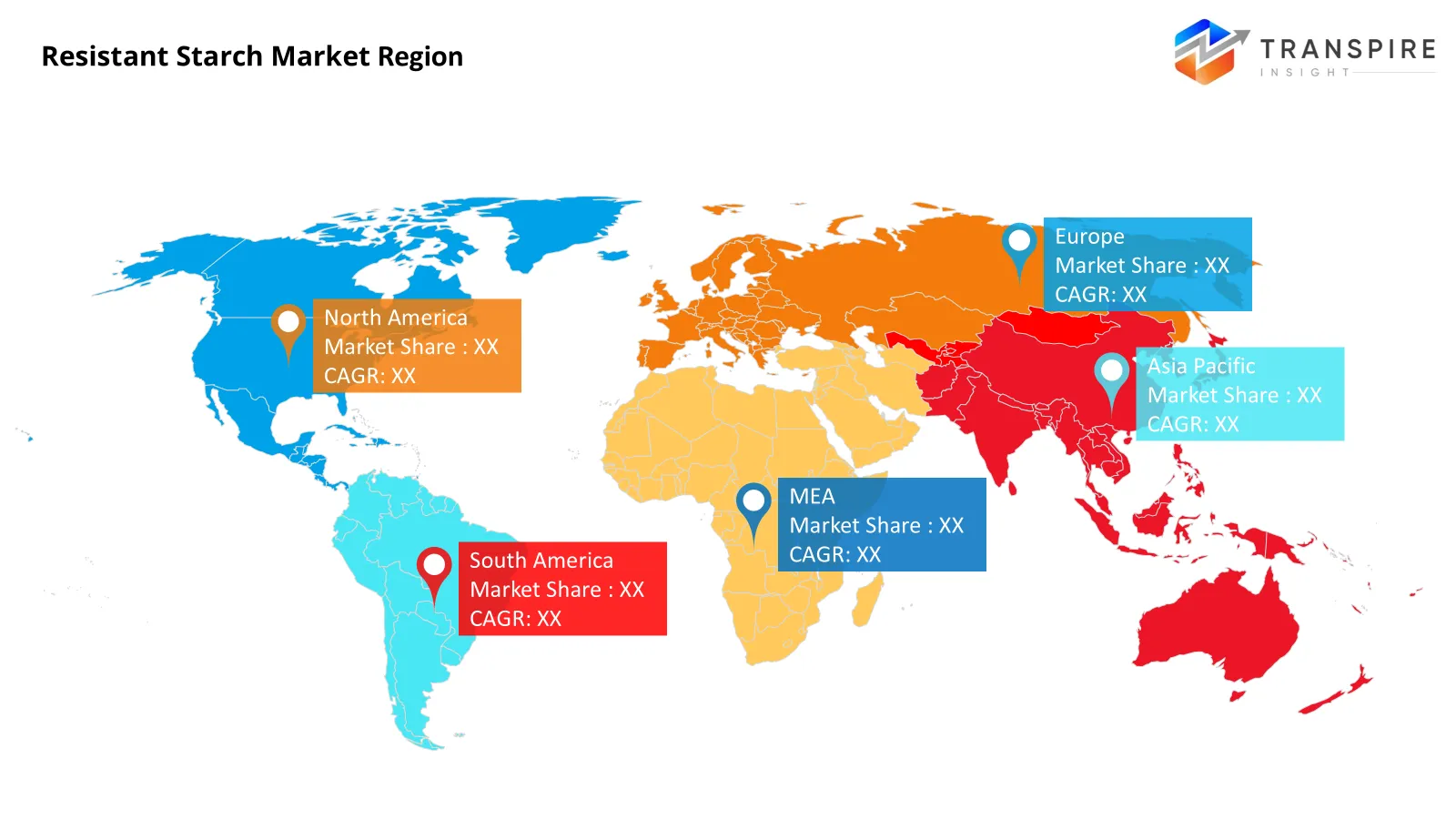
Who are the Key Players in the Resistant Starch Market and how do they Compete?
In the Resistant Starch Market, competition will shift away from the importance of scale of production and toward formulation expertise, application-specific innovations, regional manufacturing presence, and scientifically substantiated health benefits. Differentiation will come from clean-label solutions, application-specific functional ingredients, and collaborative development with food manufacturers of next-generation functional foods.
Ingredion, Cargill, ADM, Tate & Lyle and Roquette promote innovation-driven growth by enlarging their speciality starch offering, investing in precision processing equipment, upgrading regional manufacturing capacities and delivering more technical formulation assistance that enables more efficient processing in bakery, beverage and functional food applications. BENEO, Agrana, Emsland Group, MGP Ingredients, Sdzucker, Avebe, Grain Processing Corporation, KMC, Matsutani Chemical Industry, and Samyang Corporation are competing across more diverse product categories, exploitation of a broader botanical base, investment in further sustainable sources of raw materials, extensive research in clinical nutrition, and tailored functional ingredients developments for individual clients. Their strategic development is now focusing on tie-ups with leading food industry innovators, developing more state-of-the-art capabilities for starch modification, establishing local production networks and application laboratories to fast-track commercialisation, and meeting changing regulatory standards and top-end nutritional demand in the world markets.
Key Players are:
- Ingredion
- Cargill
- ADM
- Tate & Lyle
- Roquette
- BENEO
- Agrana
- Emsland Group
- MGP Ingredients
- Südzucker
- Avebe
- Grain Processing Corporation
- KMC
- Matsutani Chemical Industry
- Samyang Corporation
Recent Development News
- In April 2026, MSP Starch Products Inc. announced an exclusive partnership with Lehvoss Group to distribute its Solnul-branded resistant starch across Europe. This expansion addresses the growing European demand for natural prebiotic and gut health ingredients by making science-backed, potato-derived resistant starch available to regional formulators.
https://www.nutraingredients.com
- In July 2026, the John Innes Centre successfully engineered giant wheat starch granules to increase the content of resistant starch in staple crops. This biotechnological breakthrough delivers a highly scalable form of dietary fibre that resists small intestine digestion, mitigating postprandial glucose spikes and addressing metabolic disorders globally.
What Strategic Insights Define the Future of the Resistant Starch Market?
The industry is shifting to precision formulation with resistant starch selected for quantifiable functional performance, rather than blanket fibre claims. That is increasing the value of proprietary processing because product success will be based on controlling digestibility, textural stability and credibility of claims. Hidden risk is margin compression if suppliers overcrowd the same clean-label positioning, with no differentiated processing or application support. The opportunity is more compelling in regionally sourced, tech-optimised blends for bakery, dairy and nutrition systems - especially in APAC and Europe, where local feedstock & quicker reformulation cycles can support volume. The most intelligent approach is to put money into application science, pilot validation and co-development with food manufacturers-not just plant capacity. Companies that can blend source flexibility with process control will be best positioned to deliver health-led demand into sustained commercial repeat sales.
Key Segmentations are:
By Type
- RS1
- RS2
- RS3
- RS4
- RS5
- Blended Resistant Starch
- Functional Resistant Starch
- Others
By Source
- Corn
- Potato
- Wheat
- Tapioca
- Banana
- Rice
- Legumes
- Others
By Application
- Bakery Products
- Dairy Products
- Functional Foods
- Beverages
- Dietary Supplements
- Animal Feed Pharmaceuticals
- Others
By End User
- Food Manufacturers
- Nutraceutical Companies
- Pharmaceutical Companies
- Animal Feed Producers
- Retail Consumers
- Others
By Distribution Channel
- Direct Sales
- Ingredient Distributors
- Online B2B Platforms
- Specialty Suppliers
- Wholesalers
- Others
Regional Outlook
North America
- US
- Canada
- Mexico
Europe
- Germany
- UK
- France
- Italy
- Spain
- Russia
- Rest of Europe
Asia Pacific
- China
- Japan
- India
- South Korea
- Australia
- Rest of Asia Pacific
South America
- Brazil
- Argentina
- Rest of South America
Middle East & Africa
- UAE
- Saudi Arabia
- Qatar
- South Africa
- Rest of the Middle East & Africa
Frequently Asked Questions
Find quick answers to common questions.
The Resistant Starch Market size was valued at USD 13.16 Billion in 2025 and is poised to reach USD 19.69 Billion by 2033, expanding at a 5.17% CAGR.
Key segments for the Resistant Starch Market are By Type (RS1, RS2, RS3, RS4, RS5, Blended Resistant Starch, Functional Resistant Starch, Others); By Source (Corn, Potato, Wheat, Tapioca, Banana, Rice, Legumes, Others); By Application (Bakery Products, Dairy Products, Functional Foods, Beverages, Dietary Supplements, Animal Feed, Pharmaceuticals, Others); By End User (Food Manufacturers, Nutraceutical Companies, Pharmaceutical Companies, Animal Feed Producers, Retail Consumers, Others); By Distribution Channel (Direct Sales, Ingredient Distributors, Online B2B Platforms, Specialty Suppliers, Wholesalers, Others)
Growth is primarily driven by clean-label reformulation, rising demand for gut-health and low-glycemic foods, higher use in bakery, beverages, and supplements, and the need for ingredients that improve texture while supporting fibre and metabolic-health claims.
The Resistant Starch Market is led by major manufacturers including Ingredion, Cargill, ADM, Tate & Lyle, Roquette, BENEO, Agrana, Emsland Group, MGP Ingredients, Südzucker, Avebe, Grain Processing Corporation, KMC, Matsutani Chemical Industry, and Samyang Corporation.
North America, with a 37% share, influences Resistant Starch Market dynamics through advanced food-processing infrastructure, strong demand for functional foods, and faster adoption of clean-label reformulation across bakery, dairy, and nutrition products.
Commercial opportunities include Asia Pacific and Europe expansion, regionally sourced ingredient blends, clean-label bakery and dairy reformulation, and tech-enabled precision formulations for digestive-health and low-glycemic products.
- Ingredion
- Cargill
- ADM
- Tate & Lyle
- Roquette
- BENEO
- Agrana
- Emsland Group
- MGP Ingredients
- Südzucker
- Avebe
- Grain Processing Corporation
- KMC
- Matsutani Chemical Industry
- Samyang Corporation
About the Authors

Chetan Dhatrak
I’m Chetan Dhatrak, a Senior Research Analyst at Transpire Insight, specializing in the Consumer Goods, Foods and Beverages industry. I focus on analyzing market trends, consumer behavior, competitive landscapes, and industry developments to deliver accurate, data-driven insights. My research at Transpire Insight is built on credible sources and in-depth analysis, helping businesses and readers better understand market dynamics, emerging opportunities, and evolving consumer preferences. I’m committed to creating reliable, well-researched content that supports informed decision-making and reflects the latest developments in the consumer goods and food & beverage sectors.

Chakradhar Khansole
Chakradhar serves as the Research Director at Transpire Insight, bringing over 8 years of experience in technology, innovation, and strategic market intelligence. He specializes in transforming complex market data into actionable business insights that enable organizations to make informed, growth-oriented decisions. Recognized for his strategic vision and analytical expertise, Chakradhar leads high-impact research initiatives, delivering comprehensive market assessments, competitive intelligence, and forward-looking industry analysis.
Recently Published Reports
-
Apr 2026
Baby Infant Formula Market
Baby Infant Formula Market Size, Share & Analysis Report By ype (Infant Milk, Follow On Milk, Specialty Baby Milk, Growing-Up Milk), By Ingredient (Carbohydrate, Fat, Protein, Minerals, Vitamins, and Others), By Product Form (Powder, Liquid, and Ready-to-feed), By Distribution Channels (Supermarket/Hypermarket, Specialty Store, Pharmacies, Online Retail, and Others), and Geography (North America, Europe, Asia-Pacific, Middle East and Africa, South and Central America), 2021 - 2031
-
Apr 2026
Edible Insects for Animal Feed Market
Edible Insects for Animal Feed Market Size, Share & Analysis Report By Type (Insect Powder, Insect Meal, Insect Bar, Insect Paste, Insect Oil, and Others), By Insect Type (Beetles, Cricket, Caterpillar, Hymenoptera, Orthoptera, Tree Bugs, and Others), By Application (Livestock, Pet Food, and Aquaculture), By Livestock Type (Poultry, Swine, and Others), and Geography (North America, Europe, Asia-Pacific, Middle East and Africa, South and Central America), 2021 - 2031
-
Apr 2026
Food Industry Disinfection and Bacterial Control Market
Food Industry Disinfection and Bacterial Control Market Size, Share & Analysis Report By Type (Chemical Disinfectants, Physical Disinfectants, and Biocides and Antimicrobials), By Application (Food Processing Equipment Surface Disinfection, Food Preparation Areas Surface Disinfection, Storage Areas Surface Disinfection, Anti-microbial Coatings Food Preservation, and Preservative Solutions Food Preservation), By End User (Meat and Poultry Processing, Dairy Processing, Seafood Processing, Bakery and Confectionery, Restaurants and Commercial Kitchens, and Food Service Providers), By Sales Channel (Online, Offline), and Geography (North America, Europe, Asia-Pacific, Middle East and Africa, South and Central America), 2021 - 2031
-
May 2026
Freeze Dried Food Market
Freeze Dried Food Market Size, Share & Analysis Report By Product Type (Fruits, Vegetables, Freeze-Dried Dairy Products, Freeze-Dried Meat and Seafood, Freeze-Dried Pet Food, and Prepared Meal), By Nature (Organic, and Conventional), By Form (Powdered, Granules, and Diced), By End Use (Breakfast Cereals, Dairy Products, Bakery & Confectionery, Nutritional Bars & Supplements, Powdered Beverages, Snacks, and Retail (Household)), and Geography (North America, Europe, Asia-Pacific, Middle East and Africa, South and Central America), 2021 - 2031