
Germany Corn Starch Derivatives Market Size & Forecast:
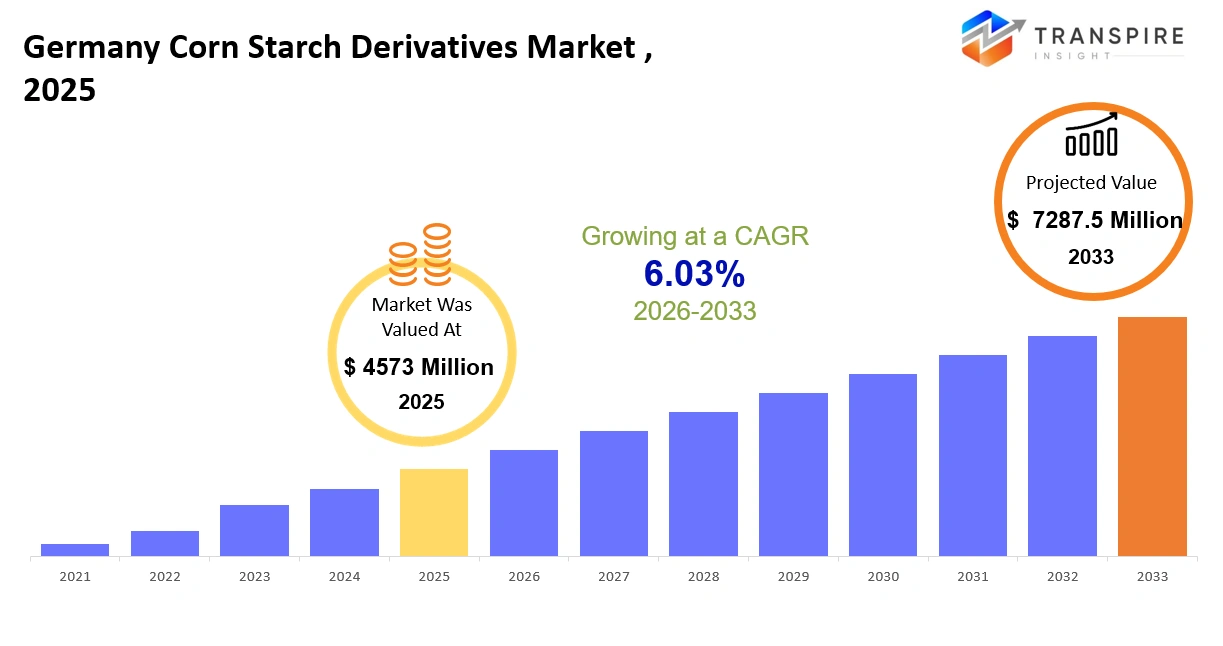
- Germany Corn Starch Derivatives Market Size 2025: USD 4573 Million
- Germany Corn Starch Derivatives Market Size 2033: USD 7287.5 Million
- Germany Corn Starch Derivatives Market CAGR: 6.03%
- Germany Corn Starch Derivatives Market Segments: By Type (Glucose Syrup, Maltodextrin, Dextrose, Sorbitol, Modified Starch), By Application (Food & Beverages, Pharmaceuticals, Paper & Packaging, Textile, Others), By Distribution Channel (Direct Sales, Distributors)
To learn more about this report,  Download Free Sample Report
Germany Corn Starch Derivatives Market Summary:
The Germany Corn Starch Derivatives Market size is estimated at USD 4573 Million in 2025 and is anticipated to reach USD 7287.5 Million by 2033, growing at a CAGR of 6.03 % from 2026 to 2033. The Germany Corn Starch Derivatives. The use of corn derivatives has increased because they function as thickening, stabilising, sweetening, and texturising agents in processed food and beverage products. The pharmaceutical industry uses these materials to make tablets and binders, and they also find applications in animal feed, textiles, paper, and biodegradable materials. Consumers are increasingly preferring functional food products with "clean label" ingredients. The German market features several large multinational companies, including Cargill and ADM, Ingredion and Tate & Lyle, AGRANA, and Roquette. The market lacks a dominant company yet major producers gain advantages through their ability to distribute products and their extensive range of offerings.
Key Market Trends & Insights:
The rising demand for natural, plant-based ingredients with clean labels forces formulators to choose corn-based products over synthetic chemical additives. The market currently supports corn starch derivatives because consumers view them as natural, sustainable, and low-processing products.
Scientists are developing modified starches together with specialty derivatives which include maltodextrin, cyclodextrin and glucose syrups, to create products that maintain better stability when exposed to extreme heat and acidic conditions and freeze-thaw cycles. Current innovations create specific functional properties designed to meet needs across various industrial applications, including pharma binders and gluten-free formulations.
Diversified demand exists across multiple sectors, which include food and pharmaceuticals and personal care and adhesives, paper and board and textiles and bio-based materials. The strong manufacturing base in Germany, which focuses on chemical, pharmaceutical and packaging industries, creates increasing demand for derivative products.
Germany Corn Starch Derivatives Market Segmentation
By Type
Glucose Syrup- Glucose syrup is one of the most widely used derivatives of corn starch in Germany. The production process involves hydrolysing corn starch to create a product that contains glucose, maltose and various other sugars. The product functions as a sweetener and thickening agent, and as a moisture-retaining component in food products.
Maltodextrin- Maltodextrin exists as a white powder which food manufacturers use for its function as an additive and its ability to thicken and stabilize products. The food industry in Germany uses maltodextrin extensively because it serves as a digestible ingredient and its taste does not affect product flavor.
Dextrose- Dextrose, which people refer to as glucose, exists as a basic sugar that manufacturers create through the conversion of corn starch. The substance serves as both a sweetener and an energy source, used by food manufacturers and pharmaceutical companies in their products. Dextrose functions as a sweetening agent that delivers immediate energy to bakery products and beverages and dairy products and confectionery items that customers buy in German markets. Dextrose serves medical purposes through its use in intravenous fluids and medical nutrition products and oral rehydration solutions. The segment is experiencing growth due to rising demand for healthcare products, sports nutrition, and medical formulations in Germany.
Sorbitol- Sorbitol functions as a low-calorie sweetener and humectant because it acts as a sugar alcohol, which researchers extract from glucose. The product serves as a fundamental component in diabetes-friendly, sugar-free food items. The German market uses sorbitol as a standard ingredient for chewing gum and sugar-free candy, toothpaste and cosmetics and pharmaceutical syrups. The substance maintains moisture levels while enhancing product texture. The growing consumer health consciousness drives demand for low- and sugar-free food products, creating a need for sorbitol.
Modified Starch- Modified starch is a type of starch that has undergone chemical and physical and enzymatic modifications to achieve better performance across different processing conditions. The substance maintains widespread use across food production and industrial processes because of its improved stability. In Germany, modified starch is heavily utilized in processed foods, sauces, soups, ready meals, and frozen foods, where it functions as a thickener, stabilizer, and emulsifier. The substance serves multiple purposes in paper production, adhesive creation and textile manufacturing and pharmaceutical development. The segment experiences growth because consumers demand more convenience foods and industrial materials.
By Application
Food & Beverages- The food and beverage sector represents the largest application segment of the German corn starch derivatives market. The derivatives serve multiple functions as sweeteners, stabilisers, thickeners, emulsifiers and texture enhancers.
Pharmaceuticals- Corn starch derivatives function as essential components in the process of pharmaceutical production. The materials function as binders and fillers and disintegrants and stabilizers for tablets, capsules and syrups. The German pharmaceutical industry uses maltodextrin and modified starch derivatives to enhance drug formulation stability while ensuring proper active ingredient delivery. The application segment continues to expand due to rising pharmaceutical production and growing healthcare demand.
Paper & Packaging- The paper and packaging industry uses corn starch derivatives because they function as adhesives and coating agents. They provide enhanced paper strength together with improved printability and surface finishing. The demand for starch-based adhesives and coatings receives support from Germany's packaging industry, which specializes in e-commerce and sustainable packaging solutions. The increasing popularity of biodegradable materials results in greater demand for starch derivatives used in packaging manufacturing.
Textile- The textile industry uses corn starch derivatives for three main purposes which include fabric sizing and finishing and enhancing weaving practice through fiber strengthening. The materials provide two benefits because they make yarns more durable and improve the efficiency of the weaving process. Starch-based products act as sustainable substitutes for synthetic chemicals in the German textile and industrial fabric manufacturing industry, which helps the sector achieve its sustainability objectives.
Other- It includes personal care products, cosmetics, adhesives, animal feed, and biodegradable plastics. European sustainability initiatives and environmental regulations support the growing use of corn starch derivatives in bio-based materials and eco-friendly products.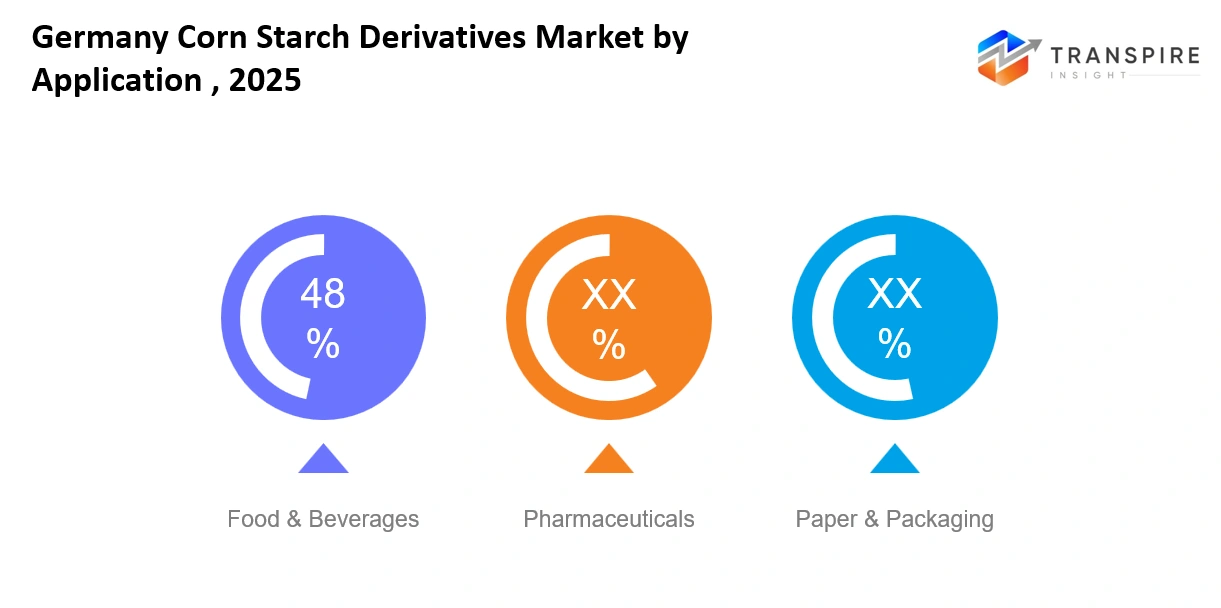
To learn more about this report, Download Free Sample Report
By Distribution Channel
Direct Sales- Manufacturers deliver corn starch derivatives to their industrial customers through direct sales to food processors and pharmaceutical companies and paper manufacturers, and textile industries.
Distributors- Distributors serve as intermediaries who connect manufacturers with their smaller customers. They provide corn starch derivatives to small food processing companies local manufacturing plants research laboratories and specialized industrial customers. This distribution channel enables businesses to extend their market presence throughout Germany and Europe. Distributors provide advantages through their distribution services which includeThe distribution of lesser quantitiesThe quick delivery of productsThe distribution of regional logistics together with their network of supply services.
Country Insights
Germany represents one of the largest starch derivatives markets in Europe because its food processing and pharmaceutical and industrial manufacturing sectors have established a strong market presence. The country requires functional ingredients which processed foods and convenience products and used in nutraceuticals.
The German food and beverage industry constitutes one of Europe's largest markets which results in high demand for corn starch derivatives like glucose syrup and maltodextrin and modified starch. These ingredients help to create better food texture, product stability and extended shelf life. The increasing popularity of ready-to-eat meals and bakery items, and confectionery products in Germany has led to greater demand for starch-based sweeteners and stabilizers.
Germany has a developed pharmaceutical industry which plays an essential role in expanding market opportunities. Corn starch derivatives function as excipients and binders and fillers for tablets and capsules. The presence of leading pharmaceutical manufacturers and research institutions supports the continuous adoption of high-quality starch derivatives.
Germany possesses a robust industrial sector which includes paper and packaging and textiles. Industries now use starch-based adhesives and coatings because consumers want sustainable packaging materials and biodegradable products. Government initiatives that promote bio-based, environmentally safe materials are driving various industries to use corn starch derivatives in their processes.
Recent Development News
European starch manufacturers have increased their production facilities to serve the rising demand from both food and industrial markets. Cargill and Ingredion Incorporated have dedicated their resources to developing advanced starch processing technologies throughout Europe to improve production efficiency and create specialized starch products.
Roquette Frères develops plant-based biodegradable starch derivatives which will be used for sustainable packaging and bioplastics. The development meets both European environmental regulations and sustainability objectives.
|
Report Metrics |
Details |
|
Market size value in 2025 |
USD 4573 Million |
|
Market size value in 2026 |
USD 4838.2 Million |
|
Revenue forecast in 2033 |
USD 7287.5 Million |
|
Growth rate |
CAGR of 6.03 % from 2026 to 2033 |
|
Base year |
2025 |
|
Historical data |
2021 – 2024 |
|
Forecast period |
2026 – 2033 |
|
Report coverage |
Revenue forecast, competitive landscape, growth factors, and trends |
|
Country scope |
Germany |
|
Key company profiled |
Cargill Inc., Archer Daniels Midland Company, Ingredion Incorporated, Tate & Lyle PLC, Roquette Frères, Tereos Group, Grain Processing Corporation, Global Bio-Chem Technology, Gulshan Polyols, AGRANA Group, BENEO GmbH, Sudzucker AG, Avebe U.A., KMC Ingredients, Zhucheng Dongxiao Biotechnology. |
|
Customization scope |
Free report customization (country, regional & segment scope). Avail customized purchase options to meet your exact research needs. |
|
Report Segmentation |
By Type (Glucose Syrup, Maltodextrin, Dextrose, Sorbitol, Modified Starch), By Application (Food & Beverages, Pharmaceuticals, Paper & Packaging, By Textile, Others), By Distribution Channel (Direct Sales, Distributors) |
Key Germany Corn Starch Derivatives Market Insights
The European market for starch derivatives considers Germany as its top market because of strong industrial facilities and high demand for processed foods. The food and beverage industry holds the biggest market share because it uses corn-based sweeteners and thickeners and stabilizers throughout its operations.
The market gets controlled By modified starch and glucose syrup because these products deliver multiple functions to various industrial sectors. Manufacturers use their growing demand for clean-label and plant-based ingredients to create new starch derivatives. The paper and packaging sector shows strong expansion because companies decide to use biodegradable and sustainable materials. Companies use increasing R&D investment and specialty starch solution research to create unique product lines.
The market operates at moderate competitiveness because multiple international and local companies concentrate on developing new products and increasing their production capacities.
Company List
- Cargill Inc.
- Archer Daniels Midland Company
- Ingredion Incorporated
- Tate & Lyle PLC
- Roquette Frères
- Tereos Group
- Grain Processing Corporation
- Global Bio-Chem Technology
- Gulshan Polyols
- AGRANA Group
- BENEO GmbH
- Sudzucker AG
- Avebe U.A.
- KMC Ingredients
- Zhucheng Dongxiao Biotechnology
Germany Corn Starch Derivatives Market Report Segmentation
By Type
- Glucose Syrup
- Maltodextrin
- Dextrose
- Sorbitol
- Modified Starch
By Application
- Food & Beverages
- Pharmaceuticals
- Paper & Packaging
- Textile
- Others
By Distribution Channel
- Direct Sales
- Distributors
Frequently Asked Questions
Find quick answers to common questions.
The approximate Germany Corn Starch Derivatives Market size for the market will be USD 7287.5 Million in 2033.
Key segments for the Germany Corn Starch Derivatives Market By Type (Glucose Syrup, Maltodextrin, Dextrose, Sorbitol, Modified Starch), By Application (Food & Beverages, Pharmaceuticals, Paper & Packaging, By Textile, Others), By Distribution Channel (Direct Sales, Distributors)
Major players in the Germany Corn Starch Derivatives Market are Cargill Inc., Archer Daniels Midland Company, Ingredion Incorporated, Tate & Lyle PLC, Roquette Frères, Tereos Group, Grain Processing Corporation, Global Bio-Chem Technology, Gulshan Polyols, AGRANA Group, BENEO GmbH, Sudzucker AG, Avebe U.A., KMC Ingredients, Zhucheng Dongxiao Biotechnology.
The Germany Corn Starch Derivatives Market size is USD 4573 Million in 2025.
The Germany Corn Starch Derivatives Market CAGR is 6.03%
- Cargill Inc.
- Archer Daniels Midland Company
- Ingredion Incorporated
- Tate & Lyle PLC
- Roquette Frères
- Tereos Group
- Grain Processing Corporation
- Global Bio-Chem Technology
- Gulshan Polyols
- AGRANA Group
- BENEO GmbH
- Sudzucker AG
- Avebe U.A.
- KMC Ingredients
- Zhucheng Dongxiao Biotechnology
Recently Published Reports
-
Apr 2026
Baby Infant Formula Market
Baby Infant Formula Market Size, Share & Analysis Report By ype (Infant Milk, Follow On Milk, Specialty Baby Milk, Growing-Up Milk), By Ingredient (Carbohydrate, Fat, Protein, Minerals, Vitamins, and Others), By Product Form (Powder, Liquid, and Ready-to-feed), By Distribution Channels (Supermarket/Hypermarket, Specialty Store, Pharmacies, Online Retail, and Others), and Geography (North America, Europe, Asia-Pacific, Middle East and Africa, South and Central America), 2021 - 2031
-
Apr 2026
Edible Insects for Animal Feed Market
Edible Insects for Animal Feed Market Size, Share & Analysis Report By Type (Insect Powder, Insect Meal, Insect Bar, Insect Paste, Insect Oil, and Others), By Insect Type (Beetles, Cricket, Caterpillar, Hymenoptera, Orthoptera, Tree Bugs, and Others), By Application (Livestock, Pet Food, and Aquaculture), By Livestock Type (Poultry, Swine, and Others), and Geography (North America, Europe, Asia-Pacific, Middle East and Africa, South and Central America), 2021 - 2031
-
Apr 2026
Food Industry Disinfection and Bacterial Control Market
Food Industry Disinfection and Bacterial Control Market Size, Share & Analysis Report By Type (Chemical Disinfectants, Physical Disinfectants, and Biocides and Antimicrobials), By Application (Food Processing Equipment Surface Disinfection, Food Preparation Areas Surface Disinfection, Storage Areas Surface Disinfection, Anti-microbial Coatings Food Preservation, and Preservative Solutions Food Preservation), By End User (Meat and Poultry Processing, Dairy Processing, Seafood Processing, Bakery and Confectionery, Restaurants and Commercial Kitchens, and Food Service Providers), By Sales Channel (Online, Offline), and Geography (North America, Europe, Asia-Pacific, Middle East and Africa, South and Central America), 2021 - 2031
-
Apr 2026
Freeze Dried Food Market
Freeze Dried Food Market Size, Share & Analysis Report By Product Type (Fruits, Vegetables, Freeze-Dried Dairy Products, Freeze-Dried Meat and Seafood, Freeze-Dried Pet Food, and Prepared Meal), By Nature (Organic, and Conventional), By Form (Powdered, Granules, and Diced), By End Use (Breakfast Cereals, Dairy Products, Bakery & Confectionery, Nutritional Bars & Supplements, Powdered Beverages, Snacks, and Retail (Household)), and Geography (North America, Europe, Asia-Pacific, Middle East and Africa, South and Central America), 2021 - 2031