

Residential Robotic Vacuum Cleaner Market Summary:
According to Transpire Insights, a detailed research report on the market reflects that the LiDAR-Based Robotic Vacuum Cleaners segment dominates the Residential Robotic Vacuum Cleaner Market, accounting for approximately 42% of the total market share worldwide. The Household Cleaning application segment leads the market with approximately 89% of the share, driven by rising consumer demand for automated home cleaning solutions. iRobot leads the market with approximately USD 890 million in annual revenue from its consumer robotics business and an estimated 18–22% market share, making it the leading contributor to market development, technological innovation, AI-powered navigation systems, advanced residential robotic vacuum cleaner production, expanding manufacturing capabilities, and overall industry growth dynamics.
Market Snapshot
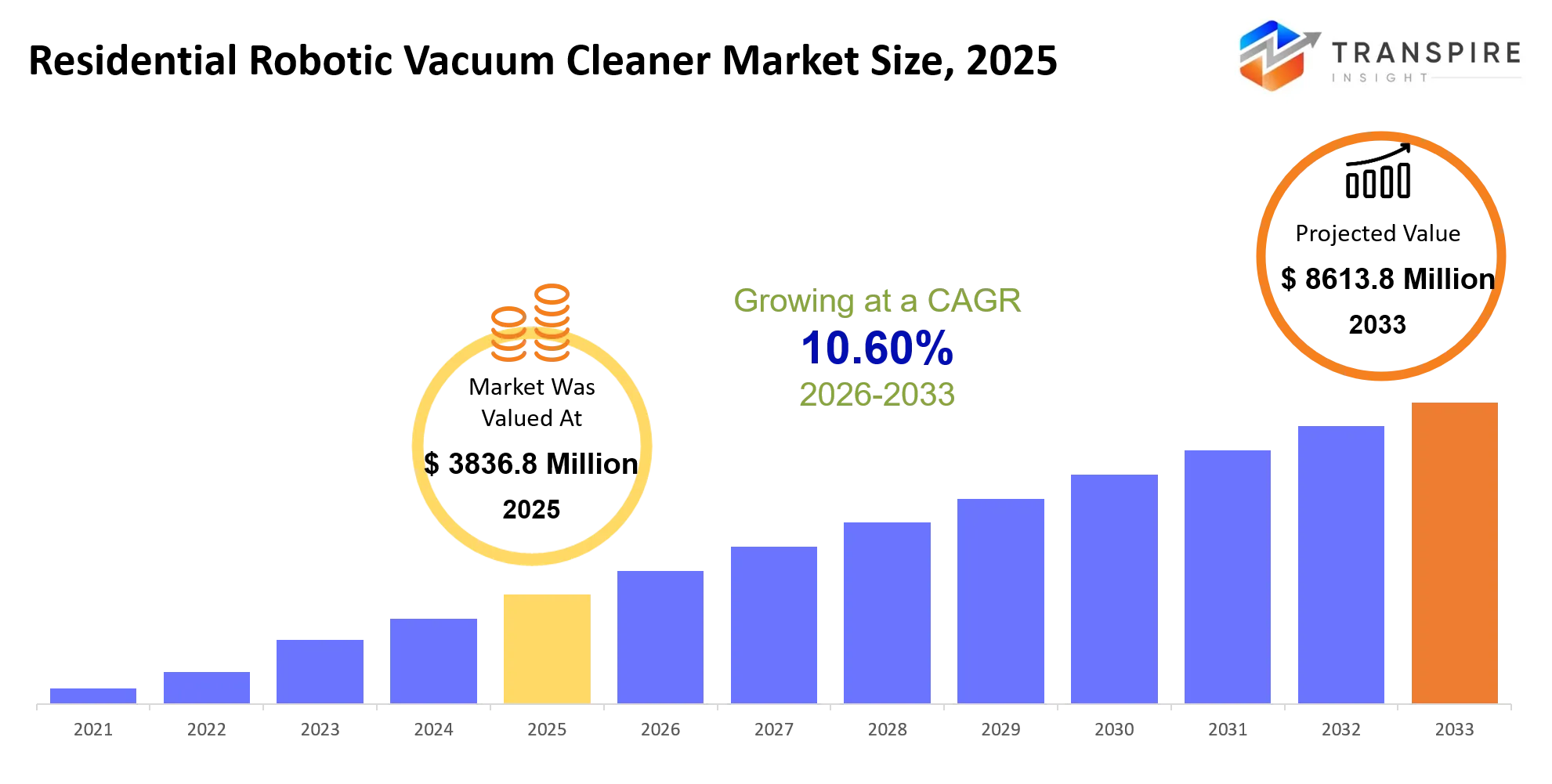
- Market Value (2025): USD 3836.8 Million
- Expected Market Value (2026): USD 4243.9 Million
- Estimated Market Value (2033): USD 8613.8 Million
- Forecast CAGR (2026–2033): 10.60%
- Leading Region in 2025: Asia Pacific
- Second-largest Region: North America Europe
- Fastest Growing Region: Europe
Introduction
The Residential Robotic Vacuum Cleaner Market is growing steadily as more consumers adopt smart home technologies and automated cleaning solutions to increase convenience and efficiency. Residential robotic vacuum cleaners are smart home devices that use advanced navigation technology, intelligent sensors and AI-powered mapping systems to autonomously clean indoor floors. They excel at obstacle detection, optimizing their cleaning routes and operating with minimal or no human intervention, all while seamlessly integrating into connected home ecosystems. Robotic intelligence is getting better, as are self-maintenance features and multi-function cleaning (vacuuming and mopping), all of which improve product performance and customer satisfaction. The market is still expanding due to the increasing need for home appliances that save time, growing urbanization, rising disposable income, and increasing smart home adoption, compelling manufacturers to provide innovative, energy-efficient and technologically advanced robotic vacuum cleaning solutions for residential applications.
For instance:-
- North America: North America leads the way in adopting premium residential robotic vacuum cleaners. This is due to robust consumer spending, AI-driven innovation, smart home integration, and significant investments in autonomous navigation and self-maintenance technologies.
- Asia-Pacific: Asia-Pacific has the largest share in the residential robotic vacuum cleaner market due to the presence of bulk manufacturing, fast-paced AI innovation, government-supported robotics projects, and increasing demand among consumers in China, Japan, South Korea, and India.
Key Market Highlights: -
- Asia Pacific is expected to grow at a rapid CAGR in the Residential Robotic Vacuum Cleaner Market by holding around40% of the share during the forecast period.
- North America is anticipated to hold roughly42% share of the Residential Robotic Vacuum Cleaner Market over the predicted timeframe.
- Europe is anticipated to hold nearly 30%share of the Residential Robotic Vacuum Cleaner Market over the predicted timeframe.
- 4 By Product Type, the Vacuum & Mop Robots dominated the market and holds nearly 61% share in 2025 and is projected to grow at a substantial CAGR during the forecast period.
- 5 By Navigation Technology, the LiDAR Navigation dominated the market and holds close to 45% share in 2025 and is projected to grow at a substantial CAGR during the forecast period.
- By Distribution Channel, the Online Retail dominated the market and holds about 35% share in 2025 and is projected to grow at a substantial CAGR during the forecast period.
- The residential robotic vacuum cleaner market is witnessing technological advancement and long-term growth owing to government initiatives on smart manufacturing, AI innovation, energy efficient appliances, e-waste management, battery safety standards and smart home adoption.
How is Technology Driving Growth in the Residential Robotic Vacuum Cleaner Market?
Technology is a key driver in the residential robotic vacuum cleaner market. Innovations in artificial intelligence, LiDAR-based navigation, and smart home connectivity are improving product efficiency and user convenience. AI-powered mapping and obstacle detection offer thorough, systematic cleaning, with seamless connectivity to smart home platforms for voice control and remote operation. Multifunctional vacuum-and-mop systems enhance the cleaning performance on a variety of floor surfaces, and self-maintenance features such as automatic dust disposal, battery charging, and mop cleaning reduce manual effort. Such innovations are further accelerating consumer adoption and driving sustained market expansion.
Market Drivers
Regional investments with continuous innovation, expanding manufacturing capacity and increasing consumer adoption are significantly driving the growth of the Residential Robotic Vacuum Cleaner Market.Demand for advanced robotic cleaning solutions is being driven by strong investments in artificial intelligence, LiDAR-based navigation, and high-end smart home technologies in North America. Asia-Pacific is expected to be the largest market due to extensive manufacturing, government support for robotics, cost-effective manufacturing, and rapid technological advancements in the large economies. At the same time, Europe is pushing market development with tough sustainability regulations, data privacy standards, energy-efficient product requirements and investments in intelligent navigation systems. These regional efforts, together, are leading to innovation, improved product performance and long-term growth in markets.
For Instance
Europe: The market in Europe is projected to grow robustly due to the strict sustainability regulations, and the use of AI, GDPR-compliant navigation technologies, and the growing demand for energy-efficient and smart residential robotic vacuum cleaning solutions by consumers.
Restrain
The Residential Robotic Vacuum Cleaner Market faces challenges due to the high cost of advanced models, limiting adoption in price-sensitive markets. Performance may be limited by heavy carpeting, complex home layouts, tight corners and low-clearance furniture, which can reduce cleaning efficiency. Further, the limitations of battery life, long charging times and the continuing costs of maintenance (e.g. sensor and battery replacements) increase the total cost of ownership and restrict wider consumer adoption and market growth
Analysis of Prices and Consumer Behaviour
The market for residential robotic vacuum cleaners is dominated by LiDAR-based robotic vacuum cleaners (approximately 42% of the total market), primarily driven by strong demand for intelligent navigation, precise mapping, and automated home cleaning.Premium AI-enabled robotic vacuum cleaners with self-emptying docks and hybrid vacuum-mop functionality are generally 30–45% pricier than standard entry-level models due to their advanced sensors, intelligent navigation, longer battery life, and self-maintenance features. The sales of hybrid vacuum-and-mop robotic cleaners represent about 48% of total unit sales, propelled by growing consumer demand for multi-functional cleaning solutions. The demand for household cleaning application accounts for nearly 89% of the total market demand, indicating widespread acceptance of automated floor cleaning technologies. Consumer buying behaviour shows that around 58% of buyers are looking for AI-driven navigation, cleaning efficiency, battery performance and smart home compatibility. Around 35% of consumers are inclined to buy during promotional campaigns, online discounts or bundled offers to get maximum value and reduce the overall cost of ownership.
Top Companies in the Residential Robotic Vacuum Cleaner Market
- iRobot
- Ecovacs
- Roborock
- Dreame Technology
- Samsung Electronics
- Xiaomi
- LG Electronics
- SharkNinja
- Dyson
- Midea
- Panasonic
- Neato Robotics
- ILIFE
- Proscenic
- Eureka
Residential Robotic Vacuum Cleaner Market Segmentation
The Residential Robotic Vacuum Cleaner Market share is divided into five categories: By Source, By Product Type, By Recycling Process, By End User, By Distribution Channel.
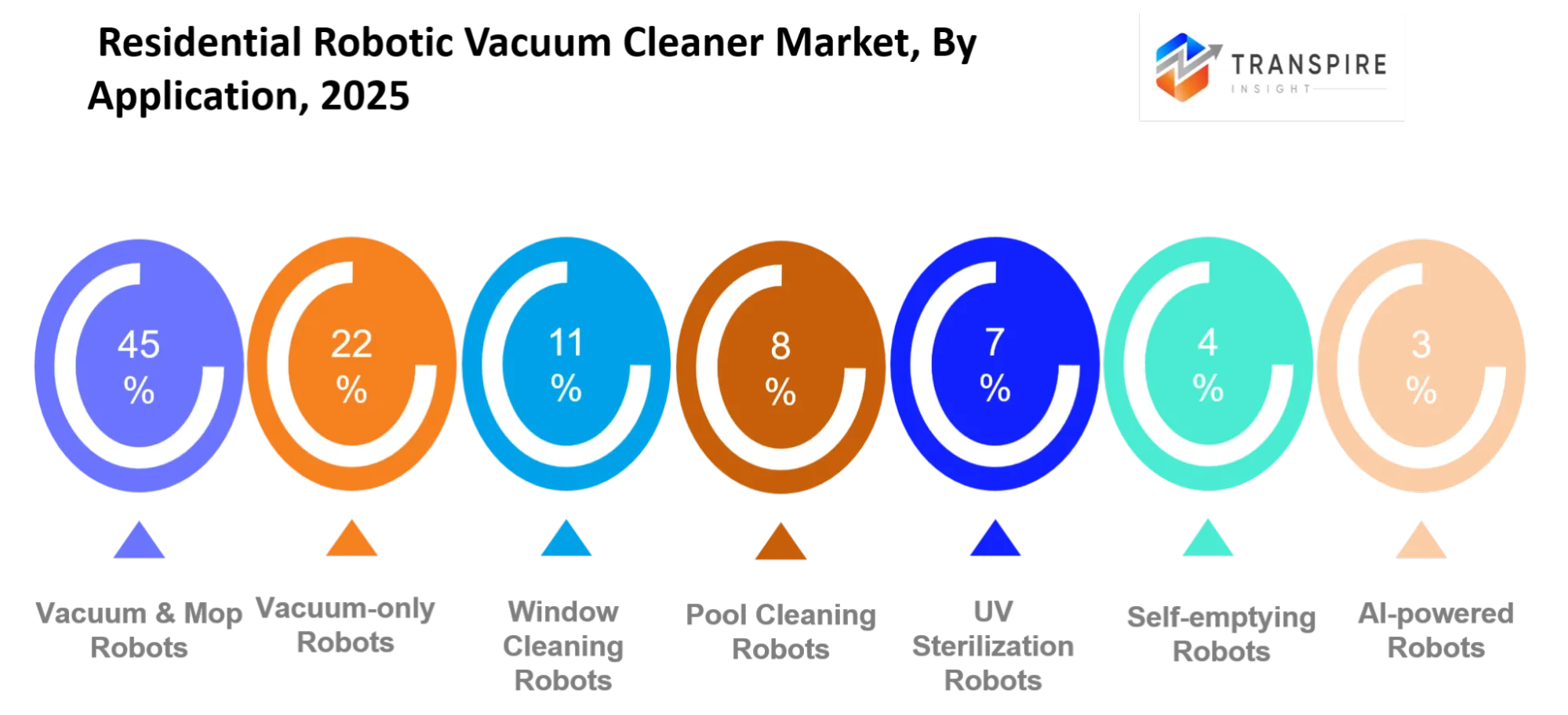
The Vacuum & Mop Robots dominated the market, accounting for nearly 61% in 2025 and is expected to rise at a significant CAGR during the forecast period.
The Residential Robotic Vacuum Cleaner Market is segmented by product type into vacuum-only robots, vacuum & mop robots, window cleaning robots, pool cleaning robots, uv sterilization robots, self-emptying robots, ai-powered robots, others. Among these, the Vacuum & Mop Robots dominated the market, accounting for nearly 61% in 2025 and expected to increase at a significant CAGR during the forecast period. Vacuum & mop robots dominated the market owing to increasing demand for multi-functional cleaning, more convenience, better floor care efficiency and smart home compatibility.
The LiDAR Navigation dominated the market, accounting for close to 45% in 2025, and is expected to rise at a significant CAGR during the forecast period
The Residential Robotic Vacuum Cleaner Market is segmented by navigation technology into lidar navigation, camera-based navigation, gyroscope navigation, infrared navigation, slam mapping, ai navigation, hybrid navigation, others. Among these, the LiDAR Navigation dominated the market, accounting for close to 45% in 2025 and expected to increase at a significant CAGR during the forecast period. The market was dominated by LiDAR navigation due to improved mapping accuracy, smart obstacle detection, systematic cleaning efficiency and more people buying premium robotic vacuums.
The Online Retail dominated the market, accounting for about 35% in 2025 and is expected to rise at a significant CAGR during the forecast period.
The Residential Robotic Vacuum Cleaner Market is by distribution channel into online retail, consumer electronics stores, hypermarkets, brand stores, home appliance dealers, direct sales, specialty stores, others. Among these, the Online Retail dominated the market, accounting for about 35% in 2025 and expected to increase at a significant CAGR during the forecast period. The online retail sector became the market leader due to the wide variety of products offered, competitive prices, convenient home delivery, feedback from consumers, and appealing special offers.
Regional Segment Analysis of the Residential Robotic Vacuum Cleaner Market
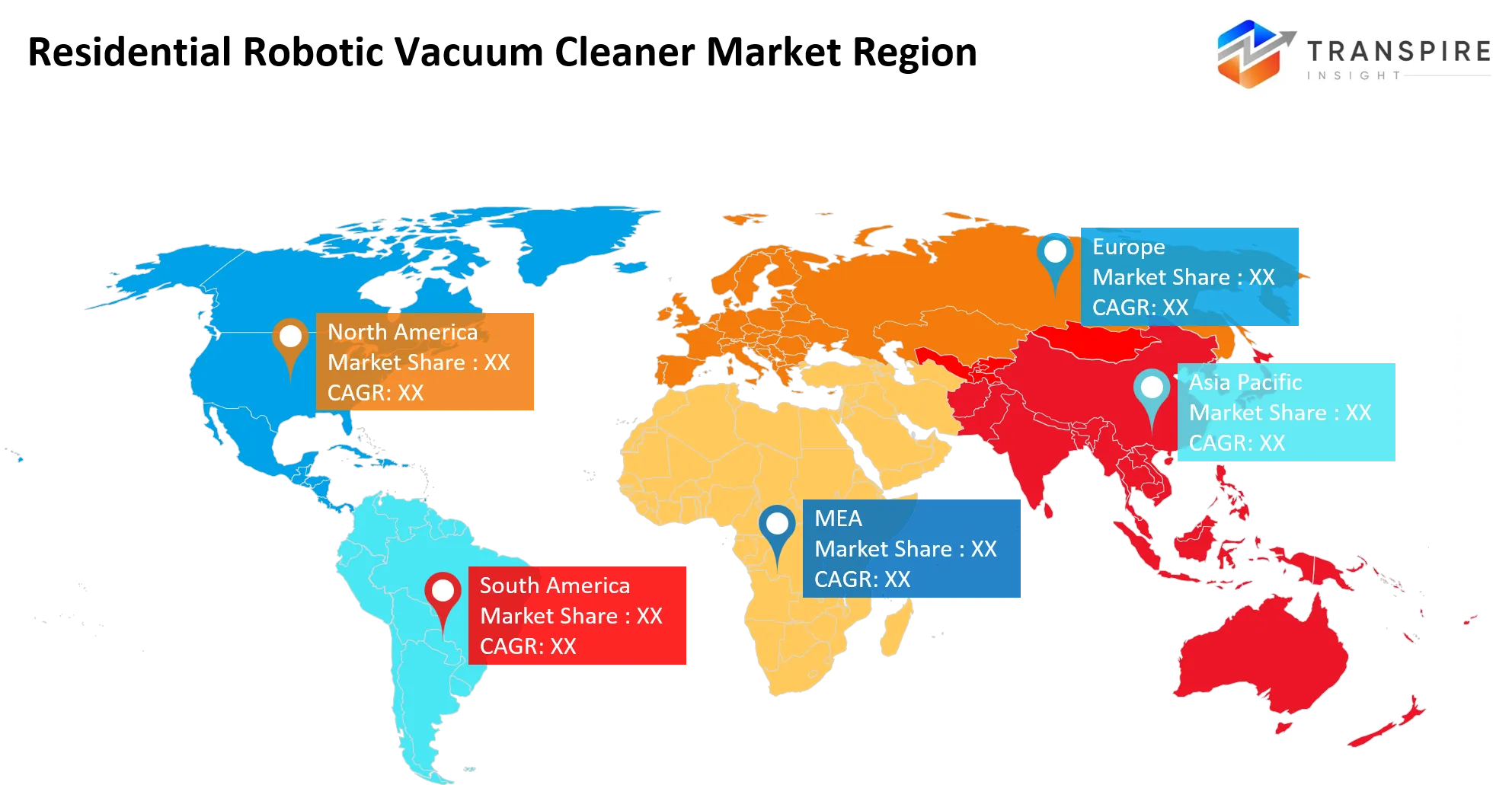
- Europe (Germany, France, U.K., Italy, Spain, Rest of Europe)
- North America (U.S., Canada, Mexico)
- Asia-Pacific (China, Japan, India, Rest of APAC)
- South America (Brazil and the Rest of South America)
- The Middle East and Africa (UAE, South Africa, Rest of MEA)
Asia Pacific is expected to grow at a rapid CAGR in the Residential Robotic Vacuum Cleaner Market, holding around 40% of the share during the forecast period.
The Asia Pacific region leads the Residential Robotic Vacuum Cleaner Market, due to its strong electronics manufacturing ecosystem, fast adoption of smart homes, rising disposable income and growing urban population. Innovations are driven by leading economies such as China, Japan and South Korea, fuelled by ongoing investment in artificial intelligence, robotics and automated manufacturing. Competitive production costs, high e-commerce penetration and rising consumer preference for intelligent home cleaning solutions further support the region’s market leadership and long-term growth prospects.
North America is the fastest-growing region in the Residential Robotic Vacuum Cleaner Market during the period, holding roughly 42% share.
North America leads the Residential Robotic Vacuum Cleaner Market due to high consumer purchasing power, widespread adoption of smart home technologies, and strong demand for premium automated cleaning solutions. Continuous investments in artificial intelligence, IoT-enabled home ecosystems, and advanced robotics accelerate product innovation across the region. In addition, the high awareness of appliances that provide convenience, the well-developed e-commerce networks, and the presence of leading robotic vacuum manufacturers are supporting the ongoing market growth and regional leadership.
Europe is the fastest-growing region in the Residential Robotic Vacuum Cleaner Market during the period, holding nearly 30% share.
The Residential Robotic Vacuum Cleaner Market is growing in Europe due to increasing penetration of smart home technologies, rising demand for energy-efficient household appliances and high consumer preference for automated cleaning solutions.Stringent environmental regulations, sustainability initiatives and advancements in artificial intelligence navigation technologies are driving the continued innovation of products. Additionally, healthy disposable income, growing e-commerce channels and increasing investments in connected home ecosystems are supporting the long-term market expansion for the region.
Strategies for Market Growth in Non-Leading Regions:
The emergence of cost-effective and scalable manufacturing technologies for residential robotic vacuum cleaners in non-leading regions would benefit emerging manufacturers and regional electronics producers. Establishment of local production facilities, assembly units of components, along with supply chains, could help reduce dependence on imports, optimize production costs and make products more affordable. Building strategic alliances with technology providers, smart home platform developers, electronics retailers, e-commerce platforms and regional distributors to enhance market penetration and reach consumers.Training programs should be implemented to enhance the workforce’s capabilities of AI integration, robotics engineering, software development, after-sales service and technical support to increase product adoption. Flexible financing options, installment payment plans, subscription-based ownership models, long-term distribution agreements, and contract manufacturing partnerships will also make residential robotic vacuum cleaners affordable for consumers. The development of collaborative initiatives with government smart manufacturing programs, digital transformation policies, electronics industry associations, and Industry 4.0 initiatives, together with expanding digital marketing strategies and online retail channels, will improve product accessibility and support sustainable long-term growth in developing regions.
Future Market Trends for the Residential Robotic Vacuum Cleaner Market: -
- Next-generation residential robotic vacuum cleaners will be enhanced with AI-enabled navigation, LiDAR mapping and sophisticated obstacle detection technologies to improve the accuracy of cleaning, autonomous decision making and operational efficiency.
- Standard features will include hybrid vacuum-and-mop functionality, self-emptying dust collection, automatic mop washing, and self-charging capabilities, which will enhance convenience and drive consumer demand for intelligent home cleaning solutions.
- Growing smart home integration, IoT connectivity, voice assistant compatibility, and continuous advancements in robotics and artificial intelligence will support sustained innovation and long-term market expansion worldwide.
Recent Development
January 2026 –
Roborock: Roborock launched the Saros Rover at CES 2026, introducing an AI-powered wheel-leg mobility system with advanced stair-climbing capabilities, significantly enhancing autonomous residential robotic vacuum cleaner performance.
March 2026 –
AI Navigation: Leading manufacturers introduced premium robotic vacuum cleaners featuring multi-camera RGB-infrared navigation, photorealistic 3D mapping, and secure onboard data storage, improving cleaning precision, privacy, and operational efficiency.
June 2026 –
Strategic Alliances: BSH Home Appliances and Ecovacs Robotics extended strategic alliances to accelerate innovation in AI-powered residential robotic vacuum cleaners, improving smart home integration and advanced automated floor-care technologies.
This study forecasts revenue at global, regional and country levels from 2020 to 2033. Transpire Insights has segmented the Residential Robotic Vacuum Cleaner Market based on the below-mentioned segments:
Residential Robotic Vacuum Cleaner Market, By Product Type
- Vacuum-only Robots
- Vacuum & Mop Robots
- Window Cleaning Robots
- Pool Cleaning Robots
- UV Sterilization Robots
- Self-emptying Robots
- AI-powered Robots
- Others
Residential Robotic Vacuum Cleaner Market, By Navigation Technology
- LiDAR Navigation
- Camera-based Navigation
- Gyroscope Navigation
- Infrared Navigation
- SLAM Mapping
- AI Navigation
- Hybrid Navigation
- Others
Residential Robotic Vacuum Cleaner Market, By Distribution Channel
- Online Retail
- Consumer Electronics Stores
- Hypermarkets
- Brand Stores
- Home Appliance Dealers
- Direct Sales
- Specialty Stores
- Others
Residential Robotic Vacuum Cleaner Market,By Price Range
- Entry-level
- Mid-range
- Premium
- Luxury
- Subscription Models
- Refurbished
- Smart Home Bundles
- Others
Residential Robotic Vacuum Cleaner Market, By End User
- Apartments
- Independent Homes
- Senior Citizens
- Smart Homes
- Pet Owners
- Working Professionals
- Property Managers
- Others
Residential Robotic Vacuum Cleaner Market, By Regional Analysis
North America
- US
- Canada
- Mexico
Europe
- Germany
- UK
- France
- Italy
- Spain
- Russia
- Rest of Europe
Asia Pacific
- China
- Japan
- India
- South Korea
- Australia
- Rest of Asia Pacific
- South America
- Brazil
- Argentina
- Rest of South America
Middle East & Africa
- UAE
- Saudi Arabia
- Qatar
- South Africa
- Rest of the Middle East & Africa
Frequently Asked Questions
Find quick answers to common questions.
Market growth is driven by AI-powered navigation, smart home integration, rising automation demand, multifunctional cleaning features, and increasing consumer preference for convenient household solutions.
Market growth is driven by AI-powered navigation, smart home integration, rising automation demand, multifunctional cleaning features, and increasing consumer preference for convenient household solutions.
LiDAR navigation delivers superior mapping accuracy, intelligent obstacle detection, systematic cleaning efficiency, and enhanced autonomous performance, making it the preferred navigation technology.
Vacuum & Mop Robots lead the market due to multifunctional cleaning capabilities, improved convenience, enhanced floor care efficiency, and growing smart home compatibility.
Asia-Pacific leads through strong electronics manufacturing, AI innovation, government robotics support, expanding urbanization, and increasing adoption of smart home technologies.
Future trends include AI-powered navigation, hybrid vacuum-mop systems, self-maintenance features, IoT connectivity, and advanced robotics improving cleaning efficiency and user convenience.
- iRobot
- Ecovacs
- Roborock
- Dreame Technology
- Samsung Electronics
- Xiaomi
- LG Electronics
- SharkNinja
- Dyson
- Midea
- Panasonic
- Neato Robotics
- ILIFE
- Proscenic
- Eureka
About the Authors

Chetan Dhatrak
I’m Chetan Dhatrak, a Senior Research Analyst at Transpire Insight, specializing in the Consumer Goods, Foods and Beverages industry. I focus on analyzing market trends, consumer behavior, competitive landscapes, and industry developments to deliver accurate, data-driven insights. My research at Transpire Insight is built on credible sources and in-depth analysis, helping businesses and readers better understand market dynamics, emerging opportunities, and evolving consumer preferences. I’m committed to creating reliable, well-researched content that supports informed decision-making and reflects the latest developments in the consumer goods and food & beverage sectors.

Chakradhar Khansole
Chakradhar serves as the Research Director at Transpire Insight, bringing over 8 years of experience in technology, innovation, and strategic market intelligence. He specializes in transforming complex market data into actionable business insights that enable organizations to make informed, growth-oriented decisions. Recognized for his strategic vision and analytical expertise, Chakradhar leads high-impact research initiatives, delivering comprehensive market assessments, competitive intelligence, and forward-looking industry analysis.
Recently Published Reports
-
Apr 2026
Bottled Water Market
Bottled Water Market Size, Share & Analysis Report By Product Type (Still Bottled Water, Carbonated Bottled Water, Functional Bottled Water, and Others), By Packaging (PET, Cans, and Others), By Sales Channel (Supermarkets/Hypermarkets, Convenience Stores/Drug Stores, Grocery Stores/Club Stores, Foodservice, and Others) and Geography (North America, Europe, Asia-Pacific, Middle East and Africa, South and Central America), 2021 - 2032
-
Apr 2026
Color Cosmetic Packaging Market
Color Cosmetic Packaging Market Size, Share & Analysis Report By Application (Mascara Packaging, Liquid Packaging, and Liquid Face), By Type (Tubes & Bottles, Pens & Markers, Compacts & Containers, and Droppers & Pumps), and Geography (North America, Europe, Asia-Pacific, Middle East and Africa, South and Central America), 2021 - 2031
-
Apr 2026
External Microphone For Camera Market
External Microphone For Camera Market Size, Share & Analysis Report By Type (Shotgun Microphone, Lavalier Microphone, and Others), By Application (Digital Camera, Professional Video Camera, and Others), and Geography (North America, Europe, Asia-Pacific, Middle East and Africa, South and Central America), 2021 - 2031
-
Apr 2026
Foot Orthotic Insoles Market
Foot Orthotic Insoles Market Size, Share & Analysis Report By Type (Pre-fabricated, and Custom-made), By Material (Thermoplastic, Composite Carbon Fiber, and Others), By Distribution Channel (Drug Stores, Hospitals & Clinics, and Others), and Geography (North America, Europe, Asia-Pacific, Middle East and Africa, South and Central America), 2021 - 2031