

Europe Mobile 3D Market Summary
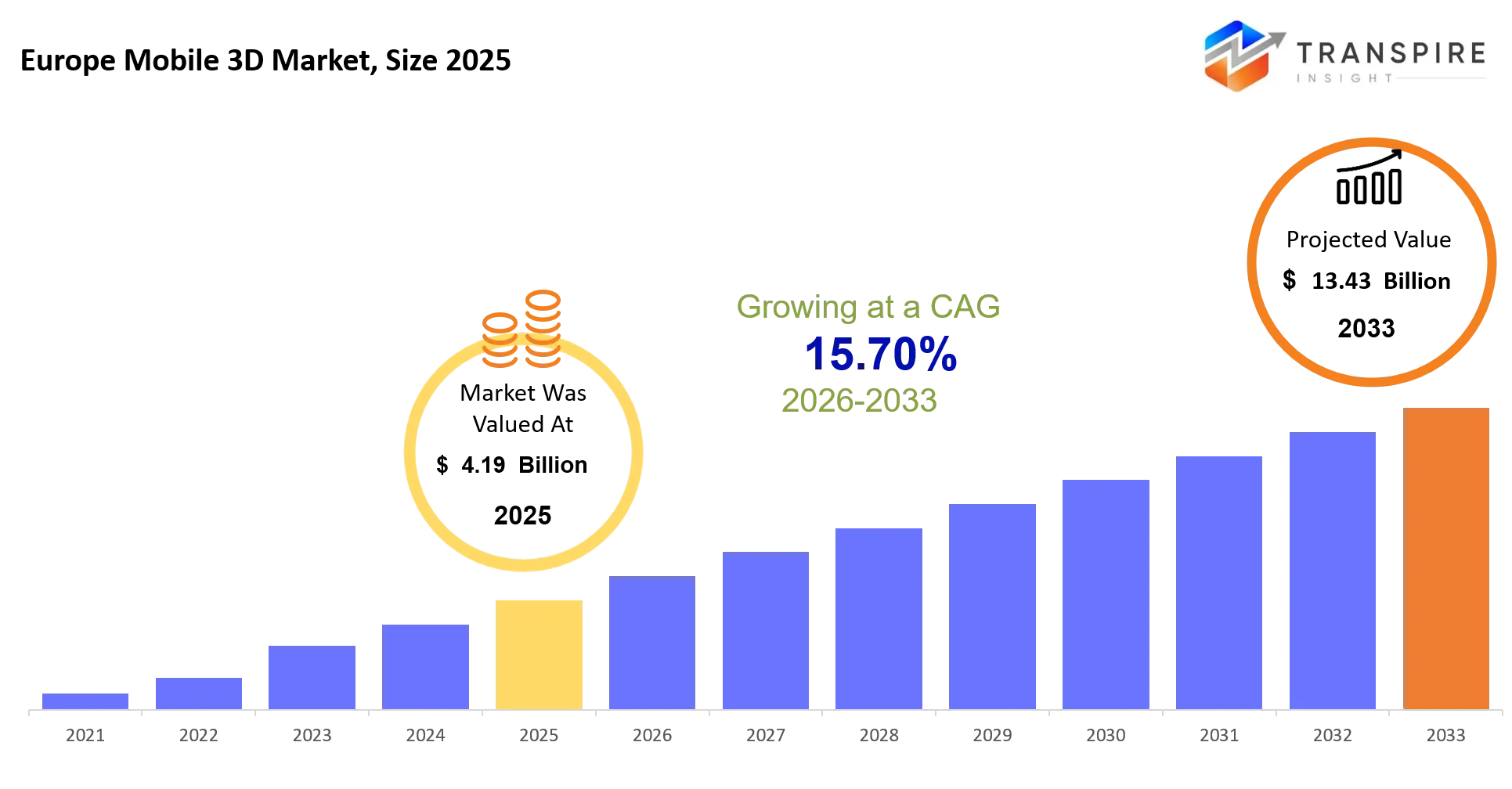
As per Transpire Insight Analysis, the Europe Mobile 3D Market size is estimated at USD 4.19 Billion in 2025 and is anticipated to reach USD 13.43 Billion by 2033, growing at a CAGR of 15.70% from 2026 to 2033.
The Europe Mobile 3D Market helps industrial operators make fairly accurate digital images of assets, infrastructure, and surrounding zones out in the field, so inspections get faster, maintenance planning feels smoother , and operational choices are more grounded even when you are not only relying on manual measurements. Over the last 3–5 years, the market moved away from standalone 3D scanning tools, toward integrated mobile solutions that blend LiDAR with cameras, cloud platforms, and AI driven processing. One big reason was the whole push for digital transformation across industries after supply chain disruptions, plus tougher asset management duties , so suddenly the need grew for quick remote reviews and data you can actually trust. Demand is also fueled by how mobile 3D systems cut down downtime, raise safety levels, and back predictive maintenance strategies. And as European industries modernize plants and start leaning into digital twins, investment in portable 3D capture technologies will keep stretching outward, bit by bit.
Europe Mobile 3D Market Size & Forecast:
- Europe Mobile 3D Market Size 2025: USD 4.19 Billion
- Expected Market Value 2033: USD 13.43 Billion
- Forecast CAGR: 15.70%
- Leading region in 2025: Germany, the United Kingdom, France, and Italy
- Fastest Growing region: Sweden, Denmark, Norway, the Netherlands, Poland, and Austria
- Key Profile: Apple, Samsung Electronics, Sony, Qualcomm, Google, Unity Technologies, NVIDIA, ARM, MediaTek, Qualcomm Technologies, Leica Geosystems, Autodesk, Epic Games, Huawei, HTC
Key Market Insights
- Western Europe really takes the lead , with roughly 55% market share in 2025, fueled mostly by Germany UK France and Italy’s industrial digitalization programs, kinda like “everythings syncing up” at once.
- Northern and Central Europe should be the quickest mover over 2025–2033, backed by smart factory investments in Sweden and Netherlands.
- On the split by component, the hardware segment is in front with almost 60% share, because LiDAR scanners, and mobile mapping devices still stay the main adoption magnets.
- The software segment sits in second place , and keeps stretching thanks to cloud based processing , plus 3D visualization platforms that help teams see more , faster.
- AI integrated mobile 3D solutions are the fastest growing slice through 2033, supporting automated assessment and inspection routines, without so much manual review.
- For application types, industrial inspection apps dominate at about 35% share in 2025, mainly driven by manufacturing quality control needs that are non negotiable.
- Meanwhile construction and infrastructure applications show the fastest growth through 2033, as digital twin projects roll out across European cities , step by step.
- Looking at end users, manufacturing leads with nearly 40% share, since industrial operators adopt mobile 3D systems for precision production monitoring and finer feedback loops.
- Finally, energy and utilities are expected to become the fastest-growing end user category through 2033, largely from infrastructure modernization efforts that keep piling up.
What are the Key Drivers, Restraints, and Opportunities in the Europe Mobile 3D Market?
The primary growth driver is the shift toward digital twins and automated asset inspections, or so it feels like. European manufacturers adopted mobile 3D systems after Industry 4.0 investments pushed down deployment costs and made the data more reachable, easier to get to. Once LiDAR, AI processing, and cloud platforms got tied together, the inspection time dropped, and that has been speeding up adoption across automotive, aerospace, and various industrial facilities. In a sense, this tech change is turning manual surveying tasks into recurring software enabled workflows, and that is creating new revenue avenues for solution providers.
The main restraint is still the high cost of integrating mobile 3D platforms with existing enterprise systems. A lot of industrial operators remain stuck with disjointed data landscapes, so the rollout gets complex and slow, not just annoying. Those integration delays can stretch digital transformation timelines by months and, in practice, hold back adoption among small to mid sized manufacturers. On top of that, there is limited availability of trained operators, which raises training expenses and reduces how fast deployments can happen.
The next opportunity sits with AI powered 3D analytics, paired up with edge computing. Germany, the Netherlands, and the Nordic countries are putting money into smart factories and connected infrastructure, so conditions look good for automated defect detection, predictive maintenance, and real time 3D decision systems.
What Has the Impact of Artificial Intelligence Been on the Europe Mobile 3D Market?
Artificial intelligence and digital technologies are kinda reshaping mobile 3D solutions, not just by “speeding things up” but by improving data capture, analysis, and day to day operational choices across European industries. With AI in the mix, algorithms now handle point cloud processing, object recognition, and even inspection report creation, so manual checking gets less needed in manufacturing plants, construction sites ,and broader infrastructure ventures. And then machine learning models chew on prior 3D data and surface equipment deterioration behaviors, they help forecast when maintenance is likely, plus they tune inspection timetables so breakdowns are less likely to happen, basically before things go wrong.
On top of that, digital platforms boost efficiency by tying mobile scanning devices into cloud based environments. This makes it possible for teams to collaborate earlier, cut down on paperwork mistakes, and keep compliance monitoring on track for regulated industries. In fact, some industrial users say they saw meaningful drops in inspection cycles and better asset visibility after they integrated automated 3D workflows, pretty quickly.
Still, AI adoption isn’t totally effortless. There are limitations, like high integration costs, since many companies need upgrades to legacy systems first before advanced analytics can be deployed. Also, accuracy can wobble in complicated conditions, where tricky lighting, incomplete datasets, or connectivity issues interfere with how the model performs. But as the data infrastructure keeps improving, AI enabled mobile 3D technologies will likely become more accepted across industry, and eventually more widely used.
Key Market Trends
- Since 2020, LiDAR enabled mobile 3D systems kind of took off, as manufacturers swapped out the manual measurement thing with automated digital capture flows, more or less.
- After 2021, cloud based 3D processing platforms really started to grow, so teams could work from a distance and push projects forward quicker across European industrial sites.
- Then starting after 2022, AI powered scanning analytics showed up, letting people do automated defect detection and cutting down on human involvement during inspections, overall.
- Between 2021 and 2025, digital twin adoption kind of sped up a lot, and that opened these fresh doors for folding mobile 3D data straight into factories, in a more practical way.
- In Europe, construction companies ramped up BIM tied 3D usage after 2022 , it helped project alignment match up better, and also cut down on design related missteps.
- From 2020 onward, automotive manufacturers broadened the mobile 3D inspection approach to support electric vehicle production accuracy, quietly, but steadily.
- After 2023, portable scanning gear became more compact, so taking it to the field felt easier across energy, infrastructure, and engineering use cases.
- After 2021, sustainability rules basically nudged digital monitoring tools into the spotlight, which reduced material waste and improved day to day operational efficiency , too.
- And after 2022, collaboration between hardware providers and software companies grew , resulting in integrated 3D workflow ecosystems across Europe, more connected than they had been before.
Europe Mobile 3D Market Segmentation
By Technology :
3D display technology kindof supports immersive visualization for gaming, healthcare, retail, and industrial use cases , and people keep noticing it more and more. Manufacturers will likely keep polishing display quality , raising resolution, and improving energy efficiency to back wider adoption. Meanwhile 3D imaging solutions are starting to really take hold, mostly thanks to advanced cameras, sensors and scanning technologies that help with precise digital capture , it’s not just a vibe.
On the other side of the workflow, 3D mapping and 3D modeling software are getting more important for construction, manufacturing, and infrastructure planning. AR/VR integration should open up fresh chances, through interactive experiences, and also simulation- based training that feels way more practical. Software improvements will speed up data processing and help teams run smoother 3D workflows, with fewer slowdowns.
By Device Type :
Smartphones remain a big device category because camera upgrades are everywhere and processing keeps improving. Mobile manufacturers will probably keep embedding advanced depth sensors and add 3D features, to improve both photography and gaming, plus the overall user experience. Tablets are also getting attention for professional visualization , and design tasks where you want bigger screens.
Wearable devices are expected to grow too, especially with apps tied to healthcare, fitness, and augmented reality experiences. With compact hardware development, and better sensor performance, adoption should expand across more users and more situations. Device innovation in general will keep strengthening demand in both consumer, and professional markets.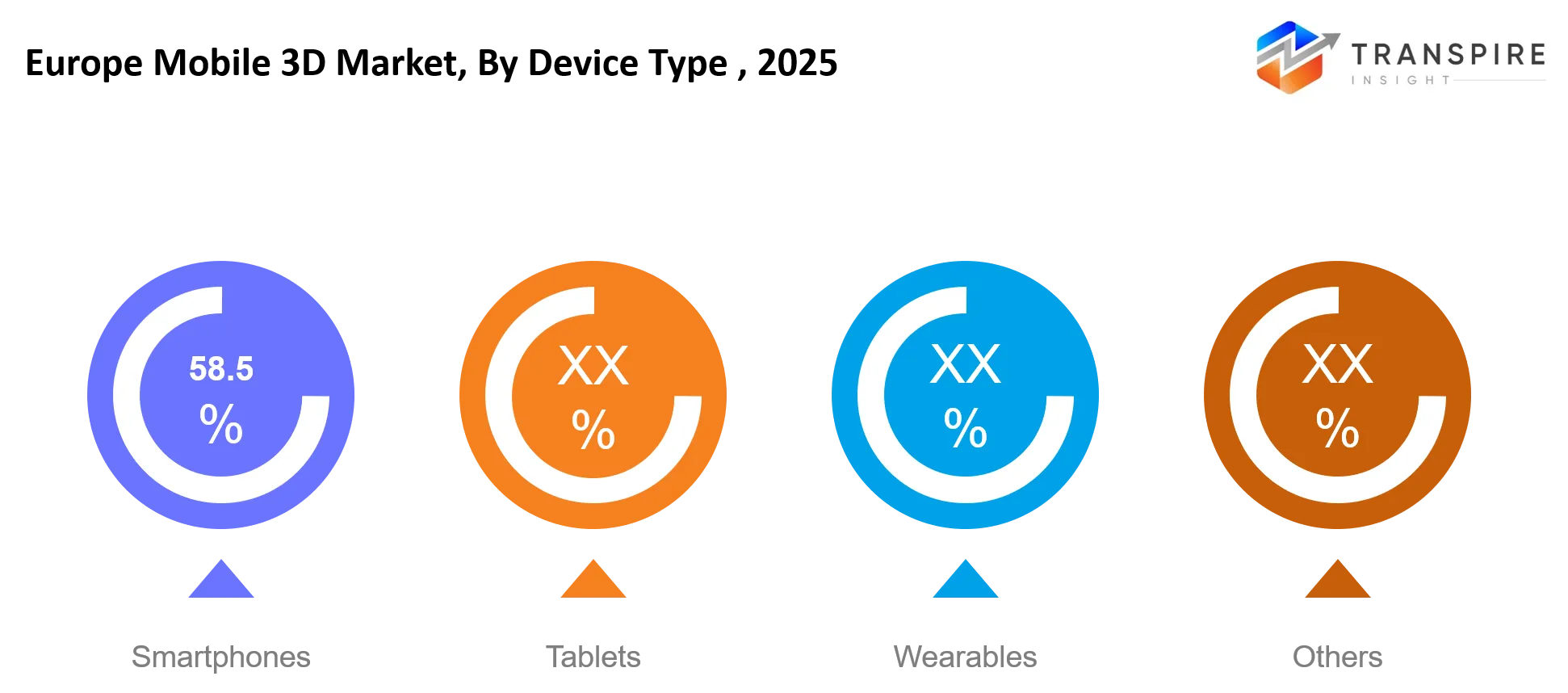
By Application :
Gaming is still one of the big application areas, because developers leverage 3D technologies for more immersive surroundings and realistic interactions, sort of like it feels less like “just a screen”. Entertainment platforms will keep grabbing on advanced visualization tools, to push digital experiences even further, and make them feel a bit more alive. In healthcare, things are also moving, with medical imaging, surgical planning and patient education solutions all widening in scope.
Retail and e-commerce will lean on 3D visualization as well, helping with better product display and deeper customer engagement. Education apps should grow too, through interactive learning models and virtual training environments that are easier to repeat. Overall digital adoption across multiple industries will open extra doors for mobile 3D applications, especially where quick access matters.
By End User :
As for end-users, consumers are a strong group, mainly because smartphones are already equipped for 3D features and immersive digital content. Enterprises will likely increase their uptake for design, inspection, training, and operational improvement routines. Healthcare providers are also expected to use mobile 3D solutions for strengthened diagnostics, plus clearer treatment planning.
Educational institutions will adopt interactive 3D tools to support hands-on learning approaches. Enterprise funding should stay meaningful, since many industries want faster visualization and better, more informed decision-making cycles. And both consumer and professional applications will keep expanding, as technology improvements keep coming.
By Component :
Hardware still matters most, mostly because you need cameras, sensors, processors and scanning gear. The providers will probably aim at smaller builds, better precision, and reduced manufacturing costs , it’s sort of the usual move. Meanwhile the software part will climb in significance, for example with data processing, analytics and cloud based 3D platforms.
Services will back the whole story , meaning setup, upkeep, and tailoring across various industries. As the software gets more capable it will boost usability, and day to day operational efficiency. And then component improvements will help push mobile 3D deployments further, across European markets too.
What are the Key Use Cases Driving the Europe Mobile 3D Market?
The industrial inspection and asset documentation angle pretty much drives the Europe Mobile 3D Market, and it is mostly pushed by enterprise customers from manufacturing , automotive , and infrastructure spaces. Factories as well as engineering teams grab mobile 3D solutions so they can upgrade quality checks , cut down inspection time, and also keep reliable digital records for maintenance planning.
On another side, healthcare imaging and construction visualization are starting to pick up speed among hospitals, contractors, and design offices. Medical providers use 3D capture for surgery prep , while construction companies lean on digital models for project coordination plus compliance oversight. Even retail brands have begun taking on 3D product visualization, mostly to make online shopping feel more clear and immersive.
There are also newer tasks coming in, like AI driven remote inspections, and augmented reality training, seen across energy , utilities, and education . Utility operators along with technical institutes will likely try mobile 3D workflows for safer field work, skill advancement, and quicker decisions throughout the forecast period.
|
Report Metrics |
Details |
|
Market size value in 2025 |
USD 4.19 Billion |
|
Market size value in 2026 |
USD 4.84 Billion |
|
Revenue forecast in 2033 |
USD 13.43 Billion |
|
Growth rate |
CAGR of 15.70% from 2026 to 2033 |
|
Base year |
2025 |
|
Historical data |
2021 - 2024 |
|
Forecast period |
2026 - 2033 |
|
Report coverage |
Revenue forecast, competitive landscape, growth factors, and trends |
|
Country scope |
Europe (Germany, United Kingdom, France, Italy, Spain and Rest of Europe) |
|
Key company profiled |
Apple, Samsung Electronics, Sony, Qualcomm, Google, Unity Technologies, NVIDIA, ARM, MediaTek, Qualcomm Technologies, Leica Geosystems, Autodesk, Epic Games, Huawei, HTC . |
|
Customization scope |
Free report customization (country, regional & segment scope). Avail customized purchase options to meet your exact research needs. |
|
Report Segmentation |
By Technology (3D Display, 3D Imaging, 3D Mapping, 3D Modeling Software, AR/VR Integration, Others); By Device Type (Smartphones, Tablets, Wearables, Others); By Application (Gaming, Entertainment, Healthcare, Retail & E-commerce, Education, Others); By End User (Consumers, Enterprises, Healthcare Providers, Educational Institutions, Others); By Component (Hardware, Software, Services, Others) |
Which Regions are Driving the Europe Mobile 3D Market Growth?
Industrial activity in Western Europe kind of dominates the Europe Mobile 3D Market, with about 55% share in 2025, it’s backed by strong manufacturing bases in Germany, France ,the UK, and Italy. Government-supported Industry 4.0 push , plus digital transformation policies and infrastructure modernization programs are basically speeding up adoption across plant operations and engineering projects, without pause. Western Europe also has a pretty mature ecosystem of automation providers, industrial software firms, and advanced measurement tech suppliers. With solid spending on smart manufacturing and digital twin platforms, Western Europe should keep a firm grip on the market position through 2033.
Southern Europe feeds steady revenue via automotive production, construction activity, and ongoing infrastructure renewal. Places like Spain and Italy manage fairly stable adoption because industrial investments stay consistent and European regulatory alignment supports digital engineering habits. The region leans on established manufacturing networks ,and modernization efforts are growing too among small and medium enterprises. Altogether, these elements produce dependable demand for mobile 3D solutions across both industrial uses and commercial tasks.
Northern and Central Europe meanwhile show the fastest growth, with Sweden, the Netherlands, Poland, and Austria pushing smart factory deployment and infrastructure digitization. New investments in automation, connected sites, and energy-minded construction practices have already lifted the need for advanced 3D capture technologies. This momentum will open doors for technology providers, and also investors, focused on industrial modernization projects between 2026 and 2033.
Who are the Key Players in the Europe Mobile 3D Market and How Do They Compete?
Industrial activity in Western Europe kind of dominates the Europe Mobile 3D Market, with about 55% share in 2025 , it’s backed by strong manufacturing bases in Germany, France ,the UK and Italy. Government-supported Industry 4.0 push and digital transformation policies , plus infrastructure modernization programs are basically speeding up adoption across plant operations and engineering projects, without pause. Western Europe also has a pretty mature ecosystem of automation providers, industrial software firms, and advanced measurement tech suppliers, so that helps a lot. With solid spending on smart manufacturing and digital twin platforms, Western Europe should keep a firm grip on market position through 2033.
Southern Europe feeds steady revenue via automotive production, construction activity, and ongoing infrastructure renewal. Places like Spain and Italy manage fairly stable adoption because industrial investments stay consistent, and European regulatory alignment supports digital engineering habits. The region leans on established manufacturing networks and modernization efforts are growing too among small and medium enterprises. Altogether these factors produce dependable demand for mobile 3D solutions across both industrial uses and commercial tasks, pretty regularly.
Northern and Central Europe meanwhile show the fastest growth, with Sweden, the Netherlands ,Poland and Austria pushing smart factory deployment and infrastructure digitization. New investments in automation, connected sites, and energy-minded construction practices have already lifted the need for advanced 3D capture technologies, like quickly. This momentum will open doors for technology providers, and also investors, focused on industrial modernization projects between 2026 and 2033.
Company List
- Apple
- Samsung Electronics
- Sony
- Qualcomm
- Unity Technologies
- NVIDIA
- ARM
- MediaTek
- Qualcomm Technologies
- Leica Geosystems
- Autodesk
- Epic Games
- Huawei
- HTC
Recent Development News
In February 2025, Topcon Corporation and FARO Technologies announced a strategic agreement for laser scanning solutions. The collaboration combines Topcon’s positioning technologies with FARO’s 3D scanning capabilities to expand digital reality workflows for construction, surveying, mapping, BIM, and industrial applications.
Source https://global.topcon.com/
In July 2025, AMETEK completed the acquisition of FARO Technologies for approximately USD 920 million. The acquisition strengthened AMETEK’s portfolio in portable 3D metrology, laser projection, and digital reality solutions, supporting broader industrial adoption of 3D measurement technologies. Source https://www.ametek.com/
What Strategic Insights Define the Future of the Europe Mobile 3D Market?
The Europe Mobile 3D Market is likely to move, slowly but surely, toward these integrated digital reality ecosystems in the next 5–7 years. In practice that means industries will connect 3D capture with artificial intelligence, automation, and cloud based analytics. The main push behind all this will be the need for faster asset decisions. Also, better operational accuracy, and less dependence on those manual inspection routines that take time.
There is also a not so obvious risk that people might overlook. It is market concentration around a small group of advanced sensor suppliers and software providers. That could bring pricing pressure and, in the worst case, make smaller industrial users hesitate to adopt.
On the opportunity side, something is starting to look real in AI powered mobile 3D analytics for predictive maintenance. This seems especially promising in Germany, the Netherlands and across Nordic manufacturing hubs. Market participants should focus on interoperable platforms, meaning hardware, software, and industry specific applications that actually work together. That approach should help secure longer term adoption. And it should build clearer customer value, instead of just selling a tool in isolation.
Europe Mobile 3D Market Report Segmentation
By Technology
- 3D Display
- 3D Imaging
- 3D Mapping
- 3D Modeling Software
- AR/VR Integration
By Device Type
- Smartphones
- Tablets
- Wearables
By Application
- Gaming
- Entertainment
- Healthcare
- Retail & E-commerce
- Education
By End User
- Consumers
- Enterprises
- Healthcare Providers
- Educational Institutions
By Component
- Hardware
- Software
- Services
Frequently Asked Questions
Find quick answers to common questions.
The expected Europe Mobile 3D Market size for the market will be USD 13.43 Billion in 2033.
Key segments for the Europe Mobile 3D Market are By Technology (3D Display, 3D Imaging, 3D Mapping, 3D Modeling Software, AR/VR Integration, Others); By Device Type (Smartphones, Tablets, Wearables, Others); By Application (Gaming, Entertainment, Healthcare, Retail & E-commerce, Education, Others); By End User (Consumers, Enterprises, Healthcare Providers, Educational Institutions, Others); By Component (Hardware, Software, Services, Others).
Major Europe Mobile 3D Market Players are Apple, Samsung Electronics, Sony, Qualcomm, Google, Unity Technologies, NVIDIA, ARM, MediaTek, Qualcomm Technologies, Leica Geosystems, Autodesk, Epic Games, Huawei, HTC.
The Current Europe Mobile 3D Market size is USD 4.19 Billion in 2025.
The Europe Mobile 3D Market CAGR is 15.70% from 2026 to 2033.
- Apple
- Samsung Electronics
- Sony
- Qualcomm
- Unity Technologies
- NVIDIA
- ARM
- MediaTek
- Qualcomm Technologies
- Leica Geosystems
- Autodesk
- Epic Games
- Huawei
- HTC
About the Authors

Avinash Kumar
I’m Avinash Kumar, a Senior Research Analyst at Transpire Insight, with expertise in the Electronics and Semiconductor and Energy & Power industry. My work focuses on analyzing emerging technologies, market trends, industry developments, and innovation across these sectors. I specialize in transforming complex technical and market insights into clear, research-backed content that helps professionals, businesses, and decision-makers stay informed. Through continuous industry research and data-driven analysis, I strive to deliver accurate, reliable, and practical perspectives on the latest advancements shaping the semiconductor and energy landscape.

Chakradhar Khansole
Chakradhar serves as the Research Director at Transpire Insight, bringing over 8 years of experience in technology, innovation, and strategic market intelligence. He specializes in transforming complex market data into actionable business insights that enable organizations to make informed, growth-oriented decisions. Recognized for his strategic vision and analytical expertise, Chakradhar leads high-impact research initiatives, delivering comprehensive market assessments, competitive intelligence, and forward-looking industry analysis.
Recently Published Reports
-
Apr 2026
Fiber Optic Faceplates Market
Fiber Optic Faceplates Market Size, Share & Analysis Report By Type (< 300 mm2, 300-350 mm2, and > 350 mm2, By Application (Night Vision, Holographic Imaging, Medical, and Others), and Geography (North America, Europe, Asia-Pacific, Middle East and Africa, South and Central America), 2021 - 2031
-
Apr 2026
High Temperature Superconductors Market
High Temperature Superconductors Market Size, Share & Analysis Report By Type (1G HTS, and 2G HTS), By Application (Power Cable, Fault Current Limiter, and Transformer), and Geography (North America, Europe, Asia-Pacific, Middle East and Africa, South and Central America), 2021 - 2031
-
Apr 2026
Industrial Plugs and Socket Market
Industrial Plugs and Socket Market Size, Share & Analysis Report By Type (Industrial Plugs, Industrial Sockets), By Current (Up to 32 A, 32 to 125 A, Above 125 A), By Protection (Dustproof and Splash Proof, Waterproof, Explosion Proof), By End User (Heavy Industries, Oil and Gas, Chemicals and Pharmaceuticals, Power Generation, Others), and Geography (North America, Europe, Asia-Pacific, Middle East and Africa, South and Central America), 2021 - 2031
-
Apr 2026
InGaAs Avalanche Photodiodes Market
InGaAs Avalanche Photodiodes Market Size, Share & Analysis Report By Type (1100 - 1700 nm, and 1000 - 1600 nm), By Application (Missile Warning System, Muzzle Flash Detection, Wafer Defect Inspection, Laser Rangefinders, and Others), and Geography (North America, Europe, Asia-Pacific, Middle East and Africa, South and Central America), 2021 - 2031