
Europe Mobile Encryption Market Summary
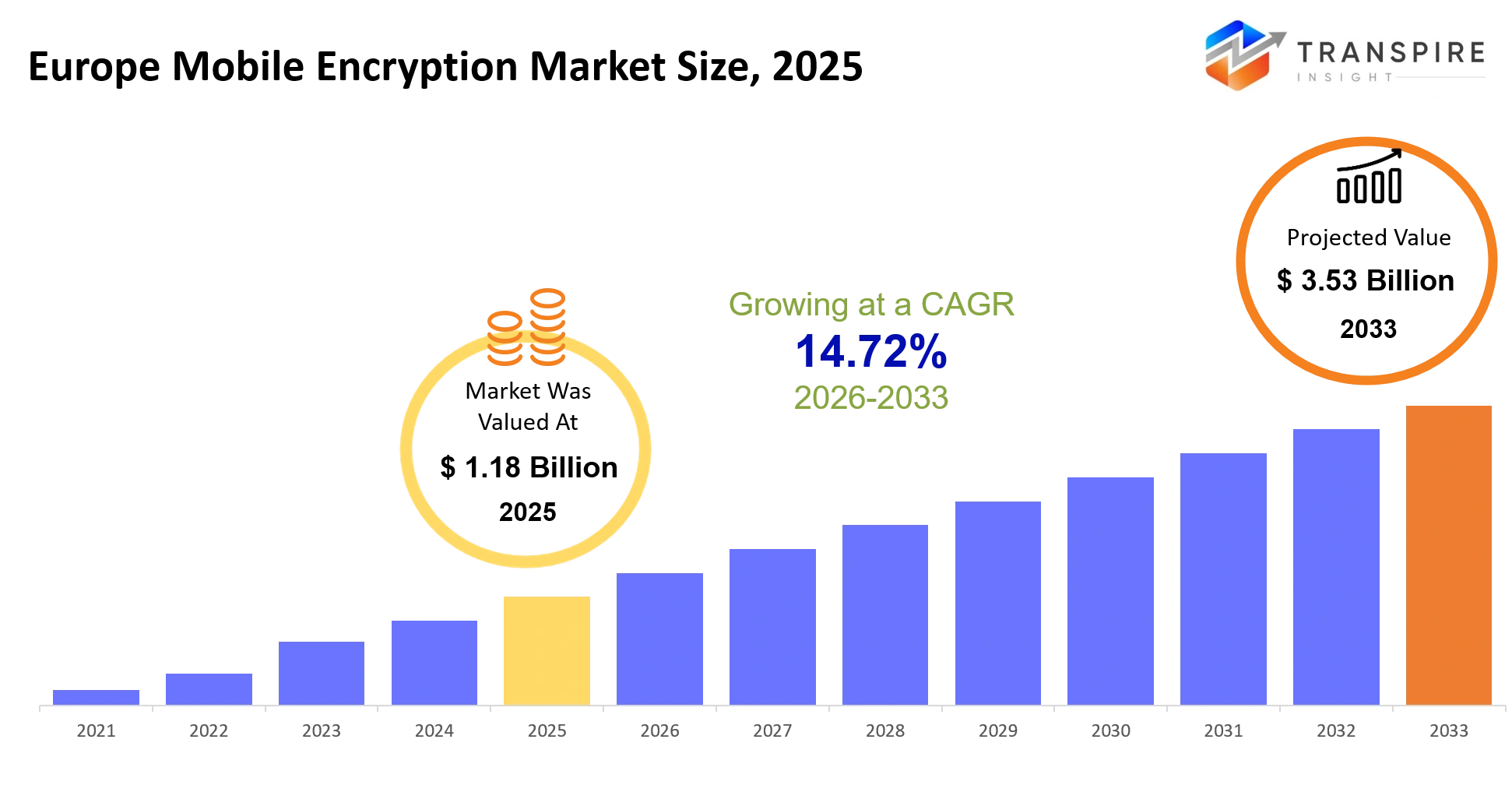
As per Transpire Insight Analysis the Europe Mobile Encryption Market size is estimated at USD 1.18 Billion in 2025 and is anticipated to reach USD 3.53 Billion by 2033, growing at a CAGR of 14.72% from 2026 to 2033.
In the Europe Mobile Encryption Market, the whole idea is basically to shield business chats, phones and tablets , plus sensitive operational details from people who should not get access, even while teams are just doing their daily stuff inside enterprises, government agencies , and all kinds of industrial environments. It supports remote entry, on site field tasks, and also connected ecosystems, where smartphones and tablets are the ones processing confidential information. Over the last 3–5 years, things have moved from simple protection for the device, to more unified encryption platforms that link up with zero trust security frameworks, cloud services and endpoint management tools. And now, with tighter European data protection rules plus cyber incidents hitting critical infrastructure, many organizations have been forced to harden mobile security plans. That change has helped adoption, because more firms realize mobile weak points can stall operations , reveal intellectual assets, and even turn into compliance problems. In the future, revenue should keep rising thanks to funding in more advanced security architectures, especially those built for distributed workforces and connected industrial networks, without so much of a gap in coverage.
Europe Mobile Encryption Market Size & Forecast:
- Europe Mobile Encryption Market Size 2025: USD 1.18 Billion
- Expected Market Value 2033: USD 3.53 Billion
- Forecast CAGR: 14.72%
- Leading country in 2025: Germany
- Fastest-growing country: France
- Key Profile: Microsoft, IBM, Broadcom (Symantec), Thales, Check Point Software, Sophos, McAfee, Trend Micro, BlackBerry, Samsung Knox, VMware, Cisco, ESET, Bitdefender, Fortinet.
Key Market Insights
- Western Europe kind of dominates the scene in 2025 with roughly 58% market share ,powered by Germany, UK, France, and Netherlands cybersecurity adoption which is fairly clear.
- Northern Europe though is the quickest mover, with Sweden, Denmark, and Finland really accelerating encryption rollout during the 2025–2033 forecast window.
- On the offering side , the Software segment comes out first at about 65% share, because enterprises keep choosing scalable mobile encryption platforms and that centralized security control approach.
- Services sit in the second spot, backed by managed security , plus implementation help across most European enterprises, so it’s less “do it alone” more “hands on”.
- Cloud-based encryption solutions are the fastest-growing type, expanding a lot from 2026 to 2033 , mainly due to hybrid workplace adoption and the way teams shift devices and access patterns.
- For application types, Enterprise application is leading, around 55% share, since companies try to secure employee devices and confidential business communications.
- Healthcare and financial applications are showing the fastest growth too. That’s because regulated areas are adopting tougher mobile data protection rules after 2025.
- End-user adoption wise, Large enterprises hold about 60% share, mostly from the complex security needs and compliance responsibilities , which don’t really go away easily.
- SMEs are the fastest-growing end-user group, as affordable cloud encryption services make it easier to reach more European businesses, even the smaller ones.
What are the Key Drivers, Restraints, and Opportunities in the Europe Mobile Encryption Market?
The main factor that seems to be shaping the Europe Mobile Encryption Market is that everyone is sort of moving toward zero-trust cybersecurity models, after tighter data protection enforcement under rules like GDPR. In practice organizations are running with bigger mobile workforces, more cloud apps, and all kinds of connected devices, so the need for encrypted access controls gets, well, pretty intense. That shift bumps up adoption of enterprise encryption platforms pretty fast, because businesses have to lower breach exposure, and also dodge those regulatory penalties. From a Transpire Insight review of regional procurement news and product launch timing, the execution risk still looks mostly tied to supply chain concentration.
The largest restraint, though, is the integration complexity across the existing enterprise setups. A lot of organizations keep mixed technology environments, and that means they often face expensive upgrades, a lot of compatibility testing, and they also need skilled cybersecurity personnel. In turn, these issues stretch deployment schedules, and they can stall the purchasing decisions, in particular for smaller companies with limited security budgets. So you end up with modernization projects that get pushed back, and encryption providers see slower revenue conversion.
The biggest opening is in AI driven encryption management, plus automated defense reaction. European companies are putting money into smart security operations that can spot weird mobile behavior and tune their protective measures all on its own, kinda automatically. The space in Germany, the UK, and the Netherlands looks ready for quicker take up as digital transformation initiatives roll out, more and more.
What Has the Impact of Artificial Intelligence Been on the Europe Mobile Encryption Market?
Artificial intelligence along with digital technologies are kind of reshaping mobile security operations, by automating threat monitoring, compliance checks and encryption policy management, but not in a simple way. With AI powered systems, teams can keep analyzing device behavior continuously, flag abnormal access patterns, and also help coordinate automated responses, without needing someone to watch everything all the time, manually. Machine learning models are being used too, to spot emerging cyber risks early, tune security configurations more precisely, and improve the forecasting of mobile protection needs across enterprise networks. In practice these capabilities help organizations shrink response times, tighten compliance reporting, and raise operational efficiency overall. Automated analytics in particular can reduce the admin load by ranking high risk events first and making security workflows less tedious, more streamlined.
Still, AI adoption doesn’t move fast everywhere because integration costs are high, data quality can be uneven, and training models across different mobile environments is tricky. Companies also have to balance automation with human oversight, otherwise the system can end up identifying a threat inaccurately. And since European enterprises keep expanding cloud based operations along with remote access systems, AI driven encryption platforms will likely become more and more important, for building resilience and handling those complex security environments.
Key Market Trends
- After 2018 GDPR enforcement, like it did not really slow down, mobile encryption adoption kind of accelerated across Europe. European orgs tightened, the safeguarding of personal data and also corporate data , which made it harder to ignore the basics.
- Zero trust security models picked up steam after 2021 and they sort of shifted enterprise thinking from perimeter defense, to identity centered mobile protection. Suddenly the strategy wasn’t about just the edge, but also who the user is and how access works, in a more subtle way.
- From 2022 through 2026 cloud encryption adoption grew quite a lot. Companies moved mobile security administration toward centralized platforms , instead of running everything in separate pockets. It felt more coordinated, less scattered.
- When remote work expanded after 2020, European businesses invested more in encrypted communication tools. For distributed operations, the encryption piece became part of the routine, not some optional add on.
- After 2023, financial institutions increased mobile security spend. That was in reaction to cyber incidents that revealed weaknesses in digital banking channels, so the vulnerability map became pretty real.
- Then after 2024, AI driven threat detection started to show up more. Providers integrated machine learning into encryption monitoring platforms, so the monitoring isn’t just watching , it’s predicting, or at least attempting to.
- Managed security services gained traction starting in 2025. Smaller enterprises, especially, wanted outsourced encryption know-how and compliance help, because doing it all internally was too heavy.
- In 2025, new European cybersecurity regulations strengthened procurement expectations. That nudged organizations to adopt advanced encryption technologies, even when budgets were a bit tense.
- Partnerships between security vendors and cloud providers increased after 2024. The goal was integrated mobile protection ecosystems, where the pieces talk to each other without too much friction.
- Hardware backed encryption adoption expanded through 2025 too. Enterprises emphasized device level security for sensitive tasks, so encryption wasn’t only in software, it was anchored closer to the device itself.
Europe Mobile Encryption Market Segmentation
By Solution :
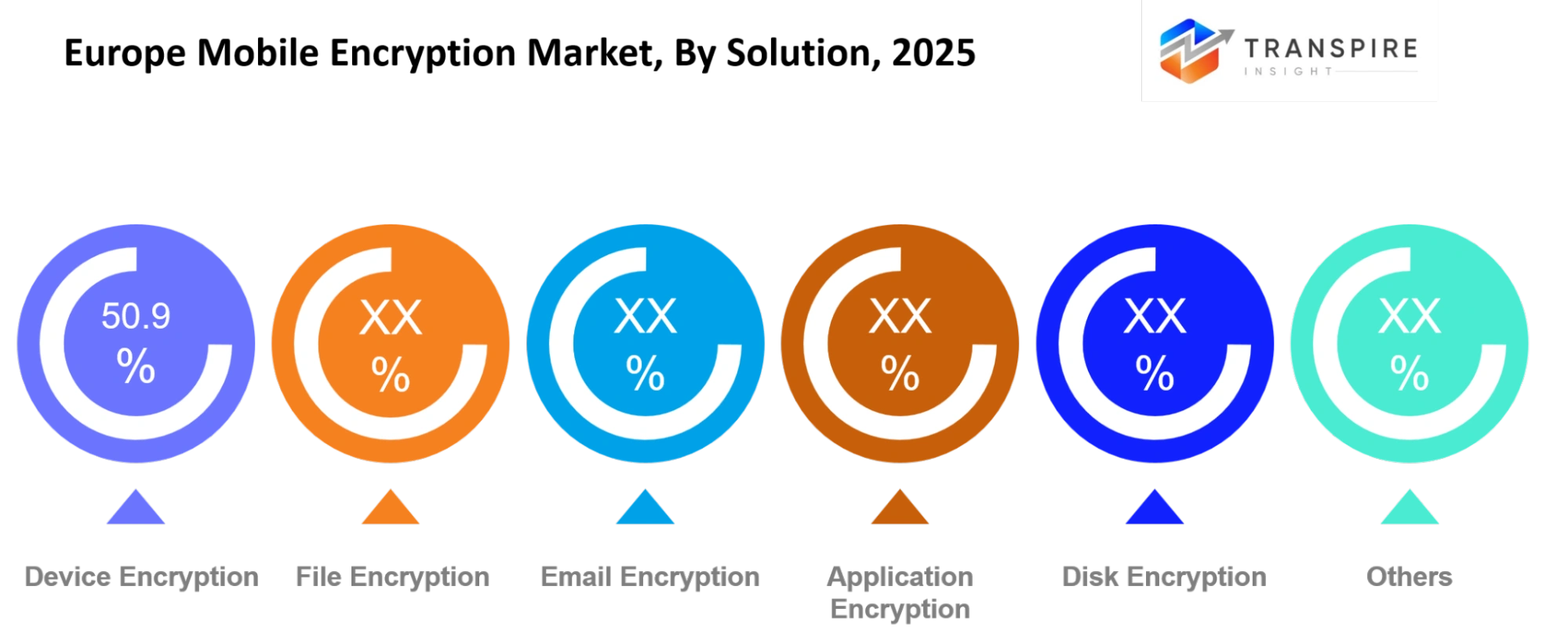
Device encryption protects stored data on smartphones and tablets using more advanced security checks, controls really. File encryption also helps with careful, maybe secure sharing of sensitive documents across business networks and while people are remote working. Email encryption does the same kind of job for confidential messages so they dont get into the wrong hands, including cyber threats.
Application encryption is going to matter more as companies rely on mobile apps for finance tasks, client support, and internal workflows. Disk encryption gives full protection for enterprise storage, especially for devices handling sensitive data. There are also other solutions, you know, for specialized security needs in different industries and in the day to day operational reality.
By Deployment :
Cloud-based deployment is being used a lot more now because organizations are moving security administration toward flexible digital infrastructure. Cloud options make updates simpler, allow centralized management, and speed up implementation across dispersed business operations. This deployment style also works well for companies coordinating large numbers of mobile devices in multiple locations, even when teams are spread out.
On-premise deployment still makes sense when an organization needs direct control over security systems and sensitive information. Hybrid deployment mixes cloud convenience with internal management so regulated industries get a kind of balanced setup. Other deployment choices exist too, depending on particular operational requirements across different enterprise environments.
By Enterprise Size :
Large enterprises hold a big share, because mobile networks are kinda complex , and they also face higher cybersecurity demands, plus strict compliance duties. These large organizations often pour money into advanced encryption tools to keep employee devices safe, protect business applications, and guard confidential operational data. With strong security budgets behind it, adoption tends to spread across multinational companies, not just in one region.
SMEs are looking more prominent too, since affordable encryption platforms make enterprise level protection more reachable. Smaller businesses are choosing cloud based security services to cut cyber risks without building major infrastructure. Other enterprise types still keep on assessing encryption solutions, depending on their operational size and security priorities, kind of pragmatically.
By End User :
BFSI orgs show heavy uptake, because financial data has to be locked down against unauthorized access and cyber attacks. Government agencies invest in mobile encryption for official talks and for sensitive information that can’t just leak. Healthcare providers rely on encryption tools to safeguard patient records and to keep regulatory compliance intact.
IT and telecom companies roll out advanced security systems, especially for handling connected devices and digital services. Retail businesses are putting more funds in, since mobile transactions and customer data protection are becoming urgent. Defense organizations need top tier encryption abilities for secure communication and operational safety. Other sectors keep adopting solutions based on their data protection needs, even if their focus varies.
By Operating System :
Android powered devices show up as a big slice because lots of enterprises rely on them and because device variety stays pretty broad across Europe. At the same time security providers keep leveling up their encryption capabilities on Android, mostly so they can handle all kinds of hardware environments, even the weird ones. In many companies, enterprise mobility programs really help keep Android security solutions getting rolled out.
As for iOS, the demand is still strong. Businesses tend to like the integrated security features and the more controlled operating environment. Meanwhile Windows Mobile and some other operating systems, still get attention when industries have specialized business needs. With so many operating systems in the mix, vendors will likely be pushed to craft more adaptable encryption solutions that support multiple device ecosystems, not only one.
What are the Key Use Cases Driving the Europe Mobile Encryption Market?
For large organizations, enterprise mobile security really is kind of the core scenario , and it’s backed up by the spread of device encryption adoption . Banks, government agencies , and corporations buy these solutions to shield employee devices, the confidential files , and regulated information against all sorts of cyber threats.
Healthcare providers lean on encrypted mobile environments to keep patient data protected, and also to meet compliance requirements. Meanwhile IT and telecom companies use encryption tooling to lock down connected services , plus remote operations that keep running. Financial institutions still put money into encrypted communication platforms, but only under very strict data protection rules.
Newer uses are showing up too, like AI-driven encryption management combined with safer mobile access for industrial field teams . Zero-trust style security models and automated compliance tracking will likely help future adoption across European enterprises, where the demand for stronger digital protection keeps growing.
|
Report Metrics |
Details |
|
Market size value in 2025 |
USD 1.18 Billion |
|
Market size value in 2026 |
USD 1.35 Billion |
|
Revenue forecast in 2033 |
USD 3.53 Billion |
|
Growth rate |
CAGR of 14.72% from 2026 to 2033 |
|
Base year |
2025 |
|
Historical data |
2021 - 2024 |
|
Forecast period |
2026 - 2033 |
|
Report coverage |
Revenue forecast, competitive landscape, growth factors, and trends |
|
Country scope |
Europe (Germany, United Kingdom, France, Italy, Spain and Rest of Europe) |
|
Key company profiled |
Microsoft, IBM, Broadcom (Symantec), Thales, Check Point Software, Sophos, McAfee, Trend Micro, BlackBerry, Samsung Knox, VMware, Cisco, ESET, Bitdefender, Fortinet. |
|
Customization scope |
Free report customization (country, regional & segment scope). Avail customized purchase options to meet your exact research needs. |
|
Report Segmentation |
By Solution (Device Encryption, File Encryption, Email Encryption, Application Encryption, Disk Encryption, Others); By Deployment (Cloud-Based, On-Premise, Hybrid, Others); By Enterprise Size (Large Enterprises, SMEs, Others); By End User (BFSI, Government, Healthcare, IT & Telecom, Retail, Defense, Others); By Operating System (Android, iOS, Windows Mobile, Others). |
Which Regions are Driving the Europe Mobile Encryption Market Growth?
Western Europe seems to hold the dominant position in the Europe Mobile Encryption Market with around 58% market share in 2025, and yeah that figure feels pretty solid. A lot of the momentum comes from strong GDPR enforcement, advanced cybersecurity frameworks, and those strict enterprise data protection rules that companies really cannot ignore. Germany, the United Kingdom, France, and the Netherlands help too, because there’s this active ecosystem of cybersecurity firms, ongoing technology investments, and broader enterprise digital transformation programs. Leadership is likely to keep going through 2033, mostly because organizations continue spending heavily on secure mobile infrastructure, plus compliance-minded solutions.
Southern Europe brings steady revenue growth, mostly because regulatory alignment stays consistent, digital services keep expanding and cybersecurity modernization moves in a gradual but reliable way. Italy, Spain, and Portugal usually show stable investment patterns, as businesses keep strengthening protection for mobile communications and sensitive data. Government initiatives alongside enterprise technology upgrades also make adoption feel more dependable, especially in financial services, healthcare, and public sector use cases. Overall, regional growth should stay supported by long-term digital transformation programs and ongoing compliance requirements.
Northern and Eastern Europe, on the other hand, are where things speed up. Countries like Sweden, Denmark, Finland, Poland, and the Czech Republic are increasing cybersecurity investments after recent upgrades to digital infrastructure. New security regulations, more cloud adoption, and modernization of enterprise systems are helping push demand for encryption solutions. There’s also a growing technology ecosystem, plus rising cybersecurity budgets, which ends up attracting vendors looking for fresh opportunities. The period from 2026 to 2033 should create favorable conditions for market entrants and strategic investors, so yeah, it looks promising.
Who are the Key Players in the Europe Mobile Encryption Market and How Do They Compete?
The Europe Mobile Encryption Market has a rather moderately fragmented competitive structure, with big global tech providers and niche security firms going head to head , mostly via encryption innovation, integration know how , and service flexibility that is not too rigid. In practice, the rivalry comes down to advanced security features, support for zero trust architecture, compliance knowhow, and whether the encryption works cleanly across different mobile ecosystems. Incumbent vendors still defend their standing, while more specialized cybersecurity companies bring in specific offerings for regulated sectors and for newer enterprise demands.
Microsoft shows up by offering integrated security platforms that link mobile encryption with cloud services and identity management tools. It tries to stand out through wide enterprise connectivity and security automation features, like orchestration that feels more seamless than the rest. IBM leans into AI powered security analytics and enterprise risk management, so organizations get advanced threat visibility and compliance oversight in one bundle.
BlackBerry leans toward regulated industries, using secure communication platforms and a set of mobile protection technologies that are more tailored. Cisco Systems pushes through zero trust security solutions and network protection capabilities, combining mobile security with wider enterprise infrastructure, kind of like one continuous layer. Samsung Electronics keeps tightening its approach via Knox security upgrades, device level protection , and enterprise mobility solutions that play well across European business markets.
Company List
- Microsoft
- IBM
- Broadcom (Symantec)
- Thales
- Check Point Software
- Sophos
- McAfee
- Trend Micro
- BlackBerry
- Samsung Knox
- VMware
- Cisco
- ESET
- Bitdefender
- Fortinet
Recent Development News
In February 2025, GSMA launched a Mobile Device Security Certification Scheme framework developed with mobile operators and device manufacturers. The initiative establishes security evaluation standards for smartphones, supporting stronger encryption and privacy protections as European organizations increase reliance on secure mobile devices.
Source: https://www.gsma.com/
In February 2025, the European Union Agency for Cybersecurity (ENISA) activated the EUCC cybersecurity certification scheme for ICT products, including mobile operating systems, encrypted storage, and secure elements. The certification framework creates a common security validation pathway across Europe, encouraging vendors to develop certified encryption technologies for enterprise and government use.
Source: https://certification.enisa.europa.eu/
What Strategic Insights Define the Future of the Europe Mobile Encryption Market?
The Europe Mobile Encryption Market seems to be moving toward integrated security ecosystems over the next 5–7 years, as zero trust adoption, cloud migration , and stricter cyber regulations sort of reshape how enterprises handle protection. There is also this less visible risk too, from market concentration among big technology vendors, which can quietly turn into dependency concerns if pricing structures, service access, or even platform policies change a bit.
At the same time, there’s an emerging opportunity that looks pretty interesting in AI enabled encryption management across Northern Europe, where more digital infrastructure investment and cybersecurity programs are pushing adoption forward, faster than before. For market participants, it might be smart to emphasize interoperable encryption platforms, make regional partnerships more real, and offer compliance ready solutions that can fit internal audits without too much friction.
Vendors that bring automation, flexible deployment models, and solid certification pathways, should end up in a stronger position as European organizations modernize their mobile security frameworks.
Europe Mobile Encryption Market Report Segmentation
By Solution
- Device Encryption
- File Encryption
- Email Encryption
- Application Encryption
- Disk Encryption
By Deployment
- Cloud-Based
- On-Premise
- Hybrid
By Enterprise Size
- Large Enterprises
- SMEs
By End User
- BFSI
- Government
- Healthcare
- IT & Telecom
- Retail
- Defense
By Operating System
- Android
- iOS
- Windows Mobile
Frequently Asked Questions
Find quick answers to common questions.
The expected Europe Mobile Encryption Market size for the market will be USD 3.53 Billion in 2033.
Key segments for the Europe Mobile Encryption Market are By Solution (Device Encryption, File Encryption, Email Encryption, Application Encryption, Disk Encryption, Others); By Deployment (Cloud-Based, On-Premise, Hybrid, Others); By Enterprise Size (Large Enterprises, SMEs, Others); By End User (BFSI, Government, Healthcare, IT & Telecom, Retail, Defense, Others); By Operating System (Android, iOS, Windows Mobile, Others).
Major Europe Mobile Encryption Market players are Microsoft, IBM, Broadcom (Symantec), Thales, Check Point Software, Sophos, McAfee, Trend Micro, BlackBerry, Samsung Knox, VMware, Cisco, ESET, Bitdefender, Fortinet.
The Europe Mobile Encryption Market size is USD 1.18 Billion in 2025.
The Europe Mobile Encryption Market CAGR is 14.72% from 2026 to 2033.
- Microsoft
- IBM
- Broadcom (Symantec)
- Thales
- Check Point Software
- Sophos
- McAfee
- Trend Micro
- BlackBerry
- Samsung Knox
- VMware
- Cisco
- ESET
- Bitdefender
- Fortinet
About the Authors

Mayur Shinde
I am Mayur Shinde, a Senior Research Analyst at Transpire Insight, specializing in the Automotive & Transportation and Information & Communication Technology (ICT) Industry. My work focuses on analyzing emerging market trends, technological advancements, competitive landscapes, and industry developments to deliver accurate, data-driven insights. I am passionate about transforming complex market information into clear, actionable content that helps businesses, professionals, and decision-makers stay informed and make confident strategic decisions.

Chakradhar Khansole
Chakradhar serves as the Research Director at Transpire Insight, bringing over 8 years of experience in technology, innovation, and strategic market intelligence. He specializes in transforming complex market data into actionable business insights that enable organizations to make informed, growth-oriented decisions. Recognized for his strategic vision and analytical expertise, Chakradhar leads high-impact research initiatives, delivering comprehensive market assessments, competitive intelligence, and forward-looking industry analysis.
Recently Published Reports
-
Apr 2026
3D Optical Profiler Market
3D Optical Profiler Market Size, Share & Analysis Report By Type (Desktop 3D Optical Profiler, and Portable 3D Optical Profiler), By Technology (Confocal Technology, and White Light Interference), By End-Use Industry (Manufacturing, Research Institutions, Automotive, Aerospace and Defense, Medical Devices, and Other), and Geography (North America, Europe, Asia-Pacific, Middle East and Africa, South and Central America), 2021 - 2031
-
Apr 2026
Depth Sensor Market
Depth Sensor Market Size, Share & Analysis Report By Type (Infrared Depth Sensors, Time-of-Flight (ToF) Sensors, Stereo Vision Sensors, Structured Light Sensors, Ultrasonic Depth Sensors), By Application (Automotive, Robotics, Gaming, Consumer Electronics, Industrial Automation, Healthcare, Security & Surveillance, Others), By End Users (Automotive Manufacturers, Consumer Electronics Companies, Healthcare Providers, Industrial Companies, Security Agencies, Gaming Companies, Robotics Companies, Others), and Geography (North America, Europe, Asia-Pacific, Middle East and Africa, South and Central America), 2021 – 2031
-
Apr 2026
Digital Manufacturing Market
Digital Manufacturing Market Size, Share & Analysis Report By Component (Hardware, Software, and Services), By Technology (Robotics, 3D Printing, Internet of Things (IoT), and Others), By Application (Automotive and Transportation, Aerospace and Defense, Consumer Electronics, Industrial Machinery, and Others), By Process Type (Computer-Based Designing, Computer-Based Simulation, Computer 3D Visualization, Analytics, and Others), and Geography (North America, Europe, Asia-Pacific, Middle East and Africa, South and Central America), 2021 – 2031
-
Apr 2026
Digital Visa Services Market
Digital Visa Services Market Size, Share & Analysis Report By Type (Individual Travelers, Group Travelers), By Application (Tourism, Business Travel, Others), and Geography (North America, Europe, Asia-Pacific, Middle East and Africa, South and Central America), 2021 – 2031