

Global AI-Driven Image-to-3D Generator Market Size & Forecast:
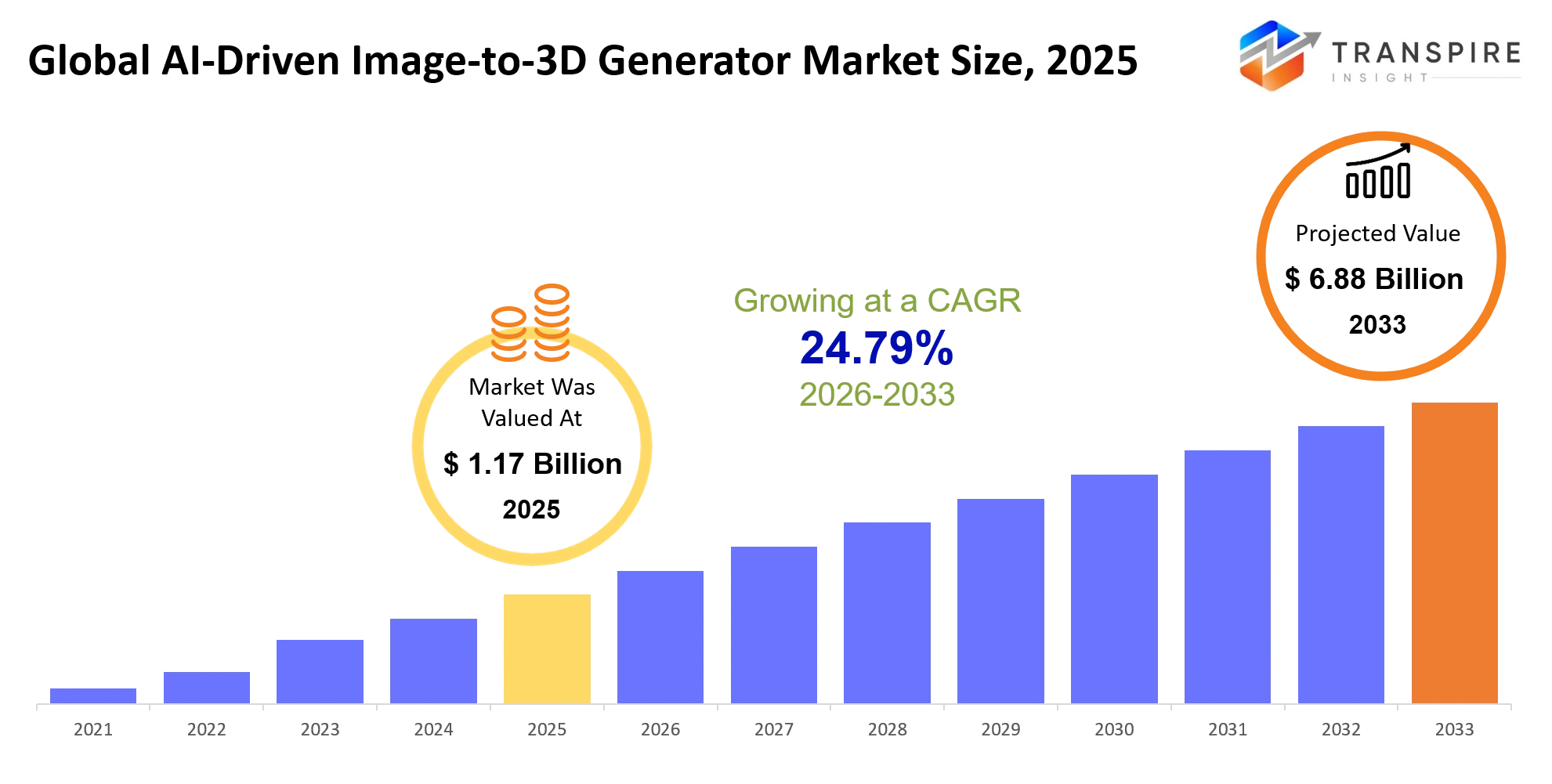
- Global AI-Driven Image-to-3D Generator Market Size 2025: USD 1.17 Billion
- Global AI-Driven Image-to-3D Generator Market Size 2033: USD 6.88 Billion
- Global AI-Driven Image-to-3D Generator Market CAGR: 24.79%
- Global AI-Driven Image-to-3D Generator Market Segments: By Deployment (Cloud, On-Premise, Hybrid, SaaS, Edge Deployment, Enterprise Deployment, Developer Platforms, Others); By Technology (Generative AI, Neural Rendering, Computer Vision, Diffusion Models, GANs, Transformer Models, Deep Learning Models, Others); By Application (Gaming, E-commerce, AR/VR, Media & Entertainment, Healthcare, Manufacturing, Education, Others); By End User (Enterprises, SMEs, Individual Creators, Developers, Design Studios, Gaming Companies, Research Institutes, Others); By Output Type (3D Models, Avatars, Objects, Environments, Character Models, Product Models, Digital Twins, Others).
Global AI-Driven Image-to-3D Generator Market Summary:
As per Transpire Insight Analysis, the Global AI-Driven Image-to-3D Generator Market size is estimated at USD 1.17 Billion in 2025 and is anticipated to reach USD 6.88 Billion by 2033, growing at a CAGR of 24.79% from 2026 to 2033. These specialized software engines convert standard 2D images, text descriptions, or sketches into fully textured, rigging-ready 3D digital assets, automating manual polygon modeling tasks for production teams. Over the last few years - the market has undergone a major structural shift driven by the transition from slow, traditional photogrammetry methods toward rapid, multi-view diffusion models and neural radiance fields (NeRFs). This shift was triggered by the commercial launch of foundational text-to-3D and image-to-3D pipeline APIs, which allowed enterprise software setups to auto-generate asset variations instantly. Consequently, the market is growing rapidly because spatial computing platforms and modern gaming environments require hundreds of thousands of cheap, highly detailed interactive assets, forcing studios to replace manual asset sculpting with algorithmic generation to lower costs.
Key Market Insights
The global AI-driven image-to-3D generator market - undergoing a profound structural transition, evolving from a niche experimental tool into an essential enterprise pipeline engine that cuts digital asset creation times from hours to seconds. As immersive digital environments proliferate, development studios are aggressively replacing manual polygon modeling pipelines with automated, multi-view diffusion models to fulfill the soaring demand for cheap, hyper-realistic spatial content.
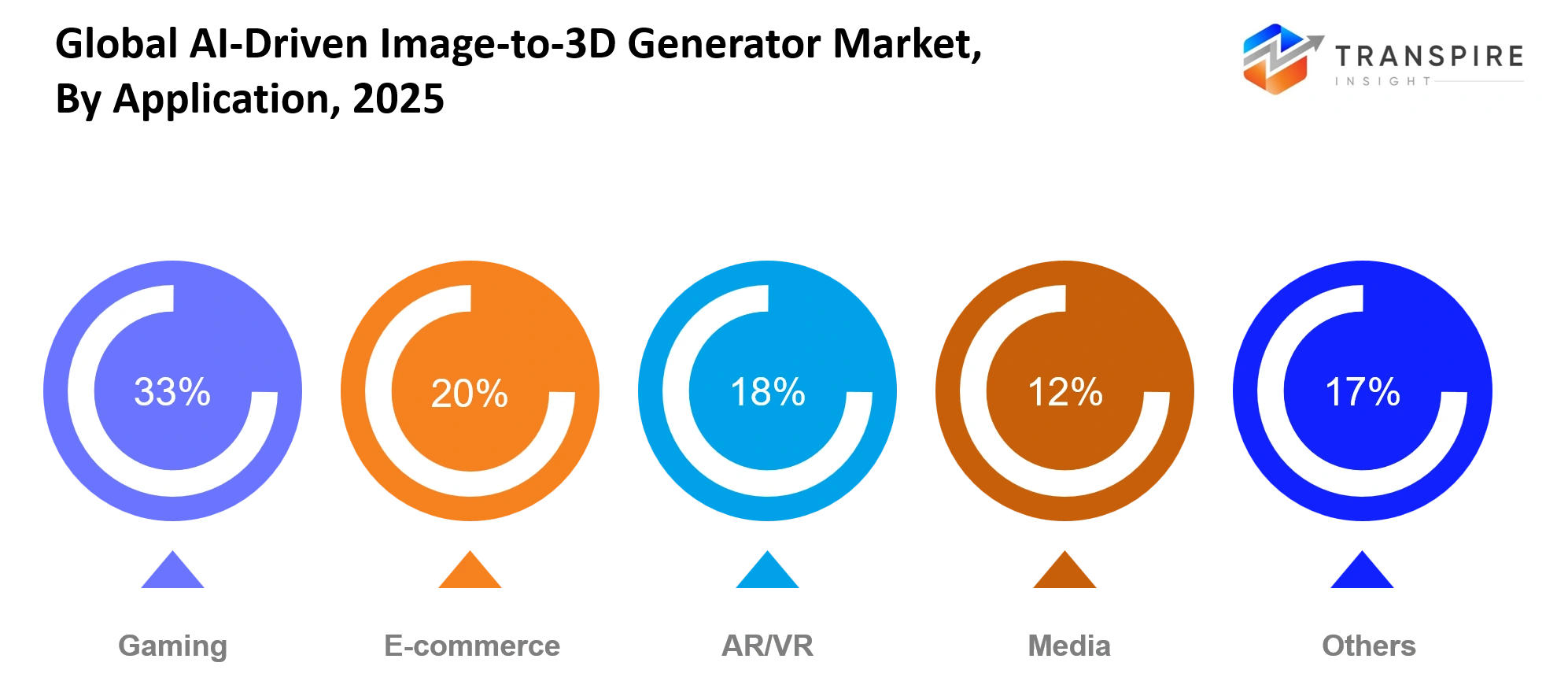
- Gaming Applications anchor the market with an authoritative 33% share - heavily driven by major studios utilizing platforms like Unity and Epic Games to auto-generate infinite background assets and non-player character (NPC) variations, freeing human animators to focus entirely on core artistic design.
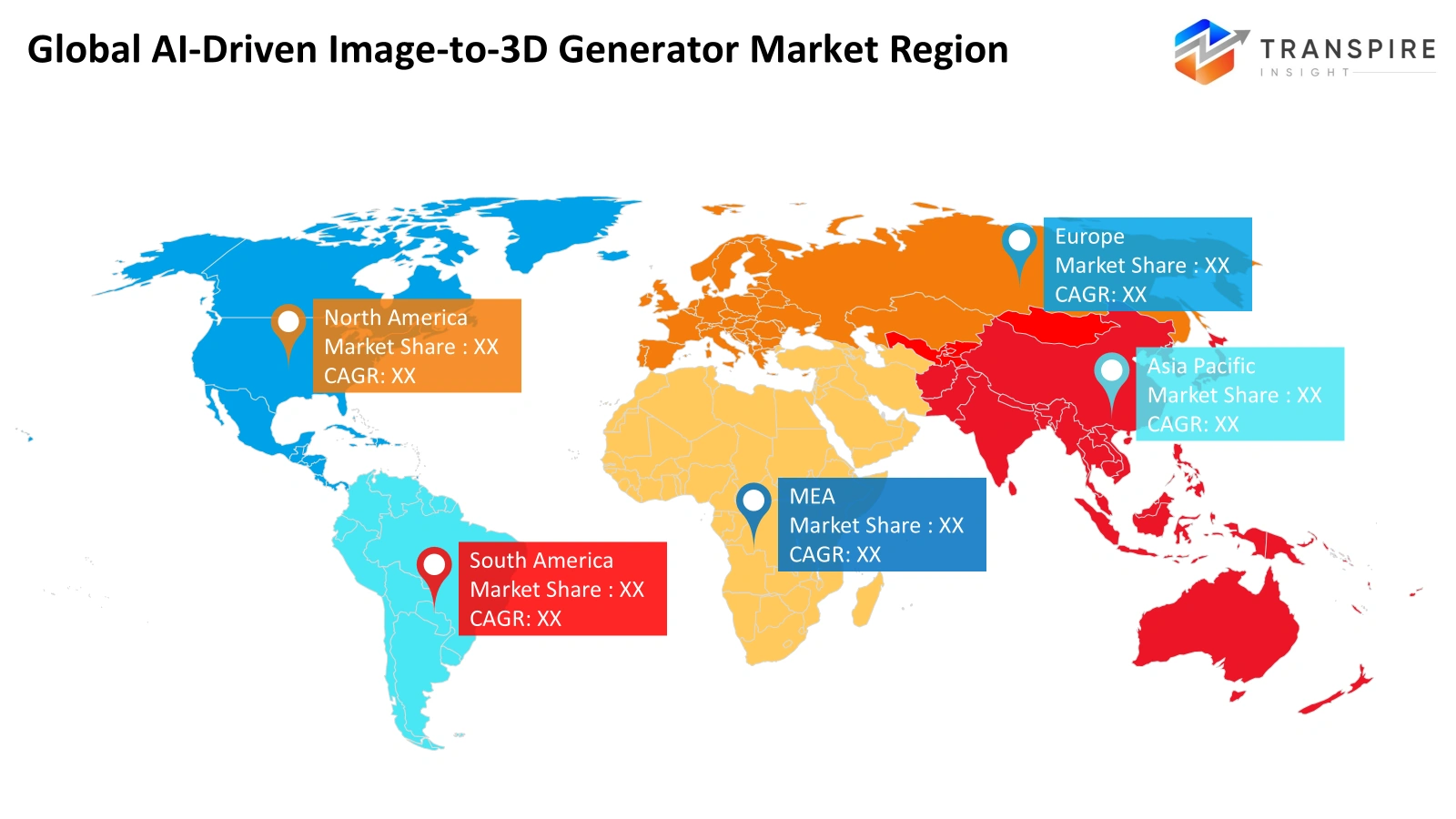
- North America commands the global marketplace with a dominant 49% share, propelled by massive tech clusters in Silicon Valley and heavy ongoing R&D capital investments from infrastructure titans like NVIDIA, OpenAI, and Meta into foundational 3D generative AI models.
- The AR/VR Content Generation sector represents the fastest-growing application corridor with a 24.5% CAGR - as hardware producers aggressively integrate spatial developer tools from Luma AI and Adobe to feed high-fidelity, real-time assets into next-generation spatial computing headsets.
- The Asia Pacific region stands as the fastest-growing geographical market with a 25.8% CAGR, fueled by rapid mobile gaming expansion, localized metaverse infrastructure projects, and tech hubs in China and Japan deploying tools like Meshy and Sloyd for agile game prototyping.
- E-commerce holds a substantial 20% slice of total market revenue - rapidly expanding as retail giants integrate automated pipelines to transform simple flat product photos into interactive, 360-degree digital twins that directly improve consumer purchasing confidence and reduce product return rates.
- Media & Entertainment locks down a 12% market share, driven by VFX studios incorporating Autodesk and SideFX neural rendering pipelines to instantly convert conceptual production sketches into complex, block-out 3D sets for pre-visualization workflows.
- Cloud and SaaS deployment frameworks capture over 65% of the operational market, as individual creators and agile SMEs increasingly lean on browser-based, developer-friendly platforms like Kaedim to bypass the heavy local GPU hardware requirements of traditional 3D rendering engines.
- The "Objects and Props" output category accounts for a vital 35% of output volume, driven by developer platforms optimizing automated texturing and auto-topology features to ensure generated assets plug cleanly into existing game engines with zero manual clean-up.
- Design Studios and SMEs represent a fast-evolving 22% end-user slice, aggressively leaning into hybrid cloud architectures to run rapid design iterations for industrial prototyping, architecture, and commercial marketing campaigns.
What Strategic Drivers, Restraints, and Opportunities Define the Global AI-Driven Image-to-3D Generator Market?
Driver
The global marketplace is expanding rapidly due to a structural transition from slow photogrammetry toward automated multi-view diffusion pipelines. Traditional sculpting systems are too labor-intensive to satisfy modern interactive asset demands. This shift was triggered by the commercial launch of foundational text-to-3D and image-to-3D APIs, which allowed software setups to generate detailed asset variations instantly. This automation boosts production revenue and system adoption as studios replace manual asset sculpting with algorithmic generation to lower costs. In May 2026, infrastructure pioneer NVIDIA officially launched its Cosmos 3 foundation model ecosystem, built on a mixture-of-transformers architecture to handle complex spatial-temporal reasoning and world simulation. This technical rollout empowers AI developers and 3D design studios to instantly generate physics-accurate 3D world models and synthetic assets, drastically reducing production training cycles from months to days.
Restraint
Prohibitive grid-topology bottlenecks and texture baking limitations persistently restrict direct enterprise integration. Algorithmic engines frequently output fragmented, un-optimized meshes with messy uv-unwrapping, requiring substantial manual cleaning before assets fit standard rendering standards. This structural issue forces studios into tedious manual re-topology routines, restricting automated software deployments from scaling cleanly into real-time production loops.
Opportunity
The most lucrative growth window lies in embedding specialized web-to-print or e-commerce asset generation engines directly into browser-based retail architectures. Fusing rapid image-to-3D generation pipelines with real-time web assembly allows online marketplaces to instantly transform casual product snaps into interactive, 360-degree digital twins. This technical shift unlocks fresh software procurement streams from massive regional online retail networks looking to improve spatial buying workflows and drop product return rates.
What Has the Impact of Artificial Intelligence Been on the Global AI-Driven Image-to-3D Generator Market?
Artificial intelligence is fundamentally reshaping how spatial computing and interactive entertainment industries create 3D assets. Instead of forcing artists to spend hours manually extruding polygons and painting seams—which severely bottlenecks development timelines—studios now deploy generative machine learning pipelines to automate structural asset modeling. AI dramatically increases asset creation speeds through optimized predictive architectures.
Advanced diffusion models and neural rendering networks process single or multi-view 2D images to instantly output ready-to-use 3D geometry. These specialized AI models possess predictive spatial capabilities, automatically calculating missing depths, generating obscured back-angle perspectives, and baking complex physically-based rendering (PBR) materials onto the mesh. This operational enhancement allows teams to build extensive, asset-heavy digital environments in seconds rather than weeks.
However, a major limitation remains the accuracy gap regarding precise mechanical geometry and hard-surface topological structures. Generated models frequently suffer from non-manifold geometry, erratic edge flows, or thin walls, requiring manual technical cleanup before they can be deployed in production game engines or manufacturing pipelines.
In January 2026, 3D generative AI pioneer Meshy officially launched its next-generation Meshy-6 production architecture. This platform rollout introduces highly advanced geometry smart-parsing and faster optimization workflows, enabling individual developers and major gaming studios to instantly turn flat sketches into clean 3D props with significantly sharper topological accuracy and photorealistic PBR texturing maps. [https://www.meshy.ai/blog/category/announcements]
Key Market Trends
Rather than approaching 3D modeling as a tedious, vertex-by-vertex manual sculpt, production studios are wiring generative pipelines directly into existing game engines and creative software. This shift completely reshapes development timelines, condensing multi-day asset drafting workflows into near-instantaneous, multi-view asset generation.
- Moving past traditional photogrammetry limitations - Creative pipelines now actively deploy multi-view diffusion models and Neural Radiance Fields (NeRFs), allowing developers to build fully textured, multi-angle 3D assets from just a single, flat 2D image input.
- SaaS platforms are democratizing heavy rendering workflows - The massive industry shift toward browser-based cloud infrastructure has stripped away localized hardware limits. Independent creators can now execute complex 3D generations on lightweight laptops without expensive, dedicated GPUs.
- Algorithmic solutions are fixing messy topology - Game developers are substituting manual, labor-intensive re-topology routines with intelligent machine learning nodes. These engines instantly reshape chaotic AI-generated wireframes into clean, quad-dominant structures ready for immediate game-engine deployment.
- E-commerce is moving beyond flat product listings - Online retail networks are swapping out static 2D photography for automated image-to-3D pipelines. This behavioral change allows digital storefronts to rapidly scale interactive, 360-degree digital twins that offer immersive spatial browsing.
- Pre-visualization workflows are evolving in virtual production - VFX studios are abandoning isolated 2D concept sketching, using neural rendering architectures to directly interpret raw production storyboards into block-out 3D sets for rapid cinematic planning.
- Automated systems are handling tedious texturing layers - Traditional material workflows are giving way to automated Physically-Based Rendering (PBR) map generation. Intelligent algorithms now auto-bake precise roughness, normal, and metallic maps directly onto raw meshes without manual painting.
- Mobile optimization is becoming completely adaptive - App developers are stepping away from heavy, high-polygon counts in favor of AI-driven, real-time Level of Detail (LoD) scaling. This balances visual fidelity on the fly, keeping immersive apps smooth even on low-tier smartphones.
- Skeletal rigging is turning automated and fluid: Immersive platform architects are transitioning from generating static, rigid objects toward deploying automated skeletal rigging nodes. Generated character models can now immediately receive complex animation sequences, entirely bypassing manual weight-painting.
Global AI-Driven Image-to-3D Generator Market Segmentation
By Deployment
Cloud and SaaS delivery frameworks hold the commanding market share, functioning as the foundational operational pillar for global asset deployment. Meanwhile, developer platforms and edge deployment systems are emerging as the most disruptive and rapidly expanding models, with browser-accessible APIs surging to democratization. The unique growth logic behind this structure is tied to hardware access constraints. Heavy game studios and enterprise teams historically relied on expensive local GPU render farms to compute polygon meshes. However, the explosive rise in SaaS and API developer platforms is fueled by an aggressive engineering demand for instantaneous, on-demand inference that runs seamlessly on lightweight, thin-client interfaces. Moving forward, the boundary between local creation suites and remote cloud engines will blur as real-time multi-view generation becomes standard. Infrastructure providers will be forced to engineer highly distributed, low-latency edge computing nodes that compute spatial geometry directly on consumer hardware, enabling instant local modifications without continuous server roundtrips.
By Technology
Generative AI and diffusion models represent the undisputed heavyweight technology pocket, locking down a majority of global market volume. Neural rendering and transformer architectures follow closely as critical secondary pillars, while GANs and computer vision models maintain stable support structures. This deep technology concentration remains ironclad because modern algorithmic texturing and depth-estimation workflows rely entirely on diffusion networks to accurately predict and generate missing back-angle asset viewpoints. However, the true technological accelerator is the neural rendering segment, which is expanding rapidly due to its unique ability to translate raw 2D image inputs into highly accurate Neural Radiance Fields (NeRFs) and 3D Gaussian splats. Looking ahead, platform developers must execute a unified algorithmic synthesis. They must fuse the raw imaginative speed of generative diffusion models with the strict polygon and edge-flow predictability of deep learning transformer structures, ensuring that automated systems output clean, quad-dominant topology that slots seamlessly into production game engines without manual cleanup.
By Application
Gaming applications anchor the market with an authoritative 33% revenue share, serving as the primary financial driver of day-to-day software procurement. E-commerce follows closely at 20%, while AR/VR content generation secures an 18% share, expanding rapidly as the fastest-growing application corridor with a 24.5% CAGR. This heavy concentration in gaming is structurally locked because major gaming companies require a constant, high-volume stream of diverse interactive background assets and NPC variations to populate expansive open-world titles. Conversely, the explosive growth in AR/VR and e-commerce is driven by a massive behavioral shift toward spatial retail, where flat imagery is systematically replaced by interactive 360-degree digital twins. Moving forward, software creators will find it impossible to dominate the long-term market by offering generic model outputs. Sustainable commercial success will require engineering hyper-specialized pipelines: high-fidelity, rigged skeletal character models optimized for immediate game engine deployment, running parallel to highly accurate, lightweight product models tailored for low-bandwidth mobile e-commerce platforms.
By End User
Enterprises and gaming companies act as the foundational financial anchors of the global market, accounting for the highest volume of platform subscriptions and custom enterprise licenses. Concurrently, individual creators and developers are escalating their purchasing activity as high-growth consumers of agile, browser-based tools. This user distribution is shifting rapidly as independent game design studios and freelance digital artists bypass slow, traditional studio outsourcing networks in favor of immediate, automated asset-generation software. Moving forward, technology providers will face severe adoption bottlenecks if they merely offer standalone generation tools. Capturing lasting market share will require delivering fully integrated creation ecosystems—wrapping the raw generative image-to-3D pipeline together with native game engine plugins, automated version control tracking, and comprehensive commercial licensing protections that secure the legal integrity of generated digital IP.
By Output Type
Objects and standalone props hold the dominant volume share, functioning as the primary output type for developers looking to rapidly build up virtual environments. Meanwhile, digital twins and character models are emerging as the most high-margin segments, expanding alongside the global proliferation of spatial computing systems. The distinct expansion logic here is that building virtual items—such as furniture, weapons, or scattered background props—has historically consumed up to 40% of standard production schedules, making them prime targets for automated machine-learning optimization. However, the rise of digital twins is driven by heavy industrial demand for real-time replica environments in manufacturing and smart-city planning. Looking ahead, output standards must mature drastically. Generation engines will be forced to transition from producing static, non-functional 3D meshes toward outputting fully interactive, physics-aware smart assets that carry embedded material attributes, collision data, and automated level-of-detail scaling right out of the box.
What Are the Key Use Cases Driving the Global AI-Driven Image-to-3D Generator Market?
The primary use case is anchored in rapid environment block-out and background prop creation for major gaming studios. Production teams upload concept sketches or single 2D reference images to automatically generate thousands of game-ready objects and non-player character variations, cutting manual asset modeling times down by over 80%.
In expanding applications, online retail networks use the technology to convert flat product photography into interactive, 360-degree digital twins for e-commerce. This automated asset pipeline lets digital storefronts deploy immersive spatial product views at scale, which directly reduces product return rates and boosts buyer engagement.
Emerging use cases are gaining traction in AR/VR spatial computing and medical simulation. Developers leverage real-time image-to-3D generation to build dynamic virtual reality environments on the fly - while healthcare institutes convert standard medical scans into interactive 3D anatomical models for pre-surgical planning.
|
Report Metrics |
Details |
|
Market size value in 2025 |
USD 1.17 Billion |
|
Market size value in 2026 |
USD 1.46 Billion |
|
Revenue forecast in 2033 |
USD 6.88 Billion |
|
Growth rate |
CAGR of 24.79% from 2026 to 2033 |
|
Base year |
2025 |
|
Historical data |
2021 - 2024 |
|
Forecast period |
2026 - 2033 |
|
Report coverage |
Revenue forecast, competitive landscape, growth factors, and trends |
|
Regional scope |
United States; Canada; Mexico; United Kingdom; Germany; France; Italy; Spain; Denmark; Sweden; Norway; China; Japan; India; Australia; South Korea; Thailand; Brazil; Argentina; South Africa; Saudi Arabia; United Arab Emirates |
|
Key company profiled |
OpenAI, NVIDIA, Autodesk, Unity, Epic Games, Luma AI, Kaedim, Meshy, Sloyd, Adobe, Meta, Google, Dassault Systemes, Hexagon, Roblox. |
|
Customization scope |
Free report customization (country, regional & segment scope). Avail customized purchase options to meet your exact research needs. |
|
Report Segmentation |
By Deployment (Cloud, On-Premise, Hybrid, SaaS, Edge Deployment, Enterprise Deployment, Developer Platforms, Others); By Technology (Generative AI, Neural Rendering, Computer Vision, Diffusion Models, GANs, Transformer Models, Deep Learning Models, Others); By Application (Gaming, E-commerce, AR/VR, Media & Entertainment, Healthcare, Manufacturing, Education, Others); By End User (Enterprises, SMEs, Individual Creators, Developers, Design Studios, Gaming Companies, Research Institutes, Others); By Output Type (3D Models, Avatars, Objects, Environments, Character Models, Product Models, Digital Twins, Others). |
Which Regions are Driving the Global AI-Driven Image-to-3D Generator Market Growth?
North America maintains a commanding grip on the global AI-driven image-to-3D generator market, capturing a dominant 49% of all worldwide industry revenue. This geographic hegemony is heavily driven by a massive concentration of premier Silicon Valley artificial intelligence laboratories and tier-one AAA game development studios. The regional ecosystem is structurally supported by unparalleled venture capital inflows and dense hyper-scale data center infrastructure optimized for heavy machine learning training workloads. Consequently, integrating cutting-edge multi-view diffusion models has become an absolute operational mandate for North American digital media enterprises looking to automate manual asset creation loops. In March 2026, San Francisco-based visual AI developer Luma AI deployed a massive architectural update to its foundational creative ecosystem, rolling out advanced multi-modal agent workflows designed to streamline asset generation across professional pipelines. This structural software rollout enables North American creators and game studios to instantly compute high-fidelity, exportable 3D meshes from flat visual briefs, drastically compressing the timeline between early concept sketching and localized asset staging.
Europe serves as a highly stable, predictable secondary pillar for the global market, locking down an essential 23% share of total industry demand. While the North American market concentrates heavily on foundational model engineering and speculative R&D, European system adoption is driven entirely by its world-class architectural design, industrial prototyping, and automotive digital twin applications. This regional market stability is structurally insulated by rigid corporate data privacy compliance frameworks and a strong engineering focus on deterministic precision rather than just creative speed. To maintain strict workflow integration, European engineering studios steadily contract for cloud-based SaaS configurations that output clean, standardized 3D mesh outputs matching strict localized quality metrics.
The Asia Pacific region has emerged as the fastest-growing territory globally, accelerating at a market-leading CAGR of 25.8% to capture a 20% slice of global sales. This sudden structural shift is driven by explosive growth in mobile gaming applications, virtual production workflows, and e-commerce platforms looking to rapidly deploy interactive product visualizers across dense mobile networks. Historically, regional teams relied almost completely on massive manual art outsourcing pipelines, but the territory has now rapidly pivoted toward agile, automated algorithmic asset generation to mitigate rising human resource costs. Looking ahead, future procurement in this booming corridor relies entirely on deploying highly optimized, lightweight generation frameworks capable of supplying instant 3D props to web-based applications.
Who Are the Key Players in the Global AI-Driven Image-to-3D Generator Market and How Do They Compete?
The global marketplace is highly fragmented and fiercely competitive, split by a sharp strategic divide between hyper-fast automated asset creation platforms and production-grade enterprise generation engines. Industry players clash over output generation speeds, polygon topology mesh cleanliness, and seamless plugin native connections into heavy industry-standard design tools like Blender, Unity, and Unreal Engine.
Luma AI anchors its market presence through an aggressive, high-frequency innovation strategy, leaning heavily into advanced Neural Radiance Fields (NeRFs) and multi-view diffusion mechanics via its Genie pipeline. The company focuses on rapid mass democratization - delivering highly accessible, browser-based web applications that empower independent creators and marketing agencies to instantly compute diverse base meshes without local GPU infrastructure. Luma AI expands its global footprint by continuously rolling out consumer-facing upgrades to capture early-stage design prototyping workflows.
Kaedim handles competition through a specialized niche and production-quality strategy, distinguishing its software suite with a proprietary hybrid pipeline that combines machine-learning inference nodes with human-in-the-loop quality checks. This deliberate focus ensures clean, quad-dominant geometry and optimized UV mapping that directly satisfies strict enterprise-level production standards. Kaedim drives its corporate expansion by securing multi-seat software agreements with major gaming studios, spatial retail networks, and product design houses seeking to bypass manual re-topology clean-up.
Company List
- OpenAI
- NVIDIA
- Autodesk
- Unity
- Epic Games
- Luma AI
- Kaedim
- Meshy
- Sloyd
- Adobe
- Meta
- Dassault Systemes
- Hexagon
- Roblox
Recent Development News
In September 2025, 3D generative software leader Meshy announced a strategic partnership with full-color 3D printing manufacturer Marketiger. This hardware-software alliance enables digital creators to instantly process flat sketches into watertight 3D models via Meshy's neural pipeline and send them directly to industrial color printers, completely bypassing traditional manual file conversion and post-processing steps.
Source: https://www.meshy.ai
In January 2026, algorithmic platform developer Tripo AI secured nearly $200 million in cumulative Series A and Series A+ financing rounds to accelerate its core architectural scaling. This massive capital infusion explicitly funds the expansion of Tripo’s multi-image diffusion infrastructure and enterprise-level automation APIs, driving massive platform adoption among commercial software setups and global gaming studios looking to generate infinite background environments on demand.
Source: https://medium.com
In April 2026, spatial platform pioneer Meshy officially launched its global 3D Generative AI Fellowship Program to fund cutting-edge research in computer graphics. This corporate initiative provides independent developers and academic research teams with high-performance infrastructure credits and dedicated engineering mentorship to systematically solve messy topology and automated rigging challenges across automated production pipelines.
Source: https://www.meshy.ai
What Strategic Insights Define the Future of the Global AI-Driven Image-to-3D Generator Market?
The global market is steadily moving toward fully automated, multi-modal asset generation where text, audio, and single images converge to output complete, interactive 3D virtual scenes rather than isolated static objects.
A critical hidden risk is the widening legal limbo surrounding IP ownership, training data scraping lawsuits, and a complete lack of standard copyright protections for entirely AI-generated algorithmic meshes. Conversely, a massive emerging opportunity lies in embedding real-time generative software components directly into custom e-commerce spatial layers and automated 3D printing pipelines, unlocking fresh software procurement revenue from enterprise brands.
To maintain long-term commercial dominance, software developers must transition away from generic "one-click" prompt generators. Strategists should focus R&D on building specialized, hybrid enterprise SDKs that guarantee strict human-in-the-loop topology cleaning, bulletproof commercial indemnification, and native, seamless pipeline compatibility with industrial CAD frameworks and heavy real-time game engines.
Key Segmentations are:
By Deployment
- Cloud
- On-Premise
- Hybrid
- SaaS
- Edge Deployment
- Enterprise Deployment
- Developer Platforms
- Others
By Technology
- Generative AI
- Neural Rendering
- Computer Vision
- Diffusion Models
- GANs
- Transformer Models
- Deep Learning Models
- Others
By Application
- Gaming
- E-commerce
- AR/VR
- Media & Entertainment
- Healthcare
- Manufacturing
- Education
- Others
By End User
- Enterprises
- SMEs
- Individual Creators
- Developers
- Design Studios
- Gaming Companies
- Research Institutes
- Others
By Output Type
- 3D Models
- Avatars
- Objects
- Environments
- Character Models
- Product Models
- Digital Twins
- Others
Regional Outlook
North America
- United States
- Canada
- Mexico
Europe
- Germany
- United Kingdom
- France
- Spain
- Italy
- Rest of Europe
Asia Pacific
- Japan
- China
- Australia & New Zealand
- South Korea
- India
- Rest of Asia Pacific
South America
- Brazil
- Argentina
- Rest of South America
Middle East & Africa
- Saudi Arabia
- United Arab Emirates
- South Africa
- Rest of the Middle East & Africa
Frequently Asked Questions
Find quick answers to common questions.
The global AI-driven image-to-3D generator market size was estimated at USD 1.17 Billion in 2025 and is anticipated to reach USD 6.88 Billion by 2033, expanding at a 24.79% CAGR from 2026 to 2033.
Key segments for the market are By Deployment (Cloud, On-Premise, Hybrid, SaaS, Edge Deployment, Enterprise Deployment, Developer Platforms, Others); By Technology (Generative AI, Neural Rendering, Computer Vision, Diffusion Models, GANs, Transformer Models, Deep Learning Models, Others); By Application (Gaming, E-commerce, AR/VR, Media & Entertainment, Healthcare, Manufacturing, Education, Others); By End User (Enterprises, SMEs, Individual Creators, Developers, Design Studios, Gaming Companies, Research Institutes, Others); By Output Type (3D Models, Avatars, Objects, Environments, Character Models, Product Models, Digital Twins, Others).
Growth is primarily driven by a structural transition from slow photogrammetry toward automated multi-view diffusion pipelines, the commercial launch of foundational text-to-3D and image-to-3D APIs that enable instantaneous asset variations, and the surging industrial demand for rapid digital asset creation inside spatial computing, open-world gaming, and e-commerce platforms.
The global market is led by major manufacturers including OpenAI, NVIDIA, Autodesk, Unity, Epic Games, Luma AI, Kaedim, Meshy, Sloyd, Adobe, Meta, Google, Dassault Systemes, Hexagon, and Roblox.
North America holds a dominant 49% share of total worldwide revenue, heavily influencing global market dynamics due to a massive regional concentration of premier artificial intelligence laboratories, tier-one AAA game development studios, dense hyper-scale data center infrastructure, and immense venture capital inflows backing foundational generative models.
Highly lucrative opportunities exist in embedding real-time generative software layers directly into web assembly for e-commerce, allowing online marketplaces to instantly transform flat photos into interactive 360-degree digital twins that directly improve consumer purchasing confidence and dramatically reduce product return rates across regional retail networks.
- OpenAI
- NVIDIA
- Autodesk
- Unity
- Epic Games
- Luma AI
- Kaedim
- Meshy
- Sloyd
- Adobe
- Meta
- Dassault Systemes
- Hexagon
- Roblox
About the Authors

Mayur Shinde
I am Mayur Shinde, a Senior Research Analyst at Transpire Insight, specializing in the Automotive & Transportation and Information & Communication Technology (ICT) Industry. My work focuses on analyzing emerging market trends, technological advancements, competitive landscapes, and industry developments to deliver accurate, data-driven insights. I am passionate about transforming complex market information into clear, actionable content that helps businesses, professionals, and decision-makers stay informed and make confident strategic decisions.

Chakradhar Khansole
Chakradhar serves as the Research Director at Transpire Insight, bringing over 8 years of experience in technology, innovation, and strategic market intelligence. He specializes in transforming complex market data into actionable business insights that enable organizations to make informed, growth-oriented decisions. Recognized for his strategic vision and analytical expertise, Chakradhar leads high-impact research initiatives, delivering comprehensive market assessments, competitive intelligence, and forward-looking industry analysis.
Recently Published Reports
-
Apr 2026
3D Optical Profiler Market
3D Optical Profiler Market Size, Share & Analysis Report By Type (Desktop 3D Optical Profiler, and Portable 3D Optical Profiler), By Technology (Confocal Technology, and White Light Interference), By End-Use Industry (Manufacturing, Research Institutions, Automotive, Aerospace and Defense, Medical Devices, and Other), and Geography (North America, Europe, Asia-Pacific, Middle East and Africa, South and Central America), 2021 - 2031
-
Apr 2026
Depth Sensor Market
Depth Sensor Market Size, Share & Analysis Report By Type (Infrared Depth Sensors, Time-of-Flight (ToF) Sensors, Stereo Vision Sensors, Structured Light Sensors, Ultrasonic Depth Sensors), By Application (Automotive, Robotics, Gaming, Consumer Electronics, Industrial Automation, Healthcare, Security & Surveillance, Others), By End Users (Automotive Manufacturers, Consumer Electronics Companies, Healthcare Providers, Industrial Companies, Security Agencies, Gaming Companies, Robotics Companies, Others), and Geography (North America, Europe, Asia-Pacific, Middle East and Africa, South and Central America), 2021 – 2031
-
Apr 2026
Digital Manufacturing Market
Digital Manufacturing Market Size, Share & Analysis Report By Component (Hardware, Software, and Services), By Technology (Robotics, 3D Printing, Internet of Things (IoT), and Others), By Application (Automotive and Transportation, Aerospace and Defense, Consumer Electronics, Industrial Machinery, and Others), By Process Type (Computer-Based Designing, Computer-Based Simulation, Computer 3D Visualization, Analytics, and Others), and Geography (North America, Europe, Asia-Pacific, Middle East and Africa, South and Central America), 2021 – 2031
-
Apr 2026
Digital Visa Services Market
Digital Visa Services Market Size, Share & Analysis Report By Type (Individual Travelers, Group Travelers), By Application (Tourism, Business Travel, Others), and Geography (North America, Europe, Asia-Pacific, Middle East and Africa, South and Central America), 2021 – 2031