
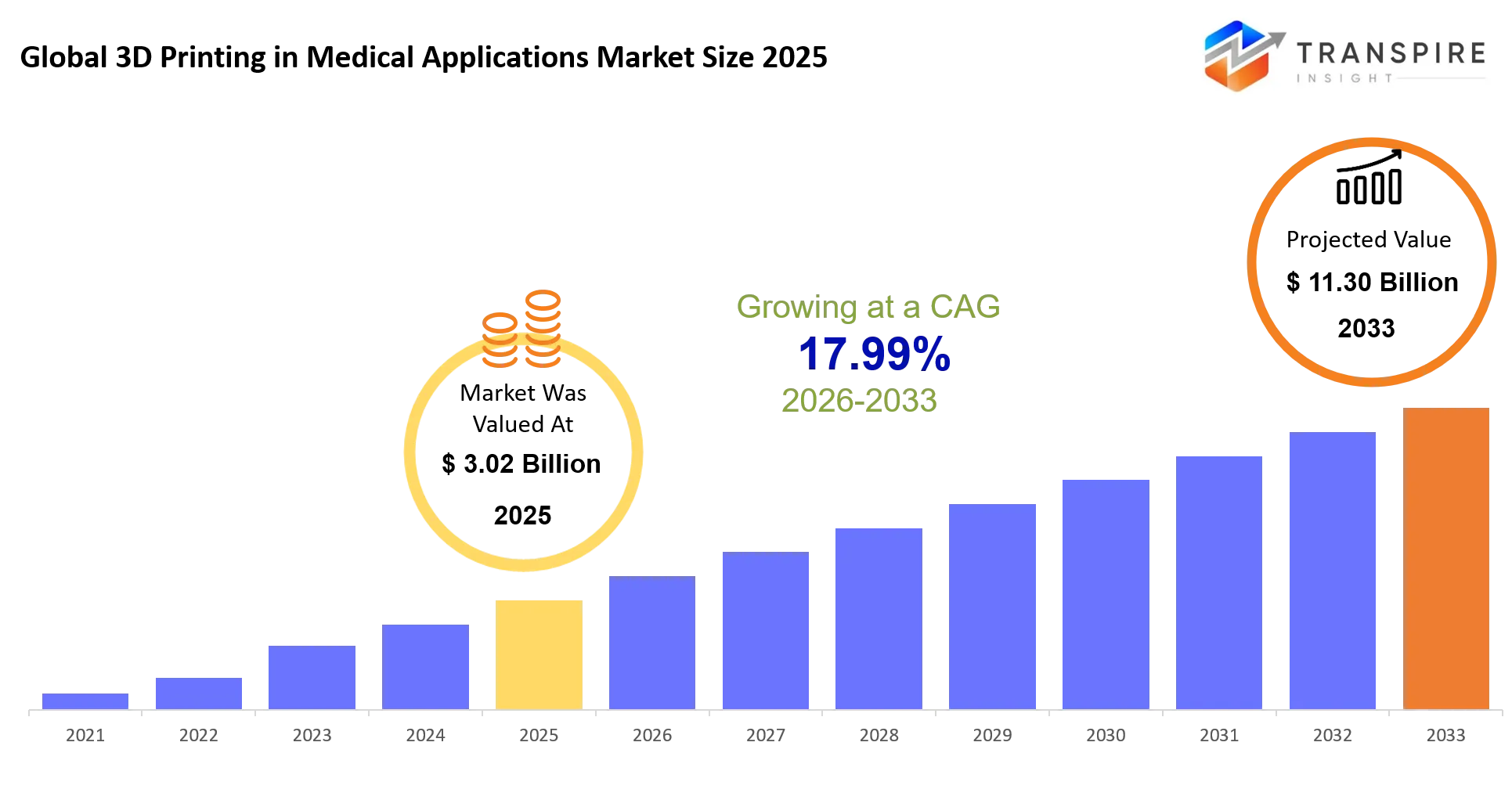
Global 3D Printing in Medical Applications Market Size & Forecast:
- Global 3D Printing in Medical Applications Market Size 2025: USD 3.02 Billion
- Global 3D Printing in Medical Applications Market Size 2033: USD 11.30 Billion
- Global 3D Printing in Medical Applications Market CAGR: 17.99%
- Global 3D Printing in Medical Applications Market Segments: By Technology (Stereolithography, Selective Laser Sintering, FDM, Electron Beam Melting, Inkjet Printing, Bioprinting, Others); By Application (Prosthetics, Implants, Surgical Guides, Tissue Engineering, Dental, Medical Devices, Others); By Material (Polymers, Metals, Ceramics, Biomaterials, Others); By End User (Hospitals, Research Institutes, Medical Device Companies, Dental Labs, Others); By Component (Printers, Materials, Software, Services, Others)
Global 3D Printing in Medical Applications Market Summary
As per Transpire Insight Analysis, the Global 3D Printing in Medical Applications Market size is estimated at USD 3.02 Billion in 2025 and is anticipated to reach USD 11.30 Billion by 2033, growing at a CAGR of 17.99% from 2026 to 2033. This high-precision medical technology sector provides the specialized additive manufacturing printers, biocompatible materials - digital slicing software required to construct patient-specific anatomical structures, surgical instrumentation, and living tissue constructs directly from clinical imaging data. Over the past few years - a critical clinical demand for personalized healthcare has pushed the industry to abandon generic, mass-manufactured sizing in favor of customized patient-matched devices. This progression triggered a massive structural shift as hospitals moved fabrication workflows straight to point-of-care settings, integrating printers directly into surgical theaters. By translating complex patient CT scans into tailored anatomical models and porous structural implants - surgical teams can dramatically compress intraoperative reconstruction times and mitigate implant rejection risks, driving explosive global healthcare adoption.
Key Market Insights
The Global 3D Printing in Medical Applications Market is fundamentally shifting from generic, mass-manufactured medical devices to highly customized, patient-matched anatomical solutions fabricated directly at the point of care. Driven by the critical demand for superior clinical outcomes and reduced operating room times, healthcare networks are replacing traditional standardized orthopedic and dental components with high-precision, biocompatible additive structures that integrate flawlessly with native human tissue.
- Locking down a dominant 34% share, Medical Implants lead the application matrix, with 3D Systems expanding its personalized health services by deploying specialized, laser-sintered titanium and medical-grade PEEK structural implants to accelerate complex bone reconstructions.
- Expanding at an explosive 20.8% CAGR, Bioprinting Applications dominate market acceleration as regenerative research institutes swap static plastic scaffolding for active cellular deposition systems to fabricate viable living tissue models.
- Capturing 42% of worldwide revenue, North America functions as the largest geographic market, backed by massive institutional capital investments across point-of-care hospital printing labs and well-established FDA regulatory clearance pathways.
- Commanding a stable 28% market slice, Europe drives system compliance and safety, pushing regional dental labs and device manufacturers to aggressively secure full-scope EU MDR certifications for jetted materials and structural components.
- Representing 22% of total industry demand, the Asia Pacific theater relies on massive government-backed healthcare infrastructure upgrades, compelling regional hospital networks to implement point-of-care 3D printing facilities to satisfy escalating localized patient demands.
- Securing 18% of the application matrix, Dental Applications remain an essential revenue driver, with Formlabs and Carbon introducing high-speed, light-curable biocompatible photopolymers to drastically compress overnight crown and denture manufacturing cycles.
- Accounting for 17% of the clinical mix, Prosthetics face rapid design upgrades as advanced manufacturers leverage lightweight, skin-compatible SLS nylon filaments to deliver highly durable, cost-effective artificial limbs.
- Securing 12% of total hardware procurement, Surgical Guides expand across acute care settings, allowing clinical teams to convert raw patient CT scans into autoclavable, high-temperature drill templates that maximize intraoperative incision accuracy.
- Claiming a targeted 5% market footprint, the Middle East & Africa region represents a high-potential development zone, accelerating structural healthcare modernization through strategic public-private partnerships and nationwide manufacturing expansion initiatives.
- Accounting for an integrated 3% market slice, Latin America moves toward modern digital dentistry and orthopedic frameworks, relying on entry-level professional desktop printers to optimize localized medical device prototyping.
What are the Key Drivers, Restraints, and Opportunities in the Global 3D Printing in Medical Applications Market?
Driver
The market is expanding due to the clinical urgency to achieve superior patient outcomes and compress operating room times via customized, patient-matched anatomical devices. Standard, mass-manufactured joint replacements or cranial plates frequently require extensive manual reshaping during active surgeries, which significantly elevates patient trauma and infection risks. This pressure was triggered by rapid hospital-level point-of-care lab modernization and the validation of laser beam melting technology - forcing clinical teams to transition from rigid off-the-shelf components to custom, porous titanium reconstructions. This operational shift drives massive hardware and material revenue as medical device companies and surgical centers invest heavily in high-fidelity slicing software and biocompatible powder beds to streamline personalized orthopedic treatments.
Restraint
Severe, structural validation and regulatory compliance bottlenecks across diverse international boundaries act as a major hurdle capping market growth. While additive printing technologies continue to evolve, multi-material bioprinting and structural implant manufacturing must survive extraordinarily long, multi-year approval pathways like the European Union's strict Medical Device Regulation (EU MDR). This friction persists because modifying a printer's physical laser settings or introducing a new material batch requires complete quality management re-certification, presenting massive financial overheads and production delays that prevent rapid, cost-effective point-of-care hospital scaling.
Opportunity
The most lucrative growth window lies in the large-scale integration of sub-micron, multi-material extrusion systems designed specifically for advanced tissue engineering and bioprinting applications. Fusing living cell deposition logic with smart bio-inks allows research institutes and medical device firms to print complex - vascularized micro-tissues for localized pharmaceutical drug testing and cosmetic trials. This structural transition unlocks long-term recurring material revenue as clinical labs invest heavily in specialized biomaterial matrices to eliminate analog animal-testing models and automate early-stage pre-clinical toxicity screening loops.
What Has the Impact of Artificial Intelligence Been on the Global 3D Printing in Medical Applications Market?
Artificial intelligence is completely changing how clinical teams handle patient imaging, moving additive medical manufacturing away from manual, multi-day digital slicing protocols into automated, real-time segmentation and modeling pipelines. Instead of requiring biomedical engineers to spend hours painstakingly tracing bone boundaries across raw CT or MRI DICOM files, operations teams use integrated machine learning algorithms to isolate Hounsfield Units (HU) and automatically generate perfect 3D-render meshes within minutes.
Inside point-of-care printing labs, AI models optimize industrial material utilization by feeding architectural configurations directly into predictive finite element simulation software. These smart networks constantly evaluate structural load-bearing stress fields, porosity variations - potential laser-fusing anomalies across complex spinal cages and cranial implants before the physical printer starts its run. By anticipating micro-cracking risks or powder-bed warping, the platform automatically adjusts toolpaths to guarantee mechanical structural integrity. However, an operational limitation persists around strict clinical accuracy gaps; neural networks trained on standard datasets frequently misinterpret complex tumor boundaries or atypical anatomical anomalies, requiring ongoing human expert verification. Even with these data filtering hurdles, physical medical automation software is advancing rapidly.
In May 2025, additive manufacturing software leader Materialise officially rolled out advanced AI-enabled segmentation algorithms within its updated Materialise Mimics platform to fast-track point-of-care 3D planning workflows. This automated intelligence system uses deep learning models to automatically isolate complex anatomical boundaries for orthognathic and reconstruction cases directly from raw patient scans. By compressing traditional manual bone-tracing and file segmentation times by up to 30%, this digital pipeline allows point-of-care hospital labs to drastically shorten patient case-to-care cycles and deliver highly precise, print-ready orthopedic and surgical templates.
Key Market Trends
The global 3D printing in medical applications landscape - undergoing a major structural evolution, shifting away from standalone, outsource-dependent prototyping bureaus toward fully integrated, in-house digital manufacturing networks. Driven by the critical necessity to reduce surgical lead times and optimize supply chain resilience, healthcare institutions are replacing legacy standard sizing with point-of-care, multi-material processing centers that fuse clinical imaging directly with active production hardware.
- For years, surgical teams relied entirely on standard mass-manufactured implants and manual sizing templates during operations, but acute care centers are rapidly implementing on-site biocompatible printers to fabricate patient-matched reconstructions within hours.
- Instead of deploying uniform, rigid plastic anatomical representations that lack lifelike tactile feedback, medical educational facilities are actively adopting multi-material jetting hardware to replicate complex organ pathologies and soft tissue variations.
- Traditional craniomaxillofacial and orthopedic clinics historically relied on delayed, multi-week external laboratory milling to secure titanium fixtures, but modern trauma units are aggressively embedding high-throughput selective laser melting (SLM) nodes directly into local sterile workflows.
- Rather than maintaining separate, disconnected digital slicing channels that delay clinical response times, radiology software developers are transitioning toward automated machine learning engines that parse DICOM imaging files to generate print-ready anatomical meshes.
- Dental laboratories and orthodontic clinics are discarding legacy manual gypsum plaster stone casts to execute high-volume, automated workflows using light-curable photopolymer resins for patient-specific alignment arrays.
- Leading medical device developers are moving far beyond static, bio-inert structural metals, driving a massive deployment of cellular bioprinting architectures to formulate living vascular networks and functional micro-tissue test beds.
- To combat material degradation and strict biological contamination risks, healthcare cleanroom networks are abandoning unmonitored atmospheric printing environments to mandate hermetically sealed, inert-gas powder beds across industrial laser systems.
- Rather than utilizing solid, heavy-gauge structural hardware that can inhibit natural bone ingrowth, orthopedic architects are rapidly transitioning toward complex, porous trabecular lattice geometries that actively promote organic osseointegration.
- Regional regulatory compliance divisions and hospital oversight groups are overhauling legacy prototyping rules, pushing a strategic rollout of point-of-care ISO 13485 quality frameworks to strictly standardize the physical execution of bedside medical components.
Global 3D Printing in Medical Applications Market Segmentation
By Technology
Stereolithography (SLA) commands the largest share of market capital, holding a dominant portion of global revenue due to its long-standing validation, high surface finish fidelity, and widespread adoption in precision dental and anatomical modeling. Selective Laser Sintering (SLS), FDM, Electron Beam Melting (EBM), and Inkjet Printing follow as critical structural fabrication layers, while Bioprinting stands as the undisputed market accelerator, driving the fastest growth with an explosive CAGR of 20.8%. This division is shaped by the clinical demands of dense - load-bearing structural parts versus living cellular engineering. Stereolithography maintains its peak position because dental labs and surgical clinics require ultra-crisp micron-level resolution to construct patient-specific crown arrays and high-temperature autoclavable drill templates. Conversely - Bioprinting applications are accelerating rapidly as regenerative medicine research institutes demand automated - high-precision cell-deposition systems to fabricate viable living vascular networks and functional tissue models for pre-clinical drug testing. Moving forward, structural technologies will pivot toward multi-material and hybrid printing architectures, forcing hardware developers to engineer dual-head systems capable of fusing rigid structural polymers alongside flexible bio-inks within a single sterile workflow.
By Application
Medical Implants function as the undisputed anchor of this segment, locking down a dominant 34% share of total industry revenue, while Dental Applications follow closely as a crucial secondary operational standard at 18%. Prosthetics capture a stable 17%, Surgical Guides sit at 12%, and other ancillary medical devices and tissue engineering frameworks account for the final 19%. The underlying growth logic is tied directly to the rising clinical urgency for patient-matched orthopedic fixes and the rapid contraction of overnight dental fabrication loops. Medical Implants lead the market position because traditional off-the-shelf joint replacements frequently require extensive manual intraoperative manipulation, which dramatically raises patient trauma and rejection rates; custom 3D-printed titanium implants resolve this by mapping directly to a patient's CT scan. Moving forward, application development will focus heavily on bio-resorbable structures and active cellular integration, forcing device suppliers to transition from inert, permanent structural metals toward advanced, porous lattice geometries that actively promote organic bone ingrowth and accelerate post-operative recovery.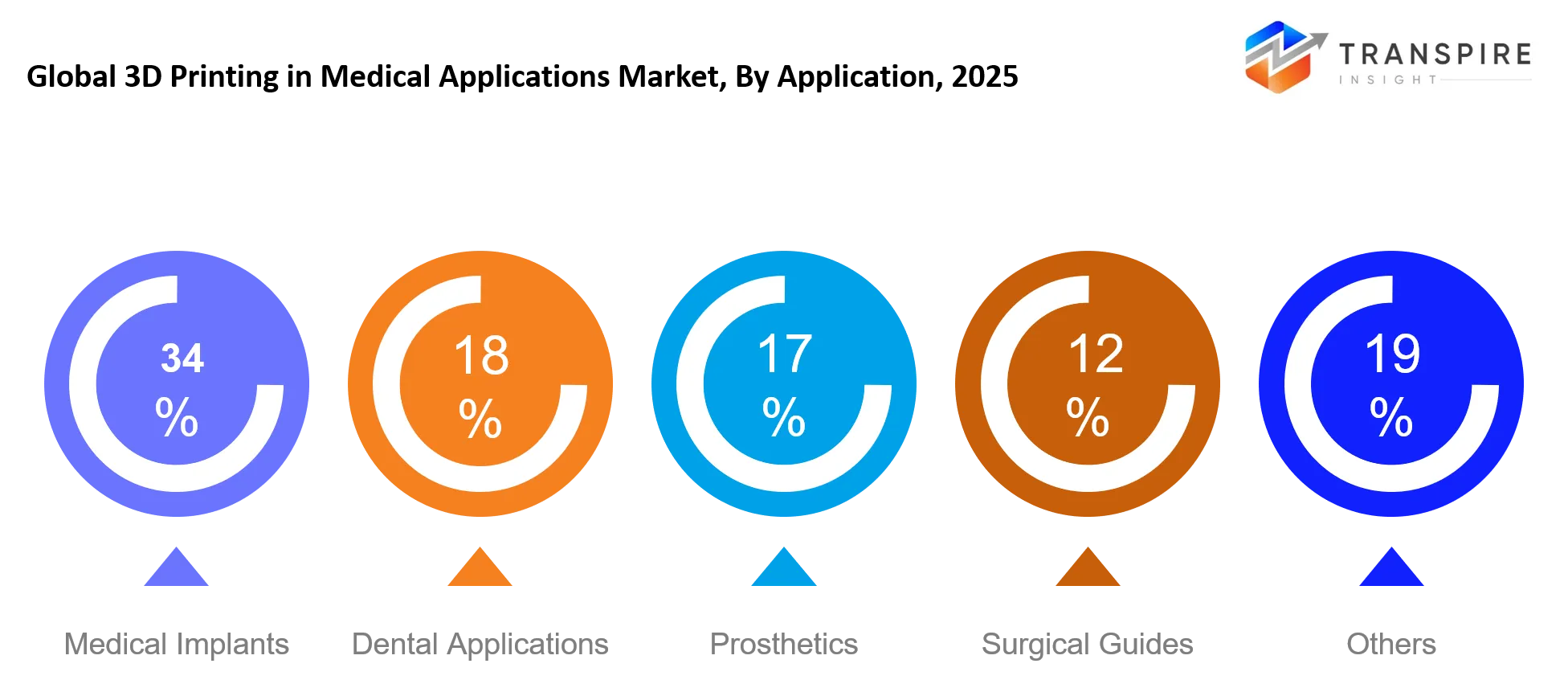
By Material
Polymers retain a massive portion of the operational footprint due to their superior structural versatility, low cost, and widespread compatibility across both desktop and industrial extrusion systems. Meanwhile - Metals (such as medical-grade titanium and cobalt-chrome alloys) and Biomaterials are leading market growth as critical options for load-bearing permanent implants - regenerative engineering. This distribution pattern is driven by a broad clinical transition toward patient-specific anatomical matching designed to optimize mechanical strength and eliminate structural rejection risks. Pure polymers are ideal for high-volume dental models, surgical drill templates, and prosthetic limbs that require lightweight durability. However, advanced Biomaterials are gaining significant ground because they allow clinical research labs to extrude cell-laden hydrogels that mimic native human tissue matrices. Looking ahead, the industry will pivot sharply toward advanced biomimetic composites, forcing material scientists to engineer smart, shape-memory polymers and specialized bio-resorbable ceramics that safely degrade within the body as natural bone tissue regenerates.
By End User
Hospitals serve as the primary financial engine of the market, controlling massive capital procurement budgets as they rapidly establish point-of-care 3D printing labs directly inside acute care networks. Concurrently, Medical Device Companies, Research Institutes, and Dental Labs represent highly active, fast-growing secondary buyers. The market dynamic here relies on the shifting centralization of medical manufacturing, where large hospital networks install industrial-grade systems to compress surgical planning timelines while dental labs leverage desktop resin printers to optimize local workflow throughput. Hospitals use on-site point-of-care infrastructure to convert raw patient DICOM imaging files into sterile surgical guides within hours, whereas medical device firms utilize high-throughput printing arrays to mass-customize complex orthopedic parts. Moving forward, market success will require a total pivot away from fragmented hardware sales. Long-term profitability will belong to providers who offer integrated "Point-of-Care-as-a-Service" packages, bundling certified medical printers with regulatory-compliant slicing software, biocompatible materials, and ongoing clinical validation support.
By Component
Printers command the largest share of market capital, holding a dominant position in global revenue due to the high upfront capital investments required to install industrial-grade, medical-certified selective laser melting (SLM) and stereolithography systems. Materials and Software follow as crucial operational layers, while professional Services and post-processing calibration workflows account for the remaining market distribution. This division persists because establishing an uncompromised, clinical-grade additive setup demands significant upfront expenditure on high-precision laser-fusing or jetting hardware. Printers maintain their peak position because healthcare networks must procure certified, cleanroom-compatible machinery to ensure absolute structural safety. Meanwhile, Materials and Software categories are accelerating rapidly as medical technicians demand automated, AI-driven digital segmentation software to instantly convert patient CT scans into print-ready meshes. Moving forward, structural components will transition toward closed-loop, software-defined ecosystems where equipment providers bundle intelligent software subscriptions with tailored material cartridges to minimize human handling and guarantee absolute clinical reproducibility.
What are the Key Use Cases Driving the Global 3D Printing in Medical Applications Market?
The real heavy lifter in this market is the direct, on-demand production of patient-matched orthopedic, spinal, and craniomaxillofacial implants. For decades, surgeons had to manually bend and shape standardized reconstructive plates mid-surgery, extending operating times and increasing infection risks. Additive manufacturing completely flips this by letting device companies turn a patient's CT scan into a custom, laser-sintered porous titanium implant. Because these fit structural bone defects perfectly, they slash intraoperative revision rates and dramatically boost natural, post-operative osseointegration.
Moving beyond permanent bone replacements, clinical teams are rapidly deploying the technology to build ultra-precise surgical drill guides, custom limbs, and everyday dental restorations. Right now, on-site hospital labs use biocompatible photopolymers to print custom surgical cutting templates. These fit directly onto a patient's bone to lock down exact incision angles in the operating room. At the same time, dental clinics are using automated desktop resin systems to turn 3D intraoral scans into custom crowns, bridges, and clear aligners on the spot.
Looking at the cutting edge, the most exciting emerging use cases are shifting toward multi-cellular bioprinting and custom-layered pharmaceuticals. Advanced research labs are now using multi-head extruders to print living cell hydrogels, recreating functional human micro-tissues and vascular channels to test experimental drugs safely without using animals. Simultaneously, clinical pharmacies are testing multi-drug layered printing. This allows them to compress a patient's complex daily pill regime into a single, custom-timed-release tablet, completely reimagining chronic patient compliance.
|
Report Metrics |
Details |
|
Market size value in 2025 |
USD 3.02 Billion |
|
Market size value in 2026 |
USD 3.55 Billion |
|
Revenue forecast in 2033 |
USD 11.30 Billion |
|
Growth rate |
CAGR of 17.99% from 2026 to 2033 |
|
Base year |
2025 |
|
Historical data |
2021 - 2024 |
|
Forecast period |
2026 - 2033 |
|
Report coverage |
Revenue forecast, competitive landscape, growth factors, and trends |
|
Regional scope |
United States; Canada; Mexico; United Kingdom; Germany; France; Italy; Spain; Switzerland; Netherlands; China; Japan; India; Australia; South Korea; Singapore; Brazil; Argentina; South Africa; Saudi Arabia; United Arab Emirates |
|
Key company profiled |
Stratasys, 3D Systems, Materialise, EOS, GE HealthCare, SLM Solutions, Formlabs, Desktop Metal, Organovo, Renishaw, EnvisionTEC, Prodways, CELLINK, HP, Carbon. |
|
Customization scope |
Free report customization (country, regional & segment scope). Avail customized purchase options to meet your exact research needs. |
|
Report Segmentation |
By Technology (Stereolithography, Selective Laser Sintering, FDM, Electron Beam Melting, Inkjet Printing, Bioprinting, Others); By Application (Prosthetics, Implants, Surgical Guides, Tissue Engineering, Dental, Medical Devices, Others); By Material (Polymers, Metals, Ceramics, Biomaterials, Others); By End User (Hospitals, Research Institutes, Medical Device Companies, Dental Labs, Others); By Component (Printers, Materials, Software, Services, Others) |
Which Regions are Driving the Global 3D Printing in Medical Applications Market Growth?
North America maintains a commanding grip on the 3D printing in medical applications market, capturing a dominant 42% of all worldwide industry revenue. This geographic leadership is heavily driven by an extensive, well-funded network of point-of-care hospital fabrication labs combined with aggressive clinical technology transitions. The regional ecosystem is structurally supported by clear, institutional FDA regulatory clearance pathways for patient-specific devices and substantial private insurance reimbursement setups. Consequently, integrating high-throughput dental printing arrays and customized orthopedic workflows has become a primary operational standard for domestic healthcare networks aiming to compress intraoperative timelines.
In April 2026, medical printing leader Stratasys officially expanded its healthcare additive pipeline by rolling out specialized software updates and material architectures designed for its PolyJet J850 Core system to accelerate clinical workflows. This technical expansion allows North American radiology departments and surgical centers to produce highly realistic, multi-material anatomical models and custom templates directly from raw diagnostic imaging data. By providing point-of-care labs with the tools to simulate complex human tissue variations and pathologies in-house, this rollout compresses traditional prototyping timelines from weeks to hours, substantially driving regional clinical adoption.
Europe serves as a highly stable, predictable secondary pillar for the global market, locking down an essential 28% share of total industry demand. While North American operational expansion focuses heavily on maximizing private point-of-care hospital network revenue, European additive adoption is driven entirely by strict continental public health safety standards and centralized procurement frameworks. This regional market stability is structurally insulated by state-backed clinical research grants and long-term public healthcare infrastructure mandates that push surgical institutes to implement standardized, multi-facility digital workflows. To maintain strict patient-safety compliance amidst shifting regulatory landscapes, European medical device manufacturers steadily invest in high-fidelity software platforms that guarantee uncompromised structural validation.
In March 2026, additive manufacturing major 3D Systems officially announced that it achieved full-scope certification under the strict European Union Medical Device Regulation (EU MDR 2017/745) for its medical quality systems and technical data. This critical regulatory milestone satisfies Europe's stringent clinical evidence and manufacturing oversight mandates, paving the way for the immediate, phased rollout of its NextDent jetted dental and prosthetic solutions across continental laboratories. By aligning its additive manufacturing platform with these updated European safety standards, the company enables regional clinics to confidently transition away from traditional analog plaster methods to automated, fully compliant digital dentistry workflows.
The Asia Pacific region has emerged as the fastest-growing territory globally, accelerating at a market-leading CAGR of 21.7% to capture a 22% slice of global sales. This sudden structural shift is driven by massive government-backed healthcare infrastructure upgrades, expanding medical tourism corridors, and an aggressive regional pivot toward localized medical device manufacturing. Historically, regional surgical departments relied heavily on importing expensive, pre-fabricated implants from Western suppliers, but the territory has now rapidly pivoted toward domestic point-of-care printing networks to drastically lower localized treatment costs. Looking ahead, future equipment procurement in this booming corridor relies entirely on deploying advanced, cost-effective selective laser sintering (SLS) systems and automated resin setups to fulfill escalating, high-volume patient demands across dense metropolitan health centers.
In June 2026, professional 3D printing supplier Formlabs officially unveiled its new industrial large-format selective laser sintering (SLS) platform, the Fuse X1 ecosystem, to scale accessible decentralized manufacturing. This high-throughput industrial platform utilizes an Adaptive Thermal Control architecture across thirteen independent thermal zones alongside AI-powered print intelligence to deliver production-quality components in under twenty-four hours. By delivering parts at up to 50% lower cost per part and triple the throughput of legacy industrial powder systems, this compact hardware deployment allows rapidly expanding medical device groups and regional laboratory hubs to mass-produce complex structural parts and surgical assemblies affordably. 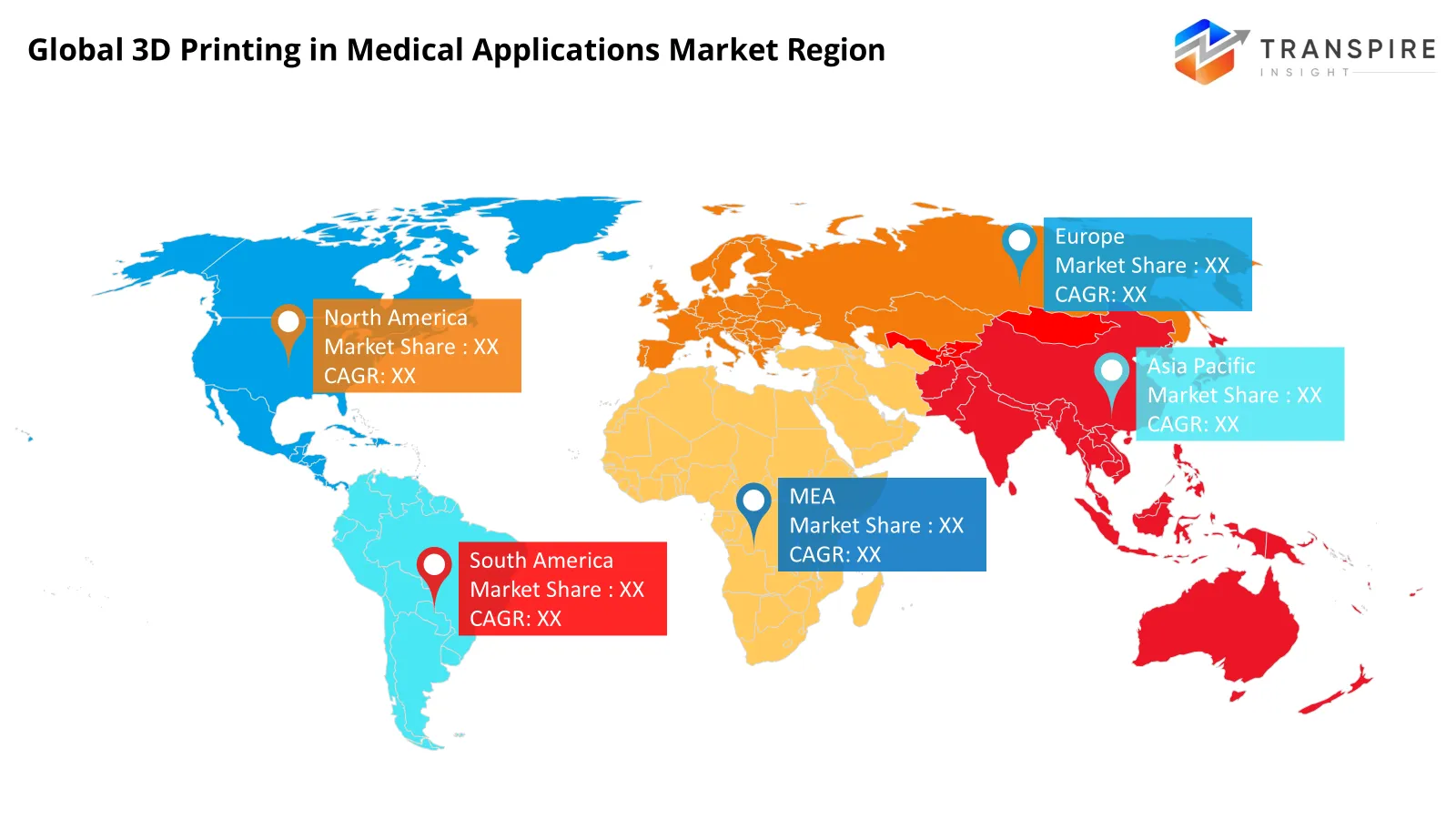
Who are the Key Players in the Global 3D Printing in Medical Applications Market and how do they Compete?
Competition in this space is no longer just about who builds the best printer box; it is a fierce battle over complete hardware - software ecosystems. Specialized additive manufacturing firms are constantly locking horns with massive medtech conglomerates. To win market share, these companies build dominance by validating end-to-end proprietary workflows. This means instead of selling standalone machinery, they bundle medical-grade, cleanroom-certified printing hardware with automated anatomical slicing software and highly specialized, biocompatible materials.
Stratasys leans heavily into an aggressive product innovation strategy, putting its chips on multi-material polymer jetting and point-of-care hospital setups. They set themselves apart by printing highly realistic, lifelike organ models that mimic actual human tissue densities and complex pathologies, giving surgeons a physical dress rehearsal before the first incision. To scale up, they are embedding their dedicated software right into local hospital radiology departments to streamline the path from patient scan to finished model.
Meanwhile - 3D Systems plays a different game, executing a multi-niche strategy that covers both permanent titanium orthopedic implants and long-term cellular bioprinting research. They gain a massive structural edge by collecting strict regulatory milestones, like FDA 510(k) clearances - EU MDR certifications, for their virtual surgical planning systems. Their growth relies on signing long-term partnership deals with medical device giants and top-tier research universities, effectively locking in highly profitable, recurring material-supply revenue.
Company List
- Stratasys
- 3D Systems
- Materialise
- EOS
- GE HealthCare
- SLM Solutions
- Formlabs
- Desktop Metal
- Organovo
- Renishaw
- EnvisionTEC
- Prodways
- CELLINK
- HP
- Carbon
Recent Development News
In April 2026, medical printing leader Stratasys officially expanded its healthcare additive platform by rolling out specialized software updates and material architectures for its PolyJet J850 Core system to accelerate medical additive manufacturing workflows. This release includes the exclusive rollout of P3 MED Silicone 25A—the first biocompatible true silicone certified to ISO 10993 standards—allowing point-of-care hospital labs to produce flexible, high-precision medical devices without relying on traditional molds or expensive tooling. [https://www.mpo-mag.com
In May 2026, leading medical software and additive provider Materialise NV hosted its annual 3D Planning - Printing in Hospitals Forum in Leuven to scale point-of-care implementation and bridge deep clinical reimbursement gaps across European medical networks. This strategic ecosystem collaboration directly aligned leading surgical teams with regulatory experts to transition advanced soft-tissue virtual planning and complex partial nephrectomy protocols into mainstream healthcare standards. [https://www.materialise.com
What Strategic Insights Define the Future of the Global 3D Printing in Medical Applications Market?
The future of this market is accelerating toward a fully decentralized, software-defined ecosystem where physical medical components are manufactured directly at the patient’s bedside. However, a hidden risk lies in data vulnerability. As hospital networks scale up point-of-care operations, the digital transfer of raw, unencrypted DICOM imaging files introduces massive cybersecurity exposures, making patient data a prime target for ransomware attacks. Conversely - an emerging opportunity rests on the commercial integration of advanced, shape-memory biomaterials. These smart polymers allow printed implants to dynamically alter their geometric form in response to internal physiological changes, matching natural bone growth profiles. To capture long-term market share, players must pivot away from standard hardware provisioning and instead build secure, cloud-hosted digital execution platforms that strictly link automated CAD file validation with immutable blockchain-based tracking architectures.
By Technology
- Stereolithography
- Selective Laser Sintering
- FDM
- Electron Beam Melting
- Inkjet Printing
- Bioprinting
- Others
By Application
- Prosthetics
- Implants
- Surgical Guides
- Tissue Engineering
- Dental
- Medical Devices
- Others
By Material
- Polymers
- Metals
- Ceramics
- Biomaterials
- Others
By End User
- Hospitals
- Research Institutes
- Medical Device Companies
- Dental Labs
- Others
By Component
- Printers
- Materials
- Software
- Services
- Others
Regional Outlook
North America
- United States
- Canada
- Mexico
Europe
- Germany
- United Kingdom
- France
- Spain
- Italy
- Rest of Europe
Asia Pacific
- Japan
- China
- Australia & New Zealand
- South Korea
- India
- Rest of Asia Pacific
South America
- Brazil
- Argentina
- Rest of South America
Middle East & Africa
- Saudi Arabia
- United Arab Emirates
- South Africa
- Rest of the Middle East & Africa
Frequently Asked Questions
Find quick answers to common questions.
The Global 3D Printing in Medical Applications Market size was valued at USD 3.02 Billion in 2025 and is poised to reach USD 11.30 Billion by 2033, expanding at a 17.99% CAGR.
Key segments for the market are By Technology (Stereolithography, Selective Laser Sintering, FDM, Electron Beam Melting, Inkjet Printing, Bioprinting, Others); By Application (Prosthetics, Implants, Surgical Guides, Tissue Engineering, Dental, Medical Devices, Others); By Material (Polymers, Metals, Ceramics, Biomaterials, Others); By End User (Hospitals, Research Institutes, Medical Device Companies, Dental Labs, Others); By Component (Printers, Materials, Software, Services, Others).
Growth is primarily driven by the urgent clinical demand for customized, patient-matched orthopedic and cranial implants that fit structural bone defects perfectly, combined with the rapid modernization of point-of-care hospital fabrication labs that drastically compress intraoperative timelines and minimize patient trauma.
The global market is led by major manufacturers including Stratasys, 3D Systems, Materialise, EOS, GE HealthCare, SLM Solutions, Formlabs, Desktop Metal, Organovo, Renishaw, EnvisionTEC, Prodways, CELLINK, HP, and Carbon.
North America holds a dominant 42% share of the worldwide revenue, driving market dynamics through its extensive, well-funded ecosystem of point-of-care surgical printing labs, robust private healthcare insurance reimbursement structures, and clear, institutional FDA regulatory clearance pathways for patient-specific medical devices.
Lucrative opportunities exist in the large-scale commercialization of sub-micron, multi-material bioprinting extrusion networks capable of depositing active cell-laden hydrogels to fabricate functional living tissues for automated, animal-free pharmaceutical testing, alongside the development of smart shape-memory biomaterials that dynamically adapt to natural bone growth profiles.
- Stratasys
- 3D Systems
- Materialise
- EOS
- GE HealthCare
- SLM Solutions
- Formlabs
- Desktop Metal
- Organovo
- Renishaw
- EnvisionTEC
- Prodways
- CELLINK
- HP
- Carbon
About the Authors

Mayur Shinde
I am Mayur Shinde, a Senior Research Analyst at Transpire Insight, specializing in the Automotive & Transportation and Information & Communication Technology (ICT) Industry. My work focuses on analyzing emerging market trends, technological advancements, competitive landscapes, and industry developments to deliver accurate, data-driven insights. I am passionate about transforming complex market information into clear, actionable content that helps businesses, professionals, and decision-makers stay informed and make confident strategic decisions.

Chakradhar Khansole
Chakradhar serves as the Research Director at Transpire Insight, bringing over 8 years of experience in technology, innovation, and strategic market intelligence. He specializes in transforming complex market data into actionable business insights that enable organizations to make informed, growth-oriented decisions. Recognized for his strategic vision and analytical expertise, Chakradhar leads high-impact research initiatives, delivering comprehensive market assessments, competitive intelligence, and forward-looking industry analysis.
Recently Published Reports
-
Apr 2026
3D Optical Profiler Market
3D Optical Profiler Market Size, Share & Analysis Report By Type (Desktop 3D Optical Profiler, and Portable 3D Optical Profiler), By Technology (Confocal Technology, and White Light Interference), By End-Use Industry (Manufacturing, Research Institutions, Automotive, Aerospace and Defense, Medical Devices, and Other), and Geography (North America, Europe, Asia-Pacific, Middle East and Africa, South and Central America), 2021 - 2031
-
Apr 2026
Depth Sensor Market
Depth Sensor Market Size, Share & Analysis Report By Type (Infrared Depth Sensors, Time-of-Flight (ToF) Sensors, Stereo Vision Sensors, Structured Light Sensors, Ultrasonic Depth Sensors), By Application (Automotive, Robotics, Gaming, Consumer Electronics, Industrial Automation, Healthcare, Security & Surveillance, Others), By End Users (Automotive Manufacturers, Consumer Electronics Companies, Healthcare Providers, Industrial Companies, Security Agencies, Gaming Companies, Robotics Companies, Others), and Geography (North America, Europe, Asia-Pacific, Middle East and Africa, South and Central America), 2021 – 2031
-
Apr 2026
Digital Manufacturing Market
Digital Manufacturing Market Size, Share & Analysis Report By Component (Hardware, Software, and Services), By Technology (Robotics, 3D Printing, Internet of Things (IoT), and Others), By Application (Automotive and Transportation, Aerospace and Defense, Consumer Electronics, Industrial Machinery, and Others), By Process Type (Computer-Based Designing, Computer-Based Simulation, Computer 3D Visualization, Analytics, and Others), and Geography (North America, Europe, Asia-Pacific, Middle East and Africa, South and Central America), 2021 – 2031
-
Apr 2026
Digital Visa Services Market
Digital Visa Services Market Size, Share & Analysis Report By Type (Individual Travelers, Group Travelers), By Application (Tourism, Business Travel, Others), and Geography (North America, Europe, Asia-Pacific, Middle East and Africa, South and Central America), 2021 – 2031