
Radiation Tester Market Summary:
As per the Transpire Insight Analysis, the Radiation Tester Market size is estimated at USD 1.42 billion in 2025 and is anticipated to reach USD 2.17 billion by 2033, growing at a CAGR of 5.52% from 2026 to 2033.
The global radiation testers market turns invisible exposures into meaningful measurements: they verify protection, find leaks, ensure workplace dose limits and record compliance at hospitals, plants, labs, ports and factories. Over the past three to five years, purchasing transitioned away from standalone handheld checks to connected, continuously logged monitors. The foundational change is from analogue instruments to compact digital, wireless, wearable and spectroscopic systems supplying safety software. A leading-edge driver was the growth of diagnostics, radiotherapy, nuclear projects and security controls, together with increased assurance demands and traceability records. Demand increases for all follow an obvious cause-and-effect chain, from added radiation sources and regulated processes to more measurement points; reliability improvement will cause common meters to be superseded by networked units, repeating calibration, service plans and data analysis. Walkaround capability is especially useful in accidents, outages and far-flung industrial inspections where instant decisions are needed more than laboratory results.
Radiation Tester Market Size & Forecast:
- Global Market Size 2025: USD 1.42 Billion
- Expected Market Value (2033): USD 2.17 Billion
- Forecast CAGR (2026–2033): 5.52%
- Leading Region in 2025: North America
- Fastest Growing Region: Asia Pacific
- Key Company Profiles: Thermo Fisher Scientific, Mirion Technologies, Fluke, Fuji Electric, Bertin Technologies, Polimaster, Ludlum Measurements, Radiation Detection Company, Tracerco, ORTEC, Canberra Industries, Hitachi, AMETEK, ECOTEST, Arrow-Tech

Key Radiation Tester Market Insights:
The market is becoming more segmented by use case, with connected and auditable systems gaining value from stand-alone meters. Installed bases remain a source of income for share leaders, and portable and AI-powered products are changing replacement economics.
- Survey meters account for 38% of sales, while Fluke's biomedical digital sales support the transition from spot checks to documented clinical quality assurance.
- Dosimeters account for 22%, and Mirion's Instadose VUE further advances wireless, real-time occupational exposure monitoring.
- Geiger counters have the advantage of being retained at 16%, and Ludlum and ECOTEST have the advantage of being cheap and continue to be important in smaller facilities.
- Personal radiation detectors make up 10%, and Thermo Fisher's RadEye development adds faster isotope identification and threat response.
- Portable radiation testers account for 9% of the market, but are expanding at a 16.7% CAGR; Polimaster's detect-locate-identify workflow enables mobile teams.
- Contamination monitors 3% share, and the nuclear portfolio of Bertin corresponds to the demand for alpha/beta detection during decommissioning and inspection.
- Others contribute 2%, and ORTEC and Canberra-type spectroscopy expertise encourages users to take higher-resolution analysis.
- North America accounts for 39%, Europe for 30%, and Asia Pacific for 24%, and Mirion's connected platforms are in line with compliance modernization in the region.
- Latin America & Africa and distributors and rugged systems are reducing access barriers, accounting for 3% and 4% respectively.
What are the Key Drivers, Restraints, and Opportunities in the Radiation Tester Market?
Driver:
The growth is due to additional tighter compliance requirements in medical imaging, radiotherapy, nuclear operations, and industrial radiation sources. FDA mandates performance controls, QC records, reporting, labelling and safety documents, while nuclear and defence operators demand traceable worker and site data. This results in demand for ionization-calibrated meters, dosimeters, contamination monitors and connected platforms. Such revenues grow through consumables, calibration, software, service contracts and replacement cycles that facilitate auditing of several sites.
Restraint:
Higher-end scintillation, spectroscopic, wearable and networked testers are still costly to buy, set up, certify and network. This is an ongoing problem as facilities have to unify different protocols, legacy interfaces, local licensing constraints, cyber security regulations and availability of radiation-safety specialists; smaller hospitals, laboratories and industrial operators tend to delay upgrades or purchase lower-function equipment.
Opportunity:
Modular, cloud-enabled monitoring simplifies deployment and generates recurring software revenue. Bringing together edge analytics and rugged wireless sensors allows vendors to offer solutions for nuclear maintenance, mining, border control, industrial inspection, and new Asian healthcare markets. Regional assembly reduces cost and lead time, while rental fleets, managed calibration, and subscription finance minimizes initial investment. These approaches enable smaller hospitals, labs, and industrial firms to use high-performance radiation testing without the need for outright purchase.
What Has the Impact of Artificial Intelligence Been on the Radiation Tester Market?
Artificial intelligence is transforming radiation monitoring devices from passive indicators to decision support nodes. Machine-learning models can categorize spectra, discern between harmless background fluctuation and likely contamination, and integrate measurements from dispersed sensors to identify abnormal dose patterns. At hospitals, analytics can evaluate dose indices across imaging protocols and detect drift before a quality-control failure; at nuclear power plants and industrial inspection, predictive models can estimate sensor ageing, battery requirements or calibration periods, minimizing unplanned outages.
Automation further streamlines alarm prioritisation, eliminates noisy readings and automatically forwards the incident reports to the relevant safety team rather than requiring operators to make this selection by viewing each trace. Connected dashboards turn output into a searchable audit trail and enable quicker correction of issues. The limiting factors are that accurate models require extensive, high quality, individually-labelled, site-specific datasets and that radiation signatures are instrument, shield, isotope and environment dependent. The integration of AI with legacy meters requires cybersecurity protocols, added validation demands, and the purchase of edge hardware may negate the savings of the new AI hardware; so AI assists certified measurement rather than replaces calibration, expert judgement or regulatory approval.
In May 2026, GE HealthCare spotlighted its AI-enabled Intelligent Radiation Therapy (iRT) software solution at the ESTRO 2026 Congress. The platform automated simulation-to-treatment workflows, helping early adopter sites cut planning duration drastically from days to minutes while streamlining multi-vendor clinical coordination.
Key Radiation Tester Market Trends:
The market is moving away from episodic measurement and towards connected risk management. Value is heading towards instruments that interpret, share and document readings in regulated operations.
- Handheld meters are getting smaller and lighter, and are making it possible to test in vehicles, maintenance crews and remote assets.
- Now, analogue displays are slowly being replaced by mobile apps, wireless connections and centralised dose records.
- Procurement is shifting from detector hardware to a combination of detector hardware, calibration and software, plus lifecycle services.
- Automatic dose reporting and quality-assurance evidence are becoming a top expectation of healthcare buyers.
- Where isotope identification is required, rather than threshold alarms, spectroscopic and multi-radiation devices are proving to be more popular.
- From passive badges to real-time worker alerts and location-aware exposure management, wearable dosimeters are evolving.
- Industrial users are installing detectors within inspection, process-control and environmental networks instead of conducting surveys periodically.
- AI-powered anomaly detection is transforming the way to respond from manual to prioritized and predictive.
- The demand is expanding in the nuclear, medical, defence, and environmental-monitoring programs in the Asia-Pacific region.
Radiation Tester Market Segmentation
By Product Type:
Radiation Survey Meters dominate the radiation meters market with a 38% share by providing broad radiation measurement from healthcare to industrial facilities to nuclear operations on a routine basis. Dosimeters have a 22% share due to routine personnel exposure measurement, while Geiger Counters have a 16% share thanks to ease of use and field reliability. Personal Radiation Detectors have 10% share as Portable Radiation Testers have 9% and are expected to have the fastest 16.7% CAGR based on mobile inspections and emergency response and field-based environmental monitoring. Contamination Monitors have a 3% share, while Other devices have a 2% share by meeting special safety applications such as surface contamination measurement.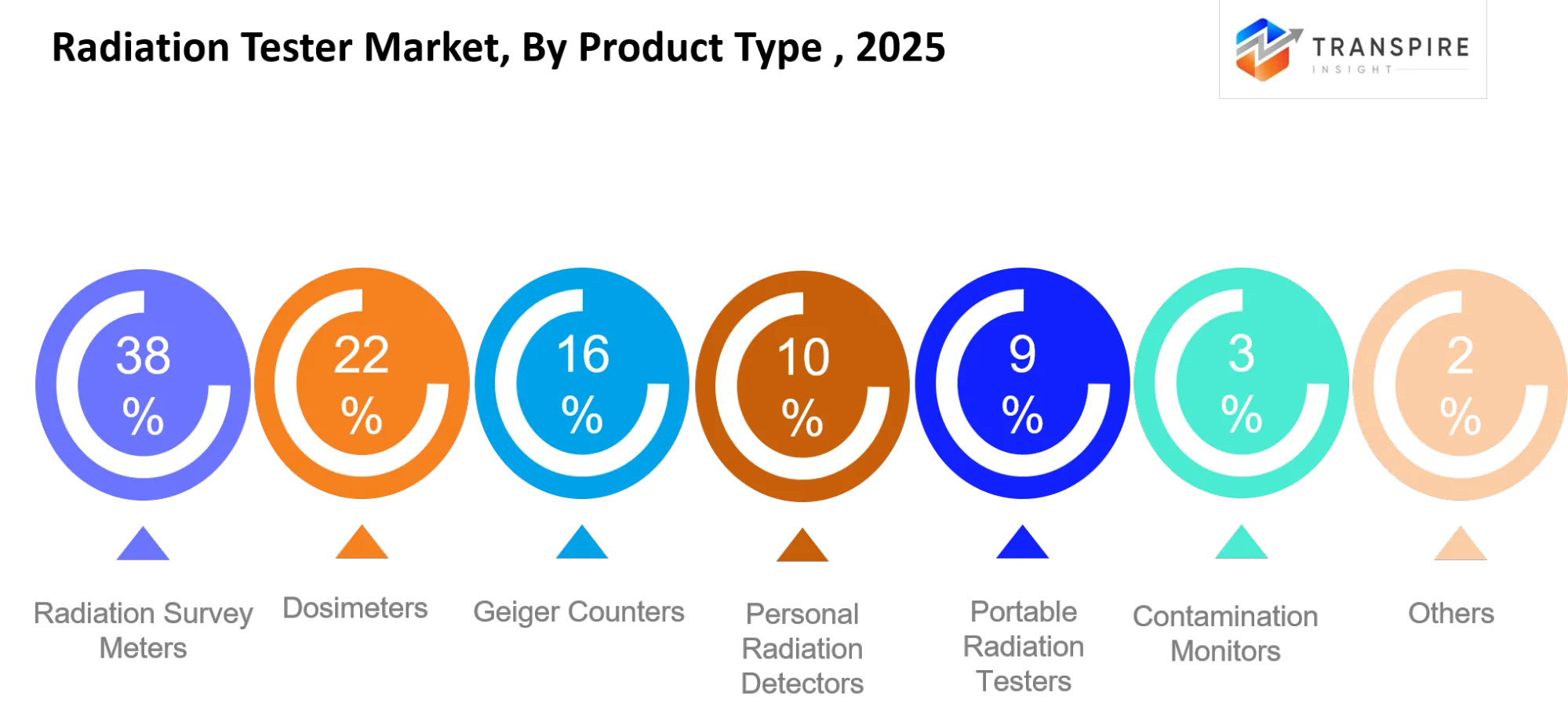
By Radiation Type:
Gamma radiation application remains the largest due to its popularity in nuclear installations, industrial inspection, and medical diagnosis. Monitoring of X-ray radiation steadily increases with the rise in diagnostic imaging. Alpha, Beta, and Neutron radiation detection becomes popular in research in nuclear science, nuclear waste handling, and defense operations. Multi-radiation detection platforms are increasingly preferred as companies consolidate a broad spectrum of tests in multi-dimensional monitoring systems.
By End User:
Health continues to be the dominant industry with a growing volume of radiology, radiotherapy, nuclear medicine, and diagnostic imaging procedures requiring tighter radiation control. Nuclear power plants, defense organizations, industrial plants, research laboratories and environmental monitoring agencies are next, as more exacting safety standards, requirements to safeguard personnel and routine compliance inspections lead to faster replacement and upgrade schedules for equipment.
By Application:
Radiation safety continues to be a necessary component of occupational monitoring and compliance regulation in all fields of high-hazard activity. Nuclear monitoring, diagnostic medicine, industrial testing, homeland security and environmental monitoring are on the rise. Enterprises and institutions are committing to automated combined monitors with automatic status updates, live dose tracking, remote data accessibility, and predictive maintenance to boost safety, speed incident response, and facilitate regulation.
By Distribution Channel:
Direct sales continue to be the technically more sophisticated radiation testing equipment, as customers need installation, calibration, operator training, and long-term after-sales support. Industrial distributors reinforce regional product availability, medical equipment suppliers prompt adoption of radiation testing in healthcare, and online B2B platforms improve procurement transparency and speed for commonly used radiation testing instrumentation across various application sectors.
What are the Key Use Cases Driving the Radiation Tester Market?
Radiation safety is the primary application, reflecting the largest radiation survey meter segment (38%). Hospitals, nuclear plants, laboratories, and manufacturing plants employ meters to check shielding, diagnose leaks, and keep employees safe. During maintenance or normal operation.
Expanding areas of application are medical diagnosis and radiotherapy quality assurance, nuclear monitoring, industrial inspection and monitoring of the environment. Connected dosimeters and contamination monitors are now used increasingly to provide records that are traceable, automatic warnings, and as evidence for audit rather than simply showing a reading.
New applications include homeland-security screening, mobile border or port inspection, decommissioning, mining, and remote asset maintenance. Portable monitors of ionizing radiation, expanding at a CAGR of 16.7%, match these dispersed workflows because they enable teams to detect irregular sources and respond quickly, before samples arrive in a central lab.
|
Report Metrics |
Details |
|
Market size value in 2025 |
USD 1.42 Billion |
|
Market size value in 2026 |
USD 1.49 Billion |
|
Revenue forecast in 2033 |
USD 2.17Billion |
|
Growth rate |
CAGR of 5.52% from 2026 to 2033 |
|
Base year |
2025 |
|
Historical data |
2021 - 2024 |
|
Forecast period |
2026 - 2033 |
|
Report coverage |
Revenue forecast, competitive landscape, growth factors, and trends |
|
Regional scope |
United States; Canada; Mexico; United Kingdom; Germany; France; Italy; Spain; Denmark; Sweden; Norway; China; Japan; India; Australia; South Korea; Thailand; Brazil; Argentina; South Africa; Saudi Arabia; United Arab Emirates |
|
Key companies profiled |
Thermo Fisher Scientific, Mirion Technologies, Fluke, Fuji Electric, Bertin Technologies, Polimaster, Ludlum Measurements, Radiation Detection Company, Tracerco, ORTEC, Canberra Industries, Hitachi, AMETEK, ECOTEST, Arrow-Tech. |
|
Customization scope |
Free report customisation (country, regional & segment scope). Avail customised purchase options to meet your exact research needs. |
|
Report Segmentation |
By Product Type (Geiger Counters, Dosimeters, Radiation Survey Meters, Contamination Monitors, Personal Radiation Detectors, Area Radiation Monitors, Portable Radiation Testers, Others); By Radiation Type (Alpha Radiation, Beta Radiation, Gamma Radiation, X-ray Radiation, Neutron Radiation, Multi-radiation Detection, Others); By End User (Healthcare, Nuclear Power Plants, Defense, Industrial Facilities, Research Laboratories, Environmental Monitoring Agencies, Others); By Application (Radiation Safety, Nuclear Monitoring, Medical Diagnostics, Industrial Inspection, Homeland Security, Environmental Monitoring, Others); By Distribution Channel (Direct Sales, Industrial Distributors, Medical Equipment Suppliers, Online B2B Platforms, Others) |
Which Regions are Driving the Radiation Tester Market Growth?
North America accounts for 39% because established nuclear, defense, healthcare, and industrial ecosystems create testing demand. The U.S. Marries overseen by the NRC, laboratories, hospital conglomerates, and the commercial replacement market of ageing nuclear stock. Emergency readiness and nuclear growth compounds generate demand for associated monitors, dosimeters and mobile detectors, providing software, certification and aftermarket revenues in addition to hardware sales.
Europe has a 30% share in the region as EURATOM-approved safety standards, medical facilities, decommissioning programmes and conformity maintain ongoing demand. The market is more replacement-driven than North America, where defence and nuclear technology allocations are relatively higher. Demand for environmental monitoring and radiotherapy quality requirements diminishes volatility. Engineering capability and rigorous approval procedures safeguard specialist suppliers from substitution.In March 2026, the European Commission allocated €330 million in funding for the 2026–2027 Euratom Research and Training Work Programme. This funding accelerates nuclear safety, radiation protection, and fission-fusion technologies to sustain strict regulatory compliance across member states.
Asia Pacific accounts for 24% and has the fastest-growing CAGR at 17.5%, driven by new nuclear capacity, diagnostic imaging, industrialization and emergency-response expenditure. China, India, South Korea and Southeast Asia are progressing towards standardized, networked monitoring. Local manufacturing and regional service centres are making calibration easier and more affordable. The opportunity is to offer portable testers with cloud dashboards and managed compliance for hospitals, reactors, ports and industrial parks.
In February 2026, RadNet Inc. completed a $32.7 million acquisition of London-based Cimar UK. This transaction expands RadNet's enterprise cloud infrastructure capabilities for medical imaging storage and remote data workflows, directly supporting digitally networked diagnostic ecosystems.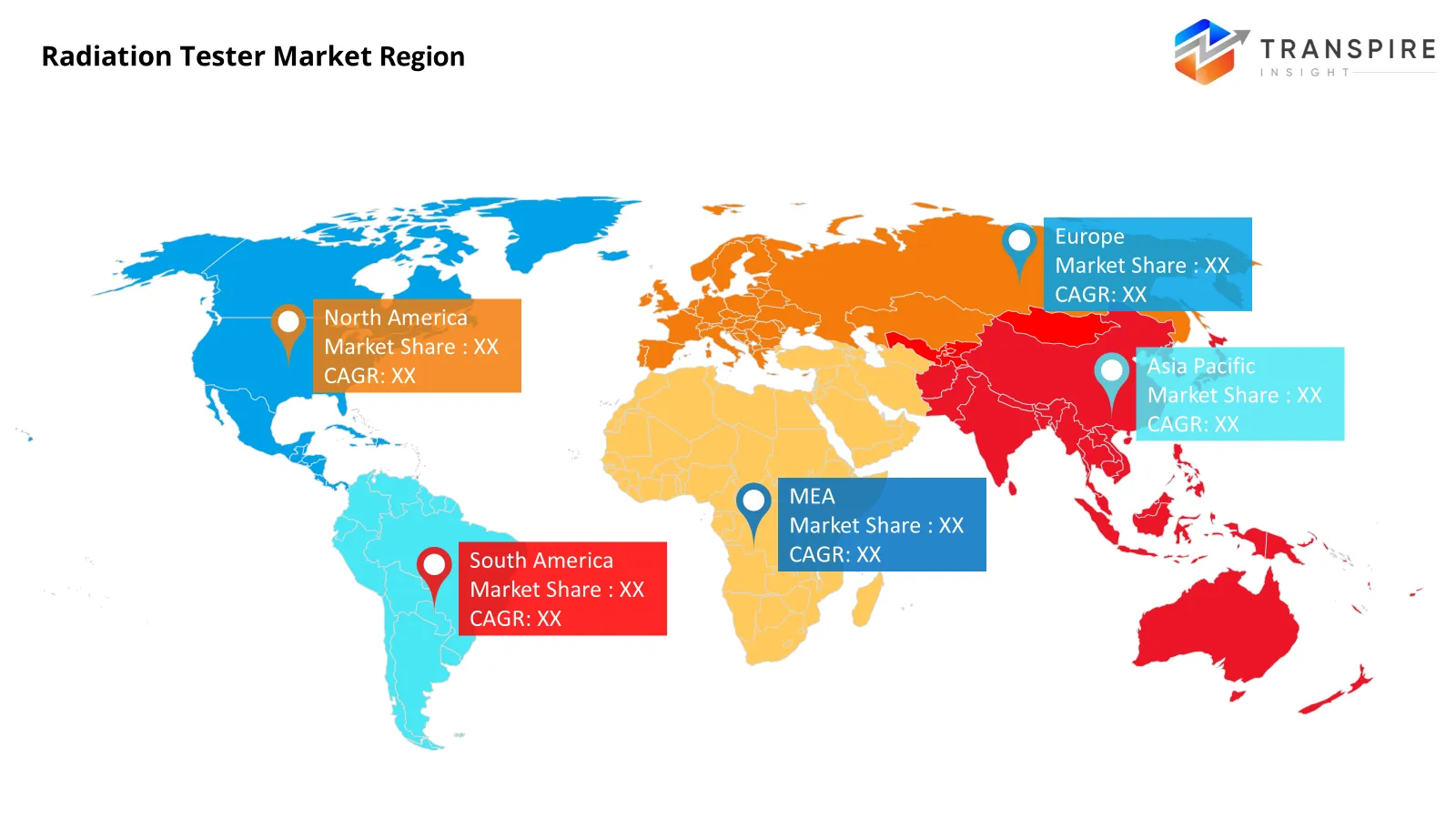
Who are the Key Players in the Radiation Tester Market and how do they Compete?
The competitive battle is not between detector sensitivity but between measurement ecosystems. Now we compete for calibration credibility, spectrum interpretation, wireless data, regulatory paperwork, and service coverage, which has a permanent opening of the market enabled by Mirion wireless dosimetry and Thermo Fisher's detector work for AI.
Thermo Fisher Scientific and Mirion Technologies focus on scale driven by innovation; Thermo Fisher through integrated instruments and laboratory channels, while Mirion through its combination of dosimetry, nuclear monitoring, software, and acquisitions. Fluke invests in biomedical calibration while Fuji Electric and Hitachi focus on industrial relationships to achieve further plant and healthcare installations. Bertin Technologies and Canberra Industries focus on niche nuclear and spectroscopy through engineering, approvals and alliances. Polimaster, Ludlum Measurements, Radiation Detection Company, Tracerco, ORTEC, AMETEK, ECOTEST, Arrow-Tech. Compete on portability, niche, price, or detector performance. Polimaster on isotope ID; Tracerco on industrial measurement; Ludlum and RDC on field ruggedness; ORTEC and AMETEK on accuracy. Growth flows from regional distributors, OEM integration, regional service and government contracts, or retail distribution to whole end markets in the US and Europe.
Key Players are:
- Thermo Fisher Scientific
- Mirion Technologies
- Fluke
- Fuji Electric
- Bertin Technologies
- Polimaster
- Ludlum Measurements
- Radiation Detection Company
- Tracerco
- ORTEC
- Canberra Industries
- Hitachi
- AMETEK
- ECOTEST
- Arrow-Tech
Recent Development News
- In June 2026, the SpaceDot engineering team at Aristotle University of Thessaloniki partnered with the European Space Agency (ESA) to calibrate its custom flight model dosimeter at the ESTEC Cobalt-60 irradiation facility. This calibration aligns raw hardware measurements with live cell biological responses to ensure precise radiation field monitoring during the upcoming AcubeSAT orbital mission.
- In July 2026, Mirion Technologies, Inc. expanded its domestic commercial footprint by scaling the operations of its newly acquired asset, Paragon Energy Solutions. This targeted industrial alignment deepens the firm's deployment of radiation detection monitors, area equipment, and wireless software across the fast-growing Small Modular Reactor (SMR) and military defence sectors.
- In May 2026, SkyFox Labs launched the piDOSE-DCD Space-Friendly digital CubeSat dosimeter. This high-precision component provides real-time radiation telemetry via a standardized UART interface, enabling satellite operators to capture crucial orbital exposure data.
What Strategic Insights Define the Future of the Radiation Tester Market?
The market is evolving toward connected radiation intelligence; instruments will integrate multi-sensor data, edge analytics, cloud audit logs, and predictive maintenance rather than function as stand-alone gauges. The strategic win will be recurring revenue from calibration, software, cybersecurity, and managed compliance-not simply replacement hardware. A potential pitfall is model and measurement fragmentation; an AI trained on one isotope, detector, or shielding configuration may misidentify another, creating liability despite apparently accurate dashboards. The real target market is low-cost modular instrumentation and software for Asia Pacific hospitals, new reactors, ports, decommissioning sites, and industrial parks, where 24/7 coverage is not yet available. Vendors should develop open APIs, validated AI layers, remote calibration procedures, and local service networks, then price outcomes-based solutions by application. They should also maintain certified human oversight and compatible data standards, because regulators will decide whether digital features produce revenue or remain demos for now.
Key Segmentations are:
By Product Type
- Geiger Counters
- Dosimeters
- Radiation Survey Meters
- Contamination Monitors
- Personal Radiation Detectors
- Area Radiation Monitors
- Portable Radiation Testers
- Others
By Radiation Type
- Alpha Radiation
- Beta Radiation
- Gamma Radiation
- X-ray Radiation
- Neutron Radiation
- Multi-radiation Detection
- Others
By End User
- Healthcare
- Nuclear Power Plants
- Defense
- Industrial Facilities
- Research Laboratories
- Environmental Monitoring Agencies
- Others
By Application
- Radiation Safety
- Nuclear Monitoring
- Medical Diagnostics
- Industrial Inspection
- Homeland Security
- Environmental Monitoring
- Others
By Distribution Channel
- Direct Sales
- Industrial Distributors
- Medical Equipment Suppliers
- Online B2B Platforms
- Others
Frequently Asked Questions
Find quick answers to common questions.
The Radiation Tester Market size was valued at USD 1.42 billion in 2025 and is poised to reach USD 2.17 billion by 2033, expanding at a 5.52% CAGR.
Key segments for the Radiation Tester Market are By Product Type (Geiger Counters, Dosimeters, Radiation Survey Meters, Contamination Monitors, Personal Radiation Detectors, Area Radiation Monitors, Portable Radiation Testers, Others); By Radiation Type (Alpha Radiation, Beta Radiation, Gamma Radiation, X-ray Radiation, Neutron Radiation, Multi-radiation Detection, Others); By End User (Healthcare, Nuclear Power Plants, Defense, Industrial Facilities, Research Laboratories, Environmental Monitoring Agencies, Others); By Application (Radiation Safety, Nuclear Monitoring, Medical Diagnostics, Industrial Inspection, Homeland Security, Environmental Monitoring, Others); By Distribution Channel (Direct Sales, Industrial Distributors, Medical Equipment Suppliers, Online B2B Platforms, Others).
Growth is primarily driven by expanding nuclear-power and healthcare-imaging activity, stricter radiation-safety compliance, increased radiotherapy and nuclear-medicine use, homeland-security spending, industrial inspection, and demand for connected, real-time monitoring systems.
The Radiation Tester Market is led by major manufacturers including Thermo Fisher Scientific, Mirion Technologies, Fluke, Fuji Electric, Bertin Technologies, Polimaster, Ludlum Measurements, Radiation Detection Company, Tracerco, ORTEC, Canberra Industries, Hitachi, AMETEK, ECOTEST, Arrow-Tech.
North America holds 39% of the market, supported by mature nuclear, defense, healthcare, laboratory, regulatory, calibration, and emergency-response ecosystems that accelerate premium equipment adoption, replacement demand, software integration, and aftermarket services.
Key opportunities include cloud-connected monitoring, AI-based anomaly detection, portable testers for Asia Pacific, managed calibration, rental fleets, subscription software, decommissioning, border security, nuclear maintenance, and industrial compliance services.
- Thermo Fisher Scientific
- Mirion Technologies
- Fluke
- Fuji Electric
- Bertin Technologies
- Polimaster
- Ludlum Measurements
- Radiation Detection Company
- Tracerco
- ORTEC
- Canberra Industries
- Hitachi
- AMETEK
- ECOTEST
- Arrow-Tech
About the Authors

Avinash Kumar
I’m Avinash Kumar, a Senior Research Analyst at Transpire Insight, with expertise in the Electronics and Semiconductor and Energy & Power industry. My work focuses on analyzing emerging technologies, market trends, industry developments, and innovation across these sectors. I specialize in transforming complex technical and market insights into clear, research-backed content that helps professionals, businesses, and decision-makers stay informed. Through continuous industry research and data-driven analysis, I strive to deliver accurate, reliable, and practical perspectives on the latest advancements shaping the semiconductor and energy landscape.

Chakradhar Khansole
Chakradhar serves as the Research Director at Transpire Insight, bringing over 8 years of experience in technology, innovation, and strategic market intelligence. He specializes in transforming complex market data into actionable business insights that enable organizations to make informed, growth-oriented decisions. Recognized for his strategic vision and analytical expertise, Chakradhar leads high-impact research initiatives, delivering comprehensive market assessments, competitive intelligence, and forward-looking industry analysis.
Recently Published Reports
-
Apr 2026
Fiber Optic Faceplates Market
Fiber Optic Faceplates Market Size, Share & Analysis Report By Type (< 300 mm2, 300-350 mm2, and > 350 mm2, By Application (Night Vision, Holographic Imaging, Medical, and Others), and Geography (North America, Europe, Asia-Pacific, Middle East and Africa, South and Central America), 2021 - 2031
-
Apr 2026
High Temperature Superconductors Market
High Temperature Superconductors Market Size, Share & Analysis Report By Type (1G HTS, and 2G HTS), By Application (Power Cable, Fault Current Limiter, and Transformer), and Geography (North America, Europe, Asia-Pacific, Middle East and Africa, South and Central America), 2021 - 2031
-
Apr 2026
Industrial Plugs and Socket Market
Industrial Plugs and Socket Market Size, Share & Analysis Report By Type (Industrial Plugs, Industrial Sockets), By Current (Up to 32 A, 32 to 125 A, Above 125 A), By Protection (Dustproof and Splash Proof, Waterproof, Explosion Proof), By End User (Heavy Industries, Oil and Gas, Chemicals and Pharmaceuticals, Power Generation, Others), and Geography (North America, Europe, Asia-Pacific, Middle East and Africa, South and Central America), 2021 - 2031
-
Apr 2026
InGaAs Avalanche Photodiodes Market
InGaAs Avalanche Photodiodes Market Size, Share & Analysis Report By Type (1100 - 1700 nm, and 1000 - 1600 nm), By Application (Missile Warning System, Muzzle Flash Detection, Wafer Defect Inspection, Laser Rangefinders, and Others), and Geography (North America, Europe, Asia-Pacific, Middle East and Africa, South and Central America), 2021 - 2031