
Global Radiation Detection Monitoring and Safety Market Size & Forecast:
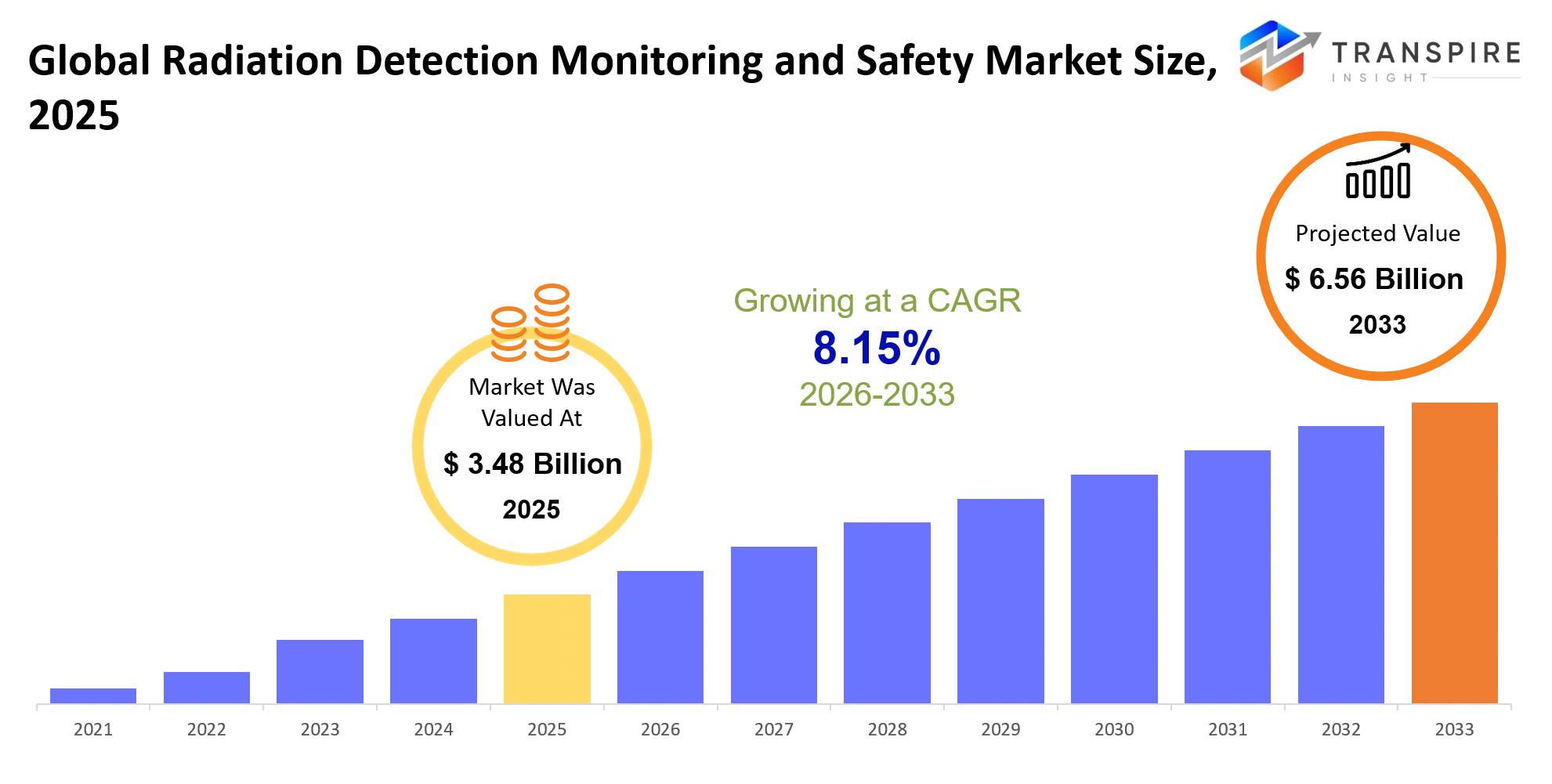
- Global Radiation Detection Monitoring and Safety Market Size 2025: USD 3.48 Billion
- Global Radiation Detection Monitoring and Safety Market Size 2033: USD 6.56 Billion
- Global Radiation Detection Monitoring and Safety Market CAGR: 8.15%
- Global Radiation Detection Monitoring and Safety Market Segments: By Product (Personal Dosimeters, Area Monitors, Survey Meters, Portal Monitors, Spectrometers, Radiation Detectors, Others); By Technology (Scintillation Detectors, Geiger-Müller Counters, Semiconductor Detectors, Ionization Chambers, Others); By Application (Nuclear Power Plants, Healthcare, Homeland Security, Industrial Safety, Research Laboratories, Others); By End User (Government, Healthcare Providers, Nuclear Industry, Industrial Facilities, Others); By Portability (Portable Systems, Fixed Systems, Wearable Devices, Others).
Global Radiation Detection Monitoring and Safety Market Summary:
As per Transpire Insight Analysis, the Global Radiation Detection Monitoring and Safety Market size is estimated at USD 3.48 Billion in 2025 and is anticipated to reach USD 6.56 Billion by 2033, growing at a CAGR of 8.15% from 2026 to 2033.
The global radiation detection, monitoring and safety market helps keep people, facilities and the environment safe from radiation. This is important in areas like healthcare, nuclear energy, manufacturing, research and homeland security. These systems measure radiation levels. Alert people to potential dangers. They also help organisations follow safety rules and keep workers safe.
In recent years, the market has moved towards smarter monitoring systems. These systems use sensors, cloud storage and artificial intelligence to better detect and respond to radiation. More nuclear power projects, increased use of radiation in medicine and stricter safety rules have driven the adoption of these technologies. Organisations are also replacing equipment with new automated safety systems. This is because they want to prioritise worker safety, follow regulations, and run efficiently. As a result, the demand for radiation detection and monitoring technologies is growing. This growth is happening in both emerging markets.
The need for radiation detection and monitoring is driven by concerns over nuclear security, emergency preparedness and industrial risks. Organisations want to protect workers and the environment from radiation exposure. They are looking for systems that provide timely monitoring. These systems should also support compliance and improve workplace safety. The market for radiation detection, monitoring and safety is expected to continue growing. It will be driven by the increasing demand for next-generation technologies that can detect and monitor radiation effectively.
Key Market Insights:
Intelligent solutions aimed at ensuring radiation safety are gaining popularity on the market amid the growing need for effective and prompt monitoring and compliance with regulations. Innovations in sensor technologies, connectivity solutions, and data analytics powered by artificial intelligence significantly influence the ways how organisations manage radiation-related risks.
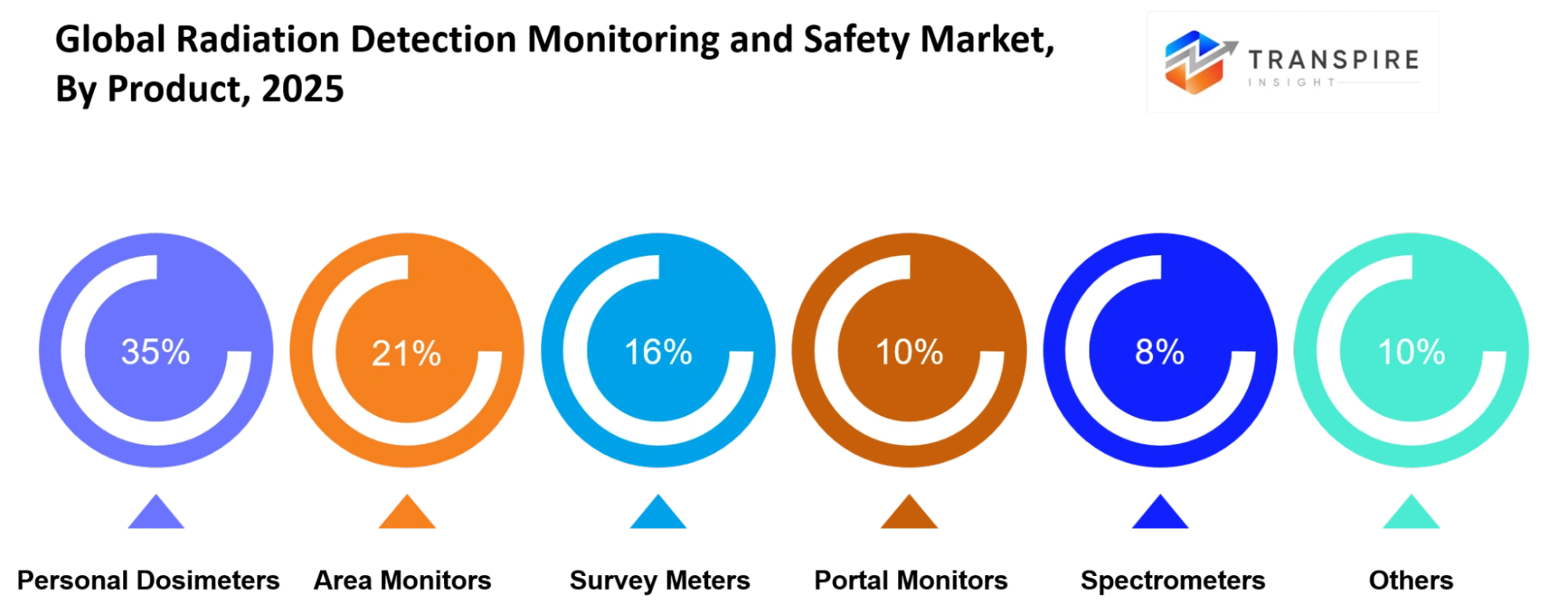
- Personal dosimeters constitute 35% of all radiation monitoring solutions sold on the market since they are widely used in health care institutions, nuclear facilities, research labs, and manufacturing sites to monitor workers’ radiation exposure continuously.
- Area monitors comprise 21% of the market because of an increasing number of companies that install the equipment to ensure radiation safety in their nuclear plants, manufacturing facilities, and critical infrastructures.
- Survey meters occupy 16% of the market since there is more and more demand for portable radiation measuring devices in emergencies, on the part of the environmental authorities, and during industrial inspections.
- Portal monitors make up 10% of the total market demand owing to their deployment at borders, airports, ports, and secure facilities to detect any illegal radiation sources.
- Spectrometers constitute 8% of the market since there are improvements in isotope identification technologies.
- Cloud-connected monitoring systems are increasingly being used in organisations for centralising radiation information, generating compliance reports automatically, and enhancing incident response through remote system management.
- Collaborations among manufacturers of equipment, health care providers, nuclear plants, and governments are increasing the speed of innovation and promoting adoption of advanced radiation safety solutions.
What are the Key Drivers, Restraints, and Opportunities in the Global Radiation Detection Monitoring and Safety Market?
Drivers
The main driving forces in the market include the rising focus on radiation safety in healthcare institutions, the nuclear power industry, the industrial sector, scientific laboratories, and homeland security applications. The rise in the application of radiation technologies in medical imaging and therapy, industry inspections, and nuclear power plants increases the need for radiation monitoring equipment. Additionally, the tightening regulations on workplace safety and radiation protection standards have forced organisations to adopt new advanced equipment. This process contributes to increased compliance and adoption of modern radiation monitoring solutions in public and private sectors.
Restraints
There are several threats that impede the growth of the market despite high demand. The high prices of advanced equipment and the difficulty of implementing such systems into existing infrastructure are among the main ones. Many small healthcare facilities, research laboratories, and industries still use traditional equipment since the replacement of the old equipment implies substantial costs, special training, and calibration.
Opportunities
An opportunity exists in the implementation of artificial intelligence-enabled monitoring systems, sensor technology, and cloud-based radiation management systems. These systems facilitate constant monitoring, predictive maintenance, automatic report generation, and quicker emergency responses. Growing nuclear energy projects, increasing investments in smart healthcare facilities, and environmental radiation monitoring initiatives are likely to present business opportunities for companies. Those who can offer intelligent, portable, and easily integrable solutions in terms of radiation safety are poised to capitalise on their market positions in future years.
What Has the Impact of Artificial Intelligence Been on the Global Radiation Detection Monitoring and Safety Market?
The use of artificial intelligence is revolutionising the radiation detection, monitoring, and safety market by making these monitoring systems smarter and more responsive. Today's AI-enabled software continuously analyses data from multiple sensors, detecting any unusual trends and giving real-time alerts when any abnormal data is detected. It not only eliminates the need for continuous surveillance but also allows safety teams to act immediately in case there is some risk of radiation exposure.
Furthermore, by assessing the historical performance of the equipment, AI systems can predict sensor failures, enabling preventive measures to avoid unexpected shutdowns and ensure continuous monitoring of radiation levels. In healthcare facilities, nuclear plants, and industrial environments, the use of artificial intelligence for radiation monitoring helps operators analyse radiation data more easily and take appropriate actions in accordance with regulations and standards.
One major benefit of using AI technology is its integration with a cloud-based radiation monitoring platform that enables organisations to remotely analyse their radiation data, generate automated compliance reports, and monitor several locations on one screen. The implementation of AI-based monitoring systems for radiation is hindered by various limitations such as high costs, difficulties in integrating the technology within existing infrastructures, and technical skills required for implementation. It is also important that organisations establish the accuracy of the information before making use of AI in decision-making. Notwithstanding, more innovations in intelligent monitoring technologies are anticipated to drive the use of AI in radiation safety operations. In April 2025, Mirion Technologies unveiled the Apex-Guard Software V1.2, which features a novel AI-based/patented gamma spectroscopy algorithm to analyse radionuclidic contaminants. The software is able to analyse radiation data, increase detection efficiency, improve compliance with regulations, and improve quality control in radiopharmaceutical manufacturing.
Key Market Trends:
The market for radiation monitoring, detection, and safety technologies is advancing as companies adopt innovative techniques to ensure safety, compliance, and effectiveness. Industry players have been increasingly investing in connected monitoring solutions, intelligence-driven analysis, and portable radiation detection equipment due to emerging safety needs across industries.
- Healthcare providers and companies working in the nuclear industry are switching from traditional radiation monitoring equipment to digital solutions offering real-time monitoring.
- Artificial intelligence has become an integral part of the radiation monitoring system as it allows for automatic threat detection, prediction of malfunctions, and interpretation of radiation data.
- Portable radiation monitoring equipment has become more popular as organisations are increasingly paying attention to the safety of workers who work in such environments.
- Radiation management systems are replacing the manual process of tracking the exposure of individuals to radiation through the use of cloud-based software.
- There have been innovations in radiation detection and monitoring equipment that include compact, lightweight, and power-saving solutions used in various industries.
- Wireless connectivity technology is being integrated into equipment to allow real-time data exchange and monitor all facilities from one dashboard.
Global Radiation Detection Monitoring and Safety MarketSegmentation
By Product
The Personal Dosimeters category holds the largest share of the global radiation detection, monitoring, and safety industry, comprising 35%, because of the increasing use of these devices in healthcare institutions, nuclear power stations, industrial locations, and research centres where individual radiation monitoring is necessary. Companies have increasingly become concerned about employee safety and compliance with rules and regulations, making personal dosimeters an important part of radiation monitoring. The use of advanced wearable technology and digital and wireless communication has contributed to improving their performance and usability. Area Monitors, Survey Meters, Portal Monitors, Spectrometers, and other radiation monitors continue to help meet specialised needs. In the future, radiation monitoring using AI technology will be one of the fastest-growing innovations in this field.
By Technology
According to technology, the market consists of Scintillation Detectors, Geiger-Müller Counters, Semiconductor Detectors, Ionization Chambers, among others. Scintillation detectors are popular owing to their high level of sensitivity and the ability to detect even lower amounts of radiation in both the medical, industrial, and nuclear spheres. Semiconductor detectors have been increasingly used lately owing to their higher accuracy, compact design and compatibility with modern digital monitoring systems. At the same time, artificial intelligence, automated analysis systems and cloud computing are making the monitoring process more efficient and enabling the prediction of radiation management in the future.
By Application
In terms of the application, the nuclear power plant sphere remains a major segment of demand due to the necessity of constant radiation monitoring and adherence to international safety standards. In addition, the healthcare industry is a key contributor to demand growth owing to an increasing number of applications of radiation in diagnosis and treatment of diseases. Other important spheres that require radiation monitoring are homeland security services, industrial safety operations and research laboratories due to the necessity of tracking radiation in order to create a safe environment.
By end users
The government agencies still rank high on the adoption rate as they control the country’s radiation safety programs, border security, emergency response systems, and environment monitoring programs. The healthcare organisations and the nuclear industry have been continuously investing in sophisticated monitoring tools in order to safeguard their staff and patients while maintaining their regulatory standards. The industrial facilities and the research organisations are also making efforts to increase the adoption rate of radiation monitoring systems.
By Portability
Through portability, portable detectors make up a major part of market demand because of their flexibility and effectiveness in terms of use as well as applicability in field inspections and emergencies. The fixed detector system remains important in nuclear power plants and hospitals as well as highly hazardous industrial facilities because it ensures continuous monitoring of radiation levels. Wearable radiation detection devices are among the most promising product types owing to recent innovations in light sensors, wireless communication, and data transfer.
What are the Key Use Cases Driving the Global Radiation Detection Monitoring and Safety Market?
Global Radiation monitoring and detection systems are mainly intended to ensure the safety of those individuals who are working within radiation-controlled environments. As Personal Dosimeters take up to 35% of the market share, they are largely used in hospitals, nuclear power plants, laboratories, and industries to monitor the level of radiation exposure of an individual.
Apart from personal protection purposes, there are more applications for radiation monitoring technology – homeland security, healthcare and industry. In particular, area monitors, survey meters and portal monitors are used to detect and monitor the level of radiation in order to control environmental conditions, inspect cargo, and ensure the safety of critical infrastructure.
Innovative use cases include AI-based monitoring systems for radiation monitoring and safety, cloud safety management platforms, and remote monitoring systems. These innovative systems offer real-time analytics, predictive maintenance, compliance reports and monitoring across various sites.
|
Report Metrics |
Details |
|
Market size value in 2025 |
USD 3.48 Billion |
|
Market size value in 2026 |
USD 3.79 Billion |
|
Revenue forecast in 2033 |
USD 6.56 Billion |
|
Growth rate |
CAGR of 8.15% from 2026 to 2033 |
|
Base year |
2025 |
|
Historical data |
2021 - 2024 |
|
Forecast period |
2026 - 2033 |
|
Report coverage |
Revenue forecast, competitive landscape, growth factors, and trends |
|
Regional scope |
United States; Canada; Mexico; United Kingdom; Germany; France; Italy; Spain; Denmark; Sweden; Norway; China; Japan; India; Australia; South Korea; Thailand; Brazil; Argentina; South Africa; Saudi Arabia; United Arab Emirates |
|
Key company profiled |
Mirion Technologies, Thermo Fisher Scientific, Fortive, Ludlum Measurements, Bertin Technologies, ORTEC, AMETEK, Tracerco, Polimaster, Kromek, Arktis Radiation Detectors, Fuji Electric, Hitachi, Canberra Industries, FujiFilm. |
|
Customization scope |
Free report customization (country, regional & segment scope). Avail customized purchase options to meet your exact research needs. |
|
Report Segmentation |
By Product (Personal Dosimeters, Area Monitors, Survey Meters, Portal Monitors, Spectrometers, Radiation Detectors, Others); By Technology (Scintillation Detectors, Geiger-Müller Counters, Semiconductor Detectors, Ionization Chambers, Others); By Application (Nuclear Power Plants, Healthcare, Homeland Security, Industrial Safety, Research Laboratories, Others); By End User (Government, Healthcare Providers, Nuclear Industry, Industrial Facilities, Others); By Portability (Portable Systems, Fixed Systems, Wearable Devices, Others). |
Which Regions are Driving the Global Radiation Detection Monitoring and Safety Market Growth?
North America
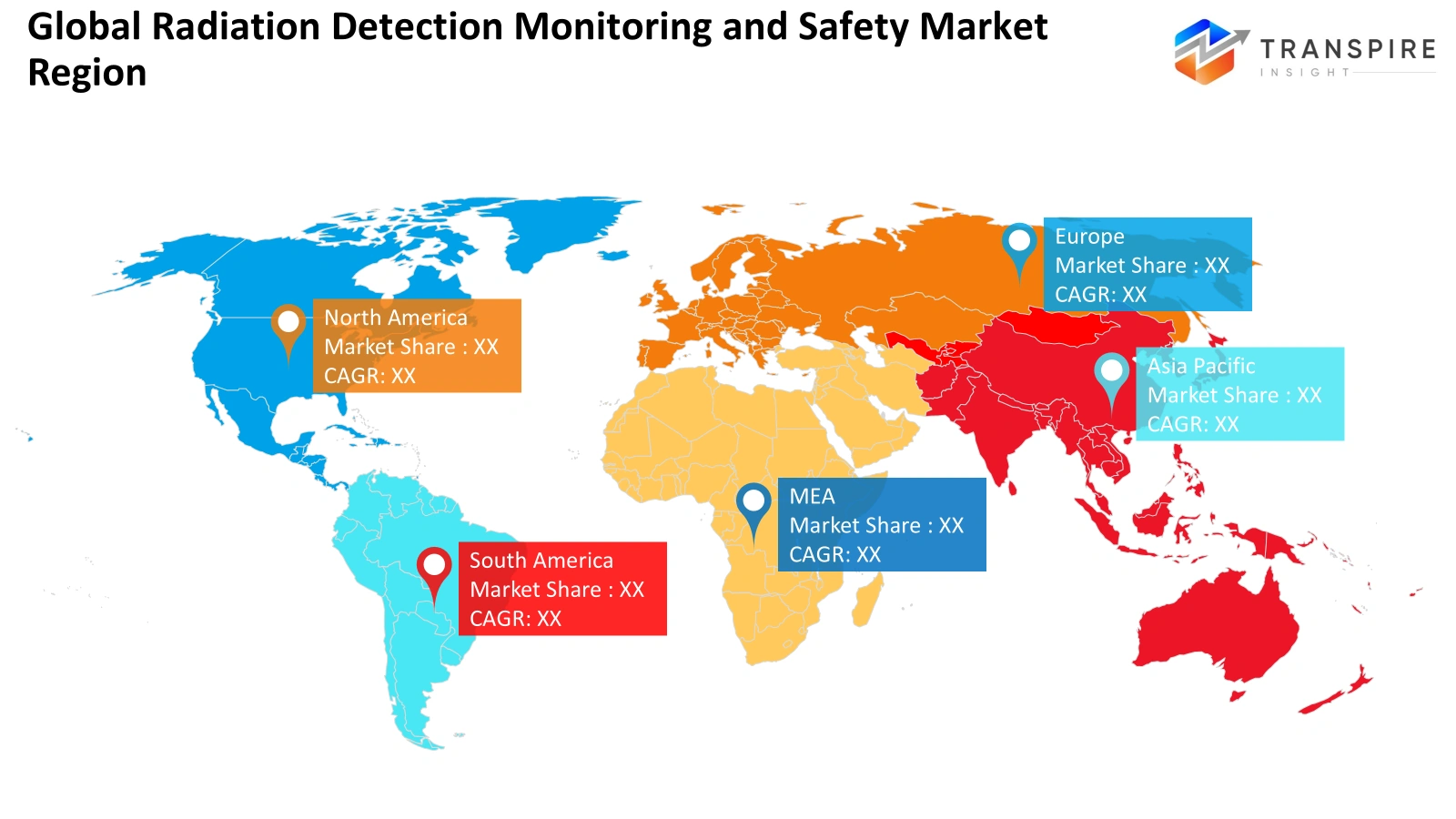
The North American market represents more than 40% of the world's radiation detection, monitoring, and safety market due to the established infrastructure of the healthcare industry in the region, widespread use of nuclear power plants, and high level of investment in homeland security in the region. This region is also constantly implementing advanced radiation monitoring technologies that help increase workplace safety and regulation compliance and improve readiness for any emergencies. Both government institutions and private companies invest in such systems to properly protect critical infrastructure and control the level of risk associated with radiation exposure. InDecember 2025, Mirion Technologies completed the acquisition of Paragon Energy Solutions, providing an enhanced offering of radiation monitoring, nuclear safety, and instrumentation systems to North American nuclear sites.
Europe
The market share of Europe accounts for 30% of the world's market. This is explained by the strict legislation on radiation safety, development of the nuclear energy sector, and the emphasis on environmental monitoring. Various countries of the region are consistently improving radiation protection systems used in health care facilities, laboratories, and industry in order to follow new safety standards. In comparison with North America, the market development of Europe is ensured by regulatory stability, consistent improvement of infrastructure, and scientific research. InMarch 2024, Teledyne FLIR introduced new scintillator detector modules that are compliant with the EURATOM Basic Safety Standards set out by the European Union, improving the monitoring of radiation within Europe’s nuclear facilities and research institutions.
Asia Pacific
The Asia Pacific region constitutes the fastest-growing regional market, set to grow at a CAGR of 16.3% in the forecast period. Fast-paced industrialisation, growing investments in nuclear power, expansion in the healthcare sector, and growing awareness regarding occupational safety are driving the adoption of radiation monitoring technology solutions. Radiation protection standards are being improved by governments in the region along with the implementation of technology upgrades in hospitals, industrial settings, and laboratories. With increasing investments in infrastructure and technology, the Asia Pacific region presents considerable long-term growth prospects for market players.In February 2025, Fuji Electric Co., Ltd. enhanced its radiation monitoring and environmental measurement systems for nuclear power plants and industries in Japan and other Asia-Pacific countries.
Who are the Key Players in the Global Radiation Detection Monitoring and Safety Marketand how do they Compete?
The competition in the worldwide radiation detection, monitoring, and safety market is mainly driven by technological advancements, reliability, compliance with regulations, and tailor-made solutions for various industries. There has been an increasing trend among manufacturers of expanding their range of products and services offered in response to changing requirements in the healthcare, nuclear power, homeland security, and industry sectors. The companies have increased their global footprint through collaboration, product innovation, and expanding their operations in different regions.
Top players, including Thermo Fisher Scientific, Mirion Technologies, Fortive Corporation, Ludlum Measurements, and AMETEK, compete through innovation of sophisticated radiation detection technologies, wearables for monitoring purposes, and software platforms. Innovation is a major competitive strategy for firms, as they continuously develop advanced technologies for radiation detection. This is because most of the products used by the firms are mainly for regulatory compliance and monitoring in industries. The firms also make heavy investments in R&D activities.
Global Radiation Detection Monitoring and Safety Market companies
- Mirion Technologies
- Thermo Fisher Scientific
- Fortive
- Ludlum Measurements
- Bertin Technologies
- ORTEC
- AMETEK
- Tracerco
- Polimaster
- Kromek
- Arktis Radiation Detectors
- Fuji Electric
- Hitachi
- Canberra Industries
- FujiFilm
Recent Development News
In May 2026, Thermo Fisher Scientific announced the launch of the Thermo Scientific PackEye XS Radiation Detection Backpack, which is a lightweight and efficient radiation detection system. This product was intended for homeland security, emergency, and defence use. The new product helped to diversify the portfolio of portable radiation detection solutions, making it more accurate, reducing false alarm rates, and providing mobile connectivity.
Source: https://www.azosensors.com
In October 2025, Mirion Technologies concluded an acquisition deal with Paragon Energy Solutions and thus enlarged its nuclear instrumentation and safety solutions range. The acquisition extended the product portfolio of Mirion Technologies and increased its capability of serving nuclear power plant operators through integrated radiation monitoring and safety solutions.
Source: https://www.mirion.com
In June 2025, Thermo Fisher Scientific won a five-year contract from the U.S. Department of Defense to provide advanced dosimetry systems and radiation exposure management software for the U.S. Navy. This contract was an addition to the company’s portfolio in terms of defence-related radiation safety.
Source: https://www.itnonline.com
What Strategic Insights Define the Future of the Global Radiation Detection Monitoring and Safety Market?
The radiation detection, monitoring, and safety market is trending towards the creation of intelligent, networked, and data-driven safety ecosystems that offer constant monitoring, fast response in case of incidents, and enhanced regulatory compliance. With the increasing modernisation of the safety infrastructure of healthcare facilities, nuclear facilities, industrial enterprises, and governmental bodies, there is a growing need for AI-powered analytics software, cloud-based monitoring platforms, and wearable radiation detection solutions. Among the risks faced by market players, one could mention their dependence on old-fashioned radiation monitoring infrastructure, which is hard to integrate with modern digital platforms.
One of the opportunities in the market of radiation monitoring includes expansion into emerging countries where spending on healthcare infrastructure development, nuclear energy projects, industrial safety, and environmental monitoring is constantly growing. Companies that pay attention to the development of AI integration capabilities, cybersecurity, cloud connectivity, and user-friendly monitoring platforms would have more chances to gain from the future demand. Innovation of products, establishment of partnerships in the regions, and provision of solutions tailored to the needs of specific industries will be critical in gaining a competitive advantage in the market.
Key Segmentations are:
By Product
- Personal Dosimeters
- Area Monitors
- Survey Meters
- Portal Monitors
- Spectrometers
- Radiation Detectors
By Technology
- Scintillation Detectors
- Geiger-Müller Counters
- Semiconductor Detectors
- Ionization Chambers
By Application
- Nuclear Power Plants
- Healthcare
- Homeland Security
- Industrial Safety
- Research Laboratories
By End User
- Government
- Healthcare Providers
- Nuclear Industry
- Industrial Facilities
By Portability
- Portable Systems
- Fixed Systems
- Wearable Devices
Regional Outlook
North America
- United States
- Canada
- Mexico
Europe
- Germany
- United Kingdom
- France
- Spain
- Italy
- Rest of Europe
Asia Pacific
- Japan
- China
- Australia & New Zealand
- South Korea
- India
- Rest of Asia Pacific
South America
- Brazil
- Argentina
- Rest of South America
Middle East & Africa
- Saudi Arabia
- United Arab Emirates
- South Africa
- Rest of the Middle East & Africa
Frequently Asked Questions
Find quick answers to common questions.
The global keyword size was valued at USD 3.48 Billion in 2025 and is poised to reach USD 6.56 Billion by 2033, expanding at an 8.15% CAGR.
Key segments for the global radiation detection monitoring and safety market are By Product (Personal Dosimeters, Area Monitors, Survey Meters, Portal Monitors, Spectrometers, Radiation Detectors, Others); By Technology (Scintillation Detectors, Geiger-Müller Counters, Semiconductor Detectors, Ionization Chambers, Others); By Application (Nuclear Power Plants, Healthcare, Homeland Security, Industrial Safety, Research Laboratories, Others); By End User (Government, Healthcare Providers, Nuclear Industry, Industrial Facilities, Others); By Portability (Portable Systems, Fixed Systems, Wearable Devices, Others).
Growth is primarily driven by factors that contribute to growth include increased regulations related to nuclear safety, increased application of radiation in healthcare and industries, increased exposure to radiation, increased nuclear energy projects, and improved radiation detection technology.
The global market is led by major manufacturers including Mirion Technologies, Thermo Fisher Scientific, Fortive, Ludlum Measurements, Bertin Technologies, ORTEC, AMETEK, Tracerco, Polimaster, Kromek, Arktis Radiation Detectors, Fuji Electric, Hitachi, Canberra Industries, FujiFilm.
North America comprises 40% of the total market share of the global radiation detection, monitoring, and safety industry. This predominance stems from stringent standards on radiation safety, robust health care and nuclear facilities, significant military spending, and consistent investments in radiation detection technology.
Areas of commercialisation involve growth in nuclear power plants, increased investments in homeland security and border protection, greater need for radiation detectors in medical and industrial applications, and development of intelligent radiation detection systems.
- Mirion Technologies
- Thermo Fisher Scientific
- Fortive
- Ludlum Measurements
- Bertin Technologies
- ORTEC
- AMETEK
- Tracerco
- Polimaster
- Kromek
- Arktis Radiation Detectors
- Fuji Electric
- Hitachi
- Canberra Industries
- FujiFilm
About the Authors

Avinash Kumar
I’m Avinash Kumar, a Senior Research Analyst at Transpire Insight, with expertise in the Electronics and Semiconductor and Energy & Power industry. My work focuses on analyzing emerging technologies, market trends, industry developments, and innovation across these sectors. I specialize in transforming complex technical and market insights into clear, research-backed content that helps professionals, businesses, and decision-makers stay informed. Through continuous industry research and data-driven analysis, I strive to deliver accurate, reliable, and practical perspectives on the latest advancements shaping the semiconductor and energy landscape.

Chakradhar Khansole
Chakradhar serves as the Research Director at Transpire Insight, bringing over 8 years of experience in technology, innovation, and strategic market intelligence. He specializes in transforming complex market data into actionable business insights that enable organizations to make informed, growth-oriented decisions. Recognized for his strategic vision and analytical expertise, Chakradhar leads high-impact research initiatives, delivering comprehensive market assessments, competitive intelligence, and forward-looking industry analysis.
Recently Published Reports
-
Apr 2026
Fiber Optic Faceplates Market
Fiber Optic Faceplates Market Size, Share & Analysis Report By Type (< 300 mm2, 300-350 mm2, and > 350 mm2, By Application (Night Vision, Holographic Imaging, Medical, and Others), and Geography (North America, Europe, Asia-Pacific, Middle East and Africa, South and Central America), 2021 - 2031
-
Apr 2026
High Temperature Superconductors Market
High Temperature Superconductors Market Size, Share & Analysis Report By Type (1G HTS, and 2G HTS), By Application (Power Cable, Fault Current Limiter, and Transformer), and Geography (North America, Europe, Asia-Pacific, Middle East and Africa, South and Central America), 2021 - 2031
-
Apr 2026
Industrial Plugs and Socket Market
Industrial Plugs and Socket Market Size, Share & Analysis Report By Type (Industrial Plugs, Industrial Sockets), By Current (Up to 32 A, 32 to 125 A, Above 125 A), By Protection (Dustproof and Splash Proof, Waterproof, Explosion Proof), By End User (Heavy Industries, Oil and Gas, Chemicals and Pharmaceuticals, Power Generation, Others), and Geography (North America, Europe, Asia-Pacific, Middle East and Africa, South and Central America), 2021 - 2031
-
Apr 2026
InGaAs Avalanche Photodiodes Market
InGaAs Avalanche Photodiodes Market Size, Share & Analysis Report By Type (1100 - 1700 nm, and 1000 - 1600 nm), By Application (Missile Warning System, Muzzle Flash Detection, Wafer Defect Inspection, Laser Rangefinders, and Others), and Geography (North America, Europe, Asia-Pacific, Middle East and Africa, South and Central America), 2021 - 2031