
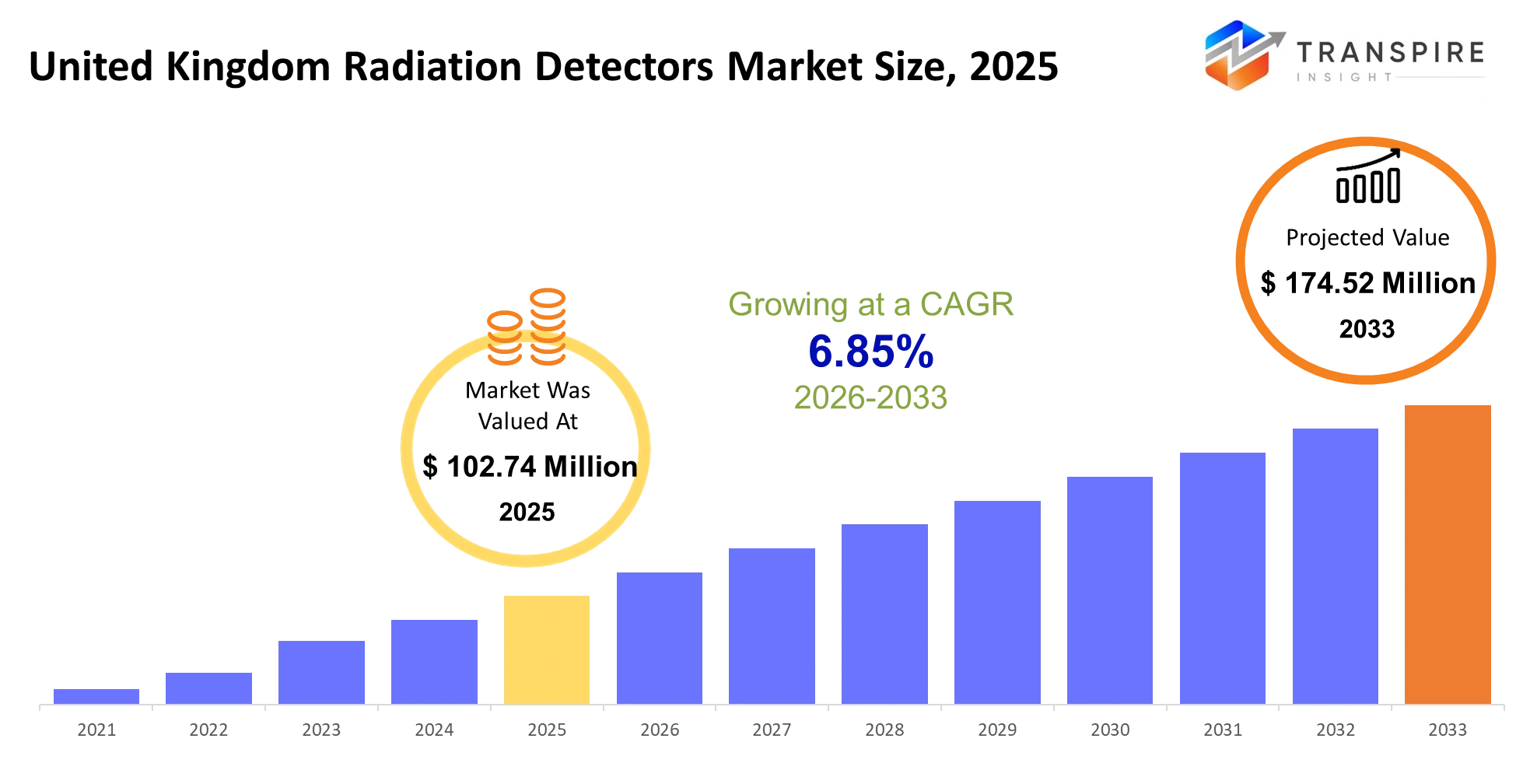
United Kingdom Radiation Detectors Market Size & Forecast:
- United Kingdom Radiation Detectors Market Size 2025: USD 102.74 Million
- United Kingdom Radiation Detectors Market Size 2033: USD 174.52 Million
- United Kingdom Radiation Detectors Market CAGR: 6.85%
- United Kingdom Radiation Detectors Market Segments: By Detector Type (Gas-filled Detectors, Scintillation Detectors, Semiconductor Detectors, Solid-state Detectors, Others); By Radiation Type (Alpha Radiation, Beta Radiation, Gamma Radiation, Neutron Radiation, Others); By Application (Nuclear Power Plants, Medical Imaging, Homeland Security, Industrial Inspection, Others); By End User (Healthcare Sector, Defense Sector, Industrial Sector, Research Institutes, Others).
To learn more about this report,  Download Free Sample Report
United Kingdom Radiation Detectors Market Summary
The United Kingdom Radiation Detectors Market was valued at USD 102.74 Million in 2025. It is forecast to reach USD 174.52 Million by 2033. That is a CAGR of 6.85% over the period.
The United Kingdom radiation detectors market actually supports continuous surveillance of ionizing radiation across nuclear plants, hospitals, industrial inspection locations, and even security checkpoints, so organizations can keep operations safe and in line with the rules. day to day these systems detect, quantify, and push out radiation exposure details in near real time, which means teams can stop possible contamination incidents early, while also sticking to tight safety limits in places that are genuinely high risk.
Over the last 3 to 5 years, the market has been moving in a more structural way away from just standalone hardware and toward digitally connected monitoring platforms. That change has been made faster by more demanding nuclear decommissioning requirements, plus the broader push for digitization of critical infrastructure which basically encouraged operators to use real-time analytics and to handle remote compliance documentation. One big catalyst was the renewed nuclear site cleanup and safety modernization program, especially after the government increased attention on older reactor decommissioning efforts and also raised security sensitivity across energy infrastructure.
Because of that, buying behavior has shifted from simple gas filled detectors into semiconductor driven, software enabled arrangements that give continuous data visibility. In many deployments this improves compliance throughput, shortens the back and forth manual checking cycles, and boosts the adoption of integrated radiation monitoring ecosystems across healthcare, defense, and nuclear energy operations.
Key Market Insights
- England still seems to dominate the United Kingdom Radiation Detectors market, with about 55% share in 2025 , mostly because the nuclear infrastructure is really concentrated and the hospital networks are pretty advanced too.
- Northern England looks like the quickest mover through 2026–2033, not just because of faster nuclear decommissioning but also because people want more portable detection deployment in the field, or something like that.
- On the product side, semiconductor detectors take the top slot with roughly 38% in 2025, it’s mainly the precision edge for nuclear work and medical imaging applications, more or less.
- Scintillation detectors stay second-largest. They keep getting traction in industrial inspection and homeland security screening setups, pretty steady.
- AI enabled radiation monitoring systems are the fastest growing segment though, and from 2024 to 2030, adoption keeps widening, especially in compliance-heavy environments where oversight is nonstop.
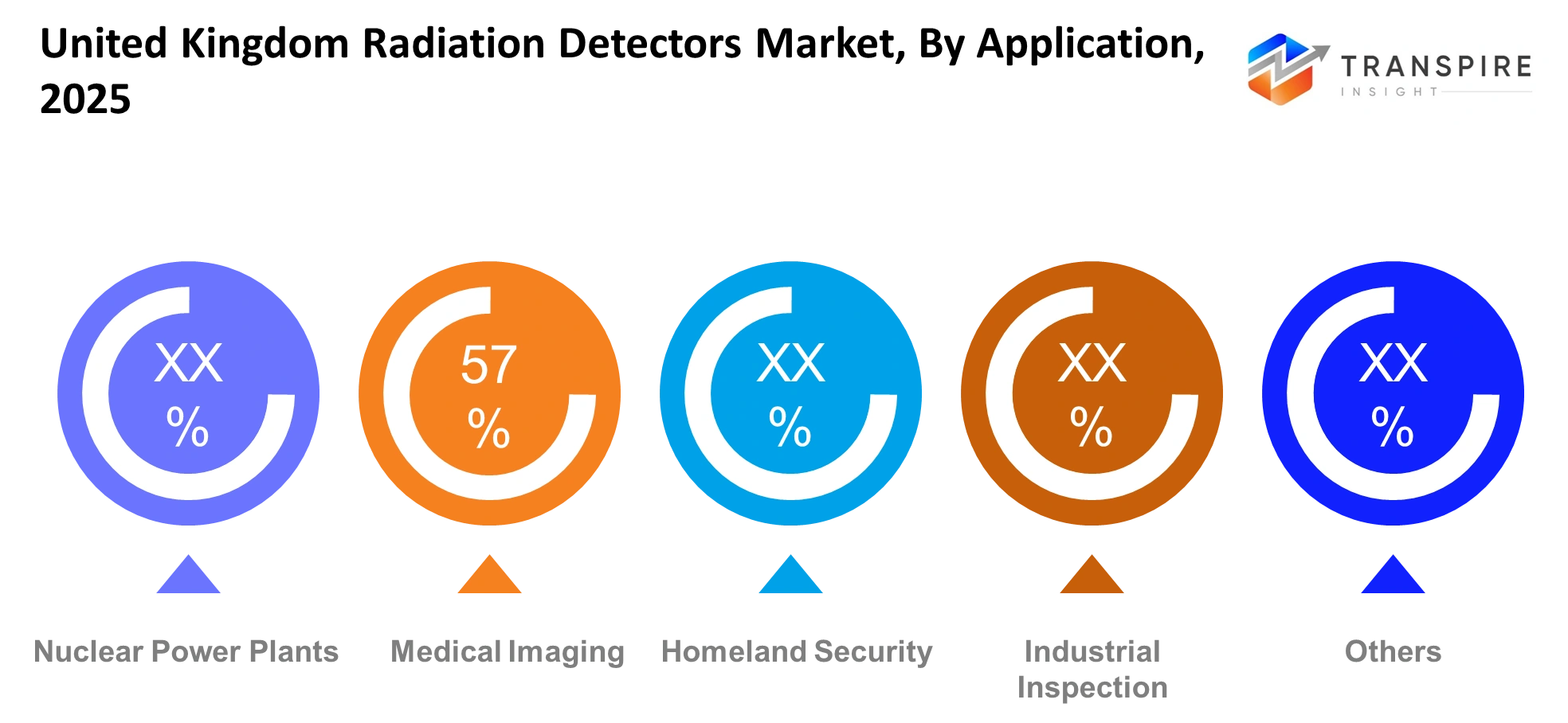
- For applications, nuclear power plants lead with nearly 42% in 2025, largely tied to tough radiation safety compliance and the constant need for ongoing monitoring.
- Homeland security ends up being the fastest growing application, backed by border modernization efforts and higher investments in threat detection.
- For end users, the healthcare sector is the main demand driver, landing at around 35% share in 2025, because oncology imaging and radiotherapy safety monitoring are expanding.
- In defense, growth is rapid, since procurement keeps rising for portable detection systems used in field operations and border surveillance, more than before.
- Finally, Mirion Technologies keeps strengthening its position, through digital radiation monitoring integration and nuclear facility contracts across Europe, overall.
What are the Key Drivers, Restraints, and Opportunities in the United Kingdom Radiation Detectors Market?
The main things that seem to be really shaping the United Kingdom radiation detectors market are tougher nuclear safety rules and the faster decommissioning of older nuclear facilities. Regulators have been pushing harder for nonstop, high-resolution radiation monitoring across sites such as active reactors, waste-handling zones, and even the transport routes used for radioactive materials. And this change has basically bumped up the purchase of newer detection gear based on semiconductors plus scintillation type methods because operators have to follow tighter real-time reporting expectations, while also shrinking the manual compliance holes that used to slip through. So yeah, revenue growth is turning more toward integrated monitoring platforms, not just “buy a detector and go”.
The biggest drag on adoption is the expensive integration work needed to modernize legacy infrastructure across nuclear, industrial, and healthcare environments. Many monitoring setups were put in place years ago and need broader compatibility revisions to support digital radiation tracking and cloud analytics. That kind of structural limitation slows replacement timelines and keeps operators running older gas-filled detector systems longer. This, in turn, indirectly suppresses demand for more advanced technologies. On top of that, there’s a shortage of well-trained technicians for calibration tasks, and that further delays updates, especially in smaller sites where budgets are tighter.
One of the more interesting opportunities is AI-assisted portable radiation detection systems aimed at decommissioning work and emergency response. More capital is going into modular monitoring units that can be deployed across UK cleanup locations, including areas like Cumbria and the northern industrial corridors. These systems combine edge computing with wireless sensor networks, kind of, letting people get a real-time map of radiation hotspots and paving the way for scalable next-generation field monitoring solutions.
What Has the Impact of Artificial Intelligence Been on the United Kingdom Radiation Detectors Market?
Artificial intelligence is reshaping radiation detection systems in the United Kingdom, mainly by making monitoring data easier to process, interpret, and act on across nuclear, healthcare, and security settings. In nuclear plants and more advanced monitoring networks, AI-enabled platforms now automate radiation-level tracking, help calibrate sensor inputs, and spot anomalies right away, so there is less need for manual inspection cycles. In scrubber performance systems and exhaust gas cleaning technology used in industrial and maritime-adjacent work, similar analytical tools also help connect sensor readings with compliance limits, speeding up reporting and making audit readiness feel more predictable.
Machine learning models are increasingly used for predictive maintenance, especially in semiconductor-based detectors from companies such as Mirion Technologies and Kromek Group. These setups detect early signs of sensor degradation and suggest recalibration before failures occur, which tends to improve uptime by reducing surprise downtime in mission-critical environments. In healthcare imaging systems, AI-assisted radiation monitoring has improved workflow efficiency by reducing redundant scans and optimizing dose tracking, supporting both cost control and patient safety compliance.
Even so, adoption still encounters friction, mostly because high-quality training data from real-world radiation events is scarce and because connectivity can be inconsistent in remote or heavily shielded environments. Because of that, predictive models can end up with accuracy gaps, and it also slows down full-scale rollout across legacy monitoring infrastructure, where upgrades are harder to schedule.
Key Market Trends
- Adoption of gas-filled detectors gradually slowed as nuclear operators moved toward higher-precision semiconductor systems after the 2023 upgrades. Not like it stopped, more like it drifted away.
- Semiconductor radiation detectors gained a stronger buying edge at UK nuclear sites after 2024, mainly because real-time data accuracy improved and they became easier to integrate into existing operations.
- Mirion Technologies also pushed broader digital monitoring rollouts across UK facilities, which looks like it signals a shift to software-enabled radiation safety systems by 2025, in a very practical way.
- Thermo Fisher Scientific has gone on to expand its integrated lab radiation solutions, replacing standalone detectors with a single unified diagnostic and monitoring platform since 2024, rather than keeping separate pieces.
- Homeland security agencies expanded procurement of portable radiation detection systems after the 2023 border modernization programs increased screening intensity at entry points, making demand more consistent.
- Medical imaging facilities increased uptake of digital radiation safety tracking systems, as oncology treatment volumes climbed between 2023 and 2025.
- Kromek Group strengthened semiconductor detector deployments through OEM channels, which aligns with the rising appetite for compact and mobile detection systems.
- And nuclear decommissioning programs accelerated the need for portable detectors, so purchasing began to lean toward temporary modular monitoring setups after 2024, rather than just fixed installations.
- Finally, industrial inspection users reduced the use of manual survey tools, and moved over to automated radiation mapping systems that are integrated with predictive maintenance platforms.
United Kingdom Radiation Detectors Market Segmentation
By Detector Type
Gas- filled detectors sit in a steady mid-tier spot in the United Kingdom radiation detectors market, mostly because they’re used so much for cost-conscious monitoring and routine radiation surveys. You see them in established industrial safety frameworks and in older nuclear facilities, which keeps demand pretty steady. Their lower sensitivity compared with more advanced options does kind of cap how far they can go in high-precision settings
Scintillation detectors and semiconductor detectors are the main drivers of performance-driven growth, as they deliver improved accuracy and faster response times. Semiconductor detectors are getting more attention in nuclear security and medical imaging, because they allow compact, high-resolution configurations. Solid-state detectors are leaning into more niche use cases in research and defense, where exactness matters more than the price tag
Looking ahead, demand should tilt toward semiconductor-based systems, especially as digitized monitoring becomes the default in nuclear and healthcare infrastructure. Gas-filled systems will still matter for entry-level needs, but they’ll probably lose ground in more demanding compliance environments. Developers may choose hybrid architectures, where toughness is balanced with digital analytics options, kinda like durable + smart in one package
By Radiation Type
Gamma radiation detection leads usage in the United Kingdom radiation detectors market, largely because it is widely used in nuclear power generation, medical imaging, and industrial inspection. Since it penetrates more deeply across regulated sites, it helps keep procurement cycles consistent. Safety requirements also push continuous monitoring obligations, so the buying pattern doesn’t really slow down
Neutron radiation detection is receiving increasing attention in nuclear reactor operations and in research settings where fuel behavior analysis is critical. In contrast, alpha and beta radiation detection still holds its place, kind of as a smaller but stubborn toolset for contamination control in lab environments. Those parts do keep expanding, yet they’re sort of boxed in by more limited uses.
Looking ahead, the growth picture seems to lean heavily toward gamma and neutron detection systems, especially when they’re plugged into digital monitoring platforms. Also, as nuclear decommissioning activity keeps rising, the need for systems that can handle multiple radiation types goes up, too. Companies will likely keep pushing multi-sensor solutions, so the day-to-day operation stays simpler, and compliance reporting is more precise, less messy, overall.
By Application
Nuclear power plants remain the largest application segment, mainly because regulations are strict and radiation safety rules are continuously enforced. Long operating timelines, plus ongoing decommissioning projects, continue to drive equipment upgrades and replacement cycles. And because reliability is a big deal, it becomes a barrier against cheaper alternatives that don’t hold up.
Medical imaging, along with homeland security, sits next in line for demand. In hospitals, radiation detectors are used for oncology diagnostics and to manage radiotherapy safety, while border security agencies use similar detection setups for threat detection. Industrial inspection grows at a steady pace, too, mostly tied to quality assurance requirements in the aerospace, oil, and energy sectors.
Future expansion will be pushed forward by decommissioning work and the modernization of hospital radiology infrastructure, or at least that's how it plays out in most plans. Homeland security will likely adopt more portable AI-enabled detection systems for quicker screening and earlier alerts. Suppliers who can weave analytics into their hardware setups will, in turn, gain a stronger procurement edge.
To learn more about this report, Download Free Sample Report
By End User
In the Healthcare sector, the end-user demand tends to lead, since radiation-based diagnostics and cancer treatment systems are used so broadly. High patient loads and strict safety protocols force more frequent equipment upgrades. Hospitals usually lean toward procurement choices that offer high accuracy and compliance tracking, rather than just basic performance.
The Defense sector, along with the Industrial sector, provides fairly consistent demand through border security, nuclear monitoring, and equipment inspection routines. Research institutes are a smaller group, but they are often more tech-forward, with a focus on experimental work and calibration tasks. These users tend to request very high sensitivity and customization options, even when timelines are tight.
Looking ahead, the biggest growth is likely to stay rooted in healthcare and defense, driven by more digitization, and security requirements that keep tightening. Industrial users may move toward predictive maintenance, combined with radiation monitoring systems, rather than treating them as separate features. Equipment suppliers should benefit if they offer modular, software-enhanced platforms, built for multi-sector deployment needs, because buyers want flexibility without the heavy rewrite every time.
What are the Key Use Cases Driving the United Kingdom Radiation Detectors Market?
The dominant use case in the United Kingdom radiation detectors market is nuclear power plant monitoring and radiation safety compliance. You can see that demand is being pulled by strict regulatory oversight and the ongoing need to keep an eye on radiation levels across reactors, fuel handling zones, and waste storage facilities. In practice, operators rely on real-time detection systems to maintain safety thresholds and meet national nuclear compliance requirements.
A secondary track is also widening, especially in healthcare radiation diagnostics, plus industrial non-destructive testing. In hospitals, they use detectors for oncology imaging and for radiation therapy safety checks, too. Meanwhile, industrial players in aerospace and energy deploy them for equipment inspections and for verifying material steadfastness or integrity. These areas are growing, since many end users are moving away from manual monitoring, toward connected digital platforms and integrated systems.
Some emerging use cases are popping up as well, such as portable detectors that emergency response teams can carry and environmental radiation mapping tools. These are becoming more important because there’s a greater emphasis on disaster preparedness and decommissioning efforts tied to older nuclear sites. Looking ahead, mobile units and IoT-enabled detection solutions are expected to rework the way people do on-site monitoring in the field.
|
Report Metrics |
Details |
|
Market size value in 2025 |
USD 102.74 Million |
|
Market size value in 2026 |
USD 109.78 Million |
|
Revenue forecast in 2033 |
USD 174.52 Million |
|
Growth rate |
CAGR of 6.85% from 2026 to 2033 |
|
Base year |
2025 |
|
Historical data |
2021 - 2024 |
|
Forecast period |
2026 - 2033 |
|
Report coverage |
Revenue forecast, competitive landscape, growth factors, and trends |
|
Regional scope |
United Kingdom |
|
Key company profiled |
Mirion Technologies, Thermo Fisher Scientific, FLIR Systems, Ludlum Measurements, AMETEK, Canberra Industries, Polimaster, Kromek Group, Radiation Detection Company, Fuji Electric, Arktis Radiation Detectors, Tracerco, Berthold Technologies, Centronic, ORTEC. |
|
Customization scope |
Free report customization (country, regional & segment scope). Avail customized purchase options to meet your exact research needs. |
|
Report Segmentation |
By Detector Type (Gas-filled Detectors, Scintillation Detectors, Semiconductor Detectors, Solid-state Detectors, Others); By Radiation Type (Alpha Radiation, Beta Radiation, Gamma Radiation, Neutron Radiation, Others); By Application (Nuclear Power Plants, Medical Imaging, Homeland Security, Industrial Inspection, Others); By End User (Healthcare Sector, Defense Sector, Industrial Sector, Research Institutes, Others). |
Which Regions are Driving the United Kingdom Radiation Detectors Market Growth?
England remains the top region in the United Kingdom radiation detectors market, largely because it has most of the nuclear infrastructure in one place, plus a highly developed healthcare system and a noticeable amount of defense monitoring needs. You can see this in sites in Cumbria and also through the huge network of urban hospitals, where there is almost always demand for high-precision detection gear. On top of that, the region has a pretty strong regulatory environment, with rigorous enforcement coming from national nuclear oversight bodies and a lot of technical know-how flowing in from nearby research universities. All of that together makes it easier to adopt newer digital radiation monitoring technologies, both with public operators and with private providers.
Scotland, in contrast, feels steadier but kind of different in structure. Its momentum seems tied mostly to long‑cycle energy transition planning and offshore decommissioning work. So instead of the higher-density institutional pull you get in England, Scotland’s market develops through consistent investment linked to legacy nuclear site handling, plus additional industrial safety improvements in energy sectors. Procurement here looks more gradual, more “same rhythm” than sudden expansion, and it is backed by long-term public funding promises,along with step-by-step modernization of monitoring infrastructure. As a result, the demand cycles feel predictable, which tends to reward suppliers that can offer long-lasting service and maintenance.
Northern England is currently the fastest-growing area, mainly because nuclear decommissioning programs are progressing more quickly, and more money is being allocated to site remediation technologies. With recent operational scaling at older nuclear facilities, the need for portable and modular radiation detection systems is rising, not just for fixed installations. Unlike the other regions, growth is being driven by cleanup deadlines and urgency, not by a continuous expansion of infrastructure. This trend signals strong opportunities for technology providers focused on mobile detection platforms and integrated monitoring software between 2026 and 2033.
Who are the Key Players in the United Kingdom Radiation Detectors Market and How Do They Compete?
In the United Kingdom radiation detectors market, the competition is kinda moderately consolidated at the top, with big global instrumentation firms holding a strong slice, while the smaller UK specialists still go for those narrower, more specific niches. The main players usually defend their ground with regulatory compliance, high detector sensitivity, and long-running service agreements. So it feels like the fight is less about pure pricing and more about the advanced sensing technology, how reliably the systems behave in nuclear environments, and how well they bundle the safety systems.
Mirion Technologies is very into tech innovation in radiation detection, and it keeps expanding through acquisitions, such as older Canberra product lines. That move helps them build a sturdier nuclear monitoring portfolio. Thermo Fisher Scientific shows up with integrated analytical instrumentation and backs it up with heavy R&D spending, which lets them offer end-to-end lab and field solutions. Smiths Detection relies on security scanning systems used in airports and at border locations, often backed by long-term service agreements.
Centronic Ltd is smaller but sharp; they specialize in custom radiation detector manufacturing in the UK, and they stand out for tailored photodiode-plus-ionization-chamber designs aimed at industrial and nuclear customers. Kromek Group, meanwhile, focuses on semiconductor-based detectors for medical imaging and security use cases and expands through OEM partnerships. Also, both Smiths Detection and Mirion broaden their market reach through defense and nuclear collaborations across Europe, even when customer requirements vary widely.
Company List
- Mirion Technologies
- Thermo Fisher Scientific
- FLIR Systems
- Ludlum Measurements
- AMETEK
- Canberra Industries
- Polimaster
- Kromek Group
- Radiation Detection Company
- Fuji Electric
- Arktis Radiation Detectors
- Tracerco
- Berthold Technologies
- Centronic
- ORTEC
Recent Development News
“In July 2025, Mirion Technologies announced the acquisition of Certrec Corporation. The deal expands Mirion’s regulatory compliance and digital integration capabilities for nuclear facilities, indirectly strengthening its radiation detection ecosystem used across regulated energy and safety-critical environments, including UK-linked nuclear operators.”
Source: https://www.mirion.com/news/mirion-acquires-certrec (Mirion Technologies)
“In December 2025, Mirion Technologies completed its acquisition of Paragon Energy Solutions. The acquisition enhances Mirion’s nuclear instrumentation and radiation monitoring portfolio, improving its ability to supply integrated detection and safety systems for global nuclear power markets, including Europe and the UK.”
Source: https://www.mirion.com/news/mirion-completes-acquisition-of-paragon-energy-solutions (Mirion Technologies)
What Strategic Insights Define the Future of the United Kingdom Radiation Detectors Market?
The United Kingdom radiation detectors market is inching toward a more software-defined and connected monitoring approach, where the detection hardware starts to feel kind of secondary , to real-time analytics, remote compliance writeups , and a broader integrated safety environment. People are pushing this change because nuclear safety rules are getting tighter, decommissioning work keep expanding, and digitization is spreading through the critical infrastructure monitoring effort across energy and healthcare. In the next 5 to 7 years, competitive edge will probably gather around companies that can blend sensor precision with cloud-style diagnostics and predictive risk modeling, more or less.
A quieter but still meaningful hazard is overdependence on a fairly small set of advanced semiconductor and scintillation materials suppliers, that can end up creating supply choke points, and then pricing pressure too, if geopolitical constraints start getting tighter. At the same time, there’s an emerging opening: modular radiation detection systems , built for mobile nuclear decommissioning teams and temporary inspection deployments, which are becoming more relevant as the UK speeds up its cleanup programs.
Market players should probably focus on hybrid hardware and software frameworks that let customers buy subscription-style monitoring services, since that format is likely to change how procurement happens in public nuclear and defense contracts , not just in theory but in practice too.
United Kingdom Radiation Detectors Market Report Segmentation
By Detector Type
- Gas-filled Detectors
- Scintillation Detectors
- Semiconductor Detectors
- Solid-state Detectors
- Others
By Radiation Type
- Alpha Radiation
- Beta Radiation
- Gamma Radiation
- Neutron Radiation
- Others
By Application
- Nuclear Power Plants
- Medical Imaging
- Homeland Security
- Industrial Inspection
- Others
By End User
- Healthcare Sector
- Defense Sector
- Industrial Sector
- Research Institutes
- Others
Frequently Asked Questions
Find quick answers to common questions.
The United Kingdom Radiation Detectors Market size is USD 174.52 Million in 2033.
Key segments for the United Kingdom Radiation Detectors Market are By Detector Type (Gas-filled Detectors, Scintillation Detectors, Semiconductor Detectors, Solid-state Detectors, Others); By Radiation Type (Alpha Radiation, Beta Radiation, Gamma Radiation, Neutron Radiation, Others); By Application (Nuclear Power Plants, Medical Imaging, Homeland Security, Industrial Inspection, Others); By End User (Healthcare Sector, Defense Sector, Industrial Sector, Research Institutes, Others).
Major United Kingdom Radiation Detectors Market players are Mirion Technologies, Thermo Fisher Scientific, FLIR Systems, Ludlum Measurements, AMETEK, Canberra Industries, Polimaster, Kromek Group, Radiation Detection Company, Fuji Electric, Arktis Radiation Detectors, Tracerco, Berthold Technologies, Centronic, ORTEC.
The United Kingdom Radiation Detectors Market size is USD 102.74 Million in 2025.
The United Kingdom Radiation Detectors Market CAGR is 6.85% from 2026 to 2033.
- Mirion Technologies
- Thermo Fisher Scientific
- FLIR Systems
- Ludlum Measurements
- AMETEK
- Canberra Industries
- Polimaster
- Kromek Group
- Radiation Detection Company
- Fuji Electric
- Arktis Radiation Detectors
- Tracerco
- Berthold Technologies
- Centronic
- ORTEC
About the Authors

Avinash Kumar
I’m Avinash Kumar, a Senior Research Analyst at Transpire Insight, with expertise in the Electronics and Semiconductor and Energy & Power industry. My work focuses on analyzing emerging technologies, market trends, industry developments, and innovation across these sectors. I specialize in transforming complex technical and market insights into clear, research-backed content that helps professionals, businesses, and decision-makers stay informed. Through continuous industry research and data-driven analysis, I strive to deliver accurate, reliable, and practical perspectives on the latest advancements shaping the semiconductor and energy landscape.

Chakradhar Khansole
Chakradhar serves as the Research Director at Transpire Insight, bringing over 8 years of experience in technology, innovation, and strategic market intelligence. He specializes in transforming complex market data into actionable business insights that enable organizations to make informed, growth-oriented decisions. Recognized for his strategic vision and analytical expertise, Chakradhar leads high-impact research initiatives, delivering comprehensive market assessments, competitive intelligence, and forward-looking industry analysis.
Recently Published Reports
-
Apr 2026
Fiber Optic Faceplates Market
Fiber Optic Faceplates Market Size, Share & Analysis Report By Type (< 300 mm2, 300-350 mm2, and > 350 mm2, By Application (Night Vision, Holographic Imaging, Medical, and Others), and Geography (North America, Europe, Asia-Pacific, Middle East and Africa, South and Central America), 2021 - 2031
-
Apr 2026
High Temperature Superconductors Market
High Temperature Superconductors Market Size, Share & Analysis Report By Type (1G HTS, and 2G HTS), By Application (Power Cable, Fault Current Limiter, and Transformer), and Geography (North America, Europe, Asia-Pacific, Middle East and Africa, South and Central America), 2021 - 2031
-
Apr 2026
Industrial Plugs and Socket Market
Industrial Plugs and Socket Market Size, Share & Analysis Report By Type (Industrial Plugs, Industrial Sockets), By Current (Up to 32 A, 32 to 125 A, Above 125 A), By Protection (Dustproof and Splash Proof, Waterproof, Explosion Proof), By End User (Heavy Industries, Oil and Gas, Chemicals and Pharmaceuticals, Power Generation, Others), and Geography (North America, Europe, Asia-Pacific, Middle East and Africa, South and Central America), 2021 - 2031
-
Apr 2026
InGaAs Avalanche Photodiodes Market
InGaAs Avalanche Photodiodes Market Size, Share & Analysis Report By Type (1100 - 1700 nm, and 1000 - 1600 nm), By Application (Missile Warning System, Muzzle Flash Detection, Wafer Defect Inspection, Laser Rangefinders, and Others), and Geography (North America, Europe, Asia-Pacific, Middle East and Africa, South and Central America), 2021 - 2031