

Parcel Delivery Logistics Market Summary:
According to Transpire Insights, a detailed research report on the market reflects that the e-commerce parcel delivery application segment dominates the Parcel Delivery Logistics Market, accounting for approximately 77% of the total share worldwide. United Parcel Service, Inc. (UPS) leads the market with approximately (around USD 91.1 billion) in annual revenue and an estimated 19–23% market share, making it the leading contributor to market development, innovation, advanced parcel delivery logistics services, expanding distribution capabilities, and growth dynamics.
Market Snapshot
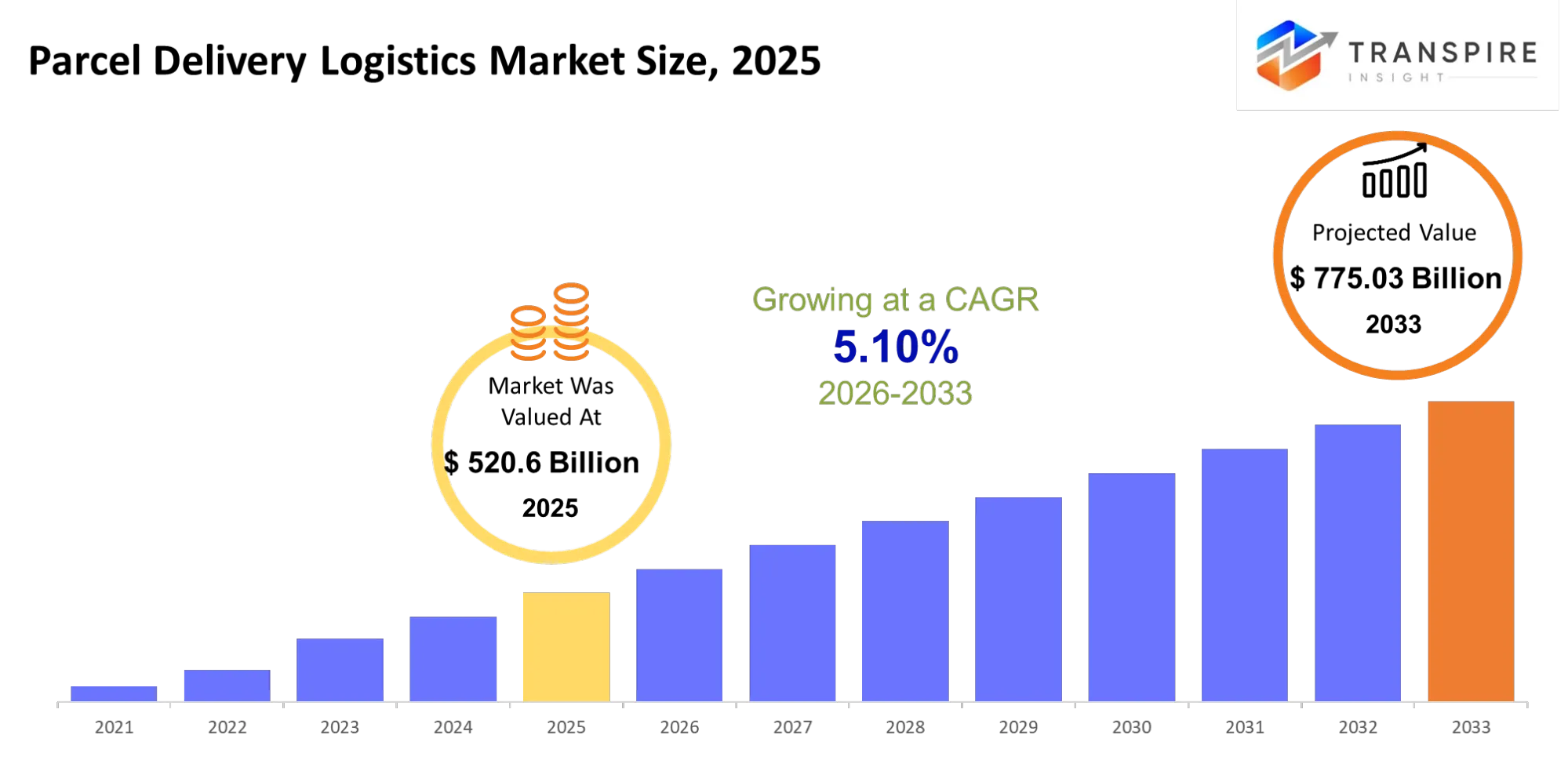
- Market Value (2025): USD 520.6 Billion.
- Expected Market Value (2026): USD 547.14 Billion.
- Estimated Market Value (2033): USD 775.03 Billion.
- Forecast CAGR (2026–2033): 5.10%.
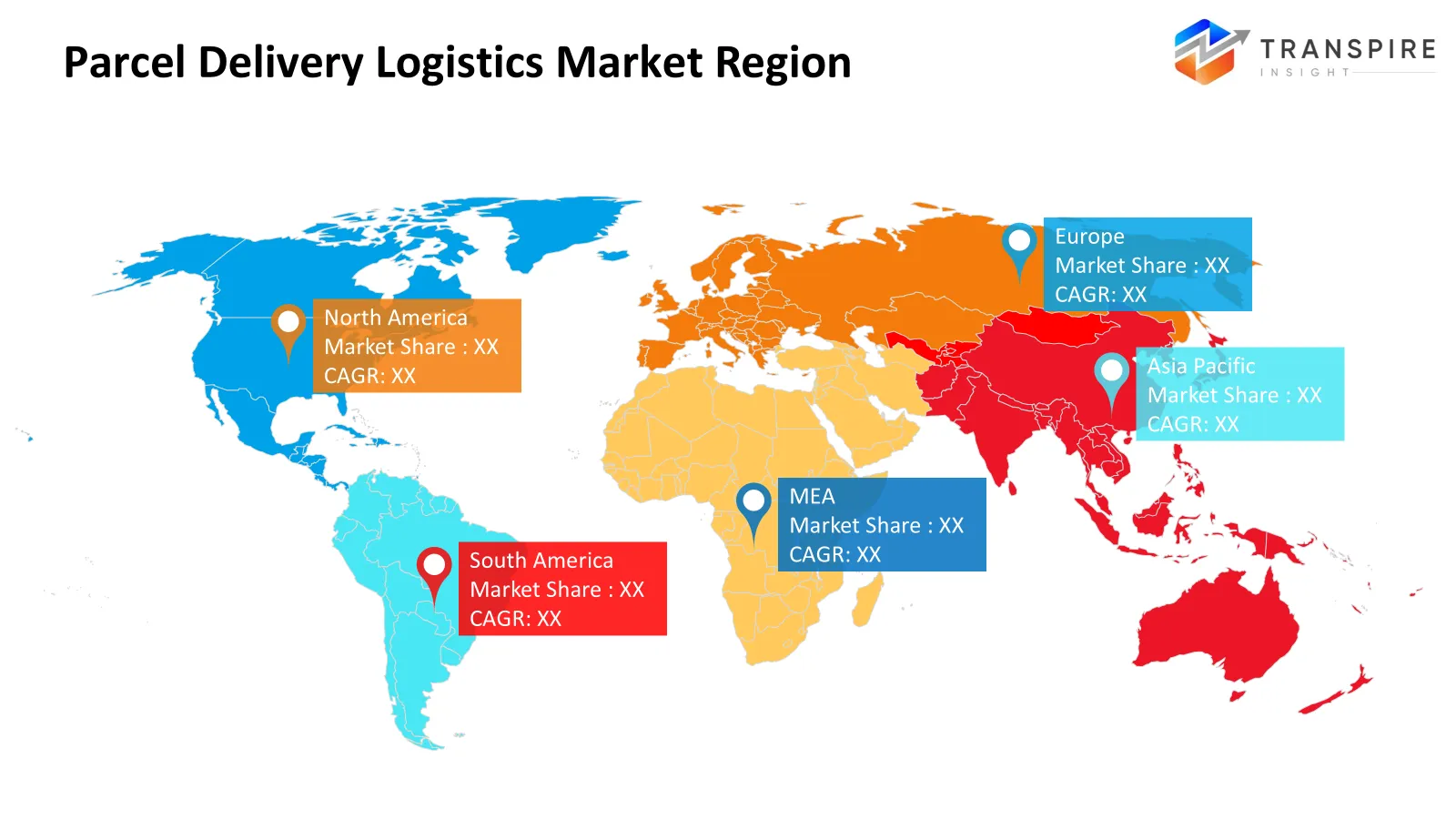
- Leading Region in 2025: Asia Pacific
- Second-largest Region: North America
- Fastest Growing Region: Europe
Introduction
The Parcel Delivery Logistics Market refers to the entire process of moving parcels, documents and small shipments through a complete network of collection, sorting, transportation and last-mile delivery services on domestic and international routes. The market enables deliveries for business-to-business (B2B), business-to-consumer (B2C) and consumer-to-consumer (C2C) via road, air, rail and sea transportation. The continued rapid growth in e-commerce, digital retail and cross-border trade is fuelling the demand for reliable, fast and technology-driven parcel logistics solutions. Automated sorting systems, AI-driven route optimization, real-time shipment tracking and sustainable delivery models are increasingly being adopted by the market to improve operational efficiency and customer satisfaction. The market is further bolstered by continuous improvements in last-mile delivery, smart logistics infrastructure and connected supply chain technologies enabling faster, more flexible and cost-effective parcel distribution worldwide.
For instance:- North America Cross-Border Logistics Expansion Increasing investments in near-shoring, healthcare logistics, warehouse automation and AI-based fulfillment networks enable higher efficiency in cross-border parcel delivery within the U.S., Canada and Mexico.
Asia-Pacific: Infrastructure and Automation Investments: The rapid deployment of automated sorting hubs, AI-powered logistics systems and expansion of regional transportation networks is driving up parcel delivery capacity and cross-border trade efficiency across Asia-Pacific.
Key Market Highlights: -
- Asia Pacific is expected to grow at a rapid CAGR in the Parcel Delivery Logistics Market by holding around 43% of the share during the forecast period.
- North America is anticipated to hold roughly 36% share of the Parcel Delivery Logistics Market over the predicted timeframe.
- Europe is anticipated to hold nearly 28%share of the Parcel Delivery Logistics Market over the predicted timeframe.
- By Service Type, the domestic parcel delivery dominated the market and holds nearly 60% share in 2025 and is projected to grow at a substantial CAGR during the forecast period.
- By Mode of Transport, the Road segment, dominated the market and holds close to 36% share in 2025 and is projected to grow at a substantial CAGR during the forecast period.
- By End User, the BFSI dominated the market and holds about 20% share in 2025 and is projected to grow at a substantial CAGR during the forecast period.
- PM Gati Shakti National Master Plan: Accelerates multimodal logistics infrastructure development by integrating road, rail, port and logistics park development; improves parcel transportation efficiency, reduces transit time and improves supply chain connectivity across the country.
How is Technology Driving Growth in the Parcel Delivery Logistics Market?
Technology is driving the growth of the Parcel Delivery Logistics Market by enhancing operational efficiency, delivery speed, and customer experience. To optimize parcel processing and lower operational costs, companies are implementing warehouse automation, robotic sorting systems and AI-driven route optimization. GPS, IoT and advanced data analysis make real-time tracking possible, increasing shipment visibility, demand forecasting and supply chain transparency. Innovations in last-mile delivery, including electric vehicles, smart parcel lockers, autonomous delivery robots and drone-based solutions, are enabling faster, more sustainable and highly efficient parcel distribution across domestic and international logistics networks.
Market Drivers
Parcel Delivery Logistics Market Growing with Expansion of Logistics Infrastructure and Investments in Automation and Cross-Border Delivery Network To boost operational efficiencies and cut delivery costs, leading logistics providers are stepping up investments in automated sorting facilities, AI-powered dispatch systems, robotics and smart warehousing. Increased investment in healthcare logistics, cold-chain infrastructure and sustainable transportation are further enhancing specialized parcel delivery capabilities. Strategic mergers, acquisitions and network expansion activities are further enhancing international connectivity, last mile delivery performance and cross border trade efficiency. These continued investments are providing faster, more consistent and technology-driven parcel logistics services, as well as supporting the increasing demand from e-commerce and commercial shipping.
For Instance: Europe: Strategic consolidation and network expansion: Large-scale mergers and acquisitions, parcel locker expansion and integrated cross-border logistics networks are improving operational efficiency, last-mile delivery capabilities and regional parcel distribution across Europe.
Restrain
However, the growth of the Parcel Delivery Logistics Market is hindered by rising last mile delivery costs, increasing labor shortages and complex cross-border regulatory requirements. Operational costs and transit times continue to increase due to rising fuel prices, failed delivery attempts, and lack of transportation infrastructure in rural and developing areas. And, as if that wasn’t enough, the supply chain disruptions and geopolitical uncertainties are also challenging delivery reliability, network efficiency and the entire logistics performance, thus limiting market expansion.
Analysis of Prices and Consumer Behaviour
B2C and e-commerce parcel services dominate the parcel delivery logistics market, representing some 68% of the overall market, driven by the rapid growth of online retail, omnichannel commerce, and the consumer demand for fast and reliable deliveries. Express and time-definite delivery services are usually 30-40% more expensive than standard parcel services because of premium transit speeds, advanced tracking capabilities, priority handling and guaranteed delivery windows. Domestic parcel deliveries, boosted by robust local e-commerce activities, urbanization and increasing retail distribution networks, account for about 72% of total shipment volume.Consumer buying habits show that around 58% of customers prefer fast shipping, live tracking of shipments, and reliable service, while around 35% of businesses tend to use long-term logistics contracts and bulk shipping agreements to reduce transportation costs, ensure consistent service quality, and improve supply chain efficiency in both domestic and international markets.
Top Companies in the Parcel Delivery Logistics Market
- DHL Group
- FedEx
- UPS
- Amazon Logistics
- SF Express
- JD Logistics
- Yamato Holdings
- DPDgroup
- Royal Mail
- Blue Dart
- Aramex
- Ninja Van
- Canada Post
- Poste Italiane
- GLS Group
Audio Codec Market Segmentation
The Parcel Delivery Logistics Market share is divided into five categories: By Service Type, By Mode of Transport, By End User, By Parcel Size, By Delivery Model
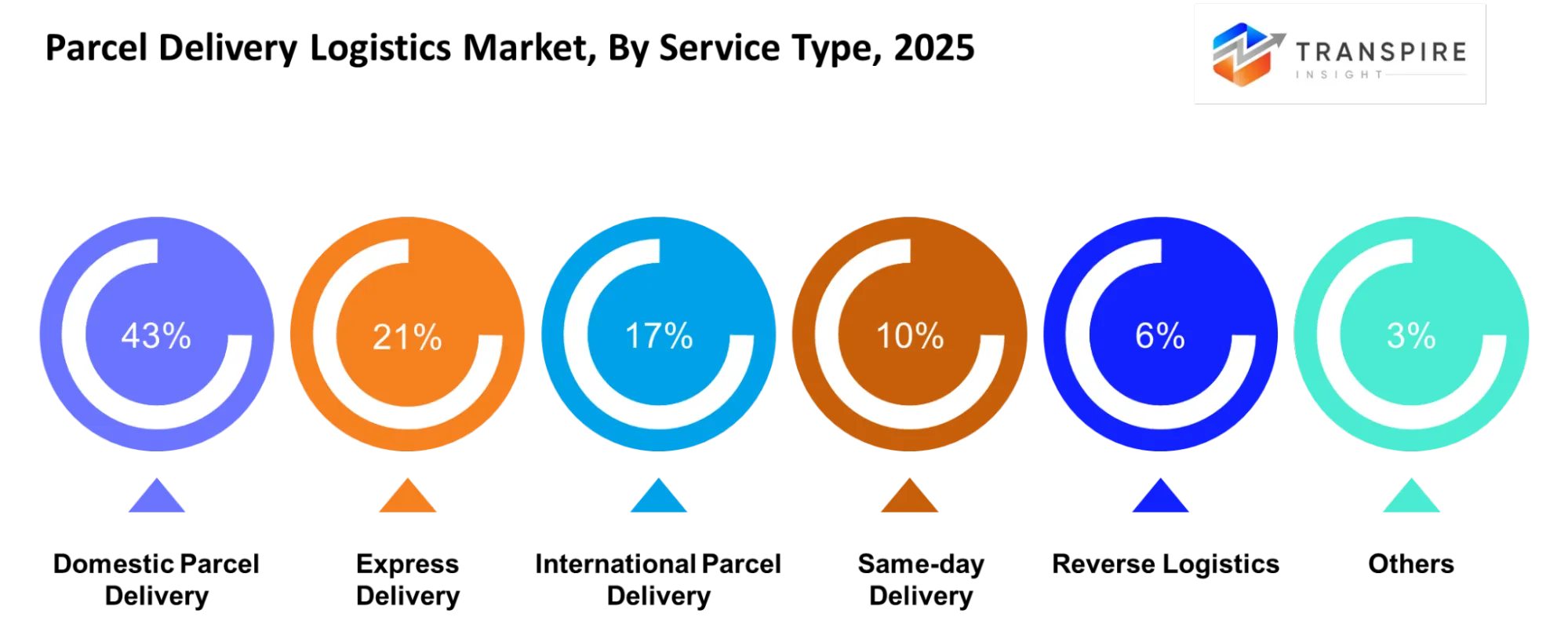
The domestic parcel delivery dominated the market, accounting for nearly 60% in 2025 and is expected to rise at a significant CAGR during the forecast period.
The Parcel Delivery Logistics Market is segmented by service type into domestic parcel delivery, international parcel delivery, express delivery, same-day delivery, reverse logistics, others Among these, the domestic parcel delivery dominated the market, accounting for nearly 60 % in 2025 and expected to increase at a significant CAGR during the forecast period. E-commerce activity is growing, domestic retail networks are expanding, delivery expectations are getting faster and last-mile infrastructure is strong – all of which continue to drive demand for reliable domestic parcel delivery services.
The Road segment, dominated the market, accounting for close to 36% in 2025, and is expected to rise at a significant CAGR during the forecast period
The Parcel Delivery Logistics Market is segmented by mode of transport into road, air, rail, sea, others. Among these, the Road segment, dominated the market, accounting for close to 36% in 2025 and expected to increase at a significant CAGR during the forecast period. Road transport is dominant because of its extensive connectivity, cost effectiveness, flexibility in last-mile delivery, increasing demand from e-commerce and widespread domestic distribution networks across the globe.
The BFSI dominated the market, accounting for about 20% in 2025 and is expected to rise at a significant CAGR during the forecast period.
The Parcel Delivery Logistics Market is by end user into e-commerce, retail, healthcare, manufacturing, bfsi, others Among these, the BFSI dominated the market, accounting for about 20% in 2025 and expected to increase at a significant CAGR during the forecast period. The rising demand for secure document delivery, financial services, regulatory compliance, and quick courier services is also driving the adoption of parcel logistics across BFSI.
Regional Segment Analysis of the Parcel Delivery Logistics Market
- Europe (Germany, France, U.K., Italy, Spain, Rest of Europe)
- North America (U.S., Canada, Mexico)
- Asia-Pacific (China, Japan, India, Rest of APAC)
- South America (Brazil and the Rest of South America)
- The Middle East and Africa (UAE, South Africa, Rest of MEA)
Asia Pacific is expected to grow at a rapid CAGR in the Parcel Delivery Logistics Market, holding around 43% of the share during the forecast period.
The Asia Pacific region is the leading region in the Parcel Delivery Logistics Market owing to the rapid growth of e-commerce, growing internet penetration, rising urbanization, and increasing cross-border trade activities. Capital investments in logistics infrastructure, automated warehousing, AI-powered delivery systems and last-mile distribution networks continue to drive operational efficiency. In addition, the existence of large manufacturing hubs, growing retail sectors, favorable government initiatives in logistics, and increasing consumer demand for fast and reliable parcel delivery services further boost the growth of the regional market.
North America is the fastest-growing region in the Parcel Delivery Logistics Market during the period, holding roughly 36% share.
North America is the fastest growing region in the Parcel Delivery Logistics Market owing to high penetration of e-commerce, advanced logistics infrastructure, and widespread adoption of automation and AI-powered supply chain technologies. We continue to make large investments in warehouse modernization, last mile delivery optimization and cross-border logistics to improve operational efficiency. Moreover, the growing presence of leading logistics providers, high consumer demand for same-day and next-day delivery services, and the growing healthcare and retail distribution networks are contributing to the regional market growth.
Europe is the fastest-growing region in the Parcel Delivery Logistics Market during the period, holding nearly 28% share.
Europe is witnessing substantial growth in the Parcel Delivery Logistics Market, driven by the rise in cross-border e-commerce, the availability of advanced transportation infrastructure, and growing investments in automated logistics and eco-friendly delivery solutions. The area is well connected by integrated road, rail, air and maritime networks, which improve the efficiency of parcel movement. Moreover, the growing preference for parcel lockers, electric delivery fleets, digital logistics platforms, and strategic mergers among the leading logistics providers, continue to improve last-mile delivery capabilities and regional market expansion.
Strategies for Market Growth in Non-Leading Regions:
The development of non-leading regions with efficient, tech-driven parcel delivery infrastructure, automated sorting facilities and scalable logistics networks would support small and medium-sized logistics providers and strengthen robust regional logistics capabilities. By establishing local fulfillment centers, distribution hubs, and last-mile delivery networks, you can cut down on transportation costs, accelerate delivery times, and reduce dependence on centralized logistics facilities. Strategic partnerships with e-commerce platforms, retailers, 3rd party logistics (3PL) providers, courier companies and regional distribution partners will increase the market penetration and service coverage. Training programs and technical skill development in warehouse automation, AI-powered route optimization, fleet management and digital logistics technologies are essential to improving operational efficiency. Flexible financing models, long-term logistics contracts and collaborative transportation agreements can also boost affordability and operational scalability for regional logistics providers.Government-led initiatives such as infrastructure development programs, digital logistics platforms, smart transportation initiatives and cross-border trade facilitation measures will continue to improve parcel delivery accessibility, bolster supply chain connectivity and support sustainable long-term growth across emerging markets.
Future Market Trends for the Parcel Delivery Logistics Market: -
- Warehouse Automation and AI Integration: Logistics companies are using AI to optimize routes, automate sorting, and perform predictive analytics, aiming to boost operational efficiency, delivery precision, and supply chain visibility.
- Last-Mile Delivery Innovation The deployment of electric delivery vehicles, smart parcel lockers, autonomous delivery robots and drone technologies is increasing delivery speed, flexibility and customer satisfaction.
- Sustainable and Cross-Border Logistics: The growth of cross-border e-commerce, the use of eco-friendly packaging, efforts to lower carbon emissions, and improvements in transportation infrastructure are driving sustainable parcel delivery and reinforcing logistics operations.
Recent Development
- In July 2026 – Strategic acquisition DHL eCommerce signed a definitive agreement to acquire Venipak Group, strengthening its Baltic parcel network, out-of-home locker infrastructure and cross-border e-commerce delivery capabilities.
- In February 2026 – Predictive Logistics & AI Growth: Major parcel delivery companies enhanced delivery efficiency, reduced transit delays, and bolstered supply chain resilience by adopting AI-powered predictive routing, real-time analytics, and smart network optimization.
Market Segment
This study forecasts revenue at global, regional and country levels from 2020 to 2033. Transpire Insights has segmented the Parcel Delivery Logistics Market based on the below-mentioned segments:
Parcel Delivery Logistics Market, By Service Type
- Domestic parcel delivery
- International Parcel Delivery
- Express Delivery
- Same-day Delivery
- Reverse Logistics
- Others
Parcel Delivery Logistics Market, By Mode of Transport
- Road
- Air
- Rail
- Sea
- Others
Parcel Delivery Logistics Market, By End User
- E-commerce
- Retail
- Healthcare
- Manufacturing
- BFSI
- Others
Parcel Delivery Logistics Market, By Parcel Size
- Small Parcels
- Medium Parcels
- Large Parcels
- Heavy Freight
- Others
Parcel Delivery Logistics Market, By Delivery Model
- Business-to-Consumer
- Business-to-Business
- Consumer-to-Consumer
- Others
Parcel Delivery Logistics Market, By Regional Analysis
North America
- United States
- Canada
- Mexico
Europe
- Germany
- United Kingdom
- France
- Spain
- Italy
- Rest of Europe
Asia Pacific
- Japan
- China
- Australia & New Zealand
- South Korea
- India
- Rest of Asia Pacific
South America
- Brazil
- Argentina
- Rest of South America
Middle East & Africa
- Saudi Arabia
- United Arab Emirates
- South Africa
- Rest of the Middle East & Africa
Frequently Asked Questions
Find quick answers to common questions.
Rapid e-commerce expansion, AI-powered logistics, warehouse automation, cross-border trade, and growing demand for faster, reliable last-mile delivery services drive growth.
Asia Pacific leads the market due to expanding e-commerce, advanced logistics infrastructure, manufacturing strength, urbanization, and increasing investments in delivery technologies.
Domestic parcel delivery benefits from rising online shopping, strong retail distribution, efficient transportation networks, and increasing demand for fast local deliveries nationwide.
Artificial intelligence improves route optimization, automated parcel sorting, predictive analytics, shipment visibility, operational efficiency, and customer satisfaction across logistics networks.
Rising last-mile delivery costs, labor shortages, fuel price volatility, regulatory complexities, and supply chain disruptions continue challenging parcel logistics operations.
- DHL Group
- FedEx
- UPS
- Amazon Logistics
- SF Express
- JD Logistics
- Yamato Holdings
- DPDgroup
- Royal Mail
- Blue Dart
- Aramex
- Ninja Van
- Canada Post
- Poste Italiane
- GLS Group
About the Authors

Mayur Shinde
I am Mayur Shinde, a Senior Research Analyst at Transpire Insight, specializing in the Automotive & Transportation and Information & Communication Technology (ICT) Industry. My work focuses on analyzing emerging market trends, technological advancements, competitive landscapes, and industry developments to deliver accurate, data-driven insights. I am passionate about transforming complex market information into clear, actionable content that helps businesses, professionals, and decision-makers stay informed and make confident strategic decisions.

Chakradhar Khansole
Chakradhar serves as the Research Director at Transpire Insight, bringing over 8 years of experience in technology, innovation, and strategic market intelligence. He specializes in transforming complex market data into actionable business insights that enable organizations to make informed, growth-oriented decisions. Recognized for his strategic vision and analytical expertise, Chakradhar leads high-impact research initiatives, delivering comprehensive market assessments, competitive intelligence, and forward-looking industry analysis.
Recently Published Reports
-
Apr 2026
ATV & UTV Market
ATV & UTV Market Size, Share & Analysis Report By Type (ATV, and UTV), By Variants (Less Than 400 CC, 400 CC To 800 CC, and More Than 800 CC), and Geography (North America, Europe, Asia-Pacific, Middle East and Africa, South and Central America), 2021 - 2031
-
Apr 2026
Automotive Central Gateway Module Market
Automotive Central Gateway Module Market Size, Share & Analysis Report By Type (Ethernet Central Gateway Module, CAN Central Gateway Module, LIN Central Gateway Module, and FlexRay), By Application (Powertrain Control, Body Control, Infotainment System, Advanced Driver Assistance Systems (ADAS), and Others), By End User (Passenger Vehicles, and Commercial Vehicles), and Geography (North America, Europe, Asia-Pacific, Middle East and Africa, South and Central America), 2021 - 2031
-
Apr 2026
Automotive Engine Oil Filter Market
Automotive Engine Oil Filter Market Size, Share & Analysis Report By Filter Type (Fuel Filter, Engine Oil Filter, Hydraulic Oil Filter, and Others), By Filter Media (Cellulose, Synthetic, and Micro), By Sales Channel (OEMs, and Aftermarket), By Vehicle Type (Passenger Cars, Light Commercial Vehicles, Heavy Duty Trucks, Buses and Coaches, and Off-road Vehicles), and Geography (North America, Europe, Asia-Pacific, Middle East and Africa, South and Central America), 2021 - 2031
-
Apr 2026
Automotive Parts Aluminium Die Casting Market
Automotive Parts Aluminium Die Casting Market Size, Share & Analysis Report By Production Process (Pressure Die Casting, Vacuum Die Casting, Squeeze Die Casting, Gravity Die Casting), By Application (Body Parts, Engine Parts, Transmission Parts, Battery And Related Components, Other Application Types), and Geography (North America, Europe, Asia-Pacific, Middle East and Africa, South and Central America), 2021 - 2031
Our Clients



