

Asia Pacific Courier, Express, & Parcel Services Market Summary
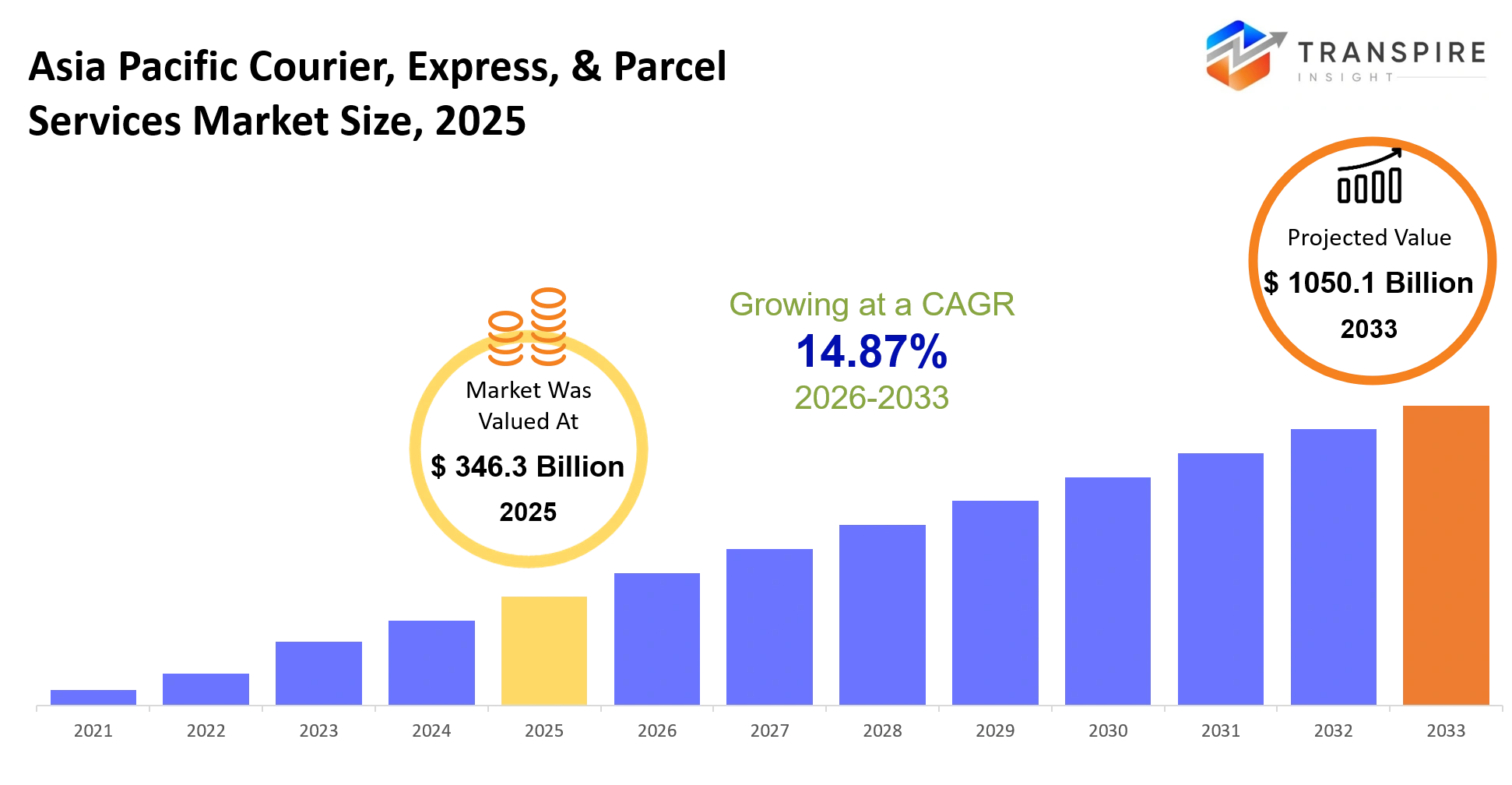
As per Transpire Insight Analysis the Asia Pacific Courier, Express, & Parcel Services Market size is estimated at USD 346.3 Billion in 2025 and is anticipated to reach USD 1050.1 Billion by 2033, growing at a CAGR of 14.87% from 2026 to 2033.
The Asia Pacific Courier, Express, & Parcel Services Market sort of keeps commercial life moving , by making sure paperwork, retail orders, industrial parts, pharmaceuticals ,and also time sensitive cargo reach businesses and everyday consumers with speed , plus a decent level of dependability. When parcel transport stays quick and fairly predictable, it supports e-commerce, production lines, healthcare ,and cross-border trade because stock hold ups get reduced , and the supply chain “quick reaction” gets better.
Over the last three to five years , the market has kinda shifted direction, moving away from labor heavy delivery networks , toward tech enabled operations that rely on automated sorting, AI driven route planning, and near real time shipment visibility. This move gathered steam after the COVID-19 pandemic showed up the weak spots in older logistics setups, and somehow it adjusted fulfillment expectations across the region, more or less in a durable way.
As firms reorganized their supply chains and pushed deeper into omnichannel distribution, courier operators put money into digital infrastructure and last-mile capabilities. Those investments have boosted delivery efficiency, widened service reach, and allowed more premium logistics offerings too, which creates better revenue chances through higher shipment volumes, plus value-added services, and more resilient distribution networks.
Asia Pacific Courier, Express, & Parcel Services Market Size & Forecast:
- Asia Pacific Courier, Express, & Parcel Services Market Size 2025: USD 346.3 Billion
- Expected Market Value 2033: USD 1050.1 Billion
- Forecast CAGR: 14.87%
- Leading region in 2025: East Asia
- Fastest Growing region: Southeast Asia
- Key Profile: DHL, FedEx, UPS, SF Express, Japan Post, Yamato Holdings, Blue Dart, Delhivery, J&T Express, Kerry Logistics, Ninja Van, Australia Post, Aramex, JD Logistics, ZTO Express
Key Market Insights
- East Asia ended up dominating the market at about 58% share in 2025, mainly held up by China’s parcel volumes and pretty advanced logistics infrastructure, overall it looks strong.
- Southeast Asia, though, is projected to turn into the fastest-growing regional market during 2025–2033, pushed forward by the rise of digital commerce and ongoing regional logistics investments .
- In the product/service slice, Business-to-Consumer (B2C) parcel services seemed to lead, with nearly 52% market share in 2025, and a lot of that was from high online retail fulfillment volumes.
- Meanwhile Business to Business (B2B) delivery services stayed as the second-largest segment, and that tracks pretty well since manufacturing supply chains still depend on reliable movement, plus there are those time-critical industrial shipments that really can’t just wait around.
- For growth speed, cross-border express delivery is forecast to see the quickest expansion all the way through 2033, pushed by regional trade pacts, and also international online marketplaces.
- When it comes to applications, e-commerce fulfillment took the leading position with about 61% share in 2025, which kind of underlines how fast omnichannel retail distribution is being taken up.
- Healthcare and pharmaceutical logistics is expected to turn into the fastest-growing application across the forecast period, largely because cold-chain investment keeps moving upward .
- As for end users, retail and e-commerce businesses together made up roughly 48% of end-user revenue in 2025, supporting steady, high-frequency parcel flows.
- Lastly, healthcare providers and pharmaceutical companies are set to be the fastest-growing end-user cohort through 2033, supported by the need for specialized delivery requirements.
What are the Key Drivers, Restraints, and Opportunities in the Asia Pacific Courier, Express, & Parcel Services Market?
Digital commerce, yeah, has become the main thing that keeps pushing market growth forward. With mobile shopping being so common, digital payment platforms everywhere, and omnichannel retail moving in after the pandemic it sort of changed the fulfillment expectations in a major way. Retailers now, not even joking, often promise same-day or next-day delivery across big metro zones. That change kinda pushed logistics providers to enlarge automated sorting facilities, set up regional distribution centers, and also grow their last‑mile delivery fleets. When fulfillment is quicker, customers tend to stick around more, and the more premium delivery options can bring in better revenue per shipment.
Still, network fragmentation is the biggest structural obstacle. Asia Pacific alone has thousands of islands, plus remote communities, and customs rules that are not exactly consistent, which makes cross-border movement more complicated. Getting standardized logistics infrastructure in place takes years, a lot of capital, and careful policy coordination. From the Transpire Insight review of procurement notices in the region and various launch timetables, supply chain concentration is, by far, the most important execution risk. Capacity shortages, delays in border paperwork, and uneven transport infrastructure all tend to squeeze operating margins , slow down service expansion, and reduce how fast premium express gets adopted across developing economies.
The next real growth phase should come from intelligent logistics ecosystems , kind of like it’s already starting to happen. With AI-driven route optimization, warehouse robotics, electric delivery fleets, and regional fulfillment automation in the mix, companies can push delivery speed up and bring operating costs down, even if it takes some tuning. Southeast Asia looks like the strongest opening here, mainly because governments and private investors are still backing logistics parks, digital customs systems, and the transportation infrastructure around them. And the firms that blend predictive analytics with automated fulfillment networks, will likely boost their regional competitiveness, while also opening up new revenue streams from cross-border parcel services, so yeah, that’s the general direction.
What Has the Impact of Artificial Intelligence Been on the Asia Pacific Courier, Express, & Parcel Services Market?
Artificial intelligence has kind of reshaped parcel logistics a lot, mostly by improving operational precision through sorting hall workflows, transportation routes, and those last mile handoffs. With AI vision systems in place parcels get recognized automatically, labeling errors are spotted in real time, and then shipments are grouped by delivery commitments, more or less like a quiet choreography that never really stops.Meanwhile, automated control platforms keep checking fleet movement, warehouse capacity usage, and delivery outcomes all the time. That means teams can react fast to disruptions, without having to do everything manually, and not so much guess work.
On top of that, machine learning has given forecasting a stronger backbone across wider regional logistics networks. Old shipment volumes, local weather conditions, seasonal retail activity, and even traffic records are used to anticipate parcel flows and to tune vehicle allocation before congestion even starts.Predictive analytics also helps ease those warehouse slowdowns, boosts vehicle utilization, and sort of steers steadier staffing decisions during the huge shopping surges. In general, these changes make delivery reliability better, shorten the transit times, reduce fuel burn, and bring down operating expenses, while still keeping customers more satisfied, which honestly matters in the end.
Still, even with all that, AI adoption runs into practical hurdles. Putting advanced analytics into legacy logistics platforms can demand a lot of budget and specialized technical know how. Smaller courier operators often don’t have standardized operational data, so training accurate predictive models becomes difficult or incomplete. Also, connectivity gaps in out of the way delivery corridors can shrink real time visibility, so AI performance drops outside major urban zones. But as regional digital infrastructure improves over time, these limitations should gradually soften, and that should allow wider deployment of intelligent logistics solutions.
Key Market Trends
- Since 2022, automated parcel sorting facilities have been rolling out across China , Japan, and South Korea kinda fast, to boost throughput and push down those manual processing costs.
- In the meantime, same day and next day delivery services have turned into a kind of default thing in many big metropolitan markets , which also nudged companies to invest in urban micro fulfillment centers.
- Between 2023 and 2026, electric delivery vehicles got a noticeably stronger foothold, commercial adoption wise , and that lets logistics providers trim fuel bills and still meet city emission targets.
- AI enabled route optimization has been cutting delivery delays, at the same time as it improves fleet utilization across major regional courier operators.
- Cross border parcel volumes picked up after certain trade agreements made customs procedures simpler, and then digital commerce in parts of Southeast Asia got extra support too.
- More and more , logistics firms are rolling out warehouse robotics not only so sorting gets more precise , but also to cut down on labor reliance, and bump up operational scalability whenever seasonal demand really spikes.
- Cainiao, JD Logistics, and SF Express are still growing smart logistics parks and automated fulfillment centers across Asia Pacific markets, it really seems like it is continuing as a kind of trend, even now.
- Meanwhile, cold chain parcel networks have been expanding rather quickly since 2024, helping pharmaceutical deliveries, plus other temperature sensitive health-care goods across regional supply lines.
- And lastly, strategic partnerships between logistics providers and e-commerce platforms are trimming delivery times while reinforcing integrated fulfillment capacity across a lot of emerging economies, all together.
Asia Pacific Courier, Express, & Parcel Services Market Segmentation
By Service Type :
Courier services keep on helping with document movement, business correspondence, and small parcel transportation across city areas and semi-urban zones. Business contracts that stay stable, plus financial transactions, and also legal documentation, build a fairly steady need for this service tier. Express delivery is for time sensitive shipments, where you want guaranteed transit windows, so it becomes useful for healthcare products, industrial components, and even premium consumer orders. Parcel delivery ends up handling the largest shipment volumes , since online retail platforms and digital marketplaces mostly rely on dependable door-to-door distribution each day.
Same-day delivery has expanded pretty fast in big urban zones, where people tend to expect faster order completion, and retailers push back with delivery speed as a competitive edge. Cross-border shipping meanwhile binds exporters, manufacturers, and retailers to customers abroad through connected logistics networks , plus customs support. Freight express supports urgent commercial cargo that cannot afford production delays, especially through manufacturing and industrial supply chains. Other options include niche logistics, like temperature controlled delivery, timed distribution routes, and tailored business logistics, which handle industry-specific transportation needs, in practical ways.
By Destination :
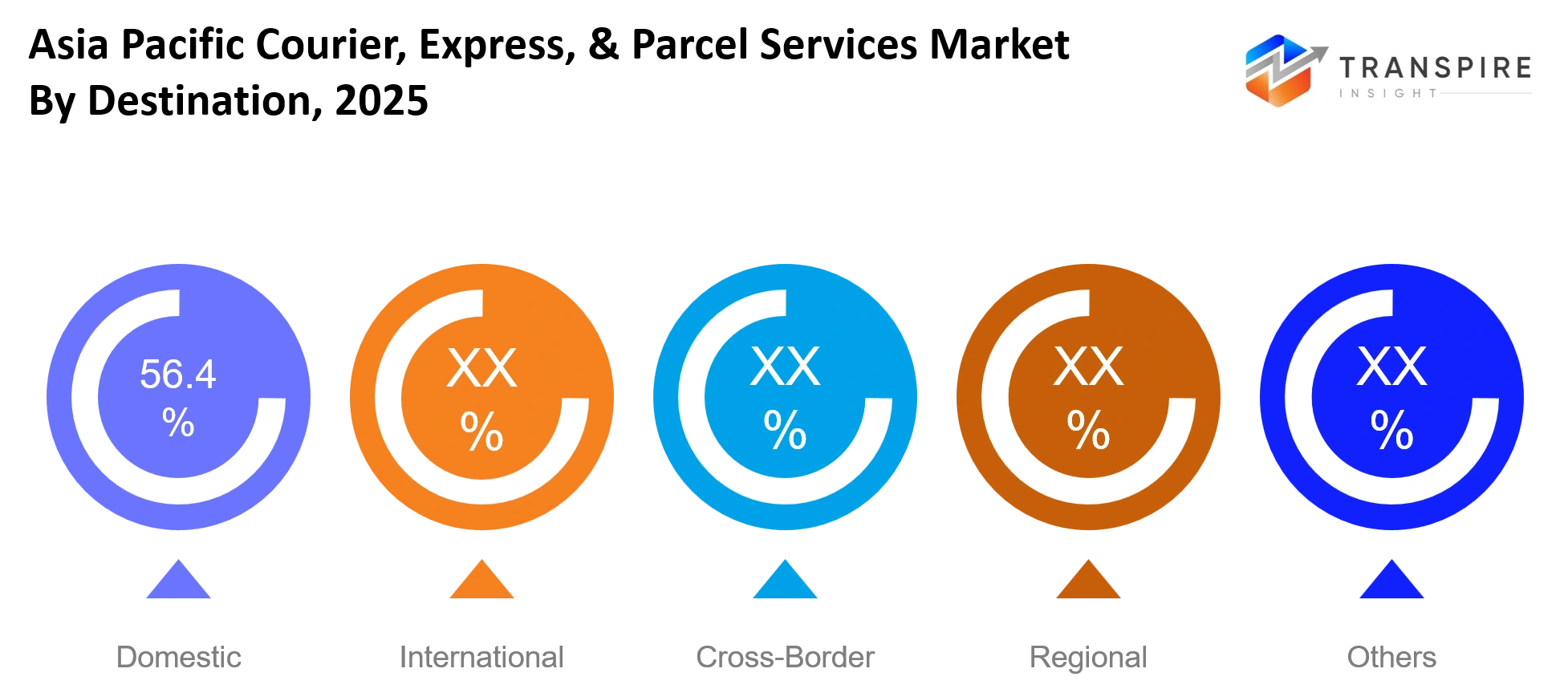
Domestic delivery takes the biggest part, because each day parcel movement inside the country helps retail sales, healthcare distribution, manufacturing activity, and even government operations, kind of all together. Because transportation infrastructure is already well-built and delivery networks are dense, operators can still manage frequent collections and deliver quicker through the major cities. International delivery stays a key segment too, since exporters and global retailers keep pushing their trade relationships across Asia Pacific and other outside markets. Customs handling, documentation support, plus integrated tracking systems, all these add real service value for business customers.
Cross Border delivery has been getting more important, mostly because online marketplaces kind of nudge people toward buying straight from international sellers in nearby countries. At the same time, trade agreements and digital customs initiatives have cut down processing time a lot, so cross border shipping ends up being more efficient for businesses as well as consumers. Regional delivery not only helps in that sense, but also supports economic cooperation among neighboring countries with shorter transit routes and stronger logistics connectivity, which sounds simple but actually matters.Other kinds include project-based logistics, delivery to remote areas, and specialized transport solutions made for unique commercial needs.
By Transportation Mode :
Road transport still remains the main option, because route planning can be flexible and the huge highway networks help with quick first-mile and last-mile deliveries. On most days, parcel distribution is very dependent on trucks, vans, and other delivery vehicles that link warehouses with homes and business sites. Air transport tends to show up when it really matters, like urgent shipments where travel time affects customer happiness and helps the business keep running, uninterrupted. Premium express, medical deliveries, and international packages often end up using air cargo since it moves faster over long distances.
Rail transport works well for cost saving movement when there are large shipment volumes, especially along freight corridors that are already in place in countries with mature rail systems. Sea transport, meanwhile, supports a variety of bulk commercial shipments and cross border freight, whenever the delivery timetables can tolerate a longer voyage , in return for smaller transport charges. Multimodal transportation mixes road plus air, rail, and sea corridors all together, so the day to day operations stay more adaptable and supply chain disruptions get reduced. Other options cover more niche transportation methods too, for example tailored solutions for remote areas, project cargo handling, and logistics needs that are specific to certain industries.
By End User :
E-commerce is still basically the primary end user category, because online shopping platforms kinda rely on dependable parcel delivery to reach customer expectations and keep order fulfillment running smoothly. When the transaction volume gets high, logistics providers tend to grow their sorting facilities, add more warehouse capacity and improve last mile delivery networks, you know. Retail businesses keep using delivery services to restock stores, complete online purchases and handle inventory, across several sales channels too. Manufacturing firms are dependent on scheduled logistics for raw materials, spare components, and finished goods, so the production line stays consistent without interruption.
Healthcare orgs really need secure and on time transportation for medicines, medical equipment, lab samples, and temperature sensitive products. BFSI institutions still use courier services for confidential papers, payment instruments, and regulatory files that need careful secure handling. Government agencies, meanwhile, rely on organized logistics for official correspondence, administrative documents and public service distribution over cities and rural areas. Other sectors include education, telecommunications, hospitality and assorted commercial activities that all depend on steady logistics support for everyday operations.
By Shipment Weight :
Lightweight parcels take up quite a big slice because fashion items, consumer electronics, cosmetics, books, and everyday household goods usually dominate those online retail orders. People get them delivered often to homes, and shipping is cheaper overall so the category keeps moving upward. Medium Parcels, meanwhile, tend to be used by businesses and also by consumers, when they need to move bigger household items , packaged tools, and commercial supplies where you still want reasonable handling together with practical transport efficiency. Heavy Parcels are still a key part too, especially for industrial equipment, machinery components, and trade goods that call for more specific logistics planning and careful handling.
Documents keep showing solid shipment levels, think banking, legal services, healthcare administration, schooling, and government communication. Even with the broader push toward digital channels, there’s still a need for these transfers. Secure handling, plus guaranteed delivery, stays essential when it comes to sensitive paperwork and regulatory requirements. As for “Others”, this can mean oversized shipments, tailored packing needs, fragile merchandise, and cargo tied to specific industries, all of which really require specialized transportation, careful handling processes, and value-added logistics help.
What are the Key Use Cases Driving the Asia Pacific Courier, Express, & Parcel Services Market?
Retail e-commerce still feels like the biggest use case, mainly because online marketplaces , direct-to-consumer brands, and big retailers need fast parcel flow to finish same day customer orders. With high order volume, delivery choices that can bend to the customer , and dependable tracking, companies keep putting money into courier and express delivery systems. So, this app ends up being the biggest driver for service revenue , kind of straightforward.
Healthcare and manufacturing are also pushing into more meaningful delivery scenarios. Hospitals , along with pharmaceutical distributors and diagnostic labs , want secure movement for medicines, medical devices, and anything that is heat sensitive or temperature dependent. On the manufacturing side, firms use express logistics to relocate critical parts. That helps avoid production standstills and supports just in time operations, without the usual delays.
Cross-border fulfillment for small and medium sized enterprises looks like a real opportunity too, because digital trade platforms make overseas selling easier. There is also a growing pattern around specialized shipments for electric vehicle components and semiconductor supply chains. In these cases handling rules are stricter, traceability matters, and faster customs processing will likely open fresh business avenues across the forecast period.
|
Report Metrics |
Details |
|
Market size value in 2025 |
USD 346.3 Billion |
|
Market size value in 2026 |
USD 397.8 Billion |
|
Revenue forecast in 2033 |
USD 1050.1 Billion |
|
Growth rate |
CAGR of 14.87% from 2026 to 2033 |
|
Base year |
2025 |
|
Historical data |
2021 - 2024 |
|
Forecast period |
2026 - 2033 |
|
Report coverage |
Revenue forecast, competitive landscape, growth factors, and trends |
|
Regional scope |
Asia Pacific (India, China, Japan, Australia, South Korea, Rest of Asia Pacific) |
|
Key company profiled |
DHL, FedEx, UPS, SF Express, Japan Post, Yamato Holdings, Blue Dart, Delhivery, J&T Express, Kerry Logistics, Ninja Van, Australia Post, Aramex, JD Logistics, ZTO Express . |
|
Customization scope |
Free report customization (country, regional & segment scope). Avail customized purchase options to meet your exact research needs. |
|
Report Segmentation |
By Service Type (Courier Services, Express Delivery, Parcel Delivery, Same-Day Delivery, International Shipping, Freight Express, Others); By Destination (Domestic, International, Cross-Border, Regional, Others); By Transportation Mode (Road, Air, Rail, Sea, Multimodal, Others); By End User (E-commerce, Retail, Manufacturing, Healthcare, BFSI, Government, Others); By Shipment Weight (Lightweight Parcels, Medium Parcels, Heavy Parcels, Documents, Others) |
Which Regions are Driving the Asia Pacific Courier, Express, & Parcel Services Market Growth?
In 2025 East Asia, pretty much held the leading role, at around 58% of the market. The mix of strong transport infrastructure, more or less advanced customs systems and government backing for digital commerce has made an efficient logistics setup across China , Japan , and South Korea. A lot of the heavy lifting comes from major parcel operators, automated fulfillment facilities, cargo airports, and also connected warehouse networks , and together they boost regional delivery ability. Ongoing spending on smart logistics tools plus broader cross-border trading should help keep that regional lead for the whole forecast period.
South Asia sits in second place in the regional market, mainly because fast urbanization meets a big internal customer base, while manufacturing keeps expanding too. Logistics momentum is reinforced by infrastructure modernization, national digital programs and various policy actions aimed at better freight routing and improved tax effectiveness. The domestic courier system keeps spreading out past the big metropolitan zones, while organized retail along with business related delivery work keeps shipment levels steady. Those underlying advantages, generally translate into reliable revenue chances even if global trade turns a bit uncertain, or stays shaky for a while.
Southeast Asia is set to see the quickest growth between 2026 and 2033, as governments push harder on logistics infrastructure projects , and also simplify the regional trade paperwork. More money is going into distribution hubs, airport cargo facilities, and digital customs platforms. That has made delivery move faster across Indonesia , Vietnam, Thailand , Malaysia and the Philippines . At the same time, regional e-commerce marketplaces and global logistics operators keep extending their delivery fleets , plus their fulfillment capacity to meet rising demand from consumers. This ongoing momentum should open interesting opportunities for fresh market players and investors , who are looking for long term expansion via technology based logistics services and cross-border distribution pathways .
Who are the Key Players in the Asia Pacific Courier, Express, & Parcel Services Market and How Do They Compete?
Competition is still kinda moderately fragmented because global logistics firms run head to head with solid regional and domestic players, each one has its own geographic advantage. The big drivers that keep shaping competition are basically cost efficiency, delivery speed, digital visibility or tracking, plus network reach. Meanwhile established companies keep beefing up their automated logistics backbone, and regional operators push deeper into less served areas, using flexible delivery patterns and price points that are often really competitive.
DHL Express goes with a more technology focused approach, expanding automated sorting facilities and also reinforcing its international express routes, which gives multinational businesses dependable cross border delivery options. FedEx stands out via its broad air cargo capacity and connected time definite delivery services, supporting manufacturing , healthcare, and international trade in a pretty direct way. SF Express builds an edge through advanced automation, smarter distribution hubs, and wide domestic coverage throughout China, and at the same time it keeps widening its regional logistics offerings.
J&T Express competes by moving fast on regional growth and maintaining cost efficient delivery networks, especially for high volume e-commerce ecosystems across Southeast Asia. JD Logistics boosts its standing by combining AI enabled warehouse management, automated fulfillment, and end to end supply chain services for enterprise clients. Taken together, these choices push better delivery performance, cut down operating expenses, and let each company match different customer expectations while still expanding its market presence across Asia Pacific.
Company List
- DHL
- FedEx
- UPS
- SF Express
- Japan Post
- Yamato Holdings
- Blue Dart
- Delhivery
- J&T Express
- Kerry Logistics
- Ninja Van
- Australia Post
- Aramex
- JD Logistics
- ZTO Express
Recent Development News
In February 2026, DHL Group and JD.com signed a strategic memorandum of understanding to support German brands entering China and expand European market access through JD.com's retail platform. The partnership strengthens cross-border logistics capabilities by combining DHL's global logistics network with JD Logistics' fulfillment ecosystem, supporting Asia Pacific parcel and e-commerce services. Source https://group.dhl.com/
In April 2026, FedEx announced a strategic partnership with Viettel Post Joint Stock Corporation to strengthen end-to-end logistics connectivity in Vietnam. The collaboration expands nationwide pickup and delivery operations while improving cross-border logistics across Asia Pacific, supporting regional parcel network growth and trade connectivity.
Source https://newsroom.fedex.com/
What Strategic Insights Define the Future of the Asia Pacific Courier, Express, & Parcel Services Market?
The Asia Pacific Courier, Express, & Parcel Services Market is headed toward more and more integrated logistics ecosystems, where automated fulfillment, AI based decisions, and cross border digital commerce will end up, defining long term competitiveness. The real change is not so much shipment growth but the digitalization of the supply chain , and in practice companies start caring about delivery reliability, clearer visibility, plus network flexibility.
There is also a risk that is kinda less noticeable at first , the parcel volumes are getting more concentrated, sitting with just a handful of big e-commerce platforms and logistics providers. That situation can squeeze pricing flexibility and make the business more dependent on a small, pretty specific customer base.
On the opportunity side , you can see movement toward specialized logistics networks for healthcare goods, semiconductor parts, and high value electronics across Southeast Asia. This is driven by regional manufacturing expanding, so demand patterns shift faster. Firms that go early into intelligent warehouse automation, interoperable digital platforms, and regionally diversified fulfillment infrastructure will likely sit in a better spot. They can capture higher margin service revenue, while also lowering both operational exposure and concentration risks, over the next few years.
Asia Pacific Courier, Express, & Parcel Services Market Report Segmentation
By Service Type
- Courier Services
- Express Delivery
- Parcel Delivery
- Same-Day Delivery
- International Shipping
- Freight Express
By Destination
- Domestic
- International
- Cross-Border
- Regional
By Transportation Mode
- Road
- Air
- Rail
- Sea
- Multimodal
By End User
- E-commerce
- Retail
- Manufacturing
- Healthcare
- BFSI
- Government
By Shipment Weight
- Lightweight Parcels
- Medium Parcels
- Heavy Parcels
- Documents
Frequently Asked Questions
Find quick answers to common questions.
The expected Asia Pacific Courier, Express, & Parcel Services Market size for the market will be USD 1050.1 Billion in 2033.
Key segments for the Asia Pacific Courier, Express, & Parcel Services Market are By Service Type (Courier Services, Express Delivery, Parcel Delivery, Same-Day Delivery, International Shipping, Freight Express, Others); By Destination (Domestic, International, Cross-Border, Regional, Others); By Transportation Mode (Road, Air, Rail, Sea, Multimodal, Others); By End User (E-commerce, Retail, Manufacturing, Healthcare, BFSI, Government, Others); By Shipment Weight (Lightweight Parcels, Medium Parcels, Heavy Parcels, Documents, Others).
Major Asia Pacific Courier, Express, & Parcel Services Market players are DHL, FedEx, UPS, SF Express, Japan Post, Yamato Holdings, Blue Dart, Delhivery, J&T Express, Kerry Logistics, Ninja Van, Australia Post, Aramex, JD Logistics, ZTO Express.
The Asia Pacific Courier, Express, & Parcel Services Market size is USD 346.3 Billion in 2025.
The Asia Pacific Courier, Express, & Parcel Services Market CAGR is 14.87% from 2026 to 2033.
- DHL
- FedEx
- UPS
- SF Express
- Japan Post
- Yamato Holdings
- Blue Dart
- Delhivery
- J&T Express
- Kerry Logistics
- Ninja Van
- Australia Post
- Aramex
- JD Logistics
- ZTO Express
About the Authors

Mayur Shinde
I am Mayur Shinde, a Senior Research Analyst at Transpire Insight, specializing in the Automotive & Transportation and Information & Communication Technology (ICT) Industry. My work focuses on analyzing emerging market trends, technological advancements, competitive landscapes, and industry developments to deliver accurate, data-driven insights. I am passionate about transforming complex market information into clear, actionable content that helps businesses, professionals, and decision-makers stay informed and make confident strategic decisions.

Chakradhar Khansole
Chakradhar serves as the Research Director at Transpire Insight, bringing over 8 years of experience in technology, innovation, and strategic market intelligence. He specializes in transforming complex market data into actionable business insights that enable organizations to make informed, growth-oriented decisions. Recognized for his strategic vision and analytical expertise, Chakradhar leads high-impact research initiatives, delivering comprehensive market assessments, competitive intelligence, and forward-looking industry analysis.
Recently Published Reports
-
Apr 2026
ATV & UTV Market
ATV & UTV Market Size, Share & Analysis Report By Type (ATV, and UTV), By Variants (Less Than 400 CC, 400 CC To 800 CC, and More Than 800 CC), and Geography (North America, Europe, Asia-Pacific, Middle East and Africa, South and Central America), 2021 - 2031
-
Apr 2026
Automotive Central Gateway Module Market
Automotive Central Gateway Module Market Size, Share & Analysis Report By Type (Ethernet Central Gateway Module, CAN Central Gateway Module, LIN Central Gateway Module, and FlexRay), By Application (Powertrain Control, Body Control, Infotainment System, Advanced Driver Assistance Systems (ADAS), and Others), By End User (Passenger Vehicles, and Commercial Vehicles), and Geography (North America, Europe, Asia-Pacific, Middle East and Africa, South and Central America), 2021 - 2031
-
Apr 2026
Automotive Engine Oil Filter Market
Automotive Engine Oil Filter Market Size, Share & Analysis Report By Filter Type (Fuel Filter, Engine Oil Filter, Hydraulic Oil Filter, and Others), By Filter Media (Cellulose, Synthetic, and Micro), By Sales Channel (OEMs, and Aftermarket), By Vehicle Type (Passenger Cars, Light Commercial Vehicles, Heavy Duty Trucks, Buses and Coaches, and Off-road Vehicles), and Geography (North America, Europe, Asia-Pacific, Middle East and Africa, South and Central America), 2021 - 2031
-
Apr 2026
Automotive Parts Aluminium Die Casting Market
Automotive Parts Aluminium Die Casting Market Size, Share & Analysis Report By Production Process (Pressure Die Casting, Vacuum Die Casting, Squeeze Die Casting, Gravity Die Casting), By Application (Body Parts, Engine Parts, Transmission Parts, Battery And Related Components, Other Application Types), and Geography (North America, Europe, Asia-Pacific, Middle East and Africa, South and Central America), 2021 - 2031
Our Clients



