

Asia Pacific Courier, Express, And Parcel Market Size & Forecast:
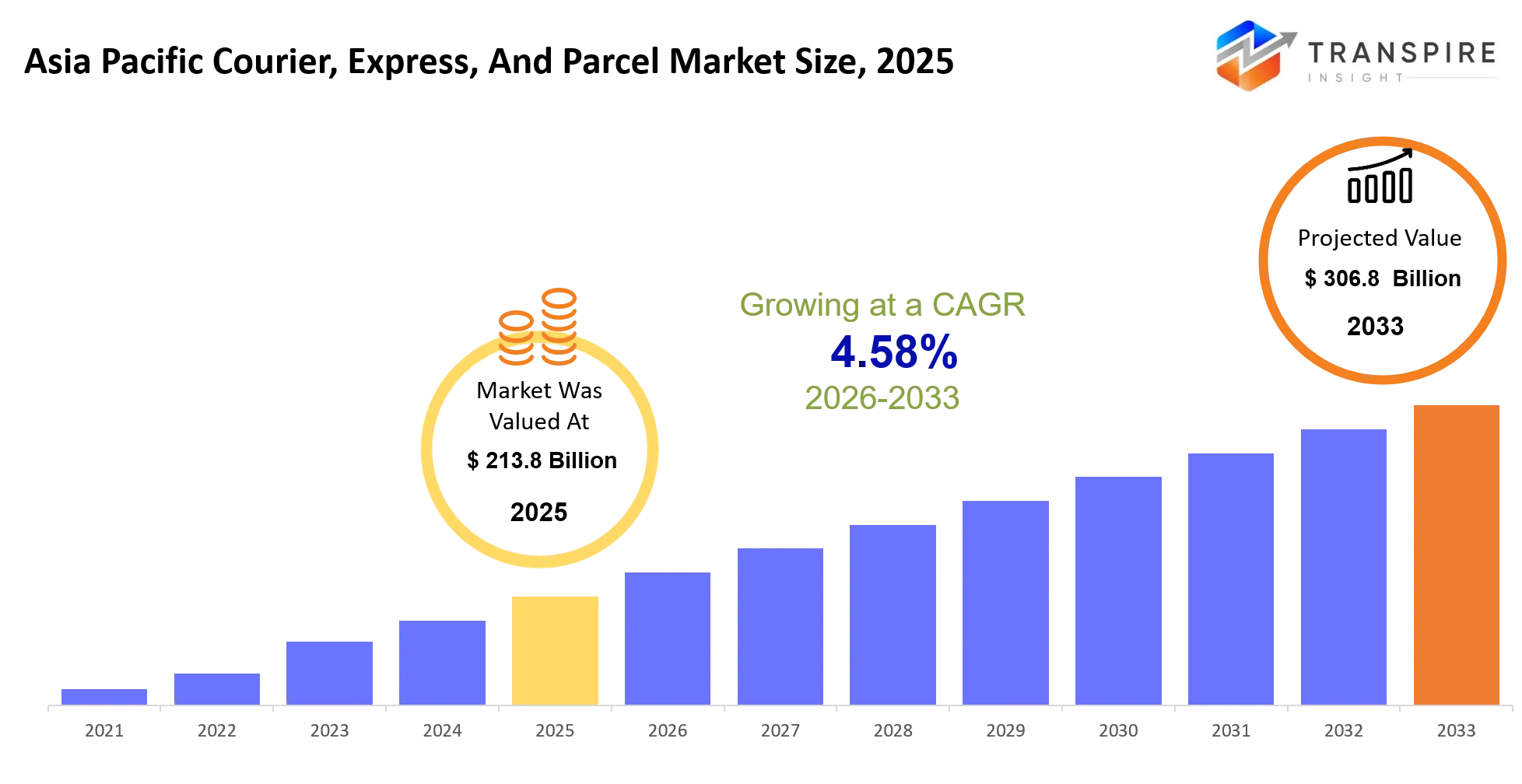
- Asia Pacific Courier, Express, And Parcel Market Size 2025: USD 213.8 Billion
- Asia Pacific Courier, Express, And Parcel Market Size 2033: USD 306.8 Billion
- Asia Pacific Courier, Express, And Parcel Market CAGR: 4.58%
- Asia Pacific Courier, Express, And Parcel Market Segments: By Service Type (Courier Services, Express Delivery, Parcel Delivery, Same-day Delivery, International Shipping, Others); By Application (E-commerce Deliveries, Retail Logistics, Healthcare Logistics, Documents Delivery, Others); By End User (E-commerce Companies, Enterprises, Individuals, Government Sector, Others)
To learn more about this report,  Download Free Sample Report
Asia Pacific Courier, Express, And Parcel Market Summary
The Asia Pacific Courier, Express, And Parcel Market was valued at USD 213.8 Billion in 2025. It is forecast to reach USD 306.8 Billion by 2033. That is a CAGR of 4.58% over the period.
In Asia Pacific, the courier, express, and parcel market kind of works like a time critical circulation system for small shipments, it moves e-commerce orders, industrial spare parts, and cross-border documents between manufacturers, retailers, and consumers. It helps with last mile delivery in dense urban corridors, and it also supports air and road express lanes, that keep regional supply chains responsive. Over the past five years the market has been shifting more structurally, toward platform integrated fulfillment and automated sorting networks where digital APIs connect retailers straight to courier fleets, plus routing systems.
The COVID-19 disruption was sort of the key trigger, it showed how warehousing and border delays can bite, while also speeding up online retail adoption across emerging economies. Because of that, companies expanded decentralized micro fulfillment centers and put more money into route optimization and real time tracking, to squeeze the delivery windows a bit. All this has pushed revenue growth mainly via higher shipment frequency, and also premium express services, not just by growing simple volume.
Key Market Insights
- The Asia Pacific Courier Express and Parcel Market is led by China, taking up about 38% share in 2025, mainly because there are dense e-commerce logistics networks in place.
- India then looks like the fastest-growing region, expected to expand rather quickly all the way through 2030, with digital retail penetration still climbing.
- Southeast Asia is showing pretty strong momentum too, cross border parcel demand is rising by more than 20% each year across a few major trade corridors.
- In terms of parcel types, Standard parcel delivery basically dominates the Asia Pacific market, with nearly 45% share, pushed along by e-commerce shipments.
- Express delivery services are next, grabbing the second-largest slice, since time sensitive B2B logistics is increasing along with medical logistics demand.
- When it comes to the segment view, same day delivery services are projected as the fastest-growing line through 2030, because urban fulfillment innovations are spreading.
- E-commerce logistics remains the main application, holding over 50% share and shaping how the whole Asia Pacific Courier Express and Parcel Market grows.
- Industrial spare parts logistics is an emerging, higher-growth application, it’s being supported by manufacturing automation and the need to reduce downtime.
- On the end user side, retail and e-commerce firms lead demand with around 55% share in the market.
- Healthcare and pharmaceuticals are the fastest-growing category, driven by temperature sensitive shipments and urgent delivery requirements.
What are the Key Drivers, Restraints, and Opportunities in the Asia Pacific Courier, Express, And Parcel Market?
The Asia Pacific Courier, Express, And Parcel Market is mostly moved by this big structural shift toward platform led e-commerce logistics, you know the kind that kinda grows from the back end. The whole trigger seems to be rapid digitalization across China, India, and Southeast Asia retail ecosystems, where mobile first commerce has basically replaced the usual storefront led distribution. That change has compelled courier operators to link straight into marketplace APIs, which then supports automated order dispatch and even dynamic route optimization. So basically shipment frequency goes up while unit delivery costs get partly balanced out by higher network density, and that ends up lifting revenue per logistics node too, plus it speeds up adoption of express fulfillment models.
Still though, the most serious constraint remains fragmented last mile infrastructure across many emerging economies. In nations with uneven road connectivity and inconsistent address standardization, delivery efficiency tends to drop, because it causes repeated failed drop offs and higher rerouting expenses. And it feels like this kind of structural inefficiency can’t be fixed fast, since it leans on long term urban planning, standardized addressing systems, and continued logistics investment. Because of that, margin expansion gets suppressed, and same day delivery models struggle to scale in semi urban as well as rural corridors.
A key opportunity sits in scaling automated micro fulfillment centers backed by AI driven inventory placement. For instance, India’s Tier-2 cities are seeing pilot rollouts where couriers collaborate with local warehouses to pre position high velocity SKUs nearer to demand clusters. That shortens delivery time windows from days into hours, and it also unlocks incremental revenue, often through premium express pricing models.
What Has the Impact of Artificial Intelligence Been on the Asia Pacific Courier, Express, And Parcel Market?
Artificial intelligence is kind of remapping operational efficiency in the Asia Pacific Courier, Express, And Parcel Market by folding automation into fleet management, sorting hubs, and delivery orchestration systems. Now logistics operators deploy AI-enabled telematics platforms, to streamline fleet compliance tracking , like driver behavior monitoring, route adherence, and emissions reporting across urban delivery vehicles. In practice these systems cut down on manual auditing workloads and also strengthen regulatory visibility in high-density cities where delivery volumes are tightly regulated.
Predictive abilities are also moving to the center of network reliability. Machine learning models look at vehicle sensor data plus traffic patterns to guess maintenance needs earlier, improve route sequencing, and lower breakdown risks in last-mile fleets. At the same time, emissions monitoring systems kind of related in function to marine exhaust gas cleaning tech principles are being repurposed for logistics fleets to estimate fuel burn and environmental performance in real time. So operators can adjust dispatch patterns before issues show up, which helps fuel efficiency across high-frequency delivery routes.
On the operational side, many companies are saying they see reduced downtime, better delivery accuracy, and clear cost savings, through smarter routing and fewer unexpected vehicle stoppages. Still, adoption is constrained by high integration costs and a patchwork of older IT systems across regional logistics providers. There is also limited interoperability between data platforms, and that makes the real-time model accuracy weaker, especially in lower-tier cities where connectivity gaps reduce the reliability of continuous AI-driven decision processes.
Key Market Trends
- Asia Pacific Courier , Express And Parcel Market kinda saw e-commerce integration climb past 50% of shipment share by 2025, and it started to replace the older retail logistics flows, more or less.
- Automated sorting moved into more of the major hubs in 2022, and that lowered parcel processing time by almost 30% in high volume urban facilities.
- After 2023 , RCEP trade facilitation reforms, cross border parcel volumes rose hard, and it helped speed up the intra-Asia fulfillment corridor development.
- AI driven route optimization systems rolled out at DHL Group and FedEx, which reduced last mile delivery delays, mostly by improving the dynamic traffic rerouting efficiency.
- SF Express also expanded smart logistics hubs across China after 2022, boosting same day delivery penetration in Tier 1 cities and around industrial clusters.
- Cash on delivery became less of a crutch after 2023, since digital payment integration got stronger, so e-commerce logistics reliability improved and fewer deliveries failed.
- UPS and some regional operators shifted toward predictive maintenance systems, and that cut fleet downtime while raising delivery reliability across crowded city routes.
- Labor costs have been going up since 2024, so courier companies pushed harder into warehouse robotics adoption, basically swapping manual parcel sorting in those high throughput centers.
- Meanwhile Southeast Asia courier networks leaned more into platform based aggregation models, which improved SME involvement in cross border e-commerce logistics ecosystems, and you can see the effect spreading.
Asia Pacific Courier, Express, And Parcel Market Segmentation
By Service Type :
Courier services still get used a lot for papers and small parcels, especially in business conversations. Express delivery has gotten a lot more traction, partly because people want quicker turnaround, especially with retail and e-commerce shipments. Parcel delivery keeps taking on the bigger e-commerce volume, while same-day delivery is popping up fast in major cities where consumers sort of want near-instant fulfillment. International shipping has been going up steadily too, as cross-border e-commerce expands, and then there are other, more niche services that fit specialized logistics needs, but yeah, they’re there.
Service patterns have shifted too, more or less because customer expectations moved toward speed and tracking accuracy. Companies now put extra effort into real-time tracking platforms and automated sorting, in order to cut down delays. Same-day delivery used to be mostly for premium users, but it’s become more normal in metropolitan areas, thanks to better route planning and warehouse distribution approaches that actually work.
By Application :
E-commerce deliveries dominate the application side, and it’s linked to the big growth of online retail across China, India, and Southeast Asia. Retail logistics also supports traditional store replenishment, plus hybrid retail models where offline and online channels mix together. Healthcare logistics is expanding because medicines and medical supplies need fast and dependable movement. Document delivery is still important for legal, financial, and administrative sectors.
Application trends are leaning hard into digital commerce integration now. Retailers rely on logistics partners that use API-based systems so ordering can connect straight to dispatch operations. Healthcare logistics is also getting more time-sensitive, which means stricter delivery accuracy is required and, in certain cases, temperature-controlled handling matters, so service specialization has increased along the way.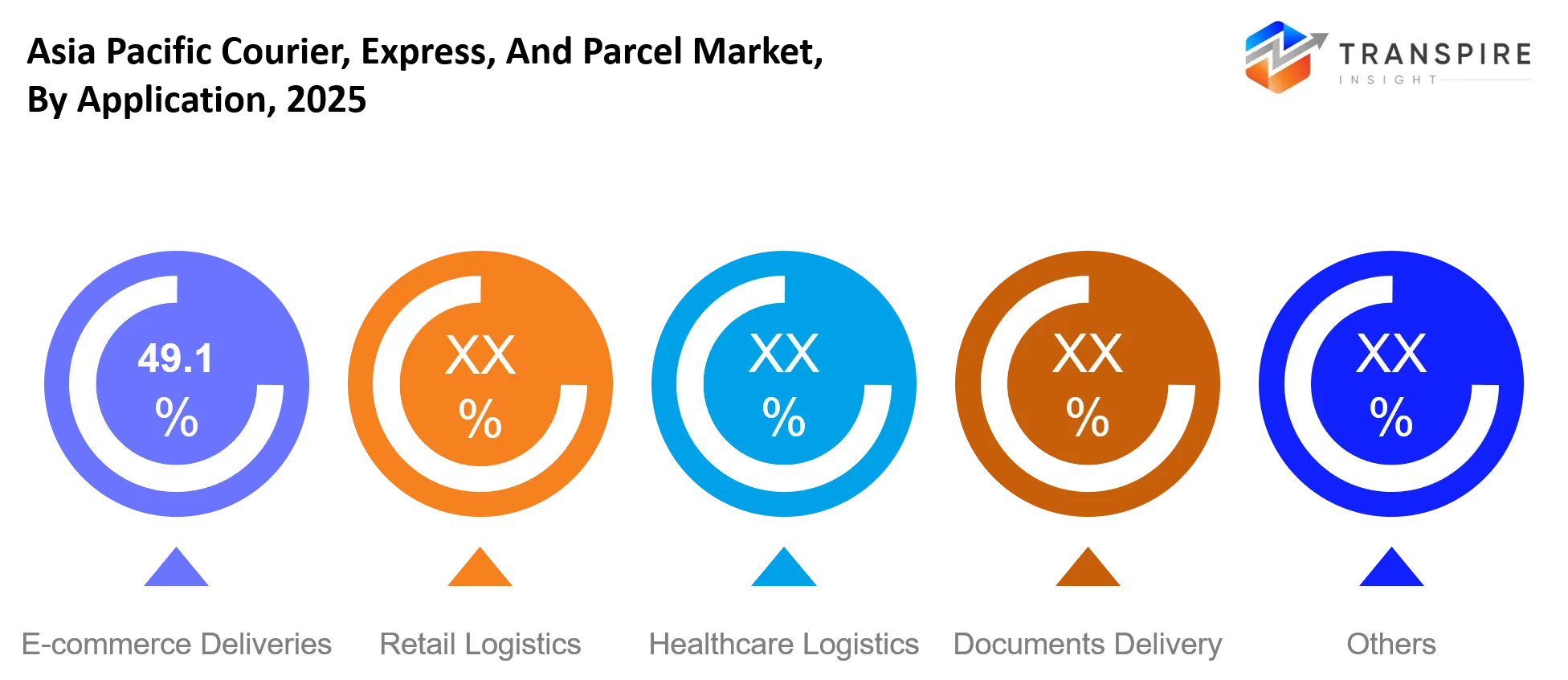
To learn more about this report, Download Free Sample Report
By End User :
E-commerce companies, they kinda represent the biggest end-user group, since online platforms depend a lot on courier networks to do daily order fulfillment. Enterprises, in practice, lean on express services for supply chain coordination, spare parts dispatch, and even inter-branch communication. Individuals tap parcel services for personal shipments and online purchases, and the government sector is more about official document movement plus public service logistics, basically.
Also the way end users behave has shifted, because digital platforms opened up wider access to delivery services. E-commerce companies now try to negotiate integrated logistics agreements, to get better cost efficiency and also faster delivery times. Enterprises tend to care more about reliability and tracking visibility, so operational delays can be reduced. Individual users are also choosing doorstep delivery more often, usually supported by cashless payments and mobile tracking systems, which has in turn strengthened the overall dependence on these services.
What are the Key Use Cases Driving the Asia Pacific Courier, Express, And Parcel Market?
E-commerce fulfillment is still basically the main use case in the Asia Pacific Courier, Express, And Parcel Market because rapid online retail growth needs nonstop, high-frequency parcel movement. Big marketplaces really lean on fast last mile delivery, to satisfy same-day and next-day expectations over dense city populations, almost constantly.
Healthcare logistics and B2B spare parts delivery are also coming up as these secondary use cases, sort of gradually but still noticeable. Hospitals, and pharmaceutical firms depend on time-sensitive transport for medicines and diagnostic supplies, while manufacturers use express networks to cut downtime by getting urgent components faster across regional supply chains.
Newer use cases are starting to show up too, like cross-border SME exports and temperature controlled specialty shipments. Smaller businesses are using courier platforms more and more to connect with international customers via integrated logistics networks. At the same time cold chain parcel services are getting more traction for biotech and specialty food distribution across Asia Pacific trade corridors, and people seem to be adopting it quickly.
|
Report Metrics |
Details |
|
Market size value in 2025 |
USD 213.8 Billion |
|
Market size value in 2026 |
USD 224.3 Billion |
|
Revenue forecast in 2033 |
USD 306.8 Billion |
|
Growth rate |
CAGR of 4.58% from 2026 to 2033 |
|
Base year |
2025 |
|
Historical data |
2021 - 2024 |
|
Forecast period |
2026 - 2033 |
|
Report coverage |
Revenue forecast, competitive landscape, growth factors, and trends |
|
Regional scope |
Asia Pacific (India, China, Japan, Australia,South Korea, Rest of Asia Pacific) |
|
Key company profiled |
DHL, FedEx, UPS, SF Express, Blue Dart, Yamato Holdings, Aramex, Delhivery, JD Logistics, Kerry Logistics, Japan Post, Australia Post, India Post, Ninja Van, J&T Express |
|
Customization scope |
Free report customization (country, regional & segment scope). Avail customized purchase options to meet your exact research needs. |
|
Report Segmentation |
By Service Type (Courier Services, Express Delivery, Parcel Delivery, Same-day Delivery, International Shipping, Others); By Application (E-commerce Deliveries, Retail Logistics, Healthcare Logistics, Documents Delivery, Others); By End User (E-commerce Companies, Enterprises, Individuals, Government Sector, Others) |
Which Regions are Driving the Asia Pacific Courier, Express, And Parcel Market Growth?
Asia Pacific is basically led by China which kind of dominates the Courier, Express, And Parcel Market there, largely because it has a really advanced e-commerce logistics setup and very dense city distribution networks. In general, strong government support for digital commerce plus logistics automation has helped unlock big money into smart warehouses and faster sorting hubs. Also, the existence of major homegrown players like SF Express and YTO Express helps sharpen network efficiency, and coverage too. When ports connect smoothly with better inland transport corridors, parcels can move quickly between manufacturing zones and the places where people buy and use. So this whole ecosystem keeps shipment volumes up most of the time, and it keeps reinforcing China as the regional leader.
Japan sits in the second spot, but it doesn’t really play the same kind of game as China. Here the growth feels more about operational dependability than just pushing volume expansion. The market benefits from logistics practices that are very standardized, plus strong regulatory adherence, and ongoing investment by well-known courier firms. Japan has an aging population and consumption that stays pretty steady, which leads to demand patterns that are predictable rather than sudden surges. Businesses therefore lean into careful delivery execution, service quality, and automation in sorting centers, to keep everything running efficiently. Because of this steadiness Japan turns out to be a reliable revenue contributor even without aggressive scale-up.
Southeast Asia is basically the fastest-growing region , mostly because digital commerce platforms are expanding very quickly and there have been some recent investments in logistics infrastructure across Indonesia , Vietnam, and Thailand. On top of that, governments rolled out trade facilitation reforms and updated customs digitization, this seems to have cut down cross-border clearance delays . Also, new warehouse development plus mobile-first retail adoption has pushed courier penetration further into places that were kinda underserved before. For investors and market entrants this kind of momentum means a solid long-term opportunity from 2026 to 2033, especially around last-mile logistics and cross-border fulfillment networks.
Who are the Key Players in the Asia Pacific Courier, Express, And Parcel Market and How Do They Compete?
The Asia Pacific Courier, Express, And Parcel Market has this kinda moderately consolidated setup, where a handful of global integrators go head to head with really solid regional specialists. The rivalry feels like it is shaped mostly by speed, cost efficiency, and how far the last-mile network actually reaches, not just plain pricing. Big incumbents try to hold on to share with automation plus integrated digital platforms, but the regional players still manage to shake up established routes by pushing faster domestic fulfillment, along with localized service models that fit high-density urban demand.
DHL Group leans into technology-led premium express services, and it uses AI driven route optimization, plus automated hubs, to smooth out cross-border delivery consistency across Asia Pacific corridors. The edge is that its air and ground networks are tightly integrated, so enterprise customers get more predictable transit times. Expansion keeps moving via investments in carbon-efficient air fleet upgrades, and also through partnerships with e-commerce platforms, to boost last-mile visibility. Even small improvements here seem to matter.
FedEx tends to stand out via high-value international express shipments, especially time-definite B2B logistics. Its hub-and-spoke air setup supports faster customs clearance integration, which helps cut down transit variability on long-haul routes. On the other side, United Parcel Service boosts competitiveness with advanced package tracking systems and automated distribution centers, so delivery accuracy improves a lot in dense urban markets, where precision really counts.
SF Express keeps, pretty much, the upper hand in China via thick domestic coverage and a well designed warehouse setup, which helps with same day dispatch at scale. Meanwhile Alibaba Group extends its reach in a less direct way, by weaving logistics into its e-commerce platforms, so purchase demand moves in a more guided manner and there’s less friction between sellers and courier systems. In the end, both companies pick up an edge by governing data visibility, and by steering shipping operations so they match real time consumer buying behavior, kind of like it’s listening in.
Company List
- DHL
- edEx
- UPS
- SF Express
- Blue Dart
- Yamato Holdings
- Aramex
- Delhivery
- JD Logistics
- Kerry Logistics
- Japan Post
- Australia Post
- India Post
- Ninja Van
- J&T Express
Recent Development News
In April 2026, FedEx announced a strategic partnership with Viettel Post to make Viettel Post its National Network Provider in Vietnam. The collaboration strengthens FedEx’s domestic pickup-and-delivery capabilities and improves cross-border express connectivity across Vietnam, enhancing service speed and network efficiency in the Asia Pacific CEP market. Source https://newsroom.fedex.com/
In January 2026, Singapore Post entered an exclusive strategic partnership with SkyNet Worldwide Express in Singapore. The agreement enhances cross-border eCommerce and express parcel services across the Asia Pacific region by combining SingPost’s domestic delivery infrastructure with SkyNet’s international express network.
Source https://www.prnewswire.com/
What Strategic Insights Define the Future of the Asia Pacific Courier, Express, And Parcel Market?
The Asia Pacific Courier, Express, And Parcel Market is moving, more and more, toward fully digitized platform controlled logistics ecosystems over the next 5 to 7 years. Growth won’t be powered just by extra shipment volume, it’ll be driven by those orchestration layers that link e-commerce platforms, warehouse networks, and last mile fleets in real time. So, the operators that will benefit are the ones who can stitch together data visibility across these fragmented delivery routes and turn routing efficiency into revenue uplift, especially via premium time-definite services.
There’s also a risk that is less obvious, like sort of quiet, and it comes from rising dependency on platform concentration where a small number of e-commerce ecosystems increasingly determine parcel flow allocation. Then, if there’s any algorithm change, fee restructuring, or a policy intervention inside these platforms, it can quickly mess with courier profitability and basically lower the bargaining power of logistics providers.
On the flip side, there’s an emerging opportunity in Tier-2 and Tier-3 city micro fulfillment ecosystems. In these setups, localized warehousing paired with predictive demand mapping can shrink delivery time windows in a noticeable way. It’s still early deployment, but it’s gaining some momentum in India and Indonesia. Market participants should focus investment on modular automation systems, plus API driven retail integration, so they can lock in long-term agreements with platform led commerce networks before logistics allocation becomes completely centralized.
Asia Pacific Courier, Express, And Parcel Market Report Segmentation
By Service Type
- Courier Services
- Express Delivery
- Parcel Delivery
- Same-day Delivery
- International Shipping
By Application
- E-commerce Deliveries
- Retail Logistics
- Healthcare Logistics
- Documents Delivery
By End User
- E-commerce Companies
- Enterprises
- Individuals
- Government Sector
Frequently Asked Questions
Find quick answers to common questions.
The Expected Asia Pacific Courier, Express, And Parcel Market size is USD 306.8 Billion in 2033.
Key Segments for the Asia Pacific Courier, Express, And Parcel Market are By Service Type (Courier Services, Express Delivery, Parcel Delivery, Same-day Delivery, International Shipping, Others); By Application (E-commerce Deliveries, Retail Logistics, Healthcare Logistics, Documents Delivery, Others); By End User (E-commerce Companies, Enterprises, Individuals, Government Sector, Others).
Major Asia Pacific Courier, Express, And Parcel Market Players are DHL, FedEx, UPS, SF Express, Blue Dart, Yamato Holdings, Aramex, Delhivery, JD Logistics, Kerry Logistics, Japan Post, Australia Post, India Post, Ninja Van, J&T Express.
The Current Asia Pacific Courier, Express, And Parcel Market size is USD 213.8 Billion in 2025.
The Asia Pacific Courier, Express, And Parcel Market CAGR is 4.58% from 2026 to 2033.
- DHL
- edEx
- UPS
- SF Express
- Blue Dart
- Yamato Holdings
- Aramex
- Delhivery
- JD Logistics
- Kerry Logistics
- Japan Post
- Australia Post
- India Post
- Ninja Van
- J&T Express
About the Authors

Mayur Shinde
I am Mayur Shinde, a Senior Research Analyst at Transpire Insight, specializing in the Automotive & Transportation and Information & Communication Technology (ICT) Industry. My work focuses on analyzing emerging market trends, technological advancements, competitive landscapes, and industry developments to deliver accurate, data-driven insights. I am passionate about transforming complex market information into clear, actionable content that helps businesses, professionals, and decision-makers stay informed and make confident strategic decisions.

Chakradhar Khansole
Chakradhar serves as the Research Director at Transpire Insight, bringing over 8 years of experience in technology, innovation, and strategic market intelligence. He specializes in transforming complex market data into actionable business insights that enable organizations to make informed, growth-oriented decisions. Recognized for his strategic vision and analytical expertise, Chakradhar leads high-impact research initiatives, delivering comprehensive market assessments, competitive intelligence, and forward-looking industry analysis.
Recently Published Reports
-
Apr 2026
ATV & UTV Market
ATV & UTV Market Size, Share & Analysis Report By Type (ATV, and UTV), By Variants (Less Than 400 CC, 400 CC To 800 CC, and More Than 800 CC), and Geography (North America, Europe, Asia-Pacific, Middle East and Africa, South and Central America), 2021 - 2031
-
Apr 2026
Automotive Central Gateway Module Market
Automotive Central Gateway Module Market Size, Share & Analysis Report By Type (Ethernet Central Gateway Module, CAN Central Gateway Module, LIN Central Gateway Module, and FlexRay), By Application (Powertrain Control, Body Control, Infotainment System, Advanced Driver Assistance Systems (ADAS), and Others), By End User (Passenger Vehicles, and Commercial Vehicles), and Geography (North America, Europe, Asia-Pacific, Middle East and Africa, South and Central America), 2021 - 2031
-
Apr 2026
Automotive Engine Oil Filter Market
Automotive Engine Oil Filter Market Size, Share & Analysis Report By Filter Type (Fuel Filter, Engine Oil Filter, Hydraulic Oil Filter, and Others), By Filter Media (Cellulose, Synthetic, and Micro), By Sales Channel (OEMs, and Aftermarket), By Vehicle Type (Passenger Cars, Light Commercial Vehicles, Heavy Duty Trucks, Buses and Coaches, and Off-road Vehicles), and Geography (North America, Europe, Asia-Pacific, Middle East and Africa, South and Central America), 2021 - 2031
-
Apr 2026
Automotive Parts Aluminium Die Casting Market
Automotive Parts Aluminium Die Casting Market Size, Share & Analysis Report By Production Process (Pressure Die Casting, Vacuum Die Casting, Squeeze Die Casting, Gravity Die Casting), By Application (Body Parts, Engine Parts, Transmission Parts, Battery And Related Components, Other Application Types), and Geography (North America, Europe, Asia-Pacific, Middle East and Africa, South and Central America), 2021 - 2031
Our Clients



