

Packaging Equipment Market Summary:
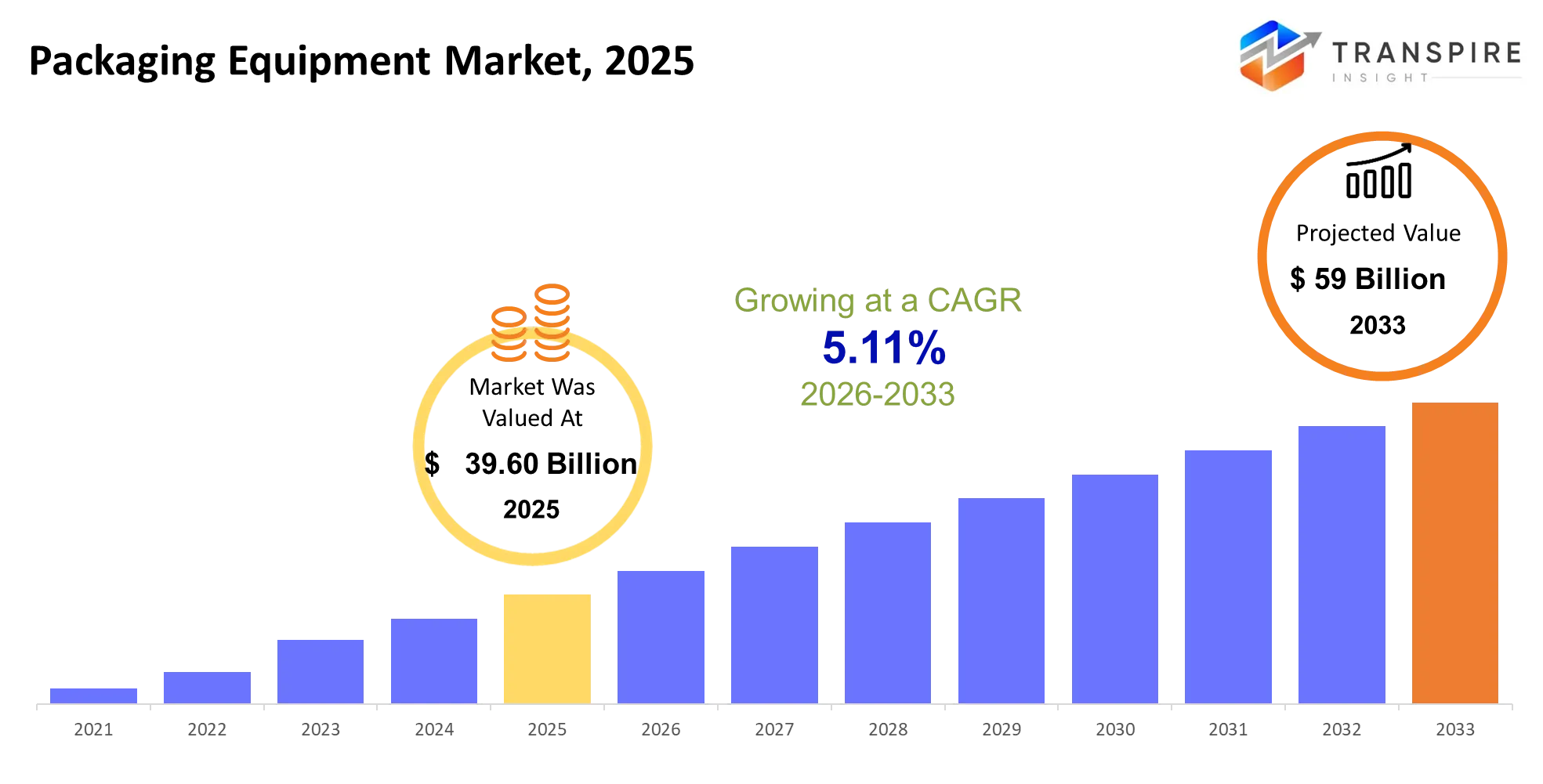
As per Transpire Insight Analysis, the Packaging Equipment Market size is estimated at USD 39.60 billion in 2025 and is anticipated to reach USD 59 billion by 2033, growing at a CAGR of 5.11% from 2026 to 2033.
The packaging equipment market provides manufacturers with automation for steps like filling, forming, sealing, labelling, cartoning, wrapping, inspection and palletising. These functions are used across food, pharmaceutical, personal care and industrial production sectors. In the past three to five years, buyers have shifted from using individual machines to connected lines. This shift has led to higher throughput, improved traceability, faster changeovers and higher labour efficiency. A big change in the industry has been the growing use of robotics and smart controls. These technologies are especially useful for end-of-line tasks that can be automated. One strong driver behind this change is the growth of e-commerce and convenience-focused products. This growth has created a need for flexible packaging formats and quicker production cycles. Manufacturers now face pressure to make products with fewer manual inputs. They also need to control waste and keep package quality consistent. To meet these demands, equipment suppliers are offering automation solutions. They are also providing monitoring tools and modular systems. These systems can adjust easily to changes in product volumes and different types of packaging materials.
Packaging Equipment Market Size & Forecast:
- Market Size 2025: USD 39.60 Billion
- Expected Market Value (2033): USD 59 Billion
- Forecast CAGR (2026–2033): 5.11%
- Leading Region in 2025: Asia Pacific
- Fastest Growing Region: Middle East & Africa
- Key Company Profiles: Krones, Tetra Laval, Syntegon Technology, Coesia, IMA Group, MULTIVAC, Marchesini Group, Sidel, ProMach, KHS Group, OPTIMA, Barry-Wehmiller, Ishida, Duravant, BW Packaging
Key Market Insights:
market is moving towards automation, connectivity, and flexibility in manufacturing processes. Filling machinery continues to be the largest identifiable equipment category, whereas robotics is increasingly being considered due to the need for increased efficiency.
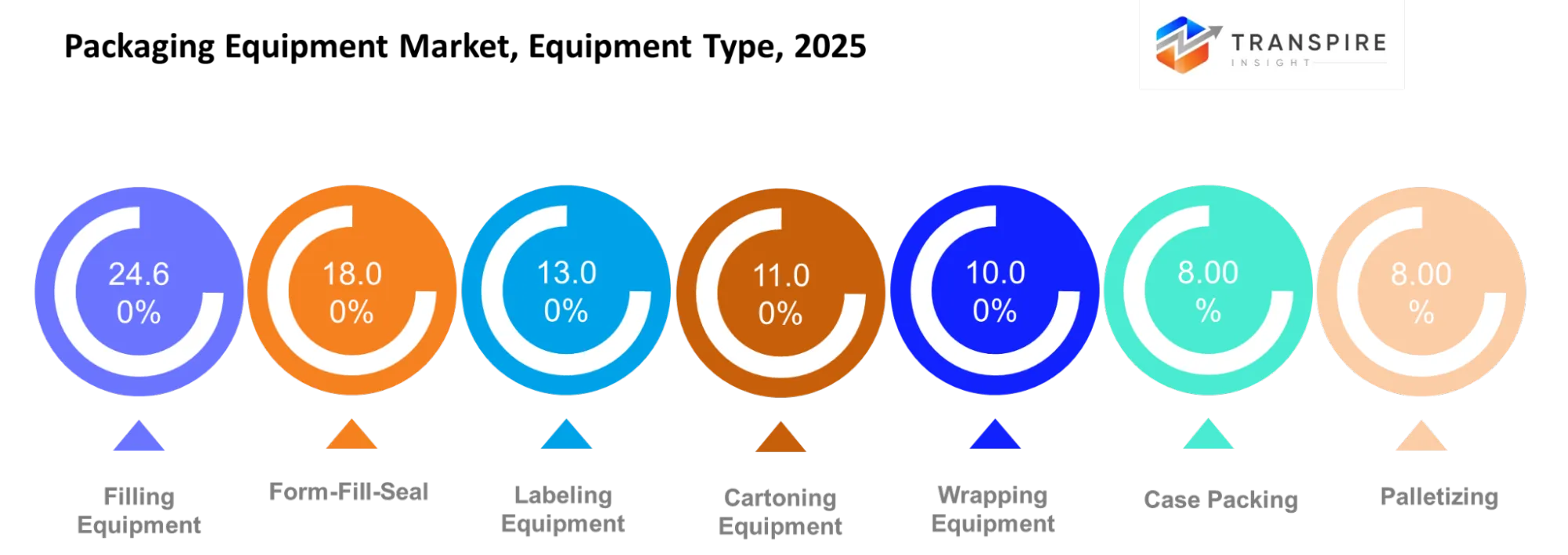
- Filling Equipment constituted a 24.60% share, with equipment manufacturers including MULTIVAC developing equipment for integrating filling and packaging processes, along with focusing on proper dosing.
- Form-Fill-Seal Equipment holds an 18.00% share, where suppliers like Syntegon are developing automated equipment for combining packaging processes.
- Labelling Equipment constituted 13.00% market share, where equipment manufacturers are developing labelling equipment with increased levels of automation and inspection.
- Cartoning Equipment constituted 11.00% market share, where integrated packaging lines are increasingly using integrated cartoning processes with other machinery.
- Wrapping Equipment constituted 10.00% market share, where equipment manufacturers are increasingly developing automated wrapping equipment to adapt to changes in product form factor.
- Case Packing constituted 8.00% market share, with growing demand for automated case packing processes for secondary packaging.
What are the Key Drivers, Restraints, and Opportunities in the Packaging Equipment Market?
Drivers
Automated packaging lines have become an important factor driving the growth of the packaging equipment market. Increased demands for labour and consistency in production have motivated manufacturers to automate processes like filling, sealing, labelling, inspection, and palletising. The increase in e-commerce along with products that are convenient has resulted in manufacturers investing in faster and flexible packaging systems. This has led to higher equipment adoption since manufacturers have been able to increase their production capabilities.
Restraints
The high initial cost factor is restricting the deployment of high-end packaging machines, especially robots and fully automated machines. The limitation continues due to the fact that small manufacturing companies may lack funds, technical knowledge, and facilities to install and maintain sophisticated automated lines. Even the installation of such machines, along with the existing machines, will increase the cost factor.
Opportunities
Modular and interconnected automation is a growth opportunity by helping manufacturers to upgrade specific phases in the production process without the need for upgrading the complete packaging line. Robotic palletising, machine vision technology, predictive monitoring, and digital control can be linked to the existing machines. It will help manufacturers in the Asia Pacific region and other emerging production centres gradually automate their operations.
What Has the Impact of artificial intelligence on the Packaging Equipment Market?
Artificial intelligence will transform packaging machinery through increased responsiveness, measurement, and optimisation. Vision systems driven by AI technology can quickly check packages for quality problems like deformities, incorrect labelling, filling issues, sealing problems, and other production errors. The technology can leverage machine data to recognise any abnormalities related to vibration, temperature, pressure, and cycle, and provide information necessary for performing predictive maintenance of machines before the breakdown halts operations. Automated packaging lines can benefit from AI systems through optimisation of machine settings, product handling, sequencing, and changeovers, improving production capacity and minimising waste due to materials and unexpected machine downtime. The technology proves to be particularly helpful in the cases of working with several packaging formats or maintaining high-quality standards in large production volumes. Moreover, AI can facilitate better decision-making by transforming data about machine operations and production into insightful performance reports. There are a number of obstacles on the way to using the technology, including high costs of sensors, software, connectivity, and overall system integration. Moreover, older machines might generate insufficient or inaccurate data.
Instance
In April 2026, MULTIVAC unveiled an AI-assisted TX traysealer line during interpack 2026. The technology features AI-powered product recognition along with intelligent labeling and inspection to recognize different products and apply the right labels to them. This indicates that AI is being incorporated into packaging machines in order to increase efficiency of automation and inspection processes.https://multivac.com/ua/uk/company/news/interpack-ai-supported-traysealer-line
Key Market Trends:
Trends in the packaging machinery market are now moving away from standalone machines towards networked manufacturing systems. Equipment choices are balancing automation, flexibility, sustainability, and visibility for the manufacturer.
- Packaging lines have evolved from individual machines to integrated systems that incorporate filling, sealing, labelling, inspection, and end-of-line functions.
- Robotic automation has evolved from being used in big plants to being a sought-after means of decreasing manual labour by reducing repetitive operations.
- Machine vision is increasingly integrated into packaging machinery, enabling inspection to be done during production and not after the process.
- Machinery buyers have become more interested in quick machine changeover due to wider product ranges and varying production batches.
- Connectivity has evolved from an option to a necessity because it is used to monitor equipment performance and production data.
- Efficiency in terms of material usage, low energy consumption, and recyclable packaging materials is gaining importance in packaging machinery design.
- Predictive maintenance has become relevant due to efforts to decrease unplanned shutdowns and improve equipment longevity.
Packaging Equipment Market Segmentation
By Equipment Type
Filling Equipment holds the largest share with 24.60%, while Form-Fill-Seal Machines account for 18.00%, Labelling Machines for 13.00%, Cartoning Machines for 11.00%, Wrapping Machines for 10.00%, Case Packing Machines for 8.00%, Palletising Equipment for 8.00%, and Inspection Equipment for 7.40%. Filling machines get a boost due to their versatile nature of use within the categories of food and beverages, medicines, personal care products, and industrial products. Future trends of this segment will be more focused on accuracy, speed, flexibility, and automation.
By Packaging Type
bottles, pouches, cartons, cans, trays, bags, boxes, and containers indicate varying equipment needs in the course of manufacturing operations. Bottles and containers will need precise filling and sealing, whereas pouches offer possibilities of form-fill-seal solutions. Cartons, boxes, and trays are suitable for use in secondary packaging operations wherein cartoning, wrapping, case packing, and palletising equipment may be employed. The future need is going to be for machinery able to deal with different formats without requiring much time for production changeover.
By Automation
manual and semi-automatic systems are still suitable for those operations where there is not enough production volume or investment, while automatic and robotic systems are appropriate when high production volume is needed. Integrated systems, intelligent packaging systems, and equipment involving artificial intelligence go further in automation, from physical machine management up to monitoring and optimisation of the process.
By End User
Food and beverages continue to be an important field of application for the industry since food producers need to package their products quickly. Pharmaceuticals and personal care are more concerned with the issues of accuracy and quality control as well as safety and controlled handling, whereas chemicals, consumer goods, e-commerce, industrial goods, and electronics need certain levels of protection, speed, and flexibility. This variety of applications allows equipment manufacturers to build industry-specific machines instead of one universal machine.
By Operation
Filling, sealing, wrapping, labelling, coding, sorting, inspecting, and palletising each cover a particular operation within the packaging process. More and more companies try to integrate such processes to make data and the movement of materials transfer from one stage to another smoother. In such a case, future equipment development will be focused on coordinated operations rather than separate processes.
By Sales Channel
Direct sales and OEM agreements continue to be significant in major projects that require a highly technical approach, while distributors and dealers help manufacturers serve regional customers. The growing relevance of system integration is seen as manufacturers require fully automated systems rather than individual machines. The web sales and after-sales channels can also be used for spare parts, accessories, services and small equipment. The opportunity for the future comes from equipment sales together with installation, software, maintenance, training and servicing.
What are the Key Use Cases Driving the Packaging Equipment Market?
A use case is high-volume filling and dosing that correlates with the dominant Filling Equipment that requires accuracy and repeatability in product filling. Other uses by manufacturers include form-fill-seal, labelling, cartoning, wrapping, and case packing to accommodate wide product variety, small batch sizes, and rapid restocking. Food and beverage companies utilise these systems in convenience food products, while pharmaceuticals and personal care companies utilise filling, inspection, coding, and labelling for quality control and traceability purposes. The new applications include robotic packaging, intelligent inspection, flexible changeover, and end-of-line automation for eCommerce, electronic, and industrial products.
|
Report Metrics |
Details |
|
Market size value in 2025 |
USD 39.60 Billion |
|
Market size value in 2026 |
USD 41.62 Billion |
|
Revenue forecast in 2033 |
USD 59 Billion |
|
Growth rate |
CAGR of 5.11% from 2026 to 2033 |
|
Base year |
2025 |
|
Historical data |
2021 - 2024 |
|
Forecast period |
2026 - 2033 |
|
Report coverage |
Revenue forecast, competitive landscape, growth factors, and trends |
|
Regional scope |
United States; Canada; Mexico; United Kingdom; Germany; France; Italy; Spain; Denmark; Sweden; Norway; China; Japan; India; Australia; South Korea; Thailand; Brazil; Argentina; South Africa; Saudi Arabia; United Arab Emirates |
|
Key company profiled |
Krones, Tetra Laval, Syntegon Technology, Coesia, IMA Group, MULTIVAC, Marchesini Group, Sidel, ProMach, KHS Group, OPTIMA, Barry-Wehmiller, Ishida, Duravant, BW Packaging |
|
Customization scope |
Free report customization (country, regional & segment scope). Avail customized purchase options to meet your exact research needs. |
|
Report Segmentation |
Equipment Type (Filling Equipment, Form-Fill-Seal Machines, Labeling Machines, Cartoning Machines, Wrapping Machines, Case Packing Machines, Palletizing Equipment, Inspection Equipment); Packaging Type (Bottles, Pouches, Cartons, Cans, Trays, Bags, Boxes, Containers); Automation (Manual, Semi-Automatic, Automatic, Robotic, Fully Integrated, Smart Packaging, AI-Enabled); End User (Food & Beverage, Pharmaceuticals, Personal Care, Chemicals, Consumer Goods, E-Commerce, Industrial, Electronics); Operation (Filling, Sealing, Wrapping, Labeling, Coding, Sorting, Inspection, Palletizing); Sales Channel (Direct Sales, Distributors, Dealers, System Integrators, Online Sales, OEM Partnerships, Aftermarket) |
Which Regions are Driving the Packaging Equipment Market Growth?
North America
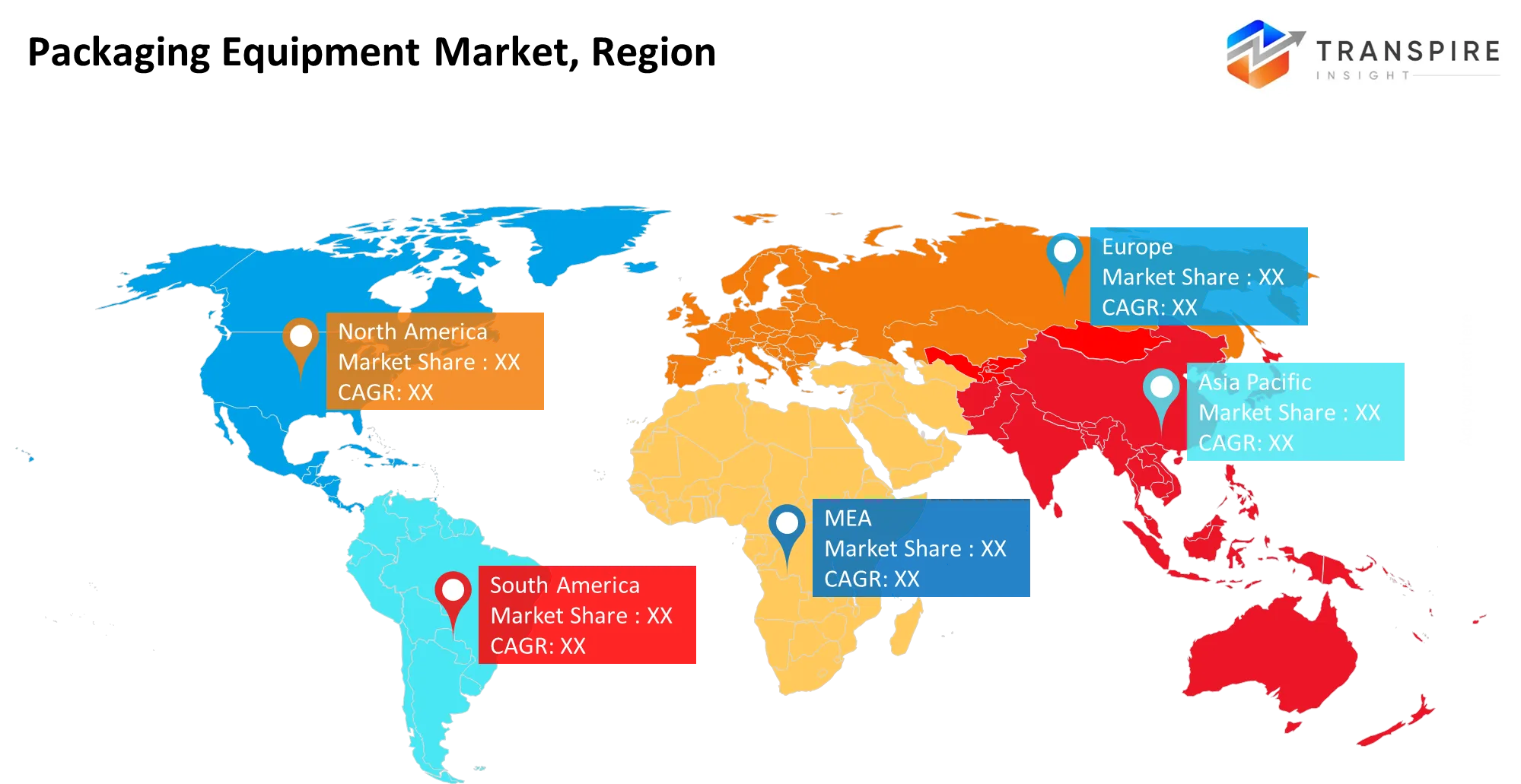
North America constitutes 24.00% of the world’s packaging equipment market and has a developed food and beverage, pharmaceutical and consumer goods manufacturing industry. North America has a developed automation industry enabled by advanced facilities, existing equipment providers and investment in efficiency improvements. There is also demand driven by companies looking for automated, integrated and supported solutions. Its developed industry ensures the stability of the market as companies renew their older packaging lines through the installation of robotic, inspection and digital technologies.
In September 2026, BW Packaging made an announcement that it will be exhibiting an integrated packaging line at PACK EXPO International 2026 held in Chicago. This line includes bag filling, sealing, labeling, case erecting, robotic case packing, and robotic palletizing. It reflects the increasing trend of integrated automation systems in packaging.https://www.bwpackaging.com/about/news/2026/09/25/at-pack-expo-international--bw-packaging-is-expanding-manufacturing-capability
Europe
Europe constitutes 29.00% of the world’s market and the advantages of developed machinery production and packaging technology. The region has been maintaining its demand for equipment that will improve the efficiency of production along with solving the issues of material usage, energy consumption and packaging sustainability. Companies are looking at the possibility of having flexible machinery for handling recyclable materials and different package forms.
In September 2026, ULMA Packaging UK made an announcement about demonstration of five packaging machines at the PPMA Show 2026 which will be held in Birmingham. It includes tray sealing, thermoforming, horizontal flow wrapping, and vertical bagging machines. In addition to it, ULMA also mentioned their integrated systems such as automatic loading, inspection, case packing, and end-of-line automation.https://www.ulmapackaging.co.uk/en/news/ppma-2026
Asia Pacific
The Asia Pacific region holds the largest share at 35.80% in the regional market due to increased activities in manufacturing, food processing, consumer goods manufacturing, and investments. There is increased need for automation of filling machines, labelling machines, cartoning machines, and other end-of-line machines in light of increased production capacities in the respective countries. Manufacturers are also beefing up their local service, manufacturing, and technical support capacity to cope with their increased demands. There is a great opportunity for the future, with automation giving way to robotics and connectivity.
In September 2026, Shubham Automation announced an end-to-end packaging automation solution for Anuga FoodTec India 2026 in Mumbai. They are showcasing the integrated systems from inspection to finished shipper case, including bottles, jars, carton, pouches, tubes, and sachets.https://themachinemaker.com/show-reports/shubham-automation-to-present-end-to-end-packaging-automation-at-anuga-foodtec-india-2026/
Who are the Key Players in the packaging equipment market and how do they compete?
Competition in the market of packaging equipment is more and more associated with automation levels, line integration, servicing capacities, and adaptability to new package formats. Enterprises have been moving from the sale of single machines to the production of solutions, including primary and secondary packaging, inspection, robotics, software, and lifetime maintenance services. Syntegon focuses on its integrated packaging lines, flexibility of equipment, and servicing programs aimed at reliability and efficiency improvements, whereas the products' development of Syntegon indicates its attention to connected and sustainable machinery. The portfolio of MULTIVAC consists of solutions for packaging, processing, automation, labelling, inspection, and medical industries, and is backed up by investments into production and logistics capacities. Coesia is developing its competences in digital and smart manufacturing with the help of software integration and automation acquisitions, while at the same time developing robotics in packaging. Duravant follows the strategy of portfolio extension, which includes the acquisition of Pattyn company and increasing its capabilities of automation in bulk and industrial packaging.
Packaging Equipment Market companies
- Krones
- Tetra Laval
- Syntegon Technology
- Coesia
- IMA Group
- MULTIVAC
- Marchesini Group
- Sidel
- ProMach
- KHS Group
- OPTIMA
- Barry-Wehmiller
- Ishida
- Duravant
- BW Packaging
Recent Development News
In April 2026, MULTIVAC launched its RX Ultimate thermoforming packaging machine for Interpack 2026 with multi-sensor control, online connectivity, modular design, and matrix heating technology to enhance process reliability while enabling recyclable films and reduced material usage.https://multivac.com/ae/en/company/news/interpack-rx-ultimate
In July 2025, Coesia took control of the majority shares in Autoware, an industrial software integrator that focuses on manufacturing execution systems MES, manufacturing operations management, and supervisory control and data acquisition SCADA solutions.https://www.coesia.com/en/news/coesia-announces-a-strategic-partnership-with-autoware
What Strategic Insights Define the Future of the Packaging Equipment Market?
The packaging machinery industry will shift towards connectivity, flexibility, and automation rather than stand-alone machinery. Manufacturers will favour machines that support multi-format packaging, provide production data, and connect to robotics, inspection, and plant control software systems without having to change their production lines completely. An unseen threat is integration complexity arising from old machines, separate controls, and varied production data, slowing digitalisation processes. There is a rising trend in modular automation for manufacturers willing to transform their production stages one at a time, especially in rapidly industrialising countries. This trend can be tapped by packaging equipment suppliers through scalable robotic cells, inspection solutions, predictive maintenance, and on-site technical assistance. Investments in this trend should go to interoperability, support services, flexibility in machine designs, and software in addition to mechanics. This way, suppliers can meet demands due to labour shortages, shorter production cycles, environmental sustainability, and reliable, fast-speed packaging processes.
Equipment Type
- Filling Equipment
- Form-Fill-Seal Machines
- Labeling Machines
- Cartoning Machines
- Wrapping Machines
- Case Packing Machines
- Palletizing Equipment
- Inspection Equipment
Packaging Type
- Bottles
- Pouches
- Cartons
- Cans
- Trays
- Bags
- Boxes
- Containers
Automation
- Manual
- Semi-Automatic
- Automatic
- Robotic
- Fully Integrated
- Smart Packaging
- AI-Enabled
End User
- Food & Beverage
- Pharmaceuticals
- Personal Care
- Chemicals
- Consumer Goods
- E-Commerce
- Industrial
- Electronics
Operation
- Filling
- Sealing
- Wrapping
- Labeling
- Coding
- Sorting
- Inspection
- Palletizing
Sales Channel
- Direct Sales
- Distributors
- Dealers
- System Integrators
- Online Sales
- OEM Partnerships
- Aftermarket
By Regional Analysis
North America
- US
- Canada
- Mexico
Europe
- Germany
- UK
- France
- Italy
- Spain
- Russia
- Rest of Europe
Asia Pacific
- China
- Japan
- India
- South Korea
- Australia
- Rest of Asia Pacific
South America
- Brazil
- Argentina
- Rest of South America
Middle East & Africa
- UAE
- Saudi Arabia
- Qatar
- South Africa
- Rest of the Middle East & Africa
Frequently Asked Questions
Find quick answers to common questions.
The packaging equipment market size was valued at USD 39.60 billion in 2025 and is poised to reach USD 59 billion by 2033, expanding at a 5.11% CAGR.
Key segments for the packaging equipment market are Equipment Type (Filling Equipment, Form-Fill-Seal Machines, Labeling Machines, Cartoning Machines, Wrapping Machines, Case Packing Machines, Palletizing Equipment, Inspection Equipment); Packaging Type (Bottles, Pouches, Cartons, Cans, Trays, Bags, Boxes, Containers); Automation (Manual, Semi-Automatic, Automatic, Robotic, Fully Integrated, Smart Packaging, AI-Enabled); End User (Food & Beverage, Pharmaceuticals, Personal Care, Chemicals, Consumer Goods, E-Commerce, Industrial, Electronics); Operation (Filling, Sealing, Wrapping, Labeling, Coding, Sorting, Inspection, Palletizing); Sales Channel (Direct Sales, Distributors, Dealers, System Integrators, Online Sales, OEM Partnerships, Aftermarket)
Growth is primarily driven by increasing demand for automatic packaging, the growing popularity of the food and beverage industry, expansion of e-commerce, an increase in pharmaceutical products, and smart packaging technology.
The market is led by major manufacturers including Krones, Tetra Laval, Syntegon Technology, Coesia, IMA Group, MULTIVAC, Marchesini Group, Sidel, ProMach, KHS Group, OPTIMA, Barry-Wehmiller, Ishida, Duravant, BW Packaging
The Asia-Pacific region represents a 35.80% stake in the worldwide packaging equipment industry on the strength of fast industrialisation, growth in the food & beverages sector, pharmaceutical manufacturing, and the use of automation in packaging.
The commercial opportunities available in this sector include increased demand for automation and intelligent packaging machinery, growing usage of artificial intelligence in packaging, growth in e-commerce packaging, and increased demand for sustainable and flexible packaging.
- Krones
- Tetra Laval
- Syntegon Technology
- Coesia
- IMA Group
- MULTIVAC
- Marchesini Group
- Sidel
- ProMach
- KHS Group
- OPTIMA
- Barry-Wehmiller
- Ishida
- Duravant
- BW Packaging
About the Authors

Kartik bhong
I am Kartik Bhong, a Senior Research Analyst at Transpire Insight, specializing in the Packaging, Manufacturing, and Construction industry. My work focuses on analyzing market trends, emerging technologies, industry regulations, and competitive landscapes to deliver accurate, data-driven insights. I am passionate about transforming complex industry information into clear, practical content that helps businesses, professionals, and decision-makers stay informed and make confident strategic decisions. Through continuous research and a strong commitment to accuracy, I strive to create reliable, well-researched content that reflects the latest developments across these dynamic industries and supports the vision of Transpire Insight in delivering valuable market intelligence.

Chakradhar Khansole
Chakradhar serves as the Research Director at Transpire Insight, bringing over 8 years of experience in technology, innovation, and strategic market intelligence. He specializes in transforming complex market data into actionable business insights that enable organizations to make informed, growth-oriented decisions. Recognized for his strategic vision and analytical expertise, Chakradhar leads high-impact research initiatives, delivering comprehensive market assessments, competitive intelligence, and forward-looking industry analysis.
Recently Published Reports
-
Apr 2026
Pharmaceutical Cold Chain Packaging Market
Pharmaceutical Cold Chain Packaging Market By Material (Plastic,(Polyethylene (PE), Polypropylene (PP), Polyethylene Terephthalate (PET), Expanded Polystyrene (EPS), Polyurethane (PU),Others), Paper, Metal, Others), By Product (Small Boxes, Pallets, Large Sized Pallet Containers, Others), By End Use (Biopharmaceutical Companies, Clinical Research Organizations, Hospitals, Research Institutes, Logistics and Distribution Companies, Others)”, By Industry Analysis, Size, Share, Growth, Trends, and Forecasts 2026-2033
-
Apr 2026
Active & Intelligent Packaging Market
Active & Intelligent Packaging Market By Type (Active Packaging, Smart Packaging), By Material (Polymer-Based, Paper & Board-Based, Metal-Based, Glass-Based), By Technology (Time-Temperature Indicators, Freshness Indicators, RFID, Antimicrobial Packaging, Modified Atmosphere Packaging), By Application (Food & Beverages, Pharmaceutical, Cosmetics & Personal Care, Electronics & Consumer Goods, Others), By Industry Analysis, Size, Share, Growth, Trends, and Forecasts 2026-2033
-
Apr 2026
Biodegradable Cut Flower Packaging Market
Biodegradable Cut Flower Packaging Market By Material Type (Paper & Paperboard, Biodegradable Plastics, Natural Fibers, Molded Pulp, Others), By Product Type (Sleeves, Wraps, Boxes & Cartons, Bags & Pouches, Inserts & Holders), By Application (Roses, Carnations, Tulips, Chrysanthemums, Mixed Flowers, Others) and By Distribution Channel (Direct Sales, Distributors & Wholesalers, Online Channels), By Industry Analysis, Size, Share, Growth, Trends, and Forecasts 2026-2033
-
May 2026
Pharmaceutical Packaging Market
Pharmaceutical Packaging Market By Material Type (Plastic, Glass, Metal, Paper & Paperboard, Others), By Packaging Type (Bottles, Blister Packs, Vials, Ampoules, Pouches & Sachets, Others) and By End User (Hospitals & Clinics, Retail Pharmacies, Online Pharmacies, Pharmaceutical Manufacturers), By Industry Analysis, Size, Share, Growth, Trends, and Forecasts 2026-2033