

Japan Food Wrapping Paper Market Summary:
According to Transpire Insight, a detailed research report on the market reflects that the food and beverages application segment dominates the Japan Food Wrapping Paper Market, accounting for approximately 60% of the total share in 2025. Oji Holdings Corporation is a leading participant in Japan’s paper and packaging industry, generating approximately USD 12.4 billion in net sales in March 2025 and maintaining substantial capabilities in packaging papers, sustainable packaging, and paper-based food packaging solutions, supporting market development, innovation, advanced food wrapping paper production, expanding manufacturing capabilities, and growth dynamics.
Market Snapshot
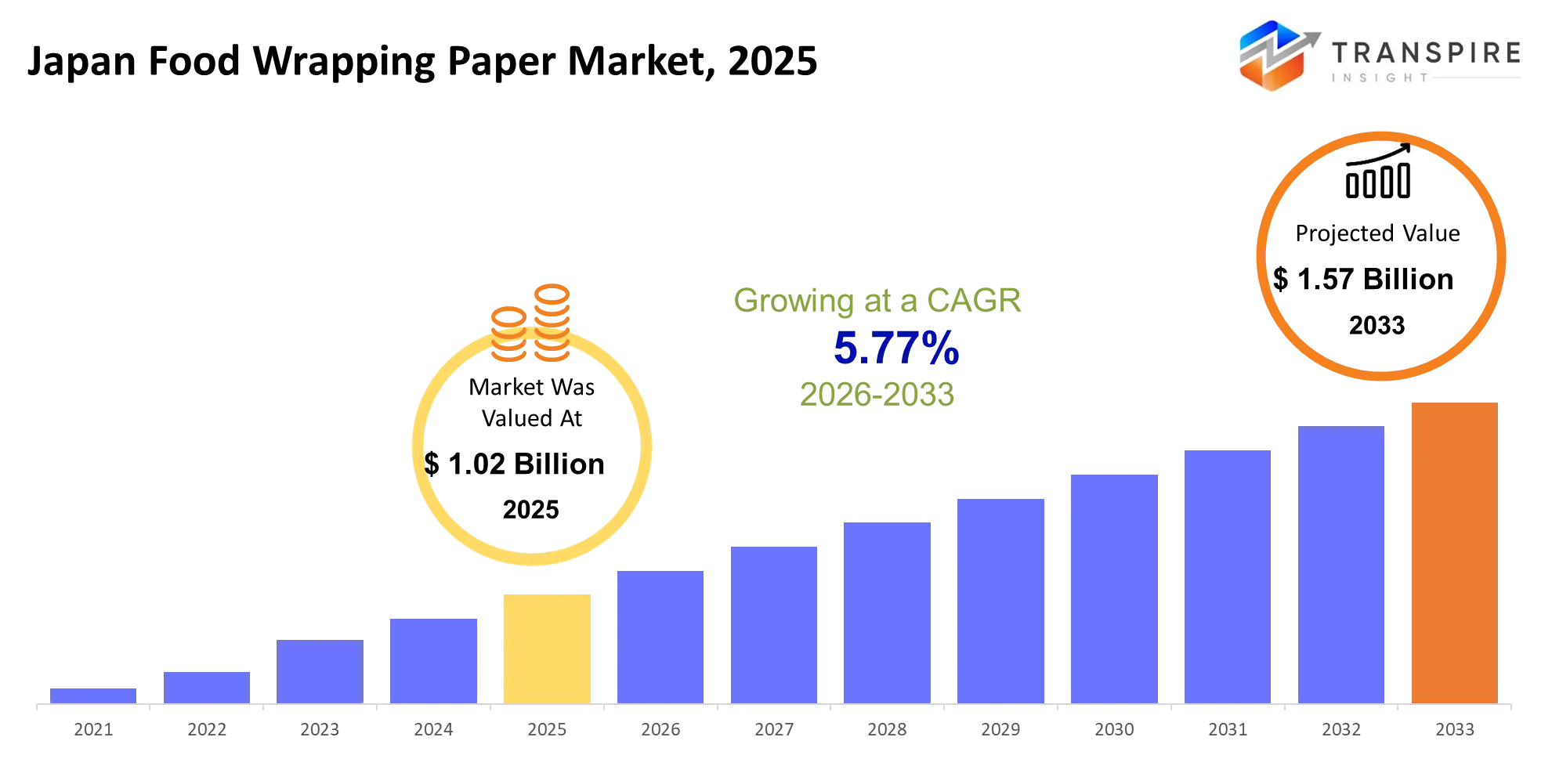
- Market Value (2025): USD 1.02 Billion.
- Expected Market Value (2026): USD 1.06 Billion.
- Estimated Market Value (2033): USD 1.57 Billion.
- Forecast CAGR (2026–2033): 5.77%
Introduction
The food wrapping paper market entails an industry chain of suppliers who provide the supply of paper products like greaseproof papers, glassine, parchment paper, and wax paper used in food contact. Such materials ensure that there is food hygiene, no leakage of grease or moisture, prolongation of food shelf-life, and environmental friendliness to meet the consumers' needs. Paper and board products meant for safe contact with foods without transmitting any toxic substances, ensuring food safety and hygiene. Some of the common products include greaseproof papers, parchment papers, and wax papers. The food wrapping paper industry of Japan provides cutting-edge solutions that ensure food safety, functionality, and sustainability. Barrier Properties: Grease and moisture proofing ensures quality protection of food products as well as protection against any kind of contamination from outside as well as migration of any substance inside the food. Health & Safety Regulations Compliance: Food grade material for packaging food products to ensure compliance with health and safety standards. Environmentally Friendly & Sustainable Solutions: Recyclable, biodegradable, and compostable paper solutions catering to increasing environmental concerns as well as reducing dependency on traditional plastics. Functional Properties: Specialized food wrapping paper can offer heat resistance and durability as per specifications.
Key Market Highlights: -
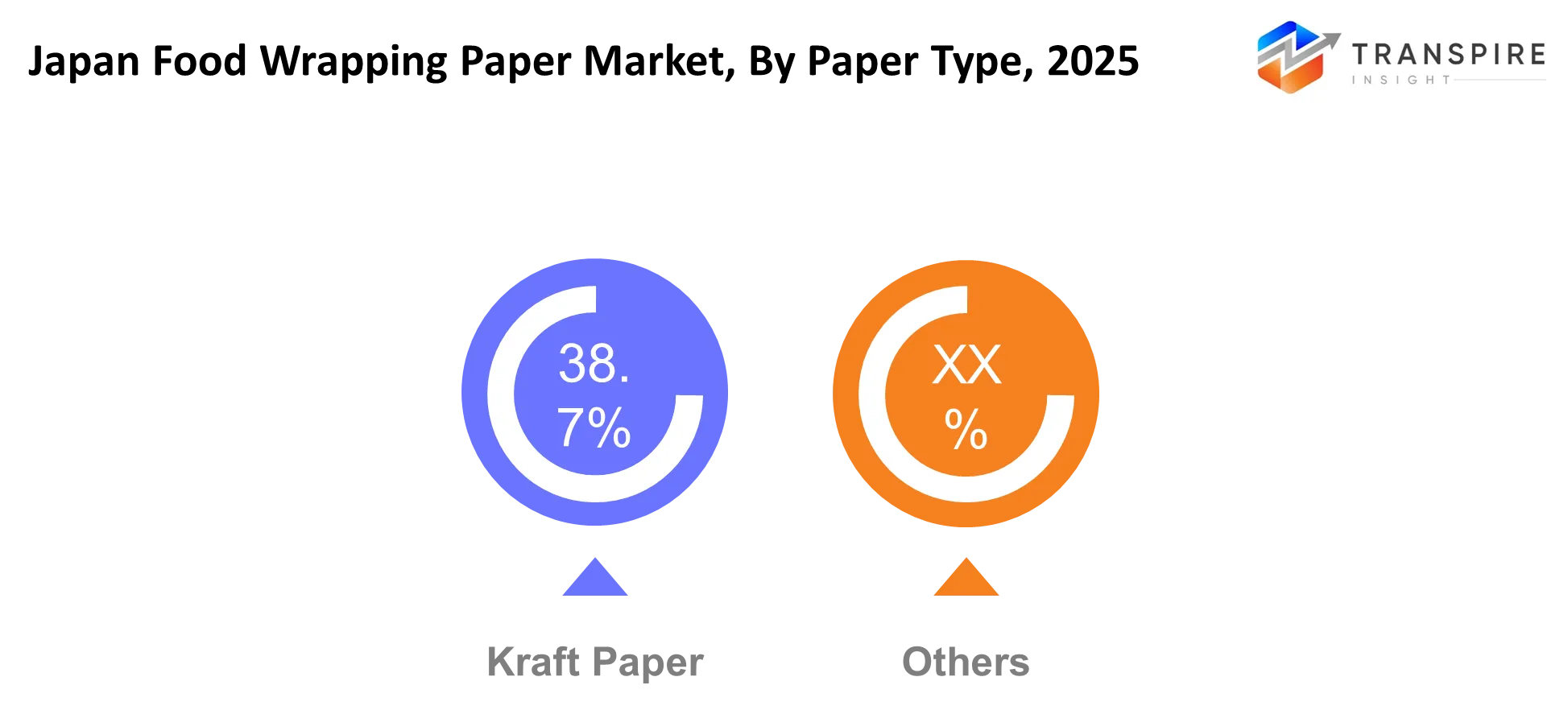
- By paper type, the Kraft Paper segment dominated the market and holds nearly 39% share in 2025 and is projected to grow at a substantial CAGR during the forecast period.
- By application, the Bakery segment dominated the market and holds nearly 34% share in 2025 and is projected to grow at a substantial CAGR during the forecast period.
- By end user, the Household Consumers segment dominated the market and holds nearly 62% share in 2025 and is projected to grow at a substantial CAGR during the forecast period.
- The Plastic Resources Recycling Act of Japan: The Plastic Resources Recycling Act of Japan is a law that aims at encouraging the reduction of designated plastic products that are used only once and their recycling, in addition to using other sustainable sources like paper or other renewable materials. This contributes to sustainable food packaging and provides favorable circumstances for food wrapping papers.
How is Technology Driving Growth in the Japan Food Wrapping Paper Market?
Japanese food wrapping paper packaging industry is making progress through sustainable material innovations and smart manufacturing technology. Sustainable Material Innovations involve biodegradable and compostable paper substrates, sustainable and renewable material substitutes to single use plastics, as well as advanced barrier coatings that provide grease and moisture resistance while promoting recycling. All these developments are in line with the regulatory policies of the Japanese environmental protection agencies and the goals of the circular economy of the country. Smart manufacturing and industry 4.0 involves robotics, Internet of Things, artificial intelligence, and digital twins that will facilitate increased productivity, quality controls and supply chain traceability. Leading automation technologies also assist companies in overcoming labor challenges.
Market Drivers
The growth in the market of food wrappers in Japan stems from the presence of strict laws regarding food safety and the need to use greaseproof, non-toxic, durable, and food contact compliant paper products. Consumer awareness about the importance of sustainable environment, together with efforts of the Japanese government to implement principles of circular economy, is leading to increased usage of recyclable and biodegradable packaging. Additionally, the rise in the number of quick-service restaurants, convenience stores, takeaway foods, and food delivery platforms has boosted demand for disposable food wrapping products. There is strong sustainability, performance, and manufacturing strength within Japan’s food wrappers market. High Sustainability & Ecological Compliance: Recyclable and biodegradable paper based solutions are highly compliant with the increasing environmental regulations as well as consumer demand for sustainable food wrappers. High Protection and Quality: Highly innovative barrier coating solutions provide protection against water, grease, and oxidation without compromising on the quality of the food. High Convenience and Innovation: Easy to open, tear apart, and portion based packaging is a major benefit in the field of convenience foods, bakery, and takeaway products.
Restrain
The Japan food wrappers market encounters problems such as high cost of production due to the use of eco-friendly material and barriers. High costs related to compliance with food contact laws, demographic shrinkage, and market maturity limit the internal growth. There is a technical problem that makes it hard to achieve resistance to grease, moisture, tear resistance, and recyclability simultaneously. Competition from plastic films and other packaging forms also influences pricing.
|
Driver |
Relative Impact on Growth (%) |
Geographic Relevance |
Impact Timeline |
Demand Strength |
Growth Mechanism |
Key Beneficiaries |
Major Constraint |
|
Driver 1 – Shift Toward Sustainable Paper-Based Food Packaging |
28% |
Nationwide; strongest in Kanto and Kansai |
Long-term (≥4 years) |
High |
Replaces plastic-heavy formats with recyclable paper solutions |
Paper converters, food brands, retailers, packaging suppliers |
Higher costs for barrier-treated paper structures |
|
Driver 2 – Expansion of Takeaway, Convenience Food, and Foodservice Packaging |
25% |
Nationwide; strongest in Tokyo, Osaka, and major cities |
Medium-term (2–4 years) |
High |
Increases demand for wraps across prepared-food applications |
Foodservice operators, convenience stores, paper converters |
Labor shortages and volatile foodservice operating costs |
|
Driver 3 – Advances in Grease-, Moisture-, and Heat-Resistant Paper Technology |
18% |
Nationwide; strongest near manufacturing clusters |
Medium-term (2–4 years) |
High |
Improves paper performance for demanding food applications |
Coating suppliers, paper mills, converters, food manufacturers |
Coating complexity can reduce recyclability and raise costs |
|
Driver 4 – Food-Loss Reduction and Shelf-Life Preservation Requirements |
16% |
Nationwide; strong across retail and foodservice |
Long-term (≥4 years) |
Medium |
Functional wrapping helps preserve freshness and reduce waste |
Food producers, retailers, packaging technology providers |
Performance requirements may increase material consumption |
|
Driver 5 – Recycling Infrastructure and Food-Packaging Regulatory Compliance |
13% |
Nationwide; strongest where collection systems mature |
Short-term (≤2 years) |
Medium |
Encourages compliant, recyclable packaging material adoption |
Recyclers, paper manufacturers, converters, food companies |
Collection gaps and contamination complicate recycling economics |
Analysis of Prices and Consumer Behaviour
The market of Japan Food Wrapping has been majorly serving its customers through paper-based food wrapping products (56.07% share of Japan food-wrap market in 2024) which is largely because of the need for eco-friendly, recyclable, and food-safe packaging. The cost of high-quality food wrapping paper with barrier coating technology is significantly higher than the normal paper products given that these solutions use sophisticated coating technologies that provide resistance against grease, moisture, and oil, while remaining safe for food applications. The pouch segment accounted for around 46% of the flexible paper food packaging market of Japan in 2025 which indicates the demand for simple and light-weight paper packaging. The production volume is driven by the use of paper packaging in foodservice, retail, convenience, bakery, snack, and other types of packaged foods. Given the demands of convenience food culture and many ready-to-eat items in Japan, the food and beverage sector accounted for nearly 60% of the flexible paper packaging market in 2025. Consumers are gradually becoming more aware of sustainability and food safety, recycling potential of the products, and the ability of the package to provide barrier function against external agents.
Who are the Key Players in the Japan Food Wrapping Paper Market and how do they compete?
The international market of food packaging foil is typically dominated by companies that have expertise in specialized paper-making technology, production of quality food-grade paper, environment-friendly packaging materials, and creation of productive wrapping paper solutions for the catering, retail industry, flour and pastry products, candies, take-out food, as well as packaged products. Such companies don't only compete via their pricing strategies but are also quite strong due to their capabilities in producing quality paper while providing barrier properties, ability to print on paper, resistance to oil and moisture, recyclability, and scalability of their production. Therefore, competitive strategy enables innovative improvement of the products.
Such companies as Nippon Paper Industries, Oji Holdings, and Rengo become more competitive by developing unique wrapping papers for food, sustainable packaging solutions, and special technologies for converting and coating of paper. They are able to succeed in creation of superior coated, waterproof, greaseproof, and recyclable wrapping paper products which makes them stand out from competitors. Oji company has very solid advantages over its competitors by using modern paper and packaging materials produced and marketed by it. Nippon Paper company is also steady in its position thanks to creation of special food-grade.
Top Companies in the Japan Food Wrapping Paper Market
- Oji Holdings
- Nippon Paper Industries
- Rengo
- Daio Paper
- Hokuetsu Corporation
- Mitsubishi Paper Mills
- Tokushu Tokai Paper
- Lintec
- Toppan
- Dai Nippon Printing
- Fujimori Kogyo
- Marubeni
- Sealed Air
- Mondi
- Huhtamaki
|
Company |
Est. Revenue Share Range |
Key Offerings |
Strategic Positioning |
Geographic Strength |
Technology Focus |
|
Oji Holdings Corporation |
12–16% (Estimated) |
Packaging paper; greaseproof paper; SILBIO; O-hajiki non-fluorine greaseproof paper |
Market leadership through integrated paper packaging capabilities |
Japan, Asia Pacific, Europe |
Barrier coatings, PFAS-free grease resistance, recyclable paper |
|
Nippon Paper Industries Co., Ltd. |
9–13% (Estimated) |
SHIELDPLUS; LAMINA; paper packaging; functional paper; paper containers |
Innovation-led sustainable barrier-paper specialization |
Japan, Asia Pacific, North America |
Water-based barrier coating, heat-shield paper, cellulose technology |
|
Daio Paper Corporation |
7–10% (Estimated) |
Food-grade pure-white roll paper; oil-resistant paper; packaging paper; functional food paper |
Broad domestic portfolio with food-packaging specialization |
Japan, Asia Pacific |
Functional coatings, oil resistance, food-grade paper processing |
|
Rengo Co., Ltd. |
6–9% (Estimated) |
Packaging paper; folding cartons; food packaging; flexible packaging |
Integrated packaging solutions with extensive domestic reach |
Japan, Asia Pacific |
Packaging engineering, converting, printing, automation |
|
TOPPAN Holdings Inc. |
5–8% (Estimated) |
Paper food containers; paper pouches; TrayTight; microwaveable paper trays |
Technology-led conversion from plastic to paper packaging |
Japan, Asia Pacific, Europe |
High-barrier paper, heat sealing, microwaveable packaging |
|
Dai Nippon Printing Co., Ltd. (DNP) |
4–7% (Estimated) |
Super-high-barrier paper packaging; paper trays; food packaging systems |
Advanced converting and high-barrier packaging leadership |
Japan, Asia Pacific, Europe |
High-barrier coatings, monomaterial structures, converting |
|
Hokuetsu Corporation |
3–5% (Estimated) |
Food packaging paper; paperware; confectionery packaging; processed paper |
Integrated base-paper-to-converted-packaging specialization |
Japan, Asia Pacific |
Paper processing, traceability, food-contact manufacturing |
|
LINTEC Corporation |
2–4% (Estimated) |
Oil-resistant paper; non-fluorine food paper; baking trays; confectionery wrapping |
Niche specialty-paper differentiation for food applications |
Japan, Asia Pacific, North America |
Oil/water resistance, specialty papermaking, functional coatings |
|
Mitsubishi Paper Mills Ltd. |
2–3% (Estimated) |
barricote®; barrisherpa™; coated packaging paper; food-contact packaging grades |
Premium functional-paper and sustainable barrier specialization |
Japan, Europe, North America |
Heat-sealable coatings, oxygen/moisture barriers, recyclable structures |
|
Tokushu Tokai Paper Co., Ltd. |
1–3% (Estimated) |
Specialty paper; functional paper; packaging grades; processed paper |
Specialty-paper differentiation and customized applications |
Japan, Asia Pacific |
Advanced papermaking, specialty coatings, functional materials |
Japan Food Wrapping Paper Market Segmentation
The Japan Food Wrapping Paper Market share is divided into six categories: By paper type, packaging format, application, coating, material source and end user.
The Kraft Paper dominated the market, accounting for nearly 39% in 2025 and is expected to rise at a significant CAGR during the forecast period.
The Japan Food Wrapping Paper Market is segmented by paper type into Kraft Paper, Greaseproof Paper, Waxed Paper, Parchment Paper, Coated Paper, Bleached Paper, Recycled Paper, Specialty Paper. Among these, the Kraft Paper segment dominated the market, accounting for nearly 39% in 2025 and expected to increase at a significant CAGR during the forecast period. The Kraft Paper segment led the market because of the rising demand for sustainable, recyclable, and robust packing solutions utilized by food, beverages, e-commerce, retail, and industrial applications, which is contributed to by the increasing environmental awareness and rules supporting green packaging options.
The Bakery dominated the market, accounting for nearly 34% in 2025, and is expected to rise at a significant CAGR during the forecast period.
The Japan Food Wrapping Paper Market is segmented by application into Bakery, Meat & Seafood, Fruits & Vegetables, Confectionery, Fast Food, Dairy, Takeaway Food, Frozen Food. Among these, the Bakery segment dominated the market, accounting for nearly 34% in 2025 and expected to increase at a significant CAGR during the forecast period. The Bakery sector led the market, owing to the increased consumption of baked items like bread, cakes, pastries, etc., supported by factors such as urbanization, changing lifestyles, and growing retail distribution. Moreover, increasing demand for convenient food choice and premium bakery products will fuel the Bakery segment's growth as well.
The Household Consumers dominated the market, accounting for nearly 62% in 2025 and is expected to rise at a significant CAGR during the forecast period.
The Japan Food Wrapping Paper Market is segmented by end user into Food Manufacturers, Restaurants, Bakeries, Supermarkets, Catering Companies, Fast-Food Chains, Household Consumers, Foodservice Operators. Among these, the Household Consumers segment dominated the market, accounting for nearly 62% in 2025 and expected to increase at a significant CAGR during the forecast period. Household Consumers segment held significant share in the marketplace as a result of ever-expanding household requirements, purchases made as a result of convenience, higher frequency of consumption, and product availability. Rising urbanization, improvement in lifestyles of people, and wider retail distribution are the factors sustaining the category while increasing consumption rate and demand for reliable and accessible products are anticipated to promote development in the segment throughout the projected timeline.
Future Market Trends for the Japan Food Wrapping Paper Market: -
- Biodegradable and Eco-Friendly Materials: Biodegradable paper sections experience the most significant growth through substituting conventional wax/plastic coating by renewable barriers.
- Advanced Barrier Coatings: Brand owners prefer advanced barrier coated papers offering ultra-low oxygen transmission rate for increased food preservation.
- Intelligent Manufacturing: Utilizing Industry 4.0 approach, IoT and intelligent manufacturing lines ensure optimized paper wrap manufacturing with less material losses.
- Convenience & Ageing Population: Ageing population trend requires portion control, easy handling, and high-value mono-material packaging.
Recent Development
- In August 2026: The RISUPACK plant in the Kansai region was enlarged in order to manufacture more containers made out of biomass plastic. While the initiative does not involve food wrapping paper, it underscores the increasing interest in environmentally friendly packaging materials and innovation in the Japanese food packaging industry.
- In May 2026: A solvent less electron beam curing lamination process and adhesive technology for environmentally friendly food packaging have been jointly created by Mitsui Chemicals and Toray. This invention is expected to cut down the carbon dioxide emissions during the lamination process by around 61 percent.
Market Segment
This study forecasts revenue at Japan, regional and country levels from 2020 to 2033. Transpire Insight has segmented the Japan Food Wrapping Paper Market based on the below-mentioned segments:
Japan Food Wrapping Paper Market, By Paper Type
- Kraft Paper
- Greaseproof Paper
- Waxed Paper
- Parchment Paper
- Coated Paper
- Bleached Paper
- Recycled Paper
- Specialty Paper
Japan Food Wrapping Paper Market, By Packaging Format
- Sheets
- Rolls
- Bags
- Pouches
- Wraps
- Sachets
- Sleeves
- Liners
Japan Food Wrapping Paper Market, By Application
- Bakery
- Meat & Seafood
- Fruits & Vegetables
- Confectionery
- Fast Food
- Dairy
- Takeaway Food
- Frozen Food
Japan Food Wrapping Paper Market, By Coating
- PE Coating
- Wax Coating
- Silicone Coating
- Acrylic Coating
- Water-Based Coating
- Bio-Based Coating
- Compostable Coating
- Uncoated
Japan Food Wrapping Paper Market, By Material Source
- Virgin Pulp
- Recycled Pulp
- Bamboo Pulp
- Agricultural Residues
- Mixed Pulp
- FSC-Certified Pulp
- Bleached Pulp
- Unbleached Pulp
Japan Food Wrapping Paper Market, By End User
- Food Manufacturers
- Restaurants
- Bakeries
- Supermarkets
- Catering Companies
- Fast-Food Chains
- Household Consumers,
- Foodservice Operators
Frequently Asked Questions
Find quick answers to common questions.
The market is projected to reach USD 1.57 billion by 2033, expanding from USD 1.02 billion in 2025 at a 5.77% CAGR.
Kraft Paper dominates with nearly 39% market share in 2025, supported by durability, recyclability, versatility, and sustainability demand.
The Bakery segment holds nearly 34% share, driven by strong consumption of bread, pastries, cakes, convenience foods, and premium bakery products.
Sustainability, takeaway foods, convenience stores, advanced barrier coatings, recycling initiatives, food safety requirements, and food-loss reduction are driving market growth.
Biodegradable materials, PFAS-free coatings, recyclable high-barrier papers, intelligent manufacturing, lightweight structures, and convenient packaging formats are shaping future market development.
- Oji Holdings
- Nippon Paper Industries
- Rengo
- Daio Paper
- Hokuetsu Corporation
- Mitsubishi Paper Mills
- Tokushu Tokai Paper
- Lintec
- Toppan
- Dai Nippon Printing
- Fujimori Kogyo
- Marubeni
- Sealed Air
- Mondi
- Huhtamaki
About the Authors

Chetan Dhatrak
I’m Chetan Dhatrak, a Senior Research Analyst at Transpire Insight, specializing in the Consumer Goods, Foods and Beverages industry. I focus on analyzing market trends, consumer behavior, competitive landscapes, and industry developments to deliver accurate, data-driven insights. My research at Transpire Insight is built on credible sources and in-depth analysis, helping businesses and readers better understand market dynamics, emerging opportunities, and evolving consumer preferences. I’m committed to creating reliable, well-researched content that supports informed decision-making and reflects the latest developments in the consumer goods and food & beverage sectors.

Chakradhar Khansole
Chakradhar serves as the Research Director at Transpire Insight, bringing over 8 years of experience in technology, innovation, and strategic market intelligence. He specializes in transforming complex market data into actionable business insights that enable organizations to make informed, growth-oriented decisions. Recognized for his strategic vision and analytical expertise, Chakradhar leads high-impact research initiatives, delivering comprehensive market assessments, competitive intelligence, and forward-looking industry analysis.
Recently Published Reports
-
Apr 2026
Baby Infant Formula Market
Baby Infant Formula Market Size, Share & Analysis Report By ype (Infant Milk, Follow On Milk, Specialty Baby Milk, Growing-Up Milk), By Ingredient (Carbohydrate, Fat, Protein, Minerals, Vitamins, and Others), By Product Form (Powder, Liquid, and Ready-to-feed), By Distribution Channels (Supermarket/Hypermarket, Specialty Store, Pharmacies, Online Retail, and Others), and Geography (North America, Europe, Asia-Pacific, Middle East and Africa, South and Central America), 2021 - 2031
-
Apr 2026
Edible Insects for Animal Feed Market
Edible Insects for Animal Feed Market Size, Share & Analysis Report By Type (Insect Powder, Insect Meal, Insect Bar, Insect Paste, Insect Oil, and Others), By Insect Type (Beetles, Cricket, Caterpillar, Hymenoptera, Orthoptera, Tree Bugs, and Others), By Application (Livestock, Pet Food, and Aquaculture), By Livestock Type (Poultry, Swine, and Others), and Geography (North America, Europe, Asia-Pacific, Middle East and Africa, South and Central America), 2021 - 2031
-
Apr 2026
Food Industry Disinfection and Bacterial Control Market
Food Industry Disinfection and Bacterial Control Market Size, Share & Analysis Report By Type (Chemical Disinfectants, Physical Disinfectants, and Biocides and Antimicrobials), By Application (Food Processing Equipment Surface Disinfection, Food Preparation Areas Surface Disinfection, Storage Areas Surface Disinfection, Anti-microbial Coatings Food Preservation, and Preservative Solutions Food Preservation), By End User (Meat and Poultry Processing, Dairy Processing, Seafood Processing, Bakery and Confectionery, Restaurants and Commercial Kitchens, and Food Service Providers), By Sales Channel (Online, Offline), and Geography (North America, Europe, Asia-Pacific, Middle East and Africa, South and Central America), 2021 - 2031
-
May 2026
Freeze Dried Food Market
Freeze Dried Food Market Size, Share & Analysis Report By Product Type (Fruits, Vegetables, Freeze-Dried Dairy Products, Freeze-Dried Meat and Seafood, Freeze-Dried Pet Food, and Prepared Meal), By Nature (Organic, and Conventional), By Form (Powdered, Granules, and Diced), By End Use (Breakfast Cereals, Dairy Products, Bakery & Confectionery, Nutritional Bars & Supplements, Powdered Beverages, Snacks, and Retail (Household)), and Geography (North America, Europe, Asia-Pacific, Middle East and Africa, South and Central America), 2021 - 2031