
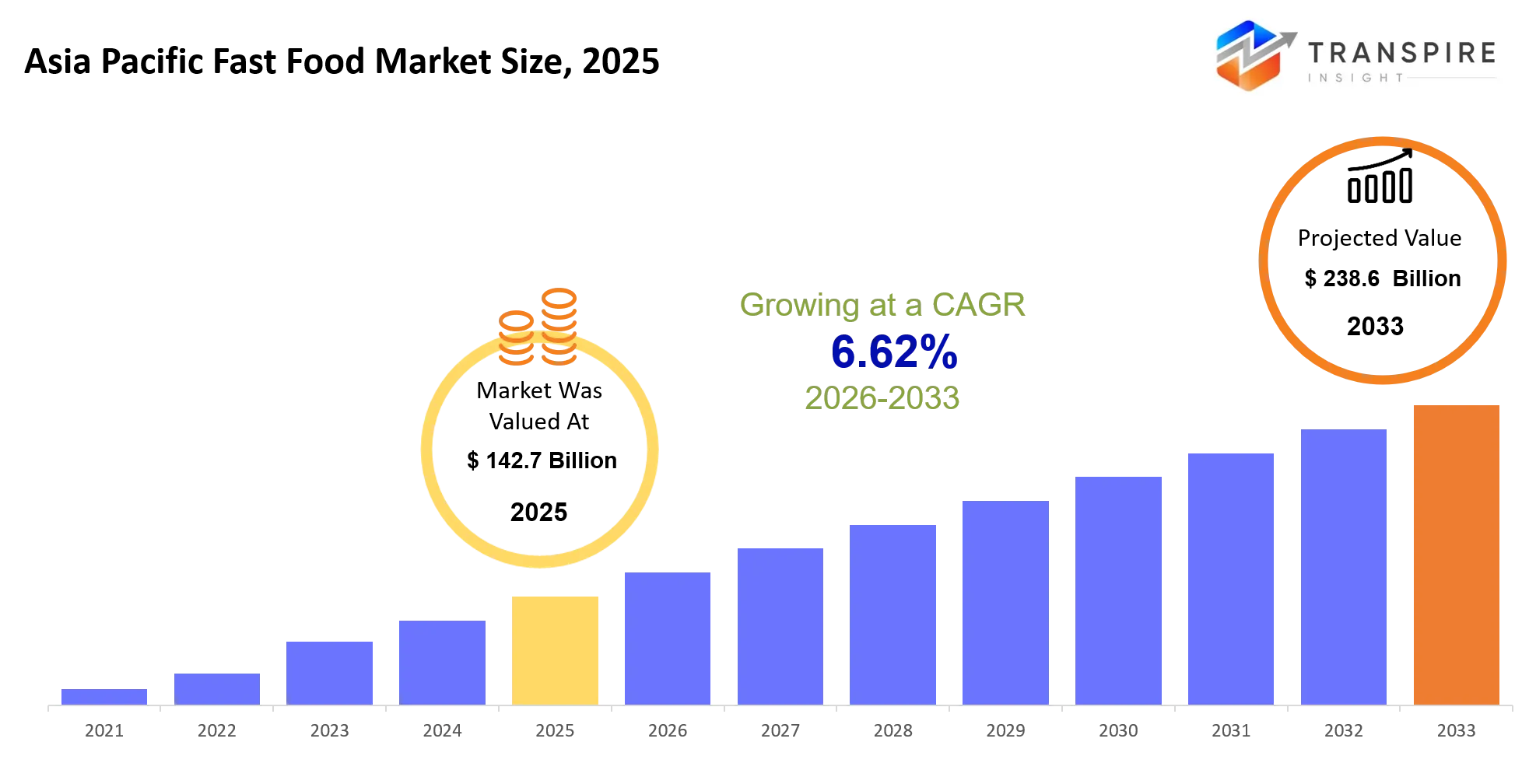
Asia Pacific Fast Food Market Size & Forecast:
- Asia Pacific Fast Food Market Size 2025: USD 142.7 Billion
- Asia Pacific Fast Food Market Size 2033: USD 238.6 Billion
- Asia Pacific Fast Food Market CAGR: 6.62%
- Asia Pacific Fast Food Market Segments: By Product Type (Burgers, Pizza, Fried Chicken, Sandwiches, Asian Fast Food, Others); By Distribution Channel (Quick Service Restaurants, Online Food Delivery, Drive-through Services, Food Courts, Others); By End User (Teenagers, Working Professionals, Families, Students, Others)
To learn more about this report,  Download Free Sample Report
Asia Pacific Fast Food Market Summary
The Asia Pacific Fast Food Market was valued at USD 142.7 Billion in 2025. It is forecast to reach USD 238.6 Billion by 2033. That is a CAGR of 6.62% over the period.
The Asia Pacific fast food market kind of plays a big critical role in meeting the region’s need for convenient, affordable, and pretty standardized meal solutions across densely populated urban centers, transport hubs, commercial districts, and those newer suburban communities that are still emerging. It allows consumers to get quick-service dining that matches increasingly time constrained lifestyles while also giving foodservice operators scalable, high volume business frameworks, that they can run at speed.
Over the past five years, the market has basically shifted in structure, toward digitally enabled ordering ecosystems where mobile applications, delivery platforms and loyalty programs become kind of the core for customer acquisition,and retention. Then the COVID 19 pandemic kind of acted like this big push, set off wider adoption of contactless ordering and off premise dining channels, and such. After that, as the digital infrastructure kept maturing, operators started having better access to customer data, which then helped them run more tailored promotions and manage menus in a more efficient way. Overall it reinforced revenue generation by nudging order frequency up, stretching delivery coverage, and tightening operational efficiency, so both international chains and local brands are now speeding up network expansion across high growth markets.
Key Market Insights
- East Asia kinda dominates the Asia Pacific Fast Food Market, grabbing roughly 42% market share in 2025, mostly because China, Japan and South Korea keep pushing demand forward.
- Southeast Asia looks like the fastest-growing regional area during the forecast window, helped along by higher disposable incomes and more people moving into towns.
- India is still emerging as a big opportunity, and quick service restaurant growth is speeding up across Tier II and Tier III cities.
- When it comes to product, burgers and sandwiches are leading the Asia Pacific Fast Food Market, with an estimated 34% share in 2025, mostly due to broad everyday customer acceptance.
- Pizza stays in second place as a segment, with brand visibility doing a lot of work, plus family dining demand and the convenience of online ordering.
- Asian-style quick-service meals are the fastest-growing segment through 2030, which lines up with localized menu preferences and cultural fit.
- Value meals and combo deals keep pulling in more customers too, as operators try to stay affordable and hold onto repeat buyers.
- On the service side, dine-in and takeaway together hold the dominant market share, contributing almost 55% of total fast food industry revenue in 2025.
- For channels, online delivery platforms are the fastest-growing application segment, powered by app-based ordering and logistics networks that keep expanding.
- And then cloud kitchens, plus delivery-first formats, are opening up fresh revenue chances across densely populated urban areas.
What are the Key Drivers, Restraints, and Opportunities in the Asia Pacific Fast Food Market?
The strongest force that’s pushing growth in the Asia Pacific fast food market is the rapid merging of digital ordering along with delivery ecosystems. A lot of consumers now use smartphones, digital payment platforms, and those third party delivery apps, so it changed how people get fast food, like really changed it. This shift picked up a lot of speed during the pandemic, when restaurants were putting money into mobile ordering, loyalty programs, and delivery partnerships just to keep sales steady. And the outcome is pretty clear: more frequent orders, bigger average transaction sizes because promotions are more tailored, and a wider audience reach than what traditional dine in places usually see. In other words operators can earn revenue from a broader geographic area without needing to grow their physical footprint in the same way.
Still, persistent food inflation plus rising labor costs are basically the biggest structural hurdle the market has. These aren’t just quick, momentary disruptions, they’re tied to longer term supply chain entanglements, wage growth, and unstable agricultural input costs across the region. When operators end up absorbing those costs, their margins get squeezed, and then if they raise menu prices, some customers might show up less, especially in areas where people are pretty price-sensitive. It’s kinda like a tug of war, and that dynamic generally slows revenue growth because it limits expansion plans and makes putting money into fresh outlets feel delayed, in particular for regional and independent chains.
The next big growth chance seems to be in rolling out organized quick-service restaurant networks across newer cities in India, Indonesia, Vietnam and the Philippines. As cities get better urban infrastructure and as digital payments adoption keeps climbing, plus food delivery platforms seeing more traction, the whole setup feels kind of ideal for operations. In other words, brands that blend locally tuned menus with data-guided customer outreach, and delivery-first formats, can grab those still underserved consumer groups and then drive real long-term revenue growth.
What Has the Impact of Artificial Intelligence Been on the Asia Pacific Fast Food Market?
The examples in your prompt (scrubber monitoring, fleet compliance tracking, exhaust gas cleaning technology, marine emission control systems ) really point to the maritime emissions industry more than the Asia Pacific Fast Food Market. So for the Asia Pacific Fast Food Market, a more AI focused angle could kinda sit inside how quick service places work, like day to day, not just some abstract idea.
Artificial intelligence along with other more advanced digital tools are slowly reshaping the fast food landscape in the Asia Pacific region, mostly by pushing operational efficiency, making customer interaction feel smoother, and generally helping margins. Quick-service restaurant operators are increasingly using AI enabled ordering systems, self service kiosks, and demand prediction platforms to speed up the boring routine steps, and yes also to reduce waiting time. What happens in practice is that these systems look at purchasing behaviors, local events, weather signals, and historical sales data to “guess” what customers might want, with a sharper kind of precision.
Machine learning models also assist restaurants with inventory control and scheduling the workforce. By using demand projections for those high traffic moments, and also tracking how menu items tend to trend, operators can cut down on food waste, decrease the chance of running out of ingredients, and place staff where they’re actually needed most. Also, a number of larger chains now roll out AI suggestion systems inside their mobile apps, so the deals feel a bit more personal, and the average order value can go up as a result.Taken together, this tends to improve outlet output, strengthen repeat visits, and bring operating costs down.
Beyond that, advanced analytics solutions help with supply chain tuning, by spotting possible disturbances ahead of time and suggesting substitute sourcing options. This helps operators keep product availability steadier, and maintain a relatively consistent service standard across their locations.
However, one key limitation still holds: the pricey part of plugging AI systems into scattered restaurant networks. In many cases smaller operators are missing that technical backbone, plus their data quality is not as sturdy, and the money to invest isn’t really there, so they can’t fully deploy advanced analytics right away. This slows adoption, or at least it drags it out across portions of the regional market, because the whole setup is kind of uneven and a bit messy between operators.
Key Market Trends
- Since 2020, mobile ordering adoption has basically picked up speed across big markets, and this has made leading chains push harder for app-based loyalty ecosystems , plus more personalized promotions.
- Food delivery platforms have kind of moved from “extra channel” mode into a main revenue engine, and that has reshaped how outlets are designed, along with more money being put into delivery-first formats.
- From 2021 to 2025, operators expanded pretty aggressively into Tier II and Tier III cities, especially in India and Southeast Asia, though it varies by market.
- At the same time, global brands have been swapping out standardized menus for more local offerings, which lines up with shifting consumer preferences and also tougher competition, from regional chains that are more agile.
- After 2022, self-service kiosks and AI-powered ordering systems started to gain real traction, which helped restaurants lower labor dependency a bit and improve order accuracy.
- Supply chain diversification became a must-have priority after pandemic disruptions, meaning companies could reduce reliance on one single supplier and on imported ingredients.
- Value-focused meal bundles came back pretty strongly too, because inflationary pressures squeezed household budgets, so brands had to rework pricing, and retention strategies, in a fairly direct way.
- Cloud kitchens grew a lot in dense urban areas, allowing brands to enter new markets without needing heavy real estate commitments, or at least not as much.
- Big names like McDonald's, KFC, Domino's Pizza, and Jollibee also increased their technology spending, in order to strengthen digital touchpoints, and improve operational efficiency.
- Finally, sustainability initiatives went from “nice to have” niche efforts into mainstream operating habits, with restaurants rolling out recyclable packaging and waste-reduction technologies across many regional networks.
Asia Pacific Fast Food Market Segmentation
By Product Type :
Fast food products get categorized mostly by the main menu stuff offered by restaurants and food service operators, kind of like the big obvious items. Burgers are meat, and also plant-based burger offerings, served through quick-service outlets. Pizza covers both dine-in and delivery-oriented products that show up in several formats, with different toppings too. Fried chicken is basically breaded and seasoned chicken meals, and they are consumed a lot in urban, as well as suburban places.
Sandwiches are those grab-and-go meal options made with bread, vegetables, meats, and other fillings. Asian fast food is more like region-specific quick meals such as rice bowls, noodles, wraps, and street-food-inspired products that are localized, and adjusted for fast service environments. The “others” category includes snacks, desserts, beverages, and specialty menu items that just complement the core fast food offerings.Overall, product segmentation helps operators deal with a broader set of consumer preferences, and different meal moments across the region.
By Distribution Channel :
Distribution channels are basically the ways fast food stuff gets to consumers. Quick service restaurants still count as a primary channel, because they give dine-in, takeaway, and counter service types of experiences that are built for speed, and general convenience. Online food delivery usually means orders done via mobile applications, restaurant sites, and third party delivery platforms, those link customers with the food outlets pretty directly. Drive through services let people buy meals without leaving the vehicles, so convenience rises and the service timeline gets shorter.
Food courts also matter, since they put several food brands inside shopping centers, transportation hubs, and commercial complexes. Then there’s the other category, it tends to include kiosks, vending concepts, pop up outlets, and fast food through catering services. Channel segmentation helps the business look at how customers purchase things and then fine tune service delivery approaches.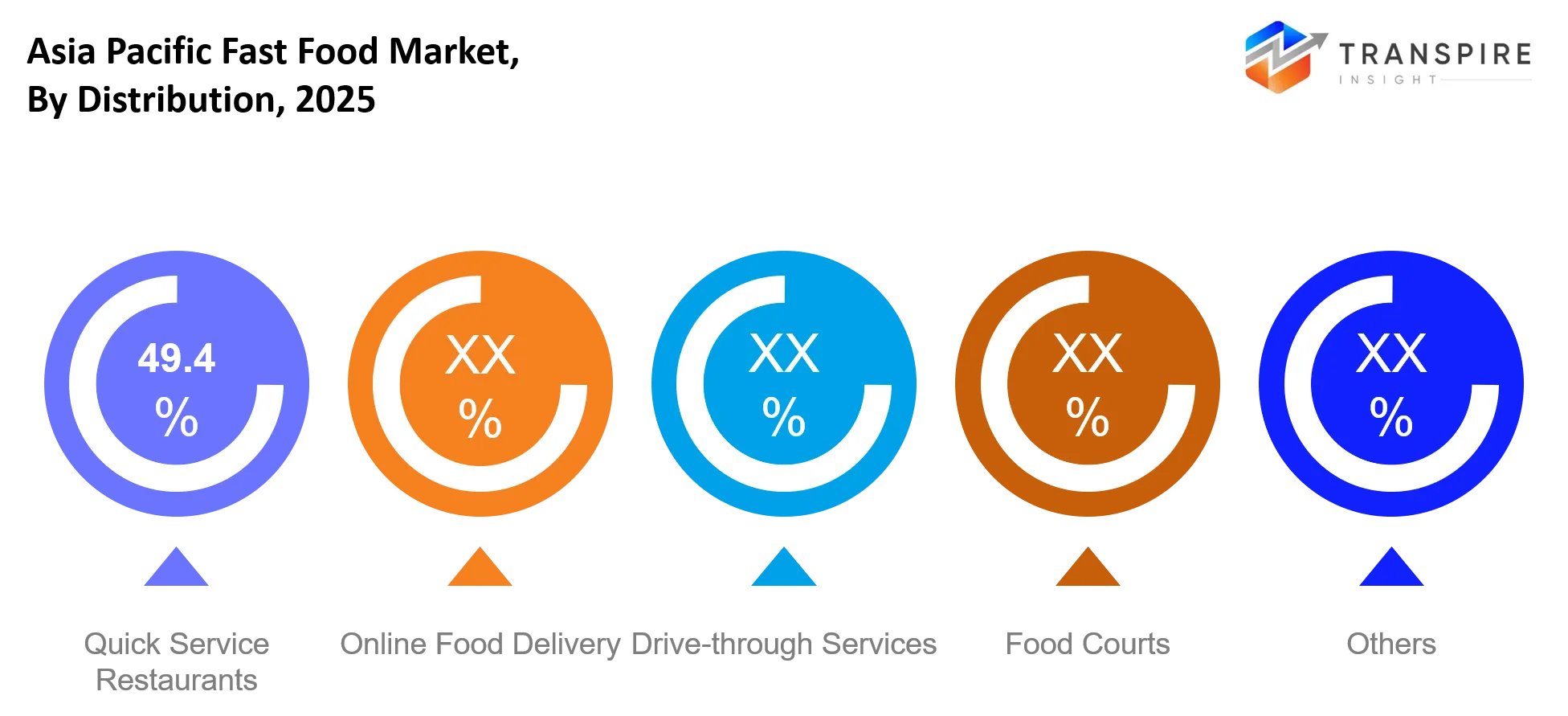
To learn more about this report, Download Free Sample Report
By End User :
End-user segmentation kinda sorts consumers based on lifestyle, age group, and how they tend to consume. Teenagers, as a real key audience, often buy fast food, not just because it’s convenient but also for social get-togethers, and affordability. Working professionals usually go for quick-service meals since there’s not much time for meal prep and work schedules are pretty demanding .
Families drive a lot of market movement through group dining moments and meal bundles. Students are also an important customer segment, because they’re budget-conscious in what they spend, and fast food outlets are easy to reach near schools. The “others” group covers senior citizens, travelers, and people who buy only sometimes, usually with pretty specific preferences . Overall, end-user analysis helps restaurant operators craft more targeted menu options, set pricing that fits, and run promotional campaigns that match the different needs of each type of customer.
What are the Key Use Cases Driving the Asia Pacific Fast Food Market?
The main thing moving the Asia Pacific fast food market forward is basically the need for convenient, time saving meal options, especially for working professionals and city dwellers. Quick service restaurant locations still get the biggest attention, because they keep the meals fairly standardized, they prepare quickly and they’re easy to reach in office zones, transit areas, and those crowded shopping and business corridors.
At the same time, more and more additional applications are getting tied to online food delivery and mobile ordering apps. Students and younger consumers are pushing growth through app based ordering, while families are leaning on delivery for shared meals and those weekend hangouts. Also, digital payment options plus loyalty programs seem to have strengthened these habits even further, in a pretty direct way.
New use cases are starting to show up too, like cloud kitchen operations and data driven virtual restaurant brands that really run without the usual dine in setup. This is getting noticed in packed cities where rent is expensive, and space is basically not cheap. On top of that, personalized menu suggestions powered by customer analytics, along with subscription meal programs, look like they could open up extra revenue channels across the forecast period as well.
|
Report Metrics |
Details |
|
Market size value in 2025 |
USD 142.7 Billion |
|
Market size value in 2026 |
USD 152.4 Billion |
|
Revenue forecast in 2033 |
USD 238.6 Billion |
|
Growth rate |
CAGR of 6.62% from 2026 to 2033 |
|
Base year |
2025 |
|
Historical data |
2021 - 2024 |
|
Forecast period |
2026 - 2033 |
|
Report coverage |
Revenue forecast, competitive landscape, growth factors, and trends |
|
Regional scope |
Asia Pacific (India, China, Japan, Australia,South Korea, Rest of Asia Pacific) |
|
Key company profiled |
McDonald’s, KFC, Subway, Domino’s Pizza, Burger King, Pizza Hut, Starbucks, Yum! Brands, Jollibee, Taco Bell, Dunkin’, Wendy’s, Chick-fil-A, Papa John’s, Tim Hortons |
|
Customization scope |
Free report customization (country, regional & segment scope). Avail customized purchase options to meet your exact research needs. |
|
Report Segmentation |
By Product Type (Burgers, Pizza, Fried Chicken, Sandwiches, Asian Fast Food, Others); By Distribution Channel (Quick Service Restaurants, Online Food Delivery, Drive-through Services, Food Courts, Others); By End User (Teenagers, Working Professionals, Families, Students, Others) |
Which Regions are Driving the Asia Pacific Fast Food Market Growth?
East Asia still kind of leads the Asia Pacific fast food market, mostly pushed by China, Japan and South Korea . The whole picture here looks good because there are really dense urban populations, plus quick service restaurant networks that are already mature, and digital payment ecosystems that are basically highly developed. Logistics is strong too, so delivery stays efficient, which means big brands can reach huge customer groups, fast, and with decent consistency . At the same time, you’ve got international chains sitting next to strong local operators, and that mix keeps things competitive enough to keep the region at the top.
Oceania, meanwhile, is more like a steady contributor to market revenue, even though its growth path isn’t as dramatic as East Asia’s . Australia and New Zealand tend to show stable consumer spending, well built franchise systems, and ongoing investment aimed at restaurant modernization . Instead of chasing rapid outlet expansion, the operators tend to go for menu innovation, customer loyalty programs, and small operational tweaks that improve efficiency. That kind of steadiness turns the region into a dependable revenue base, plus longer term business performance that feels more predictable.
South Asia is emerging as the fastest-growing region, and it’s mainly driven by India, plus the steady build-out of expanding urban centers in nearby markets . Smartphone use keeps rising, food delivery applications get adopted wider and faster, and organized retail infrastructure has developed quickly, which changes how easily people can access fast food . International as well as domestic brands have been moving aggressively into Tier II and Tier III cities, not only the biggest metros . Over the 2026–2033 period, that momentum should pull in meaningful investment, help franchise development, and increase competition between established players and newer market entrants.
Who are the Key Players in the Asia Pacific Fast Food Market and How Do They Compete?
In the Asia Pacific fast food market, competition feels quite intense, yet also kinda moderately fragmented. You have global restaurant chains, but they’re not alone, strong regional brands and local operators also push hard for customers. Most participants seem to win more by digital convenience, menu localization, careful pricing strategies and delivery capabilities, not really by the sheer number of stores. Established brands keep defending their market share by leaning into mobile ordering platforms, loyalty programs, and data-driven advertising tools, so it’s more about repeat visits. Meanwhile, regional chains are nipping at bigger players by putting culturally relevant menu items forward, and by moving into or targeting underserved urban areas.
McDonald's, for its part, concentrates on operational efficiency and localized product development to improve customer engagement across many Asia Pacific markets. The company’s menu adaptations, aimed at local tastes, help it stand out versus rivals that still depend on more standardized offerings. It keeps investing in mobile apps, self-service kiosks and delivery partnerships, which tends to lift transaction volumes and support better retention. And by expanding into emerging cities, the company can access new consumer groups while still keeping a consistent brand feel.
KFC sort of taps into solid know-how with chicken centered menu offerings, giving the name a noticeable product focus that kind of lands well across a bunch of Asian markets. Domino's Pizza stands out more on the delivery side, with streamlined operations, more advanced tracking systems and digital ordering tools for extra ease. Jollibee Foods Corporation, meanwhile, gains from real brand familiarity in Southeast Asia and it manages to blend local tastes with international expansion moves, pretty smoothly actually. Together these players keep tightening their competitive stance via franchise growth, tech upgrades, strategic alliances and by pushing into fast growing city zones across the region, which is kinda where the momentum is.
Company List
- McDonald’s
- KFC
- Subway
- Domino’s Pizza
- Burger King
- Pizza Hut
- Starbucks
- Yum! Brands
- Jollibee
- Taco Bell
- Dunkin’
- Wendy’s
- Chick-fil-A
- Papa John’s
- Tim Hortons
Recent Development News
In January 2026, Devyani International Ltd. announced the merger of Sapphire Foods India Ltd. in a share-swap transaction valued at approximately US$933 million. The combination creates one of Asia-Pacific’s largest quick-service restaurant operators with more than 3,000 outlets across brands including KFC, Pizza Hut, and Taco Bell, strengthening scale and operational efficiency in the region’s fast-food market. Source https://www.bloomberg.com/
In February 2026, Tam Jai International Co. Ltd. entered a franchise partnership with Suyen Corporation to launch its first Tamai Mixian restaurant in the Philippines. The partnership marked the company’s entry into a new Southeast Asian market and accelerated its Asia-Pacific expansion strategy, increasing competitive activity within the region’s fast-casual dining segment. Source https://www.prnewswire.com/
What Strategic Insights Define the Future of the Asia Pacific Fast Food Market?
The Asia Pacific fast food market is going to move, over the next five to seven years, toward a more digitally integrated and oddly localized operating way of doing things. The main nudge for this change comes from mobile commerce, data analytics, and also from growing urban populations in emerging economies. Basically growth is going to lean more and more on how well operators actually use customer data to personalize menus, tune pricing, and make delivery run more efficiently, not just by pushing out more outlets.
There’s a risk that’s a bit less visible too, market concentration inside digital food delivery ecosystems. If only a few delivery platforms end up having more say in who customers see and where orders flow from, restaurant operators could end up dealing with higher commission fees and, what’s worse, less control over customer relationships. So margins can get squeezed even while sales keep rising.
At the same time there’s an emerging opportunity that sounds kind of new. It is the rise of AI enabled virtual restaurant brands that are shaped around local consumer tastes, in fast growing cities across India, Indonesia, and Vietnam. These setups generally need less capital to start, and they can react quickly to demand patterns that keep shifting. Participants in the market should really focus on flexible delivery-first formats backed by their own digital channels, so they’re not so stuck on third party platforms, and can build longer term profitability and customer retention, steadier than before.
Asia Pacific Fast Food Market Report Segmentation
By Product Type
- Burgers
- Pizza
- Fried Chicken
- Sandwiches
- Asian Fast Food
By Distribution Channel
- Quick Service Restaurants
- Online Food Delivery
- Drive-through Services
- Food Courts
By End User
- Teenagers
- Working Professionals
- Families
- Students
Frequently Asked Questions
Find quick answers to common questions.
The Expected Asia Pacific Fast Food Market size is USD 238.6 Billion in 2033.
Key Segments for the Asia Pacific Fast Food Market are By Product Type (Burgers, Pizza, Fried Chicken, Sandwiches, Asian Fast Food, Others); By Distribution Channel (Quick Service Restaurants, Online Food Delivery, Drive-through Services, Food Courts, Others); By End User (Teenagers, Working Professionals, Families, Students, Others).
Major Asia Pacific Fast Food Market Players are McDonald’s, KFC, Subway, Domino’s Pizza, Burger King, Pizza Hut, Starbucks, Yum! Brands, Jollibee, Taco Bell, Dunkin’, Wendy’s, Chick-fil-A, Papa John’s, Tim Hortons.
The Current Asia Pacific Fast Food Market size is USD 142.7 Billion in 2025.
The Asia Pacific Fast Food Market CAGR is 6.62% from 2026 to 2033.
- McDonald’s
- KFC
- Subway
- Domino’s Pizza
- Burger King
- Pizza Hut
- Starbucks
- Yum! Brands
- Jollibee
- Taco Bell
- Dunkin’
- Wendy’s
- Chick-fil-A
- Papa John’s
- Tim Hortons
About the Authors

Chetan Dhatrak
I’m Chetan Dhatrak, a Senior Research Analyst at Transpire Insight, specializing in the Consumer Goods, Foods and Beverages industry. I focus on analyzing market trends, consumer behavior, competitive landscapes, and industry developments to deliver accurate, data-driven insights. My research at Transpire Insight is built on credible sources and in-depth analysis, helping businesses and readers better understand market dynamics, emerging opportunities, and evolving consumer preferences. I’m committed to creating reliable, well-researched content that supports informed decision-making and reflects the latest developments in the consumer goods and food & beverage sectors.

Chakradhar Khansole
Chakradhar serves as the Research Director at Transpire Insight, bringing over 8 years of experience in technology, innovation, and strategic market intelligence. He specializes in transforming complex market data into actionable business insights that enable organizations to make informed, growth-oriented decisions. Recognized for his strategic vision and analytical expertise, Chakradhar leads high-impact research initiatives, delivering comprehensive market assessments, competitive intelligence, and forward-looking industry analysis.
Recently Published Reports
-
Apr 2026
Baby Infant Formula Market
Baby Infant Formula Market Size, Share & Analysis Report By ype (Infant Milk, Follow On Milk, Specialty Baby Milk, Growing-Up Milk), By Ingredient (Carbohydrate, Fat, Protein, Minerals, Vitamins, and Others), By Product Form (Powder, Liquid, and Ready-to-feed), By Distribution Channels (Supermarket/Hypermarket, Specialty Store, Pharmacies, Online Retail, and Others), and Geography (North America, Europe, Asia-Pacific, Middle East and Africa, South and Central America), 2021 - 2031
-
Apr 2026
Edible Insects for Animal Feed Market
Edible Insects for Animal Feed Market Size, Share & Analysis Report By Type (Insect Powder, Insect Meal, Insect Bar, Insect Paste, Insect Oil, and Others), By Insect Type (Beetles, Cricket, Caterpillar, Hymenoptera, Orthoptera, Tree Bugs, and Others), By Application (Livestock, Pet Food, and Aquaculture), By Livestock Type (Poultry, Swine, and Others), and Geography (North America, Europe, Asia-Pacific, Middle East and Africa, South and Central America), 2021 - 2031
-
Apr 2026
Food Industry Disinfection and Bacterial Control Market
Food Industry Disinfection and Bacterial Control Market Size, Share & Analysis Report By Type (Chemical Disinfectants, Physical Disinfectants, and Biocides and Antimicrobials), By Application (Food Processing Equipment Surface Disinfection, Food Preparation Areas Surface Disinfection, Storage Areas Surface Disinfection, Anti-microbial Coatings Food Preservation, and Preservative Solutions Food Preservation), By End User (Meat and Poultry Processing, Dairy Processing, Seafood Processing, Bakery and Confectionery, Restaurants and Commercial Kitchens, and Food Service Providers), By Sales Channel (Online, Offline), and Geography (North America, Europe, Asia-Pacific, Middle East and Africa, South and Central America), 2021 - 2031
-
May 2026
Freeze Dried Food Market
Freeze Dried Food Market Size, Share & Analysis Report By Product Type (Fruits, Vegetables, Freeze-Dried Dairy Products, Freeze-Dried Meat and Seafood, Freeze-Dried Pet Food, and Prepared Meal), By Nature (Organic, and Conventional), By Form (Powdered, Granules, and Diced), By End Use (Breakfast Cereals, Dairy Products, Bakery & Confectionery, Nutritional Bars & Supplements, Powdered Beverages, Snacks, and Retail (Household)), and Geography (North America, Europe, Asia-Pacific, Middle East and Africa, South and Central America), 2021 - 2031