

Process Equipment Market Summary:
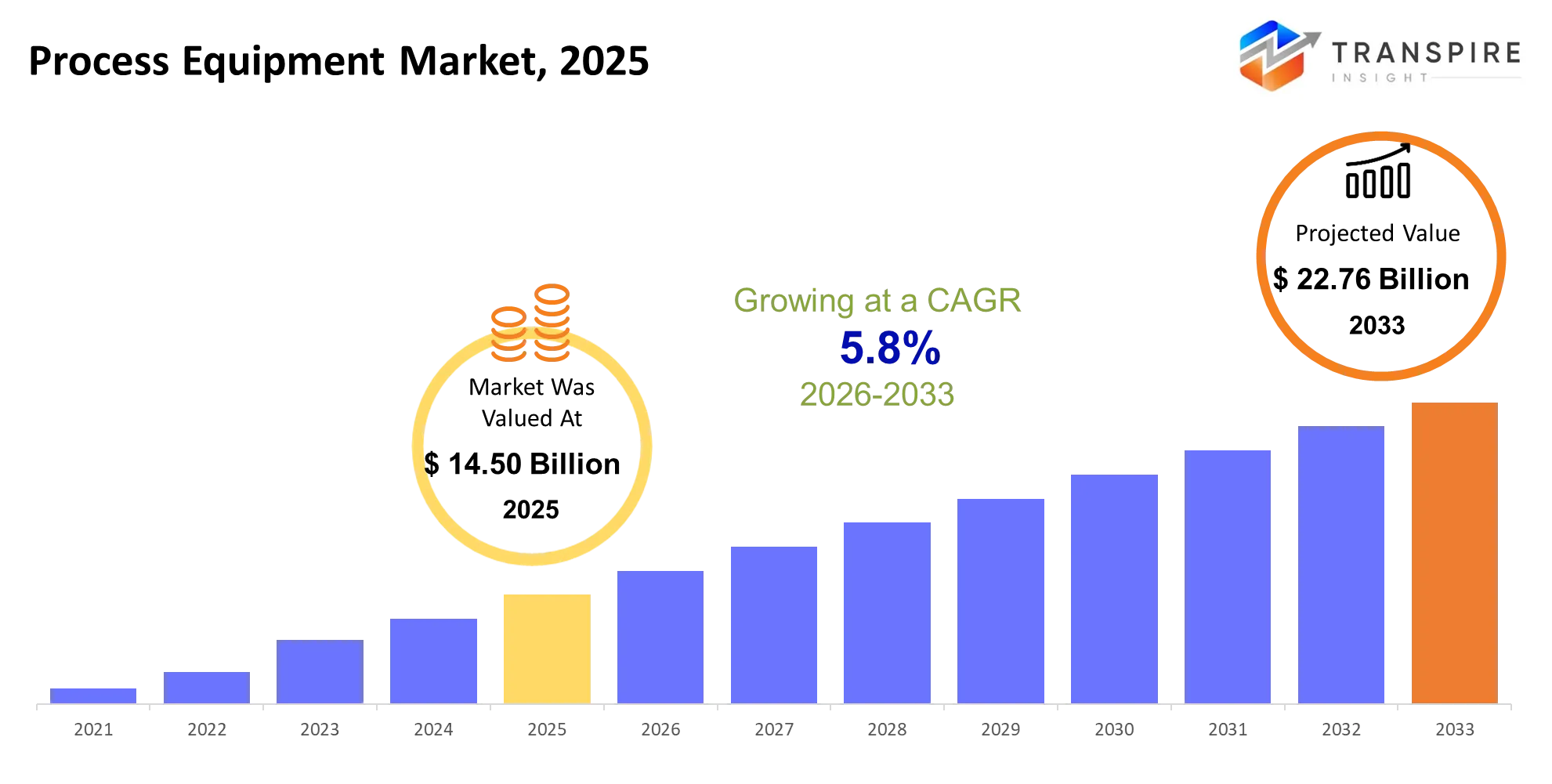
As per Transpire Insight, the Process Equipment Market size is estimated at USD 14.50 billion in 2025 and is anticipated to reach USD 22.76 billion by 2033, growing at a CAGR of 5.8% from 2026 to 2033.
The process equipment market facilitates the movement, heating, cooling, separation, mixing and control of materials in industries such as chemicals, energy, pharmaceuticals, food processing, water treatment and manufacturing facilities. Over the past three to five years, buyers have started looking for connected systems instead of single pieces of equipment. These systems offer efficiency, easier monitoring and clearer views of maintenance needs. A big change has been the move toward automated equipment. At the same time, saving energy and reducing pollution have become more important when making purchases. A real reason for this shift is the pressure on factory workers to manage energy costs and other operating expenses after changes in energy prices and how much energy is available. This is making companies spend more on pumps, heat exchangers, valves, compressors and other equipment that can work with tools. These tools supports reduce time when things stop working and make plants perform better. As factories update their tools, the companies that sell equipment are adding sensors, software, service plans and ways to predict when maintenance is needed.
Process Equipment Market Size & Forecast:
- Market Size 2025: USD 14.50 Billion
- Expected Market Value (2033): USD 22.76 Billion
- Forecast CAGR (2026-2033): 5.8%
- Leading Region in 2025: Asia Pacific
- Fastest Growing Region: Middle East & Africa
- Key Company Profiles: Alfa Laval, Flowserve, Sulzer, Emerson, Honeywell, Siemens, Schneider Electric, Pentair, Xylem, SPX Technologies, KSB, Metso, ANDRITZ, GEA Group, Thermo Fisher Scientific
Key Market Insights:
The market is shifting from traditional equipment buying to connected, efficient, and serviced process systems. The pumps are the biggest equipment category, but there is growing interest in smart process equipment as businesses look for ways to enhance availability and energy management.
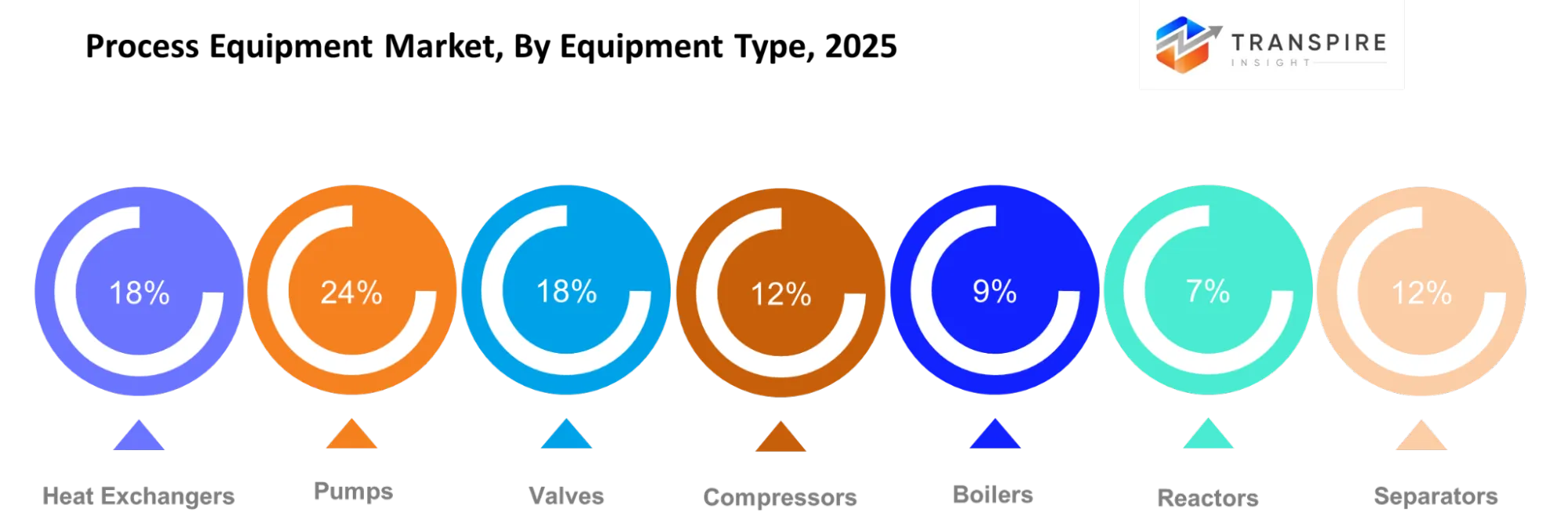
- Pumps continue to lead the market with a 24% share because of their popularity among users for transferring fluids.
- Heat Exchangers have an 18% share in the market owing to the need for effective heat transfer and energy management.
- Valves comprise an 18% share in the market owing to the increasing use of automatic flow control systems in industrial facilities. Compressors are responsible for a 12% share in the market owing to effective gas handling and processing needs in industries.
- Boilers make up 9% share of the market because of the focus of industries on energy-efficient and versatile heating solutions.
- Reactors comprise 7% of the market due to the usage of reactors in chemical, pharmaceutical, and controlled processing applications.
- Separators constitute 6% of the market owing to the increased efficiency of material separation and processes. Other equipment makes up 6% of the market, including specialised equipment for varied industrial uses.
What are the Key Drivers, Restraints, and Opportunities in the Process Equipment Market?
Drivers:
This growth is being driven by plant modernisation, energy efficiency initiatives, replacement of older equipment, and increased usage of process automation systems. One of the primary catalysts for this trend is the desire of industries to maintain production levels while cutting down energy consumption, mainly in the chemical industry, pharmaceutical industry, food industry, water utilities, and the power industry. Energy-efficient pumps, heat exchangers, compressors, and valves have been found to improve operational efficiency and production capacity, driving investments in replacement and modernisation of equipment. Another reason is the influence of digital monitoring on equipment purchases, where industries demand information on condition.
Restraints:
The high cost associated with the replacement of the already installed equipment. Equipment in process plants operates for a long time, and any modernisation can involve downtime, modifications in engineering design, compatibility testing, worker training, and compatibility with existing control systems.
Opportunities:
The opportunity is the transition to smart, modular, and energy-efficient equipment. Manufacturers can meet the demands by integrating equipment with the capabilities of sensors, analytics, remote monitoring, and service agreements. Investment in the region in terms of new production capacity, water infrastructure, and pharmaceuticals can increase the scope of operations.
What Has the Impact of Artificial Intelligence Been on the Process Equipment Market
AI is useful for process equipment since it allows turning data about such equipment into operational decision-making. AI algorithms can be used to analyse sensor readings for pumps, compressors, valves, heat exchangers, and other types of equipment to detect patterns that indicate possible problems before they lead to equipment failure. This will make it possible to conduct predictive maintenance, making it easier to plan maintenance operations according to production plans instead of responding to emergencies created by equipment failure. AI can help to optimise the process by comparing temperature, pressure, flow, vibration, and energy consumption data and proposing optimal parameters. With automated plants, AI can interact with industrial control and monitoring systems in order to find anomalies, enhance quality control procedures, and respond to the changing process more effectively. AI technologies are also combined with industrial IoT platforms and digital twins in order to test operating scenarios without affecting the production process. The problem is that AI projects require significant integration efforts, proper data storage, cybersecurity measures, and competent personnel. Old equipment might not have the sensors necessary for creating the input for AI.
Instance:
In August 2026, Siemens emphasised the use of AI-assisted predictive maintenance within semiconductor production facilities, where AI helps analyse the equipment data collected by pumps, fans, chillers, and other utility systems in order to predict equipment failures up to 20-40 minutes prior to affecting the production process. This shows how AI can help improve the reliability of process equipment.
Key Market Trends:
Equipment market trends have shown a shift towards equipment that integrates mechanical functionality with digital control, energy management, and lifecycle support.
- Industrial purchasers have evolved from simple replacement buying to purchasing upgrades to machinery that can enhance future plant efficiency.
- The importance of energy efficiency has increased because companies try to manage operational costs and reduce resource utilisation.
- Connected sensors are becoming common on key pieces of machinery as operators can assess equipment conditions not just based on planned inspections.
- Predictive maintenance is becoming popular as plants utilise equipment information to detect problems and prevent unscheduled downtime.
- Process automation is increasing in industry as there is a decrease in dependency on human intervention for regular operations.
- Product providers are offering packages that include software, monitoring systems, technical assistance, and maintenance along with the actual products.
Process Equipment Market Segmentation
By Equipment Type:
Pumps dominate the market share, accounting for 24%, with heat exchangers and valves holding the second place, both with a market share of 18%. Compressors have a market share of 12%, boilers 9%, reactors 7%, separators 6%, and other equipment 6%. Pumps are in great demand because of their vital importance in fluid transportation within industrial plants, whereas heat exchangers and valves still have high significance in the field of energy efficiency and regulation.
By Process:
Fluid handling will continue to be closely associated with the established infrastructure of pumps and valves, whereas heat transfer, separation, mixing, reaction, filtration, and drying processes are needed to meet the specific demands of manufacturing. Different process types give rise to different requirements in terms of equipment that has to match material properties, temperature, pressure, and volume. Future developments will favour those pieces of equipment that will be able to serve several purposes at once, combine well with automated systems, and provide operating data. The market can be segmented into Fluid Handling, Heat Transfer, Separation, Mixing, Reaction, Filtration, Drying, and Others.
By Industry:
The chemical industry, oil and gas, pharmaceuticals, food and beverages, power industry, water treatment, mining, and others are the major sources of demand. Equipment for the chemical and oil and gas sectors needs to be equipped to handle challenging conditions, while in the pharmaceutical and food industries, the requirements in relation to hygienic conditions will be high.
By Material:
Carbon steel still finds extensive usage in various industrial operations due to its proven record and availability, while stainless steel, alloy steel, aluminium, titanium, nickel alloys, and plastics find their applications based on their ability to resist corrosion, temperature, pressure, and compatibility with the products to be handled. Tougher demands are making vendors supply materials that increase the life of the equipment and reduce the need for maintenance. In the future, the selection of material will continue to depend upon the process conditions, safety regulations, durability, and lifecycle costs.
By Operation:
Continuous operations continue to hold significance in high production volume processes in the industry, whereas batch and semi-batch operations offer flexibility for industries whose product demands keep on changing. Automated operations become increasingly significant as plants opt for consistency in process control and automation of operations. Hybrid and modular operations provide more flexibility.
By End User:
Process industries, manufacturing plants, utilities, refineries, chemical plants, pharmaceutical plants, and food plants are some key application sectors. The refineries and chemical plants require heavy-duty flow, pressure, heat transfer, and separation machinery, while pharmaceutical and food plants require more hygiene-based and controlled process machinery. Going forward, the demand will increasingly come from those plants that want to upgrade their existing machinery and install connected machinery to gain more uptime, efficiency, and compliance.
By Technology:
Conventional machinery will remain the installed base, but smart, IoT-enabled, AI-enabled, energy-efficient, automated, and digital twin-enabled technologies are changing the trend of investments. The fast-growing category of machinery is smart process machinery at a 9.7% CAGR because the operator wants better insights into the status of the machinery and operating conditions.
What are the Key Use Cases Driving the Process Equipment Market?
Pumps are a use case, since they transport liquid through process lines, cooling systems, water supply, chemical plants and other industrial systems. Widespread usage of pumps increases the importance of their efficiency, durability, sealing effectiveness and maintenance in their purchase. The expanded applications involve heat exchangers for thermal regulation, valves for flow management, compressors for gas transportation and separators for removal of excess materials. The chemical plants, oil and gas processing plants, pharmaceutical, food and beverage industries, power plants and water treatment plants utilise these systems for increased efficiency while managing expenses. New use cases relate to intelligent or automated systems. Sensors connected remotely, predictive maintenance, and digital twins help managers detect performance changes early and make maintenance decision with higher process visibility.
|
Report Metrics |
Details |
|
Market size value in 2025 |
USD 14.50 Billion |
|
Market size value in 2026 |
USD 15.34 Billion |
|
Revenue forecast in 2033 |
USD 22.76 Billion |
|
Growth rate |
CAGR of 5.8% from 2026 to 2033 |
|
Base year |
2025 |
|
Historical data |
2021 - 2024 |
|
Forecast period |
2026 - 2033 |
|
Report coverage |
Revenue forecast, competitive landscape, growth factors, and trends |
|
Regional scope |
United States; Canada; Mexico; United Kingdom; Germany; France; Italy; Spain; Denmark; Sweden; Norway; China; Japan; India; Australia; South Korea; Thailand; Brazil; Argentina; South Africa; Saudi Arabia; United Arab Emirates |
|
Key company profiled |
Alfa Laval, Flowserve, Sulzer, Emerson, Honeywell, Siemens, Schneider Electric, Pentair, Xylem, SPX Technologies, KSB, Metso, ANDRITZ, GEA Group, Thermo Fisher Scientific |
|
Customization scope |
Free report customization (country, regional & segment scope). Avail customized purchase options to meet your exact research needs. |
|
Report Segmentation |
By Equipment Type (Heat Exchangers, Pumps, Valves, Compressors, Boilers, Reactors, Separators, Others); By Process (Fluid Handling, Heat Transfer, Separation, Mixing, Reaction, Filtration, Drying, Others); By Industry (Chemical, Oil & Gas, Pharmaceutical, Food & Beverage, Power, Water Treatment, Mining, Others); By Material (Carbon Steel, Stainless Steel, Alloy Steel, Aluminum, Titanium, Nickel Alloys, Plastics, Others); By Operation (Continuous, Batch, Semi-batch, Automated, Manual, Hybrid, Modular, Others); By End User (Process Industries, Manufacturing, Utilities, Refineries, Chemical Plants, Pharmaceutical Plants, Food Plants, Others); By Technology (Conventional, Smart, IoT-enabled, AI-enabled, Energy-efficient, Automated, Digital Twin-enabled, Others) |
Which Regions are Driving the Process Equipment Market Growth?
North America:
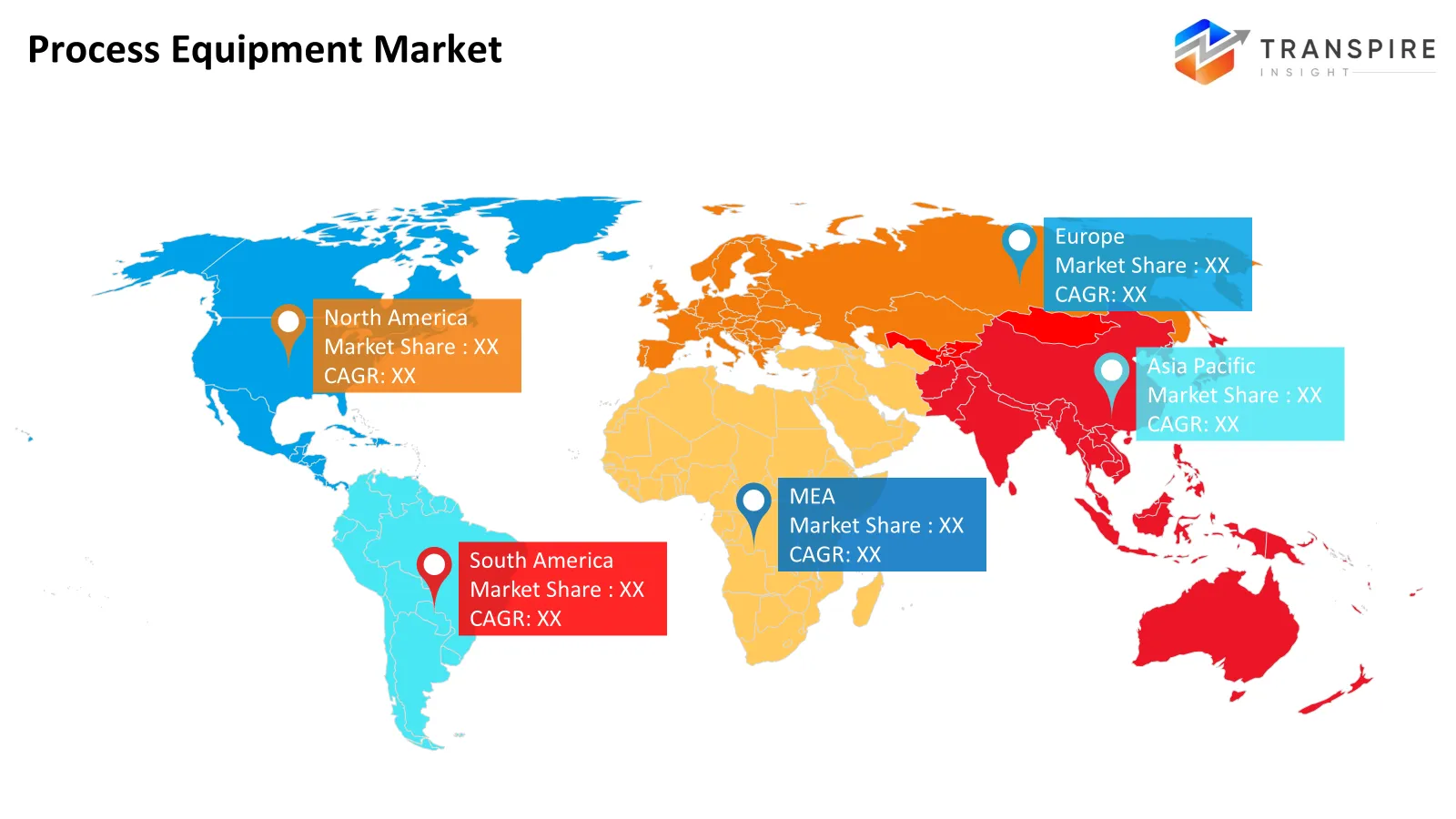
North America constitutes 23% of the world market of process equipment and has the advantage of being home to an established industrial and process infrastructure. Demand will be driven by the modernisation of plants, replacing older equipment, and the automation and monitoring of the processes. A diverse range of customers from the chemical, energy, pharmaceutical, food processing, and water industries will contribute to the demand. Smart equipment will also find favour here as most operators are upgrading their existing facilities and not building entirely new ones.
In June 2026, Grundfos launched the expansion of its manufacturing facilities in Brookshire, Texas, with an addition of 143,000 square feet of manufacturing space for high-end pumps and water technologies. The purpose of this expansion was to satisfy the growing demands of North American customers.
Europe:
Europe accounts for 25% of the market and is characterised by a good equipment ecosystem aided by the capabilities of industrial engineering and sustainable investments. There is a growing emphasis on efficiency and environmental performance by manufacturers that will allow heat transfer, separation, automation, and energy-saving equipment to find favour. In comparison to North America, the purchase decisions made in Europe are driven by efficiency and environmental considerations as well.
In August 2026, Metso decided to purchase the peristaltic hose and progressive cavity pump technology from Valmet. This technology would expand its range of slurry handling and pumping equipment in industrial and mining application areas. The manufacture of the purchased products will take place at Metso's facility in Lappeenranta, Finland.
Asia Pacific:
The Asia-Pacific region leads in market share with 39% owing to growth in manufacturing and processing facilities. Some of the countries in the region include China, India, Japan, South Korea, and others, which provide opportunities for growth through demand from the chemical, pharmaceutical, food processing, energy, water treatment, and manufacturing industries. The Middle East & Africa is the most rapidly growing regional market with CAGR of 8.8%.
In September 2026, Metso was awarded a contract for supplying more than EUR 30 million of mineral processing equipment for a copper project in the Asia Pacific region.
Who are the Key Players in the Process Equipment Marketand how do they compete?
The competition in the international market of process equipment includes diverse portfolios, engineering capabilities, digital offerings, and customer support throughout the entire equipment life cycle. The companies are beginning to compete not only in sales but also in monitoring, maintenance, energy efficiency, and application engineering. For instance, Flowserve consists of pumps, valves, seals, automation, and services; the purchase of the Valves Division from Trillium Flow Technologies adds to the company’s portfolio of engineered valve products for the power and nuclear industries. Alfa Laval offers process efficiency, hygienic processing, separation, heat transfer technology, and new products that respond to the needs of the energy and food processing industry. Innovations of the company included, for example, Culturefuge 200 B and Clariot condition monitoring. Energy efficiency and decarbonization solutions like VoltaSplit electrified distillation became the emphasis of Sulzer’s marketing campaign. Industrial AI offerings were improved due to the cooperation between Emerson and SiMa.ai with an emphasis on edge intelligence, anomaly detection, and predictive maintenance. Digital process-industry capabilities are growing due to the cooperation between GEA and RebelDot.
Process Equipment Market Companies
- Alfa Laval
- Flowserve
- Sulzer
- Emerson
- Honeywell
- Siemens
- Schneider Electric
- Pentair
- Xylem
- SPX Technologies
- KSB
- Metso
- ANDRITZ
- GEA Group
- Thermo Fisher Scientific
Recent Development News
- In May 2026, Emerson has collaborated with SiMa.ai to provide physical AI capability to Emerson industrial PCs. This project will emphasise real-time edge processing of industrial data, anomaly detection, quality inspection, and predictive maintenance. https://www.emerson.com/en/corporate/news/2026/emerson-simaai-deliver-physical-ai-intelligence-industrial-edge
- In January 2025, Sulzer introduced VoltaSplit, an electrically driven distillation technology that aims at energy efficiency and decreasing direct carbon emissions during distillation. It uses electricity instead of steam energy input for the distillation process. https://solutions.sulzer.com/post/sulzer-launches-voltasplit-an-electrified-distillation-solution-to-improve-energy-efficiency-and
What Strategic Insights Define the Future of the Process Equipment Market?
The future of the process equipment market is shifting towards the concept of connectivity, energy efficiency, and services in contrast to standalone pieces of equipment. In terms of competition, it is expected that equipment vendors will focus on lifecycle management, availability of information, uptime, and connectivity with plant automation systems. The hidden threat is the emergence of problems during the integration of newly installed equipment with existing infrastructure in connection with digitalisation and related cybersecurity threats. The other hidden threat is delayed replacement of equipment by operators due to budget constraints, despite the high maintenance cost of aged equipment. Thus, the vendor strategy should be oriented at both greenfield and brownfield markets in combination with the development of equipment that is flexible, efficient in energy consumption, and easy to maintain. The expansion strategy should be oriented toward regions that invest in water treatment, pharmaceuticals, food processing, chemicals, power generation, and brownfields.
Key Segmentations:
By Equipment Type
- Heat Exchangers
- Pumps
- Valves
- Compressors
- Boilers
- Reactors
- Separators
- Others
By Process
- Fluid Handling
- Heat Transfer
- Separation
- Mixing
- Reaction
- Filtration
- Drying
- Others
By Industry
- Chemical
- Oil & Gas
- Pharmaceutical
- Food & Beverage
- Power
- Water Treatment
- Mining
- Others
By Material
- Carbon Steel
- Stainless Steel
- Alloy Steel
- Aluminum
- Titanium
- Nickel Alloys
- Plastics
- Others
By Operation
- Continuous
- Batch
- Semi-batch
- Automated
- Manual
- Hybrid
- Modular
- Others
By End User
- Process Industries
- Manufacturing
- Utilities
- Refineries
- Chemical Plants
- Pharmaceutical Plants
- Food Plants
- Others
By Technology
- Conventional
- Smart
- IoT-enabled
- AI-enabled
- Energy-efficient
- Automated
- Digital Twin-enabled
By Regional Analysis
North America
- US
- Canada
- Mexico
Europe
- Germany
- UK
- France
- Italy
- Spain
- Russia
- Rest of Europe
Asia Pacific
- China
- Japan
- India
- South Korea
- Australia
- Rest of Asia Pacific
South America
- Brazil
- Argentina
- Rest of South America
Middle East & Africa
- UAE
- Saudi Arabia
- Qatar
- South Africa
- Rest of the Middle East & Africa
Frequently Asked Questions
Find quick answers to common questions.
The process equipment market size was valued at USD 14.50 billion in 2025 and is poised to reach USD 22.76 billion by 2033, expanding at a 5.8% CAGR.
Key segments for the process equipment market are By Equipment Type (Heat Exchangers, Pumps, Valves, Compressors, Boilers, Reactors, Separators, Others); By Process (Fluid Handling, Heat Transfer, Separation, Mixing, Reaction, Filtration, Drying, Others); By Industry (Chemical, Oil & Gas, Pharmaceutical, Food & Beverage, Power, Water Treatment, Mining, Others); By Material (Carbon Steel, Stainless Steel, Alloy Steel, Aluminum, Titanium, Nickel Alloys, Plastics, Others); By Operation (Continuous, Batch, Semi-batch, Automated, Manual, Hybrid, Modular, Others); By End User (Process Industries, Manufacturing, Utilities, Refineries, Chemical Plants, Pharmaceutical Plants, Food Plants, Others); By Technology (Conventional, Smart, IoT-enabled, AI-enabled, Energy-efficient, Automated, Digital Twin-enabled, Others).
Growth is primarily driven by Industrialization, growth in the chemical industry and the pharmaceutical industry, increased automation, the need for energy-efficient machines, and investment in water and wastewater facilities.
The market is led by major manufacturers including Alfa Laval, Flowserve, Sulzer, Emerson, Honeywell, Siemens, Schneider Electric, Pentair, Xylem, SPX Technologies, KSB, Metso, ANDRITZ, GEA Group, Thermo Fisher Scientific.
The Asia Pacific region accounts for 39% of the entire market for process equipment, driven by factors such as industrialisation, development of chemical and manufacturing industries, growing infrastructure spending, and the need for processing equipment.
The opportunities in the process equipment market include an increase in demand for energy-efficient and automated systems, growth in the chemical, pharmaceutical, and food processing industries, use of IoT-based process equipment, and investment in water and wastewater treatment facilities.
- Alfa Laval
- Flowserve
- Sulzer
- Emerson
- Honeywell
- Siemens
- Schneider Electric
- Pentair
- Xylem
- SPX Technologies
- KSB
- Metso
- ANDRITZ
- GEA Group
- Thermo Fisher Scientific
About the Authors

Avinash Kumar
I’m Avinash Kumar, a Senior Research Analyst at Transpire Insight, with expertise in the Electronics and Semiconductor and Energy & Power industry. My work focuses on analyzing emerging technologies, market trends, industry developments, and innovation across these sectors. I specialize in transforming complex technical and market insights into clear, research-backed content that helps professionals, businesses, and decision-makers stay informed. Through continuous industry research and data-driven analysis, I strive to deliver accurate, reliable, and practical perspectives on the latest advancements shaping the semiconductor and energy landscape.

Chakradhar Khansole
Chakradhar serves as the Research Director at Transpire Insight, bringing over 8 years of experience in technology, innovation, and strategic market intelligence. He specializes in transforming complex market data into actionable business insights that enable organizations to make informed, growth-oriented decisions. Recognized for his strategic vision and analytical expertise, Chakradhar leads high-impact research initiatives, delivering comprehensive market assessments, competitive intelligence, and forward-looking industry analysis.
Recently Published Reports
-
Apr 2026
Active Power Filter Market
Active Power Filter Market Size, Share & Analysis Report By Type (Shunt Active Power Filters, Series Active Power Filter, Hybrid Active Power Filter), By Application (Harmonics Mitigation, Reactive Power Compensation, Voltage Regulation, Power Factor Correction), By Phase (Single Phase, Three Phase), By End-User Industry (Manufacturing, Healthcare, Commercial, Automotive, Oil and Gas, Others), and Geography (North America, Europe, Asia-Pacific, Middle East and Africa, South and Central America), 2021 - 2031
-
Apr 2026
Electrical Transformer Market
Electrical Transformer Market Size, Share & Analysis Report By Core (Closed, Shell, and Berry), By Insulation (Gas, Oil, Solid, Air, and Other), By Phase (Single, and Three), By Rating (100 MVA to 500 MVA, 501 MVA to 800 MVA, and 801 MVA to 1200 MVA), and Geography (North America, Europe, Asia-Pacific, Middle East and Africa, South and Central America), 2021 – 2031
-
Apr 2026
Hydraulic Piston Pumps Market
Hydraulic Piston Pumps Market Size, Share & Analysis Report By Type (Axial Piston Pumps, Radial Piston Pumps), By Operating Pressure (Low Pressure, Medium Pressure, High Pressure), By Application (Construction, Mining, Agriculture, Automotive, Oil & Gas, Industrial Machinery, Others), By End-User (OEMs, Aftermarket), and Geography (North America, Europe, Asia-Pacific, Middle East and Africa, South and Central America), 2021 – 2031
-
Apr 2026
Laboratory Gas Generators Market
Laboratory Gas Generators Market Size, Share & Analysis Report By Product (Nitrogen Gas Generator, Hydrogen Gas Generator, Zero Air Gas Generator, Purge Gas Generator, TOC Gas Generators, Others), By Application (Gas Chromatography, Liquid Chromatography-mass Spectrometry (LC-MS), Gas Analyzers, Others), By End-user (Life Science, Chemical & Petrochemical, Food & Beverage, Others), and Geography (North America, Europe, Asia-Pacific, Middle East and Africa, South and Central America), 2021 – 2031