
Middle East and Africa Heat Exchanger Market Size & Forecast:
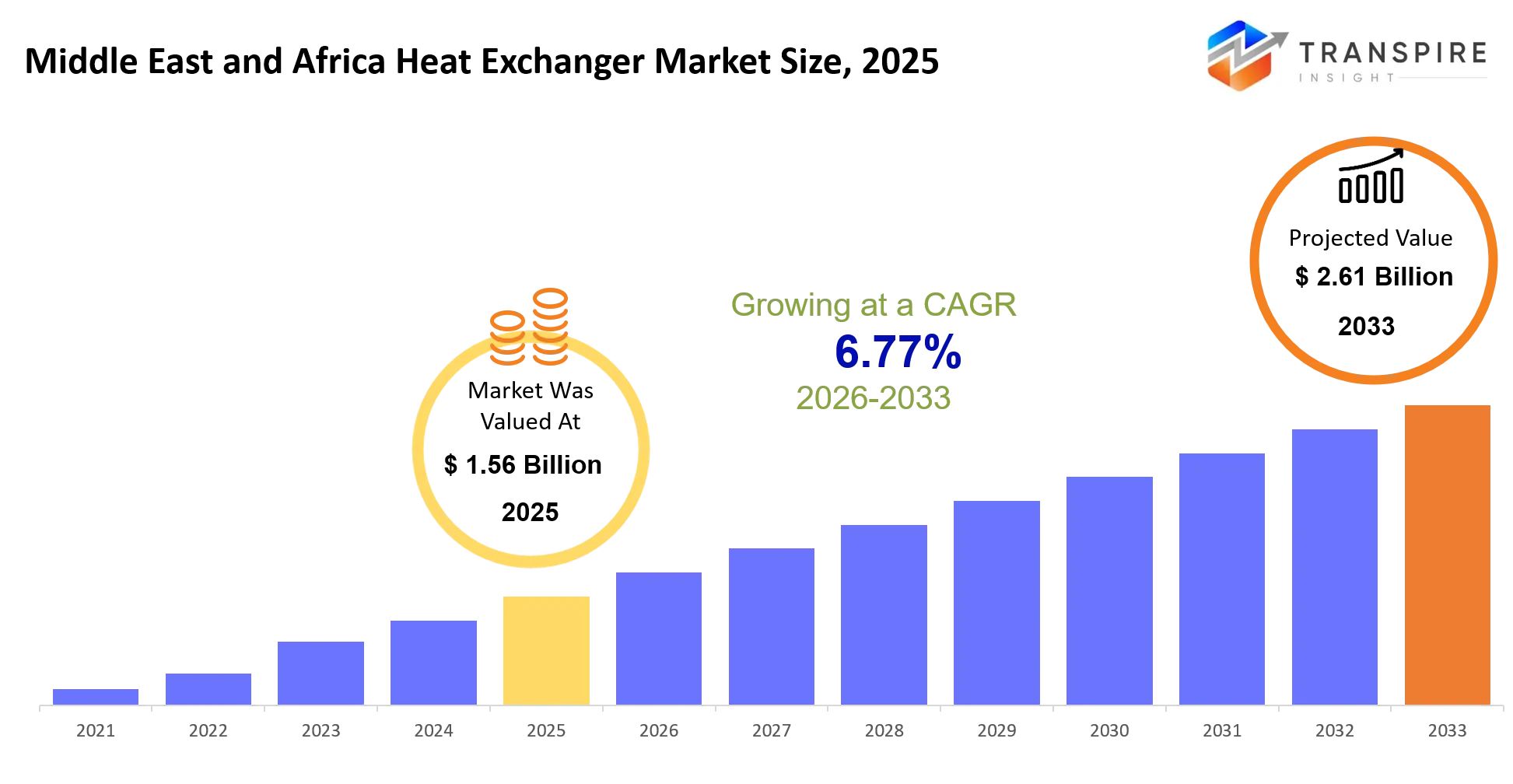
- Middle East and Africa Heat Exchanger Market Size 2025: USD 1.56 Billion
- Middle East and Africa Heat Exchanger Market Size 2033: USD 2.61 Billion
- Middle East and Africa Heat Exchanger Market CAGR: 6.77%
- Middle East and Africa Heat Exchanger Market Segments: By Product Type (Shell & Tube Heat Exchangers, Plate Heat Exchangers, Air-Cooled Heat Exchangers, Double Pipe Heat Exchangers, Others); By Material (Steel, Copper, Aluminum, Titanium, Others); By Application (Oil & Gas, Power Generation, Chemicals, HVAC, Food & Beverage, Others); By End User (Industrial, Commercial, Utilities, Others)
To learn more about this report,  Download Free Sample Report
Middle East and Africa Heat Exchanger Market Summary
The Middle East and Africa Heat Exchanger Market was valued at USD 1.56 Billion in 2025. It is forecast to reach USD 2.61 Billion by 2033. That is a CAGR of 6.77% over the period.
Heat exchangers kinda have a super critical role pretty much across oil and gas facilities, power stations, desalination units , chemical processing places, HVAC systems, and also in the industrial manufacturing operations you see across the Middle East and Africa. These systems move heat quite efficiently between different fluids, and that helps operators reduce energy use, improve process steadiness, and also hold safer working temperatures even when things get rough, like truly demanding conditions.
Over the last five years, the market has been drifting away from the older thermal equipment side, and more toward higher efficiency plate-and-frame designs and other advanced compact heat exchanger technologies. They generally deliver better heat recovery, and they also often come with lower operating costs, so that’s a pretty big driver. This shift picked up momentum once governments and industrial operators started pushing for energy efficiency, and at the same time decarbonization programs. Extra funding flowing into petrochemicals, hydrogen initiatives, desalination infrastructure, and district cooling systems in Gulf countries also keeps reinforcing the demand for these units. And because energy intensive industries are trying to trim their operating expenses, while still meeting sustainability goals, the take up of modern heat transfer solutions keeps expanding too, more or less. So yeah, that also opens up new revenue opportunities for manufacturers , maintenance providers, and technology suppliers alike.
Key Market Insights
- The Middle East and Africa heat exchanger market is projected to go from USD 1.56 billion in 2025 to USD 2.61 billion by 2033, pretty steady overall.
- In the Gulf Cooperation Council countries, they account for an estimated 55%+ of regional industry revenue , mainly because of big industrial and energy programs.
- The Middle East keeps the lead in market share, driven by petrochemical, refining, and desalination buildouts that keep expanding.
- Africa is seen as the quickest regional opening through 2033, supported by mining, electricity generation, and broader industrial build programs.
- For products, shell-and-tube heat exchangers are still the main segment, holding more than 40% market share in industrial uses.
- Plate-and-frame systems come next as the second-largest category, largely because of higher thermal efficiency, and also because compact layout demands are growing.
- Brazed plate heat exchangers are forecast to show the quickest growth through 2033 as energy efficiency requirements keep tightening.
- Oil and gas processing stays the dominant application, taking up close to one-third of regional installations.
- Desalination and district cooling are among the faster-rising application areas across Saudi Arabia and the UAE, with more projects showing up every year.
- Industrial manufacturing and energy firms remain the core end-user group, while data centers are becoming a fast-growing customer category.
- Key players such as Alfa Laval, Kelvion, Danfoss, SPX Flow, and SWEP are placing bets on advanced thermal management technologies.
- Firms are improving their competitive position via product upgrades, locally run service centers, digital monitoring features, and regional expansion plans.
What are the Key Drivers, Restraints, and Opportunities in the Middle East and Africa Heat Exchanger Market?
The main driver of market expansion sort of comes down to modernization of industrial infrastructure around the Gulf region. Governments and industrial players are putting substantial money into petrochemical complexes, hydrogen production sites, desalination plants, and power generation initiatives, all of which really need dependable thermal management systems. Energy expenses and efficiency targets have become more and more critical from a financial point of view, so operators are encouraged to swap out older assets for advanced heat exchangers that boost heat recovery ,while also trimming operating expenses. that in turn supports equipment sales, aftermarket assistance, and those long term maintenance streams.
The biggest restraint, however, is the big upfront capital cost tied to advanced heat exchanger technologies and large scale retrofit works. A lot of industrial plants still run legacy arrangements that were built around traditional thermal equipment. because of that, replacing everything can be complicated and expensive. Engineering changes, shutdown time during installation, and integration requirements add up into barriers that cannot be ironed out quickly. So some operators delay upgrades, which slows adoption and in practice reduces the near term market revenue picture.
A big opportunity shows up in the hydrogen push ,carbon capture efforts, and district cooling projects unfolding across Gulf states. These use cases demand heat transfer systems that are very efficient ,and that can also function under stressful operating conditions. Saudi Arabia, the UAE, and a few North African countries are all investing in next generation energy frameworks. that creates openings for suppliers who can provide compact ,corrosion resistant, and digitally enabled thermal management solutions.
What Has the Impact of Artificial Intelligence Been on the Middle East and Africa Heat Exchanger Market?
Artificial intelligence is increasingly transforming thermal management operations across industrial facilities, power plants, petrochemical complexes, and desalination projects across the Middle East and Africa. Operators are rolling out AI-enabled monitoring platforms that, almost nonstop, analyze temperature , pressure , flow rates and equipment performance signals. These setups automate operational adjustments and help keep heat transfer efficiency at a steady high level, without needing that much constant manual attention.
At the same time, machine learning models are making predictive maintenance a lot sharper, in a way that is almost eerie. Rather than leaning on rigid maintenance routines operators can catch early signals that link to fouling, corrosion, leakage or that slow drift in performance before equipment failures ever really show up. It helps reduce unplanned downtime a fair amount, it stretches the useful life of assets and it often trims maintenance costs too. In many industrial sites, predictive analytics has supported better equipment availability and at the same time reduced maintenance spending by double-digit percentages.
Then there are the advanced digital twins, which are getting more and more useful for performance tuning. Engineers can “try out” operating scenarios, measure possible efficiency gains, and estimate thermal behavior when loads change. In practice these tools support smarter energy management and more realistic operational planning.
Even so, AI adoption seems kind of slowed down, mostly from integration costs , and also by how much data can realistically be collected. A bunch of facilities keep using older equipment, and that device side usually lacks sensors plus the connectivity that’s needed for deeper analytical work. On top of that, when operational data quality is inconsistent , the prediction accuracy can get worse, which then restricts how well advanced machine learning models really can work in the field.
Key Market Trends
- Plate heat exchanger adoption started climbing pretty fast from 2021 to 2026, operators were basically chasing higher heat transfer efficiency and a smaller footprint, you know not too much space taken.
- In the Gulf region, industrial projects put more money into waste heat recovery systems, and that helped raise plant energy utilization roughly 10%–20% , over time.
- Meanwhile desalination plants leaned more toward corrosion resistant heat exchangers since seawater treatment capacity kept expanding across the region.
- After 2024, data center cooling investments really sped up, which brought in new demand for advanced compact thermal management solutions.
- AI enabled monitoring also got more attention, it cut down on unexpected maintenance incidents and improved how reliable the equipment stayed across industrial sites.
- Manufacturers expanded local service networks too, so for example Alfa Laval increased its regional support setup in the UAE, and that made servicing easier.
- Demand for heat exchangers tied to hydrogen, carbon capture, and industrial heat pump projects strengthened a lot after 2023, more than before.
- Compact plus semi-welded exchanger designs grabbed extra market attention, mostly because of space constraints and better performance per unit.
- Suppliers also began embedding digital diagnostics and predictive maintenance features into their premium lines, not just basic hardware anymore.
- And sustainability requirements pushed broader use of lower carbon materials, plus manufacturing practices that are more environmentally tuned.
Middle East and Africa Heat Exchanger Market Segmentation
By Product Type
The product type segment shows the main heat exchanger technologies you’ll see used across industrial, commercial, and utility settings. Shell & Tube Heat Exchangers keep a solid position, mostly because durability, the ability to manage high pressure, and their fit for large scale operations help them get adopted pretty widely in energy and process fields. Their dependable performance in harsh operating conditions still helps justify installations at refineries, chemical plants , and power stations.
Plate Heat Exchangers get plenty of attention for a compact build, strong thermal efficiency, and because servicing them is relatively straightforward. Air Cooled Heat Exchangers stay relevant where water saving matters, or where limited water availability shapes how people pick a cooling system. Double Pipe Heat Exchangers fit cases that call for an uncomplicated layout while still delivering good heat transfer, especially when the process demand is smaller. There are also other options, like specialized heat exchanger arrangements, developed to handle distinct thermal management requirements across different industrial spaces.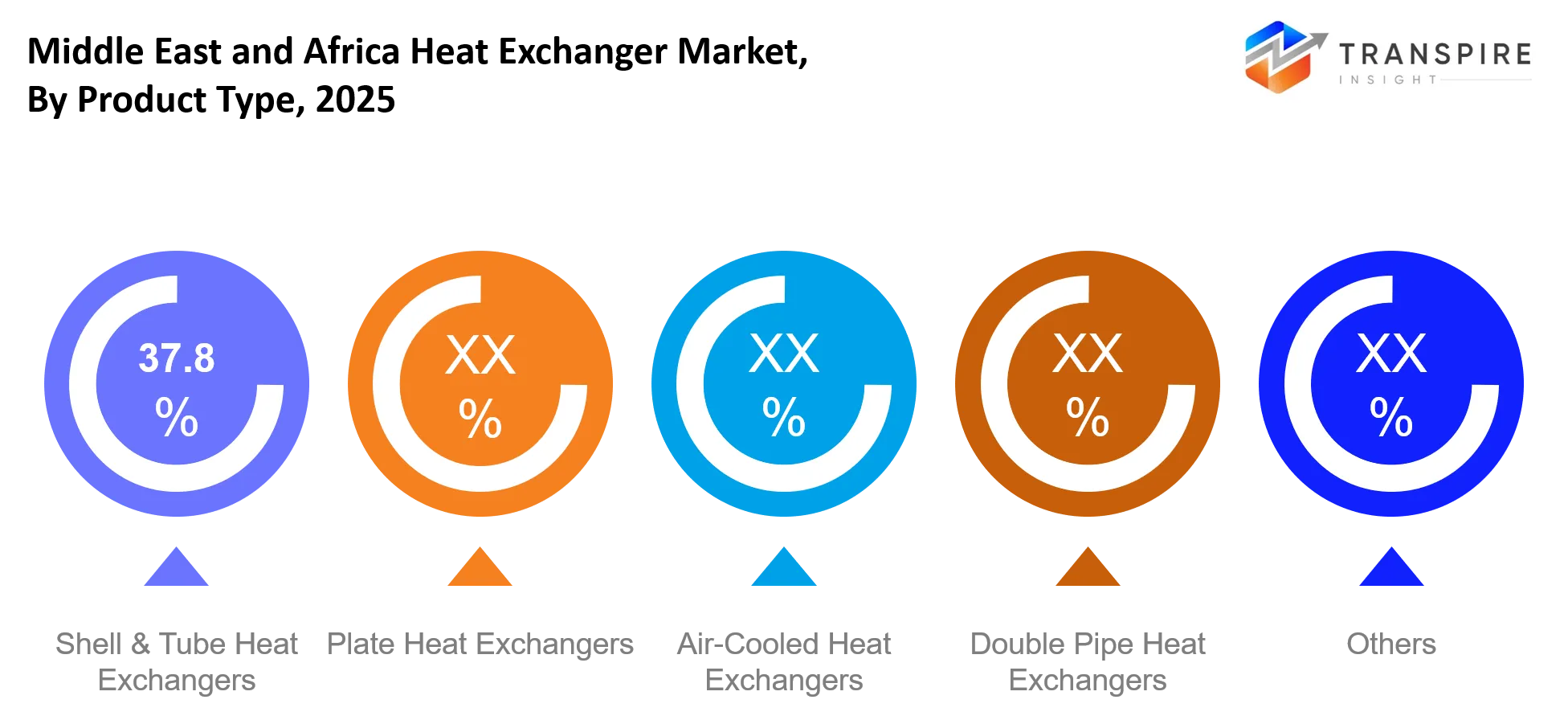
To learn more about this report, Download Free Sample Report
By Material
The material segment kind of mirrors the variety of construction materials that get selected to satisfy performance, durability, and the actual operating condition demands. Steel makes up a solid portion, mostly because strength, corrosion resistance, and overall cost-effectiveness help it work across a lot of industrial use cases. There’s also ongoing investment in energy and manufacturing infrastructure that keeps demand alive for steel-based heat exchanger systems.
Copper is still appreciated for great thermal conductivity, and for those efficient heat transfer traits, especially in HVAC and refrigeration applications. Aluminum is getting more acceptance too, it carries lightweight properties and pretty solid corrosion resistance when the operating environments are selected carefully. Titanium supports specialized uses, like when harsh process conditions show up, or when exposure to corrosive fluids forces more advanced material performance. And then there are the rest, which includes material combinations and specialty alloys, created for particular industrial needs and for specific process requirements.
By Application
The application segment mostly pinpoints the wide range of industries that depend on heat transfer systems in order to run smoothly and keep process control on track, you know. Oil & Gas is a sizable category here because refining, processing, transportation, and production tasks all call for solid temperature handling across many stages. Also there’s a steady push for investment in upstream and downstream facilities that keeps equipment deployment moving along, more or less.
Power Generation still counts as a key application area, since thermal management systems help enable more efficient electricity production while also improving equipment reliability. Chemicals create substantial demand too, because careful temperature control supports product quality and keeps process stability intact. HVAC keeps growing as commercial infrastructure expands, along with climate control needs that keep getting louder in demand. Food & Beverage sites lean on heat exchangers for processing, cooling, and sanitation workflows. Other areas cover mining, marine, pharmaceutical, and still more industrial use cases where dependable thermal management solutions are really required.
By End User
The final customer segment kind of mirrors the wide range of buyers using heat exchanger technology across multiple fields. Industrial clients make up the biggest portion because manufacturing facilities, processing plants, refineries, and production sites need uninterrupted heat transfer tasks, more or less all the time. Lately, growth in industrial infrastructure and modernization programs continue to push uptake of this equipment, even when timelines get tight.
On the other hand , commercial users show steady contribution, since office buildings, retail venues, hospitals, and big commercial complexes typically lean on effective heating and cooling setups. Utilities also stay pretty significant, mainly because there’s broad adoption in power generation, water treatment, and district energy networks, where operational effectiveness is still a major priority.
Then there are the other groups, like institutional facilities and specialized operations, they rely on dependable thermal management systems, to keep everyday activities running smoothly and to meet long term performance goals.
What are the Key Use Cases Driving the Middle East and Africa Heat Exchanger Market?
The biggest source of demand is coming from oil and gas processing, refining, petrochemical making, and also power production plants. In these industries heat exchangers are basically a must, mainly to handle the process temperatures, recapture waste heat, tune energy efficiency, and keep day to day reliability. Because these facilities are huge and run pretty much nonstop, they end up being the main buyers of thermal management gear, you know the kind.
After the usual industrial use cases, desalination plants along with district cooling networks are showing up as fast growth areas. With quick urban expansion across Gulf countries the need for big cooling infrastructure has gone up, and at the same time, more freshwater output capacity is pushing further spending on improved thermal systems.
Newer uses are starting to appear too, like hydrogen production units, carbon capture programs, industrial heat pumps, and newer data center cooling setups. Even if these parts are still smaller today, the continuing energy transition spending and the expansion of digital infrastructure are expected to open up significant opportunities over the forecast timeline.
|
Report Metrics |
Details |
|
Market size value in 2025 |
USD 1.56 Billion |
|
Market size value in 2026 |
USD 1.65 Billion |
|
Revenue forecast in 2033 |
USD 2.61 Billion |
|
Growth rate |
CAGR of 6.77% from 2026 to 2033 |
|
Base year |
2025 |
|
Historical data |
2021 - 2024 |
|
Forecast period |
2026 - 2033 |
|
Report coverage |
Revenue forecast, competitive landscape, growth factors, and trends |
|
Regional scope |
Middle East and Africa (Saudi Arabia, United Arab Emirates, South Africa, Rest of Middle East and Africa) |
|
Key company profiled |
Alfa Laval, Kelvion, Danfoss, SPX Flow, API Heat Transfer, Xylem, Tranter, Hisaka, Johnson Controls, Bosch, Mitsubishi Heavy Industries, Chart Industries, Modine, SWEP, Thermax |
|
Customization scope |
Free report customization (country, regional & segment scope). Avail customized purchase options to meet your exact research needs. |
|
Report Segmentation |
By Product Type (Shell & Tube Heat Exchangers, Plate Heat Exchangers, Air-Cooled Heat Exchangers, Double Pipe Heat Exchangers, Others); By Material (Steel, Copper, Aluminum, Titanium, Others); By Application (Oil & Gas, Power Generation, Chemicals, HVAC, Food & Beverage, Others); By End User (Industrial, Commercial, Utilities, Others) |
Which Regions are Driving the Middle East and Africa Heat Exchanger Market Growth?
The Middle East still sort of looks like the big regional winner, with Saudi Arabia, the United Arab Emirates, and Qatar taking the lead. There are also extensive investments going into refining, petrochemicals, desalination, and energy infrastructure, which then keeps demand steady for heat transfer equipment. Government-backed industrial diversification programs keep feeding the large capital projects, too. On top of that, a mature supplier ecosystem and well-established engineering know-how basically lock in the region’s leadership position, for the most part.
South Africa comes in as the second-largest contributor to regional revenue. But unlike the Gulf economies, here the momentum is more tied to industrial processing , mining operations, food production, and power generation activities. The country has a diversified industrial foundation, so demand stays relatively steadier across several sectors. Then there’s the ongoing maintenance and modernization spending which also enables recurring equipment replacement opportunities, more than once.
The rest of Africa is expected to show the strongest growth momentum all the way through 2033. Mining investments are expanding, industrialization initiatives are moving forward, new power generation projects are coming online, and infrastructure development is basically opening up fresh chances for heat exchanger suppliers. A few countries are also pushing manufacturing and energy capacity that needs modern thermal management solutions. For market entrants and investors, these emerging economies can offer strong long term expansion potential, even if the current infrastructure situation feels a bit challenging right now.
Who are the Key Players in the Middle East and Africa Heat Exchanger Market and How Do They Compete?
Competition in the Middle East and Africa Heat Exchanger Market is kinda moderately consolidated , you know, not totally fragmented but also not like one or two firms run everything. Big global engineering names tend to compete using technology performance, application know-how, regional service coverage, and lifecycle support, pretty much the usual list but with some real emphasis on execution. For industrial customers, reliability comes first, then energy efficiency, and also how easy maintenance is to access , plus the ability to get local technical support quickly. Price alone rarely wins. So firms that already have established regional networks and specialized engineering knowledge often get the upper hand.
Alfa Laval stands out with high-efficiency plate heat exchanger technology, a pretty wide aftermarket services offering, and a strong presence across the region. They have recently pushed out more support capabilities in the Middle East , and rolled in new large-scale semi-welded exchanger technology that’s meant for energy transition applications.
Kelvion goes hard on customized thermal solutions across industrial processing, energy infrastructure, and data center cooling. Their moves around carbon capture applications and digital cooling solutions help lock in relevance in these newer, faster growing industrial segments.
SWEP mainly focuses on compact brazed plate heat exchangers for HVAC, refrigeration, and also advanced cooling applications. They keep expanding the product lineup around sustainable cooling technologies , and they also emphasize lower-carbon manufacturing practices , which is becoming more important every year.
Company List
- Alfa Laval
- Kelvion
- Danfoss
- SPX Flow
- API Heat Transfer
- Xylem
- Tranter
- Hisaka
- Johnson Controls
- Bosch
- Mitsubishi Heavy Industries
- Chart Industries
- Modine
- SWEP
- Thermax
Recent Development News
In May 2026, Alfa Laval launched the TS45 semi-welded plate heat exchanger. The new platform targets large-scale energy transition, industrial heat pump, carbon capture, and energy efficiency applications, expanding the company's high-capacity thermal solutions portfolio.https://www.alfalaval.com
In January 2026, SWEP launched the All-Stainless B4TS brazed plate heat exchanger. The product supports semiconductor, electronics, and next-generation refrigerant applications while improving resistance to corrosive cooling environments.https://www.prnewswire.com
In August 2025, Apollo Funds agreed to acquire a majority stake in Kelvion from Triton. The transaction strengthens Kelvion's access to investment capital and supports expansion in thermal management, data center cooling, and energy transition markets.https://www.nasdaq.com
What Strategic Insights Define the Future of the Middle East and Africa Heat Exchanger Market?
The market is shifting toward more efficient, digitally linked, and application specific thermal management setups that can actually back industrial decarbonization goals, help with water security, and support energy diversification objectives. In the next five to seven years, funding for hydrogen production, carbon capture infrastructure, district cooling networks, and newer industrial processes will keep getting stronger as demand drivers. The best openings may show up exactly where thermal efficiency ties directly into operating economics.
There is also a kind of sneaky risk. Dependence on specialized alloys and advanced materials is getting bigger, and that can quietly bite later. If supplies get tight, or prices start swinging, equipment costs could rise, and project math could feel more pressured. On top of that, the demand is somewhat concentrated in big energy and industrial programs, so certain parts of the market may end up being sensitive to capex cycles, and those swings can be nasty.
Still, an opportunity is forming too. An emerging angle is AI enabled thermal management platforms that blend predictive maintenance with performance optimization. Firms should put more money into localized engineering services, sharpen their digital capabilities, and offer application focused solutions so they can stay competitive over the long run, and also capture the higher margin growth chances across the region.
Middle East and Africa Heat Exchanger Market Report Segmentation
By Product Type
- Shell & Tube Heat Exchangers
- Plate Heat Exchangers
- Air-Cooled Heat Exchangers
- Double Pipe Heat Exchangers
- Others
By Material
- Steel
- Copper
- Aluminum
- Titanium
- Others
By Application
- Oil & Gas
- Power Generation
- Chemicals
- HVAC
- Food & Beverage
- Others
By End User
- Industrial
- Commercial
- Utilities
- Others
Frequently Asked Questions
Find quick answers to common questions.
The Expected Middle East and Africa Heat Exchanger Market size for the Market will be USD 2.61 Billion in 2033.
Key Segments for the Middle East and Africa Heat Exchanger Market are By Product Type (Shell & Tube Heat Exchangers, Plate Heat Exchangers, Air-Cooled Heat Exchangers, Double Pipe Heat Exchangers, Others); By Material (Steel, Copper, Aluminum, Titanium, Others); By Application (Oil & Gas, Power Generation, Chemicals, HVAC, Food & Beverage, Others); By End User (Industrial, Commercial, Utilities, Others).
Major Middle East and Africa Heat Exchanger Market Players are Alfa Laval, Kelvion, Danfoss, SPX Flow, API Heat Transfer, Xylem, Tranter, Hisaka, Johnson Controls, Bosch, Mitsubishi Heavy Industries, Chart Industries, Modine, SWEP, Thermax.
The Current Middle East and Africa Heat Exchanger Market size is USD 1.56 Billion in 2025.
The Middle East and Africa Heat Exchanger Market CAGR is 6.77% from 2026 to 2033.
- Alfa Laval
- Kelvion
- Danfoss
- SPX Flow
- API Heat Transfer
- Xylem
- Tranter
- Hisaka
- Johnson Controls
- Bosch
- Mitsubishi Heavy Industries
- Chart Industries
- Modine
- SWEP
- Thermax
About the Authors

Pankaj Ghogare Patil
I am Pankaj Ghogare Patil, a Senior Research Analyst at Transpire Insight, specializing in the Pharmaceutical, Chemicals & Materials, Healthcare IT, and Biotechnology industry. My expertise lies in conducting comprehensive market research, analyzing industry trends, evaluating competitive landscapes, and translating complex data into actionable insights. At Transpire Insight, I closely follow emerging technologies, regulatory developments, and market innovations to create accurate, well-researched, and informative content that helps businesses and professionals make informed decisions. I am committed to producing credible, evidence-based articles that reflect industry best practices while making technical topics accessible and valuable for a broad audience.

Chakradhar Khansole
Chakradhar serves as the Research Director at Transpire Insight, bringing over 8 years of experience in technology, innovation, and strategic market intelligence. He specializes in transforming complex market data into actionable business insights that enable organizations to make informed, growth-oriented decisions. Recognized for his strategic vision and analytical expertise, Chakradhar leads high-impact research initiatives, delivering comprehensive market assessments, competitive intelligence, and forward-looking industry analysis.
Recently Published Reports
-
May 2026
Healthcare Polymer Packaging Market
Healthcare Polymer Packaging Market Size, Share & Analysis Report By Packaging Type (Syringes, IV Bottles and Pouches, Clamshells, Blisters, Bottles & Jars, Containers, Tubes, IV Parental Packaging, Others), By Type (Regulated, Non-regulated), By Polymer Type (LDPE (Low-Density Polyethylene), HDPE (High-Density Polyethylene), Homo-polymer (Homo), Random Copolymer (Random), Block Copolymer (Block), PET, Polystyrene, Polyvinyl Chloride, Polyamide/EVOH, Others), and Geography (North America, Europe, Asia-Pacific, Middle East and Africa, South and Central America), 2021 - 2031
-
Apr 2026
Hydrophilic Tape (Waterstop) Market
Hydrophilic Tape (Waterstop) Market Size, Share & Analysis Report By Type (Bentonite-Based Hydrophilic Tape, Rubber-Based Hydrophilic Tape), By Application (Residential Buildings, Commercial Buildings, Infrastructure Projects), and Geography (North America, Europe, Asia-Pacific, Middle East and Africa, South and Central America), 2021 - 2031
-
Apr 2026
Metalens Market
Metalens Market Size, Share & Analysis Report By Type (Visible Light Metalens, and Infrared Metalens), By Application (Consumer Electronics, Automotive Electronics, Industrial, Medical, and Others), and Geography (North America, Europe, Asia-Pacific, Middle East and Africa, South and Central America), 2021 - 2031
-
Apr 2026
PBT Resin Market
PBT Resin Market Size, Share & Analysis Report By Type (Reinforced PBT Resin, Unreinforced PBT Resin), By Processing Method (Injection Molding, Extrusion, Blow Molding, Others), By End-User (Automotive, Electrical & Electronics, Consumer Appliances, Industrial Machinery, Medical Devices, Packaging, Others), and Geography (North America, Europe, Asia-Pacific, Middle East and Africa, South and Central America), 2021 - 2031