
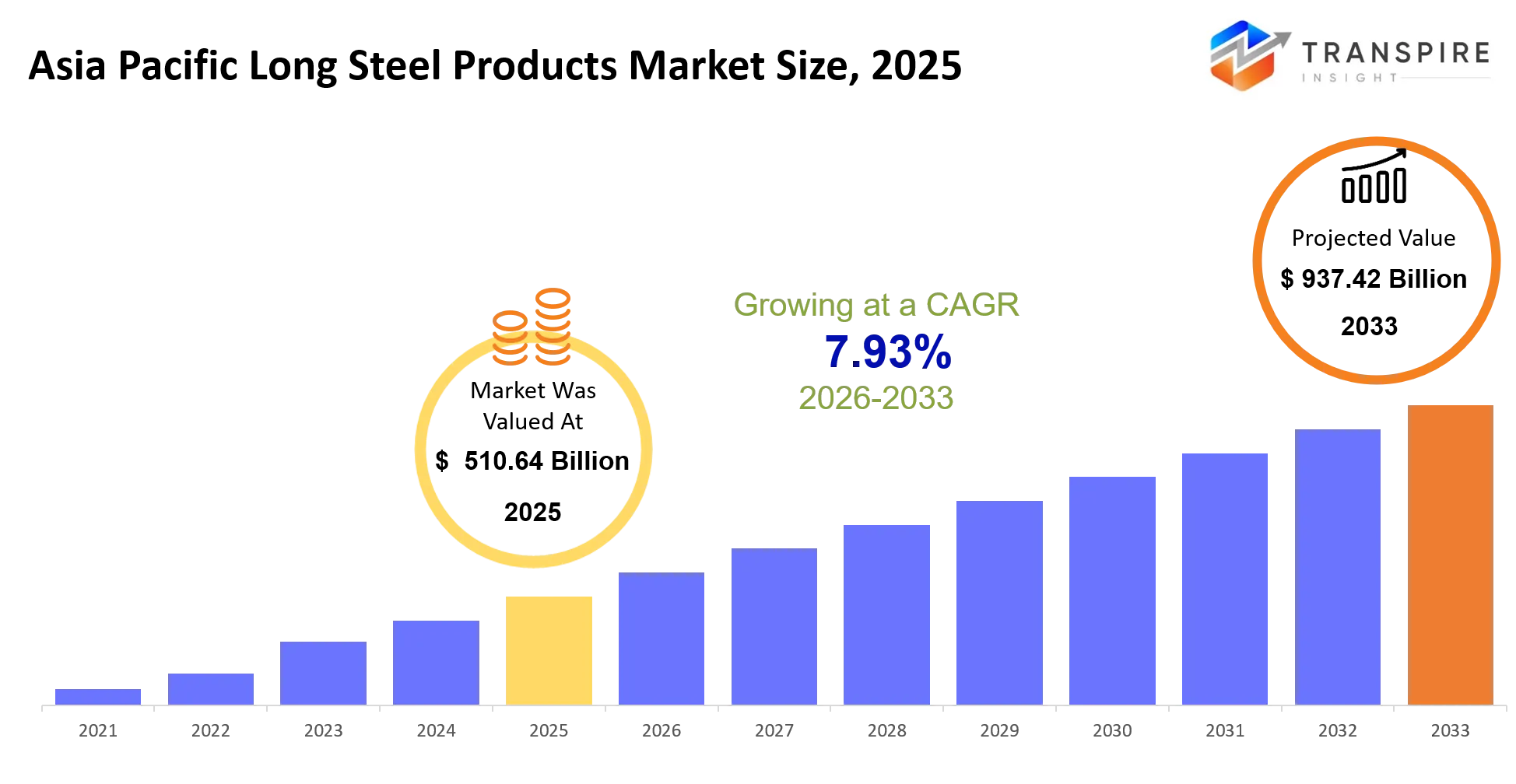
Asia Pacific Long Steel Products Market Size & Forecast:
- Asia Pacific Long Steel Products Market Size 2025: USD 510.64 Billion
- Asia Pacific Long Steel Products Market Size 2033: USD 937.42 Billion
- Asia Pacific Long Steel Products Market CAGR: 7.93%
- Asia Pacific Long Steel Products Market Segments: By Product Type (Rebar, Wire Rod, Rails, Structural Steel, Merchant Bars, Angles, Channels, Beams, Others); By Manufacturing Process (Basic Oxygen Furnace, Electric Arc Furnace, Induction Furnace, Continuous Casting, Hot Rolling, Cold Finishing, Others); By Application (Construction, Infrastructure, Railways, Automotive, Energy, Shipbuilding, Industrial Manufacturing, Others); By End User (Construction Companies, Infrastructure Developers, Automotive Industry, Industrial Sector, Government Projects, Others)
To learn more about this report,  Download Free Sample Report
Asia Pacific Long Steel Products Market Summary
The Asia Pacific Long Steel Products Market was valued at USD 510.64 billion in 2025. It is forecast to reach USD 937.42 billion by 2033. That is a CAGR of 7.93% over the period.
The Asia Pacific long steel products sector is kind of like the physical backbone behind industrial and city development across the region, in a real hands-on way. Rebar, wire rod, structural sections , and rails help push forward high-rise building, transport corridors, energy infrastructure, manufacturing plants, and a lot of major public works stuff that truly depends on load-bearing strength and a long operational life. In practice, governments and private developers lean on these materials to speed up urban expansion, improve logistics connectivity, and modernize industrial capacity , with less hesitation than before
Over the past five years, the market’s been shifting from a mostly volume-led production mindset to something more efficiency-first, plus lower-emission manufacturing. Electric arc furnace adoption went up, mostly because steelmakers have been grappling with tougher carbon reduction targets across China, Japan, South Korea, and India.On top of that, the pandemic-era supply disruptions, plus the Russia-Ukraine conflict , kind of shifted the routes for raw materials, and it made reliance on imported coking coal and scrap feel pretty unavoidable too. After 2021, the infrastructure stimulus programs expanded , so steel producers began putting more funding into localized production, automation and downstream processing, instead of only chasing raw output.
All in all, this turn helped support stronger pricing power for value-added long steel grades and gave producers steadier revenue visibility. They’re especially well placed for transport projects, renewable energy buildouts, and industrial construction programs that keep going even when the wider conditions feel uncertain , or just a little too shaky
Key Market Insights
- China sort of dominated the Asia Pacific long steel products market, with almost 48% regional share in 2025, via infrastructure spending and large-scale manufacturing capacity.
- India, on the other hand came out as the fastest growing regional market during 2026–2032 because of railway expansion, industrial corridor projects, and then urban housing investments which kept stacking up.
- For products, rebar sort of took the lead with over 35% share in 2025, mostly because residential towers, bridges , and metro rail projects kept accelerating across the region.
- Structural steel stayed in the second spot as well, since logistics parks, renewable energy plants, and industrial warehouses required heavier load-bearing components, more or less, in a very straightforward way.
- Wire rod showed the quickest growth path after 2023, pushed by automotive manufacturing, transmission infrastructure, and also fastener production expansion.
- When it came to applications, construction usage pretty much dominated regional consumption with nearly 50% market share in 2025, helped by government backed urban redevelopment and transport infrastructure programs.
- At the same time renewable energy infrastructure became a fast-growing use case, since offshore wind foundations and transmission towers demand specialized long steel grades.
- About the end-users, construction companies were still the leading category,while industrial manufacturing actually showed the quickest revenue expansion, fueled by factory automation capex .
- On the company side Tata Steel, JSW Steel, POSCO, Nippon Steel, and Baowu Steel kept expanding electric arc furnace capacity between 2023 and 2026.
- In the meantime regional producers continued to pour more money into digital blast furnace monitoring, scrap recycling networks, and low carbon steel pathways to bolster export competitiveness.
- Also strategic partnerships between steelmakers and infrastructure developers improved longer term supply agreements for railways, ports, metro systems, and industrial clusters, and well, that helped stabilize demand over time
What are the Key Drivers, Restraints, and Opportunities in the Asia Pacific Long Steel Products Market?
Infrastructure led industrial expansion is still, basically the main reason behind long steel demand across Asia Pacific. After the pandemic, many Governments bumped up capital expenditure to keep people employed, make logistics run smoother, and to reinforce domestic manufacturing ecosystems, which sounds simple buAfter the pandemic, many Governments bumped up their capital expenditure to keep people employed, make logistics run smoother, and reinforce domestic manufacturing ecosystems, which sounds simple but it usually means a lot more physical build out. In India for example, the dedicated freight corridor construction ramped up , metro rail deployment grew , and smart city development gathered momentum. Meanwhile in Southeast Asia, several economies pushed forward with airports, ports and industrial parks. These works kind of end up needing huge volumes of rebar, beams, rails, and other structural sections, so procurement contracts grow, and steelmakers get higher production utilization rates across the region.
It usually means a lot more physical build out. In India for example, dedicated freight corridor construction ramped up, metro rail deployment grew, and smart city development gathered momentum. Meanwhile in Southeast Asia, several economies pushed ahead with airports, ports, and industrial parks. These works end up needing huge volumes of rebar, beams, rails, and other structural sections, so procurement contracts grow, and steelmakers get higher production utilization rates across the region. On top of that, solid public infrastructure pipelines help producers and downstream fabricators, keep a clearer view of long term revenue.
Even so, volatile raw material costs are the most important, structural pullback. Many countries still lean on imported coking coal, iron ore prices swing around, and scrap supply can be inconsistent. That combination keeps squeezing operating margins in a number of Asian markets. Smaller manufacturers feel it more, because modernization is not cheap: advanced furnace upgrades and energy efficient production systems demand substantial capital. As a result, modernization moves slower, pricing flexibility gets limited, and it becomes harder for these firms to compete in higher value export markets that are increasingly focused on lower carbon steel products.
One big future opportunity, is in the green steel push, supported by renewable energy tie-ins and the expansion of electric arc furnaces . Japan, South Korea, and India are also ramping up investments in hydrogen based steelmaking pilots and in recycled scrap ecosystems, kind of in parallel . Firms that lock in low emission production capabilities will get better access to automotive, renewable energy, and even international infrastructure supply chains, where carbon reporting requirements are tightening very quickly .
What Has the Impact of Artificial Intelligence Been on the Asia Pacific Long Steel Products Market?
Artificial intelligence, and advanced industrial analytics, are starting to reshape steel manufacturing operations across Asia Pacific, by somehow boosting production efficiency, keeping quality consistent, and making equipment more reliable. Big steel producers increasingly roll out AI–driven process control systems , to watch furnace temperatures rolling speeds, energy usage and material composition, all in real time. With these setups the need for constant manual checks tends to drop, and output quality stays steadier across high-volume production lines. In the same way, smart monitoring platforms let operators fine-tune fuel consumption and lower waste creation during hot rolling and continuous casting, which feels like a practical win.
Now machine learning models also enable predictive maintenance across blast furnaces rolling mills and conveyor systems. Basically sensors gather vibration, heat, and pressure signals and then the algorithms dig through them to spot early failure hints before a shutdown happens. Several integrated steel plants have mentioned clear reductions in unexpected downtime and maintenance costs after they put predictive analytics in place. On top of that AI-assisted production planning helps with inventory distribution and delivery timing, so manufacturers can answer faster when there are shifts in infrastructure and construction demand .
Despite these gains, adoption remains uneven across the regional market. High implementation costs, fragmented plant infrastructure, and limited digital expertise continue to slow deployment among mid-sized and smaller manufacturers. Data integration challenges also reduce model accuracy in older production facilities where legacy equipment lacks real-time monitoring capability.
Key Market Trends
- Investments in electric arc furnace type setups seemed to ramp up after 2022, mostly because more carbon reduction rules started piling on pressure to the usual blast furnace workflow, kind of like it became non negotiable.
- Infrastructure stimulus programs also did a weird shift in buying habits, moving money toward high strength structural steel, and even the seismic resistant building grades across several big city economies.
- Steelmakers, between 2023 and 2026, rolled out broader scrap recycling networks in different regions to curb reliance on imported raw feedstock.
- At the same time Chinese producers leaned harder into exports after the domestic real estate tone got weaker, and that changed regional pricing behavior and competitiveness in a noticeable way.
- Rail and metro projects kept pulling demand for specialized rails, beams, and other heavy structural parts across South and Southeast Asia.
- Manufacturers started using AI enabled rolling mill automation , to get more uniform quality and cut energy usage during those high volume production loops.
- With renewable energy expanding, procurement also turned more toward corrosion resistant steel for offshore wind structures, and for transmission infrastructure too.
- Automotive suppliers meanwhile moved toward advanced wire rod plus specialty steel grades, to fit the lightweight vehicle manufacturing direction.
- In the region, many producers strengthened long term procurement partnerships with infrastructure developers, so order pipelines would be steadier and spot market exposure would shrink a bit.
- And some of the largest companies increased downstream fabrication efforts, aiming to improve margins through tailored structural steel solutions, and prefabricated components that are easier to install.
Asia Pacific Long Steel Products Market Segmentation
By Product Type
Rebar basically kept a solid grip on regional demand, mainly because big construction activity keeps happening in residential complexes, bridges, industrial buildings , and transport projects, you know. At the same time strong government spending on urban infrastructure helped keep a pretty steady run for reinforced steel products across China, India, and the Southeast Asian economies. Structural steel and beams started showing up more often in logistics parks, factories, and commercial builds, since higher strength plus durability really helps them last longer during the whole lifecycle. Rails also saw healthy demand, driven by metro rail expansion and freight corridor work in a bunch of major economies.
For wire rod, it supported growth tied to automotive components, industrial fasteners and transmission equipment manufacturing. Merchant bars, angles, and channels stayed in steady use for fabrication activities, especially those connected with warehouses, agricultural equipment, and industrial structures. Demand shifted toward customized products and higher tensile grades as engineering standards got stricter across public infrastructure and industrial projects. And finally, product diversification opened extra revenue lanes for manufacturers serving both domestic demand and export focused markets.
To learn more about this report, Download Free Sample Report
By Manufacturing Process
Basic oxygen furnace production kept on backing up big, high volume steel output across integrated making plants in China and Japan, you know the usual. Electric arc furnace adoption was also growing steadily, largely because carbon curbing targets and energy efficiency ambitions made the cleaner steel production approach more attractive. India and Southeast Asia saw new capital going into electric arc furnace facilities, partly due to rising scrap recycling activity , and also because operational emissions are lower in practice. Continuous casting tech kept getting better, so the whole production flow stayed smoother and material waste was reduced during steel processing.
Hot rolling still mattered a lot for large scale infrastructure and industrial uses, since mass output remains key for structural products. Cold finishing actually picked up more momentum in automotive and engineering circles where surface look and dimensional exactness really count. Induction furnace systems helped regional makers cover localized demand and squeeze costs on price sensitive projects. Technology upgrades across the production sites tightened up operational efficiency, and they also raised product quality standards across different steel grades .
By End User
Construction activities have been behind a lot of steel consumption, mostly through residential buildings, commercial complexes, industrial parks, and urban redevelopment programs… sometimes not in exactly that sequence, though. Infrastructure projects—like highways, airports, ports, and metro systems—kept a longer term demand flowing for beams, rebar, and structural sections across many developing economies, which basically helps keep the pipeline steady. Expanding the railway network also boosted the procurement of rails along with bulky structural materials for passenger and freight service. On top of that, big public investment programs supported steadier order pipelines for steel makers as well as fabrication companies .
Automotive manufacturing then pushed higher usage of wire rod and specialty steel grades, especially in suspension systems, fasteners, and engineered vehicle parts. Energy projects also mattered, supporting demand for transmission towers, renewable energy installations, plus industrial power infrastructure, and all of those require tough steel products that can handle the load. Industrial manufacturing sites leaned on long steel materials too , for machinery, warehouses, and production plants. Since the applications are so varied the market stays less dependent on a single sector and it supports balanced growth, even when demand does fluctuate.
What are the Key Use Cases Driving the Asia Pacific Long Steel Products Market?
The biggest use case still looks like reinforced building activity, tied to housing towers , industrial sites, bridges, and the wider transport infrastructure. Rebar and structural sections do a lot of the work for high load concrete frameworks, needed for quick city build out across India , China, Indonesia and Vietnam. Metro rail systems keep moving, freight corridors are still expanding, and airport modernization keeps rolling along too, so procurement volumes for long steel products stay pretty substantial.
On top of that, industrial manufacturing keeps widening, along with renewable energy installs, across the whole regional market. Automotive suppliers are turning more and more to wire rod and specialty steel grades, not just for bolts , fasteners, suspension pieces, but also for precision made parts in general. Wind energy projects and transmission infrastructure also keep demanding durable structural steel, the sort that can endure high environmental stress conditions without giving up.
Newer angles are showing up as well, like prefabricated modular construction systems and green infrastructure efforts that lean on lower emission steel grades. Hydrogen-ready industrial plants and smart logistics parks are beginning to create additional space for advanced structural products with greater strength and corrosion resistance. Overall, these applications will probably see better commercial traction as sustainability rules get tighter across Asia Pacific economies.
|
Report Metrics |
Details |
|
Market size value in 2025 |
USD 510.64 Billion |
|
Market size value in 2026 |
USD 549.43 Billion |
|
Revenue forecast in 2033 |
USD 937.42 Billion |
|
Growth rate |
CAGR of 7.93%from 2026 to 2033 |
|
Base year |
2025 |
|
Historical data |
2021 - 2024 |
|
Forecast period |
2026 - 2033 |
|
Report coverage |
Revenue forecast, competitive landscape, growth factors, and trends |
|
Regional scope |
Asia Pacific (India, China, Japan, Australia, South Korea, Rest of Asia Pacific) |
|
Key company profiled |
ArcelorMittal, Nippon Steel, POSCO, JFE Steel, Tata Steel, Baowu Steel, Hyundai Steel, JSW Steel, Nucor, Gerdau, Steel Authority of India, Shagang Group, Kobe Steel, Thyssenkrupp, HBIS Group |
|
Customization scope |
Free report customization (country, regional & segment scope). Avail customized purchase options to meet your exact research needs. |
|
Report Segmentation |
By Product Type (Rebar, Wire Rod, Rails, Structural Steel, Merchant Bars, Angles, Channels, Beams, Others); By Manufacturing Process (Basic Oxygen Furnace, Electric Arc Furnace, Induction Furnace, Continuous Casting, Hot Rolling, Cold Finishing, Others); By Application (Construction, Infrastructure, Railways, Automotive, Energy, Shipbuilding, Industrial Manufacturing, Others); By End User (Construction Companies, Infrastructure Developers, Automotive Industry, Industrial Sector, Government Projects, Others) |
Which Regions are Driving the Asia Pacific Long Steel Products Market Growth?
China stayed in that leading place across the regional market, mostly because of big scale infrastructure building, a bundled steel making capacity , and government industrial policies that were really backed up. Big national investment schemes, the ones for railways, highways, industrial corridors, and also urban redevelopment, kept feeding demand for rebar, structural steel, and beams in both public and private areas. On top of that, better port facilities plus already formed raw material pathways made it easier to export, so domestic steel makers could compete more firmly when serving Southeast Asia and other worldwide customers. And then there was the downstream mesh too, with fabrication units, machinery manufacturers, logistics providers, and construction contractors, all of that kept production stable, and the steel usage stayed large-volume, pretty much steady.
Japan, by comparison, looked more like a reliable steady contributor because industrial demand was still tied tightly to advanced manufacturing, automotive output, and higher quality engineering use cases, not just to big infrastructure expansion. Japanese steel producers leaned hard into premium-grade materials, operational efficiency, and long term supply arrangements with automotive and industrial customers. Their regulatory rollout stayed consistent, and the steady investments in low-emission steelmaking technologies helped regional makers earn in a predictable manner. Also, the strong financial discipline and the mature industrial networks let them modernize without as much of the cyclical swings you often notice in economies that are overly driven by construction only.
India showed up as, like, the fastest-growing regional market, because infrastructure started moving real quick, railway modernization programs rolled out more fast, and industrial manufacturing growth picked up after 2022. The Government push around smart cities, freight corridors, renewable energy installations, and domestic manufacturing incentives helped to speed up procurement actions across long steel categories. At the same time metro rail projects kept expanding, and more money went into industrial parks , so regional steelmakers and downstream processing companies got fresh chances. The overall upswing across India should keep building momentum, so between 2026 and 2033 there will be interesting entry points for investors as well as manufacturers, particularly tied to electric arc furnace capacity, value-added steel processing, and infrastructure related supply contracts.
Who are the Key Players in the Asia Pacific Long Steel Products Market and How Do They Compete?
The competition across the Asia Pacific long steel industry is still kind of moderately consolidated, with the big integrated steelmakers holding a lot of production capacity while smaller regional players fight it out using localised supply moves and pricing flexibility, which is not always obvious but it works. Cost efficiency keeps driving positioning, because raw material swings and energy expenses hit operating margins across construction and infrastructure supply chains pretty fast. At the same time, technology adoption is becoming a real differentiator, since steelmakers are putting money into electric arc furnaces, digital production monitoring, and manufacturing systems that are less polluting, to match stricter industrial standards that keep showing up. For new entrants, barriers exist tied to heavy capital needs environmental compliance costs, and also big scale distribution requirements. So the established producers can protect market share through vertically aligned operations and long term infrastructure contracts, even when demand softens.
Tata Steel has managed to strengthen its competitive stance by leaning into value-added structural steel products, plus integrated logistics support for infrastructure builders and industrial buyers. Their solid domestic distribution footprint and investments in low carbon steelmaking technologies helped improve long-term supply dependability, and also kept them aligned with newer sustainability expectations. JSW Steel meanwhile pushed capacity growth and downstream processing facilities to speed up deliveries, and to offer more tailored products for construction and automotive customers. Their strategic moves around coated steel, recycled scrap utilization, and digital manufacturing systems supported operational efficiency, and gave them better reach in regional markets.
POSCO really carved out its own lane by using advanced high-strength steel grades plus energy-efficient manufacturing setups, that back up things like car parts, industrial goods, and infrastructure related builds. They kept upping the research push, especially around hydrogen based steelmaking and smart factory technologies, and it helped secure their long-term edge in export focused markets, even as emissions rules keep getting tighter. Meanwhile Nippon Steel stayed ahead thanks to precision engineered steel products meant for high performance uses, both in industry and transportation, where quality consistency has to be strict, every single time. There was also active collaboration with automotive manufacturers and some production upgrades that were technology-oriented, and that kind of support helped them hold onto premium pricing and a more stable flow of international demand. On the other side, Baowu Steel expanded its influence through large scale integrated production, strong export capacity, and digitalized steel manufacturing systems, those systems lowered operating costs across high volume product categories and kept throughput steady.
Company List
- ArcelorMittal
- Nippon Steel
- POSCO
- JFE Steel
- Tata Steel
- Baowu Steel
- Hyundai Steel
- JSW Steel
- Nucor
- Gerdau
- Steel Authority of India
- Shagang Group
- Kobe Steel
- Thyssenkrupp
- HBIS Group
Recent Development News
In April 2026, Tata Steel entered into definitive agreements with SMS Group to deploy the world’s first EASyMelt decarbonisation technology at the Jamshedpur facility. The project will reduce carbon emissions by more than 50% compared with conventional blast furnace operations and strengthen low-carbon steel production capability in India.https://www.tatasteel.com
In May 2026, Nippon Steel announced a merger with Sanyo Special Steel Co., Ltd. as part of a broader restructuring and global expansion strategy. The move strengthened specialty steel production capability and supported long-term competitiveness across automotive, infrastructure, and industrial manufacturing supply chains.https://www.nipponsteel.com
What Strategic Insights Define the Future of the Asia Pacific Long Steel Products Market?
The Asia Pacific long steel industry is sort of shifting toward a more tech led and lower emission production approach over the next five to seven years, it’s not just incremental. Growth will depend more and more on electric arc furnace uptake, scrap recycling ecosystems, and digitally steered manufacturing systems, not simply on raw production scale alone. Infrastructure upgrades across India and Southeast Asia will keep backing demand, but the real edge later will come from operational efficiency, carbon compliance, and supply chain resilience. Steelmakers that can deliver high strength low emission grades at steadier costs are likely to lock in better status in export driven and infrastructure tied agreements.
There’s also a less obvious risk bubbling under the surface—competition for quality scrap metal across Asia is tightening. This is extra noticeable because several countries are ramping electric arc furnace investments at the same time, almost in lockstep. If scrap supply stays constrained, production costs may jump, and margin improvements assumed from low carbon steelmaking roadmaps might not land as expected. Meanwhile, hydrogen based steel production pilots in Japan and South Korea are opening an early stage chance that could reshape premium steel supply chains after 2030. Market players should line up regional scrap sourcing arrangements, secure dependable renewable energy access, and build or ally with downstream fabrication capacity before cost pressure spreads further across the whole supply network.
Asia Pacific Long Steel Products Market Report Segmentation
-
By Product Type
- Rebar
- Wire Rod
- Rails
- Structural Steel
- Merchant Bars
- Angles
- Channels
- Beams
- Others
-
By Manufacturing Process
- Basic Oxygen Furnace
- Electric Arc Furnace
- Induction Furnace
- Continuous Casting
- Hot Rolling
- Cold Finishing
- Others
-
By Application
- Construction
- Infrastructure
- Railways
- Automotive
- Energy
- Shipbuilding
- Industrial Manufacturing
- Others
-
By End User
- Construction Companies
- Infrastructure Developers
- Automotive Industry
- Industrial Sector
- Government Projects
- Others
Frequently Asked Questions
Find quick answers to common questions.
The Expected Asia Pacific Long Steel Products Market size for the Market will be USD 937.42 Billion in 2033.
Key Segments for the Asia Pacific Long Steel Products Market are Type (Functional Foods, Fortified & Healthy Bakery Products, Healthy Snacks & Beverages, Dietary & Weight Management Foods, Sports & Energy Foods), Nature (Organic, Conventional), Calorie Content (Low Calories, No Calories, Reduced Calories), Distribution Channel (Supermarkets & Hypermarkets, Convenience Stores, Online Retail, Specialty Stores).
Major Asia Pacific Long Steel Products Market Players are ArcelorMittal, Nippon Steel, POSCO, JFE Steel, Tata Steel, Baowu Steel, Hyundai Steel, JSW Steel, Nucor, Gerdau, Steel Authority of India, Shagang Group, Kobe Steel, Thyssenkrupp, HBIS Group.
The Current Asia Pacific Long Steel Products Market size is USD 510.64 Billion in 2025.
The Asia Pacific Long Steel Products Market CAGR is 7.93% from 2026 to 2033.
- ArcelorMittal
- Nippon Steel
- POSCO
- JFE Steel
- Tata Steel
- Baowu Steel
- Hyundai Steel
- JSW Steel
- Nucor
- Gerdau
- Steel Authority of India
- Shagang Group
- Kobe Steel
- Thyssenkrupp
- HBIS Group
About the Authors

Pankaj Ghogare Patil
I am Pankaj Ghogare Patil, a Senior Research Analyst at Transpire Insight, specializing in the Pharmaceutical, Chemicals & Materials, Healthcare IT, and Biotechnology industry. My expertise lies in conducting comprehensive market research, analyzing industry trends, evaluating competitive landscapes, and translating complex data into actionable insights. At Transpire Insight, I closely follow emerging technologies, regulatory developments, and market innovations to create accurate, well-researched, and informative content that helps businesses and professionals make informed decisions. I am committed to producing credible, evidence-based articles that reflect industry best practices while making technical topics accessible and valuable for a broad audience.

Chakradhar Khansole
Chakradhar serves as the Research Director at Transpire Insight, bringing over 8 years of experience in technology, innovation, and strategic market intelligence. He specializes in transforming complex market data into actionable business insights that enable organizations to make informed, growth-oriented decisions. Recognized for his strategic vision and analytical expertise, Chakradhar leads high-impact research initiatives, delivering comprehensive market assessments, competitive intelligence, and forward-looking industry analysis.
Recently Published Reports
-
May 2026
Healthcare Polymer Packaging Market
Healthcare Polymer Packaging Market Size, Share & Analysis Report By Packaging Type (Syringes, IV Bottles and Pouches, Clamshells, Blisters, Bottles & Jars, Containers, Tubes, IV Parental Packaging, Others), By Type (Regulated, Non-regulated), By Polymer Type (LDPE (Low-Density Polyethylene), HDPE (High-Density Polyethylene), Homo-polymer (Homo), Random Copolymer (Random), Block Copolymer (Block), PET, Polystyrene, Polyvinyl Chloride, Polyamide/EVOH, Others), and Geography (North America, Europe, Asia-Pacific, Middle East and Africa, South and Central America), 2021 - 2031
-
Apr 2026
Hydrophilic Tape (Waterstop) Market
Hydrophilic Tape (Waterstop) Market Size, Share & Analysis Report By Type (Bentonite-Based Hydrophilic Tape, Rubber-Based Hydrophilic Tape), By Application (Residential Buildings, Commercial Buildings, Infrastructure Projects), and Geography (North America, Europe, Asia-Pacific, Middle East and Africa, South and Central America), 2021 - 2031
-
Apr 2026
Metalens Market
Metalens Market Size, Share & Analysis Report By Type (Visible Light Metalens, and Infrared Metalens), By Application (Consumer Electronics, Automotive Electronics, Industrial, Medical, and Others), and Geography (North America, Europe, Asia-Pacific, Middle East and Africa, South and Central America), 2021 - 2031
-
Apr 2026
PBT Resin Market
PBT Resin Market Size, Share & Analysis Report By Type (Reinforced PBT Resin, Unreinforced PBT Resin), By Processing Method (Injection Molding, Extrusion, Blow Molding, Others), By End-User (Automotive, Electrical & Electronics, Consumer Appliances, Industrial Machinery, Medical Devices, Packaging, Others), and Geography (North America, Europe, Asia-Pacific, Middle East and Africa, South and Central America), 2021 - 2031