

Oil Storage Market Summary:
According to Transpire Insights, a detailed research report on the market reflects that the oil storage terminal application segment dominates the Oil Storage Market, accounting for approximately 68% of the total share worldwide. Vopak NV leads the market with approximately (around USD 1.5 billion) in annual revenue and an estimated 10-15% market share, making it a leading contributor to market development, innovation, advanced oil storage infrastructure, expanding terminal capacity, strategic petroleum reserve projects, and overall market growth dynamics.
Market Snapshot
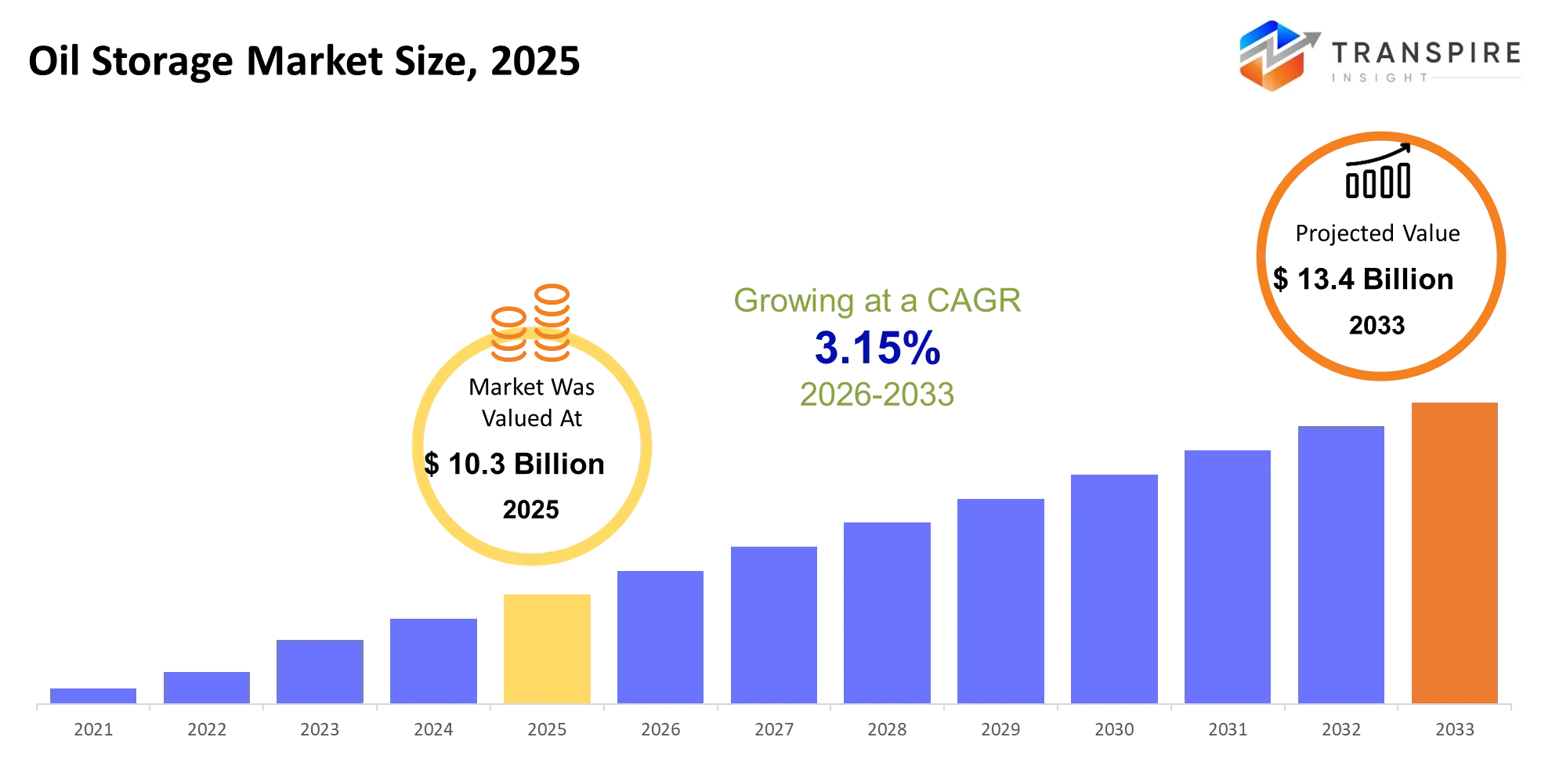
- Market Value (2025): USD 10.3 Billion.
- Expected Market Value (2026): USD 10.6 Billion.
- Estimated Market Value (2033): USD 13.4 Billion.
- Forecast CAGR (2026-2033): 3.15%.
- Leading Region in 2025: Middle East & Africa
- Second-largest Region: North America
- Fastest Growing Region: Asia Pacific
Introduction
According to the Grand View Research Oil Storage Market Report, the oil storage market is considered to encompass both the total volume and the economic value associated with the creation, functioning, and application of storage facilities for crude oil and processed oil products. It involves a network of land-based terminals, offshore installations, oil storage facilities and state oil reserves aimed at balancing between supply and demand and guaranteeing energy security. Oil storage is the process of keeping, protecting, and storing crude oil, refined fuels (such as petrol, diesel, and jet fuel), and liquefied hydrocarbons in specific tanks or underground caves with the aim of maintaining supply chains and securing energy supply. Oil storage infrastructure plays a vital role in strengthening energy security by enabling governments and corporations to maintain Strategic Petroleum Reserves (SPRs) against unexpected supply disruptions, import failures, and geopolitical uncertainties. Storage facilities provide essential supply chain flexibility by absorbing fluctuations caused by crude oil production disruptions, refinery outages, and transportation challenges. Additionally, oil storage supports price optimization by allowing market participants to store excess petroleum during periods of oversupply or lower prices and strategically release inventories during demand surges, ensuring market stability, operational continuity, and efficient resource management across the energy sector.
For instance: The market has Shale crude accommodation, terminal upgrading, and compliance with environmentally friendly floating roof tanks are the main areas of investment in the North American business.
Market Highlights: -
- Middle East & Africa is anticipated to hold around 35% share of the Oil Storage Market over the predicted timeframe.
- North America is expected to grow at a rapid CAGR in the Oil Storage Market by holding roughly 39% of the share during the forecast period.
- Asia Pacific is anticipated to hold roughly 32% share of the Oil Storage Market over the predicted timeframe.
- By storage type, the Above-ground Tanks segment dominated the market and holds nearly 68% share in 2025 and is projected to grow at a substantial CAGR during the forecast period.
- By material, the Steel segment dominated the market and holds nearly 57% share in 2025 and is projected to grow at a substantial CAGR during the forecast period.
- By end user, the Oil & Gas segment dominated the market and holds nearly 40% share in 2025 and is projected to grow at a substantial CAGR during the forecast period.
- India has entrusted Oil and Natural Gas Corporation (ONGC) with the task of setting up a new $1.6 billion Strategic Petroleum Reserve (SPR) facility in the city of Mangaluru, Karnataka, thus augmenting the country’s crude oil storage capacity and energy security. This project signifies an increase in worldwide investment in strategic oil storage infrastructure to avert supply disruptions and improve market resilience
How is Technology Driving Growth in the Oil Storage Market?
In order to improve operational effectiveness, safety and regulatory compliance, the worldwide oil storage market is progressively implementing smart technologies. IoT-enabled monitoring systems assist avoid leaks, overflows, and operational risks by checking tank temperature, pressure, and inventory levels in real-time. By lowering emissions and promoting adherence to clean-air laws, automated vapor recovery systems enhance environmental performance. Predictive maintenance is made possible by the combination of automation and artificial intelligence (AI), which lowers equipment failure rates and unscheduled downtime. Advanced inventory management systems maximize supply chain effectiveness, blending processes, and storage use. Additionally, by facilitating quicker, safer, and more precise evaluations of storage infrastructure, structural integrity, and environmental performance, drone-based aerial inspections, LiDAR technology, and thermal imaging technologies are transforming terminal monitoring.
Market Drivers
Increase in strategic oil reserves governments are increasing strategic oil reserves in order to boost energy security, decrease dependence on geopolitical threats, and minimize the impact of sudden changes in the energy market. An increase in investments in reserve development leads to greater demand for oil storage facilities. Surge in energy demand increased industrialization, urbanization, and population migration in developing countries drive long-term demand for oil and oil products. Growth in energy demand results in investments in storage and transport systems that help to coordinate supply schedules. Instability of prices and market efficiency swing in crude oil prices around the world motivates traders and energy companies to take advantage of the use of storage systems. Use of oil storage systems allows companies to make profits during fluctuations in prices. Expansion of refining capacity, the establishment of big refineries and development of downstream production make the need for intermediate and terminal storage more urgent. Additional refining output requires modern oil storage systems. Technological innovations, introduction of modern technologies, IoT monitoring systems, automated tanks and floating roof tanks permits equipment to be more efficient, secure, and compliant with legislation. The equipment can also improve the performance of the assets. Security of supply provides an important cushion in case of abrupt geopolitical upheavals, natural calamities, or unforeseen drop in production output from key suppliers. Arbitaration of prices enables traders and businesses to keep inventories of surplus crude oil or refined oil while prices are low and sell these inventories when prices go up. Operational consistency: Provides continuous supply of feedstock to refiners and petrochemical plants that helps eliminate imbalances in mise and distribution channels.
For Instance: -
- North American production dominance, strategic reserves, and modernization investments are driving the oil storage market. The United States and other major national hubs are the focal points of important infrastructure and financial drivers.
- Due to increased energy consumption, strategic petroleum reserve expansions, and significant infrastructure investments in the Asia-Pacific region, the oil storage industry is growing quickly.
Restrain
The international oil storage industry is encountering difficulties owing to soaring construction and maintenance costs, strict environmental standards, growing compliance requirements, and increasing investment in renewable energy solutions. Additionally, scarce land availability around relevant ports and business centers presents major obstacles to new capacity building and storage installation expansion.
Analysis of Prices and Consumer Behaviour
The market for tanks used for aboveground storage of oil accounts for around 68% of the oil storage market mainly because of high levels of implementation at crude oil terminals, oil refineries, oil distribution systems, and storage facilities. The prices of modern automated storage technology will be around 20-30% more than those of traditional storage solutions since these technologies are equipped with IoT-based monitoring, automated controls as well as other features inclusive of enhanced safety elements. It should be noted that about 60% of total world oil storage capacity is concentrated in aboveground storage tanks due to factors like cost-effectiveness, ease of maintenance, scalability, and flexibility. In turn, the oil and gas industry accounts for almost 70% of total demand, which is promoted by the growth in the production of crude oil and refining usage rates combined with various programs to improve energy security worldwide. The research of the priorities of storage operators shows that more than 50% of operators are primarily interested in storage volume, safety, efficiency, and asset reliability. Around 30-35% of buyers are interested in formalizing long-term agreements and developing partnerships that will allow them to minimize their operating costs.
Top Companies in the Oil Storage Market
- CST Industries
- McDermott International
- CB&I Storage Solutions
- Snyder Industries
- PermianLide
- Toyo Kanetsu
- Superior Tank
- Highland Tank
- Fox Tank Company
- Matrix Service Company
- TF Warren Group
- Ishii Iron Works
- Rosenbauer
- GSC Tanks
- Polymaster
Market Segmentation
The Oil Storage Market share is divided into five categories: By storage type, material, product stored, end user and capacity.
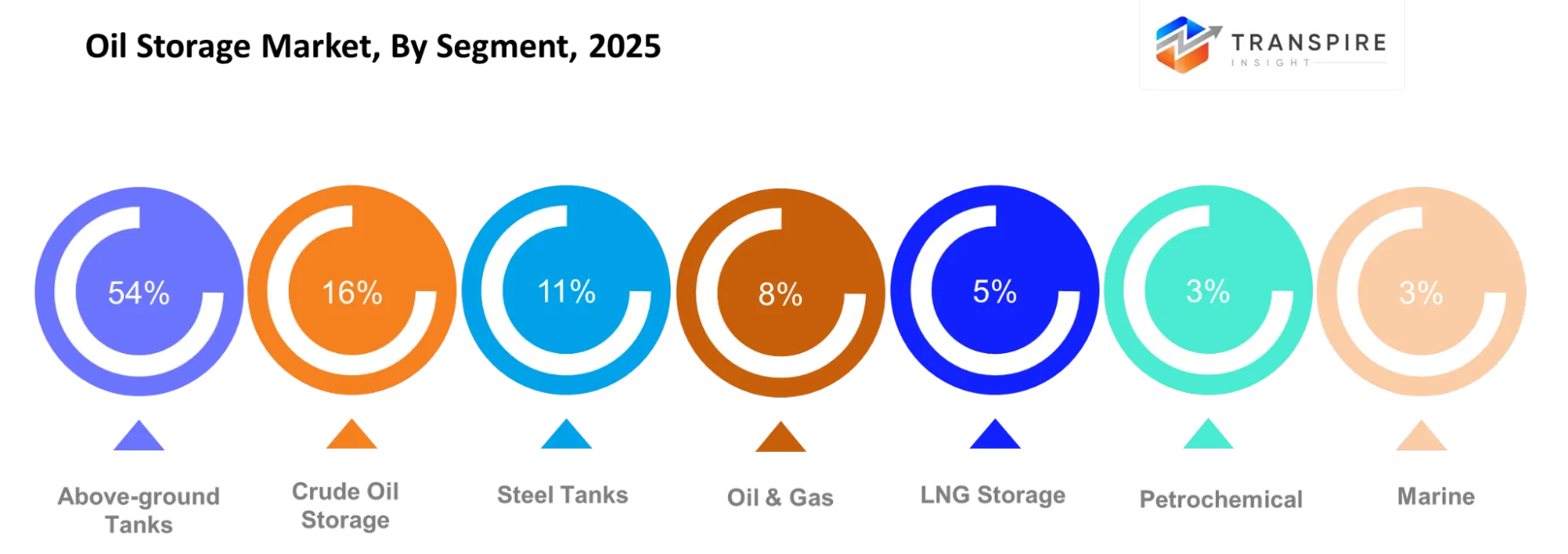
The Above-ground Tanks dominated the market, accounting for nearly 68% in 2025 and is expected to rise at a significant CAGR during the forecast period.
The Oil Storage Market is segmented by storage type into Above-ground Tanks, Underground Tanks, Floating Roof Tanks, Fixed Roof Tanks, Spherical Tanks, Bullet Tanks, Modular Tanks, Others Among these, the Above-ground Tanks segment dominated the market, accounting for nearly 68% in 2025 and expected to increase at a significant CAGR during the forecast period. Many industry players are shifting from below-ground storage to tanks above-ground as a result of numerous benefits offered by these tanks, including cost-efficient installation, easy maintenance, better access, and flexibility in operation. Above-ground tanks are very popular among oil and gas, water treatment, and chemical industry players owing to quick deployment, compliance with regulations, as well as cost-saving storage plans.
The Steel dominated the market, accounting for nearly 57% in 2025, and is expected to rise at a significant CAGR during the forecast period.
The Oil Storage Market is segmented by material into Steel, Carbon Steel, Stainless Steel, Fiberglass, Concrete, Polyethylene, Composite Materials, Others. Among these, the Steel segment dominated the market, accounting for nearly 57% in 2025 and expected to increase at a significant CAGR during the forecast period. The steel sector leads the industry because of its unique characteristics like durability, high strength resistance to corrosion, and amazing operational life. The tanks made of steel have been used widely in oil and gas industries, as well as in chemical, waste treatment, and industrial storage sectors, due to their great strength capabilities, compliance with the regulations, and usage at minimal costs, which makes them popular among customers that need cheap storage for their products.
The Oil & Gas dominated the market, accounting for nearly 25% in 2025 and is expected to rise at a significant CAGR during the forecast period.
The Oil Storage Market is segmented by end user into Oil & Gas, Petrochemical, Power Generation, Marine, Aviation, Industrial, Government Reserves, Others. Among these, the Oil & Gas segment dominated the market, accounting for nearly 25% in 2025 and expected to increase at a significant CAGR during the forecast period. The majority of the market is held by oil and gas segment because of high demand for efficient storage of bulk liquids in the upstream, midstream, and downstream sectors. The increasing energy consumption and the rapid growth of oil refinery capacity, strategic petroleum reserves, and investments in storage infrastructure across the globe are resulting in a steady growth of need for high-quality industrial tanks.
Regional Segment Analysis of the Oil Storage Market:
- North America (U.S., Canada, Mexico)
- Europe (Germany, France, U.K., Italy, Spain, Rest of Europe)
- Asia-Pacific (China, Japan, India, Rest of APAC)
- South America (Brazil and the Rest of South America)
- The Middle East and Africa (UAE, South Africa, Rest of MEA)
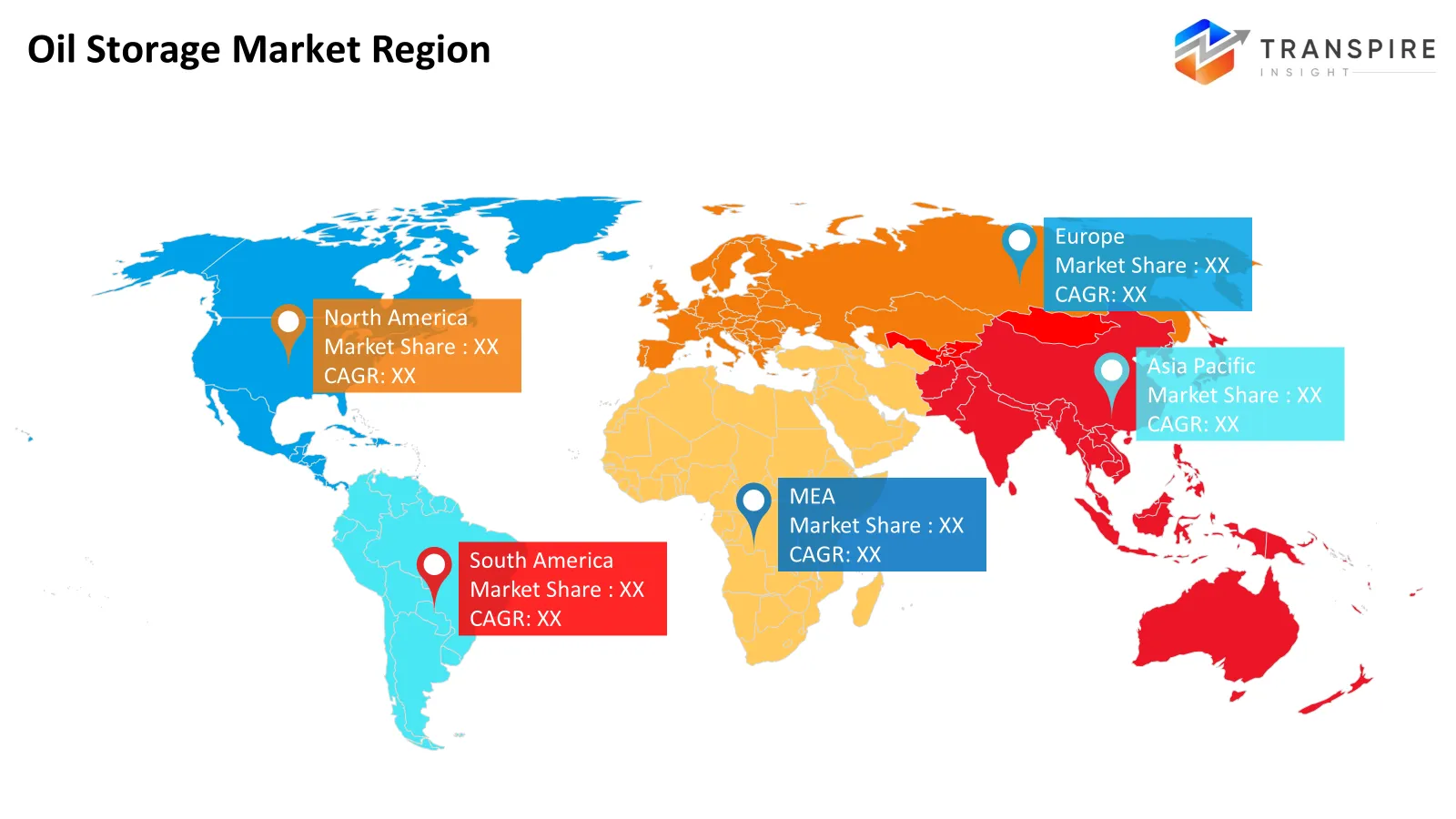
Middle East & Africa is expected to grow at a rapid CAGR in theOil Storage Market, holding around 35% of the share during the forecast period.
Middle East & Africa is expected to grow at a rapid CAGR in the Oil Storage Market holding around 35% share during the forecast period. The oil storage industry in the Middle East & Africa is being driven by a number of factors, including the existence of large crude oil reserves, increasing refinery capacity, rising export activities, and large-scale investments in energy infrastructure. In addition, the growth of strategic petroleum reserve projects and the rising need for bulk storage facilities will further enhance the growth of the regional market in the forecast period.
North America is the fastest-growing region in the Oil Storage Market during the period, holding roughly 39% share.
North America is expected to grow at a rapid CAGR in the Oil Storage Market holding roughly 39% share during the forecast period. The rapid growth of the oil storage market in North America is due to high shale oil production, the increase of strategic reserves, the growth of oil exports, and constant improvement in terminal infrastructure. A good pipeline system, new technologies of storage, and increased energy security programs is driving the demand for storage areas.
Asia Pacific is the fastest-growing region in the Oil Storage Market during the period, holding roughly 32% share.
Asia Pacific is the fastest-growing region in the Oil Storage Market during the forecast period, holding roughly 32% share during the forecast period. The Asia Pacific region shows the fastest expansion in the oil storage market due to higher levels of energy consumption and refining capacity, increased importation of crude oil, and faster industrialization. Various government initiatives, such as strategic petroleum reserves investments, port expansion programs, and energy security departments have further increased the impact of growing demand from newly developing economies.
Strategies for Market Growth in Non-Leading Regions:
With the development of sophisticated and scalable oil storage systems, small and medium-sized terminal operators and energy companies could benefit in many ways. The establishment of storage terminals locally, expansion of oil tank farms, and the development of storage centers in regional locations could lead to a decrease in dependence on supply chains, improvement of energy security, and minimization of operational costs. Formulation of cooperative relationships with oil producers, oil refineries, logistics companies, and energy distributors would facilitate the penetration into the market as well as the creation of oil storage facilities’ network. Improvement in oil storage management skills, automation of terminal processes, safety measures, leak detection, and inventory management will require the implementation of training programs. In addition to that, the use of various financing schemes, signing of long-term storage agreements, and making use of some PPP schemes would improve availability of advanced oil storage solutions.
Future Market Trends for the Oil Storage Market: -
- Strategic Petroleum Reserves (SPR): The various governments around the world have made significant contributions towards building up their Strategic Petroleum Reserves (SPR) to avoid the risk of a disruption in the supply chain due to crises across the globe.
- Underground Storage Caverns: Underground salt caverns and rock storage systems are preferred when compared to above-ground storage systems due to the higher security that is offered, lower evaporation losses, and lower maintenance costs associated with using underground storage systems.
- Infrastructure for Clean Fuels: Modern terminals are being renovated to handle ultra-low-sulfur diesel (ULSD) and renewable diesel mixtures since they require special internal tank protection.
- Digitalization and IoT: The operators have embraced the growing popularity of the Internet of Things (IoT). Various programs have made it easier to monitor and detect leaks, as well as track the flow of inventory.
- Regional Shifts: The Asia-Pacific region continues to be the fastest-growing region in terms of building up the Strategic Petroleum Reserves (SPR) because of the fast pace of development in the industrial sector and the increase in refinery capacities in places like India and China.
Recent Development
- In July 2026: The International Energy Agency (IEA) has launched updated Oil Market Reports which underline some important developments in the oil market, including considerable oil inventory declines, geopolitical supply disruptions, and changing oil storage dynamics due to tensions in the Middle East. The reports pointed out the increasing importance of strategic oil storage infrastructure and inventory management in maintaining the energy security
- In April 2026: The report titled "Oil Storage Terminal Market Industry Size, Share, Trends, Opportunities, and Forecast" was released by Research and Markets. The report forecasts that the oil storage terminal market will grow from USD 43.17 billion in 2031. The growth is expected to be driven by an increasing crude oil demand, strategic petroleum reserves development of terminal infrastructure, automation, and rising investment in oil storage facilities around the world.
- In January 2026: According to an oil storage forecast from S&P Commodity Insights, commercial oil stocks exceeded 1.07 billion barrels due to heightened concerns over energy security, increased trading activity, and further investments in storage infrastructure. The importance of sophisticated oil storage facilities and strategic inventory management has been underscored in the report.
Market Segment
This study forecasts revenue at global, regional and country levels from 2020 to 2033. Transpire Insights has segmented the Oil Storage Market based on the below-mentioned segments:
Oil Storage Market, By Storage Type
- Above-ground Tanks
- Underground Tanks
- Floating Roof Tanks
- Fixed Roof Tanks
- Spherical Tanks
- Bullet Tanks
- Modular Tanks
- Others
Oil Storage Market, By Material
- Steel
- Carbon Steel
- Stainless Steel
- Fiberglass
- Concrete
- Polyethylene
- Composite Materials
- Others
Oil Storage Market, By Product Stored
- Crude Oil
- Refined Petroleum
- Lubricants
- LNG
- Biofuels
- Chemicals
- Industrial Oils
- Others
Oil Storage Market, By End User
- Oil & Gas
- Petrochemical
- Power Generation
- Marine
- Aviation
- Industrial
- Government Reserves
- Others
Oil Storage Market, By Capacity
- Below 10,000 Barrels
- 10,000-50,000 Barrels
- 50,000-100,000 Barrels
- 100,000-500,000 Barrels
- Above 500,000 Barrels
- Modular Capacity
- Custom Capacity
- Others
Oil Storage Market, By Regional Analysis
North America
- US
- Canada
- Mexico
Europe
- Germany
- UK
- France
- Italy
- Spain
- Russia
- Rest of Europe
Asia Pacific
- China
- Japan
- India
- South Korea
- Australia
- Rest of Asia Pacific
South America
- Brazil
- Argentina
- Rest of South America
Middle East & Africa
- UAE
- Saudi Arabia
- Qatar
- South Africa
- Rest of the Middle East & Africa
Frequently Asked Questions
Find quick answers to common questions.
The market will grow steadily, driven by energy security, SPR expansion, rising demand, refinery growth, and storage infrastructure investments.
Above-ground Tanks dominate with 68% share due to cost efficiency, easy maintenance, flexibility, and widespread industrial adoption.
Growth is driven by SPR investments, energy demand, supply security, refinery expansion, and advanced storage technology adoption.
IoT, AI, automation, and drones enhance monitoring, safety, predictive maintenance, efficiency, and regulatory compliance in storage operations.
Middle East & Africa, North America, and Asia Pacific grow through reserves, exports, refinery expansion, and infrastructure investments.
- CST Industries
- McDermott International
- CB&I Storage Solutions
- Snyder Industries
- PermianLide
- Toyo Kanetsu
- Superior Tank
- Highland Tank
- Fox Tank Company
- Matrix Service Company
- TF Warren Group
- Ishii Iron Works
- Rosenbauer
- GSC Tanks
- Polymaster
About the Authors

Avinash Kumar
I’m Avinash Kumar, a Senior Research Analyst at Transpire Insight, with expertise in the Electronics and Semiconductor and Energy & Power industry. My work focuses on analyzing emerging technologies, market trends, industry developments, and innovation across these sectors. I specialize in transforming complex technical and market insights into clear, research-backed content that helps professionals, businesses, and decision-makers stay informed. Through continuous industry research and data-driven analysis, I strive to deliver accurate, reliable, and practical perspectives on the latest advancements shaping the semiconductor and energy landscape.

Chakradhar Khansole
Chakradhar serves as the Research Director at Transpire Insight, bringing over 8 years of experience in technology, innovation, and strategic market intelligence. He specializes in transforming complex market data into actionable business insights that enable organizations to make informed, growth-oriented decisions. Recognized for his strategic vision and analytical expertise, Chakradhar leads high-impact research initiatives, delivering comprehensive market assessments, competitive intelligence, and forward-looking industry analysis.
Recently Published Reports
-
Apr 2026
Active Power Filter Market
Active Power Filter Market Size, Share & Analysis Report By Type (Shunt Active Power Filters, Series Active Power Filter, Hybrid Active Power Filter), By Application (Harmonics Mitigation, Reactive Power Compensation, Voltage Regulation, Power Factor Correction), By Phase (Single Phase, Three Phase), By End-User Industry (Manufacturing, Healthcare, Commercial, Automotive, Oil and Gas, Others), and Geography (North America, Europe, Asia-Pacific, Middle East and Africa, South and Central America), 2021 - 2031
-
Apr 2026
Electrical Transformer Market
Electrical Transformer Market Size, Share & Analysis Report By Core (Closed, Shell, and Berry), By Insulation (Gas, Oil, Solid, Air, and Other), By Phase (Single, and Three), By Rating (100 MVA to 500 MVA, 501 MVA to 800 MVA, and 801 MVA to 1200 MVA), and Geography (North America, Europe, Asia-Pacific, Middle East and Africa, South and Central America), 2021 – 2031
-
Apr 2026
Hydraulic Piston Pumps Market
Hydraulic Piston Pumps Market Size, Share & Analysis Report By Type (Axial Piston Pumps, Radial Piston Pumps), By Operating Pressure (Low Pressure, Medium Pressure, High Pressure), By Application (Construction, Mining, Agriculture, Automotive, Oil & Gas, Industrial Machinery, Others), By End-User (OEMs, Aftermarket), and Geography (North America, Europe, Asia-Pacific, Middle East and Africa, South and Central America), 2021 – 2031
-
Apr 2026
Laboratory Gas Generators Market
Laboratory Gas Generators Market Size, Share & Analysis Report By Product (Nitrogen Gas Generator, Hydrogen Gas Generator, Zero Air Gas Generator, Purge Gas Generator, TOC Gas Generators, Others), By Application (Gas Chromatography, Liquid Chromatography-mass Spectrometry (LC-MS), Gas Analyzers, Others), By End-user (Life Science, Chemical & Petrochemical, Food & Beverage, Others), and Geography (North America, Europe, Asia-Pacific, Middle East and Africa, South and Central America), 2021 – 2031