
Europe LPG (Liquefied Petroleum Gas) Market Size & Forecast:
- Europe LPG (Liquefied Petroleum Gas) Market Size 2025: USD 39.67 Billion
- Europe LPG (Liquefied Petroleum Gas) Market Size 2033: USD 50.55 Billion
- Europe LPG (Liquefied Petroleum Gas) Market CAGR: 3.08%
- Europe LPG (Liquefied Petroleum Gas) Market Segments:By Source (Refinery, Natural Gas Processing, Others); By Application (Residential, Commercial, Industrial, Autogas, Others); By Distribution Channel (Bulk Supply, Cylinders, Pipelines, Others); By End User (Households, Industries, Transportation, Others); By Product Type (Propane, Butane, LPG Mix, Others); By Storage Type (Pressurized Tanks, Cylinders, Others)
Europe LPG (Liquefied Petroleum Gas) Market Summary
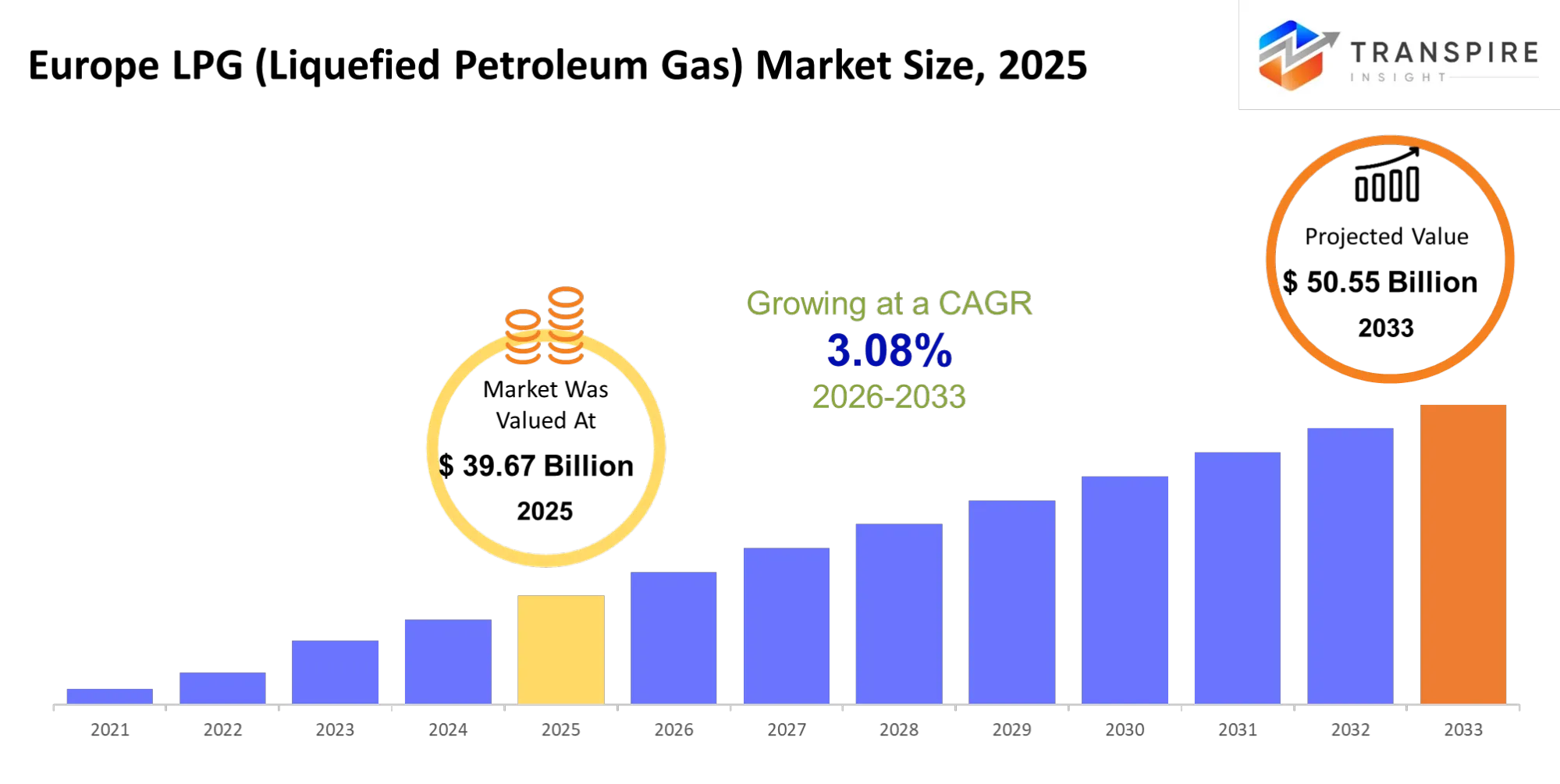
The Europe LPG (Liquefied Petroleum Gas) Market was valued at USD 39.67 billion in 2025. It is forecast to reach USD 50.55 billion by 2033. That is a CAGR of 3.08% over the period.
The Europe LPG Market helps people with their heating, cooking and energy needs for industries where it is hard to build pipelines or it is too expensive. It is also very important for getting energy to areas as a backup for industrial fuel systems and for commercial use in construction, farming and small factories. When it comes to ships and logistics LPG is used as a fuel because there are stricter rules about emissions.
In the few years something big has changed in Europe. The continent is moving towards using fuels that're better for the environment and LPG is seen as a way to get from traditional fossil fuels to renewable energy sources. This change happened faster after there were problems with getting gas in 2022, which made people worried about energy security. Because of this industries and utilities started using LPG more to keep things running smoothly and to rely less on gas that comes through pipelines.
This mix of wanting to use energy and having problems with the supply chain has made the demand, for LPG more stable. Now the market benefits from being able to get LPG from places having more space to store it and being used more in systems that make energy in a decentralized way. All these things help the Europe LPG Market make money consistently in both industries and homes.
Key Market Insights
- Western Europe leads the Europe LPG market with a 40-45% share in 2025. This is because it has storage facilities and well-established distribution networks for LPG.
- Eastern Europe is growing fast. It will grow the most from 2026 to 2033. This is because people in areas need energy that is not connected to the main grid. Also pipelines in these areas have limitations.
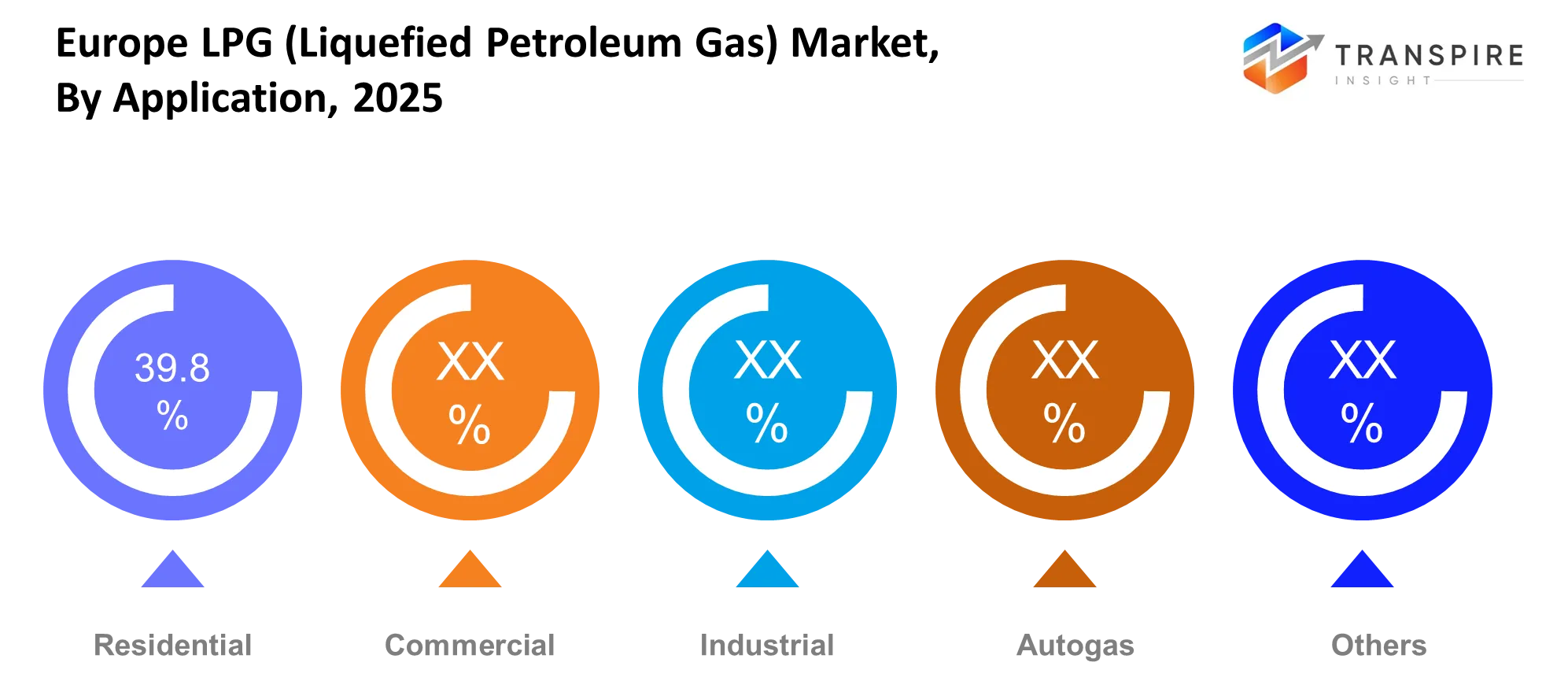
- People use LPG the most for heating their homes. It makes up over 35% of the market. This is because many are switching from natural gas systems to LPG since 2022.
- Industries, small and medium-sized enterprises (SMEs) use LPG a lot. They find it to be a cost- flexible energy source.
- Autogas, which is LPG used as a transportation fuel is growing fast. More and more fleets are switching to it because it has emissions.
- Most people use LPG for heating. However its use for cooking remains steady in semi-urban areas.
- Industries are increasingly using LPG as an energy source. This is because there have been disruptions in the gas supply.
- Companies like TotalEnergies and Shell are working on expanding their LPG storage and distribution networks. This is to make sure the supply of LPG is secure, in the region.
- Repsol is investing in making its distribution more efficient. It is also working on blending LPG with fuels.
- BP is focusing on changing its energy strategy. It wants to link its LPG supply with low-carbon fuels.
What are the Key Drivers, Restraints, and Opportunities in the Europe LPG (Liquefied Petroleum Gas) Market?
Drivers
The Europe LPG market is driven by the need for energy security in Europe. This is because there were problems with the supply of gas after 2022. As a result people started to use LPG as a temporary solution for heating and industry. Governments and utility companies built storage facilities and found new ways to import LPG. This led to an increase in the amount of LPG bought and sold which in turn increased revenue from LPG sales to homes and businesses.The Europe LPG market is also driven by the need for energy systems that can work on their own. This is especially true in industrial areas.
Restraints
However the Europe LPG market is limited by its reliance on fuels. This is a problem because Europe wants to reduce its use of fuels. Even though LPG is cleaner than coal and oil it still produces carbon emissions. This means that governments may not support the use of LPG in the term. As a result companies may be less likely to invest in LPG infrastructure, which could slow down the growth of the Europe LPG market in some European countries.
Opportunity
There is an opportunity for the Europe LPG market in the use of autogas and hybrid energy systems especially in Central and Eastern Europe. Many transport companies are switching from diesel to autogas because it is better for the environment and costs less. Countries that are building roads and transport systems, in rural areas are creating opportunities for LPG to be used in logistics and public transport. This could lead to demand for LPG until 2033. The Europe LPG market is expected to benefit from this trend.
What Has the Impact of Artificial Intelligence Been on the Europe LPG (Liquefied Petroleum Gas) Market?
LPG distribution networks are changing in Europe because of intelligence and new digital technologies. These changes are making storage management and logistics better. They are also making it easier to predict when people will need LPG.
In the places where LPG is stored artificial intelligence is helping to track how much LPG is there and control the pressure. This means that people do not have to do these things by hand which makes it safer. Digital tools are also helping the trucks that carry LPG to find the routes, which means they can deliver LPG on time. This is important for people who live in areas and for industries that need LPG.Artificial intelligence is being used to predict how much LPG people will need. It looks at the weather. What industries are doing to make these predictions. This helps the people who supply LPG to plan better. They can make sure they have LPG and do not have to move it around at the last minute.
Artificial intelligence is also being used to check the equipment that is used to store and move LPG. It can find problems before they happen which means that the equipment can be fixed before it breaks. This makes sure that LPG is always available when people need it.There is a problem. It costs a lot of money to put intelligence into old LPG storage and transport systems. Many companies that distribute LPG are still using systems that are not compatible, with new digital technologies. This makes it hard to get the information that is needed to make decisions. So many companies are starting to use artificial intelligence and other digital technologies to make their LPG distribution networks better.
Key Market Trends
- The Europe LPG market changed a lot after 2022 because people in Western Europe started to look for sources of LPG when they did not want to depend on Russian gas as much.
- People invested money in storage facilities, which increased by more than 20 percent between 2023 and 2025 and this helped to make sure that people in rural areas had a steady supply of energy.
- In Germany and France people started using LPG systems for heating their homes of pipeline gas especially when the prices of energy went up and down a lot.
- More and more people started using Autogas companies that had big fleets of vehicles because they wanted to use less diesel and meet the new rules about emissions that the European Union put in place in 2024.
- medium-sized businesses that made things started using LPG instead of oil for their backup systems, which helped them to keep working even when the power was out.
- The Europe LPG market started getting LPG from the US and the Middle East which helped to reduce the risk of depending on one source and made the prices of LPG in Europe more stable.
- More and more LPG terminals started using systems to keep track of their inventory, which used artificial intelligence to make logistics more efficient and reduce the chances of running out of stock.
- TotalEnergies expanded its LPG distribution networks in Central Europe, which helped to make the supply of LPG more reliable.
- Shell made its LPG trading operations better by focusing on getting LPG from sources and storing it in a way that was more efficient.
- Because of pressure from the government to reduce carbon emissions people, in Europe started to use LPG-electric heating systems, which was a gradual change that happened over time in urban areas.
Europe LPG (Liquefied Petroleum Gas) Market Segmentation
By Source:
The Europe LPG market gets its supply from refineries and natural gas processing. Refineries are still very important because they are connected to fuel production systems in big European energy hubs. Natural gas processing also adds an amount of LPG because the gas infrastructure helps to recover LPG consistently. This balance keeps the supply stable when crude oil prices change.The supply also depends on imports and how much LPG each region can produce. Countries with refineries have enough LPG for their people but others need to buy it from other countries. This makes the LPG market in Europe sensitive to changes in energy conditions.
By Application:
People in Europe use LPG a lot for heating, cooking and backup energy at home. Businesses like restaurants and hotels also use LPG for their operations. Factories use it for heating and making things.More and more transport companies are using LPG because it produces emissions. This is because LPG is available and cheaper in some areas. All these different uses help to keep the demand for LPG steady throughout the year.
By Distribution Channel:
LPG is delivered in bulk to industrial and commercial customers. Small businesses and homes use cylinders because they are easy to move. In some areas LPG is delivered through pipelines.The way LPG is delivered depends on how developed the energy infrastructure's how many people live in an area. In cities pipelines are used a lot. In rural areas cylinders are more common. This mix of delivery methods helps to get LPG to people over Europe.
By End User:
Many households in Europe use LPG for cooking and heating. Factories also use it for heating and making things. Some vehicles, like fleets use LPG of other fuels.The way people use LPG depends on how much they pay for energy and what infrastructure they have. Factories use LPG steadily. Households use more in the winter. More and more vehicles are using LPG because it is an alternative.
By Product Type:
In areas propane is used a lot because it works well in low temperatures. In areas butane is used more because it is suitable for indoor use. Some LPG products are a mix of propane and butane which helps them work well in temperatures.The type of LPG used depends on the climate. What it is used for. Suppliers change the mix of propane and butane to make sure it works well in temperatures.
By Storage Type:
Big industrial and commercial customers use pressurized tanks to store LPG. Small businesses and homes use cylinders because they are easy to handle.The way LPG is stored is important, for getting it to customers reliably. Big tanks help to store a lot of LPG and cylinder networks help to get it to peoples homes. This helps to make sure that LPG is always available.
What are the Key Use Cases Driving the Europe LPG (Liquefied Petroleum Gas) Market?
People in Europe use Liquefied Petroleum Gas for heating and cooking at home. This is the reason Liquefied Petroleum Gas is used in the Europe LPG Market. It is reliable. People can use it when they do not have access to pipelines. Liquefied Petroleum Gas helps people have energy when it is cold outside. They need to heat their homes. This is when Liquefied Petroleum Gas is used the most.
Some businesses also use Liquefied Petroleum Gas. Restaurants and hotels use Liquefied Petroleum Gas for cooking because it is easy to control. Small factories use Liquefied Petroleum Gas to heat things up when electricity's too expensive. These businesses help keep the demand for Liquefied Petroleum Gas steady in cities and towns.
There are ways that Liquefied Petroleum Gas is being used. Some cars and buses are starting to use Liquefied Petroleum Gas because it's a good alternative, to other fuels. Liquefied Petroleum Gas is also used as a backup when the electricity goes out in areas. This is becoming more popular as people want to make sure they have energy when they need it. Liquefied Petroleum Gas will likely keep being used more and more over time.
|
Report Metrics |
Details |
|
Market size value in 2025 |
USD 39.67 Billion |
|
Market size value in 2026 |
USD 40.89 Billion |
|
Revenue forecast in 2033 |
USD 50.55 Billion |
|
Growth rate |
CAGR of 3.08% from 2026 to 2033 |
|
Base year |
2025 |
|
Historical data |
2021 - 2024 |
|
Forecast period |
2026 - 2033 |
|
Report coverage |
Revenue forecast, competitive landscape, growth factors, and trends |
|
Regional scope |
United States; Canada; Mexico; United Kingdom; Germany; France; Italy; Spain; Denmark; Sweden; Norway; China; Japan; India; Australia; South Korea; Thailand; Brazil; Argentina; South Africa; Saudi Arabia; United Arab Emirates |
|
Key company profiled |
SHV Energy, UGI Corporation, TotalEnergies, Shell, BP, Repsol, DCC plc, Primagaz, Gasum, Vitol, Petredec, Chevron, Gazprom, ENI, Calor Gas |
|
Customization scope |
Free report customization (country, regional & segment scope). Avail customized purchase options to meet your exact research needs. |
|
Report Segmentation |
By Source (Refinery, Natural Gas Processing, Others); By Application (Residential, Commercial, Industrial, Autogas, Others); By Distribution Channel (Bulk Supply, Cylinders, Pipelines, Others); By End User (Households, Industries, Transportation, Others); By Product Type (Propane, Butane, LPG Mix, Others); By Storage Type (Pressurized Tanks, Cylinders, Others) |
Which Regions are Driving the Europe LPG (Liquefied Petroleum Gas) Market Growth?
Residential heating and cooking remain the core use case in the Europe LPG (Liquefied Petroleum Gas) Market, driven by reliable energy access in areas without full pipeline infrastructure. LPG supports consistent household energy supply during peak winter demand when heating requirements rise sharply across colder European regions. This steady consumption base creates the highest share of overall demand.
Commercial kitchens, hospitality services, and small industrial heating systems are expanding use cases. Restaurants and hotels depend on LPG for fast, controllable cooking energy, while small manufacturing units use it for process heating where electricity costs remain high. These applications strengthen mid-scale consumption stability across urban and semi-urban zones.
Autogas adoption and rural electrification backup systems represent emerging applications. Transport operators are gradually shifting to LPG-powered fleets in regions with fuel diversification policies. Backup energy systems in remote installations also show rising interest as energy security concerns increase, supporting gradual long-term expansion of demand.
Who are the Key Players in the Europe LPG (Liquefied Petroleum Gas) Market and How Do They Compete?
Competition in the Europe LPG (Liquefied Petroleum Gas) Market remains moderately consolidated, with large integrated energy suppliers controlling upstream sourcing and distribution networks while regional distributors serve localized demand. Incumbents focus on protecting long-term supply contracts and infrastructure access, while smaller players compete through regional pricing flexibility and service reliability. Cost efficiency and secure logistics capacity remain the primary competitive levers, especially in cross-border LPG trading and storage operations.
TotalEnergies strengthens its position through vertically integrated supply chains, linking refinery output with downstream distribution networks across Europe. This structure reduces exposure to import volatility and improves pricing stability for industrial customers. Expansion is supported through long-term energy transition investments and partnerships in low-carbon fuel logistics infrastructure.
Shell focuses on trading capability and global supply optimization, leveraging its international LPG sourcing network to balance regional shortages. Its differentiation comes from advanced trading analytics and flexible cargo allocation across European terminals. Growth continues through strategic investments in storage terminals and cross-border supply agreements.Repsol emphasizes refinery-linked LPG production in Southern Europe, using domestic refining strength to maintain competitive pricing. The company expands through downstream retail distribution and partnerships with regional energy distributors, improving last-mile reach. This localized integration provides resilience against imported LPG price fluctuations.
BP competes through portfolio diversification and strong LNG-LPG integration strategies. Its differentiation lies in integrated fuel supply optimization across multiple energy products, improving customer flexibility. Expansion includes infrastructure upgrades in European storage hubs and participation in multi-energy transition projects.
Company List
- SHV Energy
- UGI Corporation
- TotalEnergies
- Shell
- BP
- Repsol
- DCC plc
- Primagaz
- Gasum
- Vitol
- Petredec
- Chevron
- Gazprom
- ENI
- Calor Gas
Recent Development News
“In March 2026, TotalEnergies signed a long-term LPG supply agreement with India-based import and distribution partners to strengthen flexible LPG sourcing into Europe-linked trading flows. The agreement enhances supply diversification and improves resilience of LPG imports into European downstream distribution networks during volatile global energy pricing conditions.”https://totalenergies.com
“In January 2026, Shell expanded its European LPG autogas infrastructure partnership with multiple fleet operators to accelerate low-emission LPG vehicle adoption across urban logistics corridors. The initiative strengthens autogas demand stability and supports infrastructure-driven LPG consumption growth in transport applications.”https://www.shell.com
“In November 2025, Repsol completed the upgrade of its Tarragona LPG storage and distribution terminal to increase pressurized storage capacity for propane–butane blends. The expansion improves regional supply security and enhances flexibility in meeting seasonal residential and industrial LPG demand across Southern Europe.”https://www.repsol.com
What Strategic Insights Define the Future of the Europe LPG (Liquefied Petroleum Gas) Market?
Europe’s LPG market is structurally shifting toward a transitional fuel role rather than long-term energy anchoring, with demand increasingly shaped by energy security buffering, industrial backup systems, and off-grid residential dependence rather than pure substitution growth. Over the next 5–7 years, this direction is driven by uneven electrification across Southern and Eastern Europe, alongside policy-driven pressure to decarbonize heating, which is gradually constraining traditional residential LPG expansion while preserving niche demand pockets. A less obvious risk is accelerated demand erosion from hybrid heat-pump–LPG systems that extend electrification deeper into semi-urban and rural zones, reducing per-household LPG intensity without a visible drop in installation base. An emerging opportunity lies in renewable LPG (bio-LPG) blending mandates, which could unlock premium pricing and regulatory-backed demand pools as decarbonization rules tighten. Strategically, market participants should invest early in bio-LPG sourcing partnerships and infrastructure blending capability to avoid stranded asset risk and maintain relevance within Europe’s evolving low-carbon fuel hierarchy.
Europe LPG (Liquefied Petroleum Gas) Market Report Segmentation
By Source
- Refinery
- Natural Gas Processing
- Others
By Application
- Residential
- Commercial
- Industrial
- Autogas
- Others
By Distribution Channel
- Bulk Supply
- Cylinders
- Pipelines
- Others
By End User
- Households
- Industries
- Transportation
- Others
By Product Type
- Propane
- Butane
- LPG Mix
- Others
By Storage Type
- Pressurized Tanks
- Cylinders
- Others
Frequently Asked Questions
Find quick answers to common questions.
The expected Europe LPG (Liquefied Petroleum Gas) Market size for the market will be USD 50.55 Billion in 2033.
Key segments for the Europe LPG (Liquefied Petroleum Gas) Market are By Source (Refinery, Natural Gas Processing, Others); By Application (Residential, Commercial, Industrial, Autogas, Others); By Distribution Channel (Bulk Supply, Cylinders, Pipelines, Others); By End User (Households, Industries, Transportation, Others); By Product Type (Propane, Butane, LPG Mix, Others); By Storage Type (Pressurized Tanks, Cylinders, Others).
Major Europe LPG (Liquefied Petroleum Gas) Market players are SHV Energy, UGI Corporation, TotalEnergies, Shell, BP, Repsol, DCC plc, Primagaz, Gasum, Vitol, Petredec, Chevron, Gazprom, ENI, Calor Gas.
The Europe LPG (Liquefied Petroleum Gas) Market size is USD 39.67 Billion in 2025.
The Europe LPG (Liquefied Petroleum Gas) Market CAGR is 3.08% from 2026 to 2033.
- SHV Energy
- UGI Corporation
- TotalEnergies
- Shell
- BP
- Repsol
- DCC plc
- Primagaz
- Gasum
- Vitol
- Petredec
- Chevron
- Gazprom
- ENI
- Calor Gas
About the Authors

Avinash Kumar
I’m Avinash Kumar, a Senior Research Analyst at Transpire Insight, with expertise in the Electronics and Semiconductor and Energy & Power industry. My work focuses on analyzing emerging technologies, market trends, industry developments, and innovation across these sectors. I specialize in transforming complex technical and market insights into clear, research-backed content that helps professionals, businesses, and decision-makers stay informed. Through continuous industry research and data-driven analysis, I strive to deliver accurate, reliable, and practical perspectives on the latest advancements shaping the semiconductor and energy landscape.

Chakradhar Khansole
Chakradhar serves as the Research Director at Transpire Insight, bringing over 8 years of experience in technology, innovation, and strategic market intelligence. He specializes in transforming complex market data into actionable business insights that enable organizations to make informed, growth-oriented decisions. Recognized for his strategic vision and analytical expertise, Chakradhar leads high-impact research initiatives, delivering comprehensive market assessments, competitive intelligence, and forward-looking industry analysis.
Recently Published Reports
-
Apr 2026
Active Power Filter Market
Active Power Filter Market Size, Share & Analysis Report By Type (Shunt Active Power Filters, Series Active Power Filter, Hybrid Active Power Filter), By Application (Harmonics Mitigation, Reactive Power Compensation, Voltage Regulation, Power Factor Correction), By Phase (Single Phase, Three Phase), By End-User Industry (Manufacturing, Healthcare, Commercial, Automotive, Oil and Gas, Others), and Geography (North America, Europe, Asia-Pacific, Middle East and Africa, South and Central America), 2021 - 2031
-
Apr 2026
Electrical Transformer Market
Electrical Transformer Market Size, Share & Analysis Report By Core (Closed, Shell, and Berry), By Insulation (Gas, Oil, Solid, Air, and Other), By Phase (Single, and Three), By Rating (100 MVA to 500 MVA, 501 MVA to 800 MVA, and 801 MVA to 1200 MVA), and Geography (North America, Europe, Asia-Pacific, Middle East and Africa, South and Central America), 2021 – 2031
-
Apr 2026
Hydraulic Piston Pumps Market
Hydraulic Piston Pumps Market Size, Share & Analysis Report By Type (Axial Piston Pumps, Radial Piston Pumps), By Operating Pressure (Low Pressure, Medium Pressure, High Pressure), By Application (Construction, Mining, Agriculture, Automotive, Oil & Gas, Industrial Machinery, Others), By End-User (OEMs, Aftermarket), and Geography (North America, Europe, Asia-Pacific, Middle East and Africa, South and Central America), 2021 – 2031
-
Apr 2026
Laboratory Gas Generators Market
Laboratory Gas Generators Market Size, Share & Analysis Report By Product (Nitrogen Gas Generator, Hydrogen Gas Generator, Zero Air Gas Generator, Purge Gas Generator, TOC Gas Generators, Others), By Application (Gas Chromatography, Liquid Chromatography-mass Spectrometry (LC-MS), Gas Analyzers, Others), By End-user (Life Science, Chemical & Petrochemical, Food & Beverage, Others), and Geography (North America, Europe, Asia-Pacific, Middle East and Africa, South and Central America), 2021 – 2031