
Global Pultruded Fiberglass Market Size & Forecast:
- Global Pultruded Fiberglass Market Size 2025: USD 2.33 Billion
- Global Pultruded Fiberglass Market Size 2033: USD 3.60 Billion
- Global Pultruded Fiberglass Market CAGR: 5.59%
- Global Pultruded Fiberglass Market Segments: By Resin Type (Polyester, Vinyl Ester, Epoxy, Polyurethane, Phenolic, Acrylic, Hybrid Resins, Others); By Product (Profiles, Gratings, Rods, Tubes, Angles, Channels, Beams, Others); By Application (Construction, Electrical, Infrastructure, Industrial, Transportation, Renewable Energy, Marine, Others); By End User (Construction Industry, Utilities, Transportation Sector, Marine Industry, Industrial Sector, Energy Sector, Commercial Sector, Others); By Process (Continuous Pultrusion, Custom Pultrusion, Automated Pultrusion, Closed Molding, Open Molding, Hybrid Processing, High-speed Processing, Others).
Global Pultruded Fiberglass Market Summary:
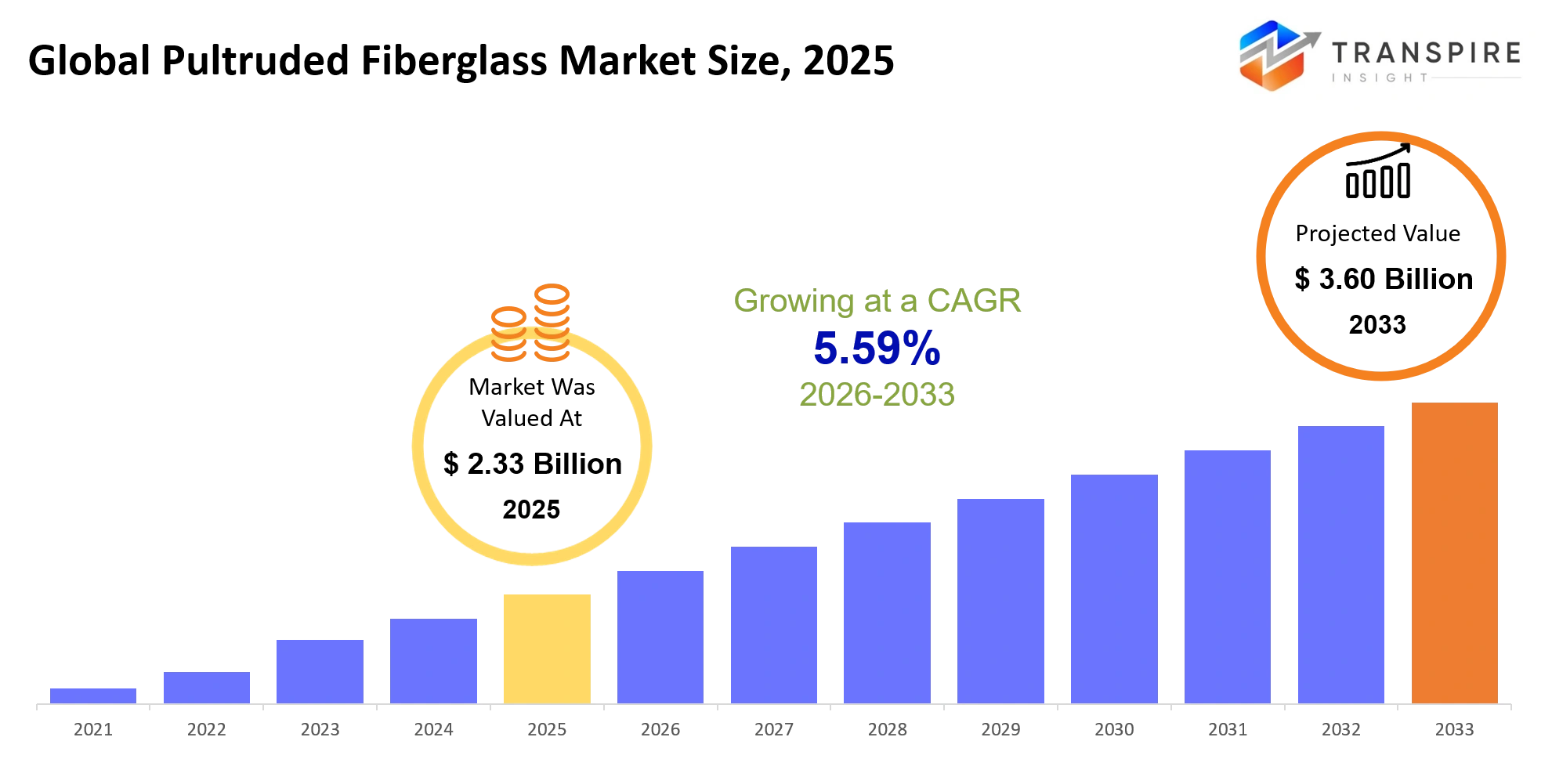
As per Transpire Insight Analysis, the Global Pultruded Fiberglass Market size is estimated at USD 2.33 Billion in 2025 and is anticipated to reach USD 3.60 Billion by 2033, growing at a CAGR of 5.59% from 2026 to 2033.
Producing an ultra-lightweight corrosion-resistant structural profile by drawing continuous fiberglass filaments into heating resin tanks to be shaped in dies, this market evolved from an obscure option to steel over three years ago to a heavy-duty material, as a solution, driven by increasingly aggressive building decarbonization requirements. Another key structural development came with the building code adoption of FRP (fiber-reinforced polymers) at a global level on public and governmental load-bearing structures. But perhaps the pragmatic push to the composite market is from, again, what has and continues to be highly variable pricing and global supply issues with steel products, forcing engineers to seek out predictability. This market is growing because the cost of composite as the complete lifetime investment is advantageous over materials that require annual maintenance from oxidation, while minimising the logistics associated with replacement, as composites extend maintenance cycles and reduce cost.
Key Global Pultruded Fiberglass Market Insights:
The worldwide picture is that while industrial volumes for raw materials are still growing, structural composite usage is accelerating much faster as the sectors are turning to high-performance, corrosion-free building elements fast.
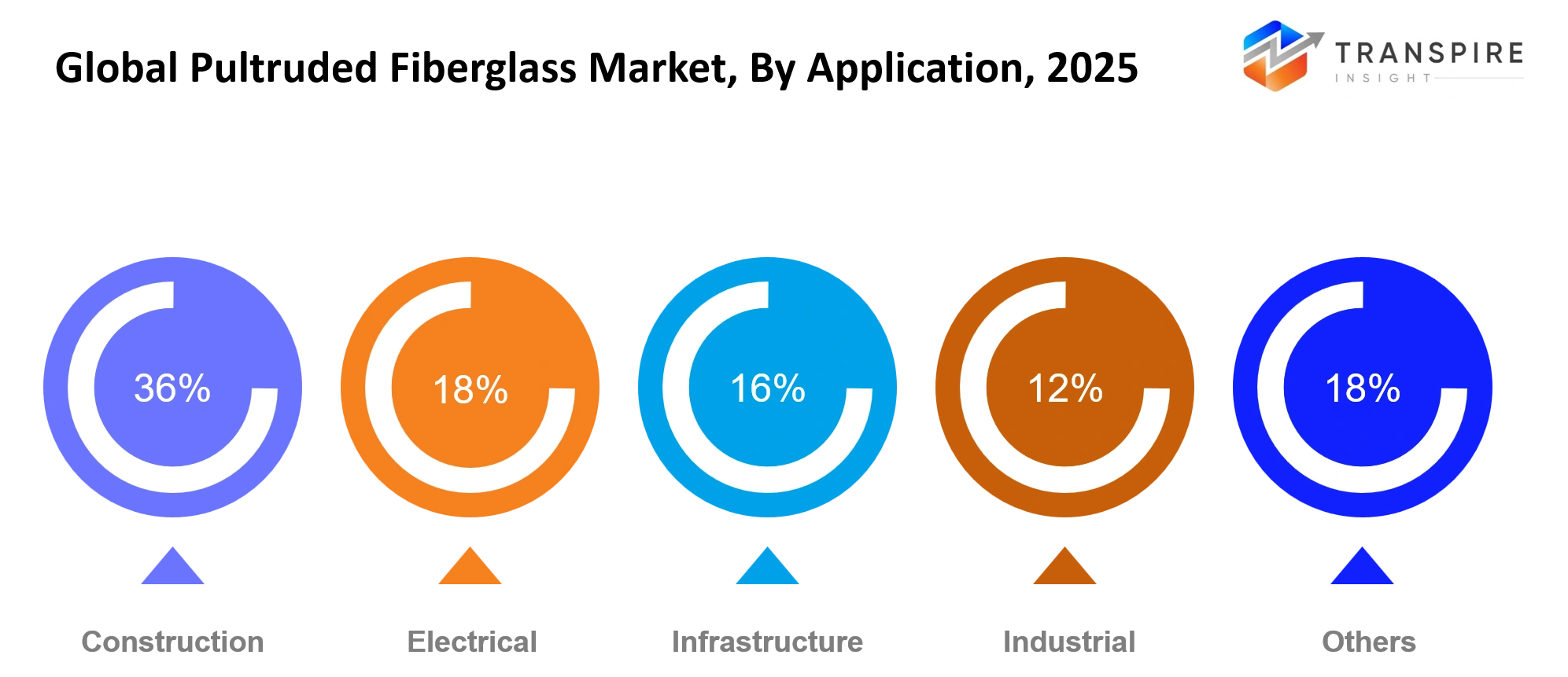
- Construction profiles make up 36% of the market, and notable firms, such as Strongwell, are experimenting with ultra-wide pultrusion technologies to replace structural steel beams.
- The electrical segment accounts for 18%, representing cross arms by Exel Composites made with high insulation materials to resist the extreme pressure of weather conditions on grids.
- Heavy-duty modular bridge decks that are not degraded by road salt are driving 16% of the market with infrastructure, through the efforts of Creative Pultrusions.
- Industrial uses account for 12% of total volume, and Fibergrate is making a step forward with chemical-resistant ergonomic floor gratings for use on harsh offshore drilling platforms.
- Pultron Composites' engineering high-modulus tension rods for the next generation of wind turbine blades are driving renewable energy usage to grow at a rapid 13.7% CAGR.
- North America is at the forefront of consumption at 38%, with Bedford Reinforced Plastics growing its automated manufacturing presence to support the nation's infrastructure bills.
- Europe's market share is also on the high side, with P-TREX launching bio-resin-infused profiles to meet the very stringent carbon neutrality criteria set by Europe.
- The other 18% of the market covers specialised areas such as marine and transportation, where companies such as Composite Advantage make fender systems that are integrated.
What are the Key Drivers, Restraints, and Opportunities in the Global Pultruded Fiberglass Market?
Driver:
The biggest factor pushing this has to do with decarbonization requirements and demand for materials with enhanced structural durability. Decarbonization requirements were further accelerated by the International Building Codes, or IBC, which now allow much wider use of composite materials within civil infrastructure. This demand has caused the materials to enter the new construction pipeline rapidly, as development project managers are reluctant to embrace costly maintenance of traditional metal materials, fueling a rise in manufacturer sales.
In February 2026, Polymec launched a new composite corrugated bar at the European Rebar Council. This product launch provides structural concrete reinforcement that eliminates metallic corrosion while meeting strict building decarbonization targets.
Restraint:
Large capital requirement and difficulty in customising dies also remain major structural challenges for pultrusion. Steel Fabrication can achieve rapid modifications in situ, whereas in Pultrusion, expensive custom-machined dies are needed for each unique profile geometry; This capital requirement limits uptake by medium-scale contractors and slows the process of design modification for low-volume custom projects.
Opportunity:
The build-out of the massive infrastructure associated with utility-scale energy development presents a real opportunity for expansion moving forward. The adoption of fast, high-speed automated pultrusion equipment can allow a facility to achieve significant volumes of output on equipment for both solar racking and offshore wind. This can facilitate build-out in coastal economic development areas and permit efficient direct delivery of components to the large offshore wind facilities currently underway and planned.
In March 2026, the EU-funded FOREST Project partnered with AIMPLAS to develop advanced thermoplastic pultruded laminates. This partnership successfully combined bio-based polyamide-6 (PA6) with a hybrid layout of unidirectional continuous fibers and recycled carbon fiber mats.
What has the Impact of Artificial Intelligence been on the Global Pultruded Fiberglass Market?
AI is now starting to transform the production environment of the pultrusion factory. Machine learning is even integrated in situ in the hot die stage for online optimization of cure parameters. Predictive capabilities of the AI system for such parameters as pulling tension, line speed, and exothermic temperature variance allow them to detect impending fibre wet-out failures before occurrences. As a result, companies get their material scrap rates significantly down, use substantially less energy for the part, and ensure the highest reliability over many miles of endless product. There is a downside, though. The barrier to entry for the implementation still appears high, just like the models’ accuracy compared to the physics-based reality. The existing legacy pultrusion machines cannot supply sufficient IoT sensor-based inputs to machine learning algorithms, thereby rendering it prohibitively expensive to upgrade for midsize companies. Moreover, if new resin compositions are applied or a hybrid glass-carbon fiber is employed, costly recalculation for the AI can delay production. In April 2026, researchers introduced an experimental-numerical machine learning framework utilising surrogate AI models to enhance accuracy while reducing the computational costs of simulating complex, physics-based thermal interactions.
Key Global Pultruded Fiberglass Market Trends:
The market is shifting from simple structural forms to sophisticated and high-performance composites (so-called 'smart' composites) with enhanced functions and designed for the most challenging environments.
- Manufacturers are shifting from traditional thermal curing to inline ultraviolet (UV) pultrusion to reduce energy consumption and speed up processing.
- Industrial plants are replacing heavy metallic architectural parts with composite options to minimise structural dead weight.
- The industry is adopting sensor-embedded "smart" pultruded profiles that track structural health and material stress in real time.
- Producers are replacing standard petroleum-derived solvents with closed-mould processes to lower VOC emissions on the shop floor.
- Suppliers are transitioning from simple custom profile shapes to large-scale modular assembly systems for faster field installation.
- Energy markets are prioritising high-modulus polyurethane resins over standard polyesters to ensure durability under heavy mechanical loads.
- Civil engineering projects are shifting from short-term material procurement budgets to lifecycle-cost evaluations for public infrastructure.
- Logistics networks are using lightweight pultruded shipping containers to lower fuel use and maximise freight capacity.
Global Pultruded Fiberglass Market Segmentation
By Resin Type:
Polyester remains the market’s frontrunner due to value combined with acceptable mechanical performance, with vinylester gaining popularity in highly corrosive conditions. Epoxy, on the other hand, lends itself to higher-end applications, for high-strength performance, whereas polyurethane can lead to lightweight structures, and phenolics contribute to fireproof infrastructure. Finally, resins made of acrylic, hybrid resins, and similar alternative formats that add to custom durability, along with environmental sustainability, are picking up pace with the market.
By product:
Profiles dominate demand because of their extensive use in structural frameworks, while gratings, rods, tubes, angles, channels, beams, and other engineered products benefit from increasing infrastructure modernization and industrial replacement projects.
By Application:
Construction at 36%, in which Pultruded fiberglass is substituting steel and wood for use in bridges, buildings, and civil structures, followed closely by 18% electrical, thanks to smart grid investments and non-conductive utility components, then 16% infrastructure for transportation improvements and water management systems. Some 12% is Industrial (due to corrosion-resistant equipment installations), with the remaining 18% for such segments as Transportation, Marine, and Renewable Energy. However, it's the Renewable Energy segment expected to generate the fastest 13.7% CAGR on installation growth for wind turbine components and solar support structures.
By End-User:
Construction remains the number one profit driver, followed by utilities, transportation, marine, industrial, energy, commercial, and so on, as there are more and more needs to manufacture composites with a low weight and low maintenance value.
By Process:
Continuous pultrusion leads production through high-volume manufacturing efficiency, while custom and automated pultrusion address precision-engineered applications. Closed molding improves product quality, open molding supports specialized production, and hybrid and high-speed processing are expected to accelerate future innovation, manufacturing flexibility, and cost-efficient composite production.
What are the Key Use Cases Driving the Global Pultruded Fiberglass Market?
In dominant construction, Pultruded Fiberglass is primarily employed in building enclosures, structural framework, and thermal breaks of high-performance windows to prevent heat loss through bridging by combining its high strength-to-weight with low thermal conductivity.
Non-conductive utility poles, wastewater treatment baffles, and electrical cable trays of extended utility infrastructures exploit the composite's inherent chemical resistance, water resistance, and high-voltage protection qualities without maintenance coatings.
Other emergent uses include subsea oil platforms, containment systems, and supports in storage frameworks for water and hydrogen production, and supports for coastal solar structures that would not last in water and sunlight exposure in the absence of composite material.
|
Report Metrics |
Details |
|
Market size value in 2025 |
USD 2.33 Billion |
|
Market size value in 2026 |
USD 2.46 Billion |
|
Revenue forecast in 2033 |
USD 3.60 Billion |
|
Growth rate |
CAGR of 4.32% from 2026 to 2033 |
|
Base year |
2025 |
|
Historical data |
2021 - 2024 |
|
Forecast period |
2026 - 2033 |
|
Report coverage |
Revenue forecast, competitive landscape, growth factors, and trends |
|
Regional scope |
United States; Canada; Mexico; United Kingdom; Germany; France; Italy; Spain; Denmark; Sweden; Norway; China; Japan; India; Australia; South Korea; Thailand; Brazil; Argentina; South Africa; Saudi Arabia; United Arab Emirates |
|
Key company profiled |
Strongwell, Bedford Reinforced Plastics, Exel Composites, Creative Pultrusions, Fibergrate, Jiangsu Jiuding, Pultron Composites, P-TREX, Glasforms, Fibrolux, Composite Advantage, Enduro Composites, Sireg Geotech, Jiangsu Hengshen, AGY. |
|
Customization scope |
Free report customization (country, regional & segment scope). Avail customized purchase options to meet your exact research needs. |
|
Report Segmentation |
By Resin Type (Polyester, Vinyl Ester, Epoxy, Polyurethane, Phenolic, Acrylic, Hybrid Resins, Others); By Product (Profiles, Gratings, Rods, Tubes, Angles, Channels, Beams, Others); By Application (Construction, Electrical, Infrastructure, Industrial, Transportation, Renewable Energy, Marine, Others); By End User (Construction Industry, Utilities, Transportation Sector, Marine Industry, Industrial Sector, Energy Sector, Commercial Sector, Others); By Process (Continuous Pultrusion, Custom Pultrusion, Automated Pultrusion, Closed Molding, Open Molding, Hybrid Processing, High-speed Processing, Others). |
Which Regions are Driving the Global Pultruded Fiberglass Market Growth?
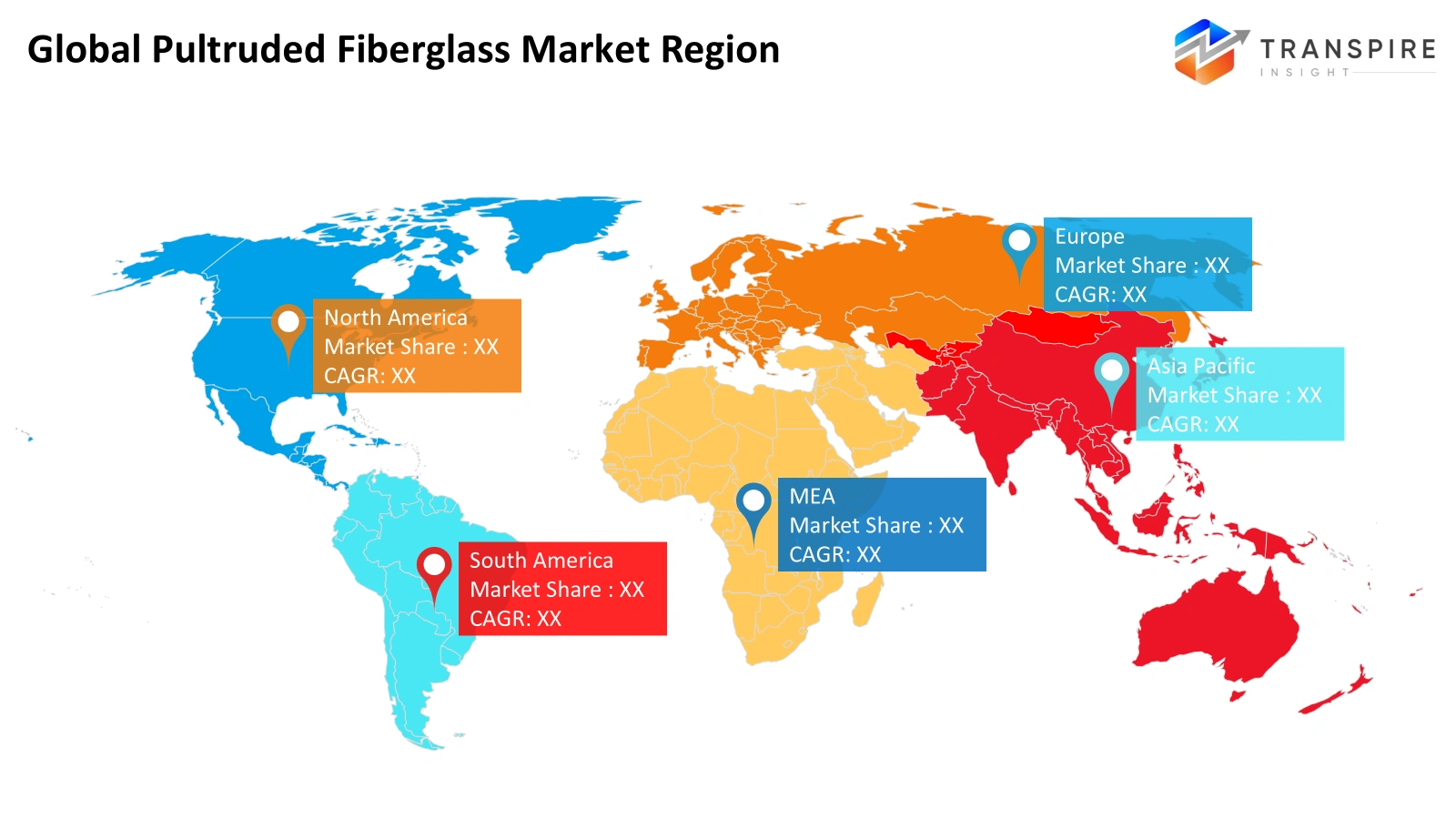
North America commands a leading 38% market share due to its ageing public infrastructure and active industrial modernisation programs. The region benefits from a well-established regulatory framework, such as the ASCE pre-standards for FRP composites, which simplifies the engineering approval process for public bridges and highways. Additionally, a strong network of domestic aerospace and defence tier-one suppliers drives continuous demand for advanced, high-strength pultruded profiles. In May 2026, Exel Composites exhibited advanced pultruded carbon fiber conductor cores, aimed at doubling power grid transmission capacity.
European market share is 26%, emphasising the stringent environmental legislation and building efficiency requirements. Instead of the construction growth fueled by infrastructure investment in North America, European development trends are towards sustainability projects such as the European Green Deal policy, which boosts the development of low-carbon chemical materials. Stable chemical production within the region also supports the high value of epoxy and phenolic resins.
The highest growth market is in the Asia Pacific region at 14.8%CAGRand accounts for 25% of the total market share due to new big urban developments, substantial investment in high-voltage power grids, and increased use in the region's wind energy sector in manufacturing countries. The local supply chains of the region are moving from supplying just simple components to automated pultrusion and support for larger domestic and overseas markets. The Latin America & the Middle East & Africa regions have a6% & 5% market share respectively that remain localised.
Who are the Key Players in the Global Pultruded Fiberglass Market and how do they Compete?
The global pultruded fiberglass market consists of existing Western composite experts competing with fast-growing manufacturers concentrated within the Asian industrial zones. Competition is rapidly shifting from a basic cost-per-pound price point toward strong materials science expertise and in-house engineering and large-scale manufacturing. Companies are also increasingly distinguishing themselves from competitors through regional product fire, building code, and electrical certifications across multiple regions to become the long-term strategic suppliers of choice for global infrastructure needs.
Strongwell and Bedford Reinforced Plastics lead through large-scale capacity and broad market presence, investing in automated, wide-profile pultrusion lines to replace structural steel in commercial building frameworks. Exel Composites and Pultron Composites focus on high-performance innovation, developing custom resin-fiber formulations for demanding applications like wind energy tension rods and telecommunication antenna radomes. Creative Pultrusions and Fibergrate pursue an integrated systems approach, delivering complete structural solutions, such as modular bridge decks and industrial grating systems, to infrastructure and marine clients. Jiangsu Jiuding, Jiangsu Hengshen, and AGY win volume manufacturing markets within a growing Asian power grid by using integration and competitive production processes. P-TREX, Glasforms, Fibrolux, Composite Advantage, Enduro Composites, and Sireg Geotech focus on a regional or technical niche, offering specific civil components, soil nail components from geotech materials, or unique chemically-resistant material products.
Key Players are:
- Strongwel
- Bedford Reinforced Plastics
- Exel Composites
- Creative Pultrusions
- Fibergrate
- Jiangsu Jiuding
- Pultron Composites
- P-TREX
- Glasforms
- Fibrolux
- Composite Advantage
- Enduro Composites
- Sireg Geotech
- Jiangsu Hengshen
- AGY
Recent Development News
In June 2026, HÖRMANN Vehicle Engineering GmbH concluded its funded three-year PulPro-SMC research initiative by validating a single-step automated composite pressing methodology. This infrastructure milestone fuses continuous pultrusion profiles directly to structural nodes under high pressure and temperature.
Source: https://www.compositesworld.com
In April 2026, Prince Fibre completed the funding and operational construction of its advanced composite production facility in Kampen. This operational rollout scales custom-engineered carbon- and glass-fiber pultrusion capabilities, establishing localised supply chains for robust structural components.
Source: https://www.compositesworld.com
What Strategic Insights Define the Future of the Global Pultruded Fiberglass Market?
The market is moving beyond standalone structural materials to become part of fully integrated, multi-material engineering ecosystems. Thermoset resins are subject to increasing and inevitable long-term regulatory pressure because of a poor recyclability/disposability profile; A rising, obvious opportunity: circular thermoplastic pultrusion offering structurally shaped materials which can be subsequently thermoformed, welded, and at the end of life fully recycled. Strategic success requires manufacturers to transition from acting as component suppliers to serving as full-service structural design partners. Buying hybrid pultrusion equipment for simultaneous processing of glass and carbon can position companies to pursue high-margin infrastructure programs featuring higher-modulus materials; it’s a material adaptability that anticipates long-term performance needs, while addressing today’s structural cost challenges.
Key Segmentations are:
By Resin Type
- Polyester
- Vinyl Ester
- Epoxy
- Polyurethane
- Phenolic
- Acrylic
- Hybrid Resins
- Others
By Product
- Profiles
- Gratings
- Rods
- Tubes
- Angles
- Channels
- Beams
- Others
By Application
- Construction
- Electrical
- Infrastructure
- Industrial
- Transportation
- Renewable Energy
- Marine
- Others
By End User
- Construction Industry
- Utilities
- Transportation Sector
- Marine Industry
- Industrial Sector
- Energy Sector
- Commercial Sector
- Others
By Process
- Continuous Pultrusion
- Custom Pultrusion
- Automated Pultrusion
- Closed Molding
- Open Molding
- Hybrid Processing
- High-speed Processing
- Others
Regional Outlook
North America
- United States
- Canada
- Mexico
Europe
- Germany
- United Kingdom
- France
- Spain
- Italy
- Rest of Europe
Asia Pacific
- Japan
- China
- Australia & New Zealand
- South Korea
- India
- Rest of Asia Pacific
South America
- Brazil
- Argentina
- Rest of South America
Middle East & Africa
- Saudi Arabia
- United Arab Emirates
- South Africa
- Rest of the Middle East & Africa
Frequently Asked Questions
Find quick answers to common questions.
The global pultruded fiberglass market size was valued at USD 2.33 Billion in 2025 and is poised to reach USD 3.60 Billion by 2033, expanding at a 5.59% CAGR.
Key segments for the global pultruded fiberglass market are By Resin Type (Polyester, Vinyl Ester, Epoxy, Polyurethane, Phenolic, Acrylic, Hybrid Resins, Others); By Product (Profiles, Gratings, Rods, Tubes, Angles, Channels, Beams, Others); By Application (Construction, Electrical, Infrastructure, Industrial, Transportation, Renewable Energy, Marine, Others); By End User (Construction Industry, Utilities, Transportation Sector, Marine Industry, Industrial Sector, Energy Sector, Commercial Sector, Others); By Process (Continuous Pultrusion, Custom Pultrusion, Automated Pultrusion, Closed Molding, Open Molding, Hybrid Processing, High-speed Processing, Others).
Growth is primarily driven by updated civil engineering codes that approve composites, volatile steel prices, and the accelerating demand for lightweight, corrosion-free materials in building construction, wind energy, and utility grids.
The global pultruded fiberglass market is led by major manufacturers, including Strongwell, Bedford Reinforced Plastics, Exel Composites, Creative Pultrusions, Fibergrate, Jiangsu Jiuding, Pultron Composites, P-TREX, Glasforms, Fibrolux, Composite Advantage, Enduro Composites, Sireg Geotech, Jiangsu Hengshen, AGY.
Holding a dominant 38% market share, North America shapes global dynamics through its rigorous ASCE structural standards, large-scale federal funding for ageing public infrastructure, and a robust aerospace and industrial manufacturing base.
Key commercial opportunities lie in expanding high-speed pultrusion lines for offshore wind and solar racking, developing smart sensor-embedded profiles for real-time structural tracking, and commercializing fully recyclable thermoplastic composite systems.
- Strongwel
- Bedford Reinforced Plastics
- Exel Composites
- Creative Pultrusions
- Fibergrate
- Jiangsu Jiuding
- Pultron Composites
- P-TREX
- Glasforms
- Fibrolux
- Composite Advantage
- Enduro Composites
- Sireg Geotech
- Jiangsu Hengshen
- AGY
About the Authors

Pankaj Ghogare Patil
I am Pankaj Ghogare Patil, a Senior Research Analyst at Transpire Insight, specializing in the Pharmaceutical, Chemicals & Materials, Healthcare IT, and Biotechnology industry. My expertise lies in conducting comprehensive market research, analyzing industry trends, evaluating competitive landscapes, and translating complex data into actionable insights. At Transpire Insight, I closely follow emerging technologies, regulatory developments, and market innovations to create accurate, well-researched, and informative content that helps businesses and professionals make informed decisions. I am committed to producing credible, evidence-based articles that reflect industry best practices while making technical topics accessible and valuable for a broad audience.

Chakradhar Khansole
Chakradhar serves as the Research Director at Transpire Insight, bringing over 8 years of experience in technology, innovation, and strategic market intelligence. He specializes in transforming complex market data into actionable business insights that enable organizations to make informed, growth-oriented decisions. Recognized for his strategic vision and analytical expertise, Chakradhar leads high-impact research initiatives, delivering comprehensive market assessments, competitive intelligence, and forward-looking industry analysis.
Recently Published Reports
-
May 2026
Healthcare Polymer Packaging Market
Healthcare Polymer Packaging Market Size, Share & Analysis Report By Packaging Type (Syringes, IV Bottles and Pouches, Clamshells, Blisters, Bottles & Jars, Containers, Tubes, IV Parental Packaging, Others), By Type (Regulated, Non-regulated), By Polymer Type (LDPE (Low-Density Polyethylene), HDPE (High-Density Polyethylene), Homo-polymer (Homo), Random Copolymer (Random), Block Copolymer (Block), PET, Polystyrene, Polyvinyl Chloride, Polyamide/EVOH, Others), and Geography (North America, Europe, Asia-Pacific, Middle East and Africa, South and Central America), 2021 - 2031
-
Apr 2026
Hydrophilic Tape (Waterstop) Market
Hydrophilic Tape (Waterstop) Market Size, Share & Analysis Report By Type (Bentonite-Based Hydrophilic Tape, Rubber-Based Hydrophilic Tape), By Application (Residential Buildings, Commercial Buildings, Infrastructure Projects), and Geography (North America, Europe, Asia-Pacific, Middle East and Africa, South and Central America), 2021 - 2031
-
Apr 2026
Metalens Market
Metalens Market Size, Share & Analysis Report By Type (Visible Light Metalens, and Infrared Metalens), By Application (Consumer Electronics, Automotive Electronics, Industrial, Medical, and Others), and Geography (North America, Europe, Asia-Pacific, Middle East and Africa, South and Central America), 2021 - 2031
-
Apr 2026
PBT Resin Market
PBT Resin Market Size, Share & Analysis Report By Type (Reinforced PBT Resin, Unreinforced PBT Resin), By Processing Method (Injection Molding, Extrusion, Blow Molding, Others), By End-User (Automotive, Electrical & Electronics, Consumer Appliances, Industrial Machinery, Medical Devices, Packaging, Others), and Geography (North America, Europe, Asia-Pacific, Middle East and Africa, South and Central America), 2021 - 2031