
North America Vaccine Delivery Devices Market Size & Forecast:
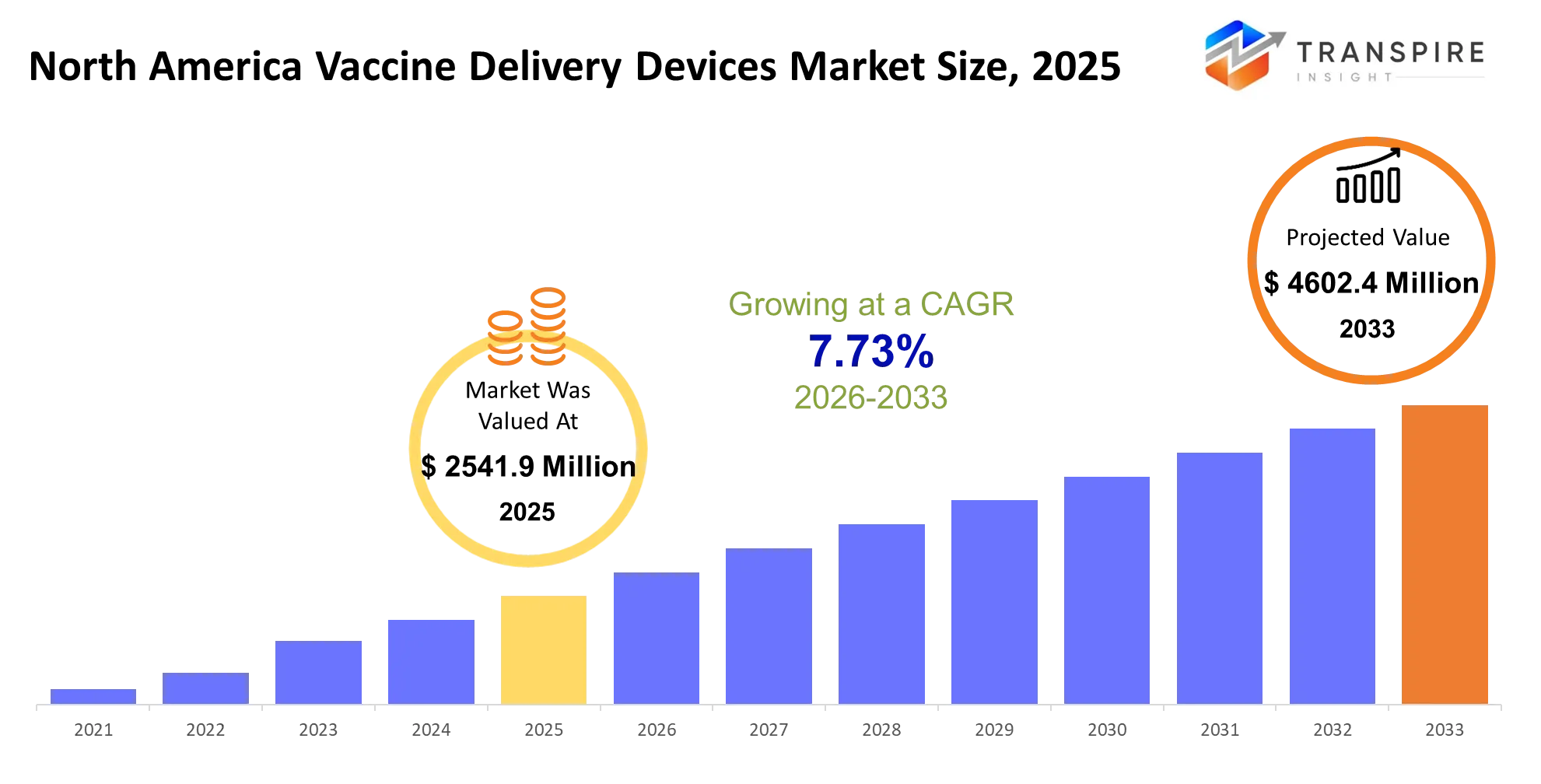
- North America Vaccine Delivery Devices Market Size 2025: USD 2541.9 Million
- North America Vaccine Delivery Devices Market Size 2033: USD 4602.4 Million
- North America Vaccine Delivery Devices Market CAGR: 7.73%
- North America Vaccine Delivery Devices Market Segments: By Product Type (Needle-free Injectors, Syringes, Auto-injectors, Nasal Delivery Devices, Others), By Application (Routine Immunization, Pandemic Vaccination, Pediatric Vaccination, Travel Vaccination, Others), By End User (Hospitals, Clinics, Vaccination Centers, Home Care Settings, Others), By Technology (Disposable Devices, Reusable Devices, Smart Delivery Devices, Others).
To learn more about this report,  Download Free Sample Report
North America Vaccine Delivery Devices Market Summary:
The North America Vaccine Delivery Devices Market size is estimated at USD 2541.9 Million in 2025 and is anticipated to reach USD 4602.4 Million by 2033, growing at a CAGR of 7.73% from 2026 to 2033. The North America Vaccine Delivery Devices Market kinda matters a lot, because it turns vaccine development into actual immunization results, by allowing safe , precise, and speedy administration across hospitals, pharmacies public health programs, and community clinics. In other words, these devices let clinicians deliver vaccines at scale while also cutting down dosing errors, lowering contamination exposure ,and reducing those everyday inefficiencies that show up during busy hours.
In the last three to five years , there’s been a noticeable structural move away from the classic syringe approach and toward prefilled syringes, auto-disable mechanisms, and needle free technologies. These newer options help with workflow timing, and honestly, they also tend to make patient cooperation easier. The COVID-19 pandemic acted like a real life push , it highlighted gaps in vaccination infrastructure and led to big investments focused on mass immunization capacity, supply chain robustness, and practical device innovation.
Right now, growth is being supported by adult vaccination initiatives growing steadily, expanded immunization schedules, and the growing use of newer delivery platforms in routine care. Since many healthcare systems are prioritizing operational efficiency and aiming for higher coverage, device makers are getting more room to capture value with upgraded products—ones that enable faster administration, better safety, and less clinical burden during delivery.
Key Market Insights
- The United States pretty much runs the North America Vaccine Delivery Devices Market, with something like over 80% of the regional market share by 2025.
- On the one hand strong federal immunization initiatives and also a more advanced healthcare infrastructure kinda help keep the whole industry growing steadily across the U.S.
- Canada is seen as the fastest-growing regional market during the forecast window, mostly because adult vaccination coverage is expanding, plus public health investments keep getting reinforced.
- Even the cross-border vaccine preparedness programs keep strengthening, so regional vaccine delivery device demand stays pretty firm.
- When it comes to product types, prefilled syringes are leading the pack. They take about 40% of total revenue share in 2025, mainly for convenience and dosing accuracy reasons.
- Conventional syringes still sit in the second spot, backed by day-to-day adoption in hospitals and public immunization campaigns , which is pretty typical.
- Needle-free injection systems are forecasted to be the fastest-growing segment all the way through 2032. This is being pulled by patient comfort, and also by lower needle-stick injury risks.
- Smart delivery technologies are now showing up more often as an innovation direction across the vaccine administration ecosystem.
- In terms of use cases, routine immunization programs account for more than 50% of market share, so they stay the dominant application segment, without much drama.
- Pediatric vaccination remains a big revenue contributor across North American healthcare systems.
- Adult and geriatric vaccination programs look like the fastest-growing application area, because preventive healthcare strategies are getting broader.
- Seasonal influenza, respiratory vaccines and travel vaccines continue to provide long-term market momentum.
- Hospitals and healthcare facilities lead the market too, capturing around 45% of total revenue share in 2025, which is notable.
What are the Key Drivers, Restraints, and Opportunities in the North America Vaccine Delivery Devices Market?
The strongest force driving the North America Vaccine Delivery Devices Market is kind of, the expansion of adult immunization programs, mixed with the healthcare sector moving toward safer and more efficient administration technologies. When the COVID-19 rollout happened it showed the real operational limits of the older delivery approach and it pushed providers to use prefilled syringes, safety-engineered devices, plus automated injection systems. That shift helps cut down on the prep time, reduces dosing mistakes, and makes day to day work more smooth. And as pharmacies, hospitals, and community clinics end up administering higher vaccine volumes these productivity wins end up turning into higher device usage and stronger revenue results for manufacturers.
The biggest roadblock is the regulatory and manufacturing setup around vaccine delivery systems, it’s not simple at all. Manufacturers have to follow tough rules for quality, sterility, and overall safety, while also staying compatible with a range of vaccine formulations. This kind of demands specialized production plants, long validation cycles, and approvals that take quite a while. Since these structural limits need heavy capital spending and regulatory knowhow, they can’t be fixed quickly, not even with faster effort. So product launches get delayed, smaller players struggle to enter the market, and overall revenue growth opportunities end up being restricted.
A big growth chance is sitting in the move toward commercialization of needle-free and self administration technologies. There are a few advances with jet injection systems and wearable drug delivery platforms, they’re kind of opening up ways for vaccines to be given outside the usual clinical setting . And as healthcare systems put more emphasis on ease of use, mass immunization readiness, and more decentralized care, these tools might unlock brand new adoption channels, expand reach in North America, and honestly just keep going from there.
What Has the Impact of Artificial Intelligence Been on the North America Vaccine Delivery Devices Market?
Artificial intelligence and newer digital technologies are kind of steadily reshaping the North America Vaccine Delivery Devices Market. They do it by boosting operational efficiency , helping with inventory control, and also improving how well devices perform, plus the monitoring side. In practice, healthcare providers and vaccine distributors are rolling out AI-enabled analytics suites to sort of automate vaccine inventory monitoring , track the cold-chain conditions, and support distribution scheduling. These systems keep scanning storage environment, usage habits, and replenishment requirements, which helps cut down wastage while keeping product availability stronger across hospitals, pharmacies , and broader public health networks.
On top of that, machine learning models are being applied to forecast vaccine demand, spot likely supply bottlenecks, and tune delivery schedules. When they review older vaccination records, demographic movement , and seasonal disease cycles, they assist healthcare groups to place resources in a more sensible manner and improve immunization coverage in practical ways. There are also smart injection devices with linked sensors, and they can produce real-time administration information, so compliance tracking becomes easier and documentation mistakes go down a bit.
The operational gains really stand out. Healthcare systems can reduce vaccine losses, tighten inventory fidelity, strengthen regulatory adherence, and raise vaccination throughput during big immunization drives. In the end, these upgrades tend to lower operating costs while also supporting public health readiness in a more robust way.
Still, AI adoption is not totally smooth. It’s held back by integration expenses and uneven healthcare data systems. A lot of providers still work across multiple older platforms, so data compatibility is limited. Because of that , advanced predictive models can become less accurate and more difficult to scale up.
Key Market Trends
- Since 2020, healthcare systems have kinda rapidly adopted prefilled syringes, trimming down the prep time and helping to minimize dosing errors during those huge, high volume vaccination drives.
- Retail pharmacy vaccination programs jumped a lot between 2021 and 2025, sort of moving purchasing choices away from only the classic hospital procurement routes.
- Manufacturers have more and more been building safety engineered mechanisms into injection devices, especially as needle stick prevention requirements got more regulatory weight and day to day operational importance.
- Needle free delivery technologies also went from small niche uses toward broader commercialization, mainly because people care about patient comfort, and mass immunization efficiency goals are kinda loud right now.
- Vaccine device suppliers started boosting North American manufacturing capacity after pandemic era supply problems showed weak spots in global sourcing networks, you know.
- Digital tracking capabilities gained traction too, since providers wanted better inventory visibility administration records and compliance reporting across vaccination programs, all at once not separately.
- Companies such as Becton Dickinson, Terumo, and West Pharmaceutical increased their investment in more advanced delivery platforms, trying to stand out beyond basic syringe products that look almost like commodities.
- Adult immunization programs grew steadily after 2021, and it shifted the market focus from mostly pediatric vaccination toward lifelong preventive healthcare models, which sounds more long term.
- Strategic partnerships between vaccine developers and device manufacturers became way more common, and that helped with integrated delivery solutions as well as faster product commercialization, sometimes in shorter cycles.
- Procurement priorities, they also evolved from just unit cost optimization into more reliability, scalability, and operational efficiency concerns, especially for public health and emergency preparedness initiatives.
North America Vaccine Delivery Devices Market Segmentation
By Product Type
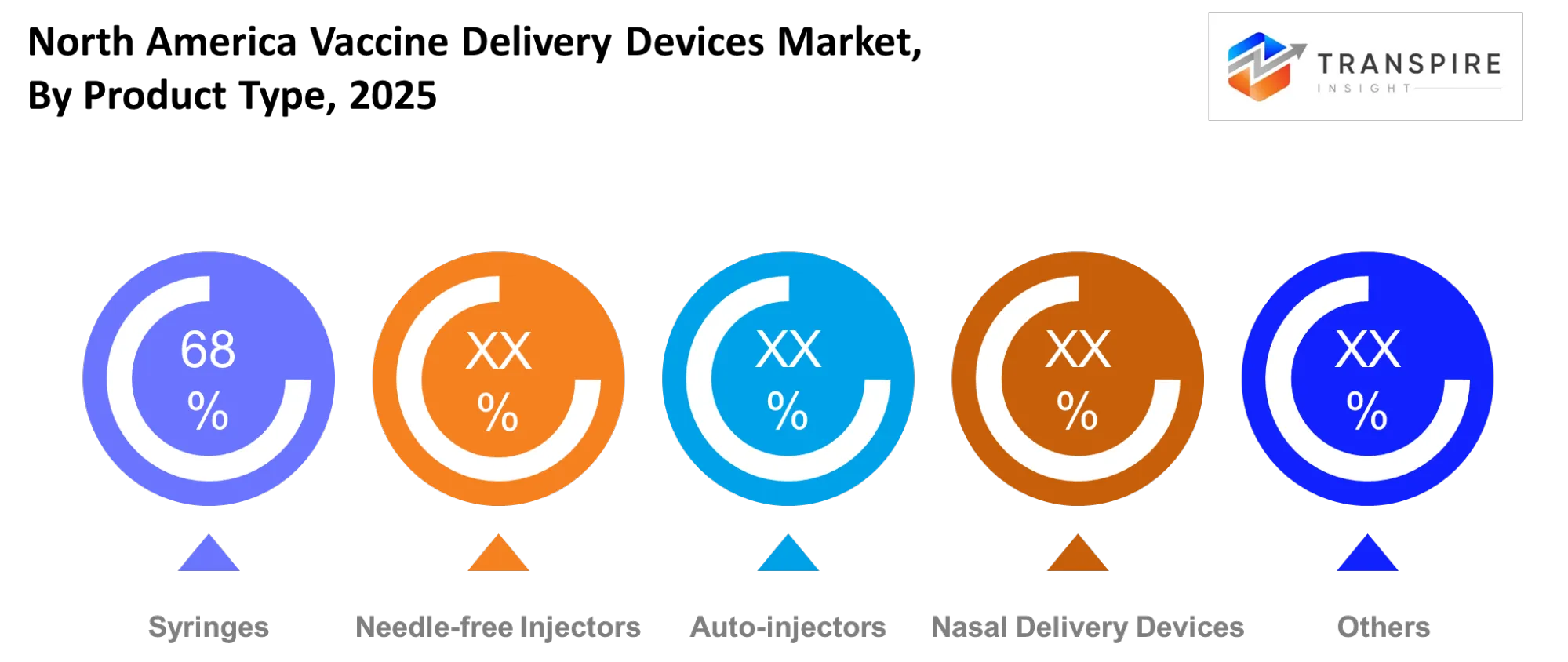
By product type, syringes keep hold of the biggest slice of the market, mostly because they are widely accepted in clinical settings, they’re backed by established manufacturing capacity, and they also match a broad range of vaccines quite well. The prefilled , and safety engineered syringe formats have sort of doubled down on that advantage. They help with dosing accuracy, and they also reduce the little administration mistakes that can happen in real use. Auto-injectors sit in a smaller, but still meaningful segment, especially in vaccination programs that are more specialized and where ease of use really matters. Needle-free injectors, plus nasal delivery devices, are getting more attention lately, since many healthcare providers are looking for substitutes that feel better for patients and also lessen needle related worries.
Still, uptake is held back by the fact that costs are higher, and because regulatory validation has to be completed properly, but the continuous innovation curve is making the commercial side more achievable over time. Looking ahead, growth should tend to move toward advanced delivery platforms that blend convenience, safety, and efficiency in one package. Manufacturers that put money into distinct delivery formats may be positioned to win premium pricing. Meanwhile, purchasers are increasingly judging products based on workflow benefits, not just the purchase price alone.
To learn more about this report, Download Free Sample Report
By Application
By application, routine immunization still sort of takes the lead, mainly because the established vaccination schedules for kids, grown-ups, and those in high-risk groups keep running. Steady government funding and a public health infrastructure that actually works behind the scenes, keep the demand fairly stable over the whole year. Pediatric vaccination keeps showing up as a big portion too, mostly because childhood immunization initiatives maintain strong coverage across North America .
Then pandemic vaccination shows up as a major category, after those large immunization drives made it clear that fast deployment matters, a lot. Travel vaccination is smaller, but it benefits from more international movement and from constantly shifting disease-prevention expectations. Looking ahead, market growth will lean more and more on adult and booster vaccination programs, and those are spreading beyond just traditional, seasonal campaigns. This trend can open doors for device suppliers, who can handle higher administration volumes, offer flexible distribution models,and respond quickly when there are public health emergencies.
By End-User
By end user, hospitals still sit as the leading segment, mostly on account of high patient throughput, big vaccine inventories, and fairly easy access to trained healthcare professionals. Large health systems keep on buying substantial volumes of delivery devices so they can support routine, but also more specialized immunization programs. Clinics are another meaningful slice, especially in community based care, where preventive services keep widening. Vaccination centers got a lot more attention during the pandemic response phase and they’re still relevant for mass scale immunization efforts.
Home care settings right now make up a smaller portion, but interest is rising since healthcare delivery is slowly getting more decentralized. Convenience , accessibility, and digital health integration are also pushing stronger adoption of self administration and remote care approaches. Looking ahead, future growth will likely lean toward providers that can deliver vaccines across several care settings, which opens up new opportunities for device manufacturers emphasizing portability, straightforward operation, and user friendly designs.
By Technology
By technology , disposable devices still end up dominating the market , mainly because of strict infection control needs , they’re easier to work with , and regulators tend to prefer single-use administration setups. In practice healthcare providers keep choosing disposable formats because they reduce contamination risk and they make day to day operations less complicated. Reusable devices keep showing up in a few specific environments where cost management and sustainability goals steer buying choices , though sterilization requirements somewhat hold them back from wider adoption.
Smart delivery devices are the fastest growing piece of the picture, since digital technologies are getting more woven into how vaccines are administered. Things like connectivity , dose tracking , and data capture are helping providers improve recordkeeping precision and inventory awareness. But uptake is still pretty early , because rollout expenses and system integration headaches can be pretty big. In the long run, it seems technology investments will shift toward connected , data-enabled platforms , which could open up opportunities for manufacturers that pair strong device performance with digital healthcare capabilities.
What are the Key Use Cases Driving the North America Vaccine Delivery Devices Market?
Routine immunization programs stay the main use case for vaccine delivery devices in lots of hospitals, public health systems, and community healthcare networks. Childhood vaccination schedules, seasonal influenza campaigns and adult booster programs keep driving steady demand because healthcare providers need dependable, high-volume administration tools all year long, no real pause.
There’s also more going on in the secondary tier. You can see it in retail pharmacies , travel medicine clinics, and dedicated vaccination centers. Pharmacy based immunization services have been growing fast, since healthcare systems push for easier access points for adult vaccines. Travel vaccination programs are moving too as international mobility climbs, and destination specific immunization requirements become more usual, kind of everywhere.
Looking ahead, emerging use cases start to sound more like self administration platforms, plus needle-free delivery technologies aimed at decentralized healthcare models. Some of the “smart” delivery devices that back digital dose tracking, and remote monitoring are drawing investment as well. These efforts are still kind of early but could, over time, change how vaccines get given—by making access simpler, supporting emergency preparedness programs, and reducing the reliance on traditional clinical settings.
|
Report Metrics |
Details |
|
Market size value in 2025 |
USD 2541.9 Million |
|
Market size value in 2026 |
USD 2732.6 Million |
|
Revenue forecast in 2033 |
USD 4602.4 Million |
|
Growth rate |
CAGR of 7.73% from 2026 to 2033 |
|
Base year |
2025 |
|
Historical data |
2021 - 2024 |
|
Forecast period |
2026 - 2033 |
|
Report coverage |
Revenue forecast, competitive landscape, growth factors, and trends |
|
Country scope |
North America (Canada, The United States, and Mexico) |
|
Key company profiled |
Becton Dickinson, Gerresheimer, West Pharmaceutical Services, AptarGroup, SCHOTT Pharma, PharmaJet, Vaxxas, SHL Medical, Nemera, Terumo Corporation, Ypsomed, Stevanato Group, Baxter International, Pfizer CentreOne, Haselmeier |
|
Customization scope |
Free report customization (country, regional & segment scope). Avail customized purchase options to meet your exact research needs. |
|
Report Segmentation |
By Product Type (Needle-free Injectors, Syringes, Auto-injectors, Nasal Delivery Devices, Others), By Application (Routine Immunization, Pandemic Vaccination, Pediatric Vaccination, Travel Vaccination, Others), By End User (Hospitals, Clinics, Vaccination Centers, Home Care Settings, Others), By Technology (Disposable Devices, Reusable Devices, Smart Delivery Devices, Others) |
Which Regions are Driving the North America Vaccine Delivery Devices Market Growth?
The United States kind of sits in front of the regional market for vaccine delivery devices because it has this big immunization setup, heavy healthcare spending , and really wide vaccination coverage efforts. A lot of federal agencies, public health groups hospitals, and retail pharmacy chains keep pushing ongoing purchases for newer delivery technologies. The whole regulatory scene is strict enough , so companies get pulled toward using safety-engineered syringes, prefilled systems and those newer administration platforms. And there’s also this mature network of vaccine makers, device suppliers, logistics distributors, plus healthcare providers that kind of keeps the market leaders in place for the long run.
Canada usually shows up as the second-largest market, but the way it grows is not exactly the same as in the United States. Because Canada has universal healthcare coverage and provincial vaccination plans that are well coordinated, buyers tend to purchase in a more predictable rhythm and demand stays steady for delivery devices. Regulatory rollouts often feel measured, consistent, so the healthcare system can integrate new tech without major chaos. That steadiness means Canada keeps contributing reliably to regional revenue, and it also stays appealing for well-established suppliers looking for longer-term agreements.
Mexico is showing up as the fastest-growing market, especially as healthcare modernization efforts stretch immunization capacity across public care and private care settings. Newer investments in vaccine distribution infrastructure, cold-chain networks, and preventive healthcare programs have improved access to getting vaccinated. As adult immunization initiatives expand , and as healthcare coverage broadens, device manufacturers start seeing fresh opportunities.
Who are the Key Players in the North America Vaccine Delivery Devices Market and How Do They Compete?
In the North America Vaccine Delivery Devices Market the level of competition is sorta moderately consolidated, like only a small set of big medical technology and pharmaceutical supply firms really holds a good chunk of revenue. Honestly the main reason companies go at it has moved away from just pricing, and more toward tech, safety, how reliable manufacturing is, and how well everything fits into large vaccination programs. Older suppliers keep their ground via long term healthcare ties, plus production scale. Meanwhile newer, more specialized innovators keep slipping into specific pockets, such as needle-free delivery methods and connected administration systems. And yeah, regulatory compliance, supply chain resilience, and product differentiation are now way more important than before.
Becton, Dickinson and Company tends to center on technology innovation and operational scale. They stand out with a wide range of safety-engineered syringe portfolios, integrated drug delivery systems, and manufacturing strength that can actually support massive immunization campaigns. West Pharmaceutical Services plays differently, using specialized containment and delivery solutions that help preserve drug compatibility and dosing precision. Their ongoing investment in advanced injectable systems, plus strategic collaborations with pharmaceutical manufacturers, is what keeps market access and customer retention stronger.
Gerresheimer AG pretty much pushes high precision prefilled syringe platforms along with tailored delivery solutions, so there is this clear advantage for premium vaccine applications. SCHOTT AG meanwhile stands out with pharmaceutical grade glass technologies, which are meant to help keep product stability and storage performance in a solid shape. Terumo Corporation really leans into practical injection systems and clinical efficiency, especially when the setting is healthcare environments that want better workflow improvements, and not just “more hardware”. Overall these companies are expanding via product innovation, capacity investments, and partnerships that connect device development with changing vaccination strategies across North America.
Company List
- Becton Dickinson
- Gerresheimer
- West Pharmaceutical Services
- AptarGroup
- SCHOTT Pharma
- PharmaJet
- Vaxxas
- SHL Medical
- Nemera
- Terumo Corporation
- Ypsomed
- Stevanato Group
- Baxter International
- Pfizer CentreOne
- Haselmeier
Recent Development News
In May 2026, Eli Lilly Expands Vaccine Portfolio with $3.8 Billion Acquisition Deal: Eli Lilly and Company announced the acquisition of vaccine developers Curevo, LimmaTech Biologics, and Vaccine Company in a combined deal valued at up to $3.8 billion. The move strengthens Lilly’s position in infectious disease prevention and supports future demand for advanced vaccine delivery platforms and administration technologies across North America.
Source: https://www.reuters.com
In January 2026, Novavax Signs Major Vaccine Technology Licensing Agreement with Pfizer: Novavax entered a licensing agreement with Pfizer granting access to its Matrix-M adjuvant technology for future vaccine development programs. The deal includes an upfront payment and potential milestone payments worth up to $500 million, highlighting continued investment in vaccine innovation and delivery-enhancing technologies.
Source: https://www.reuters.com
What Strategic Insights Define the Future of the North America Vaccine Delivery Devices Market?
Over the next five to seven years, the North America Vaccine Delivery Devices Market is expected to shift past a volume- led approach and move toward more value centered ecosystem thinking, mainly around how efficiently vaccines get administered, how convenient things feel for patients, and how well digital systems actually connect. What’s pushing that change, under the hood, is the rise of lifelong immunization strategies, these sort of programs that ask healthcare systems to push vaccines through more and more places, including pharmacies, community clinics, and maybe even settings that look more home based. Because of that, device innovation will lean harder toward being simple to operate, staying connected, and improving the whole clinical workflow, not just delivering the product in the first place.
There’s also a risk that’s a bit less obvious, and it has to do with market concentration across key components and the limited specialized manufacturing capacity behind them. If the industry leans on a handful of suppliers for advanced delivery devices and for pharmaceutical-grade materials, it could end up creating supply bottlenecks when the next public health emergency shows up.
At the same time, one real opportunity is forming self administered and connected vaccine delivery platforms, things that support more decentralized care models. Company teams, manufacturers and the rest, should focus on collaborations between device makers, digital health providers, and vaccine developers. The goal is to build integrated solutions, those longer term setups that create clearer competitive differentiation and smoother adoption routes.
North America Vaccine Delivery Devices Market Report Segmentation
By Product Type
- Needle-free Injectors
- Syringes
- Auto-injectors
- Nasal Delivery Devices
- Others
By Application
- Routine Immunization
- Pandemic Vaccination
- Pediatric Vaccination
- Travel Vaccination
- Others
By End User
- Hospitals
- Clinics
- Vaccination Centers
- Home Care Settings
- Others
By Technology
- Disposable Devices
- Reusable Devices
- Smart Delivery Devices
- Others
Frequently Asked Questions
Find quick answers to common questions.
The approximate North America Vaccine Delivery Devices Market size for the market will be USD 4602.4 Million in 2033.
The key segments of the North America Vaccine Delivery Devices Market are By Product Type (Needle-free Injectors, Syringes, Auto-injectors, Nasal Delivery Devices, Others), By Application (Routine Immunization, Pandemic Vaccination, Pediatric Vaccination, Travel Vaccination, Others), By End User (Hospitals, Clinics, Vaccination Centers, Home Care Settings, Others), By Technology (Disposable Devices, Reusable Devices, Smart Delivery Devices, Others).
Major players in the North America Vaccine Delivery Devices Market are Becton Dickinson, Gerresheimer, West Pharmaceutical Services, AptarGroup, SCHOTT Pharma, PharmaJet, Vaxxas, SHL Medical, Nemera, Terumo Corporation, Ypsomed, Stevanato Group, Baxter International, Pfizer CentreOne, Haselmeier.
The current market size of the North America Vaccine Delivery Devices Market is USD 2541.9 Million in 2025.
The North America Vaccine Delivery Devices Market CAGR is 7.73%.
- Becton Dickinson
- Gerresheimer
- West Pharmaceutical Services
- AptarGroup
- SCHOTT Pharma
- PharmaJet
- Vaxxas
- SHL Medical
- Nemera
- Terumo Corporation
- Ypsomed
- Stevanato Group
- Baxter International
- Pfizer CentreOne
- Haselmeier
About the Authors

Pankaj Ghogare Patil
I am Pankaj Ghogare Patil, a Senior Research Analyst at Transpire Insight, specializing in the Pharmaceutical, Chemicals & Materials, Healthcare IT, and Biotechnology industry. My expertise lies in conducting comprehensive market research, analyzing industry trends, evaluating competitive landscapes, and translating complex data into actionable insights. At Transpire Insight, I closely follow emerging technologies, regulatory developments, and market innovations to create accurate, well-researched, and informative content that helps businesses and professionals make informed decisions. I am committed to producing credible, evidence-based articles that reflect industry best practices while making technical topics accessible and valuable for a broad audience.

Chakradhar Khansole
Chakradhar serves as the Research Director at Transpire Insight, bringing over 8 years of experience in technology, innovation, and strategic market intelligence. He specializes in transforming complex market data into actionable business insights that enable organizations to make informed, growth-oriented decisions. Recognized for his strategic vision and analytical expertise, Chakradhar leads high-impact research initiatives, delivering comprehensive market assessments, competitive intelligence, and forward-looking industry analysis.
Recently Published Reports
-
Jul 2026
Alopecia Treatment Market
Alopecia Treatment Market Size, Share & Analysis Report By Disease Type (Alopecia Areata, Cicatricial Alopecia, Traction Alopecia, Alopecia Totalis, Androgenetic Alopecia, Alopecia Universalis, and Other Disease Types), By Treatment Type (Topical Treatments, Oral Medications, Injectable Therapies, and Hair Transplantation), By Gender (Male, and Female), By Distribution Channel (Hospitals and Clinics, Retail Pharmacies, and Online Retailers), and Geography (North America, Europe, Asia-Pacific, Middle East and Africa, South and Central America), 2021 - 2031
-
Jul 2026
Medical Ultrasound Probe Market
Medical Ultrasound Probe Market Size, Share & Analysis Report By Type (Linear Type, Convex Type, Endocavitary Probe, Phased Array/Cardiac Probe, Transesophageal (TEE) Probe, and Others), By Application (Ophthalmology, Cardiology, Musculoskeletal, Oncology, Obstetrics & Gynecology, General Imaging, and Others), By End User (Hospitals & Clinics, Diagnostic Centers, Ambulatory Surgical Centers, and Others), and Geography (North America, Europe, Asia-Pacific, Middle East and Africa, South and Central America), 2021 – 2031
-
May 2026
Biosimilars Market
Biosimilars Market By Product Type (Monoclonal Antibodies, Recombinant Hormones, Erythropoietin, G-CSF, Others), By Indication (Oncology, Autoimmune Diseases, Blood Disorders, Diabetes, Others), By Manufacturing Type (In-House Manufacturing, Contract Manufacturing), By Distribution Channel (Hospital Pharmacies, Retail Pharmacies, Online Pharmacies), By Industry Analysis, Size, Share, Growth, Trends, and Forecasts 2021-2033
-
Apr 2026
Gastrointestinal Endoscopy Market
Gastrointestinal Endoscopy Market By Type (Rigid Gastrointestinal Endoscope, Flexible Gastrointestinal Endoscopes, Disposable Gastrointestinal Endoscope), By Procedure Type (Colonoscopy, Gastroscopy, Duodenoscopy, Enteroscopy, Flexible Sigmoidoscopy, Others), By Application (Diagnosis, Treatment), By End-Users (Hospitals, Ambulatory Surgical Centers, Specialty Clinics, Laboratories, Others), By Industry Analysis, Size, Share, Growth, Trends, and Forecasts 2021-2033