North America Thoracentesis and Paracentesis Market Size & Forecast:
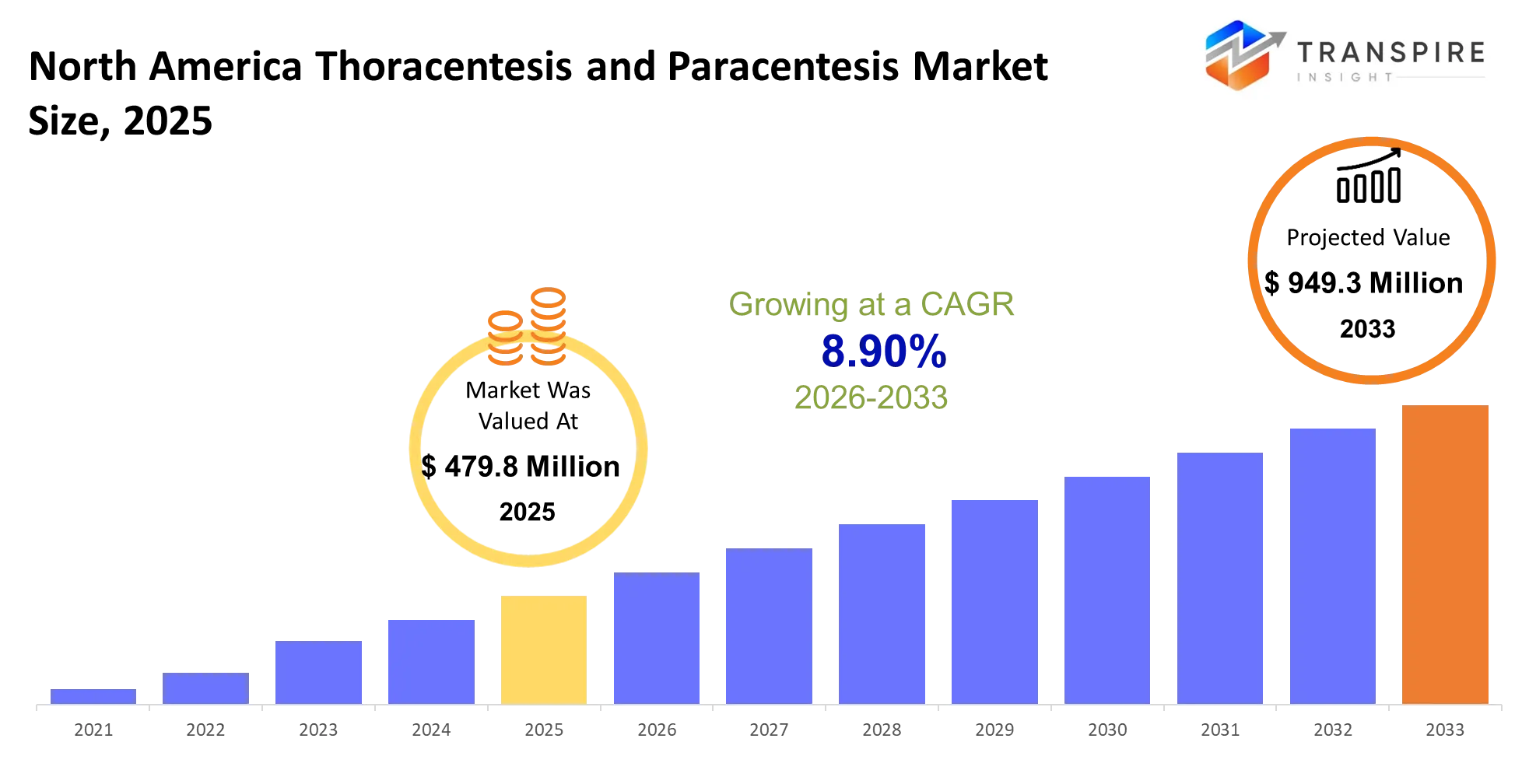
- North America Thoracentesis and Paracentesis Market Size 2025: USD 479.8 Million
- North America Thoracentesis and Paracentesis Market Size 2033: USD 949.3 Million
- North America Thoracentesis and Paracentesis Market CAGR: 8.90%
- North America Thoracentesis and Paracentesis Market Segments: By Type (Thoracentesis Kits, Paracentesis Kits, Needles, Catheters, Drainage Systems, Others), By Application (Pleural Effusion, Ascites, Oncology, Liver Disease, Others), By End-User (Hospitals, Clinics, Ambulatory Centers, Others), By Procedure (Diagnostic, Therapeutic, Others).
To learn more about this report,  Download Free Sample Report
North America Thoracentesis and Paracentesis Market Summary:
The North America Thoracentesis and Paracentesis Market size is estimated at USD 479.8 Million in 2025 and is anticipated to reach USD 949.3 Million by 2033, growing at a CAGR of 8.90% from 2026 to 2033.North America Thoracentesis and Paracentesis Market, supports day to day fluid management practices in hospitals, ambulatory clinics and critical care areas, meant to ease the pressure that comes from pleural effusion or an abdominal fluid buildup. In real workflows, these steps help clinicians steady patients who have cancer, liver disease, heart failure, or respiratory problems, and they also allow diagnostic sampling so clinical teams can decide more quickly. In the past five years the whole market sort of moved away from basic bedside drainage, toward ultrasound-guided, minimally invasive techniques, mainly because people want fewer complications, quicker discharge timing and better needle accuracy. During the COVID-19 period things sped up a lot, since overtaxed hospitals leaned into portable imaging systems, plus outpatient style fluid handling protocols. After that, buying patterns changed, with healthcare organizations giving more weight to disposable kits, infection-control oriented equipment and procedure standard formats, all at once. And as chronic disease loads keep rising across North America, providers are putting money into quicker, lower-risk intervention lanes, which then generates repeat procedural income and keeps demand strong for precision directed drainage technologies.
Key Market Insights
- The United States really takes the lead in the North America Thoracentesis and Paracentesis Market with close to 82% of the market share in 2025, mainly because of more advanced hospital infrastructure, and you know it matters.
- Canada is showing the fastest pace of growth all the way through 2031, driven by expanding critical care capacity and wider adoption of ultrasound-guided procedures, so clinicians can act faster.
- Across North America, strong reimbursement rules are still pushing procedure volumes higher, especially in tertiary care settings where they do a lot of these interventions, day after day.
- Respiratory illness prevalence, plus more liver disorder cases, is basically giving the whole industry room to grow over the long term inside North American healthcare systems.
- Disposable drainage kits hold the leading position, at over 46% share in 2025, since infection-control protocols are tightening up, and the demand for single-use routines stays high.
- Ultrasound-assisted thoracentesis systems sit in the second-largest slice, because hospitals tend to favor accuracy, and minimally invasive precision-guided actions.
- Portable fluid drainage devices are expected to grow the quickest through 2031 as outpatient care and ambulatory procedure volumes keep increasing, even on busy schedules.
- Catheter innovations along with integrated safety valve technologies are helping boost procedural efficiency, and that supports a higher market growth momentum.
- When you look at application use, pleural effusion management dominates, holding more than 58% application share in 2025.
- For applications, ascites management is becoming the fastest-growing area, largely tied to rising liver cirrhosis rates, and oncology-related abdominal fluid complications that show up more often.
- Finally, critical care and emergency medicine departments are producing a big chunk of demand, mainly for fast bedside drainage actions, especially when timing is strict.
What are the Key Drivers, Restraints, and Opportunities in the North America Thoracentesis and Paracentesis Market?
The strongest force pushing the North America Thoracentesis and Paracentesis Market along is the healthcare system’s gradual move toward ultrasound-guided, sort of minimally invasive, procedures. In fact, hospitals and outpatient centers increasingly rely on bedside imaging because it tends to lower complication rates, cuts back on repeat interventions ,and usually shortens inpatient stays. This change really picked up after the COVID-19 period, when capacity constraints came to the surface across North America hospitals ,and providers had to find better, faster ways to run procedures. At the same time, reimbursement models are starting to favor lower-cost interventions and fewer readmissions, so healthcare facilities are putting money into portable ultrasound systems and disposable drainage kits. That shift boosts procedural volumes directly, while also creating ongoing income streams for device manufacturers that supply single-use consumables and imaging-compatible tools.
Still, the market’s biggest structural issue is that there’s not enough highly trained interventional specialists, or enough clinicians who are really ultrasound-proficient. Thoracentesis and paracentesis depend on procedural accuracy, otherwise risks like pneumothorax, bleeding, or even organ injury can show up. A lot of community hospitals and rural healthcare systems don’t have trained personnel readily available, and they also may miss out on advanced imaging infrastructure. Unfortunately, this gap can’t be fixed overnight ,because physician training, credentialing, and equipment purchasing all take multi-year investment cycles. So smaller facilities often postpone adoption of advanced drainage systems, which slows down procedure standardization, and ultimately suppresses what the market could earn in revenue.
A major growth opportunity is kinda opening up in ambulatory and home based fluid care programs across the United States, and Canada. Healthcare providers are now piloting portable drainage catheter setups and distant patient monitoring systems for repeat pleural effusion plus ascites management. Basically, companies that build more integrated outpatient drainage solutions can lock in long term procedural demand while also helping hospitals ease their occupancy burden , and potentially lower treatment costs.
What Has the Impact of Artificial Intelligence Been on the North America Thoracentesis and Paracentesis Market?
Artificial intelligence along with more advanced digital technologies is gradually reshaping the North America Thoracentesis and Paracentesis Market, mainly because it boosts procedural precision, speeds up everyday workflow, and makes patient monitoring much smoother. A lot of hospitals and outpatient centers now rely on AI assisted ultrasound systems where the imaging kinda spots fluid pockets on its own, then it marks the anatomical landmarks and basically helps steer the needle during thoracentesis and paracentesis. Because of this, there is less operator to operator variation, and clinicians can finish these bedside tasks quicker, especially in busy pulmonary units and gastroenterology departments.
Then there are machine learning models that help with predictive clinical choices. In practice, providers use AI driven imaging analytics to watch how fluid is building up over time in people with liver cirrhosis, heart failure, or pleural effusion related to cancer. Some hospital networks even push predictive algorithms straight into electronic health records, so they can flag patients at higher likelihood of fluid returning. That way, earlier intervention scheduling becomes easier, and emergency admissions can drop. Clinicians often mention shorter procedure times , fewer complications, and better patient throughput in ambulatory care settings.
Beyond that, digital workflow platforms add extra operational leverage by automating documentation, pulling imaging into the right places, and keeping procedural tracking consistent across a hospital system. Still, AI adoption hits a big wall because advanced imaging platforms plus integrated data systems usually need a lot of capital investment, and the datasets must be highly standardized. Smaller facilities sometimes don’t have the infrastructure, or the trained staff needed to roll these tools out at scale, so the rollout can stall a bit there.
Key Market Trends
- Since 2021, hospitals started adopting ultrasound-guided thoracentesis more and more, up by over 35% kinda to lower the pneumothorax risk while making bedside procedures feel more accurate and calmer in practice, not just on paper.
- Outpatient fluid drainage did jump a lot too after COVID-19, when inpatient capacity got strained pretty hard across the United States and Canadian healthcare systems in 2020 and 2021, you could say it pushed people to change how they route care.
- Becton, Dickinson and Company along with Teleflex Incorporated also leaned into disposable catheter kit investment. This was when infection-control protocols got stricter after the pandemic disruptions, so they were basically moving toward safer workflow habits.
- Between 2022 and 2025, healthcare providers adjusted procurement methods, they started favoring portable ultrasound-compatible drainage systems instead of relying on conventional standalone procedural devices.
- Ambulatory surgical centers then grabbed more procedure volume, especially after insurers increased reimbursement help for minimally invasive outpatient thoracentesis and paracentesis work.
- At the same time, AI-enabled imaging guidance platforms showed up across tertiary hospitals, and that helped clinicians cut down procedure times while better improving fluid localization when cases get complex, like when the anatomy is not being cooperative.
- During 2021, supply chain disruptions made it painfully clear how dependent some organizations were on imported medical-grade tubing and catheter parts. So regional sourcing diversification across North America became a more obvious move, and faster.
- Pulmonary plus oncology departments kept standardizing single-use drainage kits more often, aiming to reduce cross-contamination dangers and keep the procedural workflow steady across different teams.
- Rural health systems however, kept slower adoption. The reason is still uneven distribution of trained interventional specialists and advanced imaging infrastructure across North America, so it’s not really a quick fix.
- After 2023, manufacturers introduced integrated safety-valve catheter systems, partly to reduce procedural complications but also to strengthen competitive differentiation inside hospital procurement contracts, which is where a lot of the decisions get made.
North America Thoracentesis and Paracentesis Market Segmentation
By Type
In terms of category, drainage systems alongside disposable thoracentesis and paracentesis kits seem to keep the strongest footing , mostly because healthcare providers keep leaning into infection control and procedural speed , but also because it’s easier to slot these products into day to day workflows. More and more hospitals opt for single use kits that already include catheters, needles, tubing, and the collection pieces, simply because a bundled setup cuts down preparation time and helps teams follow standardized clinical routines. Catheters also keep a big share of revenue, especially as repeat drainage sessions rise among oncology patients and people living with liver disease. Needle sales stay pretty steady, yet the rate of growth looks slower, since a lot of providers now prefer integrated safety features, rather than using standalone consumables. Portable drainage technologies really picked up after 2021, when outpatient visits and bedside procedures expanded across North America. Companies are answering with ultrasound friendly kits and improved safety valve designs, aiming to reduce the chance of complications. Looking ahead, the fight between brands will probably revolve around product integration disposability and compatibility with portable imaging platforms, which should open better chances for premium device suppliers as well as makers of specialized components.

To learn more about this report, Download Free Sample Report
By Application
In application pleural effusion management is still kind of the big segment, not because it’s simple, but because respiratory disorders heart failure, and cancer related fluid buildup keep pushing very high procedural volumes through acute care. The oncology side has also been growing at a steady pace—cancer treatments now help patients live longer and that, in turn , means more extended fluid management time overall. Then ascites care tied to liver cirrhosis stays a major revenue driver, especially with rising alcohol related cases plus metabolic liver disease trends, both in the United States and Canada. Diagnostic work doesn’t really wobble much, since physicians regularly depend on fluid sampling to catch infection early and to check for malignancy. Meanwhile therapeutic approaches seem to be accelerating faster because clinicians want symptom relief sooner and they lean more toward outpatient handling pathways. So current demand is tilting toward less invasive drainage systems, the kind that can shorten hospital stay duration and make patient turnover smoother. Companies that put money into precision-guided devices, and repeat-use drainage management solutions too, should be well positioned to gain from higher procedure frequency across oncology pathways and other chronic condition treatments.
By End-User
By end-user, hospitals keep on leading the market, sort of, because there are huge inpatient volumes , plus advanced imaging infrastructure, and specialists that are readily available… all of that supports frequent thoracentesis and paracentesis sessions. Meanwhile academic medical centers and tertiary hospitals are still taking on the more complicated oncology and pulmonary work, and that pretty much reinforces the pull for advanced drainage setups and ultrasound guided interventions. Clinics and ambulatory surgical centers are gathering pace too, since reimbursement structures increasingly push lower cost outpatient care . So, in many healthcare systems, uncomplicated fluid drainage is being moved away from inpatient areas, partly to cut operational costs and also to open up hospital beds and space. Smaller specialty clinics, focused on pulmonology and gastroenterology, are expanding their procedural reach as well, using portable imaging adoption, and that helps them run those services with a tighter setup. Still, rural providers tend to move slower with tech integration due to workforce gaps, plus capital limits that can be pretty rigid. Going forward, growth will likely tilt toward decentralized care delivery, which should create room for manufacturers selling compact procedural systems, disposable consumables, and workflow efficient devices that are imaging compatible, made specifically for outpatient settings.
By Producer
Through procedure logic, therapeutic interventions take the biggest slice, mostly because repeated pleural effusion plus ascites situations mean we keep doing fluid removal to manage symptoms and make the patient feel more at ease. Therapeutic thoracentesis and paracentesis went up quite a bit after healthcare teams started using shorter-stay treatment models, and these outpatient drainage programs, kind of took off too. Diagnostic procedures still matter a lot in oncology, infectious disease, and pulmonary medicine, since fluid analysis gives the guidance needed for treatment planning and for figuring out what’s going on with the disease. The appetite for diagnostic work keeps getting a lift from wider ultrasound use, it supports more precise sampling, and also helps lower complication risk.
You also see combined diagnostic-therapeutic procedures becoming more usual in busy hospitals, because putting the steps together tends to make workflow smoother and it shortens how long patients are being moved around. Overall, procedure trends lean more toward image-guided bedside treatment that’s enabled by portable systems and disposable consumables. Manufacturers who can push for better procedural accuracy, less infection exposure, and even smoother digital imaging support should land firmer purchasing agreements with hospitals and ambulatory care networks.
What are the Key Use Cases Driving the North America Thoracentesis and Paracentesis Market?
Pleural effusion management is still, pretty much, the core use case pushing procedural volumes across North American hospitals and those critical care units. In practice pulmonology teams do thoracentesis quite often especially for cancer patients, heart failure scenarios, and then for severe respiratory complications, where pulling out the fluid quickly helps breathing and seems to ease the hospitalization load not long after.
At the same time secondary applications keep growing, more in gastroenterology clinics and even ambulatory surgical centers, where recurrent ascites shows up tied to liver cirrhosis, and also metabolic liver disease. And you also see oncology outpatient programs using paracentesis more regularly, to handle abdominal fluid build up during longer chemotherapy cycles, plus in palliative care treatment schedules.
Then there are emerging angles, like home based drainage management that’s supported by portable catheter systems and remote patient monitoring platforms. A number of healthcare networks in the United States and Canada are piloting repeat outpatient fluid management pathways, with the idea of reducing inpatient occupancy, and lowering chronic care treatment costs somewhere across the forecast window.
|
Report Metrics |
Details |
|
Market size value in 2025 |
USD 479.8 Million |
|
Market size value in 2026 |
USD 522.5 Million |
|
Revenue forecast in 2033 |
USD 949.3 Million |
|
Growth rate |
CAGR of 8.90% from 2026 to 2033 |
|
Base year |
2025 |
|
Historical data |
2021 - 2024 |
|
Forecast period |
2026 - 2033 |
|
Report coverage |
Revenue forecast, competitive landscape, growth factors, and trends |
|
Country scope |
North America (Canada, The United States, and Mexico) |
|
Key company profiled |
BD, Cook Medical, Medtronic, Teleflex, Cardinal Health, Merit Medical, Boston Scientific, B. Braun, AngioDynamics, ICU Medical, Smiths Medical, Terumo, Fresenius, Conmed, Olympus |
|
Customization scope |
Free report customization (country, regional & segment scope). Avail customized purchase options to meet your exact research needs. |
|
Report Segmentation |
By Type (Thoracentesis Kits, Paracentesis Kits, Needles, Catheters, Drainage Systems, Others), By Application (Pleural Effusion, Ascites, Oncology, Liver Disease, Others), By End-User (Hospitals, Clinics, Ambulatory Centers, Others), By Procedure (Diagnostic, Therapeutic, Others) |
Which Regions are Driving the North America Thoracentesis and Paracentesis Market Growth?
The United States is still basically the dominant regional market because big hospital networks, advanced imaging infrastructure, and reliable reimbursement support just keep procedural volumes high across pulmonary and gastroenterology care. Federal healthcare spending keeps flowing and broad adoption of ultrasound-guided interventions keeps reinforcing demand for disposable drainage kits and portable procedural systems. A lot of major academic medical centers along with oncology treatment networks also run a high concentration of recurrent thoracentesis and paracentesis, it’s tied to chronic disease management. There’s also a mature medical device ecosystem backed by manufacturers, outpatient care providers, and connected health systems, which sort of locks in long-term market leadership throughout the country.
Canada comes in as the second-largest regional contributor, even if the overall market behavior feels different from the United States because healthcare expansion follows a more centralized and stability-minded model. Provincial healthcare systems keep putting money into minimally invasive procedural infrastructure, but they do it steadily while stressing long-term cost efficiency and standardized care delivery. Canadian hospitals are increasingly rolling out portable ultrasound systems in community care environments , not only in major metropolitan centers. With consistent public healthcare funding and gradual uptake of outpatient drainage pathways, Canada looks more like a steady generator of recurring procedural demand rather than a wild high-volatility growth spot.
Mexico seems to be emerging as the fastest-growing market , mostly because private healthcare investment is expanding and tertiary care facilities are getting modernized after 2022. Big city hospital groups increasingly adopted imaging-guided procedures that are more advanced, this is to help improve treatment quality, especially for oncology and liver disease patients. At the same time medical tourism is rising, and access to minimally invasive interventions is widening, so the demand is also accelerating for disposable drainage systems and portable imaging platforms. All of this momentum ends up making really appealing openings for medical device suppliers, outpatient care operators, and imaging technology providers, who want to push into the region between 2026 and 2033.
Who are the Key Players in the North America Thoracentesis and Paracentesis Market and How Do They Compete?
The North America Thoracentesis and Paracentesis Market looks kind of moderately consolidated, like a small cluster of global medical technology firms quietly controls a big portion of consumables and procedural kits. The competition is less about plain price and more about clinical performance , safety engineering , and whether the products fit smoothly into ultrasound guided workflows. The big players hold their ground by folding drainage systems into imaging guidance and pairing it with single-use sterile kits. Meanwhile smaller entrants try to shake things up with lower-cost catheter solutions that they call more “practical” for routine use. More hospitals these days tend to judge suppliers by infection control design, procedural efficiency and procurement bundling, not just by the cost of a standalone device. That shift kinda reinforces the established manufacturers because they already have wider portfolios and they can bundle everything together.
Becton, Dickinson and Company keeps pushing forward using infection-prevention centered drainage kits and safety-engineered catheters meant to cut down needle related complications during hospital procedures. They also expand by winning bundled hospital supply contracts, sort of tying consumables into broader critical care portfolios so institutional procurement cycles stay locked in. Teleflex Incorporated differentiates with catheter systems that are tuned for minimally invasive fluid drainage, especially in high-risk oncology and pulmonary care settings. Their growth approach leans on hospital partnerships and procedural standardization programs, helping adoption stay consistent across North American healthcare networks even when practices vary by facility.
Cook Medical kind of wins by leaning into procedural innovation for interventional drainage tools, it stresses precision guided catheter positioning, plus training help that is really for the physician. B. Braun SE builds its edge via combined fluid management systems and a solid grip on the hospital supply chain, especially when it comes to long term care facilities. Cardinal Health, on the other hand, leans hard on distribution reach and cost effective supply chain approaches, which then makes it easier for a lot of hospitals and ambulatory centers to get disposable thoracentesis and paracentesis kits, without too much friction.
Company List
- BD
- Cook Medical
- Medtronic
- Teleflex
- Cardinal Health
- Merit Medical
- Boston Scientific
- B. Braun
- AngioDynamics
- ICU Medical
- Smiths Medical
- Terumo
- Fresenius
- Conmed
- Olympus
Recent Development News
In May 2026, Becton Dickinson Raises 2026 Profit Forecast on Strong Medical Device Demand: BD (BectonDickinson) reported stronger-than-expected Q2 2026 performance and raised its annual profit forecast, citing robust demand for drug-delivery and surgical device products. The update is significant for the thoracentesis and paracentesis sector because BD remains a major supplier of drainage and centesis procedure systems used across North American hospitals.
Source: https://www.reuters.com
In May 2026, Artivion Announces Q1 2026 Revenue Growth and Endospan Acquisition Expansion: Artivion reported an 18% year-over-year revenue increase in Q1 2026 and announced the exercise of its option to acquire Endospan. The development highlights ongoing consolidation and investment activity in minimally invasive vascular and interventional technologies, which overlap with broader catheter-based procedure markets including thoracentesis-related drainage systems.
Source: https://www.prnewswire.com
What Strategic Insights Define the Future of the North America Thoracentesis and Paracentesis Market?
The North America Thoracentesis and Paracentesis Market seems to be drifting toward decentralized, image-guided, and more outpatient-first fluid management, kinda pushed by the need to cut inpatient burden and speed up procedural turnover—at least that’s what everyone is talking about. Over the next 5 to 7 years, demand is likely to gather more around integrated ultrasound-compatible kits, plus standardized bedside routines, since hospitals are betting on throughput optimization rather than making the process overly complicated. And because chronic conditions keep piling up, many patients end up needing repeat interventions cycles, not exactly a one-time fix.
There’s also a quieter hazard inside the diagnostic journey, where technology substitution could start changing the whole flow. Think of advanced non-invasive imaging and AI-driven fluid assessment tools that might lower how often certain procedures are performed in specific patient groups. So you could see volume pressure building over the long run, even if near-term utilization numbers don’t scream that yet. On top of that, supply chain concentration for sterile catheter-grade materials can bring exposure to pricing spikes, procurement delays, and those frustrating lead-time gaps.
Still , an emerging chance is showing up via hospital at home expansion in the United States, where portable drainage systems together with distant monitoring could shift some procedures away from usual clinical sites. Market players should probably focus on assembling compact, safety enabled drainage kits that mesh cleanly with digital monitoring integration, so they can notice this turning point early and secure longer term institutional deals.
North America Thoracentesis and Paracentesis Market Report Segmentation
By Type
- Thoracentesis Kits
- Paracentesis Kits
- Needles
- Catheters
- Drainage Systems
- Others
By Application
- Pleural Effusion
- Ascites
- Oncology
- Liver Disease
- Others
By End-User
- Hospitals
- Clinics
- Ambulatory Centers
- Others
By Procedure
- Diagnostic
- Therapeutic
- Others
Frequently Asked Questions
Find quick answers to common questions.
The approximate North America Thoracentesis and Paracentesis Market size for the market will be USD 949.3 Million in 2033.
The key segments of the North America Thoracentesis and Paracentesis Market are By Type (Thoracentesis Kits, Paracentesis Kits, Needles, Catheters, Drainage Systems, Others), By Application (Pleural Effusion, Ascites, Oncology, Liver Disease, Others), By End-User (Hospitals, Clinics, Ambulatory Centers, Others), By Procedure (Diagnostic, Therapeutic, Others).
Major players in the North America Thoracentesis and Paracentesis Market are BD, Cook Medical, Medtronic, Teleflex, Cardinal Health, Merit Medical, Boston Scientific, B. Braun, AngioDynamics, ICU Medical, Smiths Medical, Terumo, Fresenius, Conmed, Olympus.
The current market size of the North America Thoracentesis and Paracentesis Market is USD 479.8 Million in 2025.
The North America Thoracentesis and Paracentesis Market CAGR is 8.90%.
- BD
- Cook Medical
- Medtronic
- Teleflex
- Cardinal Health
- Merit Medical
- Boston Scientific
- B. Braun
- AngioDynamics
- ICU Medical
- Smiths Medical
- Terumo
- Fresenius
- Conmed
- Olympus
Recently Published Reports
-
Apr 2026
AI in Diabetic Retinopathy Market
AI in Diabetic Retinopathy Market Size, Share & Analysis Report By Type (Screening AI Systems, Diagnostic AI Systems, and Predictive AI Models), By Application Segment (Hospitals, Ophthalmology Clinics, Diagnostic Centers, and Research and Development), and Geography (North America, Europe, Asia-Pacific, Middle East and Africa, South and Central America), 2021 - 2031
-
Apr 2026
Psychometric Tests Market
Psychometric Tests Market Size, Share & Analysis Report By Type (Personality Tests, Ability/Aptitude Tests, Skill/Knowledge Tests, and Others), By Application (Talent Acquisition and Talent Management), and Geography (North America, Europe, Asia-Pacific, Middle East and Africa, South and Central America), 2021 – 2031
-
Apr 2026
Rare Biological Sample Collection Market
Rare Biological Sample Collection Market Size, Share & Analysis Report By Type (Isolation Kits & Reagent, Blood Collection Tubes, and Others), By Application (Oncology, Transcriptomics, Pharmacogenomics, and Others), and Geography (North America, Europe, Asia-Pacific, Middle East and Africa, South and Central America), 2021 – 2031
-
May 2026
Patient Lift Pendant Market
Patient Lift Pendant Market By Product Type (Wired Pendants, Wireless, Programmable), By Operation Type(Manual, Electric), By End-Users (Healthcare Professionals, Patients), By Application (Hospitals, Homecare, Rehabilitation Centers, Others), By Industry Analysis, Size, Share, Growth, Trends, and Forecasts 2021-2033
Our Clients
.jpg)