
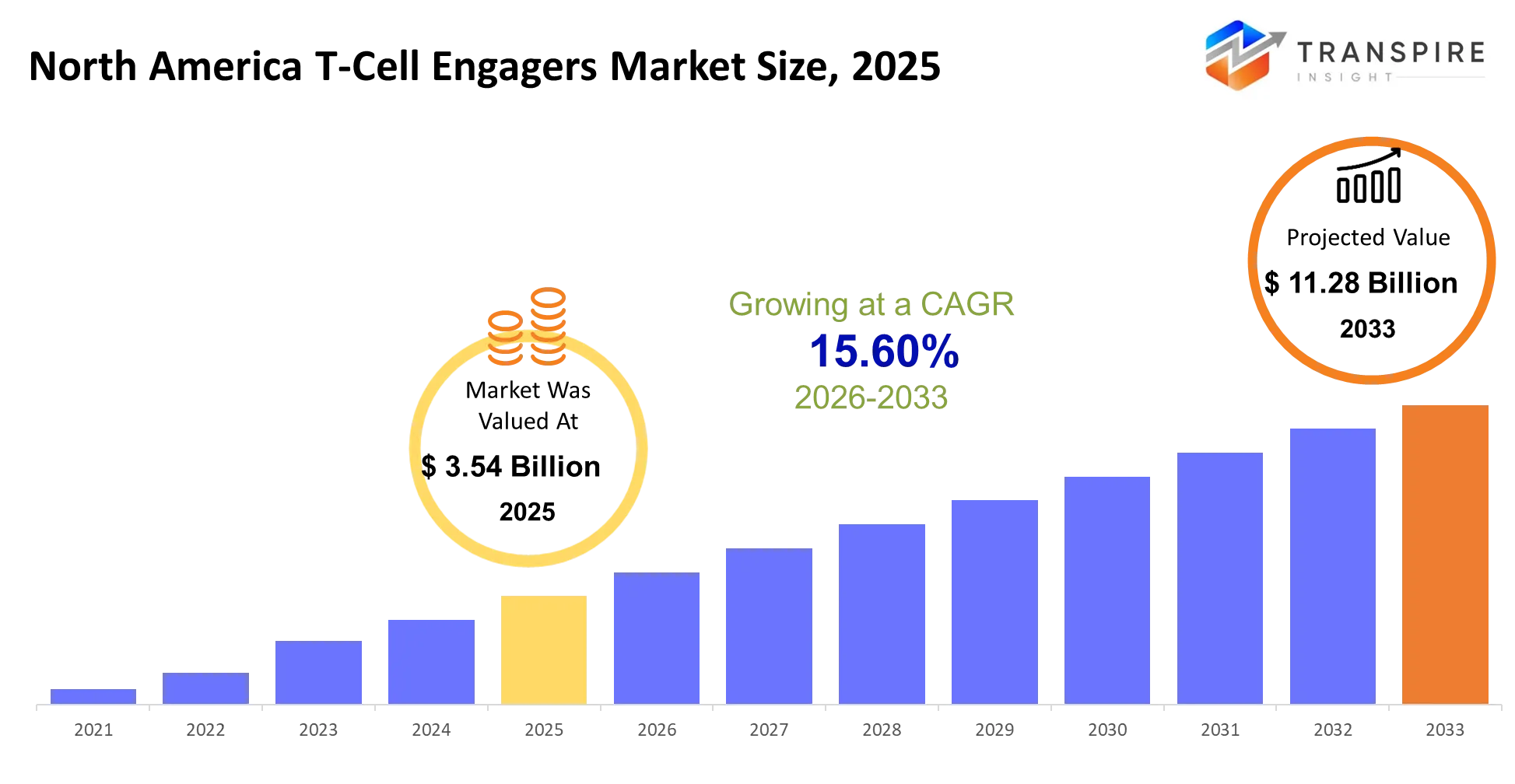
North America T-Cell Engagers Market Size & Forecast:
- North America T-Cell Engagers Market Size 2025: USD 3.54 Billion
- North America T-Cell Engagers Market Size 2033: USD 11.28 Billion
- North America T-Cell Engagers Market CAGR: 15.60%
- North America T-Cell Engagers Market Segments: By Type (Bispecific Antibodies, CAR-T Engagers, Dual-affinity Re-targeting, TCR-based Engagers, Fusion Proteins, Others), By Application (Oncology, Hematologic Malignancies, Solid Tumors, Immunotherapy, Others), By End-User (Hospitals, Cancer Centers, Research Institutes, Others), By Route (IV, Subcutaneous, Others).
To learn more about this report,  Download Free Sample Report
North America T-Cell Engagers Market Summary:
The North America T-Cell Engagers Market size is estimated at USD 3.54 Billion in 2025 and is anticipated to reach USD 11.28 Billion by 2033, growing at a CAGR of 15.60% from 2026 to 2033.The North America T-Cell Engagers Market is kind of sitting in the middle of a big change in cancer care, especially around blood cancers and those tougher solid tumors that dont respond easily. What these therapies do is redirect a patient’s immune cells toward malignant cells with more precision , so oncologists can manage situations where standard chemotherapy, or even single target biologics, give only modest control over the long run. Basically, T-cell engagers have moved from being viewed as an experimental immunotherapy idea into a commercially strategic oncology platform, which in real life matters a lot.
In the past three to five years, the market has had a noticeable structural transition, sort of starting from early-generation hematologic uses, then moving toward wider multi target approaches and solid tumor programs. This shift picked up speed after strong clinical results and regulatory momentum for bispecific antibody therapies really shifted where capital goes within North American biopharma. At the same time, the pandemic era created interruptions that highlighted weaknesses in staying consistent with oncology treatment , so healthcare systems began favoring options with shorter administration pathways and response data that can be measured. Now, as more hospitals build precision oncology initiatives and as drug developers lock in high value licensing deals, revenue growth seems more linked to earlier line adoption, combination regimens, and broader reimbursement support rather than relying only on a narrow late stage cancer storyline.
Key Market Insights
- The United States kinda dominated the North America T-Cell Engagers Market, with almost 88% share in 2025, mainly because the oncology infrastructure is more advanced, and the biologics commercialization is really strong too.
- Canada is shown as the fastest-moving regional market through 2032, it’s fueled by expanding cancer research funding and sort of quicker immunotherapy take-up, in general.
- North America keeps leading the global T-cell engager industry size, largely due to intense clinical trial activity and regulatory pathways that look pretty favorable for breakthrough oncology therapies.
- Plus, strategic investments into precision medicine programs are helping the regional market growth rate to climb, while also widening access to newer generation immunotherapies.
- Bispecific antibody T-cell engagers had the top segment position, with more than 65% share in 2025, mostly tied to solid efficacy in hematologic malignancies, and this matters a lot.
- Monoclonal antibody-based engager platforms stayed in the second slot, supported by already proven manufacturing know-how, plus commercial scalability that’s built in.
- Multi-target, solid-tumor focused engagers are expected to grow the quickest between 2026 and 2032, as pipeline diversification is expanding and companies shift priorities.
- Off-the-shelf immunotherapy platforms are also picking up meaningful share, since healthcare systems want scalable oncology treatment options that can be delivered faster.
- In terms of application, hematologic cancers led demand, holding over 58% share in 2025, because leukemia and lymphoma therapies tend to deliver higher response rates.
- Solid tumor applications are emerging as the fastest-growing therapeutic area, as tumor-targeting precision improves, and immune-cell activation efficiency gets better over time.
- And for revenue, relapsed and refractory cancer treatment is still a major contributor across the North America T-Cell Engagers Market, mostly because unmet clinical needs keep stacking up.
What are the Key Drivers, Restraints, and Opportunities in the North America T-Cell Engagers Market?
The strongest force moving the North America T-Cell Engagers Market ahead is kind of the clinical plus commercial momentum of bispecific immunotherapies, especially within blood cancers. Regulatory bodies, and the U.S. Food and Drug Administration in particular, have begun to open up faster track and breakthrough therapy routes after a few late stage studies turned up durable response rates in people with relapsed leukemia and lymphoma. And as more treatments moved from “just experimental” use into earlier lines of therapy, hospitals expanded their immunotherapy programs, while reimbursement coverage got better. In the end, this boosted prescription volumes, licensing activity, and partnership led revenue across the market.
Still, the biggest structural hurdle stays basically the same, it’s that heavy complexity, and the actual real cost of putting together and running T-cell engager therapies. These treatments require pretty sophisticated biologics manufacturing, careful cold-chain logistics, and specialized oncology infrastructure that can deal with immune related adverse events , like cytokine release syndrome. Smaller hospitals, or more regional treatment centers dont manage to stand up those capabilities quickly either, because it takes years of capital spending, trained personnel, plus the regulatory compliance processes. So geographic patient access gets restricted, patient enrollment slows down, and broader commercial uptake is dampened. That also delays revenue expansion beyond the large cancer networks, even when the clinical demand is there.
A big , forward thinking chance is showing up in solid tumor uses, helped by these next gen multi specific engager platform types. More and more firms are putting money into approaches that make the tumor binding more selective, kind of, and at the same time lower off target immune activation. On top of that, biotech businesses are teaming up with AI driven drug discovery groups , so that target figuring gets faster for pancreatic, lung, and colorectal cancers. If these platforms can really deliver repeatable clinical results , then the market might step out of a small niche in blood cancers, and move into far larger patient groups across North America.
What Has the Impact of Artificial Intelligence Been on the North America T-Cell Engagers Market?
Artificial intelligence and advanced digital technologies are, kind of, reshaping the North America T-Cell Engagers Market by making drug discovery faster, clinical trial work more precise, and biologics manufacturing steadier. Biopharmaceutical companies are increasingly leaning on AI-led platforms to automate the target identification, and the molecular screening side, especially for bispecific antibodies. In some oncology programs this has reduced early-stage development timelines from several years down to months, which sounds dramatic but it’s what teams report. There are also machine learning models that assist with patient stratification, by working through genomic information and biomarker datasets, so researchers can figure out which cancer patients might respond to T-cell engager therapies in a more reliable way.
On the clinical side, predictive analytics tools are improving trial execution by anticipating risky immune events like cytokine release syndrome before conditions get worse or escalation happens. At the same time, manufacturers are rolling out digital twins, plus AI-enabled production monitoring systems, to tune biologics manufacturing output, cut down batch failure counts, and keep process behavior consistent. Overall, these tools have been linked to less production waste, quicker scale-up cycles, and stronger regulatory compliance across modern immunotherapy facilities.
Still, AI adoption has a big obstacle, because solid oncology datasets remain scattered—across hospitals, research centers, and pharmaceutical firms. When clinical systems don’t interconnect well, model accuracy drops and it also slows the wider commercialization of AI-assisted, precision immunotherapy platforms.
Key Market Trends
- Since 2021, biopharma firms started moving their spending away from one-solo target immunotherapies and more toward multi-specific T-cell engager setups , aimed at those messy solid tumor microenvironments.
- Amgen and Pfizer also broadened oncology licensing ties after clinical response rates got better in relapsed lymphoma and leukemia studies during 2022 to 2025.
- Hospitals meanwhile adopted more outpatient immunotherapy administration models , because the newest engager therapies made the infusion process less involved and they also cut down time spent on patient monitoring afterward .
- Between 2020 and 2025, AI-based biomarker screening platforms shortened the whole oncology target discovery schedule by almost 30% across several development pipelines in North America.
- Regulatory agencies went faster on breakthrough therapy designations after bispecific antibody trials showed lasting responses in heavily pretreated cancer groups.
- Drug developers increasingly leaned on off-the-shelf engager platforms because autologous cell therapies exposed problems with scale, and manufacturing bottlenecks too , during the post-pandemic commercialization push.
- Contract manufacturing organizations added more biologics production capacity after pharmaceutical companies changed direction from fully in-house oncology manufacturing strategies since 2022.
- Academic cancer centers strengthened partnerships with industry, mostly as precision oncology initiatives began producing bigger genomic datasets, which made patient stratification , and treatment selection, feel more structured.
- In Canada, oncology networks increased trial participation after federal funding programs expanded immunotherapy research infrastructure starting around 2023.
- Competitive behavior shifted toward combination immunotherapy regimens, as companies chased longer remission durability and wider reimbursement reach across North American healthcare systems.
North America T-Cell Engagers Market Segmentation
By Type
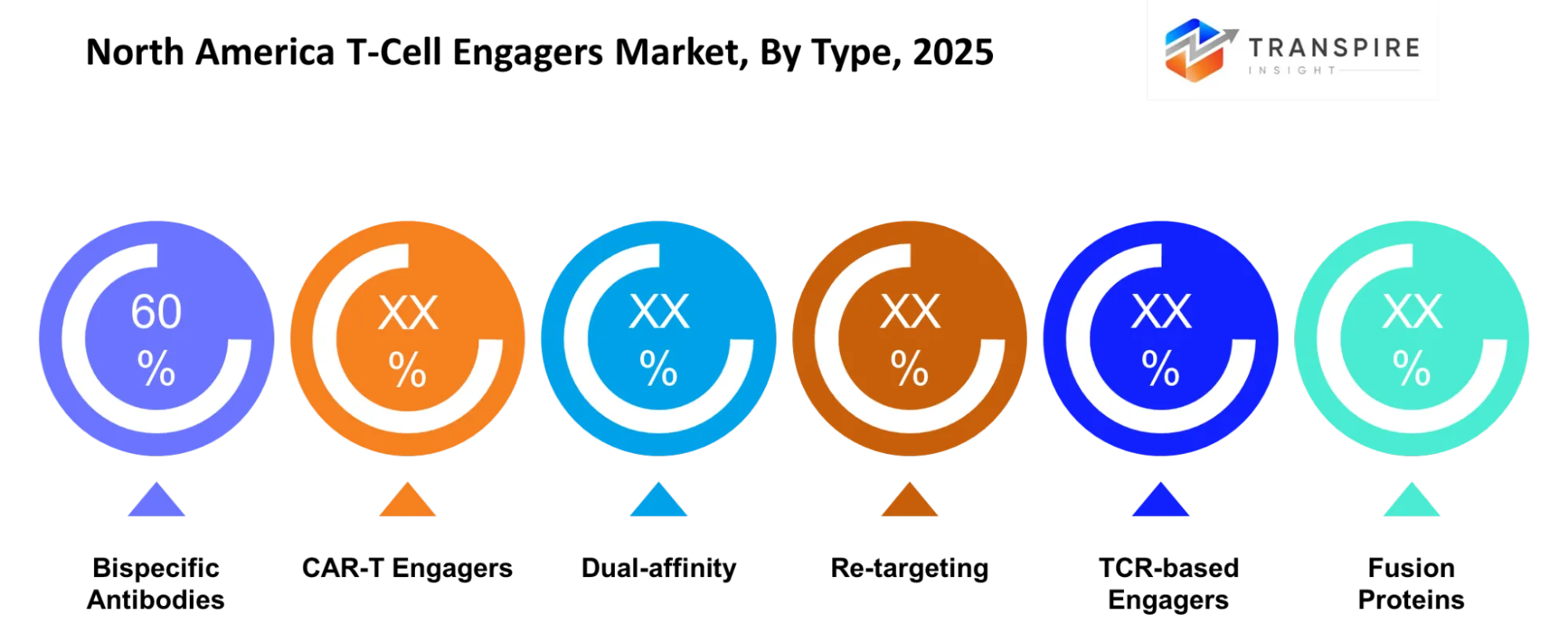
Bispecific antibodies are still sitting in the most dominant spot in this type segment, partly because the clinical validation in leukemia and lymphoma therapy has already sort of locked in commercial belief among oncology clinicians and biopharmaceutical investors. Dual-affinity re-targeting compounds, as well as fusion proteins, keep a smaller but still meaningful standing, mainly because their targeting efficiency stays high and the molecular design can be tuned in pretty flexible ways. At the same time, TCR based engagers, plus CAR-T engager platforms, are getting more momentum since developers are chasing treatments that can deal with antigen escape, and also the more messy aspects of tumor biology.
On a practical level, scaling manufacturing, managing toxicity, and the real regulatory approval timelines are still the big deal breakers across essentially every category. More and more, the large pharmaceutical firms seem to lean toward modular engager architectures that allow combination therapy development, and they also help with pipeline expansion. What happens next, in terms of competition in this segment, will likely hinge on solid tumor performance, outpatient compatibility , and production efficiency. Companies that can reduce cytokine related troubles while improving persistence and selectivity, may end up pulling stronger licensing activity and a steadier long term position across North American oncology networks.
To learn more about this report, Download Free Sample Report
By Application
Honestly, the oncology use cases really do seem to steer the whole market, mainly because T-cell engager treatments have shown fairly meaningful response rates in relapsed and refractory cancers where older biologics often don’t stick around for long. And then, hematologic malignancies keep that top application slice, mostly since treatment pathways are already kind of established in acute lymphoblastic leukemia, multiple myeloma, and non-Hodgkin lymphoma. On the other hand solid tumors look like the fastest moving chance, because companies keep throwing a lot of resources into therapies aimed at lung, colorectal, and pancreatic cancers.
Immunotherapy-leaning applications keep growing too, not just because of science, but because many healthcare systems are pushing harder toward precision-guided care approaches, the ones that can improve survival results while also dialing down unnecessary exposure to toxic chemo routines. At the same time, progress in tumor microenvironment targeting, and more importantly biomarker-led patient selection, is reshuffling what gets prioritized during clinical development across oncology programs. For what comes next, the extra momentum inside these application categories will probably hinge on earlier-line adoption, broader reimbursement coverage, and proof that durable remission benefits are achievable in larger patient cohorts, not only in those more specialized hematologic oncology environments.
By End-User
Hospitals are still kind of the dominant end-user slice, mostly because advanced immunotherapy delivery really does need intense monitoring infrastructure, multidisciplinary oncology teams, and also careful , specialized handling for biologics. Cancer centers come right after that as they have a lot of patients in one place, they show strong clinical trial participation, and they generally fold in next-generation oncology therapies sooner into the actual treatment protocols, in a practical sense. Research institutes keep pushing their influence further too, mainly via translational medicine collaborations, biomarker discovery initiatives, and investigator-led clinical studies that also back new engager platforms. Community healthcare providers , plus smaller outpatient facilities, end up more operationally constrained, because immune-related adverse event management requires specialized know-how and some emergency response readiness.
Also, strategic collabs between pharmaceutical companies and academic oncology networks have climbed a fair amount since 2021, like developers are trying to lock in faster patient enrollment , and better real world evidence creation. Looking ahead, the end user landscape is likely to drift toward integrated precision oncology ecosystems where hospitals, cancer centers , and research institutions share genomic data, treatment decision rules, and digital monitoring tools—so therapeutic decisions get sharper, and patients can receive care with less friction overall.
By Route
Right now, Intravenous administration pretty much takes the lead in the route segment, mostly because most of the approved T-cell engager therapies need controlled dosing, continuous infusion schedules, and really close clinical supervision during those early treatment cycles. Intravenous delivery also helps with quick therapeutic distribution, and it lets oncology teams handle immune related adverse reactions more effectively, especially when patients are in a hospital. Subcutaneous administration is starting to look like a big growth angle too, not just a side option , because pharmaceutical companies want to cut down on infusion burden, make outpatient access easier, and reduce the time patients spend in treatment chairs.
In early-stage development, programs are increasingly moving toward long-acting formulations, the kind that can keep efficacy steady while lowering hospitalization needs and also reducing operational costs for healthcare systems. Other delivery routes still stay pretty limited, largely due to biologic stability issues, plus the complicated pharmacokinetic requirements tied to immune-cell activation therapies. What happens next with these administration routes will likely shape commercial competitiveness a lot, especially as healthcare providers lean into patient convenience, lower resource utilization, and more scalable immunotherapy delivery models across wider oncology care networks.
What are the Key Use Cases Driving the North America T-Cell Engagers Market?
The main reason people actually start using these products is tied to treating relapsed or refractory blood cancers, especially acute lymphoblastic leukemia , and also multiple myeloma. The biggest demand tends to come from large oncology hospitals, because T cell engagers basically give patients a more focused immune activation when they no longer respond to chemotherapy, or the usual monoclonal antibody options.
On top of that, the growing use is showing up in combination immunotherapy programs, for lymphoma as well as early stage solid tumor care inside specialized cancer centers and academic research networks. Pharmaceutical companies are now more often teaming up with those groups, to test engager therapies together with checkpoint inhibitors, plus other precision oncology protocols.
Lately, what’s popping up more and more are newer use cases like personalized multi antigen targeting, and even outpatient subcutaneous delivery of the immunotherapy. The developers are also looking at engagement platforms for tough solid tumors, such as pancreatic, and colorectal cancers. In those areas, outcomes still feel limited, even when teams use aggressive chemotherapy schedules .
Report Metrics |
Details |
|
Market size value in 2025 |
USD 3.54 Billion |
|
Market size value in 2026 |
USD 4.09 Billion |
|
Revenue forecast in 2033 |
USD 11.28 Billion |
|
Growth rate |
CAGR of 15.60% from 2026 to 2033 |
|
Base year |
2025 |
|
Historical data |
2021 - 2024 |
|
Forecast period |
2026 - 2033 |
|
Report coverage |
Revenue forecast, competitive landscape, growth factors, and trends |
|
Country scope |
North America (Canada, The United States, and Mexico) |
|
Key company profiled |
Amgen, Roche, Pfizer, Novartis, Johnson & Johnson, Bristol Myers Squibb, AstraZeneca, Sanofi, GSK, Regeneron, AbbVie, Merck, Eli Lilly, Takeda, Biogen |
|
Customization scope |
Free report customization (country, regional & segment scope). Avail customized purchase options to meet your exact research needs. |
|
Report Segmentation |
By Type (Bispecific Antibodies, CAR-T Engagers, Dual-affinity Re-targeting, TCR-based Engagers, Fusion Proteins, Others), By Application (Oncology, Hematologic Malignancies, Solid Tumors, Immunotherapy, Others), By End-User (Hospitals, Cancer Centers, Research Institutes, Others), By Route (IV, Subcutaneous, Others) |
Which Regions are Driving the North America T-Cell Engagers Market Growth?
The United States still comes off as the dominant regional market because, advanced oncology infrastructure, solid biologics funding, and an accelerated regulatory pathway keeps pushing rapid commercialization of T-cell engager therapies. Federal agencies basically leaned harder into breakthrough therapy and fast-track review channels after a few immunotherapy trials showed real, strong clinical outcomes in relapsed blood cancers. Big academic cancer centers, plus integrated hospital networks, and those well-known biotechnology clusters, all together make a very coordinated ecosystem, for clinical development and commercialization . Add in steady venture capital momentum and licensing arrangements between pharma and research institutions, and it’s hard for the region not to stay on top for next-generation engager platforms.
Canada is the next tier, second-largest regional contributor, even if the market behavior looks quite different from the United States . Growth in Canada seems more dependent on coordinated public healthcare investment and research-led uptake, rather than a rapid commercial ramp. Provincial cancer care networks tend to keep immunotherapy funding models stable, so treatment integration lasts longer, instead of turning into fast commercial expansion. Canadian academic groups also have a bigger footprint in translational oncology work, especially when it comes to biomarker discovery, and combination immunotherapy studies. That sort of organized and predictable healthcare setup gives manufacturers consistent revenue visibility , and helps them lock in stable clinical partnerships for longer-duration oncology programs.
Mexico is sort of emerging as the fastest-growing regional market because of recent expansion of private oncology infrastructure and also more investment into advanced cancer treatment access, kind of. Healthcare providers seemed to accelerate modernization efforts after cross-border pharmaceutical collaborations helped improve the availability of high-value biologic therapies and specialty oncology services, sort of more smoothly. Urban cancer centers are now putting money into precision oncology capabilities, like advanced diagnostics and immunotherapy administration systems, to deal with the rising cancer burden across metropolitan populations. All this keeps building momentum, and it creates meaningful chances for biotechnology firms, contract manufacturers, and healthcare investors trying to enter earlier into an expanding immunotherapy treatment landscape between 2026 and 2033 .
Who are the Key Players in the North America T-Cell Engagers Market and How Do They Compete?
Competition inside the North America T-Cell Engagers Market is still pretty moderately consolidated, mostly because only a handful of major biopharmaceutical players steer the late-stage clinical pipelines, the manufacturing backbone, and a lot of the regulatory know how. Still, the smaller biotechnology companies keep disrupting the landscape, using more specialized engager platforms aimed at hard solid tumors and multi-antigen cancer routes. It’s less about price fighting and more about technology improvements, especially around immune-cell targeting precision, lowering toxicity, and delivery systems that can work in outpatient settings. Clinical distinction, faster regulatory clearance, and better access to oncology research networks are starting to decide long-term commercial strength across North America.
Amgen keeps its edge thanks to years of practice in bispecific T-cell engager development plus day to day commercial oncology delivery. It tends to stand apart with its already established hematologic cancer options, backed by large-scale biologics manufacturing and strong, long standing hospital connections. Roche meanwhile leans into fusing companion diagnostics with immunotherapy development, which helps enable more biomarker guided patient selection and tighter treatment directing. Pfizer continues pushing forward through licensing agreements and oncology research partnerships, aiming to broaden solid tumor pipeline diversification and also decrease development risk, in a more managed way.
Johnson & Johnson is really pushing combination immunotherapy, like pairing engager therapies with wider oncology treatment menus, so there is more of that real integration across cancer care pathways . They use global clinical trial setup and, plus, huge oncology distribution networks to help speed up market penetration. AbbVie on the other hand leans into targeted acquisitions and also partnerships, especially with up and coming biotechnology developers working on next generation immune cell engineering platforms. Meanwhile, a handful of mid sized biotech companies are taking a more narrow lane, focusing on pancreatic and colorectal cancer uses, where the bigger pharmaceutical players still have pretty mixed clinical results and treatment durability that can be less consistent.
Company List
- Amgen
- Roche
- Pfizer
- Novartis
- Johnson & Johnson
- Bristol Myers Squibb
- AstraZeneca
- Sanofi
- GSK
- Regeneron
- AbbVie
- Merck
- Eli Lilly
- Takeda
- Biogen
Recent Development News
In January 2026, Bristol Myers Squibb Expands T-Cell Engager Partnership With Janux Therapeutics: Bristol Myers Squibb signed a major collaboration with Janux Therapeutics focused on tumor-activated T-cell engager therapies for solid tumors. The deal included an upfront payment and potential milestone-based compensation tied to clinical and commercial progress, highlighting continued investment in next-generation immuno-oncology platforms in North America.
Source: https://www.linkedin.com
In March 2026, Gilead Acquires Ouro Medicines’ T-Cell Engager Program in Multibillion-Dollar Deal: Gilead Sciences announced a deal valued at up to $2 billion involving a first-in-class BCMAxCD3 T-cell engager candidate from Ouro Medicines. The acquisition strengthened Gilead’s oncology pipeline and reinforced the growing strategic value of bispecific T-cell engager technologies in hematologic cancers.
Source: https://www.europeanpharmaceuticalreview.com
What Strategic Insights Define the Future of the North America T-Cell Engagers Market?
The North America T-Cell Engagers Market is kind of moving toward earlier-line cancer intervention , and also a broader push into solid tumors over the next five to seven years. The main driver behind this shift is basically the coming together of precision oncology, biomarker-led treatment choice and next-generation bispecific engineering that can lower toxicity while keeping patients on therapy longer. As clinical results keep improving beyond hematologic cancers, commercial value will likely shift more and more from narrow salvage options toward large scale mainstream oncology platforms.
One risk that feels a bit underrecognized is manufacturing concentration across only a handful of advanced biologics sites. If demand climbs more quickly than production can expand then supply bottlenecks, quality-control disruptions ,and pricing pressure might end up delaying commercialization even though real world clinical adoption looks strong. There’s also another emerging issue, which is alternative immune-cell platforms that may compete for the same oncology funding pools and reimbursement allocations.
A big opportunity that’s starting to show up is outpatient friendly , subcutaneous engager therapies backed by digital patient monitoring. Firms that put money in early on decentralized oncology delivery models, regional manufacturing partnerships , and AI based patient stratification features may end up with better payer access and more durable competitive strength across North America.
North America T-Cell Engagers Market Report Segmentation
By Type
- Bispecific Antibodies
- CAR-T Engagers
- Dual-affinity Re-targeting
- TCR-based Engagers
- Fusion Proteins
- Others
By Application
- Oncology
- Hematologic Malignancies
- Solid Tumors
- Immunotherapy
- Others
By End-User
- Hospitals
- Cancer Centers
- Research Institutes
- Others
By Route
- IV
- Subcutaneous
- Others
Frequently Asked Questions
Find quick answers to common questions.
The approximate North America T-Cell Engagers Market size for the market will be USD 11.28 Billion in 2033.
The key segments of the North America T-Cell Engagers Market are By Type (Bispecific Antibodies, CAR-T Engagers, Dual-affinity Re-targeting, TCR-based Engagers, Fusion Proteins, Others), By Application (Oncology, Hematologic Malignancies, Solid Tumors, Immunotherapy, Others), By End-User (Hospitals, Cancer Centers, Research Institutes, Others), By Route (IV, Subcutaneous, Others).
Major players in the North America T-Cell Engagers Market are Amgen, Roche, Pfizer, Novartis, Johnson & Johnson, Bristol Myers Squibb, AstraZeneca, Sanofi, GSK, Regeneron, AbbVie, Merck, Eli Lilly, Takeda, Biogen.
The current market size of the North America T-Cell Engagers Market is USD 3.54 Billion in 2025.
The North America T-Cell Engagers Market CAGR is 15.60%.
- Amgen
- Roche
- Pfizer
- Novartis
- Johnson & Johnson
- Bristol Myers Squibb
- AstraZeneca
- Sanofi
- GSK
- Regeneron
- AbbVie
- Merck
- Eli Lilly
- Takeda
- Biogen
Recently Published Reports
-
Apr 2026
Cord Blood Banking Services Market
Cord Blood Banking Services Market Size, Share & Analysis Report By Type of Service (Collection, Processing, Storage), By Bank Type (Private Banks, Public Banks, and Hybrid Banks), By Component (Cord Blood, and Cord Tissue), By End User (Hospitals, Research Institutions, Biotechnology Companies, and Others) and Geography (North America, Europe, Asia-Pacific, Middle East and Africa, South and Central America), 2021 - 2031
-
Apr 2026
ELISA Processors Market
ELISA Processors Market Size, Share & Analysis Report By Type (Optical Filter ELISA Analyzer, and Optical Grating ELISA Analyzers), By Mode (Automated ELISA Analyzers, and Semi-Automated ELISA Analyzers), By Applications (Immunology, Vaccine development, Drug Monitoring, and Others), By End Users (Biotechnology Companies, Pharmaceutical Companies, Contract Research Organization, and Diagnostic Laboratories) and Geography (North America, Europe, Asia-Pacific, Middle East and Africa, South and Central America), 2021 - 2031
-
May 2026
Microscope Slide Scanner Market
Microscope Slide Scanner Market Size, Share & Analysis Report By Type (Portable Microscope Slide Scanner, and Desktop Microscope Slide Scanner), By Application (Biological Research, Medicine, Veterinary, and Other) and Geography (North America, Europe, Asia-Pacific, Middle East and Africa, South and Central America), 2021 - 2031
-
Apr 2026
Microwave Cookware Market
Microwave Cookware Market Size, Share & Analysis Report By Material Type (Plastic, Glass, Ceramic, Silicone, and Metal), By Application (Cooking, Reheating, and Defrosting), By End User (Household, Commercial (Restaurants, Hotels, and Cafes), and Food Service Industry), By Sales Channel (Online Retail, Offline Retail (Supermarkets, Hypermarkets, Specialty Stores), and Direct Sales (Company Outlets)) and Geography (North America, Europe, Asia-Pacific, Middle East and Africa, South and Central America), 2021 - 2031