

North America Pneumoconiosis Market Size & Forecast:
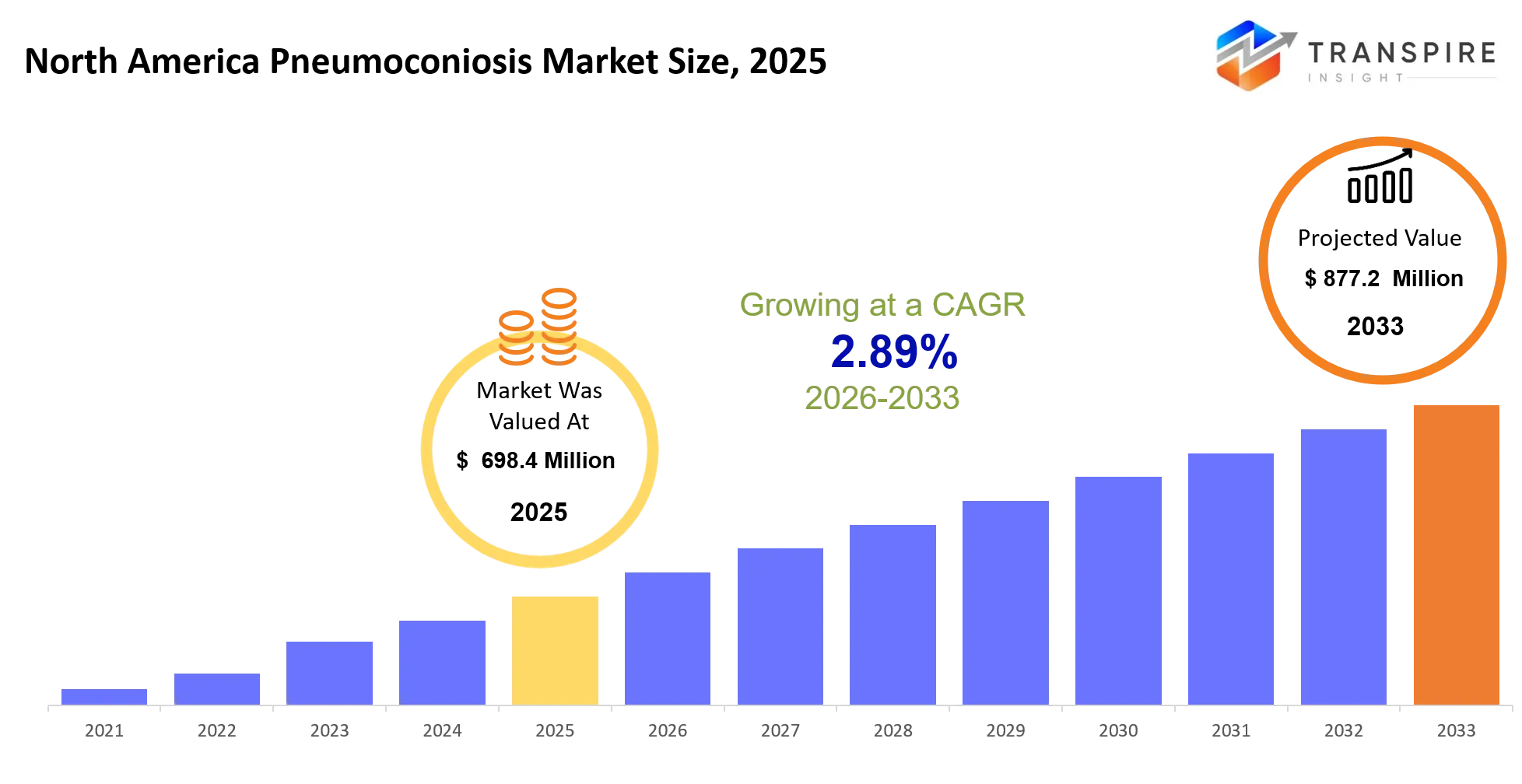
- North America Pneumoconiosis Market Size 2025: USD 698.4 Million
- North America Pneumoconiosis Market Size 2033: USD 877.2 Million
- North America Pneumoconiosis Market CAGR: 2.89%
- North America Pneumoconiosis Market Segments: By Disease Type (Asbestosis, Silicosis, Coal Workers’ Pneumoconiosis, Mixed Dust Pneumoconiosis, Others); By Treatment Type (Drug Therapy, Oxygen Therapy, Pulmonary Rehabilitation, Lung Transplantation, Others); By End User (Hospitals, Pulmonary Clinics, Rehabilitation Centers, Others); By Drug Type (Bronchodilators, Corticosteroids, Antibiotics, Antifibrotic Drugs, Others)
To learn more about this report,  Download Free Sample Report
North America Pneumoconiosis Market Summary
The North America Pneumoconiosis Market was valued at USD 698.4 Million in 2025. It is forecast to reach USD 877.2 Million by 2033. That is a CAGR of 2.89% over the period.
North America pneumoconiosis market is mostly about services and solutions that, in a bit of a practical way, help mining, construction, and heavy manufacturing operators spot prevent and control lung damage from long-term dust exposure, especially silica and coal particles . For day to day work it can look like diagnostic imaging, workplace air monitoring, respiratory protection gear, and occupational health programs that keep workers still able to remain on site, while also cutting down employer liability. In reality it covers a whole set of steps, not just one activity, and it tends to stay connected to compliance. Over the past 3–5 years, the market has been moving away from occasional manual screening and toward continuous, data driven occupational surveillance that is enabled by digital radiology and imaging tools using AI. At the same time, more forceful enforcement of respirable crystalline silica rules, plus stronger awareness of respiratory risk during the COVID-19 period, sped up compliance spending and pushed PPE upgrades. Because of that employers are more and more tying prevention and early detection directly into core operations, so demand keeps showing up again for monitoring systems, clinical assessments, and protective technologies, not only as one time interventions.
Key Market Insights
- In North America, the United States is pretty much in the driver seat for the Pneumoconiosis Market , grabbing almost 78% share in 2025, mainly because OSHA enforcement stays strict and the healthcare system is more advanced than elsewhere.
- Mexico looks like the fastest-growing regional player over 2026 to 2032, and that is largely linked to growing mining operations plus industrial safety upgrades , kinda like a two prong push.
- On the product or service side, diagnostic imaging services take the lead, with roughly 42% share, the reason being early detection needs and the regulatory screening mandates that keep getting enforced.
- Respiratory protection equipment lands in the second spot , it benefits from steady demand from mining and construction, especially when worksites are under stricter compliance.
- Occupational health monitoring services actually grow the quickest through 2032, because digital surveillance adoption is becoming more common, and employers are leaning into that.
- For applications, mining dominates the North America Pneumoconiosis Market with close to 55% share, mostly due to the stubborn exposure levels tied to silica and coal dust risks.
- The construction sector, however shows the fastest growth, and that is tied to infrastructure expansion and tighter worker safety compliance programs that employers cannot ignore.
- As for end users, industrial employers lead the market with about 60% share, they are investing a lot into preventive occupational health systems.
- Occupational health clinics are the fastest-growing end-user type too, expanding as outsourced workplace screening demand keeps increasing.
- Strategic partnerships with mining and construction firms speed up the deployment of real-time monitoring, and the compliance led respiratory safety systems, sort of thing.
What are the Key Drivers, Restraints, and Opportunities in the North America Pneumoconiosis Market?
The North America Pneumoconiosis Market sort of, mostly moves because of tightening occupational exposure rules and this gradual shift toward proactive industrial health handling. When the updated respirable crystalline silica standards get enforced across mining, tunneling, and construction, employers end up having to put in continuous dust monitoring setups, plus scheduled radiological screening. That kind of regulatory pull has really bumped up recurring spending on diagnostic imaging , workplace compliance audits, and respiratory protection programs. So occupational safety stops feeling like a once in a while cost and turns into a more structured operational budget item, or something close to that.
There’s also a restraint that keeps showing up, the long latency period of pneumoconiosis itself. It makes early diagnosis kind of messy, and it weakens the “see the return fast” view for employers. On top of that, many small and mid sized industrial operators run into heavy upfront costs for advanced imaging systems and AI enabled monitoring infrastructure. Since the disease can progress over decades, a lot of organizations end up delaying bigger rollouts. That means solution providers may have slower short term revenue momentum , even though the mandates are there.
Still, an emerging opportunity is AI-integrated radiology paired with predictive occupational health analytics, especially inside large mining clusters in the United States and western Canada. Firms like GE HealthCare are working on AI-assisted chest imaging tools, which aim to improve early detection accuracy and reduce false negatives. And when you stack that with more investment in digital occupational health platforms , these capabilities could nudge the North America Pneumoconiosis Market toward a predictive, rather than reactive approach to disease management.
What Has the Impact of Artificial Intelligence Been on the North America Pneumoconiosis Market?
Artificial intelligence is kind of reshaping how occupational lung disease management is handled in the North America Pneumoconiosis Market. it’s mostly improving the way industrial exposure risks are watched, detected, and then prevented across places like mining and construction. In these settings, AI-enabled tools are now improving exposure monitoring, not just in theory but in day to day use.
For example, AI-driven imaging systems automate the reading process for chest X-rays and CT scans, so radiology teams can flag early stage pneumoconiosis signs sooner than they would with the older manual review workflows. And at the operations level, machine learning is getting embedded into dust monitoring networks, plus ventilation control systems, where it helps fine tune airflow, send alerts when silica exposure limits start climbing, and also reduce how much teams depend on repeated manual inspection cycles.
Predictive analytics is showing up in a similar way for maintenance planning, especially for industrial air filtration and dust suppression equipment. By looking at sensor signals from drilling rigs and enclosed worksites, these models can forecast filter wear, and system inefficiencies before anything breaks down. That, in turn, supports better equipment uptime and fewer unplanned shutdowns. Early deployments in bigger mining operations are already suggesting tangible improvements too, like more consistent compliance behavior and quicker occupational screening turnaround times, which supports safety results as well as cost efficiency.
Still, adoption is a bit constrained by the integration costs, and also by fragmented industrial data systems. This is extra noticeable in older facilities where the sensor foundation is limited, or not well established. Also, there is a shortage of high quality labeled medical and exposure datasets, which can reduce model accuracy across the full range of real world working conditions. So even with strong technical promise, broad rollouts get slowed down.
Key Market Trends
- After 2020 the OSHA silica rule enforcement got more intense, so a lot of mining firms stopped doing those simple annual checks and started using continuous respirable dust monitoring systems, sort of nationwide, and yeah it’s been a big shift in practice.
- Also post 2022, AI based radiology adoption rose fast. in many large occupational health programs it started replacing manual chest X-ray screening, which sounds basic but it really changed workflows.
- Mining companies then leaned away from reactive respiratory treatment and moved toward preventive PPE integration, and that pivot lined up with the COVID-19 workplace safety disruptions in 2020 to 2021, even if some teams were late to fully adopt it.
- From 2021 on, digital occupational health platforms kept expanding. they made it easier to run centralized compliance tracking across multiple construction sites, without that constant back and forth paperwork.
- On the equipment side respiratory protection manufacturers increased automation in filter production lines since 2019, mostly to keep up with the growing industrial safety compliance demand, and they were trying to scale without losing consistency.
- In mining fleets, predictive maintenance tools picked up momentum after 2023, which sort of helped reduce those unplanned ventilation system failures across worksites, in a way.
- Meanwhile the U.S. mining sector went on to consolidate more vendor relationships, and partnerships with GE HealthCare and Siemens Healthineers became a bit more common for advanced diagnostic imaging upgrade work, yeah.
- And those supply chain changes after 2020 pushed a lot of organizations to lean harder on domestic respirator manufacturing, which lowered dependency on imported protective equipment even when lead times got complicated.
North America Pneumoconiosis Market Segmentation
By Disease Type
Coal Workers’ Pneumoconiosis seems to hold the leading spot, mostly because it has such a long history of showing up in mining-dense places in the United States, especially Appalachia. In those areas, older exposure still keeps producing ongoing clinical cases, so it doesn’t really fade out quickly. Silicosis follows close behind, helped along by construction and tunneling expanding, which means workers are still facing elevated crystalline silica exposure, often under tighter OSHA style monitoring rules. Asbestosis keeps a steady but relatively slower growth, since asbestos use has dropped over time. Mixed dust pneumoconiosis and a few other rare conditions make up a smaller slice, though they can be clinically complicated to sort out and manage.
Growth inside this segment is basically driven by a movement away from single, acute industrial exposure incidents toward long-term cumulative risk detection. Coal and silica related conditions stay on top because today’s monitoring systems often flag cases sooner, so recorded incidence rises even if the underlying prevalence hasn’t changed as much. Silicosis diagnosis rates are climbing too, largely because imaging sensitivity keeps improving across occupational screening programs and early detection pathways.
Over the forecast period, silicosis is expected to gain relative share, as construction activity ramps up, and as diagnostic accuracy keeps getting better. Coal-related cases will likely level off, but they’ll still remain important due to legacy mining populations. Diagnostic technology vendors and occupational health systems are likely to focus on early detection tools designed around silica exposure patterns, rather than one-size-fits-all approaches.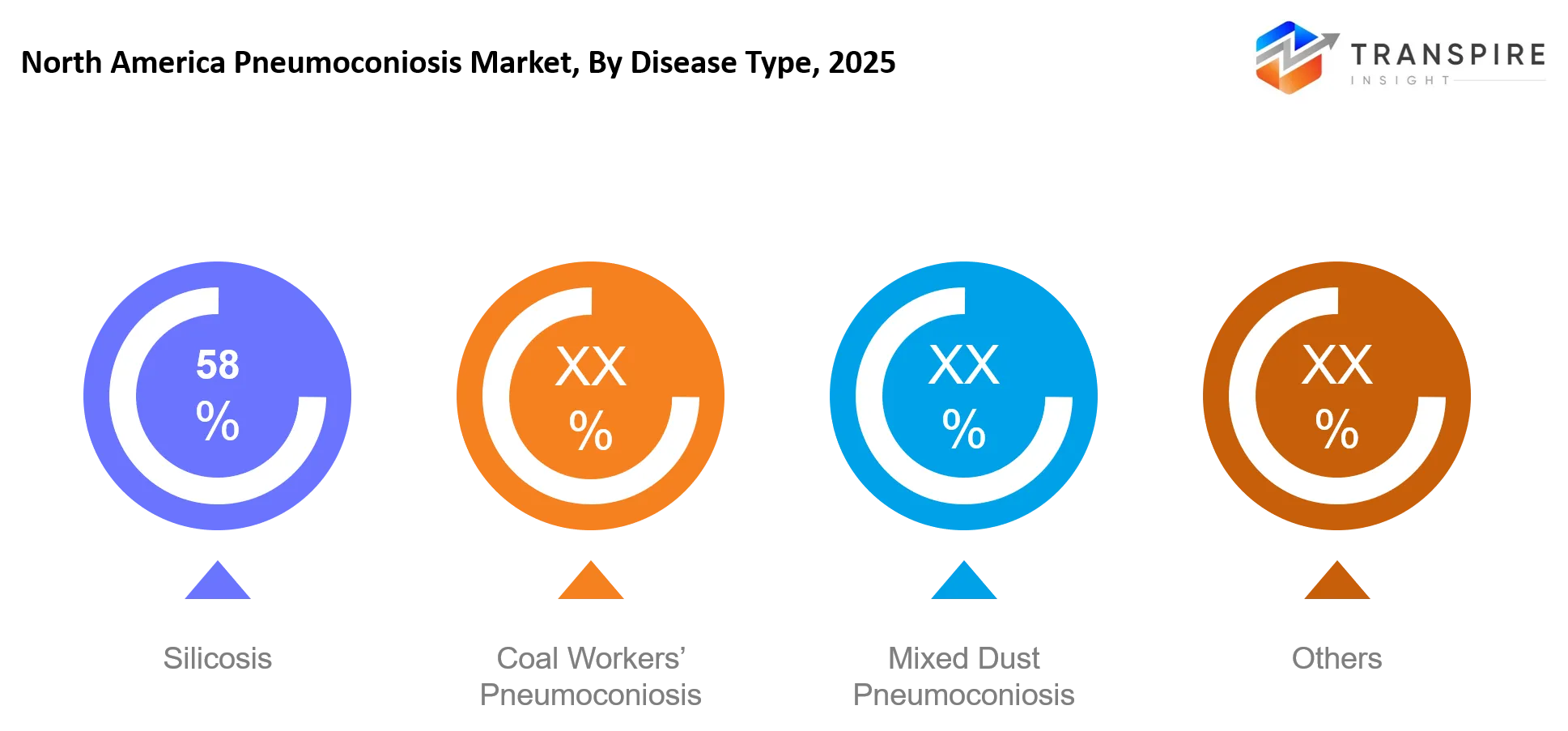
To learn more about this report, Download Free Sample Report
By Treatment Type
Pulmonary rehabilitation holds the dominant position because it sits at the center of dealing with long-term respiratory impairment, especially when lung damage becomes irreversible. Oxygen therapy also commands a significant share, since it offers ongoing symptomatic relief for advanced-stage patients in both hospital care and home-care environments, where continuity matters a lot.
Growth in this segment is pushed mainly by the long standing, chronic character of pneumoconiosis which means patients need sustained supportive care, not a quick curative course. Rehabilitation programs keep widening as healthcare systems start to lean harder into functional recovery and better life quality, more than just symptom management. Oxygen therapy demand trends upward in the same direction as worker populations age, and as diagnosis rates climb thanks to improved screening programs , and earlier detection.
Looking ahead, future growth should lean toward home style oxygen delivery, plus digitally monitored rehabilitation routines. Investors and device manufacturers will likely concentrate on light weight portable oxygen solutions and tele rehabilitation platforms. Lung transplantation will stay niche, still it is clinically decisive for end stage cases where advanced intervention is the only real option.
By End User
Hospitals take the biggest slice because they sit at the center of diagnosis, advanced imaging, and the day to day management of serious respiratory cases tied to occupational exposure. Pulmonary clinics form a strong second share, backed by focused know-how in identifying occupational lung disease, along with ongoing patient follow up. Rehabilitation centers, along with other outpatient facilities, make up a smaller portion but they keep growing steadily as more people are routed into non hospital care.
Growth in this part is also shaped by the gradual shift, where respiratory care moves away from hospitals toward specialized outpatient practices and occupational health settings. Pulmonary clinics gain from rising referrals, generated through workplace screening initiatives and digital diagnostic tools. Rehabilitation centers tend to expand when employers weave structured recovery pathways into occupational health policies.
During the forecast period, pulmonary clinics are likely to expand at a quicker pace compared with hospitals, mainly because they tend to be more cost efficient and easier to reach for patients. Because of that, investors are expected to keep looking harder at outpatient diagnostic networks and care coordination models that feel more integrated. Employers, as you might guess, will continue growing their partnerships with specialized clinics. The stated goal is to bring down the hospitalization spend, while also helping workforce retention stay steadier .
By Drug Type
Bronchodilators still take the biggest portion, and it feels like most of that is because they’re used broadly to manage airway obstruction symptoms that are tied to long term dust exposure. Corticosteroids also hold an important place, since they help address inflammatory activity in the more progressive pneumoconiosis situations. Antifibrotic drugs are a smaller segment, but they’re moving ahead quickly, almost steadily. Antibiotics in contrast, are used mainly for secondary infections, not for primary disease management.
The momentum here is supported by a rise in diagnosis of chronic respiratory impairment, plus better access to ongoing maintenance therapies through occupational health programs. Antifibrotic medication use increases as more clinical research aims at slowing the disease course , rather than only handling symptoms. Even so, bronchodilators remain the base option, largely for their affordability and fast symptomatic relief.
Looking ahead, development will likely tilt toward antifibrotic therapies as research pipelines mature and regulatory clearances expand. Pharmaceutical developers will concentrate more on disease modifying treatments rather than supportive care as the main story. Bronchodilators stay important, but they may slowly shift into combination therapies that are woven into long-term disease management plans.
What are the Key Use Cases Driving the North America Pneumoconiosis Market?
The main, dominant use case in the North America Pneumoconiosis Market kind of hangs around occupational screening, plus early diagnosis via radiology based detection, especially in mining and heavy construction environments. In practice employers end up rolling out routine chest X-rays and digital imaging setups to spot silica and coal dust exposure effects, before symptoms turn into something truly disabling. This is pushed by strict workplace safety rules , and also by liability pressures that make organizations move faster.
On the expansion side, you see continuous dust exposure monitoring getting more attention, plus more integrated respiratory protection programs inside big industrial sites. Pulmonary clinics and occupational health providers are taking on on-site screening contracts more often than before, while rehab focused care pathways are slowly gaining traction with employers trying to lower long term disability claims and keep the workforce from sitting idle.
More emerging use cases include AI assisted predictive risk scoring that flags high risk workers before clinical onset, and wearable respiratory sensors that are embedded into smart PPE. Industrial employers and safety regulators are now piloting these systems across large mining clusters, which suggests a gradual shift toward real time exposure prevention and a more data driven approach to workforce health management.
|
Report Metrics |
Details |
|
Market size value in 2025 |
USD 698.4 Million |
|
Market size value in 2026 |
USD 718.6 Million |
|
Revenue forecast in 2033 |
USD 877.2 Million |
|
Growth rate |
CAGR of 2.89% from 2026 to 2033 |
|
Base year |
2025 |
|
Historical data |
2021 - 2024 |
|
Forecast period |
2026 - 2033 |
|
Report coverage |
Revenue forecast, competitive landscape, growth factors, and trends |
|
Regional scope |
North America (Canada, The United States, and Mexico) |
|
Key company profiled |
Pfizer, Boehringer Ingelheim, Roche, AstraZeneca, GSK, Novartis, Sanofi, Merck & Co., Cipla, Teva Pharmaceuticals, Viatris, Eli Lilly, Bayer, AbbVie, Bristol Myers Squibb |
|
Customization scope |
Free report customization (country, regional & segment scope). Avail customized purchase options to meet your exact research needs. |
|
Report Segmentation |
By Disease Type (Asbestosis, Silicosis, Coal Workers’ Pneumoconiosis, Mixed Dust Pneumoconiosis, Others); By Treatment Type (Drug Therapy, Oxygen Therapy, Pulmonary Rehabilitation, Lung Transplantation, Others); By End User (Hospitals, Pulmonary Clinics, Rehabilitation Centers, Others); By Drug Type (Bronchodilators, Corticosteroids, Antibiotics, Antifibrotic Drugs, Others) |
Which Regions are Driving the North America Pneumoconiosis Market Growth?
The United States holds the dominant position in the North America Pneumoconiosis Market, mainly because occupational safety enforcement stays pretty tight, and there is also a large foundation of mining, tunneling, and heavy construction work. OSHA-driven silica exposure limits, have sped up the adoption of continuous dust monitoring systems and routine radiological screening across industrial worksites. There is a mature healthcare ecosystem with advanced imaging infrastructure as well as AI-enabled diagnostics, that helps in early detection at scale, kinda consistently. Strong presence of occupational health service providers and employer insurance frameworks that are integrated, also keep this leadership going.
Canada is more steady, but still comparatively smaller, with support from consistent mining activity in provinces such as British Columbia and Alberta. Unlike the United States, growth there is less pushed by regulatory pressure, and more tied to steady investment cycles from major resource extraction firms. Provincial safety frameworks evolve gradually, so mining operators can arrange longer-term occupational health programs with predictable compliance expenses. In addition, established industrial partnerships and cross-border equipment supply chains help reinforce Canada’s steady demand base.
Mexico is the fastest-growing region. That momentum is supported by rising investment in mining expansion and infrastructure development projects. Recent industrial safety modernization initiatives, plus stronger enforcement of workplace health standards, have increased take-up of respiratory protection and screening systems. Growth picked up after higher foreign direct investment in mineral extraction and construction sectors. This expansion, overall, signals strong opportunities for equipment manufacturers and occupational health service providers targeting emerging compliance-driven demand through 2033.
Who are the Key Players in the North America Pneumoconiosis Market and How Do They Compete?
Competition in the North America Pneumoconiosis Market is sort of moderately consolidated across imaging diagnostics and industrial safety equipment, depending on where you look really. Big incumbents tend to dominate hospital based screening programs, while PPE manufacturers usually steer workplace exposure prevention. Lately it feels like the main fight is over AI enabled diagnostics, plus integrated compliance platforms, and even those longer term service contracts with mining and construction operators. A lot of firms try to stand out by bundling hardware with software ecosystems, but smaller entrants often go for portable monitoring tools, and they also push cloud based occupational health reporting as their angle.
GE HealthCare builds AI radiology systems that improve pneumoconiosis detection and they also plug into hospital screening networks, more or less seamlessly. Siemens Healthineers leans hard into high resolution CT imaging and predictive diagnostics, and they keep expanding partnerships with occupational health providers in mining. Philips is strengthening its spot via connected care platforms that link imaging with longer term respiratory monitoring. Konica Minolta meanwhile supplies compact imaging units for mobile industrial screening clinics, so the workflow can move.
3M makes advanced respirators, and filtration systems for silica heavy environments, and they keep taking on expanded contracts with mining operators. Honeywell integrates smart PPE with sensor based compliance tracking for real time exposure monitoring in construction and extraction sites. Both of them often scale through enterprise contracts and the adoption of wearable safety technologies inside digital occupational health systems.
Company List
- Pfizer
- Boehringer Ingelheim
- Roche
- AstraZeneca
- GSK
- Novartis
- Sanofi
- Merck & Co.
- Cipla
- Teva Pharmaceuticals
- Viatris
- Eli Lilly
- Bayer
- AbbVie
- Bristol Myers Squibb
Recent Development News
“In October 2025, Boehringer Ingelheim advanced its idiopathic pulmonary fibrosis (IPF) pipeline with late-stage regulatory momentum for nerandomilast, a novel PDE4B inhibitor aimed at slowing fibrotic progression. The development reinforces Boehringer’s leadership in antifibrotic therapies that inform treatment paradigms for related fibrotic lung diseases, including pneumoconiosis.https://www.eurekapatsnap.com
What Strategic Insights Define the Future of the North America Pneumoconiosis Market?
The North America Pneumoconiosis Market is kind of drifting toward a structurally preventive model, where real time exposure monitoring and AI assisted diagnostics end up replacing those episodic screening routines. And yes, this change is getting pushed by tighter occupational safety enforcement, plus the rising spend tied to managing late stage respiratory disease… so employers are now looking to weave health surveillance into day to day industrial operations, not just treat it like periodic compliance checking, you know
There’s also a risk that’s not as loudly discussed: technology concentration. A relatively small set of diagnostic imaging and PPE providers are increasingly controlling both the data infrastructure and the compliance ecosystems. That leads to dependency issues for employers and can also slow down innovation if interoperability standards fall behind proprietary system expansion, or if they don’t keep up fast enough. On top of that, the whole market can get hit with pricing pressure once procurement gets locked into bundled service frameworks, it’s like one decision chains into the next
At the same time, there’s a growing opportunity around wearable respiratory sensors integrated with cloud based occupational health analytics. This seems especially relevant across large mining corridors throughout the United States and western Canada. These solutions are still in early adoption, but they’re picking up momentum as regulators start acknowledging continuous exposure data as a valid route for compliance verification. Market players should really prioritize interoperable platforms that can bring imaging, sensor signals, and predictive risk modeling together, so they can secure longer term contracts and also avoid getting stuck in platform lock in situations later on.
North America Pneumoconiosis Market Report Segmentation
By Disease Type
- Asbestosis
- Silicosis
- Coal Workers’ Pneumoconiosis
- Mixed Dust Pneumoconiosis
- Others
By Treatment Type
- Drug Therapy
- Oxygen Therapy
- Pulmonary Rehabilitation
- Lung Transplantation
- Others
By End User
- Hospitals
- Pulmonary Clinics
- Rehabilitation Centers
- Others
By Drug Type
- Bronchodilators
- Corticosteroids
- Antibiotics
- Antifibrotic Drugs
- Others
Frequently Asked Questions
Find quick answers to common questions.
The Expected North America Pneumoconiosis Market size is USD 877.2 Million in 2033.
Key segments for the North America Pneumoconiosis Market are By Disease Type (Asbestosis, Silicosis, Coal Workers’ Pneumoconiosis, Mixed Dust Pneumoconiosis, Others); By Treatment Type (Drug Therapy, Oxygen Therapy, Pulmonary Rehabilitation, Lung Transplantation, Others); By End User (Hospitals, Pulmonary Clinics, Rehabilitation Centers, Others); By Drug Type (Bronchodilators, Corticosteroids, Antibiotics, Antifibrotic Drugs, Others).
Major North America Pneumoconiosis Market players are Pfizer, Boehringer Ingelheim, Roche, AstraZeneca, GSK, Novartis, Sanofi, Merck & Co., Cipla, Teva Pharmaceuticals, Viatris, Eli Lilly, Bayer, AbbVie, Bristol Myers Squibb.
The Current North America Pneumoconiosis Market size is USD 698.4 Million in 2025.
The North America Pneumoconiosis Market CAGR is 2.89% from 2026 to 2033.
- Pfizer
- Boehringer Ingelheim
- Roche
- AstraZeneca
- GSK
- Novartis
- Sanofi
- Merck & Co.
- Cipla
- Teva Pharmaceuticals
- Viatris
- Eli Lilly
- Bayer
- AbbVie
- Bristol Myers Squibb
About the Authors

Pankaj Ghogare Patil
I am Pankaj Ghogare Patil, a Senior Research Analyst at Transpire Insight, specializing in the Pharmaceutical, Chemicals & Materials, Healthcare IT, and Biotechnology industry. My expertise lies in conducting comprehensive market research, analyzing industry trends, evaluating competitive landscapes, and translating complex data into actionable insights. At Transpire Insight, I closely follow emerging technologies, regulatory developments, and market innovations to create accurate, well-researched, and informative content that helps businesses and professionals make informed decisions. I am committed to producing credible, evidence-based articles that reflect industry best practices while making technical topics accessible and valuable for a broad audience.

Chakradhar Khansole
Chakradhar serves as the Research Director at Transpire Insight, bringing over 8 years of experience in technology, innovation, and strategic market intelligence. He specializes in transforming complex market data into actionable business insights that enable organizations to make informed, growth-oriented decisions. Recognized for his strategic vision and analytical expertise, Chakradhar leads high-impact research initiatives, delivering comprehensive market assessments, competitive intelligence, and forward-looking industry analysis.
Recently Published Reports
-
Jul 2026
Alopecia Treatment Market
Alopecia Treatment Market Size, Share & Analysis Report By Disease Type (Alopecia Areata, Cicatricial Alopecia, Traction Alopecia, Alopecia Totalis, Androgenetic Alopecia, Alopecia Universalis, and Other Disease Types), By Treatment Type (Topical Treatments, Oral Medications, Injectable Therapies, and Hair Transplantation), By Gender (Male, and Female), By Distribution Channel (Hospitals and Clinics, Retail Pharmacies, and Online Retailers), and Geography (North America, Europe, Asia-Pacific, Middle East and Africa, South and Central America), 2021 - 2031
-
Jul 2026
Medical Ultrasound Probe Market
Medical Ultrasound Probe Market Size, Share & Analysis Report By Type (Linear Type, Convex Type, Endocavitary Probe, Phased Array/Cardiac Probe, Transesophageal (TEE) Probe, and Others), By Application (Ophthalmology, Cardiology, Musculoskeletal, Oncology, Obstetrics & Gynecology, General Imaging, and Others), By End User (Hospitals & Clinics, Diagnostic Centers, Ambulatory Surgical Centers, and Others), and Geography (North America, Europe, Asia-Pacific, Middle East and Africa, South and Central America), 2021 – 2031
-
May 2026
Biosimilars Market
Biosimilars Market By Product Type (Monoclonal Antibodies, Recombinant Hormones, Erythropoietin, G-CSF, Others), By Indication (Oncology, Autoimmune Diseases, Blood Disorders, Diabetes, Others), By Manufacturing Type (In-House Manufacturing, Contract Manufacturing), By Distribution Channel (Hospital Pharmacies, Retail Pharmacies, Online Pharmacies), By Industry Analysis, Size, Share, Growth, Trends, and Forecasts 2021-2033
-
Apr 2026
Gastrointestinal Endoscopy Market
Gastrointestinal Endoscopy Market By Type (Rigid Gastrointestinal Endoscope, Flexible Gastrointestinal Endoscopes, Disposable Gastrointestinal Endoscope), By Procedure Type (Colonoscopy, Gastroscopy, Duodenoscopy, Enteroscopy, Flexible Sigmoidoscopy, Others), By Application (Diagnosis, Treatment), By End-Users (Hospitals, Ambulatory Surgical Centers, Specialty Clinics, Laboratories, Others), By Industry Analysis, Size, Share, Growth, Trends, and Forecasts 2021-2033