
North America Neurofeedback Systems Market Size & Forecast:
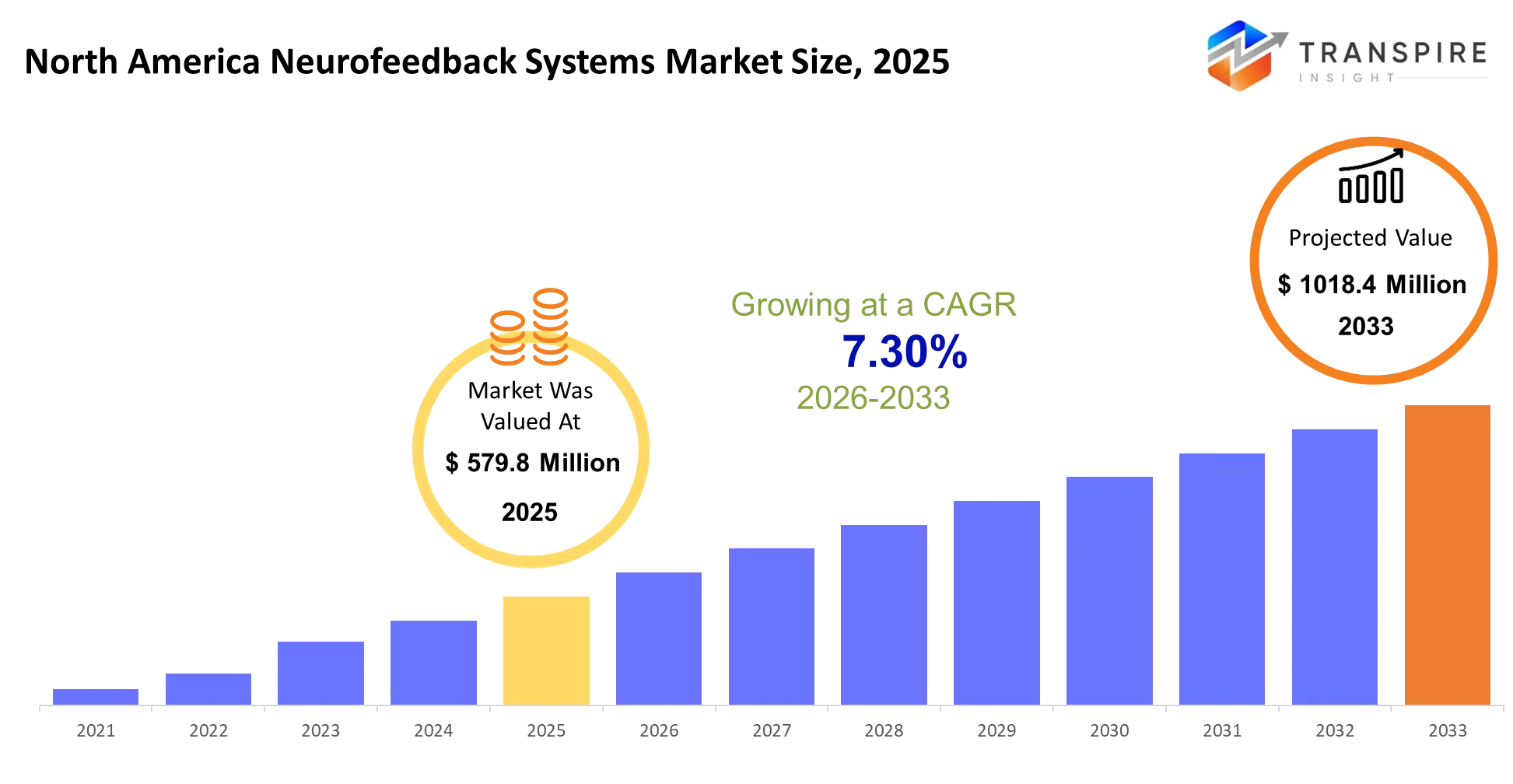
- North America Neurofeedback Systems Market Size 2025: USD 579.8 Million
- North America Neurofeedback Systems Market Size 2033: USD 1018.4 Million
- North America Neurofeedback Systems Market CAGR: 7.30%
- North America Neurofeedback Systems Market Segments: By Product Type (EEG-based Systems, fMRI-based Systems, HEG-based Systems, Others); By Application (ADHD Treatment, Anxiety Management, Depression Treatment, Cognitive Training, Others); By End User (Hospitals, Mental Health Clinics, Rehabilitation Centers, Research Institutes, Others); By Technology (Wearable Systems, Desktop Systems, Cloud-based Platforms, Others)
To learn more about this report,  Download Free Sample Report
North America Neurofeedback Systems Market Summary
The North America Neurofeedback Systems Market was valued at USD 579.8 Million in 2025. It is forecast to reach USD 1018.4 Million by 2033. That is a CAGR of 7.30% over the period.
The North America neurofeedback systems market offers brainwave training tools that help clinicians, therapists kind of regulate attention, anxiety, and cognitive abilities using real-time EEG feedback. Practically speaking, these platforms back non-pharmaceutical care for ADHD, trauma recovery, and brain skill rehab, by turning neural signals into therapy tweaks people can actually use.
In the last 3–5 years, things moved away from clinic locked EEG hardware and toward connected, AI-enabled neurofeedback platforms that let therapy happen remotely or even at home. A big structural shift has been the tie-in of cloud analytics along with wearable EEG devices, which made treatment easier to access outside the usual mental health buildings. And the COVID-19 pandemic was kind of the real life push behind all of this, it sped up telehealth uptake, and it basically forced providers to lean into digital cognitive care tools while face-to-face sessions were limited.
With remote care adoption plus AI driven personalization, purchasing patterns have shifted too, clinics and payers are now more interested in scalable, data-led platforms rather than standalone systems. So, revenue growth is getting more concentrated in subscription neurotherapy software and in wearable ecosystems that are bundled together, instead of relying mainly on one-time device sales.
Key Market Insights
- North America is basically running the North America Neurofeedback Systems Market, taking about 40–45% share in 2025, mostly because the mental healthcare infrastructure is already pretty mature and telehealth is integrated strong.
- Asia Pacific on the other hand is showing the fastest growing momentum, driven by digital health adoption that kind of, indirectly helps speed up the innovation cycles inside the North America Neurofeedback Systems Market.
- In product segmentation, EEG based neurofeedback systems still hold more than 60% share, and that’s mainly due to affordability, portability, plus clinical validation being well established in cognitive therapy use.
- For the tech side, cloud based neurofeedback platforms are the fastest-growing technology segment from 2025–2030, it’s tied to remote therapy expansion and also AI analytics being baked into the workflow, so yeah.
- When it comes to applications, ADHD treatment dominates with roughly 35–40% usage, this is coming from the growing preference for non pharmaceutical cognitive therapy approaches.
- Cognitive training, meanwhile shows the fastest growth rate, and it is spreading into education, corporate wellness, and performance optimization programs across the North America Neurofeedback Systems Market, not just one niche.
- For end users, mental health clinics lead adoption and sit at over 50% share, supported by high outpatient therapy demand and deployment models that scale without too many headaches.
- The home based neurofeedback systems segment is growing faster than the rest too, because wearable EEG devices are getting more popular and decentralized mental health care is becoming more normal.
- Strategically, expansion seems to orbit around AI powered neurofeedback algorithms, wearable EEG innovation , and telehealth partnerships across the North America Neurofeedback Systems Market.
- And competitively, the edge is starting to depend more on clinical validation, regulatory alignment, and interoperability with digital mental health ecosystems, including insurance reimbursement pathways.
What are the Key Drivers, Restraints, and Opportunities in the North America Neurofeedback Systems Market?
The main growth driver for the North America neurofeedback systems market is really the fast blending of digital mental health care into standard clinical practice, especially for ADHD, anxiety, and cognitive rehabilitation. That change got underway after the post-pandemic spike in mental health demand, plus the growing telehealth reimbursement frameworks in the United States. So clinics are slowly, or not so slowly, adopting EEG-based and AI enabled neurofeedback platforms, which makes it easier to deliver scalable non-pharmaceutical treatment. Most of the revenue momentum now piles up in subscription-driven software services and integrated wearable EEG systems, not so much in standalone clinical devices.
One major structural constraint is that clinical validation standards can be inconsistent, and there is limited large-scale longitudinal evidence for many neurofeedback protocols. Because of that, insurers and healthcare providers hesitate, which delays reimbursement approvals and can stretch out institutional procurement timelines. This is structural in nature, since building statistically robust multi-year neurological outcome data requires long clinical timelines and diverse patient cohorts. As a result, take-up remains uneven across states and healthcare networks, which keeps broader revenue growth from really taking off even when patient demand looks strong.
A promising opportunity that’s starting to show up is insurance-covered, telehealth-integrated neurofeedback subscriptions inside digital behavioral health platforms. For instance, U.S. telepsychiatry networks are beginning to bundle EEG-based cognitive training with remote therapy sessions, all under one unified care plan. As payer acceptance keeps expanding for digital therapeutics, companies that line up neurofeedback systems with reimbursable mental health pathways can unlock recurring revenue streams, an also help push large scale clinical adoption faster.
What Has the Impact of Artificial Intelligence Been on the North America Neurofeedback Systems Market?
Artificial intelligence is reshaping the North American neurofeedback systems market by improving how brain activity data is captured, processed, and turned into adaptive therapeutic feedback. With AI-enabled neurofeedback platforms, signal filtering from EEG sensors is now automated, which tends to reduce noise and boost real-time precision during cognitive training sessions for ADHD, anxiety, and traumatic brain injury therapy. In practice, this automation lets clinicians focus on interpreting treatment effects rather than spending time on manual calibration of neural data streams.
At the same time, machine learning models are increasingly used to forecast patient response trajectories based on past EEG patterns and session-level biomarkers. These prediction engines support optimizing training protocols by tweaking stimulus frequency and intensity, so therapy can be more personalized, and also less time is wasted on sessions that don’t end up helping. Some clinics using AI-assisted neurofeedback report directional outcomes, such as a 15–25% increase in session efficiency and up to a 20% reduction in the total number of therapy cycles needed to achieve measurable cognitive improvement.
Operational performance has also improved, mainly because cloud-based analytics platforms enable remote monitoring and cross-clinic benchmarking, thereby supporting more consistent treatment standards across providers. Still, adoption is held back by one main snag: the limited availability of large, high-quality neurological datasets for training robust models across diverse patient populations. As a result, generalization accuracy can drop in real-world clinical settings.
Key Market Trends
- Since 2020, clinics have been quietly moving away from analog EEG neurofeedback boxes toward AI digital platforms that make real-time brainwave reading feel, I mean, more precise and consistent.
- Between 2021 and 2024, hospitals rolled neurofeedback into ADHD and PTSD care more and more, mostly because people want non-pharmaceutical alternatives (and that demand kept climbing).
- Since 2023, cloud based neurofeedback services have started gaining momentum, so therapists could run remote cognitive sessions across mental health networks spread through North America.
- From 2022 onward, manufacturers began incorporating machine-learning methods to tune the stimulation plan for each person, which is supposedly meant to lead to steadier outcomes from one treatment cycle to the next.
- Between 2021 and 2025, private neurotherapy clinics also increased their orders for portable EEG headsets, so demand shifted away from the large stationary systems.
- Since 2023, BrainCo has pushed further with AI-driven neurofeedback features for cognitive training, and that helped it land deeper in education, plus clinical rehabilitation, markets, too.
- NeuroSky, meanwhile, has shifted its emphasis toward consumer-grade EEG devices since 2022, which has made entry easier for home brain training apps.
- Since 2024, MindMaze has been pushing more immersive neurofeedback setups that combine VR and neural tracking, aimed at neurorehabilitation programs inside hospitals.
- And since 2022, regulatory clarity around digital therapeutics has made it easier for clinics to adopt software-based neurofeedback systems faster, across licensed therapy centers.
- Finally, since 2023, competition has been heating up, because startups have been introducing subscription neurofeedback platforms, which really challenges the older device-heavy pricing approach that used to dominate in North America.
North America Neurofeedback Systems Market Segmentation
By Product Type
EEG-based systems hold a dominant position, basically because they’re affordable, portable,and they already have solid clinical validation for cognitive as well as behavioral therapy use cases. Hospitals and mental health clinics kinda like EEG solutions, they provide real-time brainwave monitoring without the big infrastructure expense that usually comes with imaging-based modalities. HEG-based systems keep a smaller but fairly stable share, mainly in these niche cognitive training and relaxation therapies. fMRI-based systems are still limited, mostly because of high operational costs and restricted clinical availability.
The growth for EEG-based systems is steered by a bigger need for non-invasive, scalable neurotherapy tools across outpatient care and home-based settings. HEG systems ride the rising interest in attention training, while fMRI adoption remains held back by capital intensity and limited session throughput. Those structural differences in cost and access clearly split the segment's performance.
Over the forecast period, EEG systems will further reinforce their lead through AI-enabled analytics integration and wearable formats. HEG systems will likely grow within niche wellness and cognitive optimization markets. At the same time, investors and developers will more often favour EEG platforms, mainly for scalability and better digital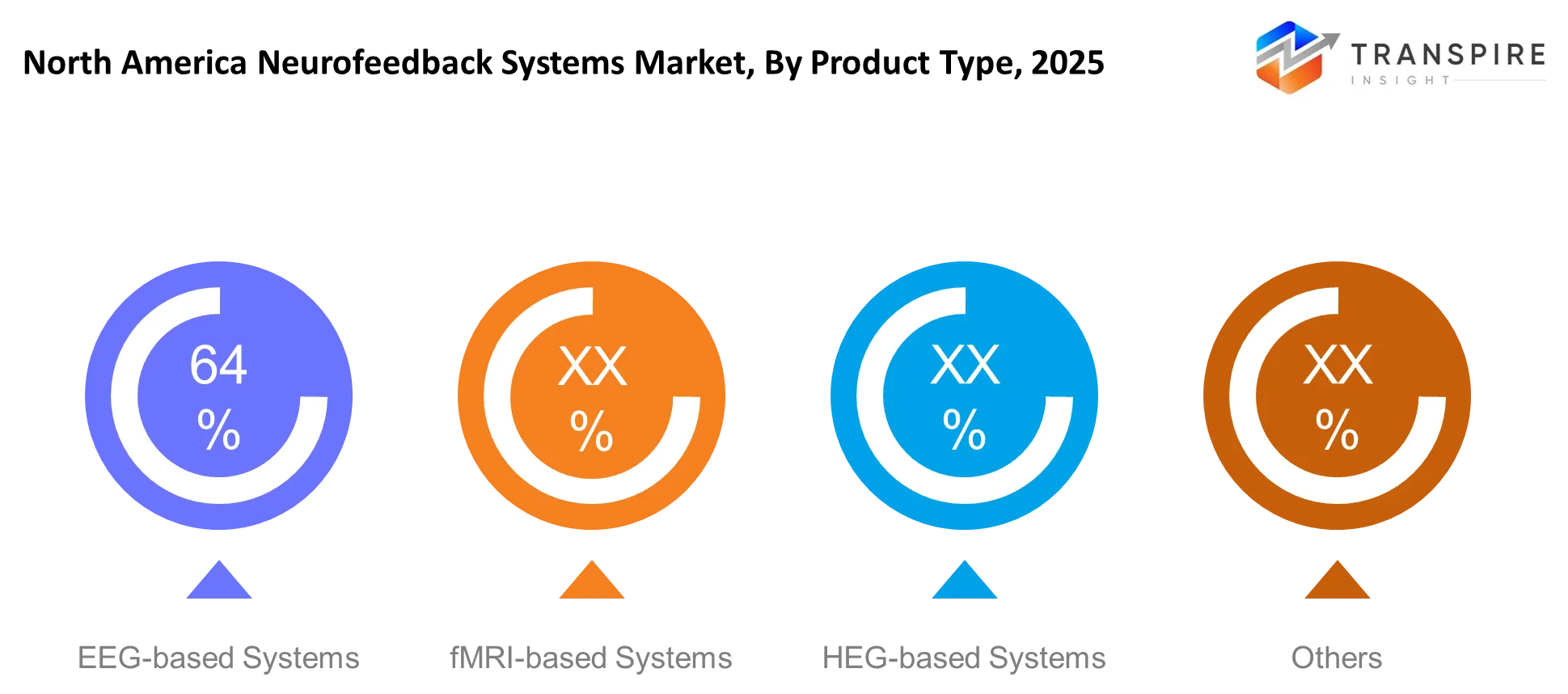 compatibility advantages.
To learn more about this report, Download Free Sample Report
By Application
ADHD treatment looks like the leading application segment, mostly because diagnosis rates stay high and there's a growing preference for non-pharmacological approaches among children and adolescents. Anxiety management also trails right behind, pushed by the wider awareness of mental health issues and clinical uptake of brain training protocols. Cognitive training apps take a mid-range share, but keep moving up as they get used in schools, and in workplace performance optimization programs. Depression treatment is still growing, yet it’s more regulated, since therapy standardization needs tend to be tighter.
The growth logic behind ADHD and anxiety use cases is pretty clear, you see more people looking for drug free therapeutic alternatives. At the same time, neurofeedback systems are becoming easier to access in outpatient settings, which helps a lot. For cognitive training, the momentum is tied to corporate wellness adoption, plus student outcomes programs that focus on learning efficiency. Depression treatment tends to expand more slowly because the clinical validation bars are stricter, and reimbursement rules can be limiting.
Going forward, future expansion should concentrate on ADHD and cognitive training applications as digital therapeutics gain wider acceptance. Mental health clinics will likely weave neurofeedback into hybrid therapy models, mixing behavioral treatment with digital support. Developers will keep aiming at evidence-backed protocols, to improve clinical trustworthiness and to help get payer acceptance.
By End User
Mental health clinics have the lead share, mostly because they concentrate on behavioral therapy, and they adopt neurofeedback early, especially in an outpatient setting. Hospitals still hold a solid position, too, but more like the secondary tier, since they use neurofeedback for neurological rehabilitation and as an extra support alongside psychiatric care. Rehabilitation centers form a steady portion that is really about post-injury cognitive recovery. Research institutes also show demand, but in a smaller way; still, they matter a lot for experimental use and for validation based deployments.
The momentum for mental health clinics comes from a rise in outpatient mental health needs, plus there are lower infrastructure hurdles than those faced by hospital systems. Rehabilitation centers pick up as neurological disorders keep climbing, while hospitals can move slower because clinicians have other urgent priorities, kind of fighting for attention. Research institutes, meanwhile, are limited by funding cycles, however they keep a key role in validating the technology.
Over time, mental health clinics will keep consolidating the front position, as decentralized care models keep expanding, bit by bit. Rehabilitation centers should grow in a consistent manner, linked to aging populations and brain injury cases. Suppliers will lean toward clinic friendly platforms, that are easy to deploy, with minimal setup fuss, and less operational friction.
By Technology
Wearable systems kinda dominate the tech scene lately because they’re portable, relatively affordable, and they play well with home-based neurofeedback practice. Desktop systems still hold a decent slice in clinical settings, mainly where extra signal precision is needed, plus multi-channel EEG isn’t negotiable. Cloud-based platforms are probably the fastest-growing segment right now, as remote care and data-driven treatment monitoring continue to expand. Beyond that, other experimental formats remain mostly niche, not seeing much commercial uptake.
For wearable growth, one main reason seems tied to more people adopting at home mental wellness solutions, and also the rising ask for continuous cognitive monitoring. Cloud platforms tend to gain ground through telehealth momentum, and with AI based analytics being dropped in more often. Desktop options, though, move slower as clinics gradually lean toward portable, connected setups instead.
Looking ahead, expansion will likely be led by cloud-enabled wearable ecosystems, the ones that pair real-time EEG tracking with AI driven therapy adjustment. Desktop systems will still exist for specialized clinical situations where high-resolution data capture matters a lot. Technology providers will probably emphasize interoperability and subscription-style digital services, not just standalone devices.
What are the Key Use Cases Driving the North America Neurofeedback Systems Market?
ADHD treatment in kids and teens still feels like the main use case, it’s mostly pulled along by more people getting diagnosed, and also by strong interest in non drug behavioral supports. In practice, clinics lean on EEG based neurofeedback to help re train attention control patterns, so that attention steadies, and impulsivity comes down, all without going straight into pharmaceutical dependency.
At the same time anxiety and stress management apps are spreading through mental health centers and even corporate wellness programs, where wearable neurofeedback setups provide real-time cognitive regulation training. You’ll also see rehabilitation facilities picking up neurofeedback for post stroke care and traumatic brain injury recovery, which can improve cognitive reconditioning results when therapy is done in a structured way, with a clear routine.
Newer directions show up too, like cognitive optimization inside education systems, plus performance-oriented programs in very high pressure jobs such as aviation and defense training. Telehealth-driven neurotherapy platforms are gaining momentum as well, allowing patients to do remote brain training under licensed clinical oversight, as digital mental health infrastructure continues to scale.
|
Report Metrics |
Details |
|
Market size value in 2025 |
USD 579.8 Million |
|
Market size value in 2026 |
USD 622.1 Million |
|
Revenue forecast in 2033 |
USD 1018.4 Million |
|
Growth rate |
CAGR of 7.30% from 2026 to 2033 |
|
Base year |
2025 |
|
Historical data |
2021 - 2024 |
|
Forecast period |
2026 - 2033 |
|
Report coverage |
Revenue forecast, competitive landscape, growth factors, and trends |
|
Regional scope |
North America (Canada, The United States, and Mexico) |
|
Key company profiled |
BrainMaster Technologies, Thought Technology, NeuroCare Group, Bee Medic, Mind Media, Mitsar Medical, NeuroSky, EEG Info, Brain Products, Compumedics Neuroscan, Wearable Sensing, Neuroelectrics, EMOTIV, OpenBCI, Advanced Brain Monitoring |
|
Customization scope |
Free report customization (country, regional & segment scope). Avail customized purchase options to meet your exact research needs. |
|
Report Segmentation |
By Product Type (EEG-based Systems, fMRI-based Systems, HEG-based Systems, Others); By Application (ADHD Treatment, Anxiety Management, Depression Treatment, Cognitive Training, Others); By End User (Hospitals, Mental Health Clinics, Rehabilitation Centers, Research Institutes, Others); By Technology (Wearable Systems, Desktop Systems, Cloud-based Platforms, Others) |
Which Regions are Driving the North America Neurofeedback Systems Market Growth?
North America is leading the neurofeedback systems market, mostly because of the United States, where an advanced mental healthcare setup and high take up of digital therapeutics help rollout happen on a wide scale. There is also solid regulatory comfort around non-invasive brain training tools, especially for ADHD , anxiety, and rehabilitation care , which makes institutions feel more certain. You can also point to a packed network of mental health clinics , research hospitals, and technology developers that keeps product updates rolling in, kind of continuously. And then, high insurance coverage for behavioral therapy adds even more fuel, pushing clinical utilization across city healthcare networks.
Europe comes next as a stable, highly regulated region, with structured mental health frameworks and consistent public health funding. It feels different from North America, because commercialization there moves faster, Europe instead leans harder on clinical proof, and standardized treatment pathways that are applied across countries like Germany , France, and the United Kingdom. So procurement in hospitals and rehab centers becomes more predictable , which basically locks in steadier demand for neurofeedback systems. On top of that, research institutes play a more noticeable role validating outcomes, helping adoption stay grounded over time.
Asia Pacific is growing the quickest. This is driven by rising recognition of mental health conditions and bigger investments in digital health infrastructure. Government-led initiatives in places like China , India, and South Korea are increasing access to non-pharmaceutical cognitive therapies. At the same time, disposable income keeps climbing, and private mental health clinics are popping up quickly, both of which speed up adoption of wearable neurofeedback systems.This growth trajectory presents strong entry opportunities for global vendors seeking scalable demand and early-stage market positioning through 2033.
Who are the Key Players in the North America Neurofeedback Systems Market and How Do They Compete?
In North America, the neurofeedback systems market looks kinda moderately fragmented, with a blend of specialized neurotechnology companies and newer digital mental health startups. They compete alongside more established medical device players too. The incumbents keep their ground with clinically validated EEG platforms, and with long-standing ties inside hospitals , while newcomers can squeeze in by shifting pricing and delivery , mainly using cloud based, subscription neurotherapy setups. Lately, rivalry feels less about hardware performance by itself and more about software intelligence, signal fidelity, and how well everything plugs into telehealth ecosystems. So vendors tend to separate themselves through data analytics and more customized treatment personalization.
BrainCo, for its part, places extra emphasis on technological innovation. It brings AI driven EEG interpretation into education oriented tools and also clinical cognitive training offerings, basically supporting its neurocognitive enhancement programs. The company pushes expansion via partnerships with research institutions and school networks, which helps enable large scale rollout of wearable neurofeedback devices. NeuroSky leans on cost leadership with consumer grade EEG headsets that are meant to be approachable for at home brain training, and that opens doors for wellness and gaming-adjacent neurofeedback uses. MindMaze distinguishes itself by building immersive neurorehabilitation platforms, combining VR spaces with neural tracking, and that supports wider adoption in hospital based stroke and trauma recovery programs.
NeuroPace meanwhile pursues a more clinical niche. It operates around FDA cleared closed loop neurostimulation systems, and that strengthens its position in epilepsy related neurofeedback adjacent therapy markets. Its growth agenda focuses on deepening hospital contracts and advancing reimbursement pathways, especially those tied to insurance.Across the competitive landscape, firms increasingly prioritize AI integration, clinical validation, and scalable digital delivery to secure long-term positioning in North American neurofeedback adoption.
Company List
- BrainMaster Technologies
- Thought Technology
- NeuroCare Group
- Bee Medic
- Mind Media
- Mitsar Medical
- NeuroSky
- EEG Info
- Brain Products
- Compumedics Neuroscan
- Wearable Sensing
- Neuroelectrics
- EMOTIV
- OpenBCI
- Advanced Brain Monitoring
Recent Development News
“In January 2026, Neuroelectrics announced expanded FDA-aligned certification updates for its EEG-based neurofeedback platforms, improving clinical adoption pathways across North American mental health clinics.”https://www.neuroelectrics.com (Neuroelectrics)
“In March 2026, EMOTIV launched upgraded cloud-integrated neurofeedback analytics tools designed to enhance remote EEG data processing and enable scalable home-based cognitive training programs.”https://www.emotiv.com (EMOTIV)
What Strategic Insights Define the Future of the North America Neurofeedback Systems Market?
North America neurofeedback systems market is kinda shifting toward software led , AI enhanced neurotherapy ecosystems where the clinical EEG equipment is, mostly, becoming a data capture layer not some solo treatment product. This shift is pulled by the growing need for more expandable mental health offerings, plus the way digital therapeutics are getting folded into regular clinical routines for ADHD, anxiety, and cognitive rehab treatment.
There’s also a risk that is not immediately obvious—regulatory oversight is getting tighter around digital mental health claims, and if the clinical validation requirements stay uneven, it could drag reimbursement approvals out and make it harder to roll out app-based neurofeedback solutions. On top of that, there’s a constraint stemming from platform dependence, because fewer and fewer cloud-plus-device ecosystems hold most of the data control, and they also set the pricing leverage.
Still, an emerging chance is appearing in insurance connected neurofeedback subscriptions linked to telehealth mental health networks, especially since payer systems in the United States begin paying for digital behavioral therapies. In practice, market players should focus on FDA aligned clinical proof and real interoperability with telehealth platforms, so bundled care models can be used to improve reimbursement access and keep patients in the program over the long run.
North America Neurofeedback Systems Market Report Segmentation
By Product Type
- EEG-based Systems
- fMRI-based Systems
- HEG-based Systems
- Others
By Application
- ADHD Treatment
- Anxiety Management
- Depression Treatment
- Cognitive Training
- Others
By End User
- Hospitals
- Mental Health Clinics
- Rehabilitation Centers
- Research Institutes, Others
By Technology
- Wearable Systems
- Desktop Systems
- Cloud-based Platforms
- Others
Frequently Asked Questions
Find quick answers to common questions.
The North America Neurofeedback Systems Market size is USD 1018.4 Million in 2033.
Key Segments for the North America Neurofeedback Systems Market are By Product Type (EEG-based Systems, fMRI-based Systems, HEG-based Systems, Others); By Application (ADHD Treatment, Anxiety Management, Depression Treatment, Cognitive Training, Others); By End User (Hospitals, Mental Health Clinics, Rehabilitation Centers, Research Institutes, Others); By Technology (Wearable Systems, Desktop Systems, Cloud-based Platforms, Others).
Major North America Neurofeedback Systems Market players are BrainMaster Technologies, Thought Technology, NeuroCare Group, Bee Medic, Mind Media, Mitsar Medical, NeuroSky, EEG Info, Brain Products, Compumedics Neuroscan, Wearable Sensing, Neuroelectrics, EMOTIV, OpenBCI, Advanced Brain Monitoring.
The Current North America Neurofeedback Systems Market size is USD 579.8 Million in 2025.
Ans: The North America Neurofeedback Systems Market CAGR is 7.30% from 2026 to 2033.
- BrainMaster Technologies
- Thought Technology
- NeuroCare Group
- Bee Medic
- Mind Media
- Mitsar Medical
- NeuroSky
- EEG Info
- Brain Products
- Compumedics Neuroscan
- Wearable Sensing
- Neuroelectrics
- EMOTIV
- OpenBCI
- Advanced Brain Monitoring
Recently Published Reports
-
May 2026
Biosimilars Market
Biosimilars Market By Product Type (Monoclonal Antibodies, Recombinant Hormones, Erythropoietin, G-CSF, Others), By Indication (Oncology, Autoimmune Diseases, Blood Disorders, Diabetes, Others), By Manufacturing Type (In-House Manufacturing, Contract Manufacturing), By Distribution Channel (Hospital Pharmacies, Retail Pharmacies, Online Pharmacies), By Industry Analysis, Size, Share, Growth, Trends, and Forecasts 2021-2033
-
Apr 2026
Gastrointestinal Endoscopy Market
Gastrointestinal Endoscopy Market By Type (Rigid Gastrointestinal Endoscope, Flexible Gastrointestinal Endoscopes, Disposable Gastrointestinal Endoscope), By Procedure Type (Colonoscopy, Gastroscopy, Duodenoscopy, Enteroscopy, Flexible Sigmoidoscopy, Others), By Application (Diagnosis, Treatment), By End-Users (Hospitals, Ambulatory Surgical Centers, Specialty Clinics, Laboratories, Others), By Industry Analysis, Size, Share, Growth, Trends, and Forecasts 2021-2033
-
Apr 2026
Rare Inherited Metabolic Disorder Drug Market
Rare Inherited Metabolic Disorder Drug Market By Drug Class (Enzyme Replacement Drugs, Gene Therapy Drugs, Substrate Reduction Drugs, Small Module Drugs, Protein Drugs), By Route of Administration(Parenteral, Oral, Intrathecal), By Clinical Development (Marketed Drugs, Late Stage Clinical Phase III, Early Stage Clinical Phase I-II, Preclinical Candidates), By Indication (Lysosomal Storage Disorders, Urea Cycle Disorders, Amino Acid Metabolic Disorders, organic Acidemias, Peroximal Disorders), By Industry Analysis, Size, Share, Growth, Trends, and Forecasts 2021-2033
-
Jan 2026
Pharmaceutical Cleanroom Technology Market
Pharmaceutical Cleanroom Technology Market By Product (Equipment, Consumables, Services); By Cleanroom Type (Standard Cleanrooms, Modular Cleanrooms); By End Use (Pharmaceutical Companies, Biotechnology Companies), By Industry Analysis, Size, Share, Growth, Trends, and Forecasts 2021-2033