
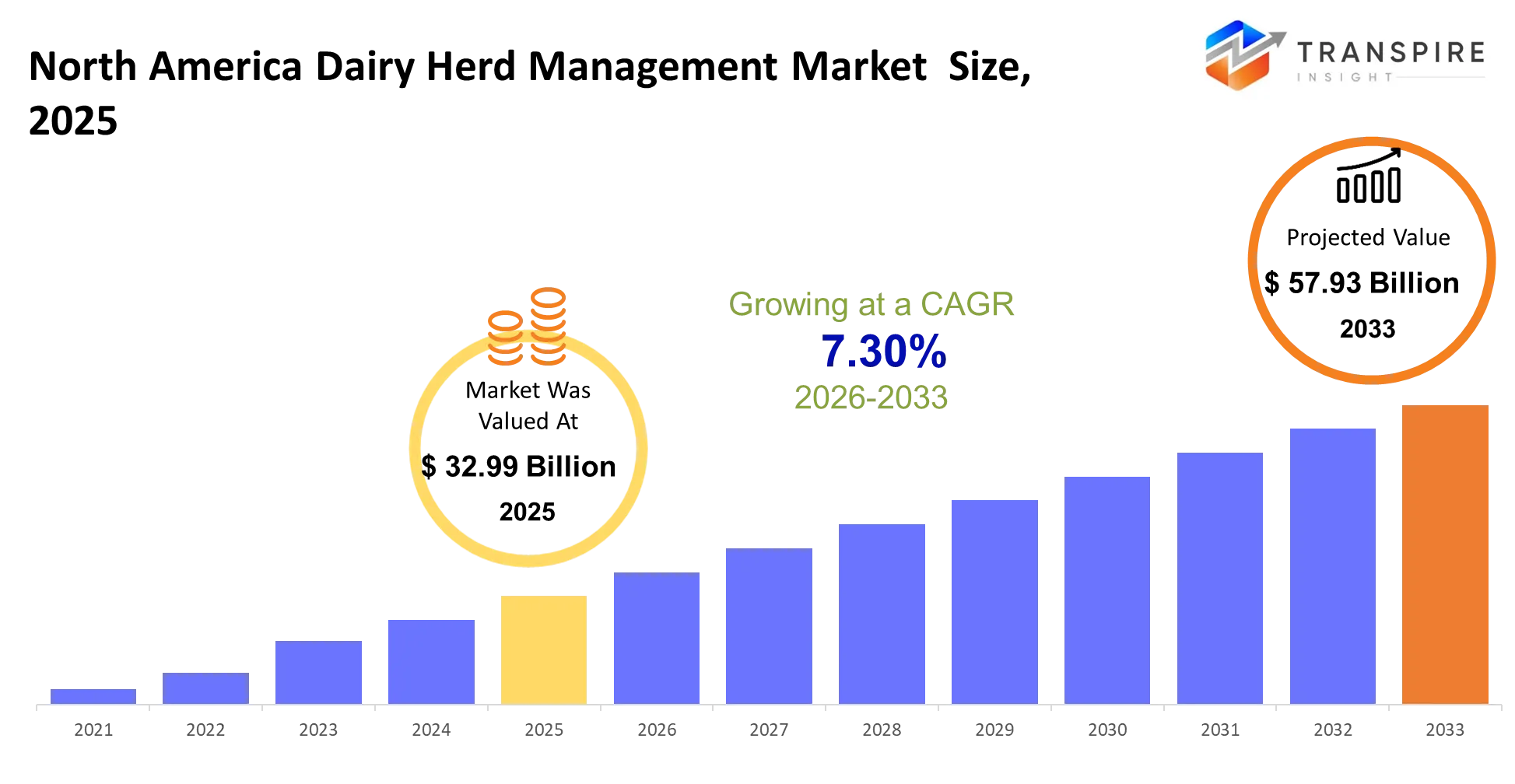
North America Dairy Herd Management Market Size & Forecast:
- North America Dairy Herd Management Market Size 2025: USD 32.99 Billion
- North America Dairy Herd Management Market Size 2033: USD 57.93 Billion
- North America Dairy Herd Management Market CAGR: 7.30%
- North America Dairy Herd Management Market Segments: By Type (Hardware, Software, Services, Sensors, Monitoring Systems, Others), By Application (Milk Harvesting, Feeding, Breeding, Health Monitoring, Others), By End-User (Dairy Farms, Cooperatives, Others), By Deployment (Cloud, On-premise, Hybrid, Others).
To learn more about this report,  Download Free Sample Report
North America Dairy Herd Management Market Summary:
The North America Dairy Herd Management Market size is estimated at USD 32.99 Billion in 2025 and is anticipated to reach USD 57.93 Billion by 2033, growing at a CAGR of 7.30% from 2026 to 2033.The North America dairy herd management market kinda moved from simple herd recordkeeping into something closer to a precision operations platform that basically lets dairy producers steer animal health, milk yield, breeding cycles, feed efficiency, and labor utilization in real time. In day to day practice, these setups cut down on production losses from disease events, reproductive lags, and uneven milk quality, and they also support farms staying profitable even when margins feel tight, like really tight.
Over the last 3 to 5 years the market has been shifting more in a structural way, toward sensor driven and cloud connected management ecosystems, and honestly it feels a bit different now. Wearable monitoring devices and automated milking systems, plus AI enabled analytics are being stitched into everyday herd decisions instead of acting like standalone add ons. The disruption connected to COVID-19 really sped it up, mostly because it pointed at labor constraints and some operational weak spots on bigger dairy farms. When producers ran into higher feed costs and workforce instability, the spending started leaning, toward automation that could keep output steadier with fewer manual interruptions . Now that same shift is also growing recurring software revenue models, and it is getting wider interest among mid sized farms that want clear productivity wins instead of just incremental digital upgrades.
Key Market Insights
- The United States kind of dominated the North America Dairy Herd Management Market , with more than 72% share in 2025, largely because of big scale commercial dairy operations.
- Canada is showing the quickest momentum through 2030 , backed by precision agriculture investments and a broader push toward smart dairy infrastructure.
- Meanwhile, the steady uptake of automated milking systems on Midwest farms keeps nudging the North America dairy management industry size higher, and that is supporting revenue growth overall.
- Also, government-backed livestock digitization programs are ramping up the need , for advanced dairy herd monitoring technologies across farms in North America.
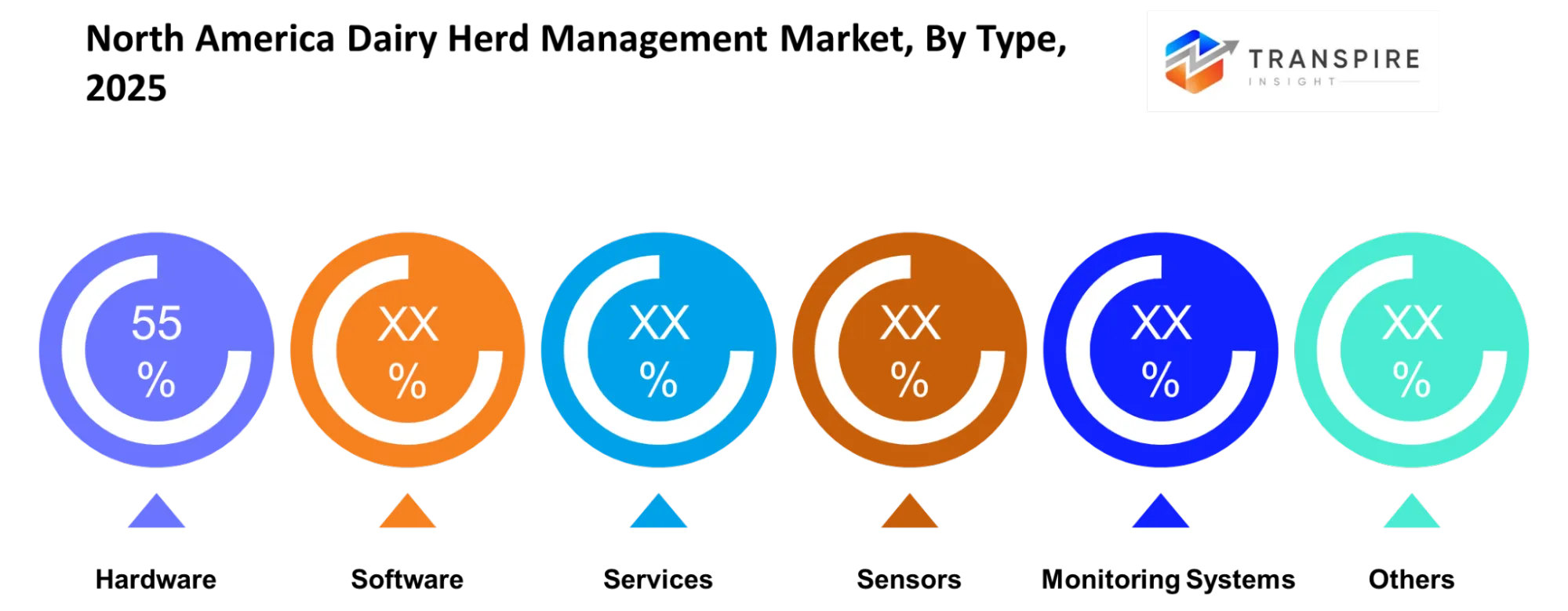
- In 2025, hardware solutions led , taking nearly 46% of the market, mostly from the growing deployment of sensors, RFID tags and wearable monitoring devices .
- Software platforms then became the second-largest segment, mainly as cloud based herd analytics and milk production management systems are getting more common.
- The services part is expected to grow the fastest through 2030 , because many farms increasingly outsource data integration , plus predictive herd analytics.
- AI-powered herd monitoring solutions are also becoming a noticeable trend, especially across large commercial dairy enterprises throughout North America.
- Milk harvesting and production management represented around 38% share in 2025 , since dairy facilities are adopting automation at a strong pace.
- Breeding and fertility management applications are seeing the quickest growth , driven by the need for better reproductive efficiency , along with reduced livestock losses .
- Finally, real time disease detection platforms are creating fresh interest, across the North America dairy herd monitoring market forecast periods.
What are the Key Drivers, Restraints, and Opportunities in the North America Dairy Herd Management Market?
The most powerful force driving the North America Dairy Herd Management Market, is kinda the fast movement toward precision dairy automation, that got sparked by the ongoing labor shortages and the feed costs climbing after 2020. Big dairy operators across the United States and Canada were under increasing pressure to keep up milk output but with fewer experienced hands, so farms started to bring in automated milking systems, wearable cattle sensors, and AI driven herd tracking platforms. That change, sort of naturally led to more spending on tech because producers could see day to day operational wins, like lower disease related losses, better reproductive results, and more milk yield per cow. On top of that vendors gained too, since recurring software and analytics subscriptions keep showing up, so growth didn’t rely only on equipment sales anymore.
Even so, the highest implementation costs are still the main structural obstacle. End to end herd management systems need serious money for sensors, robotic milking gear, connectivity infrastructure, plus training for the team. Smaller and mid sized farms often run on tight profit margins, and they simply can’t stomach multi year capital payback periods, particularly when milk prices swing around. Because of that financing gap, technology adoption slows in anything that’s not large commercial operations, and it quietly dents the wider market revenue expansion too.
Predictive livestock health analytics is kind of the next big growth opportunity, or so it seems. Dairy producers are not only looking at, but actually investing more and more into AI platforms that can pick up on mastitis, fertility decline, and even feeding irregularities before anything really shows up in the obvious ways. In Canada, dairy cooperatives and technology-supported farms are turning into early adoption centers, mostly because solid broadband infrastructure and digital agriculture funding makes the whole setup more workable, you know. That combination supports advanced herd intelligence systems, which otherwise would be harder to run.
What Has the Impact of Artificial Intelligence Been on the North America Dairy Herd Management Market?
Artificial intelligence and advanced digital tech are reshaping how dairy herds get managed across North America, turning the usual farm stuff into more or less data led decision systems, or at least that’s the idea. With AI enabled monitoring platforms, producers now automate cattle activity tracking, milk yield analysis, feeding routines, and even reproductive health oversight using wearable sensors, robotic milking stations, and cloud connected herd software. A lot of farms are also leaning on computer vision plus biometric sensing to catch behavioral weirdness tied to illness stress, or fertility slippage, without fully depending on human eyes and manual checking.
At the same time, machine learning models are getting better at predictive guidance. Dairy operators use predictive analytics to estimate mastitis risk, time breeding opportunities, and judge feed conversion trends based on weather conditions, animal movement, and prior production records. In practice this can mean fewer surprise veterinary visits and a steady bump in overall herd output. Bigger commercial setups that rely on automated milking and predictive health tooling have mentioned real gains in labor efficiency, reduced treatment expenses, and more consistent milk quality thanks to ongoing herd observation.
Even so, AI adoption has a clear snag, mostly integration and infrastructure costs. A lot of mid sized dairy farms don’t have the right connectivity, sensor compatibility, or technical know how needed to merge several data streams into one unified herd intelligence setup. On top of that, data quality can be uneven from farm to farm, which drags down predictive accuracy especially for smaller operations that only have short historical records to learn from.
Key Market Trends
- Since 2021, big U.S. dairy farms sorta ramped up robotic milking setups, partly because labor shortages became a real issue and operational risks went up across the high volume milk production places.
- AI enabled cattle monitoring systems moved from those early pilot trials into day to day use, after feed inflation really squeezed budgets and farms needed better yield efficiency per single animal.
- Wearable livestock sensors got much more popular between 2020 and 2025, producers basically wanted real time disease detection plus reproductive tracking, you know, the whole deal.
- Dairy operators also started ditching manual herd recordkeeping for cloud connected platforms , those systems pull together milk yield, feeding routines, breeding activity and animal health signals into one view, more or less.
- DeLaval and Lely expanded their AI driven milking and herd analytics product lines, which helped keep recurring software revenue coming in, consistently.
- In Canada, dairy cooperatives went faster on smart farming investments after broadband expanded and connectivity improved across rural livestock production regions starting in 2022.
- Medium sized farms leaned into subscription based herd management software, since the lower upfront costs eased the hurdle tied to full automation rollouts.
- Predictive fertility analytics became a differentiator, because farms said they saw fewer breeding losses and better calving cycle management, using machine learning models.
- More dairy tech providers started partnering with livestock genetics firms and animal health companies , building what amounts to integrated herd intelligence and performance optimization ecosystems.
- And on the compliance side, sustainability reporting requirements nudged dairy producers to adopt digital feed management along with methane monitoring tools , so environmental visibility improved for audits and overall reporting.
North America Dairy Herd Management Market Segmentation
By Type
Hardware solutions keep a pretty strong grip on dairy herd management systems, and honestly it’s mainly because big dairy operations need that physical monitoring setup, for day to day herd visibility. Stuff like sensors, RFID tags, wearable collars, automated milking equipment, and the whole monitoring systems stack… all of those produce most of the operational data that commercial farms rely on every day. Software platforms sit in the second largest slot too, since more farms are trying to keep milk production analytics, reproductive tracking, and health records in one cloud-linked dashboard, it’s kind of a consolidation trend. Services meanwhile are also growing at a steady pace, mostly as demand increases for integration support, predictive analytics consulting, and routine equipment maintenance, you know that kind of support.
Hardware tends to get adopted faster by high capacity dairy farms that have more capital and the budget for equipment. Software subscriptions usually fit mid-sized operators better, because they want less upfront spending. Looking ahead, the market seems to move toward integrated ecosystems where sensors, analytics, and automation are bundled into a single, more unified platform. And technology providers are expected to lean even more into recurring revenue models, because buyers increasingly want continuous performance optimization not just owning standalone equipment.
To learn more about this report, Download Free Sample Report
By Application
Milk harvesting applications kind of win the day in most deployments, mainly because dairy producers keep stressing production consistency, labor efficiency and of course milk quality, even when margins are tight, you know. Automated milking systems plus robotic milking stations and production monitoring platforms are still where the big spending sits, especially on larger dairy farms across the United States and Canada. Feeding management applications, well they have also picked up speed, since feed costs keep climbing, so operators are pushed to boost nutritional efficiency, and reduce waste at the same time.
Then breeding and fertility management solutions are expanding fast too, largely from wider use of predictive reproductive analytics, alongside automated estrus detection tech. On the health monitoring side, momentum looks equally solid, because spotting disease earlier helps cut treatment costs, and limits productivity losses tied to mastitis or metabolic disorders. Looking ahead, application trends suggest a deeper linkage between feeding, breeding and health intelligence systems. And tech suppliers that deliver connected operational insights instead of separate management tasks, are likely to improve their competitive standing across commercial dairy operations.
By End-User
Large commercial dairy farms really become the dominant end-user segment, mostly because the herd sizes are so extensive, they create a pretty strong push for automation, predictive analytics, and real-time operational monitoring. With that kind of scale these operations tend to spend more on technology, not just because they want to be efficient, but also due to constant pressure to keep production output steady, cut down labor dependency and raise herd productivity. At the same time dairy cooperatives hold a meaningful position too, since they often invest in centralized herd monitoring systems that help with milk quality consistency, and make compliance reporting easier across member farms.
Meanwhile, smaller family-operated farms stay more selective in what they buy, since high implementation costs, plus uncertain payback periods, can make bigger deployments feel like a bad gamble. Subscription-based software and modular monitoring systems are slowly making things more reachable for these operators. Looking ahead, market expansion is likely to hinge on scalable, and cost-efficient deployment approaches that work well for mid-sized farms. Vendors that can offer flexible pricing structures and simpler integration processes are, in general, the ones that may widen their customer base over the next several years.
By Development
Cloud deployment models are kind of leading adoption right now, partly because dairy operators, slowly but surely, are starting to demand remote access to herd data and centralized analytics, plus real time monitoring across several farm sites. With cloud based platforms, updates roll out faster, the infrastructure costs tend to shrink, and it is easier to mesh with mobile monitoring applications. Still, on-premise systems don’t really fade away, especially for big operators that want hands on data control, strong cybersecurity protection, and steady operational continuity, even when the region’s internet connection is unreliable or just… inconsistent. Then there’s hybrid deployments, which are getting more attention as farms try to juggle cloud scalability with localized data management and some practical operational reliability.
But connectivity limitations in rural farming zones keep giving headaches for anything that’s fully cloud dependent, especially for smaller farms that don't really have much broadband to lean on. Looking ahead, deployment strategies will probably orbit around flexible architectures that can manage both centralized analytics and local operational resilience, sorta in the same breath. Tech providers working on low bandwidth platforms, edge computing , and interoperable software ecosystems, are expected to gain more market traction across the various dairy production environments.
What are the Key Use Cases Driving the North America Dairy Herd Management Market?
Milk harvesting and production monitoring are still the big use cases, pushing tech adoption across a lot of the larger commercial dairy farms in the United States and Canada. You see automated milking systems, sensor based yield tracking, and real time herd analytics showing up, so operators can keep milk consistency steady , lower their reliance on labor, and squeeze better production efficiency even when feed and labor costs get shaky or volatile.
Breeding management plus animal health monitoring is also getting more attention, especially with mid-sized farms and dairy cooperatives that want stronger reproductive results, and less veterinary spend due to preventable losses. Wearable livestock sensors, together with AI driven fertility tracking, are now used for earlier disease detection, smoother calving timetables, and a more reliable view of herd productivity going forward, rather than guessing after things already happen.
On the newer side, farms are looking at methane emission monitoring, and precision feed optimization systems, aimed at sustainability reporting and environmental compliance programs. There are also trials with predictive livestock intelligence platforms that blend weather inputs with feed patterns and behavioral analytics , to anticipate health risks before any obvious symptoms show up.
|
Report Metrics |
Details |
|
Market size value in 2025 |
USD 32.99 Billion |
|
Market size value in 2026 |
USD 35.37 Billion |
|
Revenue forecast in 2033 |
USD 57.93 Billion |
|
Growth rate |
CAGR of 7.30% from 2026 to 2033 |
|
Base year |
2025 |
|
Historical data |
2021 - 2024 |
|
Forecast period |
2026 - 2033 |
|
Report coverage |
Revenue forecast, competitive landscape, growth factors, and trends |
|
Country scope |
North America (Canada, The United States, and Mexico) |
|
Key company profiled |
DeLaval, GEA Group, Lely, BouMatic, Afimilk, SCR Dairy, Nedap, Allflex, Zoetis, Merck Animal Health, Valley Agriculture, Fullwood Packo, Dairymaster, Sum-It Computer Systems, Uniform Agri |
|
Customization scope |
Free report customization (country, regional & segment scope). Avail customized purchase options to meet your exact research needs. |
|
Report Segmentation |
By Type (Hardware, Software, Services, Sensors, Monitoring Systems, Others), By Application (Milk Harvesting, Feeding, Breeding, Health Monitoring, Others), By End-User (Dairy Farms, Cooperatives, Others), By Deployment (Cloud, On-premise, Hybrid, Others) |
Which Regions are Driving the North America Dairy Herd Management Market Growth?
The United States basically takes the lead in the North America dairy herd management market since big commercial dairy farms keep putting serious money into automation, herd analytics, and robotic milking systems, not just “slow upgrades.” There is also strong uptake of precision livestock technologies because rural connectivity got better, dairy equipment providers are already well established, and there are huge milk production networks across places like Wisconsin, California, and Idaho. On top of that , federal and state agricultural modernization programs have pushed more sensor-based herd monitoring and data-led breeding programs. Overall there’s this pretty mature setup involving dairy cooperatives, veterinary technology providers, and AI centered livestock software companies, which kind of keeps reinforcing the region-wide leadership over the long term.
Canada shows up next as the second-largest regional contributor, but growth there seems to run on a stability first approach. It’s more about operational efficiency and regulatory consistency, not aggressive production expansion. Dairy producers in Ontario and Quebec increasingly focus on herd health refinement, feed efficiency, and sustainability compliance, especially under supply managed dairy frameworks. Canadian farms also keep investing at a steady pace because predictable milk pricing lowers revenue swings, so producers can plan longer-term technology decisions. And with broadband rolling out across rural farming areas, adoption improves for cloud based herd intelligence tools and remote livestock monitoring platforms.
Mexico is kind of emerging as the fastest-growing regional market, mostly because dairy modernization is accelerating and more money is flowing into commercial milk production infrastructure. In the past few quarters, big dairy operators have been increasing spend on automated feeding systems, tools for reproductive monitoring , and even mobile herd management platforms to boost output and reduce the need for so much manual labor. At the same time, government-backed agricultural digitization programs, along with larger cold-chain logistics networks, are making it easier for tech to land and stick across industrial dairy farms, not just in theory but in practice. All this seems to set a growth path that opens serious opportunities for equipment manufacturers, software vendors and livestock analytics providers who want early expansion leverage from 2026 to 2033.
Who are the Key Players in the North America Dairy Herd Management Market and How Do They Compete?
The North America dairy herd management market seems to show moderate consolidation, like there’s a small group of global dairy technology companies that wind up running the show for big commercial farm deployments, while the specialized software and sensor folks stay busy in the niche corners. Lately the competition is kind of shifting toward integrated technology ecosystems, not just pricing for standalone equipment , and honestly it’s more about how everything fits together. The well known suppliers keep defending their share using AI enabled analytics, subscription based monitoring platforms and then full service installation networks, these things help lock in long term retention. Meanwhile new players are aiming at the not-fully-served mid-sized farms with modular software, lower cost wearable sensors, and cloud based herd intelligence platforms that cut down on the usual implementation hassle.
DeLaval plays it strong with tightly connected robotic milking, herd analytics, and milk quality monitoring systems, all built with high volume dairy operations in mind. The differentiation is also in their dealer support infrastructure and the end to end automation capabilities, which can reduce labor dependency across commercial farms. Lely, on the other hand, puts a lot of emphasis on robotic dairy automation and autonomous feeding technologies, basically to push operational efficiency in regions where labor is tight. Their expansion is now increasingly aimed at North American mid sized farms using scalable automation packages and data driven herd optimization tools.
GEA Group leans on precision milking setups and connected farm management software, which kinda tie feeding, cooling and animal monitoring together into one central operational platform. They say the goal is to sharpen their competitive edge with customized deployment models, fitted to different herd dimensions and farm layouts, even if the structure looks a bit unique from place to place. Meanwhile Merck Animal Health stands out with livestock health intelligence plus biometric monitoring tech, helping teams spot likely disease earlier, and also support fertility management. Through strategic collaborations with dairy analytics providers and veterinary networks, they reach more areas in health oriented herd management applications. BouMatic keeps a solid footing with independent dairy farms by blending equipment reliability, on site like service support, and installation choices that can flex for cost sensitive operators. In other words, they stay practical about how things get installed and maintained.
Company List
- DeLaval
- GEA Group
- Lely
- BouMatic
- Afimilk
- SCR Dairy
- Nedap
- Allflex
- Zoetis
- Merck Animal Health
- Valley Agriculture
- Fullwood Packo
- Dairymaster
- Sum-It Computer Systems
- Uniform Agri
Recent Development News
In March 2026, U.S. Dairy Farms Increase Use of Wearable Monitoring Technologies for Herd Health Management: North American dairy farms continued investing in connected herd-monitoring technologies from companies including Merck Animal Health, Afimilk, and BouMatic to improve disease detection and operational efficiency. The report emphasized growing deployment of wearable cow sensors and AI-driven analytics platforms across U.S. dairy operations, particularly amid heightened disease surveillance requirements and labor shortages.
Source: https://www.wsj.com
In February 2026, North American Dairy Producers Accelerate Precision Dairy Technology Investments: U.S. dairy herd expansion in early 2026 supported increased investment in automated herd management systems, health-monitoring software, and precision dairy tools from leading suppliers such as DeLaval and Merck Animal Health.
Source: https://www.agproud.com
What Strategic Insights Define the Future of the North America Dairy Herd Management Market?
The North America dairy herd management market is quietly shifting toward fully connected livestock intelligence ecosystems, where automation, predictive analytics, and real time operational decision support kind of sit in one place, rather than scattered across tools. The push behind this transition isn’t just about reducing labor. It’s more about getting clear productivity wins while feed economics get tighter, environmental reporting becomes a bigger deal, and margin swings keep showing up across commercial dairy farms. In the next five to seven years, competitive advantage will lean more and more on data ownership, interoperability , and the ability to turn herd level information into operational forecasting tools.
There is also a less obvious risk. Market power may start clustering around a small set of integrated technology providers. When farms become reliant on proprietary software ecosystems, switching costs can rise, and data compatibility limits can block easy purchasing changes. That, in turn, might slow down innovation from smaller suppliers. At the same time, methane monitoring and carbon-linked livestock analytics feels like an emerging opportunity, especially as North American sustainability rules and dairy cooperative reporting standards become more strict. Companies entering the space should push for open architecture platforms and partner with veterinary analytics firms, so they do not end up in a kind of technology isolation. That approach can also help strengthen long term customer retention, without locking everyone in too early.
North America Dairy Herd Management Market Report Segmentation
By Type
- Hardware
- Software
- Services
- Sensors
- Monitoring Systems
- Others
By Application
- Milk Harvesting
- Feeding
- Breeding
- Health Monitoring
- Others
By End-User
- Dairy Farms
- Cooperatives
- Others
By Deployment
- Cloud
- On-premise
- Hybrid
- Others
Frequently Asked Questions
Find quick answers to common questions.
The approximate North America Dairy Herd Management Market size for the market will be USD 57.93 Billion in 2033.
The key segments of the North America Dairy Herd Management Market are By Type (Hardware, Software, Services, Sensors, Monitoring Systems, Others), By Application (Milk Harvesting, Feeding, Breeding, Health Monitoring, Others), By End-User (Dairy Farms, Cooperatives, Others), By Deployment (Cloud, On-premise, Hybrid, Others).
Major players in the North America Dairy Herd Management Market are DeLaval, GEA Group, Lely, BouMatic, Afimilk, SCR Dairy, Nedap, Allflex, Zoetis, Merck Animal Health, Valley Agriculture, Fullwood Packo, Dairymaster, Sum-It Computer Systems, Uniform Agri.
The current market size of the North America Dairy Herd Management Market is USD 32.99 Billion in 2025.
The North America Dairy Herd Management Market CAGR is 7.30%.
- DeLaval
- GEA Group
- Lely
- BouMatic
- Afimilk
- SCR Dairy
- Nedap
- Allflex
- Zoetis
- Merck Animal Health
- Valley Agriculture
- Fullwood Packo
- Dairymaster
- Sum-It Computer Systems
- Uniform Agri
Recently Published Reports
-
Apr 2026
3D Optical Profiler Market
3D Optical Profiler Market Size, Share & Analysis Report By Type (Desktop 3D Optical Profiler, and Portable 3D Optical Profiler), By Technology (Confocal Technology, and White Light Interference), By End-Use Industry (Manufacturing, Research Institutions, Automotive, Aerospace and Defense, Medical Devices, and Other), and Geography (North America, Europe, Asia-Pacific, Middle East and Africa, South and Central America), 2021 - 2031
-
Apr 2026
Depth Sensor Market
Depth Sensor Market Size, Share & Analysis Report By Type (Infrared Depth Sensors, Time-of-Flight (ToF) Sensors, Stereo Vision Sensors, Structured Light Sensors, Ultrasonic Depth Sensors), By Application (Automotive, Robotics, Gaming, Consumer Electronics, Industrial Automation, Healthcare, Security & Surveillance, Others), By End Users (Automotive Manufacturers, Consumer Electronics Companies, Healthcare Providers, Industrial Companies, Security Agencies, Gaming Companies, Robotics Companies, Others), and Geography (North America, Europe, Asia-Pacific, Middle East and Africa, South and Central America), 2021 – 2031
-
Apr 2026
Digital Manufacturing Market
Digital Manufacturing Market Size, Share & Analysis Report By Component (Hardware, Software, and Services), By Technology (Robotics, 3D Printing, Internet of Things (IoT), and Others), By Application (Automotive and Transportation, Aerospace and Defense, Consumer Electronics, Industrial Machinery, and Others), By Process Type (Computer-Based Designing, Computer-Based Simulation, Computer 3D Visualization, Analytics, and Others), and Geography (North America, Europe, Asia-Pacific, Middle East and Africa, South and Central America), 2021 – 2031
-
Apr 2026
Digital Visa Services Market
Digital Visa Services Market Size, Share & Analysis Report By Type (Individual Travelers, Group Travelers), By Application (Tourism, Business Travel, Others), and Geography (North America, Europe, Asia-Pacific, Middle East and Africa, South and Central America), 2021 – 2031