

North America Nephrology Lasers Market Size & Forecast:
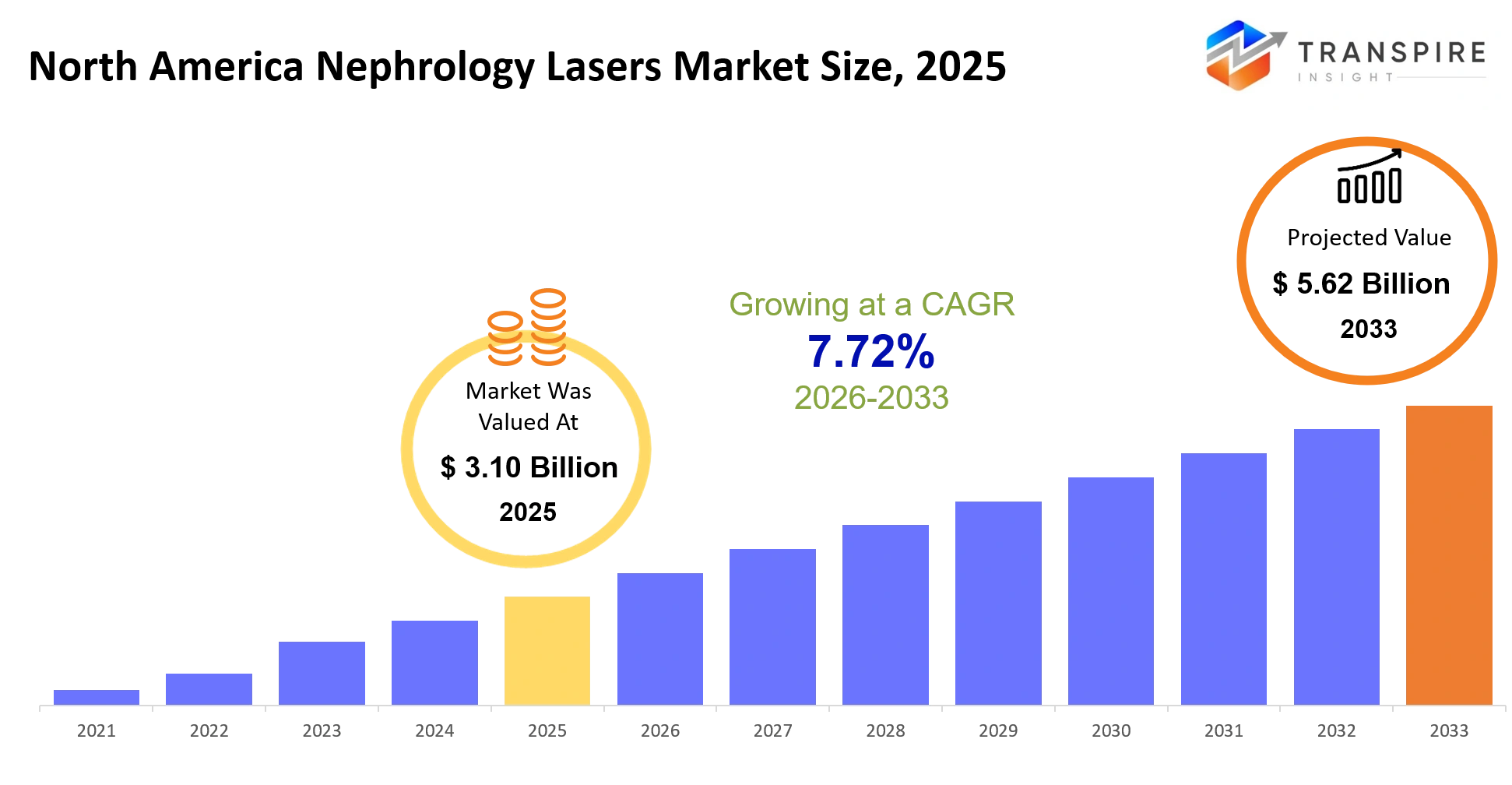
- North America Nephrology Lasers Market Size 2025: USD 3.10 Billion
- North America Nephrology Lasers Market Size 2033: USD 5.62 Billion
- North America Nephrology Lasers Market CAGR: 7.72%
- North America Nephrology Lasers Market Segments: By Product Type (Holmium Lasers, Thulium Lasers, Diode Lasers, Fiber Lasers, Others), By Application (Kidney Stone Treatment, Benign Prostatic Hyperplasia Treatment, Urology Procedures, Others), By End User (Hospitals, Urology Clinics, Ambulatory Surgical Centers, Others), By Technology (High-power Lasers, Pulse Modulated Lasers, Smart Laser Systems, Others).
To learn more about this report,  Download Free Sample Report
North America Nephrology Lasers Market Summary:
The North America Nephrology Lasers Market size is estimated at USD 3.10 Billion in 2025 and is anticipated to reach USD 5.62 Billion by 2033, growing at a CAGR of 7.72% from 2026 to 2033. Nephrology laser tools are now used in urology and kidney care areas so they can break apart kidney stones with real precision, even during minimally invasive work. in the field these systems let clinicians clear urinary passage blockages, shorten recovery periods, and generally mean fewer people end up needing open surgery. across North America, more hospitals and ambulatory surgical centers are leaning on laser lithotripsy because the overall stone problem seems to keep rising, but they also want better procedural flow, and more consistent outcomes.
In the last three to five years , the market has kinda moved in a new direction, away from older laser platforms and toward high power holmium and thulium fiber laser setups. These designs tend to provide finer control, faster stone dusting, and broader treatment options, sort of a wider lane for different cases. The COVID-19 pandemic was a big push, it caused a backlog of postponed urological procedures, and when elective care restarted, spending on newer surgical technologies sped up pretty quickly. Since healthcare providers are trying to improve patient throughput and also cut down the costs that come with complications, laser adoption is showing up as stronger equipment utilization, more repeat consumable purchases, and overall better revenue chances throughout the nephrology care network.
Key Market Insights
- The United States really dominates the North America Nephrology Lasers Market , pulling in around 80%–85% of the regional revenue in 2025.
- There are strong reimbursement frameworks in place, plus high procedural volumes, and that kind of combo really helps explain why the country keeps such a large footprint.
- Canada shows the fastest growth during the forecast window, backed by healthcare modernization and also more urology services being added or scaled up.
- Meanwhile cross-border technology adoption keeps on strengthening the total North America nephrology laser industry size , bit by bit.
- In terms of product types, holmium laser systems are leading, with almost 60% share in 2025, mainly because they have proven effectiveness for kidney stone fragmentation.
- Laser fibers and related consumables sit as the second-largest segment, and they bring in recurring revenue across healthcare facilities, kind of steadily.
- Thulium fiber laser systems are the fastest-growing segment from 2025 to 2032, largely due to better stone dusting efficiency and more precise procedural control.
- Advanced laser platforms keep gaining traction too , as upgrades land in the market and clinical outcomes look more favorable.
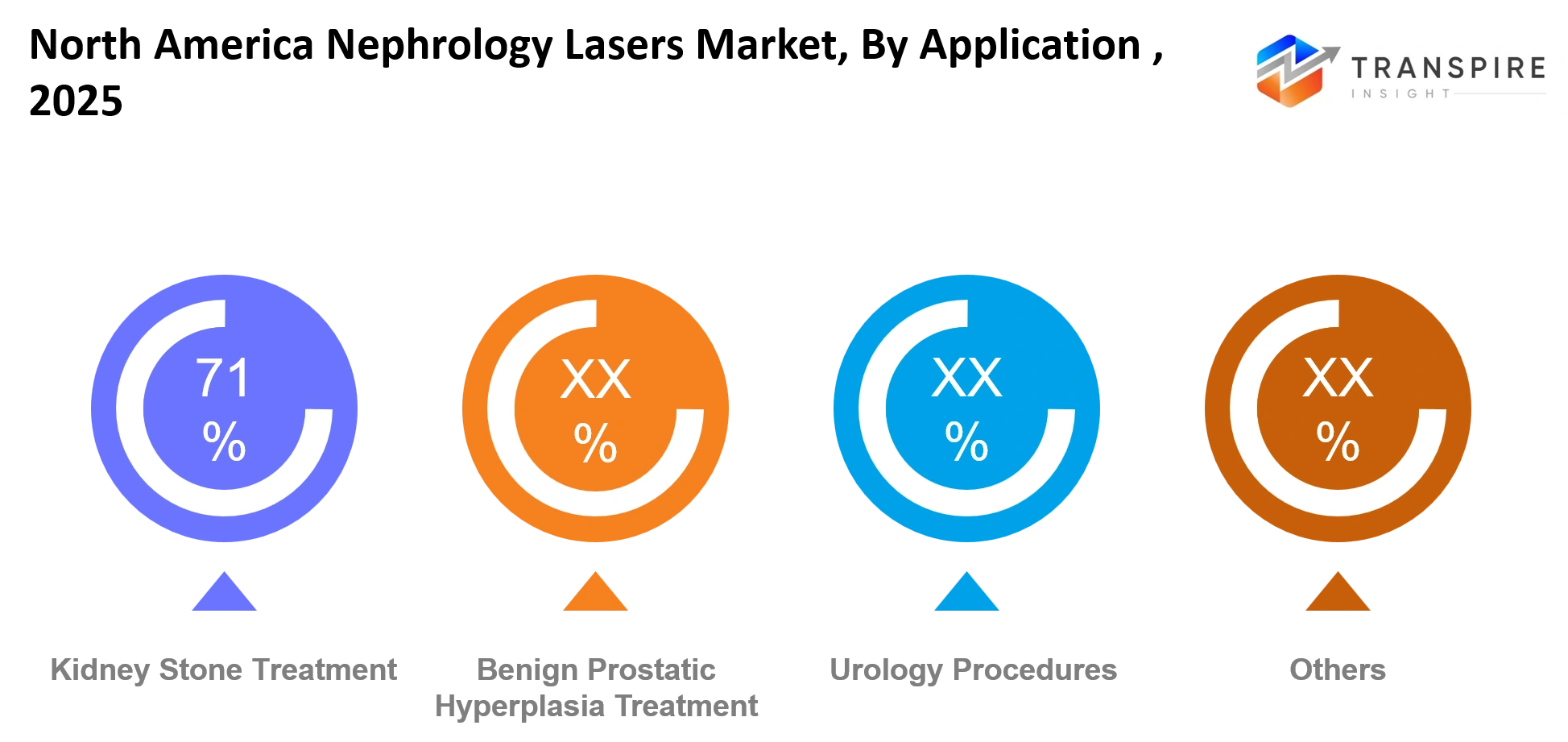
- Looking at applications, kidney stone treatment is the main driver, contributing over 70% of the total North America Nephrology Lasers Market revenue.
- Ureteroscopic lithotripsy is still the preferred procedure, mainly because it tends to involve shorter recovery times and fewer or reduced hospital stays.
- Complex stone management is starting to rise fastest as an application segment through the forecast period , it’s gaining momentum.
- A growing clinical preference for minimally invasive interventions is also supporting steady procedure growth rates.
- Finally, hospitals account for roughly 55%–60% of market demand , mainly driven by higher patient volumes and better access to advanced surgical infrastructure , not just one thing alone.
What are the Key Drivers, Restraints, and Opportunities in the North America Nephrology Lasers Market?
The biggest growth driver in the North America Nephrology Lasers Market seems to be the shift toward minimally invasive stone care, backed by some pretty notable advances in laser tech. The arrival of high-power holmium lasers and thulium fiber lasers has boosted stone fragmentation speed, it also sharpens procedural exactness, and it gives surgeons better control in the moment. People basically moved this way because healthcare systems wanted fewer inpatient days, less morbidity from complications, and lower overall costs for each treatment episode. Now that providers are doing more cases in outpatient settings, the laser systems bring value via higher procedure throughput and then, the recurring sales of disposable fibers along with other accessories. So you end up with stronger equipment utilization and additional revenue streams for hospitals plus ambulatory surgical centers.
The biggest holdback is the steep upfront investment for advanced laser platforms together with the extra specialized training needed to use them well. This limitation is kind of structural, meaning it is tied to long run hospital budget planning, reimbursement economics, and skills development in the workforce, not to quick term market swings. Smaller facilities often wait longer before upgrading, so the replacement timeline for current systems stretches out. That slows technology adoption, which then reduces procedure expansion in under served regions, and in turn it suppresses what the market could earn.
A major opportunity lies in the way thulium fiber laser adoption can spread across community hospitals, and outpatient surgical centers too. As manufacturers keep investing in more compact, energy efficient platforms, the acquisition costs are slowly getting more manageable, or at least less scary. Facilities that used to depend on older lithotripsy technologies can now get access to advanced laser capabilities, this seems like it will kick off a fresh wave of market expansion and also procedural volume growth across North America.
What Has the Impact of Artificial Intelligence Been on the North America Nephrology Lasers Market?
Artificial intelligence and a bunch of newer digital technologies are now, kind of noticeably, making nephrology laser systems work better and improving workflow efficiency for kidney stone care. On modern laser platforms, there is often AI-assisted software that, well, automatically updates energy settings, chooses pulse modulation styles, and keeps an eye on what’s happening during the procedure. It does this using stone properties and also the surgeon’s own preferences. As a result, there’s less need for constant manual adjustments and clinicians can get more consistent outcomes, even when treatment is done in different care environments.
Alongside that, machine learning is getting used for predictive maintenance, meaning the laser equipment can be serviced before something really goes wrong. The models look at system temperature, power output trends, fiber usage patterns, and how components are wearing down. With that, they can flag likely failures ahead of time, so they don’t suddenly interrupt clinical work. This generally helps healthcare facilities keep devices available longer, cut down on unexpected repair spending, and make better use of capital equipment. In some centers, digital analytics platforms even help with procedure planning by bringing together imaging data with past treatment results, so the system can nudge parameter selection in a more informed way.
From an operations perspective, these tools tend to mean shorter procedure durations, more efficient stone fragmentation, smoother operating room utilization, and less time lost to maintenance issues. Those practical benefits can support higher patient throughput, plus a stronger return on investment for hospitals and ambulatory surgical centers.
That said, a major limitation is still the cost of hooking AI-enabled platforms into existing hospital infrastructure, and it’s not always simple or cheap. Also, a lot of machine learning models depend on large amounts of high-quality procedural data, so if a facility has a smaller patient population, predictive accuracy can suffer.
Key Market Trends
- Since 2020, healthcare providers have been kinda swapping out the older holmium systems more and more, with thulium fiber lasers, for quicker stone dusting and also shorter procedures.
- Between 2021 and 2025, ambulatory surgical centers took up a bigger portion of lithotripsy cases too, especially as reimbursement models kept nudging care toward outpatient settings.
- Manufacturers then started steering their product work toward high frequency, low pulse energy platforms, because they can boost stone fragmentation, while also dialing down retropulsion during the procedure itself.
- After the pandemic, procedural backlogs kept piling up, so hospitals started investing in newer laser technologies, that in turn helped with operating room throughput and made equipment utilization feel more efficient.
- After 2022, digital connectivity features started showing up as a real differentiator, with remote diagnostics, performance monitoring, and even predictive maintenance capabilities becoming more common.
- Disposable laser fiber use rose steadily, as providers aimed for consistent procedures, better infection control, and fewer headaches around reprocessing of equipment
- Big players like Boston Scientific, Olympus, Lumenis, and Dornier MedTech expanded their training programs, to help physicians get comfortable faster with these next generation systems
- Procurement decisions also drifted away from only the upfront equipment price, and leaned more toward full procedural economics, like the maintenance spend , plus how efficiently the fibers get used up.
- From 2022 to 2025, competition got hotter, as manufacturers rolled out smaller laser platforms, which were designed specifically for community hospitals and outpatient facilities.
- AI enabled workflow tools started appearing in advanced systems, where they help clinicians fine tune energy settings and support more standardized procedural delivery.
North America Nephrology Lasers Market Segmentation
By Product Type
By product type, holmium laser systems still keep the top spot, mostly because they’ve had a lot of clinical validation behind them , plus physicians are already familiar with how they behave, and their effectiveness holds up well for kidney stone fragmentation across different stone compositions. Hospitals, and urology centers have leaned on these setups for years, so you end up with a pretty big installed base, which then feeds replacement demand and keeps consumable sales coming back again and again.
Thulium lasers are the fastest-growing category though, since many healthcare providers are really chasing higher precision, better dusting results, and smoother procedural efficiency, like less friction between steps. Fiber lasers are also getting more traction, partly due to compact designs and that kind of operational flexibility that people like in day to day practice. Meanwhile diode lasers, and a few other niche technologies sit in smaller positions but still stay steady in more specialized uses.
What comes next in competition will probably revolve around platform performance, energy efficiency, and how easily the systems fit into workflow integration. Manufacturers that manage to pair advanced laser capabilities with lower total ownership cost are likely to strengthen their market position. At the same time, investors and buyers will probably pay most attention to technologies that show clear clinical and operational benefits, not just promises.
By Application
Through application, kidney stone care still sits as the most important segment, mainly because laser lithotripsy is now a go to method for minimally invasive stone handling. As procedure counts keep rising, and patients want quicker recuperation along with fewer side effects, the segment’s leadership keeps getting stronger. Urology work that is not only for stones also takes a meaningful slice, because laser tech keeps moving into soft tissue interventions and a few connected therapies.
Benign prostatic hyperplasia care is showing up as a solid growth pocket, helped by an aging population plus the steady shift toward less invasive treatment choices. A few other focused uses add further demand, but they’re still smaller in size. What comes next will hinge on how well laser systems can cover more clinical situations while still staying fast and efficient during procedures. All of this, basically pushes manufacturers to broaden their product lines and helps healthcare providers make fuller use of lasers across several kinds of treatments.
To learn more about this report, Download Free Sample Report
By End-User
End users like hospitals take up the biggest chunk, mostly because patient volumes stay high , they also have access to more advanced surgical infrastructure, and they tend to buy in larger volumes, so they can afford premium laser platforms. A lot of big health systems tend to be early adopters of the next generation stuff too, which helps them keep a solid competitive stance. In the meantime, urology clinics form a meaningful slice because of their focused specialization and that growing procedural know how , and ambulatory surgical centers are showing the quickest momentum.
This movement toward outpatient care , plus the constant push to get better cost efficiency, has basically nudged many procedures into these locations. There are also other healthcare environments that add smaller amounts of demand in specific regions and for certain treatment categories. Looking forward, buying choices will lean more on overall procedural economics rather than just equipment acquisition costs by themselves. That shift generally rewards providers who can drive strong utilization rates , and it also supports vendors that come with adaptable service, coaching, and upkeep arrangements.
By Technology
By technology, high-power lasers kind of dominate nowadays because they let clinicians fragment stone faster, also they can handle difficult or complex cases more efficiently. Their strong clinical showing, plus outcomes that are already proven, have made adoption pretty widespread in many major healthcare facilities. Pulse modulated lasers, in particular, sit in a big place here , mainly because they improve procedural control and they reduce unwanted stone shifting while the treatment is going on.
Smart laser systems are now appearing quickly as digital integration, automated parameter optimization, and performance analytics become more valuable inside everyday clinical routines. Meanwhile, other technologies still show up for niche or specific needs but they are facing growing pressure, from these more advanced platforms. Demand trends suggest a slow move away from buying only hardware, and toward technology ecosystems that bundle software, connectivity, and clinical intelligence sort of together. For manufacturers, this pivot opens room to stand out through innovation rather than only competing on price. And for investors and buyers, the future value will depend more and more on platforms that support efficiency, data driven choices, and ongoing technological upgrades.
What are the Key Use Cases Driving the North America Nephrology Lasers Market?
Kidney stone treatment still seems to be the main reason people are adopting nephrology laser systems across North America. In practice, hospitals and urology centers lean on laser lithotripsy to break up stones with good precision, lower recovery times a bit, and keep things aligned with minimally invasive treatment paths. Even as workflows evolve, the growing number of procedures keeps this use case as the biggest driver of equipment uptime, plus that steady need for recurring consumables.
But it does not stop with stones. Laser systems are getting used more and more for benign prostatic hyperplasia treatment, and for a wider menu of urological soft tissue procedures. Ambulatory surgical centers are also jumping in here, because outpatient care models are becoming more normal, and clinicians want smoother, faster treatment workflows without as much delay between steps.
Newer directions are showing up too, like image guided laser interventions and digitally integrated procedures that use smart laser platforms. Advanced thulium laser systems are making room for tricky stone management scenarios and more precise tissue work. As the clinical evidence keeps building out, these applications could turn into fresh revenue streams and, in turn, make adoption easier among focused urology practices.
|
Report Metrics |
Details |
|
Market size value in 2025 |
USD 3.10 Billion |
|
Market size value in 2026 |
USD 3.34 Billion |
|
Revenue forecast in 2033 |
USD 5.62 Billion |
|
Growth rate |
CAGR of 7.72% from 2026 to 2033 |
|
Base year |
2025 |
|
Historical data |
2021 - 2024 |
|
Forecast period |
2026 - 2033 |
|
Report coverage |
Revenue forecast, competitive landscape, growth factors, and trends |
|
Country scope |
North America (Canada, The United States, and Mexico) |
|
Key company profiled |
Boston Scientific, Olympus Corporation, Lumenis, Cook Medical, Dornier MedTech, Richard Wolf, Quanta System, Medtronic, Coloplast, Stryker, Karl Storz, OmniGuide, Biolitec, Rocamed, Allengers Medical Systems. |
|
Customization scope |
Free report customization (country, regional & segment scope). Avail customized purchase options to meet your exact research needs. |
|
Report Segmentation |
By Product Type (Holmium Lasers, Thulium Lasers, Diode Lasers, Fiber Lasers, Others), By Application (Kidney Stone Treatment, Benign Prostatic Hyperplasia Treatment, Urology Procedures, Others), By End User (Hospitals, Urology Clinics, Ambulatory Surgical Centers, Others), By Technology (High-power Lasers, Pulse Modulated Lasers, Smart Laser Systems, Others). |
Which Regions are Driving the North America Nephrology Lasers Market Growth?
The United States kind of leads the North America nephrology lasers market, mainly because it has a huge healthcare spending, fairly advanced hospital infrastructure , and a high procedural volume for kidney stone treatment. Also strong reimbursement rules help premium laser platforms get adopted, and they kind of push teams to keep updating tech. There’s a pretty established mix of academic medical centers, urology specialists in outpatient settings, and ambulatory surgical centers, and together this setup makes innovation feel easier. Plus, when device manufacturers , healthcare providers, and research institutions cooperate closely it keeps the momentum going and speeds up commercialization of next generation laser systems.
Canada sits as the second biggest regional market , though growth comes more from how stable the healthcare system is rather than just raw procedure numbers. Provincial funding for medical technology modernization has supported steady uptake of advanced lithotripsy equipment in the major facilities. Compared with the United States, purchasing choices often weigh more on long-term clinical benefit and day-to-day operational efficiency . That mindset gives manufacturers a fairly dependable revenue floor, and it supports ongoing replacement demand when upgraded laser systems arrive , along with the related consumables.
Mexico shows up as the fastest growing market in the area, not just because demand is higher but because healthcare infrastructure investment and wider access to specialized urology services are still improving, slowly but steady. Private hospital groups have also been putting more capital into minimally invasive treatment technologies, which then opens up new chances for laser system deployment, and yes it feels like a domino effect. On top of that, medical tourism activity keeps rising, so more facilities are upgrading to advanced treatment platforms that match international patient expectations. From 2026 to 2033, that whole momentum should keep building and, as a result , it will likely offer solid opportunities for market entrants, distributors, and investors who want exposure to an expanding healthcare technology landscape.
Who are the Key Players in the North America Nephrology Lasers Market and How Do They Compete?
So the competitive landscape in North America for the Nephrology Lasers Market, is kinda moderately consolidated , with rivalry mostly around tech performance , clinical results, and how fast procedures can get done, not really on price by itself. Older manufacturers keep trying to hang onto their market share by rolling out ongoing product upgrades, while newer technology providers are pushing back at the traditional setups using more sophisticated laser architectures, and also digital capabilities that feel pretty modern. In practice, buying choices seem to lean on how quickly stones fragment, how tough the fiber stays over time, system versatility, and whether service support actually shows up when needed. And as healthcare providers look for higher throughput, and lower operating costs, innovation becomes the main, sort of core, way competitors go after each other across the whole market.
Boston Scientific keeps emphasizing technology integration and procedural workflow optimization, in a pretty deliberate way. The firm also reinforces its position through a wide urology portfolio that pairs laser related solutions with stone retrieval and access devices, basically building a fuller treatment ecosystem in one package. Lumenis stands out more from its energy based medical technology know how, plus continued investment in high power laser platforms aimed at boosting treatment efficiency. Both organizations expand adoption by supporting physician training programs, generating clinical evidence, and forming partnerships with big healthcare systems, which helps technology get deployed faster.
Olympus kind of leverages its solid presence in endoscopy and urology imaging to provide more integrated procedural solutions, so that visualization gets better and treatment precision improves, at the same time. Dornier MedTech is more about specialization in stone management technologies, which basically lets the company keep its focus on lithotripsy performance and workflow efficiency, without too much detour. Quanta System competes by pushing innovation in advanced laser technologies, especially high-performance and thulium based platforms , which seem to fit facilities that want next generation capabilities. Overall these companies are going for expansion more often via product launches, distributor partnerships, and then focused penetration into ambulatory surgical centers, where demand keeps climbing for compact systems that are efficient and also digitally enabled.
Company List
- Boston Scientific
- Olympus Corporation
- Lumenis
- Cook Medical
- Dornier MedTech
- Richard Wolf
- Quanta System
- Medtronic
- Coloplast
- Stryker
- Karl Storz
- OmniGuide
- Biolitec
- Rocamed
- Allengers Medical Systems
Recent Development News
In May 2026, Avvio Medical Expands Commercialization of Kidney Stone Technology: Avvio Medical announced the establishment of a new ureteral stone treatment vertical following publication of a dedicated Category III CPT code for its kidney stone treatment platform. The reimbursement milestone supports broader clinical adoption and commercialization of the company’s stone-treatment technology across the United States.
Source: https://www.businesswire.com
In March 2026, Boston Scientific Secures FDA Clearance for Asurys Fluid Management System: Boston Scientific received FDA clearance for the Asurys™ Fluid Management System, developed to support endourology procedures and kidney stone treatment workflows. The system is intended to improve procedural efficiency and assist clinicians during stone management interventions.
Source: https://news.bostonscientific.com
What Strategic Insights Define the Future of the North America Nephrology Lasers Market?
The North America Nephrology Lasers Market is kinda shifting, toward smart multi functional laser platforms that mix high power therapy power with digital workflow optimization and data driven clinical help. The main reason behind this is not only more procedures happening, but also the growing pressure on healthcare systems to boost productivity, lower treatment costs, and keep results steady in outpatient environments. Since reimbursement models keep rewarding efficiency, providers will likely lean toward systems that show clear operational gains along with clinical performance.
There’s also a quieter risk though, more concentration around a smaller set of technology suppliers and niche component makers. So any hiccup in the laser fiber supply chain, semiconductor availability, or crucial optical parts could slow down deployments and push up equipment costs, even if overall demand stays strong.
A promising opening is the tie-in of artificial intelligence with real time imaging and laser parameter fine tuning. While take up is still limited right now, this could change how complex stone management works and how personalized treatment plans are formed. Market players may want to fund software enabled platforms first, and form strategic collaborations with digital health providers, to create differentiation before intelligent laser ecosystems become a normal buying requirement.
North America Nephrology Lasers Market Report Segmentation
By Product Type
- Holmium Lasers
- Thulium Lasers
- Diode Lasers
- Fiber Lasers
- Others
By Application
- Kidney Stone Treatment
- Benign Prostatic Hyperplasia Treatment
- Urology Procedures
- Others
By End User
- Hospitals
- Urology Clinics
- Ambulatory Surgical Centers
- Others
By Technology
- High-power Lasers
- Pulse Modulated Lasers
- Smart Laser Systems
- Others
Frequently Asked Questions
Find quick answers to common questions.
The approximate North America Nephrology Lasers Market size for the market will be USD 5.62 Billion in 2033.
The key segments of the North America Nephrology Lasers Market are By Product Type (Holmium Lasers, Thulium Lasers, Diode Lasers, Fiber Lasers, Others), By Application (Kidney Stone Treatment, Benign Prostatic Hyperplasia Treatment, Urology Procedures, Others), By End User (Hospitals, Urology Clinics, Ambulatory Surgical Centers, Others), By Technology (High-power Lasers, Pulse Modulated Lasers, Smart Laser Systems, Others).
Major players in the North America Nephrology Lasers Market are Boston Scientific, Olympus Corporation, Lumenis, Cook Medical, Dornier MedTech, Richard Wolf, Quanta System, Medtronic, Coloplast, Stryker, Karl Storz, OmniGuide, Biolitec, Rocamed, Allengers Medical Systems.
The current market size of the North America Nephrology Lasers Market is USD 3.10 Billion in 2025.
The North America Nephrology Lasers Market CAGR is 7.72%.
- Boston Scientific
- Olympus Corporation
- Lumenis
- Cook Medical
- Dornier MedTech
- Richard Wolf
- Quanta System
- Medtronic
- Coloplast
- Stryker
- Karl Storz
- OmniGuide
- Biolitec
- Rocamed
- Allengers Medical Systems
About the Authors

Pankaj Ghogare Patil
I am Pankaj Ghogare Patil, a Senior Research Analyst at Transpire Insight, specializing in the Pharmaceutical, Chemicals & Materials, Healthcare IT, and Biotechnology industry. My expertise lies in conducting comprehensive market research, analyzing industry trends, evaluating competitive landscapes, and translating complex data into actionable insights. At Transpire Insight, I closely follow emerging technologies, regulatory developments, and market innovations to create accurate, well-researched, and informative content that helps businesses and professionals make informed decisions. I am committed to producing credible, evidence-based articles that reflect industry best practices while making technical topics accessible and valuable for a broad audience.

Chakradhar Khansole
Chakradhar serves as the Research Director at Transpire Insight, bringing over 8 years of experience in technology, innovation, and strategic market intelligence. He specializes in transforming complex market data into actionable business insights that enable organizations to make informed, growth-oriented decisions. Recognized for his strategic vision and analytical expertise, Chakradhar leads high-impact research initiatives, delivering comprehensive market assessments, competitive intelligence, and forward-looking industry analysis.
Recently Published Reports
-
Apr 2026
AI in Diabetic Retinopathy Market
AI in Diabetic Retinopathy Market Size, Share & Analysis Report By Type (Screening AI Systems, Diagnostic AI Systems, and Predictive AI Models), By Application Segment (Hospitals, Ophthalmology Clinics, Diagnostic Centers, and Research and Development), and Geography (North America, Europe, Asia-Pacific, Middle East and Africa, South and Central America), 2021 - 2031
-
Apr 2026
Psychometric Tests Market
Psychometric Tests Market Size, Share & Analysis Report By Type (Personality Tests, Ability/Aptitude Tests, Skill/Knowledge Tests, and Others), By Application (Talent Acquisition and Talent Management), and Geography (North America, Europe, Asia-Pacific, Middle East and Africa, South and Central America), 2021 – 2031
-
Apr 2026
Rare Biological Sample Collection Market
Rare Biological Sample Collection Market Size, Share & Analysis Report By Type (Isolation Kits & Reagent, Blood Collection Tubes, and Others), By Application (Oncology, Transcriptomics, Pharmacogenomics, and Others), and Geography (North America, Europe, Asia-Pacific, Middle East and Africa, South and Central America), 2021 – 2031
-
Jul 2026
Diabetic Retinopathy Market
Diabetic Retinopathy Market Size, Share & Analysis Report By Type (Proliferative Diabetic Retinopathy, and Diabetic Macular Edema (DME)), By Treatment Type (Anti VEGF Drug, Steroid Implants, Laser Surgeries, and Vitrectomy), and Geography (North America, Europe, Asia-Pacific, Middle East and Africa, South and Central America), 2021 – 2031
Our Clients







