
North America Membrane Chromatography Market Size & Forecast:
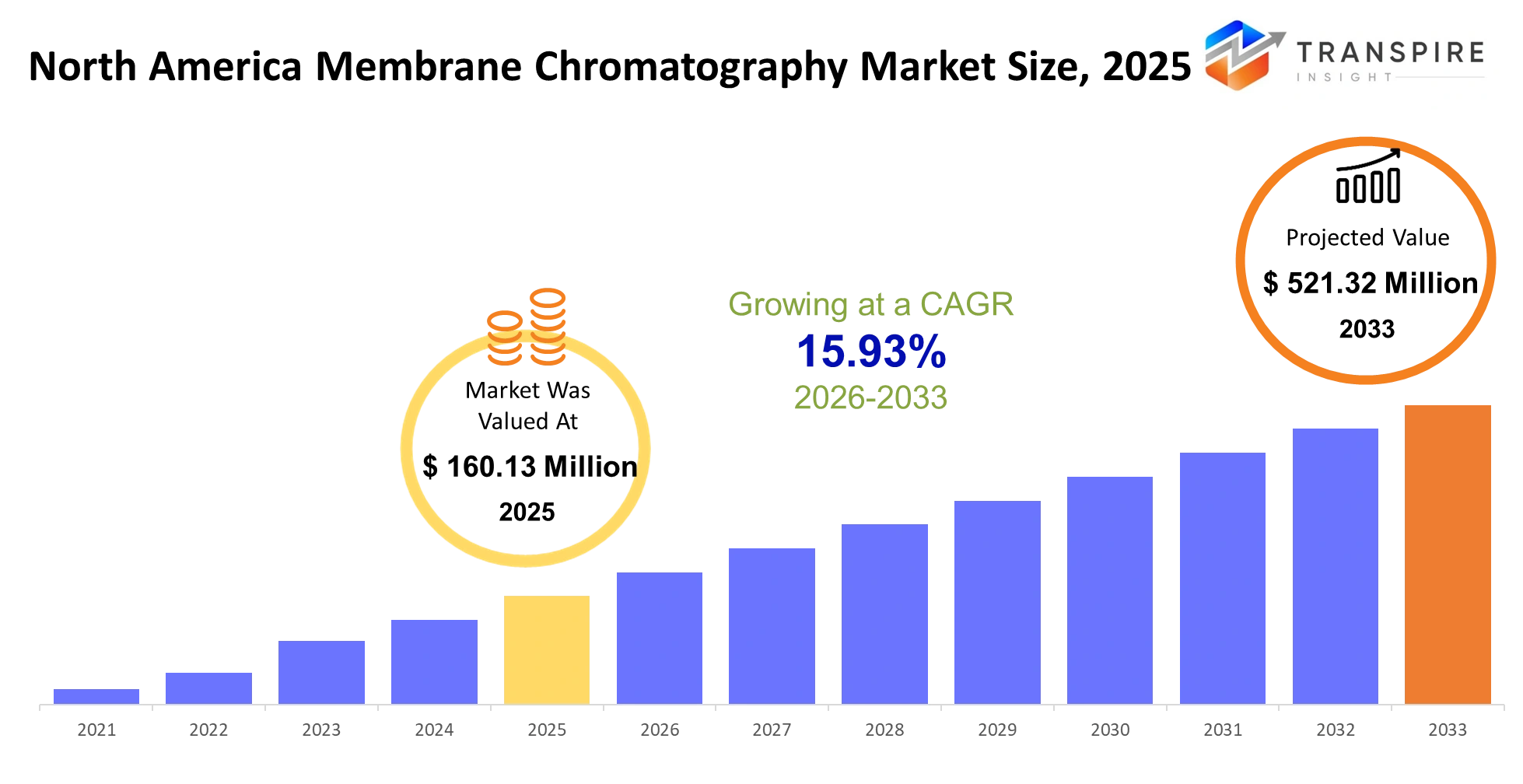
- North America Membrane Chromatography Market Size 2025: USD 160.13 Million
- North America Membrane Chromatography Market Size 2033: USD 521.32 Million
- North America Membrane Chromatography Market CAGR: 15.93%
- North America Membrane Chromatography Market Segments: By Product Type (Ion Exchange Membranes, Affinity Membranes, Hydrophobic Interaction Membranes, Mixed-mode Membranes, Others), By Application (Biopharmaceutical Purification, Vaccine Production, Gene Therapy, Diagnostics, Others), By End User (Biotechnology Companies, Pharmaceutical Companies, Research Institutes, CROs, Others), By Technique (Flow-through Chromatography, Bind-and-elute Chromatography, Others).
To learn more about this report,  Download Free Sample Report
North America Membrane Chromatography Market Summary:
The North America Membrane Chromatography Market size is estimated at USD 160.13 Million in 2025 and is anticipated to reach USD 521.32 Million by 2033, growing at a CAGR of 15.93% from 2026 to 2033. North America Membrane Chromatography Market kinda plays a critical role in modern bioprocessing, by helping manufacturers more or less purify vaccines, monoclonal antibodies, gene therapies , and other biologic products quickly. Unlike the more traditional resin-based systems, which sometimes end up making processing bottlenecks, membrane chromatography tends to deliver faster separation and purification. So biopharmaceutical producers can boost throughput, shorten manufacturing time, and keep product quality more steady at commercial scale.
In the past three to five years, there has been this structural shift toward single-use, and also continuous bioprocessing platforms . That change pretty much pushes manufacturers to lean into membrane-based technologies that bring better flexibility, plus a lower contamination risk. Then COVID-19 came along as a kind of big catalyst, it showed the weak spots in older production infrastructure , and it sped up spending on scalable biomanufacturing capacity. And as cell and gene therapy pipelines are still expanding across North America, production sites more and more need high-speed downstream processing solutions. This basically results in stronger adoption of membrane chromatography systems, which opens up new revenue streams for technology providers , and supports longer-term market growth.
Key Market Insights
- In 2024, the United States kind of dominates the North America Membrane Chromatography Market, with around 80% of the regional market share…give or take.
- Canada comes in as the second-largest market, with momentum helped along by more biotechnology investments and also the growth of biomanufacturing infrastructure.
- Mexico is expected to be the fastest-growing region during 2025–2032, mainly because pharmaceutical manufacturing capabilities keep getting stronger and more established.
- On top of that, strong government backing for biologics production keeps pushing the overall industry size upward across North America, even when demand swings a bit.
- When it comes to technology, Ion exchange membrane chromatography is leading the market, it takes up close to 45% of total revenue share in 2024.
- Affinity membrane chromatography is next, usually described as the second-largest segment, and it’s largely tied to high-purity biologics plus monoclonal antibody production.
- Hydrophobic interaction membrane chromatography meanwhile, is projected to grow the quickest through 2032, and it seems to fit the direction the industry is taking.
- Also, continuous bioprocessing trends are getting more traction, and that’s strengthening demand for high-throughput membrane purification systems.
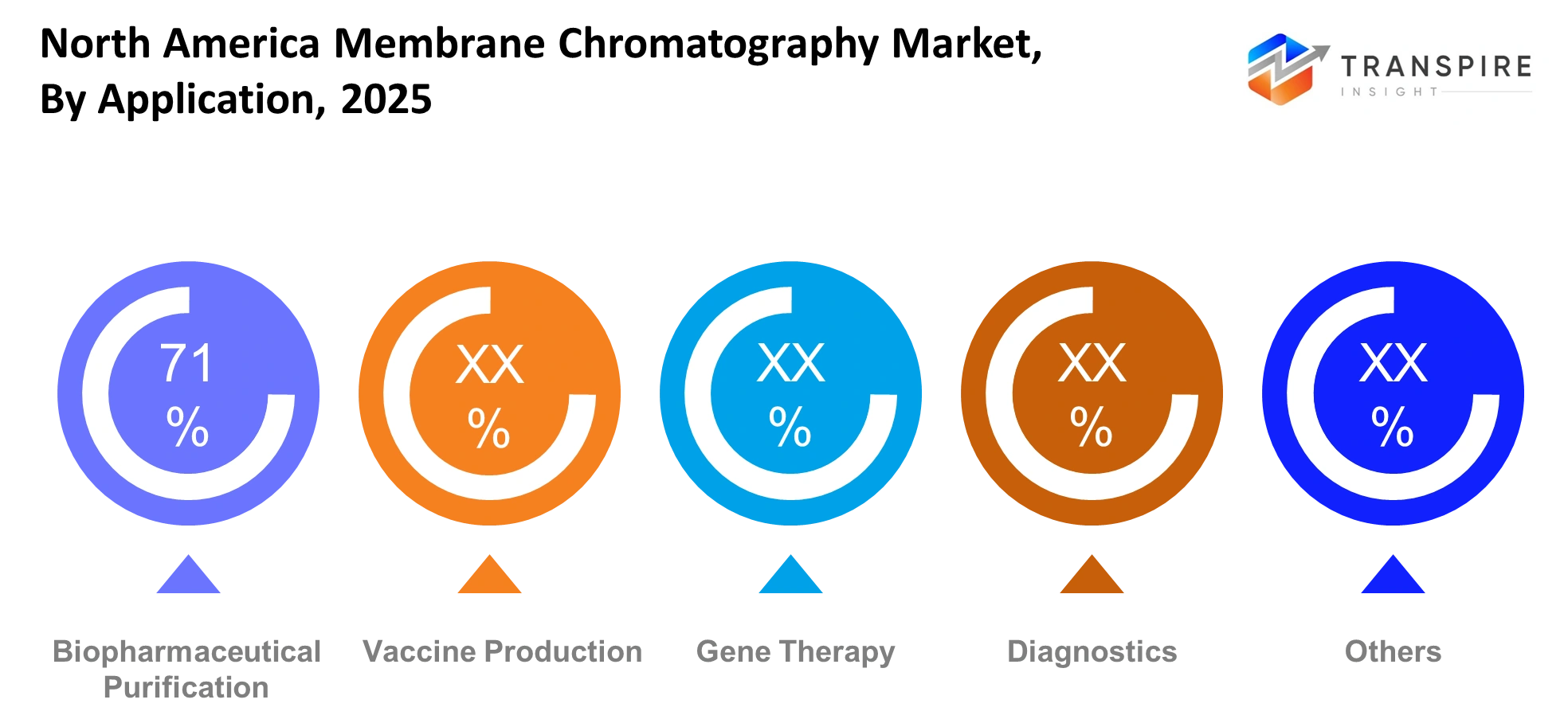
- Looking at applications, biopharmaceutical manufacturing leads the way, it contributes about 60% of North America Membrane Chromatography Market revenue in 2024.
- Vaccine production still stays important as an application segment, mostly because commercial-scale manufacturing requirements keep expanding.
- Cell and gene therapy processing is the fastest-growing application area over the whole forecast period.
- And there’s emerging demand for rapid downstream purification which is helping wider adoption across more advanced therapeutic development work.
- Finally, biopharmaceutical companies hold the largest market share, accounting for nearly 55% of total industry revenue.
What are the Key Drivers, Restraints, and Opportunities in the North America Membrane Chromatography Market?
The strongest force pushing the North America Membrane Chromatography Market ahead is this rapid expansion of biologics, cell therapies and gene therapies, sort of in a steady wave. It got triggered when pharma started leaning more heavily into complex biologic drugs, the kind that really do need faster and more efficient downstream purification than what conventional resin-based chromatography can manage. Membrane chromatography then starts to feel like the more suitable option, because it brings higher processing speeds plus more flexibility, and that’s especially useful in single-use and continuous manufacturing setups. When more biologics move from clinical development into commercial production, manufacturers tend to put money into membrane-based purification platforms—mainly to raise throughput and to cut those annoying production bottlenecks, and that tends to roll straight into higher equipment sales plus ongoing consumables revenue that keeps coming back.
The market’s biggest stumbling block is the deeply rooted use of traditional chromatography systems inside already existing biopharmaceutical facilities. This issue is kind of structural, because companies have to follow strict validation rules and regulatory requirements. Switching out established purification processes usually means a lot of process rework, regulatory reassessment, and also fresh capital spending. So, even if the operational upsides are real, many producers postpone the technology transition, or do it slower than they would like, which then limits adoption rates and ends up dragging down the pace of possible revenue growth for membrane chromatography suppliers.
There is a really major opening here in growing advanced therapy manufacturing capability across North America. In other words significant investments are going into cell and gene therapy plant facilities, and this is driving a clear demand for flexible purification solutions that can work with smaller lot sizes, plus faster product switching or changeovers. Membrane chromatography seems well set up to take advantage of this shift, because it supports scale up processes in a way that uses single-use manufacturing systems, which sort of matches the changing needs of those next generation therapeutics.
What Has the Impact of Artificial Intelligence Been on the North America Membrane Chromatography Market?
Artificial intelligence, and more advanced digital technologies, are steadily reshaping membrane chromatography work in North America’s biopharmaceutical manufacturing space. Companies are rolling out AI driven process control setups to handle key purification factors like flow rates, pressure levels, buffer use, and membrane loading conditions, often with less manual back and forth. These setups keep reading sensor signals and then tweak things on the fly, which means reduced operator involvement, and usually more steady output during biologics production, even when conditions drift a bit.
Alongside that, machine learning is boosting “what comes next” predictions across downstream processing. Instead of only reacting, AI can look at past production records plus membrane performance indicators and the way equipment was run, then it can forecast membrane fouling, flag likely process deviations, and suggest maintenance windows before a real problem shows up. The outcome tends to be fewer unexpected stoppages, and steadier production rhythms overall. In commercial biologics plants, teams have reported better batch success rates, lower buffer consumption, quicker process tuning, and stronger use of existing equipment.
Digital twins, plus advanced process analytics, are also helping with optimization by essentially staging purification workflows in a simulated space before they ever hit the factory floor. That reduces development timelines, and it can speed up scale-up work. Still, there’s a big catch with AI adoption. A lot of biopharmaceutical facilities run on older, disconnected data systems, so connecting everything is tricky and ends up being costly. On top of that, if standardized process data quality is spotty or inconsistent, model reliability can drop, and large scale deployment slows down even when the operational advantages are pretty clear.
Key Market Trends
- Since 2020, biopharmaceutical manufacturers have kinda shifted their capital spending toward single use processing platforms, which in turn sped up membrane chromatography adoption across new production facilities, and it all looks like it continues.
- Between 2021 and 2025, cell and gene therapy developers started replacing more conventional purification steps with membrane based systems, mostly to cut down on processing complexity and keep things less tangled in the workflow.
- After 2020, continuous bioprocessing got more attention, so suppliers went ahead and developed high throughput membrane solutions that are optimized for uninterrupted manufacturing operations, you know the idea.
- Over the past five years, leading suppliers like Sartorius, Merck, and Pall expanded their membrane product portfolios to catch the newer biologics opportunities that kept showing up.
- Process development timelines also got shorter. This happened because manufacturers adopted membrane chromatography technologies that shrink purification cycle times relative to traditional resin systems, which used to take longer, naturally.
- Since 2022, Contract Development and Manufacturing Organizations have been putting more money into flexible purification infrastructure to support a wider set of biologics production programs, not just one path.
- Regulatory focus on process consistency has encouraged wider deployment of automated monitoring and advanced analytics inside downstream purification operations, and that’s been a big driver.
- During the pandemic, supply chain disruptions made biopharmaceutical companies localize key manufacturing capabilities across North America between 2020 and 2024, so they wouldn’t get stuck waiting, or stuck at all.
- More recently, manufacturers have increasingly built artificial intelligence and predictive analytics into purification workflows, improving membrane utilization rates, and also reducing those unplanned downtime moments.
- And finally, strategic partnerships between technology providers and biologics manufacturers rose after 2021, which helped speed up the commercialization of next generation membrane purification platforms.
North America Membrane Chromatography Market Segmentation
By Product Type
By product type, ion exchange membranes kind of hold the leading position, mainly because they fit broadly across biologics purification workflows and they play well with large-scale manufacturing. Their high binding capacity, plus faster processing speeds, and the fact they can work as polishing steps really well have made more commercial biopharmaceutical producers adopt them. Affinity membranes sit in the second-largest segment, and that’s mostly tied to the rising production of monoclonal antibodies and the ongoing push for purification methods that are more selective than the usual options. Hydrophobic interaction membranes and mixed-mode membranes still keep gaining traction in certain purification processes, especially where standard approaches run into efficiency limits. Other membrane formats do show up for more niche requirements, but they still keep a smaller footprint in the industry.
Demand patterns are increasingly leaning toward products that support single-use manufacturing and continuous processing strategies, like it’s becoming the default expectation. Looking ahead, future market development will probably reward suppliers who boost membrane performance, improve scalability, and also drive down production costs. Manufacturers and investors are expected to prioritize advanced membrane chemistries that can handle next-generation therapies and complex biologic formulations, even when the use case is pretty demanding.
By Application
In application terms biopharmaceutical purification is still basically the big deal, because biologics manufacturing really leans on highly efficient downstream processing to keep product quality steady, and also to protect production economics. When you look at scale, large scale monoclonal antibody production keeps nudging out everything else as the main reason membrane chromatography gets deployed so often. On top of that, vaccine production sits in another major lane, especially after the newer investments into domestic manufacturing capacity and those pandemic preparedness programs.
Gene therapy is kinda showing up as one of the fastest growing areas too, mainly due to the need for rapid purification technologies that can handle smaller batch sizes and those complicated biomolecules without too much fuss. Meanwhile diagnostics and a few other applications add extra demand, particularly where research groups and specialty manufacturing teams are operating. The growth patterns are not identical across all these uses; commercial biologics tend to push throughput and cost efficiency, while advanced therapies tend to favor flexibility, and speed. Looking ahead, expansion in personalized medicine along with regenerative therapies should open up further opportunities for membrane-based purification solutions, across more types of production settings.
To learn more about this report, Download Free Sample Report
By End-User
From an end user point of view, pharmaceutical companies take the largest chunk because they have extensive biologics pipelines, solid established manufacturing infrastructure, and enough serious capital to keep investing. Biotechnology companies are also a big customer crowd, especially when they’re working on innovative treatments that need flexible yet scalable purification technologies. Research institutes add a more steady type of demand too, usually tied to process development, translational research ,and earlier stage therapeutic programs. Contract Research Organizations and other service providers are also jumping in more and more , they’re choosing membrane chromatography platforms to back outsourced development and manufacturing work.
Other users show up as well, like specialized laboratories and newer therapeutic developers who want a more efficient purification alternative, without all the extra fuss. Purchasing habits vary across this space, large pharma tends to lean hard on reliability and regulatory compliance, while smaller biotech firms usually care more about operational flexibility. Looking ahead, the growth curve should tilt toward collaborative development models, which means suppliers that can deliver customizable solutions and provide strong technical support, should be in a pretty good spot.
By Technique
Honestly, the flow-through chromatography approach is one of those things that basically wins out by technique, because it lets you pull out the impurity s o fast while still keeping high recovery. It seems to fit really well with what modern manufacturing is trying to do—speed, scale, and a kind of continuous rhythm for processing. A lot of biologics makers lean toward flow-through options for polishing steps, where efficiency and throughput end up, honestly, driving the whole production cost picture.
That said, bind-and-elute chromatography is still important, especially when you need strong selectivity and to really capture the target molecule. Yes, the processing time can run longer but the purification quality can be quite impressive, especially for the more complex biologic products. There are also other specialized techniques that pop up for specific production needs, but they only end up taking a smaller slice of overall use.
And demand keeps moving toward methods that make operations less complicated, and that play nicer with automation. Looking ahead, future investment probably goes into blending more advanced membranes with continuous manufacturing systems. That could open up chances for both equipment providers and end users who want more productivity, lower operating costs, and a steadier process from batch to batch.
What are the Key Use Cases Driving the North America Membrane Chromatography Market?
Membrane chromatography , mostly it’s used for biologics purification inside commercial biopharmaceutical manufacturing. Monoclonal antibody producers kind of lean on this technology to speed up downstream processing, cut down on production bottlenecks, and keep product purity at a high level, so in practice this use case becomes the biggest driver of market demand.
Right now adoption is stretching into vaccine manufacturing , plus contract development and manufacturing organizations (CDMOs) where fast purification and adaptable production workflows are kind of a must. Also, biotech firms apply membrane chromatography to back clinical-stage biologics programs, those programs usually need shorter development timelines and something scalable, like a processing platform that can grow.
Then there are the newer directions too, for example cell and gene therapy manufacturing. In that space developers need effective purification of viral vectors and those more complex biomolecules. Research institutions, and advanced therapy teams are even looking at membrane based platforms for personalized medicine and regenerative therapy initiatives, which is basically opening fresh opportunities for technology suppliers during the forecast period.
|
Report Metrics |
Details |
|
Market size value in 2025 |
USD 160.13 Million |
|
Market size value in 2026 |
USD 185.27 Million |
|
Revenue forecast in 2033 |
USD 521.32 Million |
|
Growth rate |
CAGR of 15.93% from 2026 to 2033 |
|
Base year |
2025 |
|
Historical data |
2021 - 2024 |
|
Forecast period |
2026 - 2033 |
|
Report coverage |
Revenue forecast, competitive landscape, growth factors, and trends |
|
Country scope |
North America (Canada, The United States, and Mexico) |
|
Key company profiled |
Sartorius AG, Merck KGaA, Cytiva, Danaher Corporation, Thermo Fisher Scientific, 3M, Pall Corporation, Repligen, Agilent Technologies, Bio-Rad Laboratories, Membrane Solutions, Purilogics, Avantor, Sartobind, GVS Group. |
|
Customization scope |
Free report customization (country, regional & segment scope). Avail customized purchase options to meet your exact research needs. |
|
Report Segmentation |
By Product Type (Ion Exchange Membranes, Affinity Membranes, Hydrophobic Interaction Membranes, Mixed-mode Membranes, Others), By Application (Biopharmaceutical Purification, Vaccine Production, Gene Therapy, Diagnostics, Others), By End User (Biotechnology Companies, Pharmaceutical Companies, Research Institutes, CROs, Others), By Technique (Flow-through Chromatography, Bind-and-elute Chromatography, Others). |
Which Regions are Driving the North America Membrane Chromatography Market Growth?
The United States kind of leads the market mostly because it has a dense clustering of biopharmaceutical manufacturing sites, along with sophisticated biotechnology research, and solid spending toward biologics production. Also, federal backing for homegrown biomanufacturing and the ongoing funding for life sciences innovation have pushed adoption of newer, more advanced purification technologies. You can see the effect in major manufacturing hubs spread across places like Massachusetts, California, and North Carolina, where there’s a mostly set ecosystem of technology vendors, contract manufacturers, and research institutions. With all of that working together, commercialization for biologics moves faster, and the country keeps that top dominant market standing.
Canada comes in as the second-largest regional market, though the way it grows is not exactly the same as in the United States. Expansion there is helped by relatively stable healthcare investment, a rising biotechnology sector, and dependable government support for biomanufacturing capabilities. Canadian players tend to lean harder into research partnerships and longer term innovation programs, rather than focusing purely on big production volumes. In practice, this kind of method builds a steadier revenue base and supports smooth technology uptake across both commercial settings and research environments.
Mexico is coming up as the fastest-growing market, even as pharmaceutical manufacturing investment keeps moving toward more cost efficient production locations. Lately the expansion of biologics production sites, plus a broader role in North American healthcare supply chains, seems to be helping the outlook. With new modern manufacturing infrastructure being funded, there are also openings for advanced purification technologies, which should align with international quality standards, more often. Across Mexico, growth is likely to pull in fresh suppliers, technology providers, and investors who want exposure to the expanding biopharmaceutical manufacturing activity through 2033.
Who are the Key Players in the North America Membrane Chromatography Market and How Do They Compete?
Competition in the North America membrane chromatography market is pretty well consolidated, but not fully—like there’s a relatively small cluster of global life science suppliers that still manages a big chunk of commercial deployments. In practice, technology performance beats price most of the time, because biopharmaceutical manufacturers tend to care more about purification efficiency, scalability, regulatory compliance, and process consistency, than whatever the sticker cost is. The established players kind of hold their ground via product improvements and integrated bioprocessing portfolios. Meanwhile, newer or specialized entrants often look for the less served spaces, such as cell and gene therapy manufacturing where things move faster, and requirements can be a bit different. More and more, the competition is really about membrane capacity, single-use compatibility, automation functions, and also technical support services that help cut down process development timelines, so projects can get to scale sooner.
Sartorius AG leans hard into technology innovation, specifically with high-performance membrane adsorbers intended for rapid downstream processing and continuous manufacturing setups. What makes them stand out is how they connect membrane chromatography offerings with broader single-use bioprocessing platforms, which helps customers tidy up entire production workflows, in one flow. They also keep investing in bioprocessing capacity and do collaborations with biologics manufacturers , which supports wider adoption across both commercial operations and clinical-scale facilities. Merck KGaA competes using a broad purification lineup that basically stitches membrane technologies together with filtration and process development services. That “one umbrella” method lets customers pull multiple purification solutions from a single supplier, cutting down implementation headaches, and helping secure long-term retention even when plants expand.
Danaher Corporation, through its life sciences segment, really leans into workflow integration and those advanced manufacturing technologies that boost process productivity. It also has strong rapport with big pharmaceutical manufacturers, plus a steady stream of investment into automation capabilities , and that whole mix is basically a competitive edge for commercial biologics production. Thermo Fisher Scientific, on the other hand, sets itself apart with broad contract manufacturing , analytical services and then bioprocessing knowledge, which pairs up well with its purification tech. Pall Corporation holds a solid footing by focusing on high-throughput purification solutions and by growing membrane technologies that are tuned for advanced therapies , including viral vector as well as gene therapy use cases. Overall, these approaches are pulling the market toward a place where innovation, process integration and application-specific know how tend to decide who wins , and how.
Company List
- Sartorius AG
- Merck KGaA
- Cytiva
- Danaher Corporation
- Thermo Fisher Scientific
- 3M
- Pall Corporation
- Repligen
- Agilent Technologies
- Bio-Rad Laboratories
- Membrane Solutions
- Purilogics
- Avantor
- Sartobind
- GVS Group
Recent Development News
In May 2026, Repligen Reports Strong Q1 2026 Growth Driven by Chromatography and Process Analytics: Repligen Corporation reported strong first-quarter 2026 results, highlighting significant growth across its chromatography and process analytics businesses. The company cited rising demand from biopharmaceutical manufacturers and continued investment in downstream processing technologies, including chromatography platforms used in biologics manufacturing. This performance reinforces North America's leadership in advanced bioprocessing infrastructure.
Source: https://www.labmanager.com
In May 2026, Repligen Highlights Chromatography Expansion at 2026 Healthcare Conference: Repligen Corporation confirmed its participation in the Bank of America Securities 2026 Global Healthcare Conference, where management outlined ongoing investments across its chromatography, filtration, and process analytics businesses. The company emphasized continued focus on bioprocessing technologies supporting biologics manufacturing, a key growth driver for the North American membrane chromatography sector.
Source: https://investors.repligen.com
What Strategic Insights Define the Future of the North America Membrane Chromatography Market?
The North America Membrane Chromatography Market is shifting, toward more integrated, continuous biomanufacturing ecosystems over the next five to seven years. The main driver isn’t only bigger biologics output, but also the industry’s push to cut manufacturing costs, speed up product release timelines, and handle increasingly complex therapeutic modalities, like gene therapies and personalized medicines. Membrane-based purification technologies seem especially well placed to gain, since they line up with automation, single-use processing, and kind of flexible production models.
There’s also a risk that’s a little less obvious, and it has to do with technology substitution across downstream processing. New developments in next-generation resins , filtration systems, and hybrid purification platforms could slow membrane chromatography adoption in some specific use cases. On top of that, market concentration can be tricky, because when companies depend on a limited number of membrane material suppliers, supply vulnerabilities can show up during production disruptions, or other operational hiccups.
At the same time, there’s an emerging opportunity around the commercialization of AI-enabled autonomous bioprocessing facilities. The idea is that real-time process optimization can improve how membranes are used and boost manufacturing efficiency. Market participants might want to focus on investing in application-specific membrane platforms for cell and gene therapy production. In those areas, technical differentiation plus regulatory hurdles can offer longer-term competitive advantages, rather than trying to compete only on scale.
North America Membrane Chromatography Market Report Segmentation
By Product Type
- Ion Exchange Membranes
- Affinity Membranes
- Hydrophobic Interaction Membranes
- Mixed-mode Membranes
- Others
By Application
- Biopharmaceutical Purification
- Vaccine Production
- Gene Therapy
- Diagnostics
- Others
By End User
- Biotechnology Companies
- Pharmaceutical Companies
- Research Institutes
- CROs
- Others
By Technique
- Flow-through Chromatography
- Bind-and-elute Chromatography
- Others
Frequently Asked Questions
Find quick answers to common questions.
The approximate North America Membrane Chromatography Market size for the market will be USD 521.32 Million in 2033.
The key segments of the North America Membrane Chromatography Market are By Product Type (Ion Exchange Membranes, Affinity Membranes, Hydrophobic Interaction Membranes, Mixed-mode Membranes, Others), By Application (Biopharmaceutical Purification, Vaccine Production, Gene Therapy, Diagnostics, Others), By End User (Biotechnology Companies, Pharmaceutical Companies, Research Institutes, CROs, Others), By Technique (Flow-through Chromatography, Bind-and-elute Chromatography, Others).
Major players in the North America Membrane Chromatography Market are Sartorius AG, Merck KGaA, Cytiva, Danaher Corporation, Thermo Fisher Scientific, 3M, Pall Corporation, Repligen, Agilent Technologies, Bio-Rad Laboratories, Membrane Solutions, Purilogics, Avantor, Sartobind, GVS Group.
The current market size of the North America Membrane Chromatography Market is USD 160.13 Million in 2025.
The North America Membrane Chromatography Market CAGR is 15.93%.
- Sartorius AG
- Merck KGaA
- Cytiva
- Danaher Corporation
- Thermo Fisher Scientific
- 3M
- Pall Corporation
- Repligen
- Agilent Technologies
- Bio-Rad Laboratories
- Membrane Solutions
- Purilogics
- Avantor
- Sartobind
- GVS Group
About the Authors

Pankaj Ghogare Patil
I am Pankaj Ghogare Patil, a Senior Research Analyst at Transpire Insight, specializing in the Pharmaceutical, Chemicals & Materials, Healthcare IT, and Biotechnology industry. My expertise lies in conducting comprehensive market research, analyzing industry trends, evaluating competitive landscapes, and translating complex data into actionable insights. At Transpire Insight, I closely follow emerging technologies, regulatory developments, and market innovations to create accurate, well-researched, and informative content that helps businesses and professionals make informed decisions. I am committed to producing credible, evidence-based articles that reflect industry best practices while making technical topics accessible and valuable for a broad audience.

Chakradhar Khansole
Chakradhar serves as the Research Director at Transpire Insight, bringing over 8 years of experience in technology, innovation, and strategic market intelligence. He specializes in transforming complex market data into actionable business insights that enable organizations to make informed, growth-oriented decisions. Recognized for his strategic vision and analytical expertise, Chakradhar leads high-impact research initiatives, delivering comprehensive market assessments, competitive intelligence, and forward-looking industry analysis.
Recently Published Reports
-
Apr 2026
Cord Blood Banking Services Market
Cord Blood Banking Services Market Size, Share & Analysis Report By Type of Service (Collection, Processing, Storage), By Bank Type (Private Banks, Public Banks, and Hybrid Banks), By Component (Cord Blood, and Cord Tissue), By End User (Hospitals, Research Institutions, Biotechnology Companies, and Others) and Geography (North America, Europe, Asia-Pacific, Middle East and Africa, South and Central America), 2021 - 2031
-
Apr 2026
ELISA Processors Market
ELISA Processors Market Size, Share & Analysis Report By Type (Optical Filter ELISA Analyzer, and Optical Grating ELISA Analyzers), By Mode (Automated ELISA Analyzers, and Semi-Automated ELISA Analyzers), By Applications (Immunology, Vaccine development, Drug Monitoring, and Others), By End Users (Biotechnology Companies, Pharmaceutical Companies, Contract Research Organization, and Diagnostic Laboratories) and Geography (North America, Europe, Asia-Pacific, Middle East and Africa, South and Central America), 2021 - 2031
-
May 2026
Microscope Slide Scanner Market
Microscope Slide Scanner Market Size, Share & Analysis Report By Type (Portable Microscope Slide Scanner, and Desktop Microscope Slide Scanner), By Application (Biological Research, Medicine, Veterinary, and Other) and Geography (North America, Europe, Asia-Pacific, Middle East and Africa, South and Central America), 2021 - 2031
-
Apr 2026
Microwave Cookware Market
Microwave Cookware Market Size, Share & Analysis Report By Material Type (Plastic, Glass, Ceramic, Silicone, and Metal), By Application (Cooking, Reheating, and Defrosting), By End User (Household, Commercial (Restaurants, Hotels, and Cafes), and Food Service Industry), By Sales Channel (Online Retail, Offline Retail (Supermarkets, Hypermarkets, Specialty Stores), and Direct Sales (Company Outlets)) and Geography (North America, Europe, Asia-Pacific, Middle East and Africa, South and Central America), 2021 - 2031