

North America Life Science Microscopy Devices Market Size & Forecast:
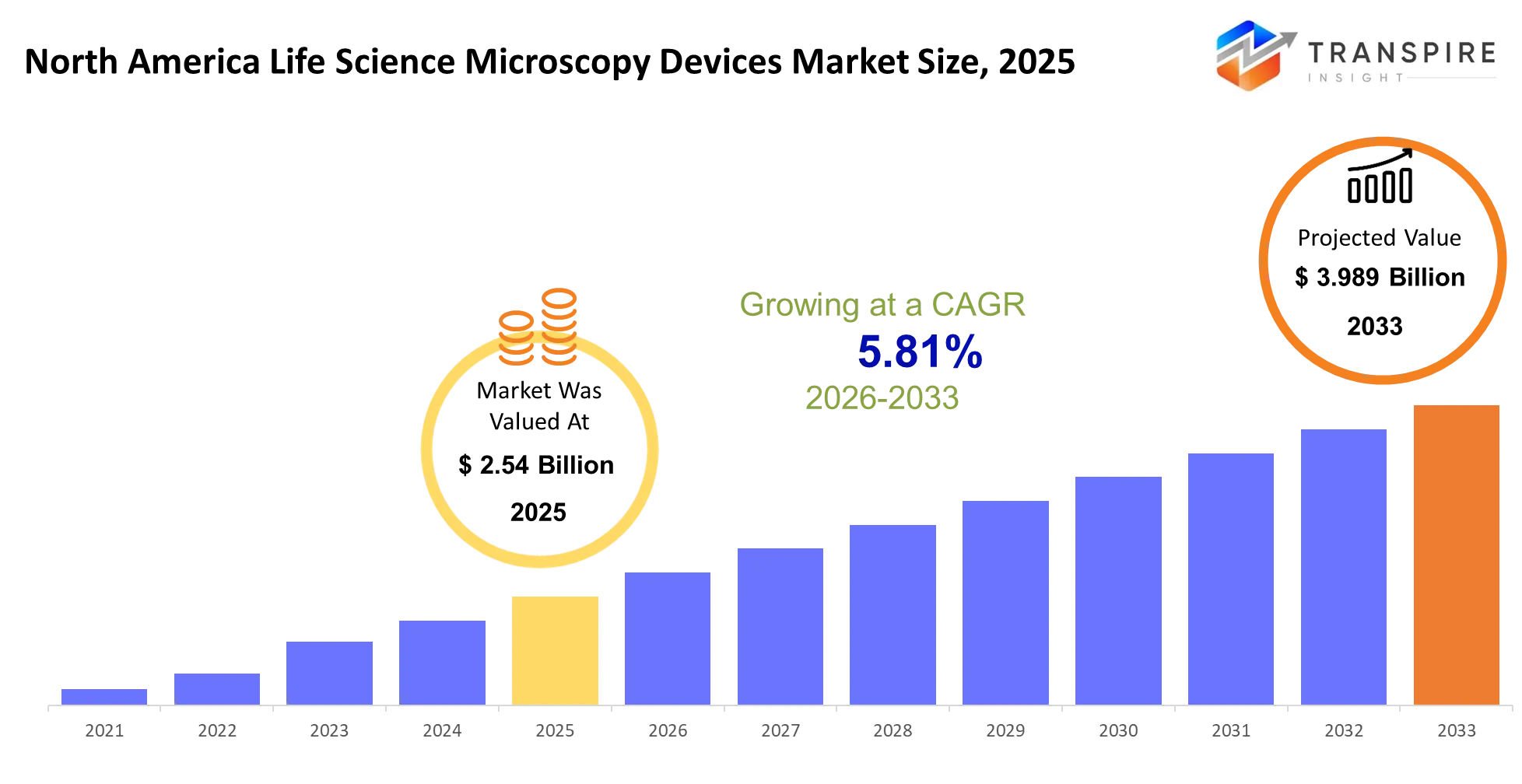
- North America Life Science Microscopy Devices Market Size 2025: USD 2.54 Billion
- North America Life Science Microscopy Devices Market Size 2033: USD 3.989 Billion
- North America Life Science Microscopy Devices Market CAGR: 5.81%
- North America Life Science Microscopy Devices Market Segments: By Product Type (Optical Microscopes, Electron Microscopes, Fluorescence Microscopes, Digital Microscopes, Confocal Microscopes, Others), By Application (Cell Biology, Molecular Biology, Pathology, Drug Discovery, Clinical Diagnostics, Others), By End User (Research Institutes, Pharmaceutical Companies, Hospitals, Academic Institutes, Others), By Technology (AI-enabled Microscopy, 3D Imaging Microscopy, Super-resolution Microscopy, Others).
To learn more about this report,  Download Free Sample Report
North America Life Science Microscopy Devices Market Summary:
The North America Life Science Microscopy Devices Market size is estimated at USD 2.54 Billion in 2025 and is anticipated to reach USD 3.989 Billion by 2033, growing at a CAGR of 5.81% from 2026 to 2033. The North America Life Science Microscopy Devices Market kind of sits at the middle of modern biomedical research, and precision diagnostics, too. These kinds of systems let researchers, pharmaceutical teams, and clinical labs actually see cellular behavior, tissue structures, and molecular interactions that you really can’t catch with conventional analytical approaches. In everyday use, microscopy equipment helps speed up drug discovery, supports biologic therapy validation, backs cancer investigations, and also improves pathology routines where the image accuracy basically changes treatment decisions.
In the last 3–5 years the scene has moved away from only standalone optical imaging and more toward integrated digital, plus AI-assisted microscopy platforms. Labs now lean into automated imaging, cloud-connected data crunching, and high throughput workflows because many research programs are producing datasets that are way bigger than older manual systems can comfortably handle. The COVID-19 pandemic was a big trigger, it highlighted lab scalability gaps and it pushed faster investment into advanced imaging infrastructure across both pharmaceutical and academic organizations. And as biologics, cell therapies, and personalized medicine programs expand, labs need quicker and more repeatable imaging capabilities. That practical requirement is now showing up as higher levels of equipment upgrades, increased spending on software integration, and steady long-term service income across the whole microscopy ecosystem.
Key Market Insights
- The United States pretty much dominated the North America Life Science Microscopy Devices Market, with more than 78% market share in 2025, because biomedical research funding stayed strong and steady, for a long time.
- Canada is showing up as the fastest-growing regional market through 2032, kind of driven by expanding biotechnology clusters, plus government supported life science infrastructure investments that keep getting pushed forward.
- Across North America, academic research institutes increased their microscopy equipment buying by roughly 20% between 2021 and 2025, mainly to support advanced cellular analysis programs and all the related work.
- Meanwhile, cross border pharmaceutical collaborations keep reinforcing regional market growth, especially for oncology and regenerative medicine imaging use cases.
- Optical microscopy systems were the leader, taking nearly 42% of revenue share in 2025, largely due to the widespread use in pathology, microbiology and clinical laboratories.
- Electron microscopy devices captured the second largest market share, as nanotechnology and structural biology research needs keep expanding, at a decent pace.
- Super resolution microscopy is projected to be the fastest growing segment through 2032, tied to the rising demand for subcellular plus molecular level visualization.
- AI powered digital microscopy platforms are also gaining meaningful share, since many labs prefer workflow automation and quicker image interpretation, without slowing things down.
- Confocal microscopy systems are still seeing strong adoption in pharmaceutical drug discovery programs and live cell imaging applications.
- Drug discovery and pharmaceutical research accounted for about 38% of the North America Life Science Microscopy Devices Market share in 2025.
- For applications, cancer diagnostics and digital pathology are the fastest moving categories, mainly because precision oncology is expanding, and biomarker based testing is being adopted more and more.
What are the Key Drivers, Restraints, and Opportunities in the North America Life Science Microscopy Devices Market?
The strongest force driving the North America Life Science Microscopy Devices Market is sort of the rapid expansion of biologics, cell therapy, and precision medicine studies. Pharmaceutical companies now seem to insist on ultra-high-resolution imaging systems, that can really analyze live cells , protein interactions, and tissue reactions in real time. This shift got even stronger after the COVID-19 pandemic kind of revealed the limits of usual lab routines and then it sped up investment in automated imaging infrastructure. As drug pipelines become more complicated laboratories are moving toward AI-enabled confocal and digital microscopy platforms that shorten evaluation time, and also help reproducibility stay consistent. And yeah, that whole transition bumps instrument sales up, plus recurring software income, plus longer service agreements too.
Still, high capital costs remain the market’s most hard to change barrier. Advanced electron microscopes and super-resolution microscopy systems often mean multimillion-dollar spending, specialized lab environments, and personnel that are highly trained. Smaller biotechnology firms and many academic institutions tend to delay buying , because financing timelines, facility upgrades, and workforce training can take years to finish. So adoption rates in mid-tier research organizations get suppressed, and replacement cycles slow down , especially for those premium imaging systems.
AI-integrated digital pathology looks like the clearest longer-term opportunity. North American healthcare networks are increasing spending on automated cancer diagnostics and cloud-connected imaging platforms. Businesses that build AI-assisted microscopy software for pathology workflows can unlock real momentum, once hospitals and diagnostic labs modernize their ability for high-volume tissue analysis.
What Has the Impact of Artificial Intelligence Been on the North America Life Science Microscopy Devices Market?
Artificial intelligence together with advanced digital imaging tools are in a way reshaping the North America Life Science Microscopy Devices Market . Not just by making things faster , but by pushing lab automation, sharpening image accuracy and boosting analytical throughput all at once. More and more research labs and pharmaceutical organizations are putting AI enabled microscopy platforms to work, so they can handle cell counting, tissue classification and even anomaly spotting inside pathology routines, almost like a silent assistant. Because of this , the time spent on manual interpretation drops, and teams can run thousands of high resolution samples in a much smaller window than what older microscopy approaches usually demand. On top of that , automated digital imaging platforms help lock in workflow standardization , which feels really important for multi site clinical trials and precision medicine initiatives.
Now machine learning models are also getting stitched into modern imaging systems to forecast sample behavior, fine tune image acquisition parameters , and surface quiet cellular changes tied to how disease may be progressing. In drug discovery settings , predictive imaging algorithms can limit unnecessary experimental repeats and speed up target validation , which tends to lift day to day productivity while cutting operational outlay. AI assisted microscopy platforms further support diagnostic consistency by reducing observer to observer variability, especially in cancer pathology evaluation.
That said , adoption still hits a hard wall. Bringing AI software into legacy laboratory infrastructure typically calls for major capital spending , and model performance often relies on access to large, high quality labeled datasets that many institutions simply do not have yet.
Key Market Trends
- Since 2021, pharmaceutical companies have started to raise adoption of automated confocal microscopy systems, mostly so the team could cut down manual imaging work and move faster in biologics development timelines , kinda like less back and forth.
- After 2020, digital pathology platforms also saw more traction in hospitals , especially when cancer diagnostics turned toward AI assisted tissue analysis and remote cooperation features that let people look at stuff together without being in the same building.
- Between 2022 and 2025, Thermo Fisher Scientific and Leica Microsystems rolled out more AI integrated imaging products , in order to reinforce lab automation capabilities, and honestly it all felt pretty connected.
- In North America, research institutes changed how they buy equipment , leaning toward cloud connected microscopy systems that enable centralized image storage and cross site analytical access , which is sort of the “everywhere at once” approach.
- Super resolution microscopy picked up speed after 2021 because cell therapy and gene editing programs needed molecular level visualization accuracy, beyond what conventional optical imaging could really deliver .
- During the COVID-19 disruption years, manufacturers leaned into regionalizing component sourcing and even increased North American assembly operations for the most critical imaging systems, since getting parts became, well, unpredictable.
- Academic labs meanwhile started swapping old fluorescence microscopes for high content screening platforms that can process thousands of cellular samples each day, without needing as much babysitting between runs.
- From 2022 through 2025, AI assisted image analysis shortened pathology interpretation timelines by as much as 30% across several precision oncology research workflows, which is a number people repeat a lot now.
- Carl Zeiss AG and Olympus Corporation also increased their collaborations with biotechnology firms, so they could co-develop imaging solutions for regenerative medicine use cases, kinda step by step together.
- Regulatory pressure, particularly on reproducible clinical data, pushed laboratories toward automated imaging systems that reduce observer variability. and improve diagnostic consistency across different research environments, even when teams are not identical.
North America Life Science Microscopy Devices Market Segmentation
By Product Type
Optical microscopes are still kinda in the front of the product type split, because research labs, pathology centers, and universities depend on cost effective imaging systems for everyday biological work. Fluorescence microscopes and confocal microscopes have grown fast too, largely from the increased need for live-cell observation , protein following, and molecular interaction work in biologics research. Electron microscopes also stay very relevant for nanotechnology and structural biology , even if the big installation and upkeep expenses keep many mid-sized laboratories from adopting them widely.
Digital microscopes are getting more traction as labs move toward cloud linked imaging workflows, and remote cooperation features. These days competition among products is less only about optical performance , and more about image automation, software integration , and how fast they can deliver usable results. Manufacturers are putting money into AI assisted image analysis and modular platform designs so the systems can scale better across different lab settings. Looking ahead , future purchasing choices will likely favor interoperability, automated diagnostics support, and strong lifecycle service capabilities , all together, not just imaging accuracy.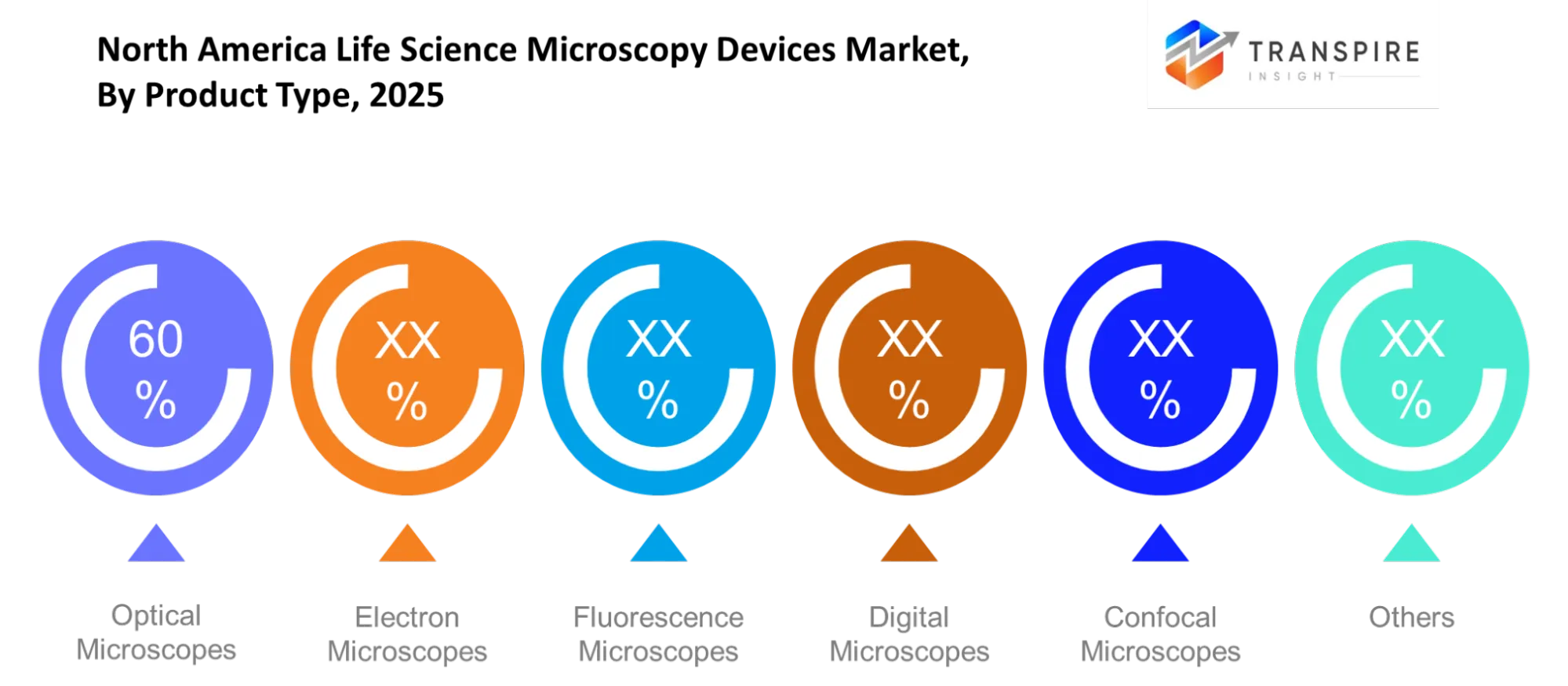
To learn more about this report, Download Free Sample Report
By Application
Drug discovery and cell biology use cases take the biggest portion of microscopy device utilization, mostly because pharma pipelines are leaning more and more on cellular imaging, toxicity testing, and biomarker validation early on, like really early-stage. You can see molecular biology and pathology still holding a solid market spot too, since genomic medicine and oncology initiatives keep expanding through North American healthcare systems. Clinical diagnostics looks like one of the quickest growing areas, largely because digital pathology is getting rolled out more, and AI-supported cancer screening workflows are becoming standard in practice.
Even the demand curve by application isn’t uniform, it sort of depends on the lab vibe. Research labs tend to favor imaging depth and higher throughput, while clinical sites go for diagnostic repeatability , and smoother workflow efficiency. In the drug discovery segment, teams are still driving uptake of high-content screening systems that can inspect, and basically process thousands of biological samples in parallel at the same time. For what comes next, the market direction points toward tighter integration between microscopy platforms, laboratory information systems, and predictive analytics tools, which should open up new income channels for imaging vendors. This is especially true for those serving pharmaceutical operations as well as hospital-based research groups and teams.
By End-User
Pharmaceutical and biotechnology companies kind of lead the end user demand situation because ongoing investment in biologics , gene therapy, and precision medicine research really needs advanced imaging infrastructure with high analytical precision, at least that’s how it usually goes. Research institutes and academic organizations still matter a lot for equipment procurement, mostly because federally supported biomedical research programs stick around and they also bring in collaborative scientific initiatives. Hospitals are stepping up market participation fast too, mainly as digital pathology and AI assisted diagnostics get folded more into oncology and tissue assessment workflows, which is why people keep mentioning it.
At the same time budget restrictions, plus those long procurement timelines, are still messing with smaller academic facilities , especially when they want premium imaging tools that have specialized installation requirements. Contract research organizations are also buying more automated microscopy setups to back outsourced drug development services and clinical trial imaging needs. Looking ahead, growth across each end user group will hinge a great deal on workflow automation, software compatibility, and service support patterns. In other words, equipment vendors that offer connected imaging ecosystems and long-term technical help are probably going to improve their competitive stance with institutional buyers.
By Technology
Conventional imaging technologies still make up the largest installed base, but AI enabled microscopy and super resolution imaging tools are kinda changing how companies compete, especially in advanced research environments. The AI enabled microscopy systems are really getting traction because many labs want automatic image classification, less time spent on manual interpretation, and steadier diagnostic consistency, even when people rotate or collaborate across teams. On the other hand, super resolution microscopy keeps pushing forward in molecular biology and regenerative medicine programs, where scientists need to actually see at subcellular and protein interaction levels.
Also, three dimensional imaging microscopy is rolling out faster in neuroscience and tissue engineering, mostly because there is more demand for spatial cellular analysis these days. Adoption still varies though, since these advanced platforms often need special computational infrastructure, more training investment than expected, and heavy duty data processing capabilities that can be a lot. Because of that, technology vendors are leaning more toward integrated software platforms, cloud based analytics, and automated workflow management, not just standalone imaging hardware alone. Looking ahead, competition will probably hinge on how fast data gets processed, how accurate the AI is, and whether the whole setup plays nicely with large scale lab automation systems.
What are the Key Use Cases Driving the North America Life Science Microscopy Devices Market?
Drug discovery still seems like the main reason people keep adopting microscopy devices across North America, it kind of drives everything. Pharmaceutical companies count on high resolution imaging setups for live-cell observation, toxicity screening, and biomarker checks during biologics as well as precision medicine development efforts.
Then you see digital pathology and clinical cancer diagnostics gathering momentum at hospitals, and in diagnostic laboratories too. AI-assisted microscopy platforms help with quicker tissue analysis, and they tend to make results more consistent in oncology workflows. At the same time, neuroscience research institutes are leaning more and more toward 3D imaging systems for brain mapping studies, which is pretty popular lately.
And on the newer side, regenerative medicine plus cell therapy manufacturing is starting to matter more. In those settings, super-resolution microscopy is used for stem cell monitoring, and it also supports cellular engineering research. Also, advanced imaging tech is now showing up in spatial genomics and organoid research programs, where you really need very detailed molecular visualization capabilities for sure.
|
Report Metrics |
Details |
|
Market size value in 2025 |
USD 2.54 Billion |
|
Market size value in 2026 |
USD 2.687 Billion |
|
Revenue forecast in 2033 |
USD 3.989 Billion |
|
Growth rate |
CAGR of 5.81% from 2026 to 2033 |
|
Base year |
2025 |
|
Historical data |
2021 - 2024 |
|
Forecast period |
2026 - 2033 |
|
Report coverage |
Revenue forecast, competitive landscape, growth factors, and trends |
|
Country scope |
North America (Canada, The United States, and Mexico) |
|
Key company profiled |
Carl Zeiss AG, Nikon Corporation, Olympus Corporation, Leica Microsystems, Thermo Fisher Scientific, Bruker, Hitachi High-Tech, JEOL, Keyence, Agilent Technologies, Andor Technology, Motic, Oxford Instruments, Danaher Corporation, Hamamatsu Photonics |
|
Customization scope |
Free report customization (country, regional & segment scope). Avail customized purchase options to meet your exact research needs. |
|
Report Segmentation |
By Product Type (Optical Microscopes, Electron Microscopes, Fluorescence Microscopes, Digital Microscopes, Confocal Microscopes, Others), By Application (Cell Biology, Molecular Biology, Pathology, Drug Discovery, Clinical Diagnostics, Others), By End User (Research Institutes, Pharmaceutical Companies, Hospitals, Academic Institutes, Others), By Technology (AI-enabled Microscopy, 3D Imaging Microscopy, Super-resolution Microscopy, Others) |
Which Regions are Driving the North America Life Science Microscopy Devices Market Growth?
The United States is basically in the lead for the North America Life Science Microscopy Devices Market, mainly because there’s a huge biomedical research backbone there, plus elevated pharmaceutical R&D spend, along with solid federal budget backing. Bodies like the National Institutes of Health keep steering big investments toward things like cancer research, genomics, and precision medicine efforts, which really lean on advanced imaging tools, in a very direct way. Then you’ve got big biotech hubs across Massachusetts, California, and Texas, they help create ongoing purchase demand for high resolution microscopy setups and AI enabled platforms. On top of that, a well established ecosystem of pharmaceutical firms , universities, diagnostic laboratories and imaging equipment manufacturers keeps strengthening the long run market position across the country.
Canada shows up as the second biggest regional contributor, but the growth rhythm looks different from the United States. It depends more on institutional steadiness and co-operative research funding models. Canadian universities and public research centers keep putting money into microscopy infrastructure through government supported innovation schemes and health research initiatives. They also get a benefit from cross border scientific collaborations which support technology transfer and shared clinical research projects. Because of that, the purchasing scene stays fairly predictable, so microscopy manufacturers can often expect steadier revenue even when broader economic conditions get a bit unstable.
Mexico seems to be coming up as the quickest-growing regional market because its pharmaceutical manufacturing is expanding ,and there is also more money going into clinical research capabilities. Lately, growth around biotechnology parks, plus new medical device production facilities, and contract research operations, has really pushed the need for advanced imaging systems in both industrial settings and healthcare laboratories. Also, major international pharmaceutical companies are moving to solidify research and manufacturing bases in Mexico ,so they can diversify the supply chain and lower their operating expenses. All of this momentum in infrastructure development is basically opening up a lot of room for microscopy vendors, software providers, and service companies that are aiming for longer-term expansion from 2026 to 2033.
Who are the Key Players in the North America Life Science Microscopy Devices Market and How Do They Compete?
The competitive landscape of the North America Life Science Microscopy Devices Market is still, kinda moderately consolidated, and the rivalry basically stays around imaging precision, software integration, automation chops, and those long haul laboratory support services. Big multinational manufacturers keep working hard to hold their positions by bundling hardware with analytics ecosystems, and then the smaller specialist imaging firms go after faster growth pockets, like super-resolution and AI-assisted microscopy. Over time, the fight seems to drift away from pure standalone optical performance, toward the whole workflow efficiency side, plus data management matters, and also interoperability with digital pathology and lab information systems. Buyers lately tend to choose vendors who can back large scale research automation, cloud connectivity, and even multi-site collaboration across pharmaceutical and clinical settings.
Carl Zeiss AG stands out by offering advanced super resolution imaging platforms along with integrated software tools, meant for tricky neuroscience and cellular biology investigations. They keep extending their reach via partnerships with biotech groups and academic research centers, especially ones focused on high resolution live-cell imaging. Thermo Fisher Scientific competes with a wide laboratory integration approach, where microscopy systems are paired with analytical instruments, reagents, and digital workflows. That whole integrated operating model helps keep customers, particularly pharmaceutical companies that want a unified research infrastructure not a patchwork of vendors.
Leica Microsystems, to be fair , leans into automated digital pathology and fluorescence imaging systems, so diagnostic reproducibility in oncology gets a real push. They’ve also beefed up regional service networks, plus software driven workflow solutions , that help hospitals modernize their pathology routines, you know. Olympus Corporation meanwhile keeps an edge by offering ergonomic imaging systems and faster image acquisition technologies, which are broadly used in both clinical and life science labs. And then Nikon Corporation keeps putting money into AI assisted imaging analytics and those high-content screening platforms that are kind of tuned for regenerative medicine as well as drug discovery.
Company List
- Carl Zeiss AG
- Nikon Corporation
- Olympus Corporation
- Leica Microsystems
- Thermo Fisher Scientific
- Bruker
- Hitachi High-Tech
- JEOL
- Keyence
- Agilent Technologies
- Andor Technology
- Motic
- Oxford Instruments
- Danaher Corporation
- Hamamatsu Photonics
Recent Development News
In May 2026, Agilent Technologies Raises 2026 Profit Forecast on Strong Demand for Life-Science Instruments: Agilent Technologies increased its annual profit outlook after reporting stronger demand for laboratory instruments and medical research tools. The announcement highlighted improving spending conditions across life-science research environments in North America, supporting continued investment in advanced analytical and imaging technologies used in biomedical laboratories.
Source: https://www.reuters.com
In March 2026, Thermo Fisher Scientific Launches Glacios 3 Cryo-TEM for Structural Biology Research: Thermo Fisher Scientific introduced the Thermo Scientific Glacios 3 Cryo-TEM, a next-generation cryogenic transmission electron microscope designed to improve structural biology imaging and expand access to advanced cryo-electron microscopy workflows. The system targets life science laboratories seeking higher-resolution imaging and enhanced automation capabilities for drug discovery and molecular research.
Source: https://www.businesswire.com
What Strategic Insights Define the Future of the North America Life Science Microscopy Devices Market?
North America Life Science Microscopy Devices Market is slowly, you know, moving toward fully integrated AI guided imaging ecosystems where the hardware, the cloud analytics and even the automated interpretation basically work like one flow. That direction feels pushed by rising complexity in biologics research and the real requirement for reproducible high-throughput imaging across multi-site pharma and clinical networks. In the next 5 to 7 years, competitive advantage is probably going to lean more on “data intelligence” layers than just the optical hardware by itself.
There’s also a less visible problem, which is growing dependency on proprietary software ecosystems. That can quietly cut interoperability and, over time, create long-term vendor lock-in for hospitals and research institutions. And because of that, it may stretch out replacement cycles, while revenue kinda concentrates among a small set of dominant suppliers. But at the same time, there’s an opportunity too: real-time AI pathology platforms that support regulatory-compliant remote diagnostics, in particular as digital pathology approvals keep expanding through North American healthcare systems.
So market participants should really focus on open-architecture microscopy platforms, with modular AI integration, to reduce the lock-in risk and to better capture enterprise-scale adoption across pharmaceutical organizations and hospital networks.
North America Life Science Microscopy Devices Market Report Segmentation
By Product Type
- Optical Microscopes
- Electron Microscopes
- Fluorescence Microscopes
- Digital Microscopes
- Confocal Microscopes
- Others
By Application
- Cell Biology
- Molecular Biology
- Pathology
- Drug Discovery
- Clinical Diagnostics
- Others
By End User
- Research Institutes
- Pharmaceutical Companies
- Hospitals
- Academic Institutes
- Others
By Technology
- AI-enabled Microscopy
- 3D Imaging Microscopy
- Super-resolution Microscopy
- Others
Frequently Asked Questions
Find quick answers to common questions.
The Approximate North America Life Science Microscopy Devices Market size for the Market will be USD 3.989 Billion in 2033.
The key Segments of the North America Life Science Microscopy Devices Market are By Product Type (Optical Microscopes, Electron Microscopes, Fluorescence Microscopes, Digital Microscopes, Confocal Microscopes, Others), By Application (Cell Biology, Molecular Biology, Pathology, Drug Discovery, Clinical Diagnostics, Others), By End User (Research Institutes, Pharmaceutical Companies, Hospitals, Academic Institutes, Others), By Technology (AI-enabled Microscopy, 3D Imaging Microscopy, Super-resolution Microscopy, Others).
Major Players in the North America Life Science Microscopy Devices Market are Carl Zeiss AG, Nikon Corporation, Olympus Corporation, Leica Microsystems, Thermo Fisher Scientific, Bruker, Hitachi High-Tech, JEOL, Keyence, Agilent Technologies, Andor Technology, Motic, Oxford Instruments, Danaher Corporation, Hamamatsu Photonics.
The Current Market size of the North America Life Science Microscopy Devices Market is USD 2.54 Billion in 2025.
The North America Life Science Microscopy Devices Market CAGR is 5.81%.
- Carl Zeiss AG
- Nikon Corporation
- Olympus Corporation
- Leica Microsystems
- Thermo Fisher Scientific
- Bruker
- Hitachi High-Tech
- JEOL
- Keyence
- Agilent Technologies
- Andor Technology
- Motic
- Oxford Instruments
- Danaher Corporation
- Hamamatsu Photonics
About the Authors

Pankaj Ghogare Patil
I am Pankaj Ghogare Patil, a Senior Research Analyst at Transpire Insight, specializing in the Pharmaceutical, Chemicals & Materials, Healthcare IT, and Biotechnology industry. My expertise lies in conducting comprehensive market research, analyzing industry trends, evaluating competitive landscapes, and translating complex data into actionable insights. At Transpire Insight, I closely follow emerging technologies, regulatory developments, and market innovations to create accurate, well-researched, and informative content that helps businesses and professionals make informed decisions. I am committed to producing credible, evidence-based articles that reflect industry best practices while making technical topics accessible and valuable for a broad audience.

Chakradhar Khansole
Chakradhar serves as the Research Director at Transpire Insight, bringing over 8 years of experience in technology, innovation, and strategic market intelligence. He specializes in transforming complex market data into actionable business insights that enable organizations to make informed, growth-oriented decisions. Recognized for his strategic vision and analytical expertise, Chakradhar leads high-impact research initiatives, delivering comprehensive market assessments, competitive intelligence, and forward-looking industry analysis.
Recently Published Reports
-
Apr 2026
Cord Blood Banking Services Market
Cord Blood Banking Services Market Size, Share & Analysis Report By Type of Service (Collection, Processing, Storage), By Bank Type (Private Banks, Public Banks, and Hybrid Banks), By Component (Cord Blood, and Cord Tissue), By End User (Hospitals, Research Institutions, Biotechnology Companies, and Others) and Geography (North America, Europe, Asia-Pacific, Middle East and Africa, South and Central America), 2021 - 2031
-
Apr 2026
ELISA Processors Market
ELISA Processors Market Size, Share & Analysis Report By Type (Optical Filter ELISA Analyzer, and Optical Grating ELISA Analyzers), By Mode (Automated ELISA Analyzers, and Semi-Automated ELISA Analyzers), By Applications (Immunology, Vaccine development, Drug Monitoring, and Others), By End Users (Biotechnology Companies, Pharmaceutical Companies, Contract Research Organization, and Diagnostic Laboratories) and Geography (North America, Europe, Asia-Pacific, Middle East and Africa, South and Central America), 2021 - 2031
-
May 2026
Microscope Slide Scanner Market
Microscope Slide Scanner Market Size, Share & Analysis Report By Type (Portable Microscope Slide Scanner, and Desktop Microscope Slide Scanner), By Application (Biological Research, Medicine, Veterinary, and Other) and Geography (North America, Europe, Asia-Pacific, Middle East and Africa, South and Central America), 2021 - 2031
-
Apr 2026
Microwave Cookware Market
Microwave Cookware Market Size, Share & Analysis Report By Material Type (Plastic, Glass, Ceramic, Silicone, and Metal), By Application (Cooking, Reheating, and Defrosting), By End User (Household, Commercial (Restaurants, Hotels, and Cafes), and Food Service Industry), By Sales Channel (Online Retail, Offline Retail (Supermarkets, Hypermarkets, Specialty Stores), and Direct Sales (Company Outlets)) and Geography (North America, Europe, Asia-Pacific, Middle East and Africa, South and Central America), 2021 - 2031