
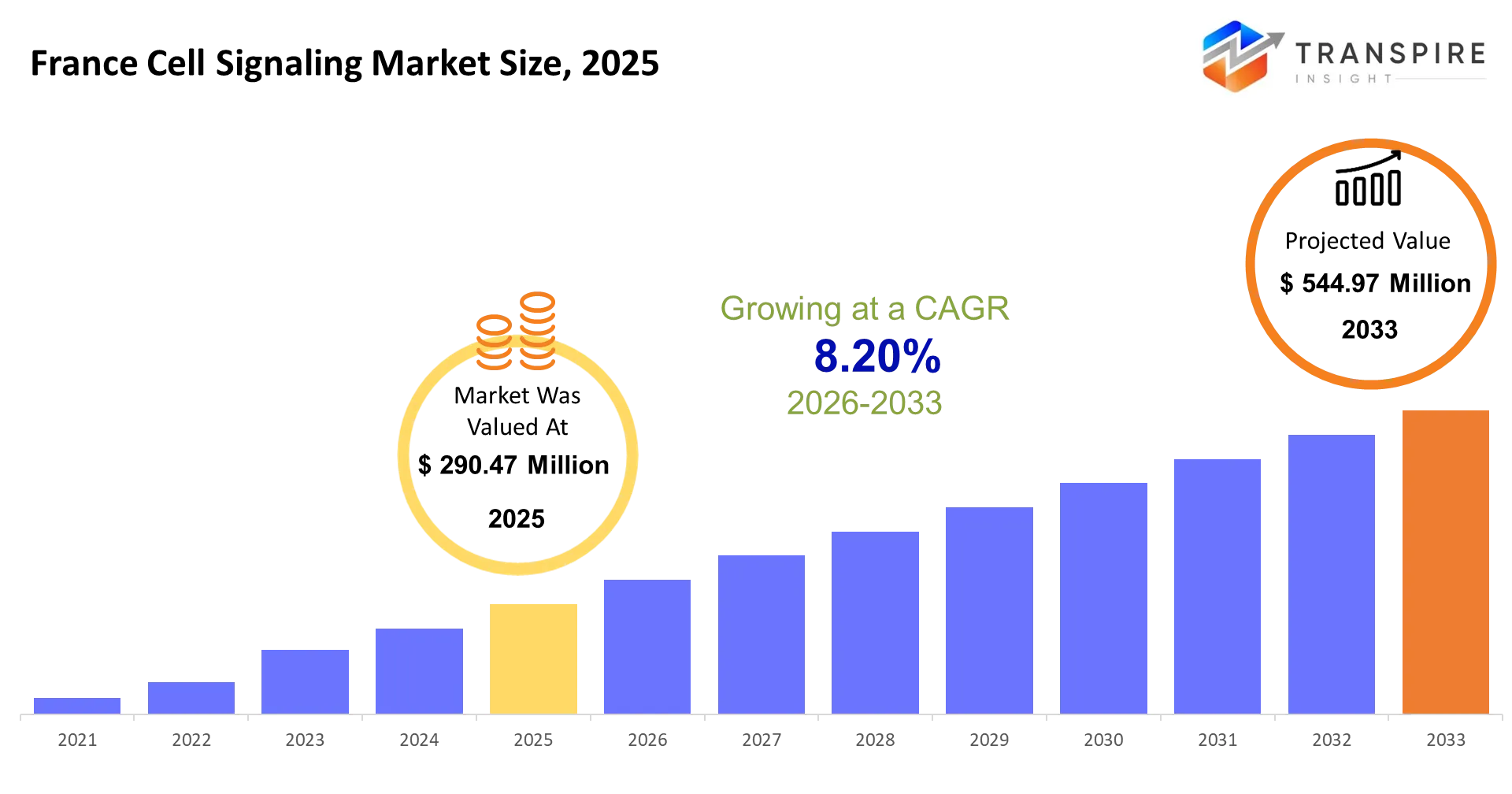
France Cell Signaling Market Size & Forecast:
- France Cell Signaling Market Size 2025: USD 290.47 Million
- France Cell Signaling Market Size 2033: USD 544.97 Million
- France Cell Signaling Market CAGR: 8.20%
- France Cell Signaling Market Segments: By Type (Reagents, Antibodies, Assay Kits, Others); By Application (Cancer Research, Drug Discovery, Immunology, Stem Cell Research, Others); By End-User (Research Institutes, Pharma Companies, Biotech Firms, Academic Institutions, Others); By Technology (Western Blotting, ELISA, Flow Cytometry, Others)
To learn more about this report,  Download Free Sample Report
France Cell Signaling Market Summary
The France Cell Signaling Market was valued at USD 290.47 Million in 2025. It is forecast to reach USD 544.97 Million by 2033. That is a CAGR of 8.20% over the period.
The France cell signaling market provides financial support to laboratory and clinical research activities which study between cell communication and their drug response and disease development mechanisms. The system enables pharmaceutical companies and biotech firms and academic institutions to discover cancer development patterns and immune defense mechanisms and develop new treatment methods. The research field impacts both the rate of drug discovery and the precision of diagnostic development which extends beyond its role as an academic research discipline.
The market experienced structural changes during the past three to five years because researchers shifted their focus from traditional manual assay methods to automated systems which use high-throughput and multiplexed testing methods. The increase in European oncology and immunology research programs which occurred after the pandemic because of expanded biomedical funding and new EU precision medicine requirements has driven this transformation. Laboratories in France needed to develop multiple supplier relationships because global reagent supply chains experienced disruptions which resulted in laboratories adopting complete digital laboratory systems. The demand for scalable data-driven cell analysis systems has increased because of their ability to enhance reproducibility while decreasing the rate of experimental failures.
Key Market Insights
- The France Cell Signaling Market depends on its strong pharmaceutical research and development base which drives both oncology and immunology research breakthroughs that will continue until 2025 and later.
- The France Cell Signaling Market operates under Western European control because France serves as a primary research center for life sciences studies that convert lab findings into practical applications.
- The demand for automated protein analysis platforms will increase at the fastest rate between 2024 and 2033 according to the forecast period.
- The product category of reagents and assay kits maintains its market leadership because researchers and diagnostic professionals use these products throughout their testing procedures.
- The market segment for instrument-based cell analysis tools maintains its position as the second-largest segment because laboratories increasingly adopt automation systems.
- The France Cell Signaling Market shows its highest market share for drug discovery applications because the industry expands its biologics and targeted treatment development programs.
- The application of biomarker identification experiences the highest growth rate because precision medicine development supports this field. Pharmaceutical and biotechnology companies remain the leading end-users with strong R&D investment capacity.
- The European Union funded molecular biology programs that academic and research institutes run show rapid growth because of their successful operations.
What are the Key Drivers, Restraints, and Opportunities in the France Cell Signaling Market?
The France cell signaling market derives its main growth force from the swift development of precise medical treatment systems which international oncology and immunology programs implement. French research institutions and pharmaceutical companies are increasingly required to validate drug mechanisms at molecular and cellular levels before clinical trials. The combination of regulatory requirements and scientific advancements has created a strong need for sophisticated signaling pathway analysis solutions which use high-throughput assays and automated imaging systems to decrease experimental differences while boosting success rates in biomedical research.
Advanced cell signaling systems require high operational costs and integration expenses which serve as a major limitation for their implementation. The budget constraints which many French mid-sized laboratories face prevent them from acquiring multiplex imaging systems and next-generation proteomics tools. The lack of unified data standards among research institutions causes interoperability issues between different platforms which results in delayed digital laboratory complete transformation and restricts research productivity during collaborative projects.
The development of AI-assisted bioinformatics platforms which will work together with existing cell signaling systems represents an upcoming business opportunity. French biotech startups together with EU-funded research clusters have increased their financial commitment towards developing machine learning models which will analyze intricate signaling networks and determine drug response patterns. AI-powered pathway modeling at Paris oncology research centers has started to decrease times needed for initial drug testing. The development of computational biology tools will enable scientists to discover biomarkers at an accelerated pace which will lead to major advancements in the creation of personalized treatment solutions.
What Has the Impact of Artificial Intelligence Been on the France Cell Signaling Market?
Artificial intelligence is increasingly transforming how cell signaling research is conducted in France by improving the speed, accuracy, and scalability of molecular analysis. The laboratory workflow now uses AI imaging systems to automatically interpret complex cell signaling assays because the system needs less human labor than traditional microscopy methods. The system enables researchers to process high-throughput experimental data more effectively because it helps them study complex signaling pathways which appear in oncology and immunology research.
Machine learning models are also being applied to predict protein interactions and signaling cascade outcomes, helping pharmaceutical researchers simulate drug responses before physical testing. The system provides predictive capabilities which enable researchers to decrease experimental rounds while reducing reagent needs and boosting efficiency during initial drug screening tests. AI integration helps research institutions achieve better data consistency while they complete their hypothesis validation work at a faster pace.
AI operates as a tool that improves laboratory productivity by determining optimal times for instrument calibration and recognizing errors within experimental data. The process of adoption still encounters various obstacles. Smaller laboratories encounter high integration costs which prevent them from adopting AI systems because those systems have difficulty handling the unpredictable nature of biological samples The existing European cell signaling research databases do not provide enough standardized training datasets which prevents models from achieving broad applicability. AI technologies continue to improve analytical precision while accelerating decision-making processes within France's cell signaling research ecosystem.
Key Market Trends
- The France Cell Signaling Market will complete its shift from manual testing methods to automated multiplex imaging systems at its primary research centers during the year 2025
- Digital laboratory platforms gained widespread adoption after 2023 because scientists needed tools that could produce consistent experimental results
- Pharmaceutical companies increased their funding for signaling pathway research to advance their biologic development programs
- European Union research programs which support precision medicine initiatives enabled French biotech companies to discover new biomarkers through their research activities
- The development of AI-based protein interaction modeling technology established a new industry standard for boosting drug screening productivity during initial research phases
- Laboratories began using multiple sources to obtain biological reagents because their supply chains faced disruptions throughout the 2022 to 2023 period
- Biotech companies and academic institutions established research partnerships to transform academic research on cell signaling into commercial products
- Oncology research now relies primarily on high-throughput screening systems which have replaced traditional small-scale testing methods
- The regulatory system which controls precision medicine needs to establish certified cell signaling measurement systems for its testing procedures.
France Cell Signaling Market Segmentation
By Type
The Reagents segment holds a strong position in the France cell signaling market because of its ongoing need for experimental procedures between drug development and disease research activities. Laboratories depend on reagents for consistent reaction environments in protein expression and cellular communication studies, which makes this category a recurring procurement component rather than a one-time purchase. The research-driven organizations maintain their primary market share through their pattern of continuous usage.
Antibodies represent a critical growth segment because of their high specificity in detecting signaling proteins involved in cancer and immunological disorders. The rising demand for validated antibody libraries is driven by the increasing emphasis on precision oncology and biomarker validation. Assay kits are experiencing rapid growth because their standardized formats create less experimental variability while enabling high-throughput screening in pharmaceutical pipelines. The "others" category which contains buffers and supporting consumables shows consistent progress although it only applies to particular research needs. The type segment currently advances toward integrated reagent-antibody-kit systems which enhance research process efficiency and consistency in research environments.
By Application
The cancer research field controls the France cell signaling market because researchers need pathway analysis to study tumor development and treatment resistance mechanisms. Pharmaceutical companies and oncology-focused institutes prioritize this application because it directly affects their ability to validate drug candidates and achieve successful clinical trials. The combination of strong government support and EU funding for oncology programs establishes its dominant position in the field.
The second most important application area for drug discovery stems from the growing need for targeted biologics and small molecule inhibitors. The field of immunology research is expanding because more people develop autoimmune diseases and vaccine development progresses in the context of post-pandemic research. The field of stem cell research shows continuous growth because academic institutions and biotechnology companies invest in regenerative medicine research. The "others" category which includes neuroscience applications now shows growth because computational biology tools have developed better pathway modeling capabilities. Applications will develop into integrated multi-disease research platforms which will replace current isolation of study areas.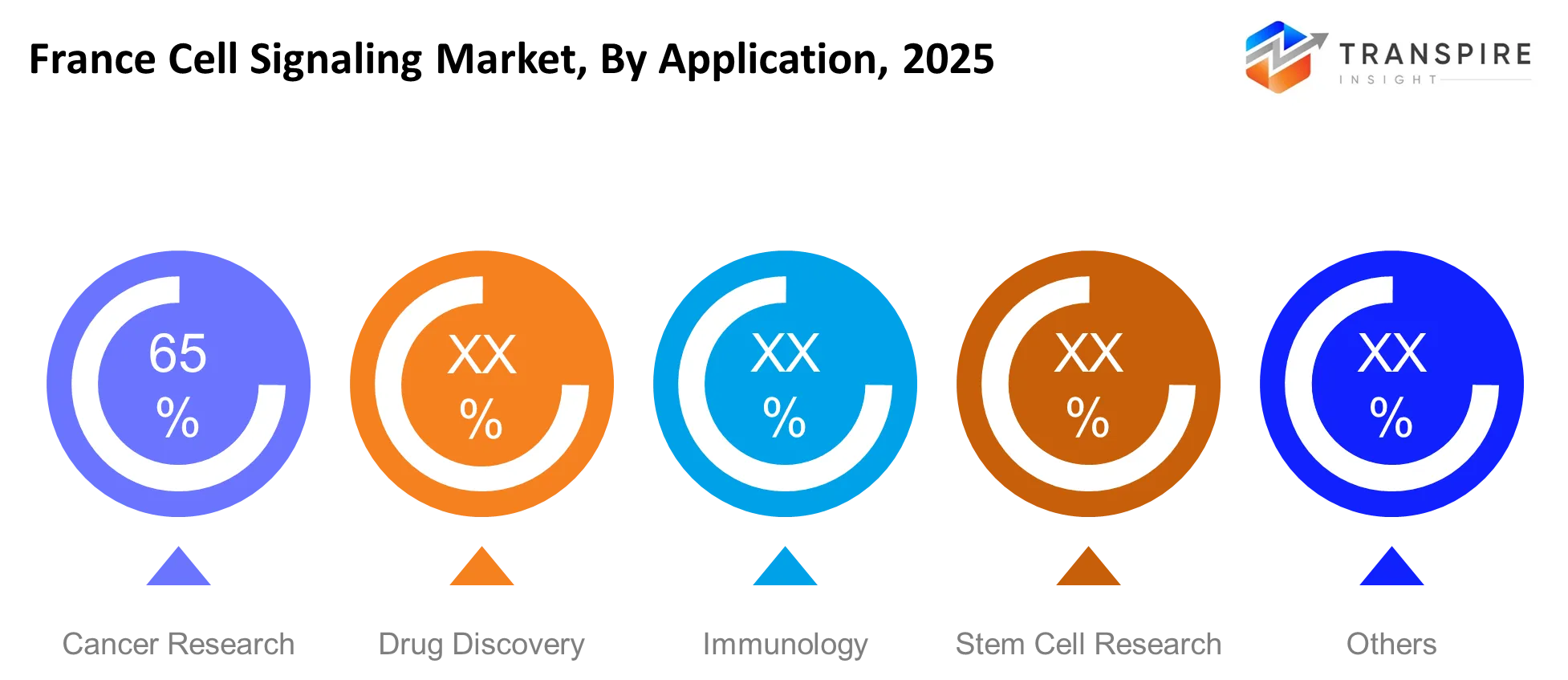
To learn more about this report, Download Free Sample Report
By End-User
The France cell signaling market depends on research institutes which function as essential research centers for both basic biological studies and government research initiatives. The institutions maintain constant needs for analytical equipment which they use to conduct pathway mapping research and investigate disease mechanisms. Their influence increases through their partnership with pharmaceutical companies and their participation in European research consortiums.
Pharmaceutical companies hold significant power in the market because their extensive drug development operations need approved signaling information for their preclinical research work. Biotechnology firms experience rapid growth because they concentrate on developing specialized therapeutic products which include gene therapy and precision medicine treatments. Academic institutions generate ongoing demand through their extensive biological research projects while the "other" category which includes clinical research organizations experiences growth because testing and validation processes are being outsourced. The end-user market is now moving toward collaborative ecosystems which enable industry partners to work together with academic institutions in order to speed up the results of translational research.
By Technology
Western blotting remains the preferred method for protein identification because it effectively detects proteins while proving their function in signaling pathways. The method has remained important because academic institutions and pharmaceutical companies use it for their testing procedures which require confirmation. The system maintains its presence because it offers simple operation and researchers have learned to use it.
The ELISA test experiences continuous growth because it enables users to test drugs and conduct immunological research with its capacity for quantitative measurement. Flow cytometry shows the fastest growth among core technologies due to its ability to analyze single-cell signaling behavior in real time which is essential for precision medicine research. The "others" category which consists of new imaging-based and multiplex technologies has become popular since laboratories started using complex screening systems. Technology adoption has progressed to automated systems which use multiple testing methods to create seamless research workflows that enhance operational speed and data precision.
What are the Key Use Cases Driving the France Cell Signaling Market?
The France cell signaling market primarily serves cancer research and drug mechanism validation in which scientists investigate tumor cell communication and their responses to targeted treatments. The main demand for this application exists because pharmaceutical companies require signaling pathway analysis to decrease late-stage drug failures and boost their chances of clinical success.
The field now extends its applications to both immunology research and neurodegenerative disease research which pharmaceutical companies and biotechnology companies primarily drive forward. The users increasingly utilize cell signaling tools to study how immune responses change and how neurons transmit information which assists their development of biologics and advanced therapy programs.
The field now develops two new applications which involve real-time single-cell signaling analysis and AI-driven pathway simulation. Academic institutes and advanced biotech startups are beginning to use these approaches to model disease progression more accurately. The upcoming applications will enhance both personalized medicine development and drug screening through predictive capabilities during the forecast period.
|
Report Metrics |
Details |
|
Market size value in 2025 |
USD 290.47 Million |
|
Market size value in 2026 |
USD 313.99 Million |
|
Revenue forecast in 2033 |
USD 544.97 Million |
|
Growth rate |
CAGR of 8.20% from 2026 to 2033 |
|
Base year |
2025 |
|
Historical data |
2021 - 2024 |
|
Forecast period |
2026 - 2033 |
|
Report coverage |
Revenue forecast, competitive landscape, growth factors, and trends |
|
Regional scope |
United States; Canada; Mexico; United Kingdom; Germany; France; Italy; Spain; Denmark; Sweden; Norway; China; Japan; India; Australia; South Korea; Thailand; Brazil; Argentina; South Africa; Saudi Arabia; United Arab Emirates |
|
Key company profiled |
Cell Signaling Technology, Thermo Fisher, Bio-Rad, Merck, Abcam, BD Biosciences, Agilent, Danaher, PerkinElmer, Miltenyi Biotec, Lonza, Qiagen, GE Healthcare, Sartorius, Promega |
|
Customization scope |
Free report customization (country, regional & segment scope). Avail customized purchase options to meet your exact research needs. |
|
Report Segmentation |
By Type (Reagents, Antibodies, Assay Kits, Others); By Application (Cancer Research, Drug Discovery, Immunology, Stem Cell Research, Others); By End-User (Research Institutes, Pharma Companies, Biotech Firms, Academic Institutions, Others); By Technology (Western Blotting, ELISA, Flow Cytometry, Others) |
Which Regions are Driving the France Cell Signaling Market Growth?
The region of Western France maintains its status as the top area because it possesses multiple pharmaceutical clusters which operate from Paris and its surrounding Île-de-France territory. The region benefits from three components which together create their research system: strong public funding for research, advanced laboratory facilities, and access to major biotech companies. The European Union establishes strict compliance standards which medical precision medicine trials must follow, thereby increasing the local requirement for advanced cell signaling systems and technologies. The primary research partnerships together with validation research which tests new products and treatments all take place in this location.
The region of southern France serves as a dependable secondary source of support while Lyon and Marseille host biotechnology parks which work together with academic hospitals to promote the regular use of analytical life science equipment. The capital region experiences faster expansion through innovation while this area develops through established industrial operations which receive backing from pharmaceutical production facilities and hospital research networks. The current situation enables organizations to keep acquiring cell signaling equipment and reagents which remain available throughout funding periods.
Northern France has become the fastest expanding area because the recent funding for biotech corridors and hospital digitization projects has led to faster technology implementation. The new funding programs together with the growth of contract research organizations will help research labs to expand their operational capabilities. The rising importance of decentralized clinical trials has created a greater demand for remote patient monitoring solutions. The period between 2026 and 2033 will create attractive market entry prospects for international suppliers who wish to establish operations in mid-sized French research environments.
Who are the Key Players in the France Cell Signaling Market and How Do They Compete?
The France cell signaling market is moderately consolidated because global life science corporations and specialized biotech suppliers control most of the market. The main factors for competition in this industry are technological advancements and precise testing capabilities and the use of digital data analysis in laboratory operations. Biotech companies with specialized products and research-focused operations face competition from established companies that use their distribution systems and existing product lines.
Thermo Fisher Scientific provides laboratory platforms that use multiple laboratory tools and software analytics together with their chemical reagents. The company achieves its competitive edge through complete workflow solutions which help maintain consistent experimental results while acquiring diagnostic companies.
Bio-Rad Laboratories develops protein analysis systems which operate with extreme accuracy together with multiplex immunoassays. The company distinguishes itself through its partnerships with academic institutions across Europe and its ongoing development of Western blot and imaging operational technologies. Merck KGaA strengthens its position through advanced reagents and cell culture systems tailored for translational research. The company uses partnerships with French biotech clusters to speed up the development of biopharmaceutical research and development work.
Abcam competes in antibody validation and protein detection markets, leveraging highly specific reagent libraries. The company expands its operations through partnerships with AI research platforms and the combination of digital catalog systems. Danaher operates its life sciences subsidiaries to develop competitive advantages through its development of automated cell analysis systems and flexible laboratory equipment which it sells to research facilities throughout Europe.
Company List
- Cell Signaling Technology
- Thermo Fisher Scientific
- Bio-Rad Laboratories
- Merck KGaA
- Abcam
- BD Biosciences
- Agilent Technologies
- Danaher
- PerkinElmer
- Miltenyi Biotec
- Lonza
- QIAGEN
- GE Healthcare
- Sartorius
- Promega
Recent Development News
In February 2025, Thermo Fisher Scientific launched an upgraded cell imaging and analysis platform designed to improve high-throughput signaling pathway research efficiency. The system enhances multi-parameter analysis speed in pharmaceutical R&D workflows.https://www.thermofisher.com (Thermo Fisher Scientific)
In September 2025, Merck KGaA expanded its European life sciences collaboration network through a strategic partnership with academic institutes in France. The initiative aims to accelerate biomarker discovery and translational medicine research.https://www.merckgroup.com (Merck KGaA)
In March 2026, Bio-Rad Laboratories introduced a next-generation multiplex assay system for protein signaling analysis. The platform is expected to improve accuracy in oncology research and reduce experimental turnaround time.https://www.bio-rad.com (Bio-Rad Laboratories)
What Strategic Insights Define the Future of the France Cell Signaling Market?
The France cell signaling market is moving toward a digitally integrated research ecosystem where AI-assisted analytics and high-throughput biological platforms define competitive advantage. Laboratories need to develop faster predictive signaling analysis tools because precision medicine requirements drive their need for improved drug development processes which enhance translational accuracy. Research institutions face a hidden danger because their need for complex digital systems will create vendor dependencies which restrict their operational capacity. If Europe fails to establish standardized interoperability protocols across its member states multiple entities will face difficulties in implementing European interoperability standards.
The real-time integration of single-cell sequencing with AI-based pathway modeling presents a new opportunity which now transforms early-stage cancer research in France. Market participants should establish their strategic focus on developing modular platforms which enable full system integration with AI bioinformatics technologies. Companies that invest early in data-standardized ecosystems will likely secure long-term institutional contracts and strengthen competitive positioning across European life sciences networks.
France Cell Signaling Market Report Segmentation
By Type
- Reagents
- Antibodies
- Assay Kits
- Others
By Application
- Cancer Research
- Drug Discovery
- Immunology
- Stem Cell Research
- Others
By End-User
- Research Institutes
- Pharmaceutical Companies
- Biotechnology Firms
- Academic Institutions
- Others
By Technology
- Western Blotting
- ELISA
- Flow Cytometry
- Others
Frequently Asked Questions
Find quick answers to common questions.
Confirmed 2033 Market size figure in USD 544.97 Million.
Key Segments for the France Cell Signaling Market are By Type (Reagents, Antibodies, Assay Kits, Others); By Application (Cancer Research, Drug Discovery, Immunology, Stem Cell Research, Others); By End-User (Research Institutes, Pharma Companies, Biotech Firms, Academic Institutions, Others); By Technology (Western Blotting, ELISA, Flow Cytometry, Others).
Major France Cell Signaling Market players are Cell Signaling Technology, Thermo Fisher, Bio-Rad, Merck, Abcam, BD Biosciences, Agilent, Danaher, PerkinElmer, Miltenyi Biotec, Lonza, Qiagen, GE Healthcare, Sartorius, Promega.
The Current France Cell Signaling Market size is USD 290.47 Million in 2025.
The France Cell Signaling Market CAGR is 8.20% from 2026 to 2033.
- Cell Signaling Technology
- Thermo Fisher Scientific
- Bio-Rad Laboratories
- Merck KGaA
- Abcam
- BD Biosciences
- Agilent Technologies
- Danaher
- PerkinElmer
- Miltenyi Biotec
- Lonza
- QIAGEN
- GE Healthcare
- Sartorius
- Promega
Recently Published Reports
-
Apr 2026
Cord Blood Banking Services Market
Cord Blood Banking Services Market Size, Share & Analysis Report By Type of Service (Collection, Processing, Storage), By Bank Type (Private Banks, Public Banks, and Hybrid Banks), By Component (Cord Blood, and Cord Tissue), By End User (Hospitals, Research Institutions, Biotechnology Companies, and Others) and Geography (North America, Europe, Asia-Pacific, Middle East and Africa, South and Central America), 2021 - 2031
-
Apr 2026
ELISA Processors Market
ELISA Processors Market Size, Share & Analysis Report By Type (Optical Filter ELISA Analyzer, and Optical Grating ELISA Analyzers), By Mode (Automated ELISA Analyzers, and Semi-Automated ELISA Analyzers), By Applications (Immunology, Vaccine development, Drug Monitoring, and Others), By End Users (Biotechnology Companies, Pharmaceutical Companies, Contract Research Organization, and Diagnostic Laboratories) and Geography (North America, Europe, Asia-Pacific, Middle East and Africa, South and Central America), 2021 - 2031
-
Apr 2026
Microscope Slide Scanner Market
Microscope Slide Scanner Market Size, Share & Analysis Report By Type (Portable Microscope Slide Scanner, and Desktop Microscope Slide Scanner), By Application (Biological Research, Medicine, Veterinary, and Other) and Geography (North America, Europe, Asia-Pacific, Middle East and Africa, South and Central America), 2021 - 2031
-
Apr 2026
Microwave Cookware Market
Microwave Cookware Market Size, Share & Analysis Report By Material Type (Plastic, Glass, Ceramic, Silicone, and Metal), By Application (Cooking, Reheating, and Defrosting), By End User (Household, Commercial (Restaurants, Hotels, and Cafes), and Food Service Industry), By Sales Channel (Online Retail, Offline Retail (Supermarkets, Hypermarkets, Specialty Stores), and Direct Sales (Company Outlets)) and Geography (North America, Europe, Asia-Pacific, Middle East and Africa, South and Central America), 2021 - 2031