

North America Life Science Consumables Market Summary
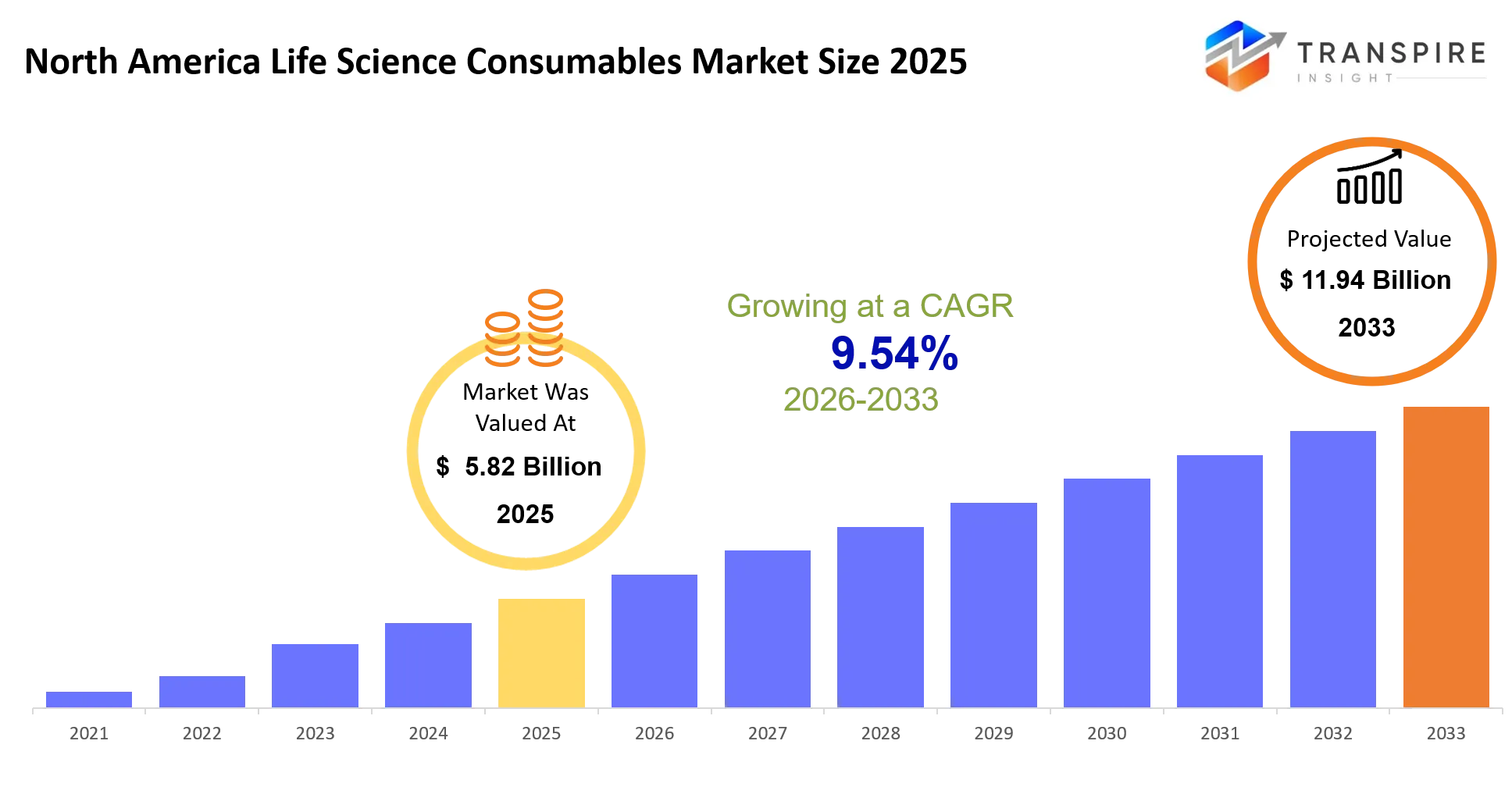
As per Transpire Insight Analysis the North America Life Science Consumables Market size is estimated at USD 5.82 Billion in 2025 and is anticipated to reach USD 11.94 Billion by 2033, growing at a CAGR of 9.54% from 2026 to 2033.
The North America Life Science Consumables Market provides the critical materials that keep research labs , pharmaceutical production areas , clinical diagnostics facilities, and biotech companies going without any real interruptions. You know the kinds of items , reagents, assay kits, culture media, pipette tips, filters, plus lab plastics , they help people run precise testing, achieve repeatable experiments and maintain steady manufacturing. So they become almost a must have across drug discovery, disease investigation, and quality control.
Over the last five years, things kinda moved , toward automated, high throughput laboratory routines. Because of that, more laboratories are now leaning into consumables made to work smoothly with robotic setups and digital lab platforms. Then the COVID-19 pandemic really showed where the global supply chains were weak. It also sped up funding for regional manufacturing and better inventory resilience, so shipments don’t stall unexpectedly.
And as research pipelines broaden, plus precision medicine programs mature, labs end up needing bigger quantities of specialized consumables. That creates ongoing reorder cycles which , in turn, supports supplier income while also helping science advance faster and making day to day lab operations more efficient.
North America Life Science Consumables Market Size & Forecast:
- North America Life Science Consumables Market Size 2025: USD 5.82 Billion
- Expected Market Value 2033: USD 11.94 Billion
- Forecast CAGR: 9.54%
- Leading region in 2025: United States
- Fastest Growing region: Canada
- Key Profile: Thermo Fisher Scientific, Danaher, Agilent Technologies, Merck KGaA, Sartorius, Corning, Eppendorf, Bio-Rad Laboratories, Cytiva, Avantor, PerkinElmer, Promega, Waters Corporation, QIAGEN, VWR International
Key Market Insights
- In 2025, the United States pretty much dominated the market with around 84% share, pushed along by upgraded biotechnology infrastructure, serious pharmaceutical investment and strong laboratory procurement budgets.
- Canada should come through as the fastest-growing regional market during 2025–2033, mostly because life science research funding is widening, and biomanufacturing capacity is also getting more attention.
- When it comes to product splits, reagents and assay kits led the way in 2025, holding close to a 42% share . This is mainly tied to molecular testing, and drug discovery needs ongoing “refill” cycles.
- Laboratory plasticware stayed as the second-largest segment, since high-throughput labs still keep swapping out single-use consumables to keep contamination-free workflows intact , and moving.
- Cell culture consumables are projected to see the fastest expansion up to 2033, supported by increased biologics output and extra momentum in regenerative medicine research, broadly speaking.
- For application , drug discovery plus development accounted for about 38% market share in 2025, and that seems to match the ongoing spend on pharmaceutical innovation, as well as translational research efforts.
- Clinical diagnostics is expected to become the fastest-growing application by 2033, helped by wider molecular diagnostics uptake and personalized medicine programs that keep rolling along.
- On end user demand , pharmaceutical and biotechnology firms led in 2025 with close to 46% share, fueled by nonstop research, plus manufacturing practices and quality assurance routines .
- Finally, contract research organizations , also known as CROs, are expected to grow fastest as outsourcing partnerships spread further across the forecast period .
What are the Key Drivers, Restraints, and Opportunities in the North America Life Science Consumables Market?
The main growth driver is, honestly, the fast scale up of biologics, cell therapy, and precision medicine R&D. On top of that, investments in automation plus regulators that keep insisting on repeatable lab workflows has pushed labs to try and standardize better quality consumables across both research and manufacturing. Every time a new clinical study starts, or an analytical test gets planned, or a production batch gets kicked off, fresh reagents show up, along with filtration products and those lab plastics. This repetitive buying loop turns what looks like “research spend” straight into reliable consumable revenue while also lifting lab output and keeping experiments more consistent
Still, the biggest structural restraint is the fact that supply chains can get too concentrated for specialized raw inputs and high-spec manufacturing. A lot of these consumables rely on already validated production locations, and they also need strict quality certification. Because of that, supplier diversification tends to move slowly, and it is capital intensive too. Requalification can take months and it typically demands regulatory paperwork before a lab is willing to even try alternatives. From the Transpire Insight review of regional procurement notices and regional launch schedules, this supply concentration is still the leading execution risk. So you end up with delayed shipments, stalled research programs, and commercial product launches that get pushed out, all of which ends up shrinking annual revenue chances
A big opportunity seems to sit inside AI enabled labs, and also in growing domestic biomanufacturing across North America. Public investment and private backing keeps rolling into advanced production sites, genomic medicine, and automated research platforms , as if they never stop. These laboratories do end up needing high quality consumables that are meant for robotic setups and digital quality surveillance. So suppliers that can bring an all-in-one automation ready range of products, plus localized manufacturing capabilities, will probably be the ones best placed to snag the next phase of this industry growth.
What Has the Impact of Artificial Intelligence Been on the North America Life Science Consumables Market?
Artificial intelligence plus digital laboratory technologies are quietly reshaping life science consumable sourcing, inventory supervision, and quality governance across lots of North American research groups. AI platforms are constantly watching inventory levels, day to day lab workflows, and reagent usage, then they nudge replenishment orders out automatically before critical materials actually run short. On the compliance side digital systems also log batch histories, expiry dates, and regulatory paperwork with more precision, so the teams spend less time doing repetitive admin stuff, and more time on bench work.
Machine learning, meanwhile, makes demand forecasting kind of sharper by looking at older consumption rhythms , clinical trial schedules, manufacturing throughput and even seasonal lab busyness. Those predictive abilities let suppliers tune their production planning, and they also assist laboratories to keep the right inventory level without ending up with excess stock just sitting there. A lot of organizations talk about real numbers, for instance less procurement delays , reduced holding expenses and better operational efficiency when automated planning is running. Digital twins with predictive analytics also help manufacturers schedule better for laboratory consumables, which supports higher equipment use and steadier product availability.
Even so, AI adoption is not fully smooth because the integrations can be kind of complex. Many labs still rely on older information systems, and those can be tricky to connect or they can not easily share standardized data with newer AI platforms. Plus implementation costs can feel steep, datasets often end up fragmented, and validation needs are strict. That all slows deployment, especially inside regulated research environments, where algorithm decisions must be backed by documented proof before they are allowed to affect operational choices.
Key Market Trends
- Since 2022 , laboratories have really moved quicker into automation compatible consumables to back robotic liquid handling and faster high-throughput analytical workflows , even when day to day setups get a bit complex.
- Between 2021 and 2025 , regional manufacturing investments picked up after pandemic interruptions, which helped supply chains stay steadier, and also reduced reliance on production overseas.
- In cell and gene therapy research the demand for premium cell culture consumables has climbed , so suppliers have been rolling out more specialized product portfolios through 2025 .
- Starting in 2023, pharmaceutical companies more often locked in long term procurement agreements, mainly to stabilize pricing and keep laboratory supply continuity smoother, across multiple sites.
- After 2022 , digital laboratory management platforms became more normal, supporting automated inventory oversight and even predictive procurement across research organizations , not just on pilot programs.
- Thermo Fisher Scientific and Danaher Corporation also expanded manufacturing investments to match the rising regional needs for lab consumables and bioprocess materials.
- Since 2023 sustainability efforts have pushed manufacturers to offer recyclable laboratory plastics and cut packaging waste , while still staying aligned with regulatory compliance requirements.
- Clinical diagnostics laboratories ramped up molecular testing capabilities after 2021 , and that has translated into more recurring purchases for assay kits, reagents , and filtration products.
- Meanwhile, contract research organizations strengthened outsourcing relationships through 2024 and 2025 , which opened up broader procurement channels for suppliers of specialized consumables.
North America Life Science Consumables Market Segmentation
By Product Type:
Laboratory reagents still take the biggest slice, mostly because ongoing research, clinical testing, and pharmaceutical development depend on steady access to top-tier chemicals and biological inputs. Everyday bench work tends to repeat itself, so there are repeat buys, which makes this segment kind of reliable for revenue. Cell culture consumables keep getting bigger too , since biologics, regenerative medicine, and vaccine programs keep rolling forward across North America. Even pipettes and tips stay in high demand, since both automated setups and everyday manual workflows rely on precise liquid handling, pretty much no matter what.
Microplates help with high-throughput screening and diagnostic tasks, letting labs run many samples at once with improved efficiency. Filtration consumables keep spreading as quality expectations become more strict, especially inside research and manufacturing sites. Tubes and vials remain crucial for secure sample storage, shipping, and lab testing, while laboratory glassware is still useful for more specialized analytical uses. And then other consumables will back smaller, niche laboratory operations, supporting a more balanced product mix across research and healthcare environments.
By Application :
Drug discovery is probably the biggest usage case , mainly because pharma companies keep stretching their research pipelines for new treatments and biologic medicines. In practice, ongoing lab testing turns into those repeat buys , think reagents, assay kits, and all the supporting consumables. Also molecular biology is pretty strong, since genetic testing and biomarker analysis keep showing up more often at research institutions. Cell biology sees solid benefit too, as regenerative medicine work goes on, plus advanced therapeutic development keeps moving forward.
Clinical diagnostics should keep growing as molecular testing becomes more common, and personalized healthcare services get wider adoption. Genomics research, along with proteomics research , tends to need very specific consumables that can produce dependable , and repeatable lab outputs. On the manufacturing side biopharmaceutical production keeps reinforcing long term purchasing, because production workflows depend on validated materials during the full run. Beyond that, other applications will still bring steadier demand from niche research teams and industrial laboratory operations.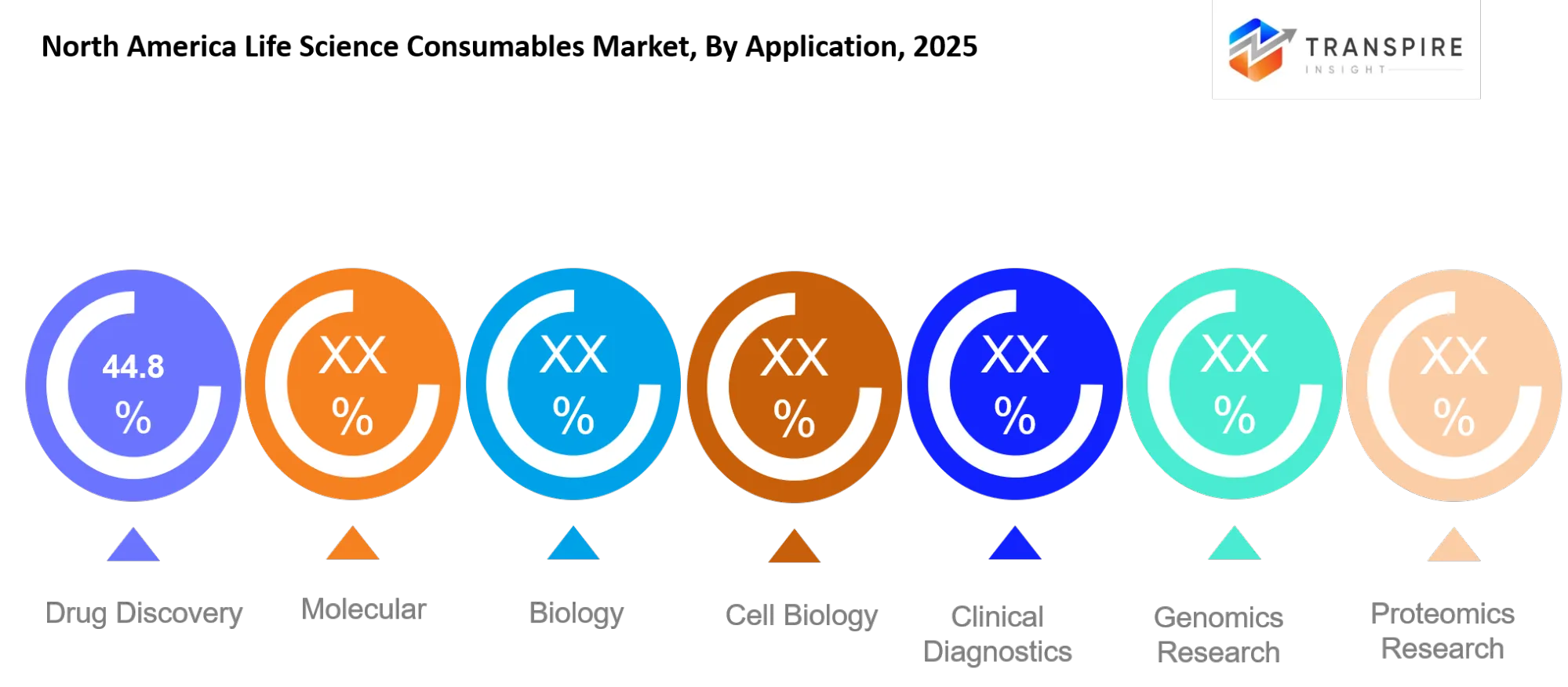
By End User :
Pharmaceutical firms kinda sit right at the top as the main end-user group because drug development programs do need nonstop lab testing, plus pretty strict quality control, all the time. With big research budgets they end up doing repeated buys of consumables across several development phases. Biotechnology companies create even more purchasing volume too, mostly due to new work in biologics, gene therapy , and cell based research. Academic research institutes keep fairly steady demand since many activities are pushed by publicly funded scientific work and university labs, you know that sort of thing.
Meanwhile contract research organizations keep growing since pharmaceutical companies outsource work to boost efficiency and also shrink development timelines. Clinical laboratories tend to buy large quantities of consumables, for diagnostic testing and regular sample analysis, every day. Hospitals and government research organizations strengthen the market push via public health initiatives and medical research programs. Other end users will add extra revenue through niche laboratory and industrial applications, alongside those bigger groups.
By Distribution Channel :
Direct sales still seems like the main distribution route because big pharma companies, plus research organizations, usually want customized purchasing terms, and they also need solid technical support that doesn't wobble when timelines get tight. Long run supply contracts help keep product availability steady and also lock in pricing patterns for high-volume buyers. Laboratory distributors matter a lot too, they bring a wide selection of products and they tend to have regional delivery reach, which is kind of the point. Online scientific suppliers keep growing by using handy digital ordering portals , along with quicker ways to compare items side by side.
Government procurement backs public labs, healthcare institutions, and national research initiatives via more structured buying pathways. Research supply vendors often provide specialized goods for advanced lab use, where technical know-how really counts. Specialty dealers usually zero in on niche lab needs, plus higher value consumable lines , and they offer more direct customer care. Other distribution pathways will keep moving for smaller laboratories and those particular buying requirements across the broader regional market.
By Workflow :
Research applications count as the largest workflow, because scientific studies call for constant use of laboratory supplies during all kinds of experimental processes. Ongoing testing tends to repeat purchasing routines across pharmaceutical, biotech, and academic labs too, even when timelines change a bit. Diagnostic testing also becomes a major workflow, since healthcare facilities carry out huge amounts of molecular and clinical laboratory tests each day. Quality control work keeps demand stable, by backing regulatory adherence and manufacturing steadiness.
Bioprocessing keeps getting bigger as investment rises in biologics and more advanced therapeutic production. Sample preparation, plus analytical testing, needs dependable consumables to keep lab results consistent, and to keep research outcomes reliable. Day to day laboratory operations generate steady revenue, largely because routine testing relies on frequent replacement of key materials. The other workflow types will still back specialized laboratory methods, and they’ll open up more chances for product suppliers, in general.
What are the Key Use Cases Driving the North America Life Science Consumables Market?
Pharmaceutical companies create the biggest portion of what they buy repeatedly, mainly consumables, using drug discovery programs that basically force constant lab checking. So there’s compound screening, validation, and then more testing, like all the time. The research teams keep ordering things such as reagents, assay kits, cell culture supplies, and even lab plastics in repeated cycles, because each experiment really leans on fresh, quality checked materials that also satisfy regulatory expectations.
Meanwhile clinical laboratories and biotechnology firms keep pushing consumable usage upward for molecular diagnostics, genomic analysis, and biologics research. Contract research organizations follow that trend too, their procurement increases as outsourced development programs keep expanding. This ends up generating steady demand for standardized items that give reliable, repeatable laboratory outputs across more than one client engagement.
More recently there are also emerging opportunities in cell and gene therapy manufacturing, along with advanced precision medicine initiatives. Those programs call for specialized consumables, the sort that fit automated lab setups and controlled production environments. Regulatory requirements around traceability and contamination control should help adoption grow, especially as commercial production keeps rolling forward during the forecast period.
|
Report Metrics |
Details |
|
Market size value in 2025 |
USD 5.82 Billion |
|
Market size value in 2026 |
USD 6.31 Billion |
|
Revenue forecast in 2033 |
USD 11.94 Billion |
|
Growth rate |
CAGR of 9.54% from 2026 to 2033 |
|
Base year |
2025 |
|
Historical data |
2021 - 2024 |
|
Forecast period |
2026 - 2033 |
|
Report coverage |
Revenue forecast, competitive landscape, growth factors, and trends |
|
Regional scope |
North America (Canada, The United States, and Mexico) |
|
Key company profiled |
Thermo Fisher Scientific, Danaher, Agilent Technologies, Merck KGaA, Sartorius, Corning, Eppendorf, Bio-Rad Laboratories, Cytiva, Avantor, PerkinElmer, Promega, Waters Corporation, QIAGEN, VWR International . |
|
Customization scope |
Free report customization (country, regional & segment scope). Avail customized purchase options to meet your exact research needs. |
|
Report Segmentation |
By Product Type (Laboratory Reagents, Cell Culture Consumables, Pipettes & Tips, Microplates, Filtration Consumables, Tubes & Vials, Laboratory Glassware, Others); By Application (Drug Discovery, Molecular Biology, Cell Biology, Clinical Diagnostics, Genomics Research, Proteomics Research, Biopharmaceutical Production, Others); By End User (Pharmaceutical Companies, Biotechnology Companies, Academic Research Institutes, CROs, Clinical Laboratories, Hospitals, Government Research Organizations, Others); By Distribution Channel (Direct Sales, Laboratory Distributors, Online Scientific Suppliers, Government Procurement, Research Supply Vendors, Specialty Dealers, Others); By Workflow (Research Applications, Diagnostic Testing, Quality Control, Bioprocessing, Sample Preparation, Analytical Testing, Routine Laboratory Operations, Others) |
Which Regions are Driving the North America Life Science Consumables Market Growth?
The United States still feels like the main regional market, with an estimated 84% slice of total revenue, basically. Strong regulatory supervision, lots of research funding and pretty advanced lab infrastructure make it easier for consumables to keep getting bought again and again. Big pharmaceutical companies, biotechnology firms, academic groups, plus domestic production facilities help build a steady supply network across the country. And even with the forecast moving forward, continued spending on precision medicine, biologics production, and laboratory automation should keep the United States in the leadership position.
Canada comes in as the second-largest regional market. This is mostly due to steady public research money, and also healthcare policies that stay consistent, which in turn backs long-term lab investment. National research initiatives, along with teaming up between universities and biotechnology companies, lead to purchasing cycles that are more predictable for laboratory supplies. With a stable regulatory structure in place, manufacturers can broaden operations while still meeting dependable product quality and compliance standards. So, even if Canada has a smaller research base than the United States, these setup advantages help Canada remain a dependable source of recurring revenue.
Canada is also projected to see the quickest growth between 2026–2033, and this is mostly because recent investments in biomanufacturing spaces and life science innovation are speeding up lab expansion. At the same time, government backing for homegrown production capabilities, plus more emphasis on advanced therapeutic research, has driven higher procurement of specialized consumables across a range of scientific disciplines. Meanwhile, more automation is being added into research labs, which further boosts demand for products made for high throughput workflows . Overall, this momentum should open up solid opportunities for manufacturers, distributors, and tech oriented suppliers who are looking for long term regional growth.
Who are the Key Players in the North America Life Science Consumables Market and How Do They Compete?
Competition stays kinda consolidated, because a set of global manufacturers still control a large slice of premium lab consumables, while there are also specialist suppliers who go after narrower , targeted product types. In practice purchasing isn't decided by price alone. Technology progress, product dependability , regulatory conformity and solid dependable supply chain handling weigh more for many buyers. Bigger firms keep pushing ahead by doing manufacturing expansion, bringing in digital lab solutions and widening their product portfolio. Smaller companies tend to counter by focusing on specialized applications,plus offering more responsive customer service.
Thermo Fisher Scientific stands out with a broad range of offerings across research , diagnostics and bioprocessing so laboratories can buy several consumables from one vendor. It keeps putting money into manufacturing capacity and automation-ready laboratory products, which helps keep relationships stable over time. Danaher Corporation leans into tech-forward laboratory systems, where consumables are paired with analytical instruments. This boosts workflow efficiency and typically supports repeat buying. Merck KGaA grows its advanced cell culture and bioprocessing assortment, to better support biologics production so customers get access to specialized options suited for regulated manufacturing settings.
Bio-Rad Laboratories builds a kind of competitive edge by using molecular biology plus diagnostic consumables, made for high analytical accuracy and lab performance that stays repeatable, even when people rush. They also do those regular product launches so labs can move toward newer testing methods without really upsetting what they already run day to day. Then there’s Corning Incorporated, which leans more into premium cell culture technologies along with laboratory plastics that help support advanced research use cases, and the ongoing manufacturing investments make sure items are more reliably in stock. Put together, these approaches mean suppliers try to win with innovation, quality assurance, and specialized scientific capabilities, not mainly by racing on price.
Company List
Merck KGaA
Corning
Eppendorf
Bio-Rad Laboratories
Cytiva
Avantor
PerkinElmer
Promega
Waters Corporation
QIAGEN
VWR International
Recent Development News
In June 2026, Merck KGaA agreed to acquire Bio-Techne for approximately US$11.3 billion. The acquisition will expand Merck's portfolio in research reagents, antibodies, proteins, and advanced life science consumables, strengthening its position in cell and gene therapy and precision diagnostics. Sourcehttps://www.merckgroup.com/
In September 2025, Merck KGaA and Siemens extended their strategic partnership through a new memorandum of understanding to accelerate AI and data-driven drug discovery. The collaboration strengthens digital laboratory capabilities and supports more efficient development workflows that increase demand for advanced life science consumables.
Source https://www.sigmaaldrich.com/
What Strategic Insights Define the Future of the North America Life Science Consumables Market?
The North America Life Science Consumables Market will shift toward more automated and digitally connected laboratory ecosystems where the repeat purchase isn’t just about picking one item at a time, instead it depends on workflow integration, kind of quietly. As biologics keep expanding, along with cell and gene therapy manufacturing and precision medicine initiatives, long term buying habits should stay steadier, and suppliers are likely to push out specialized consumables that are compatible with automation, not only standard formats.
There’s also a risk that might be a bit less noticeable at first: key raw materials and qualified manufacturing sites can get concentrated, and that situation can mess with supply continuity even if most market indicators look upbeat. Meanwhile, a fresh opportunity is forming around consumables made for AI-enabled laboratories and advanced robotic platforms, especially when new biomanufacturing investments ramp up across Canada and the United States.
Market players should gain by building out regional production capacity, diversifying supplier networks, and funding digitally integrated product portfolios, so traceability improves, regulatory compliance becomes easier to maintain, and compatibility with next-generation laboratory workflows stays strong. In the end, that approach supports better competitive positioning throughout the forecast period, with fewer surprises in day-to-day operations.
North America Life Science Consumables Market Report Segmentation
By Product Type
- Laboratory Reagents
- Cell Culture Consumables
- Pipettes & Tips
- Microplates
- Filtration Consumables
- Tubes & Vials
- Laboratory Glassware
By Application
- Drug Discovery
- Molecular Biology
- Cell Biology
- Clinical Diagnostics
- Genomics Research
- Proteomics Research
- Biopharmaceutical Production
By End User
- Pharmaceutical Companies
- Biotechnology Companies
- Academic Research Institutes
- CROs
- Clinical Laboratories
- Hospitals
- Government Research Organizations
By Distribution Channel
- Direct Sales
- Laboratory Distributors
- Online Scientific Suppliers
- Government Procurement
- Research Supply Vendors
- Specialty Dealers
By Workflow
- Research Applications
- Diagnostic Testing
- Quality Control
- Bioprocessing
- Sample Preparation
- Analytical Testing
- Routine Laboratory Operations
Frequently Asked Questions
Find quick answers to common questions.
The Expected North America Life Science Consumables Market size for the Market will be USD 11.94 Billion in 2033.
Key Segments for the North America Life Science Consumables Market are By Product Type (Laboratory Reagents, Cell Culture Consumables, Pipettes & Tips, Microplates, Filtration Consumables, Tubes & Vials, Laboratory Glassware, Others); By Application (Drug Discovery, Molecular Biology, Cell Biology, Clinical Diagnostics, Genomics Research, Proteomics Research, Biopharmaceutical Production, Others); By End User (Pharmaceutical Companies, Biotechnology Companies, Academic Research Institutes, CROs, Clinical Laboratories, Hospitals, Government Research Organizations, Others); By Distribution Channel (Direct Sales, Laboratory Distributors, Online Scientific Suppliers, Government Procurement, Research Supply Vendors, Specialty Dealers, Others); By Workflow (Research Applications, Diagnostic Testing, Quality Control, Bioprocessing, Sample Preparation, Analytical Testing, Routine Laboratory Operations, Others).
Major North America Life Science Consumables Market Players are Thermo Fisher Scientific, Danaher, Agilent Technologies, Merck KGaA, Sartorius, Corning, Eppendorf, Bio-Rad Laboratories, Cytiva, Avantor, PerkinElmer, Promega, Waters Corporation, QIAGEN, VWR International.
The Current North America Life Science Consumables Market size is USD 5.82 Billion in 2025.
The North America Life Science Consumables Market CAGR is 9.54% from 2026 to 2033.
Thermo Fisher Scientific
Danaher
Agilent Technologies
Merck KGaA
Sartorius
Corning
Eppendorf
Bio-Rad Laboratories
Cytiva
Avantor
PerkinElmer
Promega
Waters Corporation
QIAGEN
VWR International
About the Authors

Pankaj Ghogare Patil
I am Pankaj Ghogare Patil, a Senior Research Analyst at Transpire Insight, specializing in the Pharmaceutical, Chemicals & Materials, Healthcare IT, and Biotechnology industry. My expertise lies in conducting comprehensive market research, analyzing industry trends, evaluating competitive landscapes, and translating complex data into actionable insights. At Transpire Insight, I closely follow emerging technologies, regulatory developments, and market innovations to create accurate, well-researched, and informative content that helps businesses and professionals make informed decisions. I am committed to producing credible, evidence-based articles that reflect industry best practices while making technical topics accessible and valuable for a broad audience.

Chakradhar Khansole
Chakradhar serves as the Research Director at Transpire Insight, bringing over 8 years of experience in technology, innovation, and strategic market intelligence. He specializes in transforming complex market data into actionable business insights that enable organizations to make informed, growth-oriented decisions. Recognized for his strategic vision and analytical expertise, Chakradhar leads high-impact research initiatives, delivering comprehensive market assessments, competitive intelligence, and forward-looking industry analysis.
Recently Published Reports
-
Jul 2026
Alopecia Treatment Market
Alopecia Treatment Market Size, Share & Analysis Report By Disease Type (Alopecia Areata, Cicatricial Alopecia, Traction Alopecia, Alopecia Totalis, Androgenetic Alopecia, Alopecia Universalis, and Other Disease Types), By Treatment Type (Topical Treatments, Oral Medications, Injectable Therapies, and Hair Transplantation), By Gender (Male, and Female), By Distribution Channel (Hospitals and Clinics, Retail Pharmacies, and Online Retailers), and Geography (North America, Europe, Asia-Pacific, Middle East and Africa, South and Central America), 2021 - 2031
-
Jul 2026
Medical Ultrasound Probe Market
Medical Ultrasound Probe Market Size, Share & Analysis Report By Type (Linear Type, Convex Type, Endocavitary Probe, Phased Array/Cardiac Probe, Transesophageal (TEE) Probe, and Others), By Application (Ophthalmology, Cardiology, Musculoskeletal, Oncology, Obstetrics & Gynecology, General Imaging, and Others), By End User (Hospitals & Clinics, Diagnostic Centers, Ambulatory Surgical Centers, and Others), and Geography (North America, Europe, Asia-Pacific, Middle East and Africa, South and Central America), 2021 – 2031
-
May 2026
Biosimilars Market
Biosimilars Market By Product Type (Monoclonal Antibodies, Recombinant Hormones, Erythropoietin, G-CSF, Others), By Indication (Oncology, Autoimmune Diseases, Blood Disorders, Diabetes, Others), By Manufacturing Type (In-House Manufacturing, Contract Manufacturing), By Distribution Channel (Hospital Pharmacies, Retail Pharmacies, Online Pharmacies), By Industry Analysis, Size, Share, Growth, Trends, and Forecasts 2021-2033
-
Apr 2026
Gastrointestinal Endoscopy Market
Gastrointestinal Endoscopy Market By Type (Rigid Gastrointestinal Endoscope, Flexible Gastrointestinal Endoscopes, Disposable Gastrointestinal Endoscope), By Procedure Type (Colonoscopy, Gastroscopy, Duodenoscopy, Enteroscopy, Flexible Sigmoidoscopy, Others), By Application (Diagnosis, Treatment), By End-Users (Hospitals, Ambulatory Surgical Centers, Specialty Clinics, Laboratories, Others), By Industry Analysis, Size, Share, Growth, Trends, and Forecasts 2021-2033