

North America Levofloxacin Market Size & Forecast
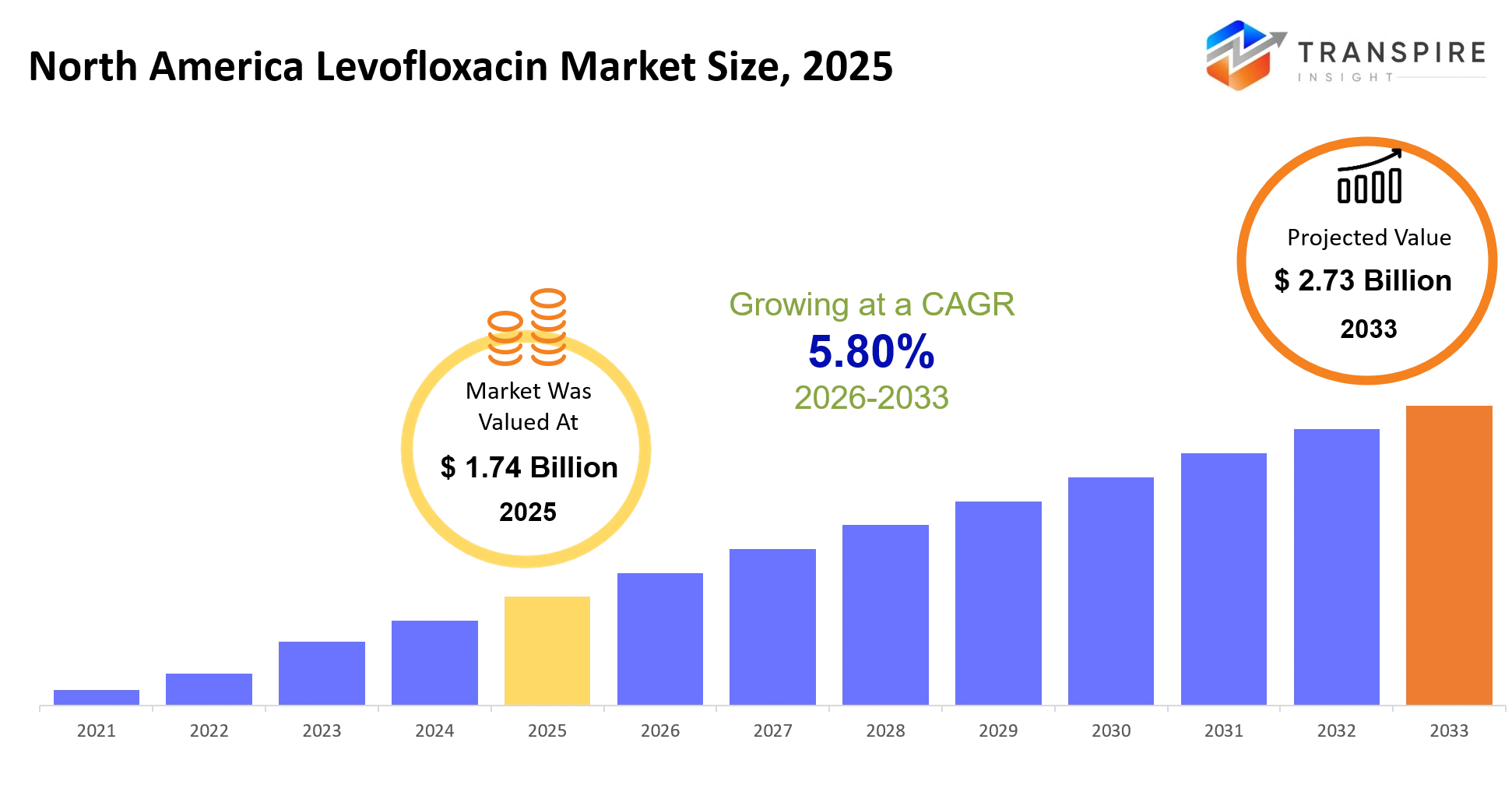
- North America Levofloxacin Market Size 2025: USD 1.74 Billion
- North America Levofloxacin Market Size 2033: USD 2.73 Billion
- North America Levofloxacin Market CAGR: 5.80%
- Primary Segment: By Dosage Form (Tablets, Injectable Solutions, Oral Solutions, Extended-Release Tablets, Generic Formulations, Branded Products, Combination Products, Others); By Application (Respiratory Tract Infections, Urinary Tract Infections, Skin Infections, Prostatitis, Gastrointestinal Infections, Anthrax Treatment, Hospital-Acquired Infections, Others); By Route of Administration (Oral, Intravenous, Combination Therapy, Hospital Administration, Prescription Products, Customized Dosing, Long-Term Therapy, Others); By End User (Hospitals, Clinics, Retail Pharmacies, Online Pharmacies, Long-Term Care Centers, Homecare, Academic Hospitals, Others); By Distribution Channel (Hospital Pharmacies, Retail Pharmacies, Online Pharmacies, Drug Stores, Direct Sales, Medical Distributors, Government Supply, Others).
North America Levofloxacin Market Summary
Levofloxacin i s a broad spectrum fluoroquinolone antibiotic used for bacterial infections in respiratory , urinary, gastrointestinal, and skin. In North America, you can spot it in tablets , oral solutions, injections, and extended release forms, and it kinda moves through hospitals, retail pharmacies, plus online channels. Back in 2025 it is valued around USD 1.74 billion, and by 2033 it is expected to climb to roughly USD 2.73 billion with about a 5.80% CAGR. This growth looks mostly tied to changing resistance patterns , shifts in clinical practice guidelines, and the way generic competition rewires what people end up buying.
A big structural shift appeared to land between 2020 and 2022. Community acquired pneumonia treatment approaches gradually turned away from older macrolide antibiotics and leaned more toward fluoroquinolones , partly because the published evidence showed improved clinical outcomes for outpatient respiratory infection management. At the same time, the COVID-19 pandemic led to more secondary bacterial infections in hospitalized patients , so levofloxacin usage went up in inpatient settings.
That upswing didn’t just fade. It keeps showing up in 2024 and 2025 via two things. First, generic erosion from Sun Pharma, Dr. Reddy’s, Lupin, and Cipla has squeezed branded pricing, which lowers the per unit cost barrier and makes distribution easier through retail. Second, resistance to older antibiotics keeps rising in uncomplicated urinary tract infections and skin infections, so treatment pathways still steer toward fluoroquinolones even with the well known black box warnings related to tendon rupture and CNS effects. So overall , you end up with a market where unit growth is fairly modest, but generic share keeps expanding, and that keeps lifting total category revenue.
Key North America Levofloxacin Market Insights
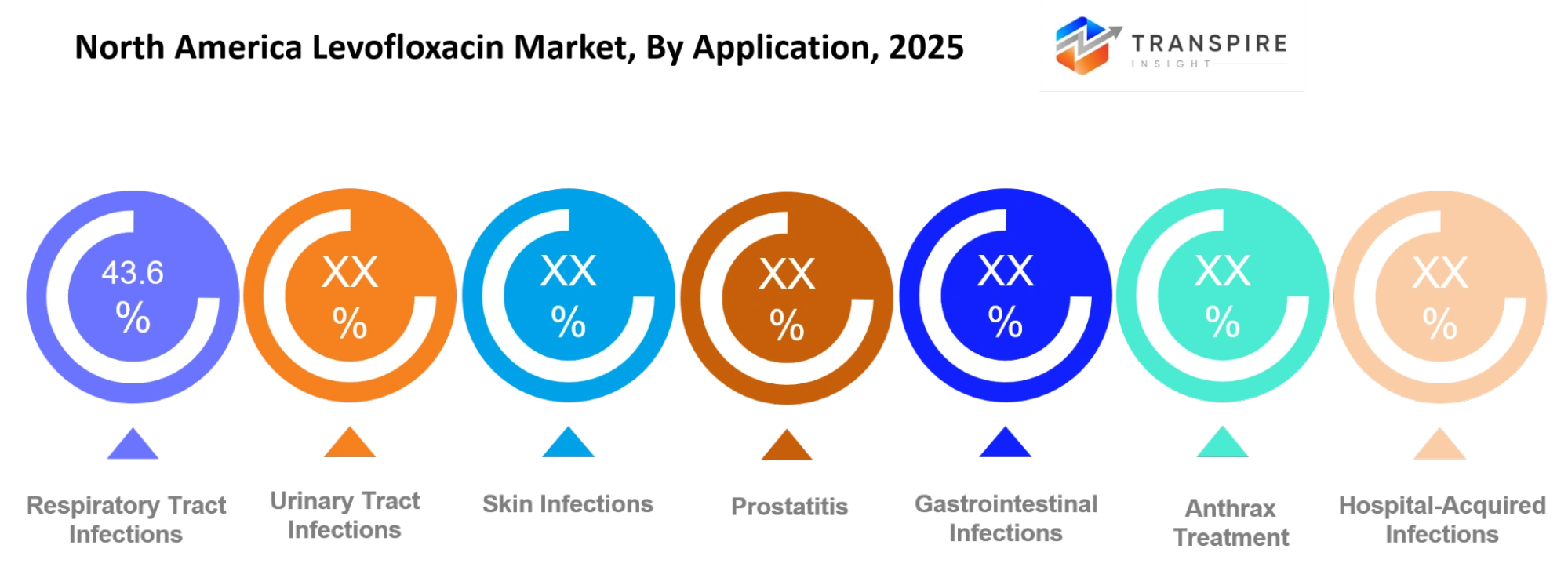
- Respiratory tract infections sorta dominate the market at 43.6% revenue share in 2025 , mainly due to community-acquired pneumonia outpatient care and hospital-acquired pneumonia handled inside critical care units.
- Generic levofloxacin basically takes 68% of prescriptions by volume in 2025 , while branded Levaquin and Tavanic keep sliding toward more specialty uses, where patent security or clinical know-how tends to shape branded preference.
- The hospitalized patient side grows quicker than ambulatory , powered by sepsis protocols and opportunistic infection prevention measures in immunocompromised groups, like cancer cases and transplant patients.
- Urinary tract infection prescribing stays pretty stable , though it’s getting squeezed by shorter-course options, so fluoroquinolones are more and more held back for complicated UTI, urosepsis, and prostatitis instead of uncomplicated cystitis.
- Johnson & Johnson still keeps the biggest revenue share via its Levaquin brand , and it tends to land formulary favor in hospital systems even with generic bioequivalents around , plus ongoing competition from newer fluoroquinolones.
- Teva Pharmaceutical and Viatris control most of the generic volume through direct hospital agreements and PBM linkages , and they push pricing compression down to USD 0.08 to USD 0.15 per dose in the intravenous line.
- Intravenous levofloxacin brings in about 31% of hospital revenue , mostly in intensive care units where fast bioavailability and reliable pharmacokinetics help with sepsis and pneumonia management.
- Oral extended-release tablets remain a kind of niche , even with convenient once-daily dosing, they cost roughly 2.5 to 3 times standard tablet formulations and they do not provide a real clinical benefit over immediate-release dosing.
What are the Key Drivers, Restraints, and Opportunities in the North America Levofloxacin Market?
Fluoroquinolone-resistant gram-negative infections are kind of the principal engine of ongoing levofloxacin use. Extended-spectrum beta-lactamase, ESBL-producing Enterobacteriaceae and Pseudomonas aeruginosa, that also resist third-generation cephalosporins still often stay susceptible to levofloxacin in many places, so fluoroquinolones become a necessary piece for empiric therapy when the resistance picture is unknown. Health system surveillance programs that actually log local resistance rates, slot fluoroquinolone susceptibility data into antibiogram–driven treatment guidelines, and that keeps prescribing volume steady even when pricing pressure shows up. It’s not really a “want” for fluoroquinolones at all, more like a clinical requirement that got imposed by changing resistance epidemiology.
Black-box warnings, along with published safety worries, like tendon rupture, aortic dissection, and irreversible peripheral neuropathy, have made prescribers hesitate in infections that aren’t life-threatening. This perception of risk, boosted by litigation and patient advocacy groups, limits market growth in primary care, where levofloxacin might have otherwise taken share from macrolides or beta-lactams. Practitioners are increasingly keeping levofloxacin for serious infections or for situations where other agents have not worked, which shrinks the addressable market to roughly 55% of patients who would have received fluoroquinolones five to ten years ago. That kind of structural pullback is not easy to undo with pharmacovigilance data, or with risk–benefit messaging.
Anthrax post-exposure prophylaxis is a separate revenue angle that grew after biodefense investment following 2001.
What Has the Impact of Artificial Intelligence Been on the North America Levofloxacin Market?
Somewhere in the levofloxacin market, artificial intelligence applications trend toward prescribing optimization, pharmacokinetic prediction, and resistance pattern forecasting. More and more , electronic health record systems now tuck in AI powered antibiotic stewardship engines that sort of flag levofloxacin prescriptions when patients have contraindications, earlier adverse events, or a clearly documented allergy state. This is meant to stop medication errors, and also avoid those unwanted adverse events.
Then there are predictive models, trained from regional surveillance data, that try to forecast local resistance patterns roughly 30 to 45 days ahead. That helps hospital formulary committees anticipate demand shifts for levofloxacin, and in a smoother way optimize procurement decisions. A few bigger health systems have already put machine learning classifiers to work, estimating the probability of fluoroquinolone susceptibility for gram-negative organisms using specimen source and local epidemiology. In practice it helps reduce inappropriate prescribing, especially where resistance levels are high.
A main constraint holding back wider AI adoption in levofloxacin therapeutics is that everything must integrate with proprietary EHR platforms, institutional pharmacy systems, and syndromic surveillance networks. A standalone AI tool that suggests levofloxacin dosing or predicts efficacy basically has no clear on-ramp to adoption unless it connects natively with the systems clinicians use every day. Plus the implementation costs , the training burden, and the regulatory clearance requirements for clinical decision support tools can add around 6 to 12 months to the deployment timeline. So it kind of suppresses market adoption of advanced pharmacokinetic optimization, or more personalized dosing strategies.
Key Market Trends
- The North America levofloxacin market seems to be growing at a 5.80% CAGR, starting at USD 1.74 Billion in 2025 and reaching around USD 2.73 Billion by 2033, mostly because fluoroquinolone-resistant infections are rising and hospital based infection prevention is getting more attention. At the same time though safety worries still kinda slow down primary care take up, you can feel it in adoption patterns.
- Generic erosion has also added a lot of pricing pressure on the levofloxacin intravenous segment , with prices dropping to about USD 0.08 to USD 0.15 per dose in 2024, compared with USD 0.25 to USD 0.40 per dose back in 2018. This change brings hospital cost savings, but it also squeezed branded product revenue by 22% , which is not exactly small.
- When it comes to use cases , hospital acquired infection management now contributes 38% of total levofloxacin revenue, up from 28% in 2020. Basically, sepsis protocols and post-operative infection prophylaxis are pushing inpatient consumption higher, and that share keeps climbing.
- For applications, respiratory tract infections are still the biggest piece at 43.6%, but urinary tract infection indications look weaker lately. Shorter course options and narrow-spectrum agents are getting more guideline support for uncomplicated cystitis , so levofloxacin is losing some ground.
- Channel wise, mail-order pharmacy plus specialty distributor routes captured an extra 8% share in 2023 and again in 2024. This reflects a patient tilt toward home delivery and pharmacist consultation for long-term suppressive therapy , even when treatment plans are prolonged.
- On the product side , combination therapy is emerging as a smaller niche , where levofloxacin is paired with beta lactams or macrolides . These are being positioned for empiric broad-spectrum regimens in hospital settings, especially for polymicrobial infections, even if the uptake is limited.
- Extended-release levofloxacin penetration stays under 5% , despite the clinical convenience angle. The cost premium just does not really pencil out for resource-constrained inpatient settings, or for retail pharmacy budgets, so adoption remains cautious.
- Finally, telehealth enabled prescribing of oral levofloxacin through urgent care virtual visits rose 40% year-over-year in 2024. That creates fresh direct-to-consumer acquisition pathways, and it feels like
North America Levofloxacin Market Segmentation
By Dosage Form
Tablets are basically in front in the levofloxacin market, hitting 54% of the volume and about 48% of revenue too. They pick up prescription refills in ambulatory, retail places where convenience matters, and cost sort of sets the pace so patients and providers lean toward whatever formulation feels easier. Injectable solutions bring in 31% of revenue, mostly tied to hospital environments, where you want fast onset and dependable pharmacokinetics, so the higher per unit cost feels more justified. Oral solutions are more like a smaller, targeted corner, including people with dysphagia, pediatric dosing needs, and those who are treatment naïve. Altogether they sit at around 8% of market volume. Extended release tablets , plus combination products, only manage under 7% combined revenue, even with the clinical upsides, but the whole thing is slowed by price frictions and formulary pushback or resistance. For generics, Sun Pharma, Dr. Reddy’s, and Cipla are leading, accounting for 68% of tablet prescriptions through direct health system contracts and PBM arrangements. And branded options like Levaquin still hold a premium lane in certain specialized indications, backed by clinical data plus long standing prescriber relationships.
By Application
Respiratory tract infections take roughly 43.6% of the market revenue, mostly thanks to community acquired pneumonia outpatient management, and hospital acquired pneumonia too, sort of a double driver. Urinary tract infections along with prostatitis sit near 28% of revenue, even if prescribing is slowly bending toward shorter course treatments and also older antibiotics for uncomplicated situations. Skin and soft tissue infections make up about 12% of the market volume, but they don’t pull in the same money since generic pricing is common and there’s solid competition from beta lactams. Hospital acquired infections, including sepsis and opportunistic infections in immunocompromised populations, contribute around 15% of revenue, and the per-dose pricing there is usually the highest. Anthrax care is more of a government stockpiling kind of stream, with a small commercial footprint. The way the drug distribution is laid out mirrors clinical practice guidelines, where levofloxacin is favored for serious infections , while older options are held back for lower risk presentations.
By Route of Administration
Oral administration kind of dominates the prescription volume at 68% , but it only brings in about 52% of revenue , mostly because the per-dose pricing is lower in ambulatory settings. Intravenous levofloxacin makes up 31% of revenue, and that share is mostly clustered in hospital acute care units and critical care areas where pricing is more tolerant of higher per-dose costs, and where clinical outcomes can really justify the therapeutic selection. Some newer combination therapy protocols seem to bounce between intravenous loading then a oral step-down phase, and that pattern keeps hospital pharmacy demand pretty steady. Hospital administration plus direct prescriber dosing, especially via institutional protocols, touches roughly 35% of total prescriptions, while the rest shows up through retail and online pharmacy channels. Customized dosing for renal impairment and drug interaction management is around 8% of prescriptions, mainly among elderly populations and in polypharmacy contexts. Finally, long-term suppressive therapy for urinary retention and chronic wound infection forms a stable revenue base, and it doesn’t really care about seasonal demand fluctuations.
By End User
Hospitals are kinda the big revenue generator, at 42% of market value, mainly pushed by critical care sepsis protocols, pneumonia management, and opportunistic infection prevention (or so it seems). Retail pharmacies grab 28% of volume via outpatient prescription fills , plus direct consumer access, even if generic pricing keeps revenue per prescription kinda capped. Clinics and urgent care centers contribute 18% of revenue by handling acute infection treatment, and short-term therapy, you know the usual. Online pharmacies are 7% of volume ,and they’re mostly concentrated in long-term suppressive therapy for chronic urinary or respiratory conditions. Long-term care centers alongside homecare settings are an emerging slice at 4%, centered on chronic suppressive therapy and infection prevention for elderly people , and also those who are functionally impaired. Academic hospitals and specialized centers keep a formulary preference for levofloxacin in teaching settings where evidence based guidelines nudge prescribing algorithms.
By Distribution Channel
Hospital pharmacies, kind of run the show with 40% of levofloxacin distribution by value, mainly because they’ve got straight health system contracts and connections with group purchasing organization relationships, which lets them negotiate volume based pricing. Retail pharmacies then take 32% , mostly through retail chain networks plus independent pharmacies that see ambulatory patients. Online pharmacies are the fastest-growing angle at 6% share, and they pull in mail order and specialty pharmacy fulfillment for chronic suppressive therapy, that part sort of keeps expanding. Drug stores and mass market retailers add up to 8% via their pharmacy operations and consumer healthcare sections. Medical distributors handle hospital supply chain logistics for about 35% of intravenous formulations, so they’re important too. Direct manufacturer sales to government agencies and institutional programs grab the anthrax post exposure prophylaxis stockpile portion. Government supply contracts are a separate revenue track, with procurement rhythms that are more predictable, and less tied to the commercial market dynamics. In the end channel choice is shaped by clinical setting, patient acuity, and therapy duration, with hospital systems leaning on institutional agreements while retail prescription management steers ambulatory channel economics.
What are the Key Use Cases Driving the North America Levofloxacin Market?
Outpatient community acquired pneumonia is kinda the main thing here, making up about 35% of the market volume. When patients show up at urgent care or retail clinics, with cough , fever, and those general respiratory complaints, levofloxacin gets used empirically pretty often, more or less because it fits the clinical picture. The course usually runs 5 to 7 days, and it tends to create steady demand across retail pharmacy networks, plus you see seasonal swings in fall and winter.
Then there’s the hospitalized population, especially people with sepsis plus respiratory infections. This is the top value use case even if the volume is lower. In the intensive care units, intravenous levofloxacin for confirmed—or sometimes just suspected—gram negative infections, supports premium pricing. That’s driven by per dose markups, which kinda track how clinically critical the situation is. For hospital acquired pneumonia and ventilator associated pneumonia protocols, levofloxacin is listed as a core piece in empiric broad spectrum combinations, so it’s repeatedly pulled into treatment decisions.
Finally, there’s the longer term suppressive approach in folks with chronic urinary retention, recurrent urinary tract infections, or a history of COPD exacerbations. That creates recurring revenue through both retail and mail order pharmacy channels. In practice, these patients may take levofloxacin off and on, intermittently or prophylactically, for months or years. The result is demand that stays pretty predictable and less tied to seasonal variation than acute treatment. With specialty pharmacy partnerships, home delivery gets enabled, along with pharmacist consultation for this group.
|
Report Metrics |
Details |
|
Market size value in 2025 |
USD 1.74 Billion |
|
Market size value in 2026 |
USD 1.84 Billion |
|
Revenue forecast in 2033 |
USD 2.73 Billion |
|
Growth rate |
CAGR of 5.80% from 2026 to 2033 |
|
Base year |
2025 |
|
Historical data |
2021 - 2024 |
|
Forecast period |
2026 - 2033 |
|
Report coverage |
Revenue forecast, competitive landscape, growth factors, and trends |
|
Regional scope |
United States, Canada |
|
Key companies profiled |
Johnson & Johnson, Daiichi Sankyo, Teva Pharmaceutical, Viatris, Sun Pharma, Dr. Reddy's, Lupin, Cipla, Hikma Pharmaceuticals, Aurobindo Pharma, Glenmark, Sandoz, Apotex, Zydus Lifesciences, Amneal Pharmaceuticals. |
|
Customization scope |
Free report customization (country, regional & segment scope). Avail customized purchase options to meet your exact research needs. |
|
Report Segmentation |
By Dosage Form (Tablets, Injectable Solutions, Oral Solutions, Extended-Release Tablets, Generic Formulations, Branded Products, Combination Products, Others); By Application (Respiratory Tract Infections, Urinary Tract Infections, Skin Infections, Prostatitis, Gastrointestinal Infections, Anthrax Treatment, Hospital-Acquired Infections, Others); By Route of Administration (Oral, Intravenous, Combination Therapy, Hospital Administration, Prescription Products, Customized Dosing, Long-Term Therapy, Others); By End User (Hospitals, Clinics, Retail Pharmacies, Online Pharmacies, Long-Term Care Centers, Homecare, Academic Hospitals, Others); By Distribution Channel (Hospital Pharmacies, Retail Pharmacies, Online Pharmacies, Drug Stores, Direct Sales, Medical Distributors, Government Supply, Others). |
Which Regions are Driving the North America Levofloxacin Market Growth?
The United States really dominates the North America levofloxacin market revenue, basically pulling in 88% of the market value. This happens via a mix of high healthcare spending, broad hospital networks , and a long-standing generic distribution setup that’s already in place. US Medicare and Medicaid reimbursement covers levofloxacin for FDA-approved uses, so coverage stays fairly consistent across age groups. In the US, the formulary environment has levofloxacin included in most institutional and commercial insurance plans, and the generic pricing helps it stay reachable for people who are underinsured. Hospital systems often steer the conversation through bulk buying, usually by using group purchasing organizations which negotiate discounts tied to volume. Also, American prescriber training highlights antibiotic stewardship guidelines, and it folds fluoroquinolones into empiric therapy pathways for serious infections, kind of in a step by step clinical logic.
Canada is smaller, but it stays steady, it contributes about 12% of North America levofloxacin regional revenue. Canadian provincial health systems keep levofloxacin on formulary for hospitals and some retail settings. Still, generic pricing caps can limit per-prescription revenue compared with the United States. Canadian patients generally get the same kind of access to generic levofloxacin, similar to US counterparts, with pricing arranged through provincial pharmacare programs rather than the usual commercial market drivers. Communication between US and Canadian prescribers, plus shared clinical guidance between both countries, tends to sync the demand. The Canadian market shows modest growth too, as clinicians follow published clinical trials and stewardship practices that match international standards, more or less.
Who are the Key Players in the North America Levofloxacin Market and How Do They Compete?
Johnson & Johnson basically keeps most of its branded levofloxacin presence through Levaquin, and it kinda stays in a more premium lane, even with generics crowding the space around it. They really push the clinical evidence piece pretty hard, along with prescriber ties, and then also formulary preference—especially when it comes to specialty use cases, like immunocompromised patient groups. Even so, Levaquin still lands at around 12% of the prescription market by volume, and something like 18% by revenue. That doesn’t fully vanish just because generic competition exists, a lot of it is tied to marketing spend, and also clinician loyalty that is slow to fade.
Teva Pharmaceutical and Viatris grab a big share of the generic tablet and injectable volume by leaning on direct health system deals and PBM partnerships. Their core move is essentially price, pretty straightforward. Teva in particular goes hard on cost leadership for hospital IV purchasing, so they end up winning that lane more often. What’s left gets divvied up among other generic players like Sun Pharma, Dr. Reddy’s, Lupin, and Cipla, and each one sort of chases smaller, more specific corridors—like retail pharmacy and specialty distribution. Then you’ve got Hikma Pharmaceuticals, Aurobindo Pharma, and Sandoz, staying selectively in the hospital and institutional segments. Apotex is mostly in Canada, while Zydus Lifesciences and Amneal Pharmaceuticals hold regional ground with more limited nationwide coverage.
North America Levofloxacin Market Companies
- Johnson & Johnson
- Daiichi Sankyo
- Teva Pharmaceutical
- Viatris
- Sun Pharma
- Dr. Reddy's
- Lupin
- Cipla
- Hikma Pharmaceuticals
- Aurobindo Pharma
- Glenmark
- Sandoz
- Apotex
- Zydus Lifesciences
- Amneal Pharmaceuticals
Recent Developments
In March 2026, Teva Pharmaceutical secured a multi-year hospital supply contract with a 150-facility health system network for generic levofloxacin intravenous and oral formulations, displacing the incumbent generic supplier through cost-based competitive bidding. The contract secures approximately 18% incremental volume growth for Teva in the hospital channel through 2028.
Source: https://www.tevapharm.com/news/ (Teva Pharmaceutical Investor Relations).
In January 2026, Johnson & Johnson expanded Levaquin formulary coverage through a health plan partnership agreement that reduced patient copayments for branded levofloxacin in immunocompromised patients, including cancer and transplant populations. The program aims to preserve market share against generic alternatives by targeting patient segments where clinical differentiation justifies premium positioning.
Source: https://www.investor.jnj.com/news/default.aspx (Johnson & Johnson Press Release).
In February 2026, Dr. Reddy's launched a levofloxacin 750 mg extended-release tablet in the US market, targeting patients with complicated urinary tract infections and chronic respiratory infections seeking once-daily convenience. The product positioning emphasizes compliance benefits over competitor immediate-release formulations.
Source: https://www.drreddys.com/media/ (Dr. Reddy's Laboratories Announcement).
What Strategic Insights Define the Future of the North America Levofloxacin Market?
Over the next five to seven years, the North America levofloxacin market is going to consolidate around hospital and institutional channels, while retail prescribing in primary care keeps slipping, kind of steadily. The main driver is antimicrobial stewardship maturing: health systems now deploy real-time prescribing analytics that basically flag inappropriate fluoroquinolone use in low-risk infections, so levofloxacin gets pushed toward more serious infections where the clinical evidence actually supports the pick. With that kind of channel migration, hospital volume can rise, while retail pharmacy pricing gets squeezed even more, further.
The tricky risk that growth rates do not really show is regulatory restriction. The FDA still holds black-box warnings around tendon rupture and aortic events. If new adverse event signals pop up, or if post-market surveillance data links levofloxacin to additional safety concerns, then prescribing restrictions could tighten again. That could also mean label updates that shrink the reachable patient base. Practitioners are already cautious in primary care. So if a widely publicized adverse outcome shows up, it could speed up practice shifts away from fluoroquinolones in non-serious infections, and not just slowly.
The opportunity that is not mainstream yet is levofloxacin integration into respiratory infection stewardship in urgent care and retail clinic networks. A lot of retail clinics still lean on broad-spectrum beta-lactams for presumed bacterial respiratory infections, even though resistance patterns are pretty clear by now. Levofloxacin’s stronger coverage against atypical pathogens and gram-negative organisms gives a plausible route to win volume from clinicians who start adopting evidence-led empiric therapy.
North America Levofloxacin Market Report Segmentation
By Dosage Form
- Tablets
- Injectable Solutions
- Oral Solutions
- Extended-Release Tablets
- Generic Formulations
- Branded Products
- Combination Products
- Others
By Application
- Respiratory Tract Infections
- Urinary Tract Infections
- Skin Infections
- Prostatitis
- Gastrointestinal Infections
- Anthrax Treatment
- Hospital-Acquired Infections
- Others
By Route of Administration
- Oral
- Intravenous
- Combination Therapy
- Hospital Administration
- Prescription Products
- Customized Dosing
- Long-Term Therapy
- Others
By End User
- Hospitals
- Clinics
- Retail Pharmacies
- Online Pharmacies
- Long-Term Care Centers
- Homecare
- Academic Hospitals
- Others
By Distribution Channel
- Hospital Pharmacies
- Retail Pharmacies
- Online Pharmacies
- Drug Stores
- Direct Sales
- Medical Distributors
- Government Supply
- Others
Frequently Asked Questions
Find quick answers to common questions.
The North America Levofloxacin Market size is expected to reach USD 2.73 Billion by 2033.
The key segments are By Dosage Form (Tablets, Injectable Solutions, Oral Solutions, Extended-Release Tablets), By Application (Respiratory Tract Infections, Urinary Tract Infections, Skin Infections, Prostatitis), By Route of Administration (Oral, Intravenous), By End User (Hospitals, Clinics, Retail Pharmacies, Online Pharmacies), and By Distribution Channel (Hospital Pharmacies, Retail Pharmacies, Online Pharmacies, Medical Distributors).
Major players include Johnson & Johnson, Teva Pharmaceutical, Viatris, Sun Pharma, Dr. Reddy's, Lupin, Cipla, Hikma Pharmaceuticals, Aurobindo Pharma, Sandoz, Apotex, Zydus Lifesciences, and Amneal Pharmaceuticals.
The North America Levofloxacin Market size is USD 1.74 Billion in 2025.
The North America Levofloxacin Market CAGR is 5.80% from 2026 to 2033.
- Johnson & Johnson
- Daiichi Sankyo
- Teva Pharmaceutical
- Viatris
- Sun Pharma
- Dr. Reddy's
- Lupin
- Cipla
- Hikma Pharmaceuticals
- Aurobindo Pharma
- Glenmark
- Sandoz
- Apotex
- Zydus Lifesciences
- Amneal Pharmaceuticals
About the Authors

Pankaj Ghogare Patil
I am Pankaj Ghogare Patil, a Senior Research Analyst at Transpire Insight, specializing in the Pharmaceutical, Chemicals & Materials, Healthcare IT, and Biotechnology industry. My expertise lies in conducting comprehensive market research, analyzing industry trends, evaluating competitive landscapes, and translating complex data into actionable insights. At Transpire Insight, I closely follow emerging technologies, regulatory developments, and market innovations to create accurate, well-researched, and informative content that helps businesses and professionals make informed decisions. I am committed to producing credible, evidence-based articles that reflect industry best practices while making technical topics accessible and valuable for a broad audience.

Chakradhar Khansole
Chakradhar serves as the Research Director at Transpire Insight, bringing over 8 years of experience in technology, innovation, and strategic market intelligence. He specializes in transforming complex market data into actionable business insights that enable organizations to make informed, growth-oriented decisions. Recognized for his strategic vision and analytical expertise, Chakradhar leads high-impact research initiatives, delivering comprehensive market assessments, competitive intelligence, and forward-looking industry analysis.
Recently Published Reports
-
Jul 2026
Alopecia Treatment Market
Alopecia Treatment Market Size, Share & Analysis Report By Disease Type (Alopecia Areata, Cicatricial Alopecia, Traction Alopecia, Alopecia Totalis, Androgenetic Alopecia, Alopecia Universalis, and Other Disease Types), By Treatment Type (Topical Treatments, Oral Medications, Injectable Therapies, and Hair Transplantation), By Gender (Male, and Female), By Distribution Channel (Hospitals and Clinics, Retail Pharmacies, and Online Retailers), and Geography (North America, Europe, Asia-Pacific, Middle East and Africa, South and Central America), 2021 - 2031
-
Jul 2026
Medical Ultrasound Probe Market
Medical Ultrasound Probe Market Size, Share & Analysis Report By Type (Linear Type, Convex Type, Endocavitary Probe, Phased Array/Cardiac Probe, Transesophageal (TEE) Probe, and Others), By Application (Ophthalmology, Cardiology, Musculoskeletal, Oncology, Obstetrics & Gynecology, General Imaging, and Others), By End User (Hospitals & Clinics, Diagnostic Centers, Ambulatory Surgical Centers, and Others), and Geography (North America, Europe, Asia-Pacific, Middle East and Africa, South and Central America), 2021 – 2031
-
May 2026
Biosimilars Market
Biosimilars Market By Product Type (Monoclonal Antibodies, Recombinant Hormones, Erythropoietin, G-CSF, Others), By Indication (Oncology, Autoimmune Diseases, Blood Disorders, Diabetes, Others), By Manufacturing Type (In-House Manufacturing, Contract Manufacturing), By Distribution Channel (Hospital Pharmacies, Retail Pharmacies, Online Pharmacies), By Industry Analysis, Size, Share, Growth, Trends, and Forecasts 2021-2033
-
Apr 2026
Gastrointestinal Endoscopy Market
Gastrointestinal Endoscopy Market By Type (Rigid Gastrointestinal Endoscope, Flexible Gastrointestinal Endoscopes, Disposable Gastrointestinal Endoscope), By Procedure Type (Colonoscopy, Gastroscopy, Duodenoscopy, Enteroscopy, Flexible Sigmoidoscopy, Others), By Application (Diagnosis, Treatment), By End-Users (Hospitals, Ambulatory Surgical Centers, Specialty Clinics, Laboratories, Others), By Industry Analysis, Size, Share, Growth, Trends, and Forecasts 2021-2033