North America Intensity Modulated Radiotherapy Market Size & Forecast:
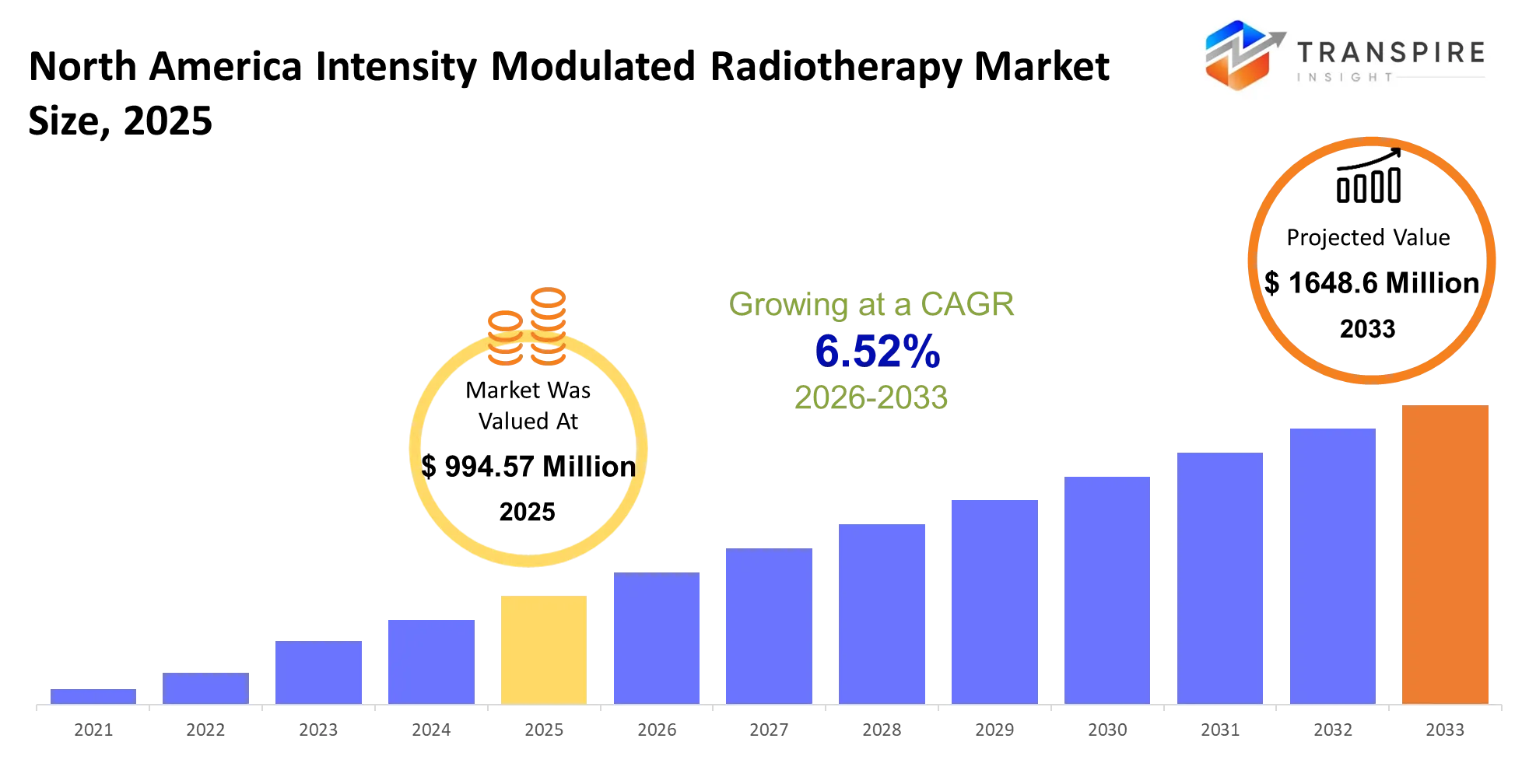
- North America Intensity Modulated Radiotherapy Market Size 2025: USD 994.57 Million
- North America Intensity Modulated Radiotherapy Market Size 2033: USD 1648.6 Million
- North America Intensity Modulated Radiotherapy Market CAGR: 6.52%
- North America Intensity Modulated Radiotherapy Market Segments: By Type (Step-and-shoot IMRT, Dynamic IMRT, Volumetric IMRT, Helical IMRT, Others); By Application (Cancer Treatment, Brain Tumors, Prostate Cancer, Breast Cancer, Others); By End-User (Hospitals, Cancer Centers, Clinics, Others); By Component (Software, Linear Accelerators, Planning Systems, Others).
To learn more about this report,  Download Free Sample Report
North America Intensity Modulated Radiotherapy Market Summary:
The North America Intensity Modulated Radiotherapy Market size is estimated at USD 994.57 Million in 2025 and is anticipated to reach USD 1648.6 Million by 2033, growing at a CAGR of 6.52% from 2026 to 2033. North America Intensity Modulated Radiotherapy market kind of sits right in the middle of today’s cancer care scene, where oncology teams can send very targeted radiation doses while also keeping collateral harm low to nearby organs and healthy tissue. Basically, hospitals lean on IMRT to manage complex tumors in the prostate, head and neck, lung, and breast , and that kind of pinpointing tends to shape how fast patients recover, how often complications pop up and also what happens in the long run.
In the past five years, the market moved away from just standalone radiation delivery systems, toward more joined up image guided and AI assisted treatment platforms. Now providers push harder for adaptive radiotherapy routines that trim down planning time, and they also help make dose matching more exact , so replacement needs for older systems keep rising. A big spark was during the COVID-19 period, when many cancer centers boosted automation and also leaned into hypofractionated treatment protocols to handle the growing patient backlog, with fewer visits to the hospital. That practical change seems to have stuck , and it reshaped what buyers care about. And as reimbursement pressure keeps increasing, clinics often put money into platforms that improve throughput, lower the chance of retreatment, and back value based oncology care approaches.
Key Market Insights
- In 2025, the United States pretty much led the North America Intensity Modulated Radiotherapy Market, holding more than 82% market share, mostly because it has better oncology infrastructure. You know, that kind of advanced setup makes adoption easier and faster.
- Canada is seen as the fastest-growing regional market over the forecast period, and this is mainly tied to expanded cancer treatment funding plus hospital modernization programs, in a pretty clear, step by step way.
- Also, cross-border uptake of AI-enabled radiotherapy platforms is speeding up overall industry growth across major healthcare systems in North America, so the market size keeps climbing.
- Meanwhile, government-backed oncology funding keeps reinforcing market reach for adaptive radiotherapy and image-guided treatment technologies, even when budgets get tight.
- In 2025, Linear accelerator-based IMRT systems took the largest share, largely due to strong procedural efficiency and the ability to deliver precise dose distribution, without much fuss.
- Software and treatment planning systems ranked second for revenue share since clinics started adopting AI-driven workflow optimization tools, which sounds small but it really changes day to day operations.
- Adaptive radiotherapy solutions are expected to grow the quickest through 2032, because there is solid demand for real time treatment personalization, especially for more complex cases.
- Cloud-connected oncology platforms are also emerging as key demand drivers across multi-site cancer care networks, and they’re becoming kind of standard.
- On the disease side, prostate cancer care dominated the North America IMRT market with almost 34% share in 2025, mainly because IMRT reduces organ harm , and patients generally benefit from that approach.
- Head and neck cancer use cases are gaining meaningful momentum as clinicians show more interest in precision-centric radiation therapy protocols.
- Lung cancer radiotherapy applications are expanding quickly too, with increased adoption of image-guided treatment and motion-management technologies.
- And in breast cancer treatment centers , more IMRT systems are being deployed to cut cardiac exposure and support better long-term patient outcomes.
What are the Key Drivers, Restraints, and Opportunities in the North America Intensity Modulated Radiotherapy Market?
The most strong force pushing the North America Intensity Modulated Radiotherapy market is basically the shift toward “precision oncology” together with the more hypofractionated cancer treatment protocols, you know. Hospitals and cancer centers are choosing IMRT more and more, because it gives better radiation precision, while also lowering harm to nearby healthy tissues which then cuts complication related costs and helps the whole treatment throughput move faster. That change really picked up after big oncology networks started using shorter treatment schedules during the COVID-19 period, largely to handle patient backlogs and to reduce how many hospital visits people needed. And now, since reimbursement models are slowly rewarding clinical efficiency plus outcome based care, providers are swapping older radiotherapy systems with AI assisted IMRT platforms, these improve workflow automation and overall patient capacity. So, you get ongoing growth in equipment, plus software revenue too.
Still though, the market’s biggest structural obstacle is the high capital, plus operational cost of the newer radiotherapy infrastructure. To install IMRT, facilities need multimillion dollar spending on linear accelerators, imaging platforms, shielding facilities, and even specialized workforce training. Smaller community hospitals often don’t have the financial scale to justify those upgrades, especially when reimbursement stays pretty fixed. As a result, adoption tends to stall beyond major urban cancer centers, and it can suppress revenue chances in underserved regional healthcare networks.
Adaptive radiation therapy, fused with artificial intelligence kind a feels like the next big growth channel. With real-time tumor tracking and some automated treatment blueprints, the dose accuracy is getting better, while the planning workload for clinicians is dropping, sometimes fast enough to notice. Meanwhile, big healthcare organizations in the United States and Canada are putting more money into AI-powered oncology systems, and especially within high-volume prostate and lung cancer programs, where treatment tailoring— for the most part can matter a lot for long-term patient results.
What Has the Impact of Artificial Intelligence Been on the North America Intensity Modulated Radiotherapy Market?
Artificial intelligence and advanced digital technologies are, in a way, reshaping the North America Intensity Modulated Radiotherapy Market , by automating several of the more time-intensive stages in radiation treatment planning and delivery. AI-assisted contouring software is now enabling clinicians to automatically locate tumors along with surrounding organs on imaging scans, which tends to cut manual planning effort from “a few hours” down to under 30 minutes in many oncology processes. Alongside that, treatment planning platforms also lean on automation for radiation dose distribution tuning, giving more uniformity across busy cancer centers and at the same time lowering clinician workload.
Machine learning models are getting used more often for forecast based treatment changes and also for keeping an eye on equipment performance. In advanced radiotherapy systems it’s kind of like they are reading imaging together with patient response details right during the sessions, and then they tweak the radiation plans pretty much near to real time. This is especially true for prostate, lung, and head-and-neck cancers , where the tumor position can move between appointments. On top of that, predictive analytics lets hospitals anticipate linear accelerator servicing needs in advance so they get fewer unexpected stops, and overall they see better equipment use.
Overall, these capabilities are lifting patient throughput, speeding up treatment cycle times, and making regulatory documentation easier to manage across oncology networks. Still, AI adoption has one big sticking point: integration expenses are staying high, because hospitals have to connect imaging systems , treatment planning tools, and electronic health records into one digital workflow. Smaller cancer centers often do not have the IT backbone and specialized teams required to roll out these platforms broadly, at scale.
Key Market Trends
- Since 2021, a lot of major oncology centers have been pushing faster replacement of older linear accelerators with AI-enabled systems that help with adaptive radiotherapy workflows.
- After COVID-19, hypofractionated treatment protocols kind of expanded, which meant fewer patient visits but at the same time it raised the need for high precision IMRT planning software.
- Varian Medical Systems and Elekta AB also increased their investments in cloud connected oncology platforms… sort of to firm up multi site treatment coordination, across different locations.
- Between 2022 and 2025, cancer centers more and more started using automated contouring tools, and that cut radiation treatment planning times by almost 50% in certain facilities, depending on the setup.
- In the U.S., hospitals shifted their buying priorities toward integrated imaging and radiotherapy systems. These systems are meant to help reimbursement performance under value based oncology models, so they said they are more aligned with the incentives.
- Proton therapy partnerships with academic cancer institutes, rose across North America after 2023. Providers seemed to chase more differentiated precision oncology capabilities, not just general delivery.
- Community hospitals kept postponing IMRT infrastructure upgrades because the installation costs are multimillion-dollar and workforce shortages became a real bottleneck. That limited expansion strategies in many regions.
- In Canada, oncology networks leaned into digital radiotherapy platforms more after provincial healthcare modernization programs brought additional funding for cancer treatment infrastructure.
- AI-assisted adaptive radiotherapy gained traction in lung and prostate cancer care, mostly because real-time imaging supports better dose accuracy during tumor movement.
- And from 2022 onward, oncology providers have been consolidating vendor relationships more often, choosing end to end treatment ecosystems—going from imaging through radiation delivery, and even workflow analytics—so everything connects in one chain.
North America Intensity Modulated Radiotherapy Market Segmentation
By Type
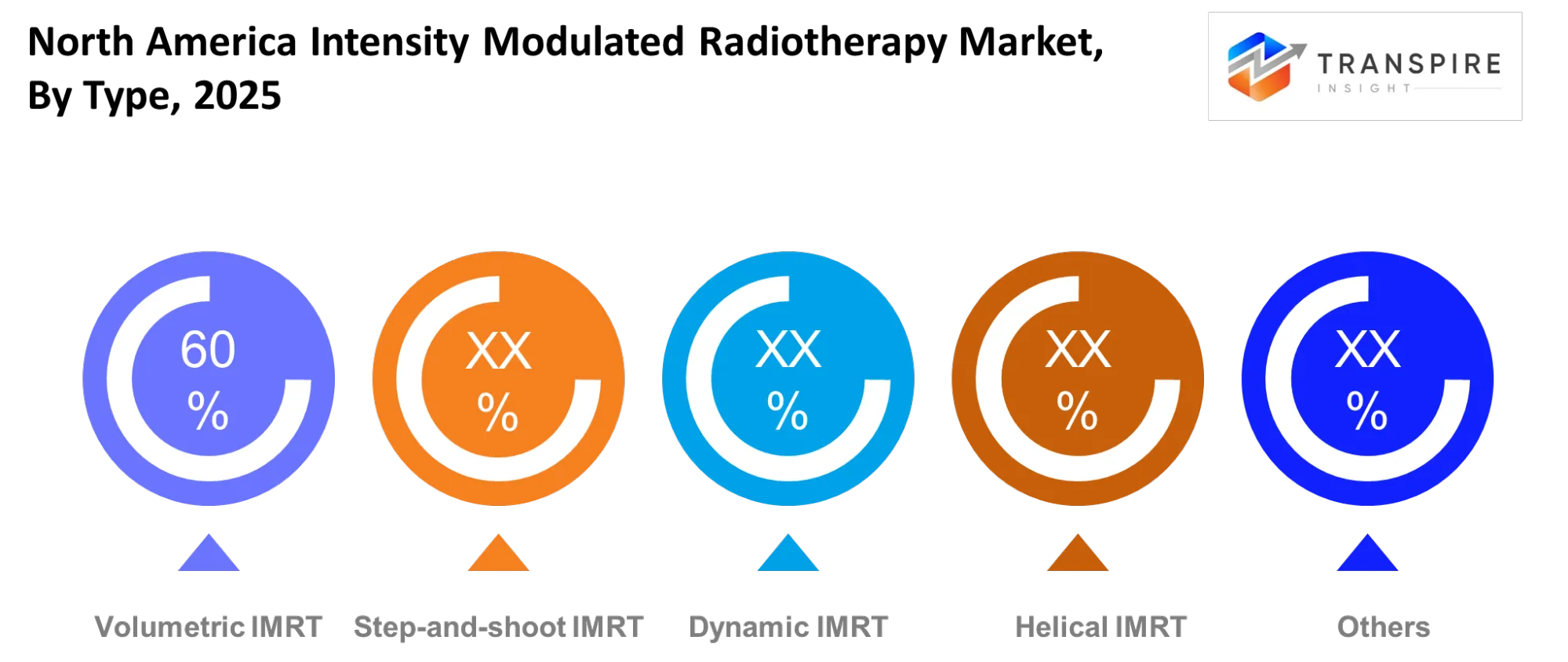
By type, volumetric IMRT systems still seem to take the lead overall , mainly because oncology providers want a quicker treatment run and very tight dose precision for the more complex tumor work. Dynamic IMRT keeps a sizable portion as well, partly because it’s been installed a lot across big hospital networks; those institutions upgraded their radiotherapy setup over the last decade. Meanwhile, step-and-shoot IMRT keeps showing up in mid-sized treatment centers where budgets are more careful, so they don’t always go for advanced adaptive platforms. Helical IMRT is also climbing, especially in specialist cancer institutes working on head and neck plus spinal tumors, where the need for steady, continuous radiation delivery accuracy matters.
On the demand side, things are moving toward integrated systems, ones that can bring imaging, automation, and adaptive planning together in one single workflow. Vendors are answering by rolling out AI-assisted treatment optimization and cloud-based data management features. In the near future, competition will probably focus on treatment speed, interoperability, and how efficiently automation is handled, since buyers want systems that raise throughput while still fitting personalized oncology protocols.
To learn more about this report, Download Free Sample Report
By Application
In application terms, prostate cancer care still leads the way, mostly because IMRT cuts down radiation exposure to nearby organs and it keeps treatment accuracy high, like very consistently. Breast cancer alongside head-and-neck cancer continues to broaden too, since oncology teams are actively looking for solutions that curb long‑term problems and help patient recovery move along better. For brain tumor care, adoption is also pretty steady, mainly because refined radiation modulation lets clinicians deliver very pinpoint therapy right next to delicate neurological tissue, so it feels more controlled than generic approaches. Lung cancer applications are showing up as one of the swifter risers, driven by wider use of motion management tools and image guided treatment routines. The different growth curves across these areas suggest clinicians are increasingly favoring precision centered oncology tactics, not the more general, broad radiation delivery style.
Manufacturers are now tuning software algorithms, and even imaging capability, to match tumor specific treatment workflows, sometimes in more integrated ways. Meanwhile, investors are putting more emphasis on adaptive radiotherapy platforms that can support more than one cancer type, whereas hospitals tend to prioritize setups that hold a balance between delivery accuracy, day to day workflow efficiency and reimbursement performance.
By End-User
From the end-user angle, hospitals end up holding the biggest market share, mainly because big healthcare organizations have the groundwork, reimbursement pathways and the oncology patient flow needed to justify expensive radiotherapy purchases. Cancer centers are the quickest growing slice, since focused oncology networks are increasingly leaning into precision medicine as well as outpatient style care models. Clinics, on the other hand keep a more modest footprint , largely tied to tighter budgets and reduced procedural bandwidth. Still, collaborations with nearby hospital groups are slowly widening the reach of advanced technology in a few locations.
Overall demand seems to move toward centralized cancer care ecosystems, where diagnostics, imaging, treatment planning, and radiation delivery all sit together under one kind of digital framework or unified platform. Meanwhile academic research institutes and specialty oncology providers are also putting money into next-generation adaptive radiotherapy systems, partly to boost trial execution and partly to refine personalized care development. Looking ahead, the market direction appears to lean toward greater consolidation among treatment providers , with buyers asking for scalable solutions that can serve multi-site oncology operations, enable remote workflow oversight, and offer AI assisted treatment planning for wider patient groups.
By Component
In terms of component categories, linear accelerators still, by far, keep pulling in most of the revenue since essentially every advanced IMRT routine relies on fast radiation delivery hardware. Treatment planning systems sit in what looks like the second-strongest spot, mainly because vendors are moving toward AI-supported software that can shrink planning timelines, and also help dose accuracy. Software platforms are getting more strategic relevance too, not just “nice to have,” because oncology networks are now trying to lock in interoperability and smoother workflow orchestration, plus cloud connected treatment coordination between different facilities.
Imaging and quality assurance pieces are also climbing in importance. This is largely because adaptive radiotherapy asks for ongoing verification during treatment, together with real time tumor monitoring, so the systems have to keep checking what’s happening. You can see the demand direction getting clearer when healthcare providers shift budgets away from just buying stand alone devices, and toward broader integrated oncology ecosystems that pair software analytics with imaging functions, and with radiation delivery tech.
Manufacturers, meanwhile, are putting more effort into machine learning, automation, and predictive maintenance features, simply to stay competitive. Over the longer run, the market seems likely to reward vendors that can deliver full digital oncology platforms, with software upgrades that can scale, and with better day to day operational efficiency.
What are the Key Use Cases Driving the North America Intensity Modulated Radiotherapy Market?
Prostate cancer treatment still looks like the main reason hospitals in North America are adopting advanced radiotherapy systems, at least that's what most people say. Its treatment precision helps keep harm down to nearby organs, so recovery tends to be better, and it can also enable shorter radiation schedules which, in turn, often boosts patient throughput.
Breast cancer as well as head and neck tumor care are showing more pull, especially at dedicated cancer centers and university oncology institutes. For these, image guided and adaptive radiotherapy setups matter a lot, because the goal is better aiming accuracy in those anatomically delicate regions, but also lower the chances of long term complications, overall.
There are newer use cases too, like adaptive lung cancer radiotherapy, and AI assisted reirradiation planning for tumors that come back. Big research hospitals are also starting to trial real time imaging with automated dose adjustment , sort of systems that may back very customized oncology protocols during the forecast period.
|
Report Metrics |
Details |
|
Market size value in 2025 |
USD 994.57 Million |
|
Market size value in 2026 |
USD 1059.4 Million |
|
Revenue forecast in 2033 |
USD 1648.6 Million |
|
Growth rate |
CAGR of 6.52% from 2026 to 2033 |
|
Base year |
2025 |
|
Historical data |
2021 - 2024 |
|
Forecast period |
2026 - 2033 |
|
Report coverage |
Revenue forecast, competitive landscape, growth factors, and trends |
|
Country scope |
North America (Canada, The United States, and Mexico) |
|
Key company profiled |
Varian Medical Systems, Elekta, Siemens Healthineers, GE Healthcare, Philips, Accuray, Brainlab, Canon Medical, Hitachi, Mevion, ViewRay, IBA Worldwide, Toshiba, Shimadzu, Fujifilm |
|
Customization scope |
Free report customization (country, regional & segment scope). Avail customized purchase options to meet your exact research needs. |
|
Report Segmentation |
By Type (Step-and-shoot IMRT, Dynamic IMRT, Volumetric IMRT, Helical IMRT, Others); By Application (Cancer Treatment, Brain Tumors, Prostate Cancer, Breast Cancer, Others); By End-User (Hospitals, Cancer Centers, Clinics, Others); By Component (Software, Linear Accelerators, Planning Systems, Others) |
Which Regions are Driving the North America Intensity Modulated Radiotherapy Market Growth?
The United States is basically leading the North America Intensity Modulated Radiotherapy market, since big oncology networks keep putting money into precision cancer treatment infrastructure, kind of like a steady drumbeat. With solid reimbursement frameworks, more advanced hospital systems and fairly high cancer screening rates, AI-enabled radiotherapy platforms get taken up pretty fast in lots of major city healthcare centers. On top of that, federal research funding together with collaborations between universities and private oncology providers, helps push innovation in adaptive radiotherapy and image guided planning. Big equipment manufacturers also keep a strong footprint, with service coverage, software support and ongoing training ecosystems across the country. So hospitals can upgrade treatment capability faster than a lot of global peers, it just seems easier logistically there.
Canada shows up as the second largest regional contributor, though the growth story looks a bit different, because provincial healthcare systems lean toward long-term infrastructure stability and more centralized oncology planning. Public funding structures help modernize cancer treatment centers in a more gradual way, not exactly in a rapid private-sector expansion sprint. The consistent investments in regional cancer care access, plus hospital digitization programs, create fairly dependable procurement cycles for radiotherapy vendors. Canadian providers also emphasize connected treatment coordination across provinces, which then raises demand for cloud connected planning tools and interoperable oncology software platforms.
Mexico is showing up as the quickest growing regional market, largely because private healthcare investments are expanding and urban cancer care facilities are being updated, kind of modernized. In the last stretch, growth really picked up after a few private hospital groups put more money into advanced oncology technology, with the goal to curb outbound medical travel and to enhance in-country cancer treatment capacity. At the same time, international equipment suppliers are building new partnerships with healthcare providers across the region, and Mexico City, Monterrey, plus Guadalajara are standing out most , since oncology infrastructure projects have been getting real momentum after 2023. All of this adds up to solid prospects for technology vendors, software developers and even investors looking to step into radiotherapy markets that are still underserved, during the 2026 to 2033 window.
Who are the Key Players in the North America Intensity Modulated Radiotherapy Market and How Do They Compete?
The North America Intensity Modulated Radiotherapy market is still kinda moderately consolidated, and the competition is mostly on how well players stitch together their technology, how much they can automate treatment, and the bigger long-term oncology service setup, not just about equipment pricing by itself. Big incumbents keep defending share via integrated imaging, treatment planning, and adaptive radiotherapy platforms , which in practice creates high switching costs for hospitals and cancer networks. Meanwhile new entrants run into obstacles linked to regulatory approvals, clinical validation expectations,and the capital heavy reality of putting radiotherapy infrastructure in place. More and more, the fight is over workflow efficiency, AI-augmented treatment planning, interoperability with hospital systems , and also whether vendors can back value-based oncology care models across multi-site healthcare networks.
Varian Medical Systems stands out by using tightly integrated oncology software, imaging systems, and linear accelerator platforms , all meant to support adaptive radiotherapy workflows smoothly. The firm improved its position after it integrated with Siemens Healthineers, which in turn expanded access to advanced imaging and AI-driven diagnostics across hospital networks. Elekta AB leans into precision treatment coordination , plus cloud-connected oncology platforms that make collaboration between treatment centers easier. They also use strategic partnerships with academic cancer institutes to help speed up adoption of more personalized radiotherapy protocols and automated planning technologies.
Accuray Incorporated kind of competes by leaning hard into niche specialization , mainly robotic radiotherapy and motion-tracking systems built for those complex tumor targeting situations. That overall angle seems to give Accuray a bit more visibility in high-acuity cancer care facilities, especially ones handling lung, spinal, and prostate cancer cases . Meanwhile, GE HealthCare expands its influence by pushing imaging integration , plus AI-enabled workflow optimization tools that essentially link diagnostics with radiation treatment planning, in one connected flow. Also, a few other companies are gradually boosting regional partnerships with outpatient oncology centers and specialty cancer clinics, where the need for smaller, digitally connected radiotherapy systems keeps climbing around North America.
Company List
- Varian Medical Systems
- Elekta
- Siemens Healthineers
- GE Healthcare
- Philips
- Accuray
- Brainlab
- Canon Medical
- Hitachi
- Mevion
- ViewRay
- IBA Worldwide
- Toshiba
- Shimadzu
- Fujifilm
Recent Development News
In May 2026, Elekta Showcases MR-Guided Radiotherapy Advances at ESTRO 2026: Elekta presented new clinical research at ESTRO 2026 demonstrating advances in MR-guided adaptive radiotherapy for multiple cancer indications. The research focused on improving treatment precision and workflow optimization, reinforcing the company’s position in advanced IMRT and adaptive radiation therapy technologies used by North American oncology providers.
Source: https://ir.elekta.com
In January 2026, Elekta Received FDA Clearance for Evo CT-Linac in the U.S.: In a major development for the North American Intensity Modulated Radiotherapy (IMRT) market, Elekta secured U.S. FDA 510(k) clearance for its Evo CT-Linac platform. The system combines advanced imaging with precision radiation delivery, supporting adaptive radiotherapy and next-generation IMRT workflows for cancer centers across the United States.
Source: https://www.itnonline.com
What Strategic Insights Define the Future of the North America Intensity Modulated Radiotherapy Market?
The North America Intensity Modulated Radiotherapy market is kind of structurally shifting toward fully adaptive, AI integrated oncology ecosystems where imaging, treatment planning, and radiation delivery work through linked digital workflows, sort of like a continuous loop rather than isolated steps. What’s really pushing this change is the healthcare industry moving to outcome based reimbursement models that actually pay for treatment accuracy, day to day operational efficiency and fewer side effects not just higher procedural volume. In the next five to seven years, it feels like competitive advantage will depend much more on software intelligence and automation features as well as interoperability with the wider hospital data setup, rather than the raw standalone hardware quality.
One quieter but important risk is that market concentration could grow around a small circle of integrated platform providers. When hospitals lock into long-term software and equipment ecosystems switching costs can become high, which may restrict innovation access for smaller oncology centers and, as a result, slow broader competitive diversification. Meanwhile, there’s also an opportunity that seems to be forming fast: AI driven adaptive radiotherapy for outpatient cancer networks. This could be especially relevant in secondary U.S. cities and in private Mexican healthcare systems, where oncology infrastructure is expanding quickly, and in some places patients are being routed through newer network models.
Market participants should probably focus on building partnerships with regional cancer networks, and invest in scalable software platforms that can support remote planning, predictive maintenance, and multi-site treatment coordination, without making each clinic reinvent the workflow.
North America Intensity Modulated Radiotherapy Market Report Segmentation
By Type
- Step-and-shoot IMRT
- Dynamic IMRT
- Volumetric IMRT
- Helical IMRT
- Others
By Application
- Cancer Treatment
- Brain Tumors
- Prostate Cancer
- Breast Cancer
- Others
By End-User
- Hospitals
- Cancer Centers
- Clinics
- Others
By Component
- Software
- Linear Accelerators
- Planning Systems
- Others
Frequently Asked Questions
Find quick answers to common questions.
The approximate North America Intensity Modulated Radiotherapy Market size for the market will be USD 1648.6 Million in 2033.
The key segments of the North America Intensity Modulated Radiotherapy Market are By Type (Step-and-shoot IMRT, Dynamic IMRT, Volumetric IMRT, Helical IMRT, Others); By Application (Cancer Treatment, Brain Tumors, Prostate Cancer, Breast Cancer, Others); By End-User (Hospitals, Cancer Centers, Clinics, Others); By Component (Software, Linear Accelerators, Planning Systems, Others).
Major players in the North America Intensity Modulated Radiotherapy Market are Varian Medical Systems, Elekta, Siemens Healthineers, GE Healthcare, Philips, Accuray, Brainlab, Canon Medical, Hitachi, Mevion, ViewRay, IBA Worldwide, Toshiba, Shimadzu, Fujifilm.
The current market size of the North America Intensity Modulated Radiotherapy Market is USD 994.57 Million in 2025.
The North America Intensity Modulated Radiotherapy Market CAGR is 6.52%.
- Varian Medical Systems
- Elekta
- Siemens Healthineers
- GE Healthcare
- Philips
- Accuray
- Brainlab
- Canon Medical
- Hitachi
- Mevion
- ViewRay
- IBA Worldwide
- Toshiba
- Shimadzu
- Fujifilm
Recently Published Reports
-
Apr 2026
AI in Diabetic Retinopathy Market
AI in Diabetic Retinopathy Market Size, Share & Analysis Report By Type (Screening AI Systems, Diagnostic AI Systems, and Predictive AI Models), By Application Segment (Hospitals, Ophthalmology Clinics, Diagnostic Centers, and Research and Development), and Geography (North America, Europe, Asia-Pacific, Middle East and Africa, South and Central America), 2021 - 2031
-
Apr 2026
Psychometric Tests Market
Psychometric Tests Market Size, Share & Analysis Report By Type (Personality Tests, Ability/Aptitude Tests, Skill/Knowledge Tests, and Others), By Application (Talent Acquisition and Talent Management), and Geography (North America, Europe, Asia-Pacific, Middle East and Africa, South and Central America), 2021 – 2031
-
Apr 2026
Rare Biological Sample Collection Market
Rare Biological Sample Collection Market Size, Share & Analysis Report By Type (Isolation Kits & Reagent, Blood Collection Tubes, and Others), By Application (Oncology, Transcriptomics, Pharmacogenomics, and Others), and Geography (North America, Europe, Asia-Pacific, Middle East and Africa, South and Central America), 2021 – 2031
-
May 2026
Patient Lift Pendant Market
Patient Lift Pendant Market By Product Type (Wired Pendants, Wireless, Programmable), By Operation Type(Manual, Electric), By End-Users (Healthcare Professionals, Patients), By Application (Hospitals, Homecare, Rehabilitation Centers, Others), By Industry Analysis, Size, Share, Growth, Trends, and Forecasts 2021-2033
Our Clients
.jpg)