

North America Intelligent Power Module Market Size & Forecast:
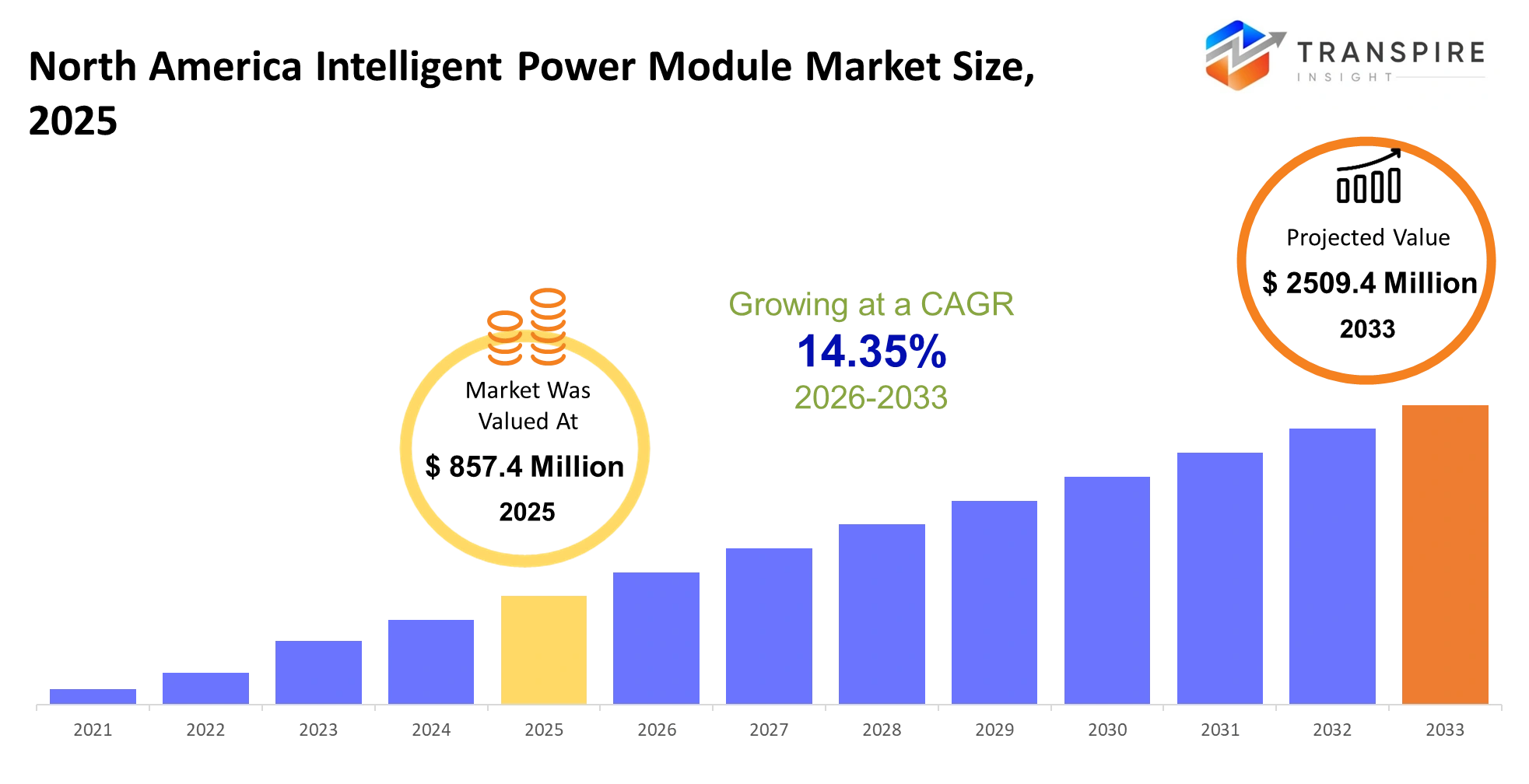
- North America Intelligent Power Module Market Size 2025: USD 857.4 Million
- North America Intelligent Power Module Market Size 2033: USD 2509.4 Million
- North America Intelligent Power Module Market CAGR: 14.35%
- North America Intelligent Power Module Market Segments: By Type (IGBT-based IPM, MOSFET-based IPM), By Application (Consumer Electronics, Industrial, Automotive), By End-User (Electronics, Automotive, Energy).
To learn more about this report,  Download Free Sample Report
North America Intelligent Power Module Market Summary:
The North America Intelligent Power Module Market size is estimated at USD 857.4 Million in 2025 and is anticipated to reach USD 2509.4 Million by 2033, growing at a CAGR of 14.35% from 2026 to 2033. The North America Cloud-Managed Wi-Fi Market, which includes Canada and the United States and Mexico, will showcase established networking companies together with new companies that focus on cloud-based solutions to develop standards for enterprise connectivity. The companies Cisco through Meraki and HPE Aruba and Juniper Mist and Extreme Networks will enhance their market positions by adding AI-powered analytical tools and automated systems and unified performance monitoring solutions to their product lines. The vendors will work to create simple solutions that enable users to manage multiple networks while they build stronger security systems. Ubiquiti and Ruckus will attract customers from budget-conscious markets through their products which offer different installation options. The industry competition will continue to be determined by breakthroughs in cloud-native systems and improvements in user experience and development of scalable service delivery solutions.
Key Market Trends & Insights:
People will choose to purchase goods because their buying habits will change due to the growing electrification of both transportation systems and industrial processes. Customers show a preference for purchasing compact modules which provide better switching performance and lower thermal loss. Automakers in the United States and Canada will increasingly align sourcing decisions with long-term platform strategies, pushing suppliers to deliver scalable designs. Manufacturing hubs in Mexico will concentrate on achieving cost-performance equilibrium which will lead to the development of modular solutions that multiple applications can use after minor changes.
The commercial market will start to adopt wide bandgap materials because performance requirements continue to increase. High-voltage automotive systems and renewable energy systems will use silicon carbide as their preferred material while gallium nitride will be used in fast-switching applications that operate at lower voltage levels. Engineers will move toward designs that reduce cooling complexity and improve power density. Buyers will establish closer ties with suppliers to develop customized solutions for joint projects that require long-term power system testing and development of reliability assurance methods.
The evaluation and deployment of intelligent modules will undergo a transformation due to power system digitalization. Customers will increasingly expect built-in sensing, fault diagnostics, and compatibility with advanced control software. The system will enable predictive maintenance through its implementation in industrial automation and energy infrastructure. Vendors will use their firmware capabilities and data integration features to distinguish their products in the market because standard connectivity has become common.
The product development priorities across North America will continue to follow policy direction because energy efficiency and emissions reduction remain critical areas of focus. The adoption of clean energy incentives and electric mobility incentives will determine how organizations approach supplier selection and procurement processes. The rise of local sourcing demands would prompt organizations to invest in manufacturing plants within their operational regions. There is a need for manufacturers to update their operational systems because end users require a clear view of their supply chain, as well as compliance with evolving industry standards.
North America Intelligent Power Module Market Segmentation
By Type
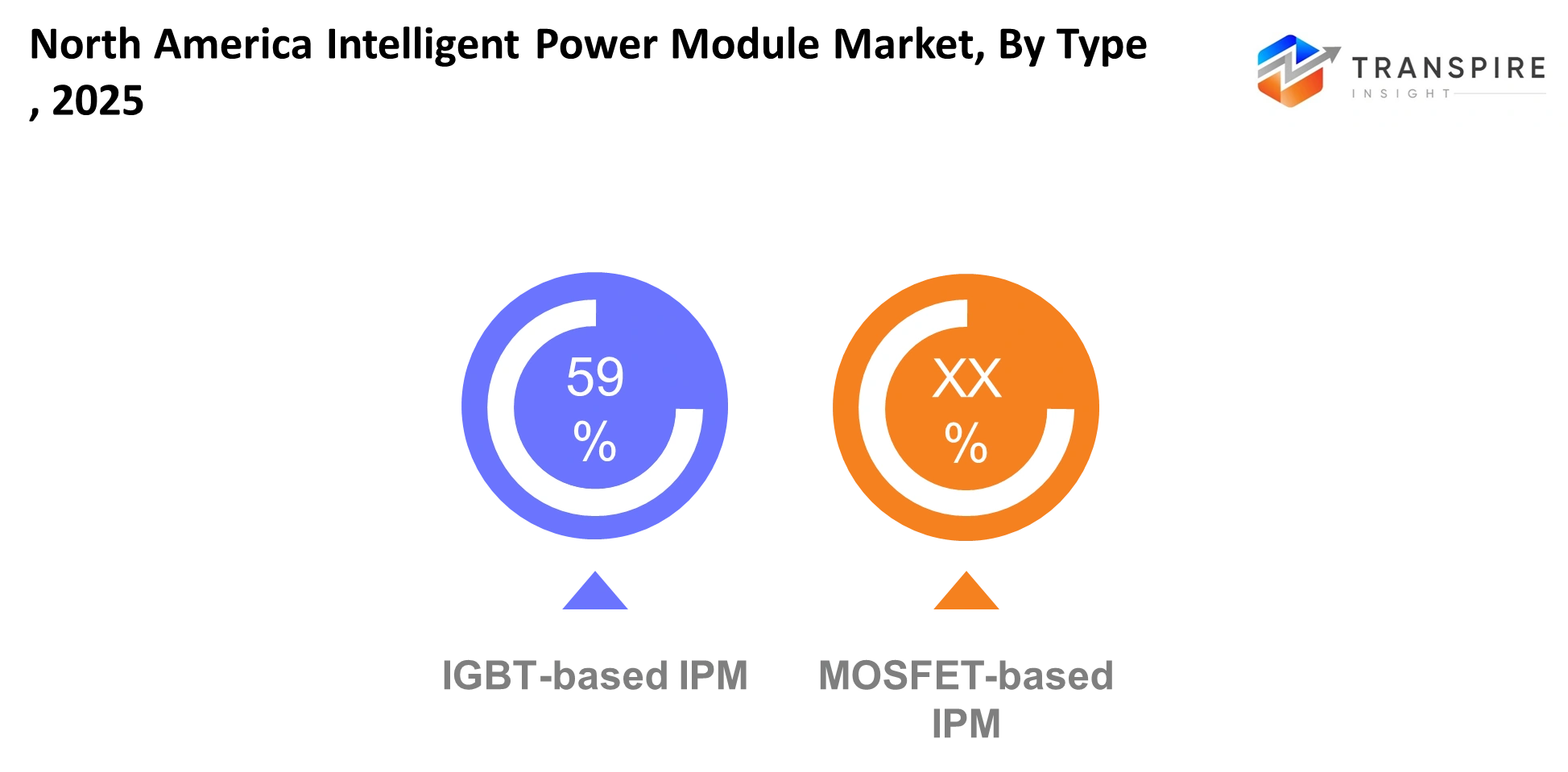
IGBT-based IPM- The IGBT-based intelligent power modules will become the standard solution for medium-to-high power applications which require both reliable performance and economical operation. The modules will provide motor drives and industrial inverters and traction systems with dependable operation under high voltage conditions. The rising demand for electrified transport and heavy-duty automation will lead manufacturers to develop switching speed and thermal management systems which meet stricter efficiency targets without compromising reliability during long operational periods.
MOSFET-based IPM- The MOSFET-based intelligent power modules will become more popular in environments that require low-to-medium power and need fast switching and small device dimensions. The technology will find growing use in consumer electronics and power supply systems and lightweight industrial equipment. Future designs will focus on decreasing conduction losses while achieving better integration with control circuitry. The modules will enable increased efficiency for products that require flexible and compact design solutions as electronics become smaller and more energy efficient.
To learn more about this report, Download Free Sample Report
By Application
Consumer Electronics- All consumer electronic devices will achieve better energy efficiency when intelligent power modules become available for use in their appliances and personal devices and home automation systems. The market will experience fluctuations because customers require products that produce less noise and generate lower amounts of heat and have smaller dimensions. The growing adoption of smart home technology will lead to enhanced functionality of these modules through their ability to work with smart home networks which will result in shorter response times and better safety measures. Manufacturers will focus on developing smaller products which will operate efficiently throughout different operating conditions.
Industrial- Industrial power systems will continue to use intelligent power modules for their essential functions in motor control systems and robotic technology and process automation. The modules will enable facilities to operate efficiently because they will manage their energy usage while providing dependable service in extreme working conditions. The upcoming research will focus on developing products which can withstand time testing and provide instant checks of their operational status and work together with digital control technologies. The use of intelligent modules will become essential for factories which want to boost their operational capacity while decreasing their production interruptions and their ability to forecast equipment failures.
Automotive- Intelligent power modules will provide essential support for electric vehicle systems because they control electric drivetrains and onboard charging systems and auxiliary vehicle functions. The increasing adoption of electric vehicles will require these modules to operate at higher voltage levels and temperatures while still maintaining safety standards. Automotive manufacturers will require more compact and lighter weight products which will help their vehicles achieve better fuel efficiency and extended driving distance. The standard vehicle control systems will include advanced control system integration which will deliver improved performance assessment capabilities and enable the development of future vehicle designs.
By End-User
Electronics- The electronics sector will create a constant need for intelligent power modules because companies continue to develop new devices and systems. Companies will look for components which enable energy-efficient product designs because their products become smaller. The modules must deliver improved thermal performance together with better control technology integration because digital ecosystems continue to expand. This segment will require affordable solutions which maintain reliable performance for high-volume production processes.
Automotive- The end-users of automotive will need intelligent power modules that offer improved efficiency, durability, and safety in electric and hybrid vehicles. There will be a need for components to withstand tough conditions in an electrically operated world. There will be a need for components to reduce weight and increase power density. The automotive industry will increase collaboration between manufacturers and suppliers to establish vehicle solutions which meet new platform requirements and performance standards.
Energy- In the energy sector, intelligent power modules will be crucial for renewable systems, grid infrastructure, and energy storage solutions. These modules will support efficient power conversion in solar inverters, wind systems, and battery management applications. The growing need for decentralized energy systems will create a demand for modules which provide dependable performance together with real-time monitoring and flexible operation. Regulatory expectations around efficiency and sustainability will further influence design and deployment strategies.
Regional Insights
The United States market will be boosted by electric mobility, data infrastructure, and industrial automation. Organizations will use advanced power modules to enhance system efficiency. Manufacturing initiatives in the country will impact procurement.The semiconductor industry will establish deeper technology partnerships with automotive manufacturers to develop customized solutions which meet performance requirements and support national energy efficiency and emissions reduction goals.
Canada will establish itself as a reliable contributor through its development of clean energy sources and advanced manufacturing capabilities. The electricity market will experience steady demand because hydropower becomes the dominant source and renewable energy investments continue to increase. Local industries will work on implementing intelligent modules within their energy storage systems and grid modernization initiatives. Government-supported sustainability objectives will determine which technologies get adopted while research institutions will partner with businesses to develop new materials and system designs.
Mexico will continue to build on its reputation as a manufacturing center, with a focus on automotive and electronic assembly. With the presence of global assembly plants, there will be a need for cost-effective power module solutions. Export-oriented industries will prioritize components that meet international efficiency standards. Mexico will attract more investment through nearshoring trends because suppliers will establish local operations to improve their supply chain efficiency across North America.
Technological development and deployment will experience changes because of regional partnerships that exist throughout North America. Trade agreements and cross-border supply networks will support smoother movement of components and expertise. The United States will provide innovative capabilities while Canada offers clean energy expertise and Mexico delivers manufacturing productivity for their respective areas. Companies will change their business methods to comply with multiple regulatory systems while they handle different customer demands within this interconnected system.
Recent Development News
United States: Expansion of Silicon Carbide Power Modules
Recent developments in the United States highlight a strong shift toward silicon carbide-based intelligent power modules, particularly for electric mobility and renewable energy systems. Companies have introduced next-generation modules designed for higher voltage platforms and improved efficiency in traction inverters. These innovations are aligning with federal energy efficiency standards and electrification programs, which are expected to influence supplier strategies and accelerate adoption across automotive and industrial sectors.
Canada: Clean Energy Integration Driving Module Innovation
In Canada, recent activity has centered on integrating advanced power modules into renewable energy and grid modernization projects. Increasing solar and wind capacity installations are encouraging the use of efficient power conversion technologies, particularly in inverter systems. Industry collaborations with research institutions are also focusing on improving thermal performance and reliability. These developments are expected to strengthen Canada’s position in sustainable energy systems and support long-term adoption of advanced module technologies.
Mexico: Manufacturing Expansion and Nearshoring Investments
Mexico has seen notable developments through increased foreign investment in automotive and electronics manufacturing, driven by nearshoring trends. Global companies are expanding production facilities to support regional supply chains, which is increasing demand for cost-efficient intelligent power modules. The focus is on scalable solutions that meet international efficiency standards. This shift is expected to enhance Mexico’s role as a key manufacturing base while strengthening its integration into North American semiconductor and electronics ecosystems.
|
Report Metrics |
Details |
|
Market size value in 2025 |
USD 857.4 Million |
|
Market size value in 2026 |
USD 981.6 Million |
|
Revenue forecast in 2033 |
USD 2509.4 Million |
|
Growth rate |
CAGR of 14.35% from 2026 to 2033 |
|
Base year |
2025 |
|
Historical data |
2021 – 2024 |
|
Forecast period |
2026 – 2033 |
|
Report coverage |
Revenue forecast, competitive landscape, growth factors, and trends |
|
Regional scope |
North America (Canada, The United States, and Mexico) |
|
Key company profiled |
Infineon Technologies AG, Mitsubishi Electric Corporation, Fuji Electric Co. Ltd., ON Semiconductor Corporation, STMicroelectronics N.V., Toshiba Corporation, Renesas Electronics Corporation, ROHM Co. Ltd., Texas Instruments Incorporated, Semikron Danfoss, Microchip Technology Inc., Vishay Intertechnology Inc., Hitachi Ltd., ABB Ltd., Power Integrations Inc. |
|
Customization scope |
Free report customization (country, regional & segment scope). Avail customized purchase options to meet your exact research needs. |
|
Report Segmentation |
By Type (IGBT-based IPM, MOSFET-based IPM), By Application (Consumer Electronics, Industrial, Automotive), By End-User (Electronics, Automotive, Energy). |
Key North America Intelligent Power Module Market Company Insights
The competitive structure of the North America region, which includes Canada, the USA, and Mexico, for the intelligent power module market will comprise the industry leaders in the global semiconductor industry. The industry leaders will be Mitsubishi Electric, Infineon Technologies, ON Semiconductor, Fuji Electric, and STMicroelectronics. These industry leaders will continue to improve the quality of the power module for the automotive, industrial, and energy markets. On the other hand, Alpha & Omega Semiconductor and Sensitron will focus on the specialized power module market. The focus of the strategic partnerships will continue to be on the development of materials, miniaturization, and intelligence for the power module.
Company List
- Infineon Technologies AG
- Mitsubishi Electric Corporation
- Fuji Electric Co. Ltd.
- ON Semiconductor Corporation
- STMicroelectronics N.V.
- Toshiba Corporation
- Renesas Electronics Corporation
- ROHM Co. Ltd.
- Texas Instruments Incorporated
- Semikron Danfoss
- Microchip Technology Inc.
- Vishay Intertechnology Inc.
- Hitachi Ltd.
- ABB Ltd.
- Power Integrations Inc
North America Intelligent Power Module Market Report Segmentation
By Type
- IGBT-based IPM
- MOSFET-based IPM
By Application
- Consumer Electronics
- Industrial
- Automotive
By End-User
- Electronics
- Automotive
- Energy
Frequently Asked Questions
Find quick answers to common questions.
The approximate North America Intelligent Power Module Market size for the market will be USD 2509.4 Million in 2033.
Key segments for the North America Intelligent Power Module Market By Type (IGBT-based IPM, MOSFET-based IPM), By Application (Consumer Electronics, Industrial, Automotive), By End-User (Electronics, Automotive, Energy).
Major players in the North America Intelligent Power Module Market are Infineon Technologies AG, Mitsubishi Electric Corporation, Fuji Electric Co. Ltd., ON Semiconductor Corporation, STMicroelectronics N.V., Toshiba Corporation, Renesas Electronics Corporation, ROHM Co. Ltd., Texas Instruments Incorporated, Semikron Danfoss, Microchip Technology Inc., Vishay Intertechnology Inc., Hitachi Ltd., ABB Ltd., Power Integrations Inc.
The North America Intelligent Power Module Market size is USD 857.4 Million in 2025.
The North America Intelligent Power Module Market CAGR is 14.35%.
- Infineon Technologies AG
- Mitsubishi Electric Corporation
- Fuji Electric Co. Ltd.
- ON Semiconductor Corporation
- STMicroelectronics N.V.
- Toshiba Corporation
- Renesas Electronics Corporation
- ROHM Co. Ltd.
- Texas Instruments Incorporated
- Semikron Danfoss
- Microchip Technology Inc.
- Vishay Intertechnology Inc.
- Hitachi Ltd.
- ABB Ltd.
- Power Integrations Inc
Recently Published Reports
-
Apr 2026
Fiber Optic Faceplates Market
Fiber Optic Faceplates Market Size, Share & Analysis Report By Type (< 300 mm2, 300-350 mm2, and > 350 mm2, By Application (Night Vision, Holographic Imaging, Medical, and Others), and Geography (North America, Europe, Asia-Pacific, Middle East and Africa, South and Central America), 2021 - 2031
-
Apr 2026
High Temperature Superconductors Market
High Temperature Superconductors Market Size, Share & Analysis Report By Type (1G HTS, and 2G HTS), By Application (Power Cable, Fault Current Limiter, and Transformer), and Geography (North America, Europe, Asia-Pacific, Middle East and Africa, South and Central America), 2021 - 2031
-
Apr 2026
Industrial Plugs and Socket Market
Industrial Plugs and Socket Market Size, Share & Analysis Report By Type (Industrial Plugs, Industrial Sockets), By Current (Up to 32 A, 32 to 125 A, Above 125 A), By Protection (Dustproof and Splash Proof, Waterproof, Explosion Proof), By End User (Heavy Industries, Oil and Gas, Chemicals and Pharmaceuticals, Power Generation, Others), and Geography (North America, Europe, Asia-Pacific, Middle East and Africa, South and Central America), 2021 - 2031
-
Apr 2026
InGaAs Avalanche Photodiodes Market
InGaAs Avalanche Photodiodes Market Size, Share & Analysis Report By Type (1100 - 1700 nm, and 1000 - 1600 nm), By Application (Missile Warning System, Muzzle Flash Detection, Wafer Defect Inspection, Laser Rangefinders, and Others), and Geography (North America, Europe, Asia-Pacific, Middle East and Africa, South and Central America), 2021 - 2031