

North America Disposable Trocars Market Size & Forecast:
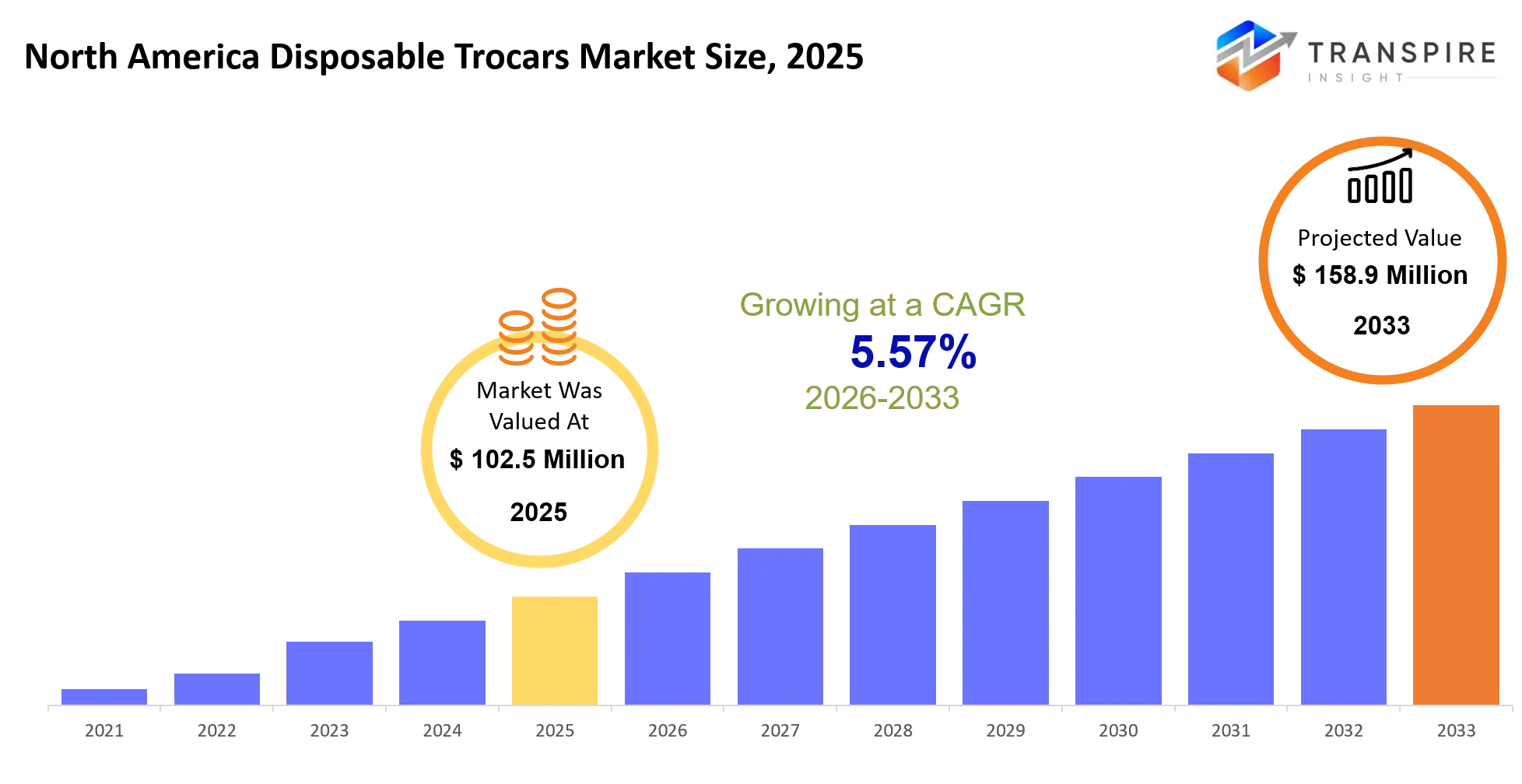
- North America Disposable Trocars Market Size 2025: USD 102.5 Million
- North America Disposable Trocars Market Size 2033: USD 158.9 Million
- North America Disposable Trocars Market CAGR: 5.57%
- North America Disposable Trocars Market Segments: By Product Type (Bladed Trocars, Bladeless Trocars, Optical Trocars, Balloon Trocars, Others), By Application (Laparoscopic Surgery, Bariatric Surgery, Gynecological Surgery, Urological Surgery, Others), By End User (Hospitals, Ambulatory Surgical Centers, Specialty Clinics, Others), By Material (Plastic Trocars, Stainless Steel Trocars, Hybrid Trocars, Others).
To learn more about this report,  Download Free Sample Report
North America Disposable Trocars Market Summary:
The North America Disposable Trocars Market size is estimated at USD 102.5 Million in 2025 and is anticipated to reach USD 158.9 Million by 2033, growing at a CAGR of 5.57% from 2026 to 2033.North America’s disposable trocars market , helps keep pace with the rising numbers of minimally invasive surgeries by supplying single-use access devices . These let surgeons bring in cameras and instruments inside the body while aiming for lower risk of cross-contamination. In day to day settings , the products tend to support hospitals with better procedural flow, uphold sterility requirements, and lower the extra workload that comes with reprocessing reusable surgical tools .
In the past three to five years , the market has actually shifted , more firmly, toward advanced laparoscopic approaches and robotic-assisted interventions . Those methods call for very dependable access systems and they also encourage heavier use of disposable components . The COVID-19 pandemic served as a big trigger , since it highlighted weak spots in sterilization workflows and it pushed many hospitals to favor single-use solutions that streamline infection-control practices . That realignment changed procurement focus quickly and it sped up buying of disposable surgical consumables. Going forward, as healthcare providers keep growing outpatient surgery volume and continue investing in minimally invasive treatment pathways, trocar use is getting more embedded in routine procedural steps. So , product utilization turns more recurring, manufacturers gain clearer revenue forecasts, and the installed base spreads across multiple surgical specialties .
Key Market Insights
- In North America, the United States basically dominates the Disposable Trocars Market, it brings in around 82% of the regional revenue in 2025, mostly because of stronger and more advanced surgical infrastructure. Meanwhile Canada shows the quickest growth during the forecast stretch, with laparoscopic procedures being adopted more often and with healthcare modernization efforts getting more traction.
- At the same time, reimbursement rules stay solid and investments tied to surgical innovation keep rising, so the regional market share picture keeps looking stronger, overall.
- When it comes to product types, bladeless disposable trocars are leading, capturing close to 48% of the North America Disposable Trocars Market in 2025 thanks to safety oriented profiles that feel more dependable.
- Optical disposable trocars sit in second place, they benefit from better visualization and tighter precision for minimally invasive procedures, which clinicians like in practice.
- Balloon-access trocars are the fastest to pick up steam through 2030, driven by the need for stable port positioning and, also by lower tissue trauma, in general.
- For applications, laparoscopic surgery stays the clear heavyweight, taking about 62% market share in 2025 across both general and specialty workflows.
- Robotic-assisted surgery is the fastest-growing application segment, powered by more robotic system installs, and also by higher procedural complexity.
- More broadly, the rising use of minimally invasive techniques keeps pushing demand forward across gynecology, urology, and bariatric surgery, which adds up over time.
- Looking at end users, hospitals lead the market with nearly 68% revenue share in 2025, supported by high surgical volumes and upgraded operating room capabilities.
- Ambulatory Surgical Centers (ASCs) are the category that grows quickest, because of cost efficiency, and shorter recovery times for patients, compared with many traditional settings.
What are the Key Drivers, Restraints, and Opportunities in the North America Disposable Trocars Market?
The most powerful driver pushing the North America Disposable Trocars Market forward is the fast shift toward minimally invasive, and robotic assisted surgery. A lot of hospitals and surgical centers have leaned into these approaches because they help with quicker patient recovery, fewer days in the hospital, and better operating room flow. Over the last ten years the installation of robotic surgical platforms has really tightened the loop, since those systems depend on very dependable access devices to run precise work. Disposable trocars fit that need pretty directly by offering steady, predictable performance while also removing the whole reprocessing step. With surgical volumes rising each procedure keeps making recurring demand for single use access devices, and that turns straight into higher revenue for the market.
The biggest brake on progress is the ongoing cost pressure hitting healthcare providers. Disposable trocars often cost more per procedure than reusable options, so hospitals get squeezed by tight budgets especially when they’re stuck inside fixed reimbursement rules. This is kind of structural because reimbursement frameworks and procurement habits don’t change quickly. Many organizations are still trying to balance clinical value against operational expense, and this shows up a lot in community hospitals and smaller surgical facilities. So adoption moves slower in places where costs matter most, which then reduces how much of the market’s revenue upside it can actually capture.
A major growth opportunity is in pushing ambulatory surgical centers across North America forward, like really expanding them. Investors and healthcare systems are still sending capital toward outpatient surgical networks, because they tend to bring lower treatment costs and faster patient throughput, sort of. These facilities more and more prefer disposable devices, which makes the whole workflow easier and also cuts down on sterilization needs, it’s practical in a way. The ongoing shift of laparoscopic, bariatric, gynecological and urological procedures into outpatient settings provides a solid groundwork for the next stage of market expansion.
What Has the Impact of Artificial Intelligence Been on the North America Disposable Trocars Market?
Artificial intelligence together with advanced digital technologies are starting to reshape the North America Disposable Trocars Market, sort of indirectly, by pushing surgical planning forward, tightening inventory control, and making operating rooms run more efficiently. Hospitals more and more rely on AI- enabled surgical workflow platforms, to sift through procedure records, estimate what instruments will be needed, and automate inventory refills for high volume disposable items like trocars. The result is fewer stockouts, less discarded material, and better purchasing accuracy across surgical units.
At the same time, machine learning is being pulled into robotic assisted and laparoscopic surgery setups. These systems read procedural data to help refine trocar placement approaches, strengthen instrument tracking, and also back surgical navigation. Predictive analytics, in plain terms, can forecast how many procedures will happen based on past utilization routines. That lets healthcare organizations match disposable device stocks with what demand is likely to look like. In bigger hospital networks, these features can lower inventory carrying expenses, while still keeping products actually on hand.
From an operations angle, digital tracking tools have boosted supply chain transparency and cut down procurement turnaround times. Meanwhile data driven operating room management has contributed to better procedural throughput and more efficient use of shared resources. Together, these advantages make disposable access devices more attractive to both hospitals and ambulatory surgical centers.
Still, AI rollouts are held back by integration expenses and healthcare data that feels fragmented. A lot of providers work across multiple software environments and that can make it hard to create high quality, standardized datasets needed for dependable predictive models and broad automation, even when teams really want it.
Key Market Trends
- Starting in 2020, hospitals kind of moved procurement toward disposable trocars, aiming to shrink the sterilization complication and also tighten infection-control rules after pandemic related disruptions, which was… you know, messy for a while.
- Then between 2021 and 2025, robotic-assisted surgery took off faster and faster, so demand rose for precision engineered access devices that actually play nice with advanced surgical platforms.
- Ambulatory surgical centers also pushed laparoscopic volumes higher, and that made single-use products feel more appealing because they streamline the workflow, and help cut turnaround times a bit.
- Manufacturers like Medtronic and Johnson & Johnson have ramped up investment in bladeless and optical trocar approaches, mostly to make procedures safer a nd to lower preventable problems, you know.
- In the middle of the 2020 and 2021 supply chain disruptions, healthcare providers began diversifying where they buy from, and they also held bigger stockpiles of key surgical consumables.
- At the same time, purchasing decisions shifted away from just looking at unit price comparisons, and now it feels more about overall procedural efficiency, which points to a clearer focus on operating room productivity.
- After 2022, digital inventory management platforms got more traction, and they let hospital networks forecast trocar utilization, so procurement delays were less frequent, or at minimum less of a surprise.
- Competition is increasingly focused on integrated access solutions, with manufacturers bundling trocars together with laparoscopic and robotic surgical portfolios, kind of like one package, rather than separate pieces.
- In Canada, health systems accelerated investment in minimally invasive surgery after 2021, which effectively made the adoption curve quicker than in earlier years.
North America Disposable Trocars Market Segmentation
By Product Type
In the product type segment, bladeless trocars keep the top market position , because many healthcare providers are starting to value patient safety more and more, along with less tissue trauma and steadier insertion control during minimally invasive work. Optical trocars are not far behind, since surgeons want sharper visualization during abdominal entry, especially when cases get tricky in complex laparoscopic procedures, and also in robotic assisted surgery. Bladed trocars still have a place in cost focused facilities and for certain procedural demands , but even so the overall market preference has been drifting—slowly—toward safer options.
Balloon trocars take up a smaller, yet growing, niche, mainly due to their ability to hold a secure access port and keep the procedure more stable. There are also other specialized trocar designs that back more targeted surgical needs, when standard products just don’t deliver the right performance. Looking ahead, growth will likely tilt toward advanced access systems that blend safety features with visualization benefits, while also staying compatible with robotic platforms. Companies that invest in distinct product designs should be able to improve their competitive position , as hospitals increasingly judge devices by clinical results and by how efficiently the operating room runs.
By Application
Application patterns are really being pushed around by the continued expansion of minimally invasive surgery across multiple specialties , and well it kind of flows from there. Laparoscopic surgery is still the dominant application, largely because it covers a wide range of general surgical procedures and it basically sits at the foundation of trocar utilization. Gynecological and urological surgeries make up a lot of the demand, since more physicians keep adopting minimally invasive approaches, mostly to speed up recovery and shorten hospital stays.
Bariatric surgery is showing up as one of the fastest-growing applications too, supported by higher obesity treatment volumes and also broader insurance coverage for these kinds of surgical interventions. Beyond that, other specialty procedures keep adding incremental demand as technological advancements keep expanding the reach of minimally invasive techniques. Looking forward , robotic-assisted surgery is expected to shift the application dynamics, mainly by driving higher needs for very precise access devices. That change, it really opens doors for suppliers who can line up product development with the evolving procedural complexity and, not least, the surgeon preferences.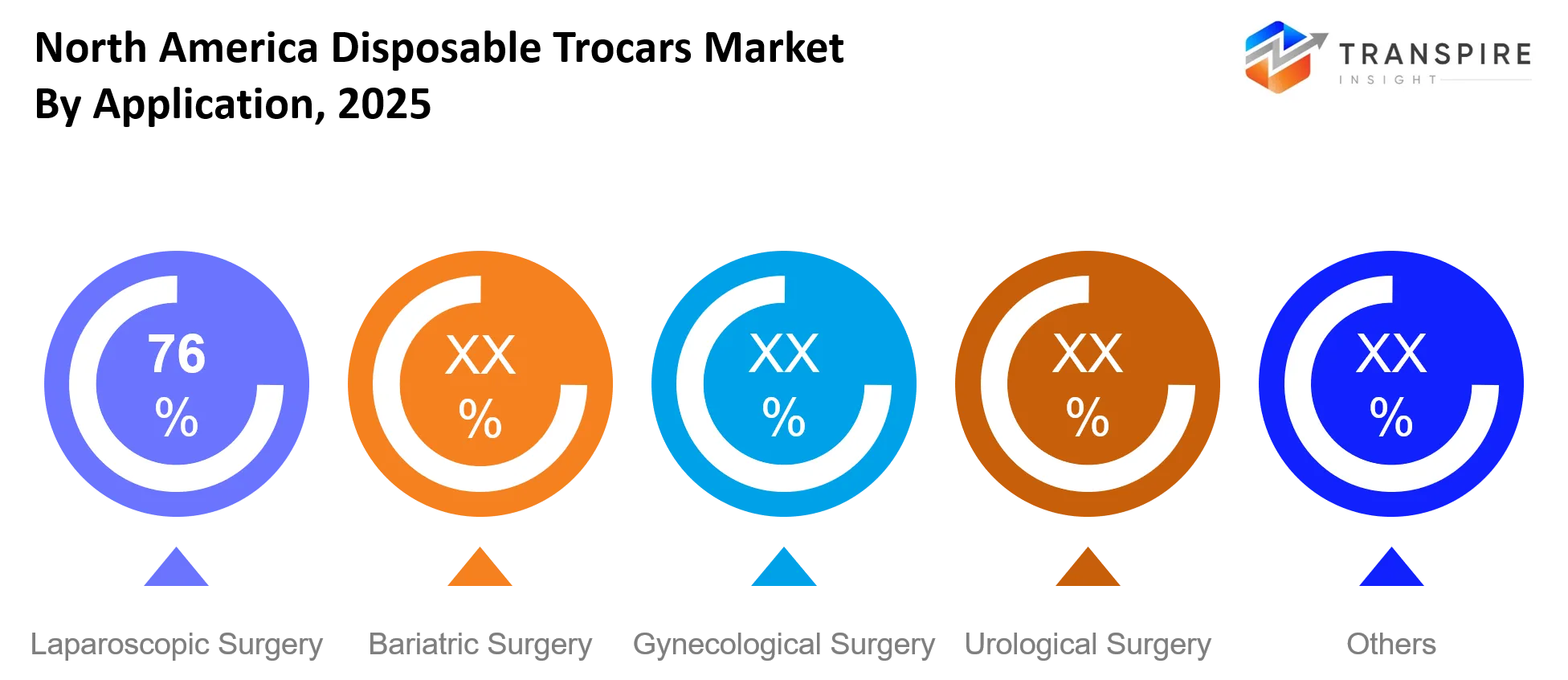
To learn more about this report, Download Free Sample Report
By End-User
Hospitals are still the biggest end user slice because of high case volumes, solid surgical setups ,and the wide uptake of laparoscopic as well as robotic assisted methods. Most big health systems often run repeatable procurement programs, so purchases of disposable surgical access devices keep coming in again and again. That said, ambulatory surgical centers are really gathering speed right now as clinicians move more appropriate procedures into lower cost outpatient settings. Patients move through faster, workflows get more streamlined ,and the facility costs tend to drop which all keeps pushing that shift.
Specialty clinics show up with a smaller footprint, though they still generate consistent demand in specific care areas where minimally invasive steps are very typical. Then there are other healthcare facilities that add extra buying activity, especially in local and community type environments. For the future, market growth will depend more and more on how well outpatient surgery expands and how efficient healthcare systems become. Suppliers that can craft practical, cost driven solutions for ambulatory use are probably going to do better as the way procedures are delivered keeps changing.
By Material
Material choice is kind of a big deal in shaping how well a product works, what it costs to produce, and even how the end user feels about it. Plastic trocars still show up a lot , mostly because they’re cost effective, they stay light, and they fit neatly into single-use surgery practices. Since disposable devices became the norm, the pull for designs based on plastic has only grown , especially because they line up with infection-control goals and also make inventory things simpler to run.
Stainless steel trocars are still around in certain situations, where durability and structural strength really matter, even if their use has slowly dropped off inside the disposable product lane. Hybrid trocars , which mix more than one material, try to hit that middle ground between stiffness, hand feel, and overall clinical results. Because of that, they’re starting to look like a better fit for more advanced operations. Beyond that, there are other material setups too , aimed at very specific needs in smaller niche use cases.
Going forward, innovation will likely concentrate on improving material performance while still keeping production costs under control. The companies that manage to boost functionality without pushing affordability out the window will probably be positioned to grab new opportunities across a range of healthcare environments.
What are the Key Use Cases Driving the North America Disposable Trocars Market?
Disposable trocar use is mostly for laparoscopic surgery that happens in hospital settings, you know like routine cases but still, there’s a lot riding on dependable abdominal access. Surgeries such as removing the gallbladder, fixing a hernia, or doing colorectal procedures often need access devices that can be trusted every time. Because procedural numbers stay high and infection control rules are strict, single-use trocars end up as the more preferred option, and they pull in the biggest chunk of overall market demand.
Still, it’s not just general surgery moving forward. Adoption keeps expanding into bariatric, gynecological, and urological procedures. Outpatient or ambulatory surgical centers also lean toward disposable access systems, it helps with smoother workflow, cuts down instrument reprocessing, and in general allows faster patient turnover. It’s kind of a practical fit when the day is packed.
More recently, you can see emerging applications inside robotic-assisted surgery programs and some advanced specialty workflows. As clinics invest in next generation surgical platforms, the need is rising for precision-engineered trocars that are built for complicated interventions, not just the basic steps. There’s also growth along same-day surgical pathways, where efficiency sterility, and procedural consistency are starting to matter more as purchasing criteria.
|
Report Metrics |
Details |
|
Market size value in 2025 |
USD 102.5 Million |
|
Market size value in 2026 |
USD 108.7 Million |
|
Revenue forecast in 2033 |
USD 158.9 Million |
|
Growth rate |
CAGR of 5.57% from 2026 to 2033 |
|
Base year |
2025 |
|
Historical data |
2021 - 2024 |
|
Forecast period |
2026 - 2033 |
|
Report coverage |
Revenue forecast, competitive landscape, growth factors, and trends |
|
Country scope |
North America (Canada, The United States, and Mexico) |
|
Key company profiled |
Medtronic, Johnson & Johnson, Applied Medical, ConMed, B. Braun, Purple Surgical, Teleflex, CooperSurgical, GENICON, LaproSurge, Ackermann Instrumente, G T.K Medical, Endopath, Surgsci Medical, Frankenman International |
|
Customization scope |
Free report customization (country, regional & segment scope). Avail customized purchase options to meet your exact research needs. |
|
Report Segmentation |
By Product Type (Bladed Trocars, Bladeless Trocars, Optical Trocars, Balloon Trocars, Others), By Application (Laparoscopic Surgery, Bariatric Surgery, Gynecological Surgery, Urological Surgery, Others), By End User (Hospitals, Ambulatory Surgical Centers, Specialty Clinics, Others), By Material (Plastic Trocars, Stainless Steel Trocars, Hybrid Trocars, Others) |
Which Regions are Driving the North America Disposable Trocars Market Growth?
The United States still feels like the main area in the North America Disposable Trocars Market, mostly because it has high surgical volume, a rather advanced healthcare framework, and it tends to pick up minimally invasive practices early. There are also strong reimbursement rules that back new spending on laparoscopic and robotic-assisted operations in big hospital systems. On top of that, there’s a solid mix of hospitals, academic medical centers and ambulatory surgical sites that keeps demand steadier for disposable surgical access tools. Plus, ongoing funding for surgical technology and clinical training kinda locks in the leadership position, even when other regions move faster.
Canada sits as the second-largest region, though the growth story is not identical to the U.S. Market results are helped by a stable public healthcare system that keeps pointing toward long-term upgrading of surgery and patient outcomes. Minimally invasive techniques get adopted in a consistent way across provincial healthcare networks, so disposable trocars keep finding a reliable buyer base. Procurement there can be more structured, and in many places centralized, so suppliers usually see a more predictable path to revenue. Still, the overall direction remains steady, with demand staying aligned to modernization efforts.
Mexico seems to be showing up as the fastest-growing regional market, as healthcare providers push harder to expand access to advanced surgical procedures and more modern operating room technologies. Lately, investments in private hospitals, specialty surgical centers, and even medical tourism infrastructure are speeding up the move toward minimally invasive surgery. With the growing availability of laparoscopic equipment, plus ongoing surgeon training programs, things look set for broader adoption of disposable access devices. This overall momentum is kind of interesting for manufacturers and investors who want higher-growth markets from 2026 to 2033, especially in major urban healthcare hubs, and where private care networks are still expanding.
Who are the Key Players in the North America Disposable Trocars Market and How Do They Compete?
Competition in the North America disposable Trocars Market is somewhat consolidated, in the sense that a small group of multinational medical device makers ends up controlling a big chunk of the procedural volume. Overall, tech innovation has shifted the playing field, so purchasing choices that used to be more price-forward now take a back seat. Hospitals, more and more, judge trocar systems on insertion safety , visualization strength, and how well the devices fit with robotic-assisted workflows, plus how smoothly things run in the operating room. Larger brands keep defending their shares by product differentiation and by offering an entire surgical package, not just one access device, but a connected suite. At the same time , specialized firms go after narrower procedural pockets, where clinical results can matter more than raw scale.
Medtronic competes using wide procedural integration and ongoing product development. The advantage there comes partly from the way it can pair access devices with laparoscopic and advanced surgical platforms, which can translate into procurement perks for hospital networks. Johnson & Johnson , by contrast, leans on deep surgeon relationships and a broad minimally invasive surgery ecosystem. Their continued spending on surgical innovation and digital OR capabilities helps keep them strong inside high-volume health systems. Applied Medical meanwhile concentrates on specialized access technology and a surgeon-centered design approach, so it can hold its ground in cases where being easy to use , and delivering good clinical outcomes, end up driving the buying decision more than anything else.
CONMED Corporation seems to push for procedural efficiency plus a kind of, targeted innovation, within minimally invasive surgery. Their whole strategy is basically about practical solutions that help operating room productivity move along smoothly, while still keeping competitive pricing in mind. BD on the other hand leans hard on its broad hospital supply chain presence and its infection-prevention know-how, to keep customers longer and to open up cross selling chances. In the wider industry, a lot of companies are expanding by doing strategic partnerships with healthcare systems , plus investing in robotic surgery compatibility, and also working on more advanced optical and bladeless trocar platforms. All of that together helps manufacturers lock in long term contracts, boost the clinical value pitch, and improve their competitive stance , especially as minimally invasive surgery volumes keep increasing.
Company List
- Medtronic
- Johnson & Johnson
- Applied Medical
- ConMed
- B. Braun
- Purple Surgical
- Teleflex
- CooperSurgical
- GENICON
- LaproSurge
- Ackermann Instrumente
- G T.K Medical
- Endopath
- Surgsci Medical
- Frankenman International
Recent Development News
In May 2026, Teleflex Reports First Quarter Financial Results and Announces CEO Transition: Teleflex, a major supplier of surgical access and minimally invasive surgery products, reported first-quarter 2026 results while announcing the appointment of Jason Weidman as President and Chief Executive Officer effective June 2026. The leadership transition comes as the company continues portfolio optimization and focuses on growth in hospital and surgical technologies, including products used in laparoscopic procedures where disposable trocars are commonly utilized.
Source: https://www.businesswire.com
In February 2026, Teleflex Reports 2025 Financial Results and Full-Year 2026 Outlook: Teleflex announced its 2026 outlook alongside financial results and restructuring initiatives tied to previously announced strategic divestitures. The company's efforts to streamline operations and concentrate on higher-growth medical technology segments could influence future investment in minimally invasive surgical portfolios and disposable surgical-access products.
Source: https://www.nasdaq.com
What Strategic Insights Define the Future of the North America Disposable Trocars Market?
The North America Disposable Trocars Market is kinda moving, structurally, toward more integrated surgical access ecosystems rather than just standalone device sales. Over the next five to seven years growth will be pulled more and more by the coming together of robotic-assisted surgery, expansion of outpatient procedures, and data-driven operating room management. As healthcare providers keep looking for procedural efficiency and steadier clinical results, purchasing decisions are probably going to lean toward suppliers that can deliver a full procedural package… not only one product at a time.
There is also a less obvious risk, it’s kind of hidden in how procurement works. Market concentration inside hospital procurement networks can matter a lot. Large group purchasing organizations keep consolidating buying power, this can squeeze margins and it may also put up barriers for smaller manufacturers even if procedure growth trends look good. Another issue that could show up involves raw material sourcing disruptions which then hits production economics for single-use medical devices.
Still, one emerging opportunity is the creation of procedure-focused trocar systems that are optimized for robotic cases and same-day surgical workflows. Manufacturers and investors should probably put priority on partnerships with ambulatory surgical center networks and robotic surgery programs, because purchasing behavior is changing faster there. And the long term adoption potential is still, in many areas, under tapped or at least not fully priced in.
North America Disposable Trocars Market Report Segmentation
By Product Type
- Bladed Trocars
- Bladeless Trocars
- Optical Trocars
- Balloon Trocars
- Others
By Application
- Laparoscopic Surgery
- Bariatric Surgery
- Gynecological Surgery
- Urological Surgery
- Others
By End User
- Hospitals
- Ambulatory Surgical Centers
- Specialty Clinics
- Others
By Material
- Plastic Trocars
- Stainless Steel Trocars
- Hybrid Trocars
- Others
Frequently Asked Questions
Find quick answers to common questions.
The Approximate North America Disposable Trocars Market size for the Market will be USD 158.9 Million in 2033.
The key Segments of the North America Disposable Trocars Market are By Product Type (Bladed Trocars, Bladeless Trocars, Optical Trocars, Balloon Trocars, Others), By Application (Laparoscopic Surgery, Bariatric Surgery, Gynecological Surgery, Urological Surgery, Others), By End User (Hospitals, Ambulatory Surgical Centers, Specialty Clinics, Others), By Material (Plastic Trocars, Stainless Steel Trocars, Hybrid Trocars, Others).
Major Players in the North America Disposable Trocars Market are Medtronic, Johnson & Johnson, Applied Medical, ConMed, B. Braun, Purple Surgical, Teleflex, CooperSurgical, GENICON, LaproSurge, Ackermann Instrumente, G T.K Medical, Endopath, Surgsci Medical, Frankenman International.
The Current Market size of the North America Disposable Trocars Market is USD 102.5 Million in 2025.
The North America Disposable Trocars Market CAGR is 5.57%.
- Medtronic
- Johnson & Johnson
- Applied Medical
- ConMed
- B. Braun
- Purple Surgical
- Teleflex
- CooperSurgical
- GENICON
- LaproSurge
- Ackermann Instrumente
- G T.K Medical
- Endopath
- Surgsci Medical
- Frankenman International
About the Authors

Pankaj Ghogare Patil
I am Pankaj Ghogare Patil, a Senior Research Analyst at Transpire Insight, specializing in the Pharmaceutical, Chemicals & Materials, Healthcare IT, and Biotechnology industry. My expertise lies in conducting comprehensive market research, analyzing industry trends, evaluating competitive landscapes, and translating complex data into actionable insights. At Transpire Insight, I closely follow emerging technologies, regulatory developments, and market innovations to create accurate, well-researched, and informative content that helps businesses and professionals make informed decisions. I am committed to producing credible, evidence-based articles that reflect industry best practices while making technical topics accessible and valuable for a broad audience.

Chakradhar Khansole
Chakradhar serves as the Research Director at Transpire Insight, bringing over 8 years of experience in technology, innovation, and strategic market intelligence. He specializes in transforming complex market data into actionable business insights that enable organizations to make informed, growth-oriented decisions. Recognized for his strategic vision and analytical expertise, Chakradhar leads high-impact research initiatives, delivering comprehensive market assessments, competitive intelligence, and forward-looking industry analysis.
Recently Published Reports
-
Jul 2026
Alopecia Treatment Market
Alopecia Treatment Market Size, Share & Analysis Report By Disease Type (Alopecia Areata, Cicatricial Alopecia, Traction Alopecia, Alopecia Totalis, Androgenetic Alopecia, Alopecia Universalis, and Other Disease Types), By Treatment Type (Topical Treatments, Oral Medications, Injectable Therapies, and Hair Transplantation), By Gender (Male, and Female), By Distribution Channel (Hospitals and Clinics, Retail Pharmacies, and Online Retailers), and Geography (North America, Europe, Asia-Pacific, Middle East and Africa, South and Central America), 2021 - 2031
-
Jul 2026
Medical Ultrasound Probe Market
Medical Ultrasound Probe Market Size, Share & Analysis Report By Type (Linear Type, Convex Type, Endocavitary Probe, Phased Array/Cardiac Probe, Transesophageal (TEE) Probe, and Others), By Application (Ophthalmology, Cardiology, Musculoskeletal, Oncology, Obstetrics & Gynecology, General Imaging, and Others), By End User (Hospitals & Clinics, Diagnostic Centers, Ambulatory Surgical Centers, and Others), and Geography (North America, Europe, Asia-Pacific, Middle East and Africa, South and Central America), 2021 – 2031
-
May 2026
Biosimilars Market
Biosimilars Market By Product Type (Monoclonal Antibodies, Recombinant Hormones, Erythropoietin, G-CSF, Others), By Indication (Oncology, Autoimmune Diseases, Blood Disorders, Diabetes, Others), By Manufacturing Type (In-House Manufacturing, Contract Manufacturing), By Distribution Channel (Hospital Pharmacies, Retail Pharmacies, Online Pharmacies), By Industry Analysis, Size, Share, Growth, Trends, and Forecasts 2021-2033
-
Apr 2026
Gastrointestinal Endoscopy Market
Gastrointestinal Endoscopy Market By Type (Rigid Gastrointestinal Endoscope, Flexible Gastrointestinal Endoscopes, Disposable Gastrointestinal Endoscope), By Procedure Type (Colonoscopy, Gastroscopy, Duodenoscopy, Enteroscopy, Flexible Sigmoidoscopy, Others), By Application (Diagnosis, Treatment), By End-Users (Hospitals, Ambulatory Surgical Centers, Specialty Clinics, Laboratories, Others), By Industry Analysis, Size, Share, Growth, Trends, and Forecasts 2021-2033