Japan Hospital Assisted Surgical Robot Procedures Market Size & Forecast:
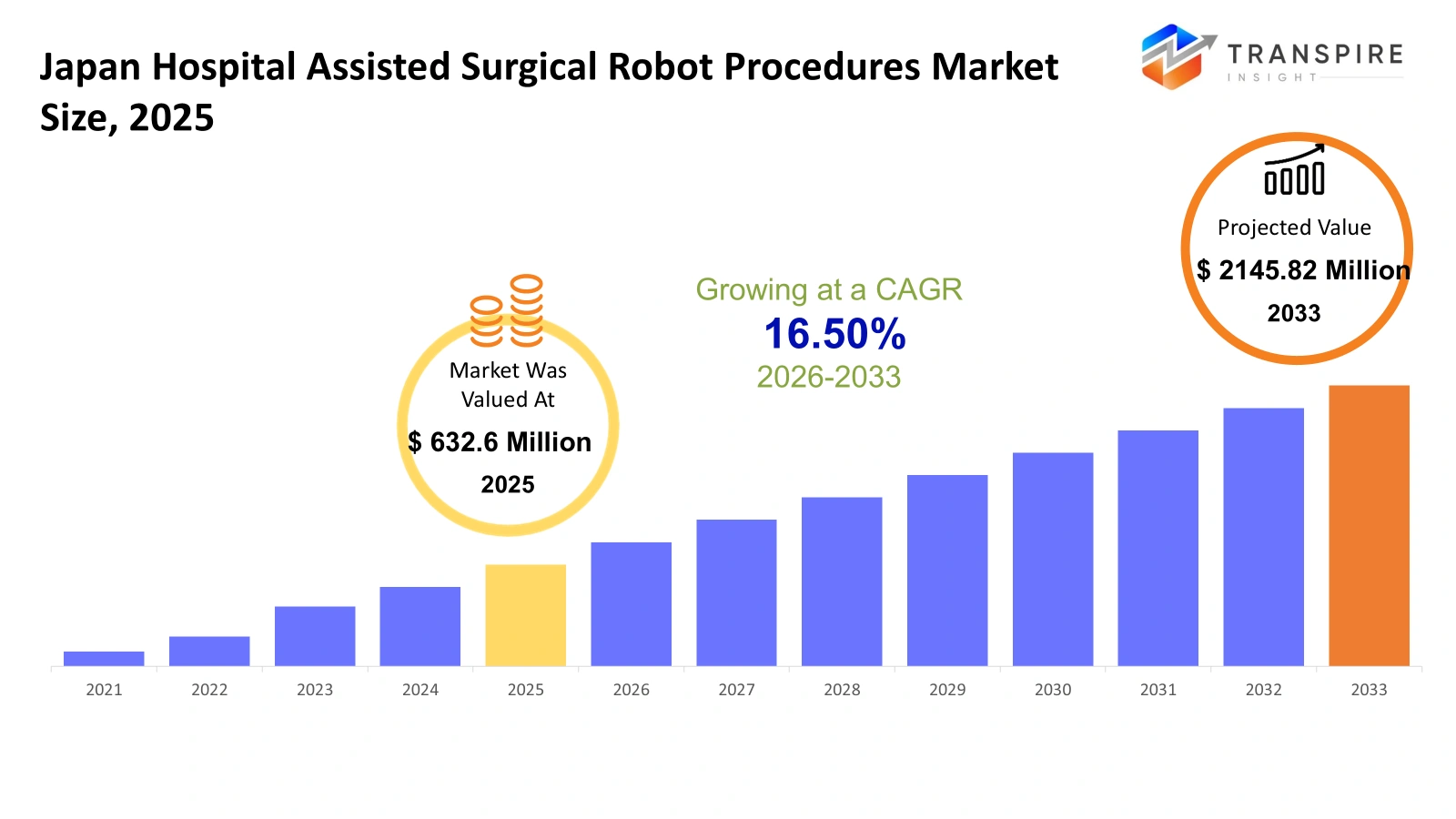
- Japan Hospital Assisted Surgical Robot Procedures Market Size 2025: USD 632.6 Million
- Japan Hospital Assisted Surgical Robot Procedures Market Size 2033: USD 2145.82 Million
- Japan Hospital Assisted Surgical Robot Procedures Market CAGR: 16.50%
- Japan Hospital Assisted Surgical Robot Procedures Market Segments: By Robot Type (Surgical Robots, Rehabilitation Robots, Hospital Automation Robots), By Application (Orthopedic Surgery, Neurosurgery, Laparoscopic Surgery, Urology Surgery).
To learn more about this report,  Download Free Sample Report
Japan Hospital Assisted Surgical Robot Procedures Market Summary:
The Japan Hospital Assisted Surgical Robot Procedures market size is estimated at USD 632.6 Million in 2025 and is anticipated to reach USD 2145.82 Million by 2033, growing at a CAGR of 16.50% from 2026 to 2033. The surgical robot market in Japan through hospital-assisted procedures shows continuous growth because hospitals now prioritise precise medical treatments and the elderly population demands less invasive surgical options. Hospitals throughout Japan are adopting robotic systems because these technologies improve their surgical precision, which leads to faster patient recovery times and better treatment results. The availability of qualified surgeons together with advanced medical equipment and government backing creates an environment that supports increased technology usage. High treatment expenses continue to present a problem, yet ongoing research developments combined with growing public knowledge will create more treatment options, which will establish robotic-assisted surgeries as a standard healthcare practice in Japan.
Key Market Trends & Insights:
- The Japanese population shows a rising tendency to select medical procedures which require smaller surgical cuts and result in quicker patient recovery. The demand for surgical procedures is met through robotic-assisted surgeries, which deliver precise medical results and decrease patient discomfort after surgery.
- The aging demographic of Japan results in increased surgical demand for treating chronic medical conditions. Hospitals adopt robotic technology to execute complicated medical operations through safer and more efficient methods.
- Surgical precision improves through constant advancements in robotic platforms together with imaging technologies and AI system integration. The new technologies enable surgeons to carry out intricate medical operations which require precise control and heightened operational certainty.
- Hospitals with leading status establish surgical robot systems to enhance their market position while delivering superior medical services to their patients. Urban healthcare facilities which possess strong financial resources display this pattern of technological evolution.
- The Japanese medical system lacks enough qualified surgeons to meet rural area healthcare needs. Robotic technology delivers essential support to surgeons, which results in consistent treatment results across multiple medical centres.
- The expensive nature of robotic systems with their maintenance needs prevents many facilities from implementing these technologies. Hospitals with lower patient volumes face difficulties in proving their investment needs because they lack adequate patient numbers.
- Medical institutions are focusing on training surgeons to operate robotic systems effectively. The process creates higher confidence levels, which lead to faster implementation of robotic-assisted medical procedures.
Japan Hospital Assisted Surgical Robot Procedures Market Segmentation
By Robot Type
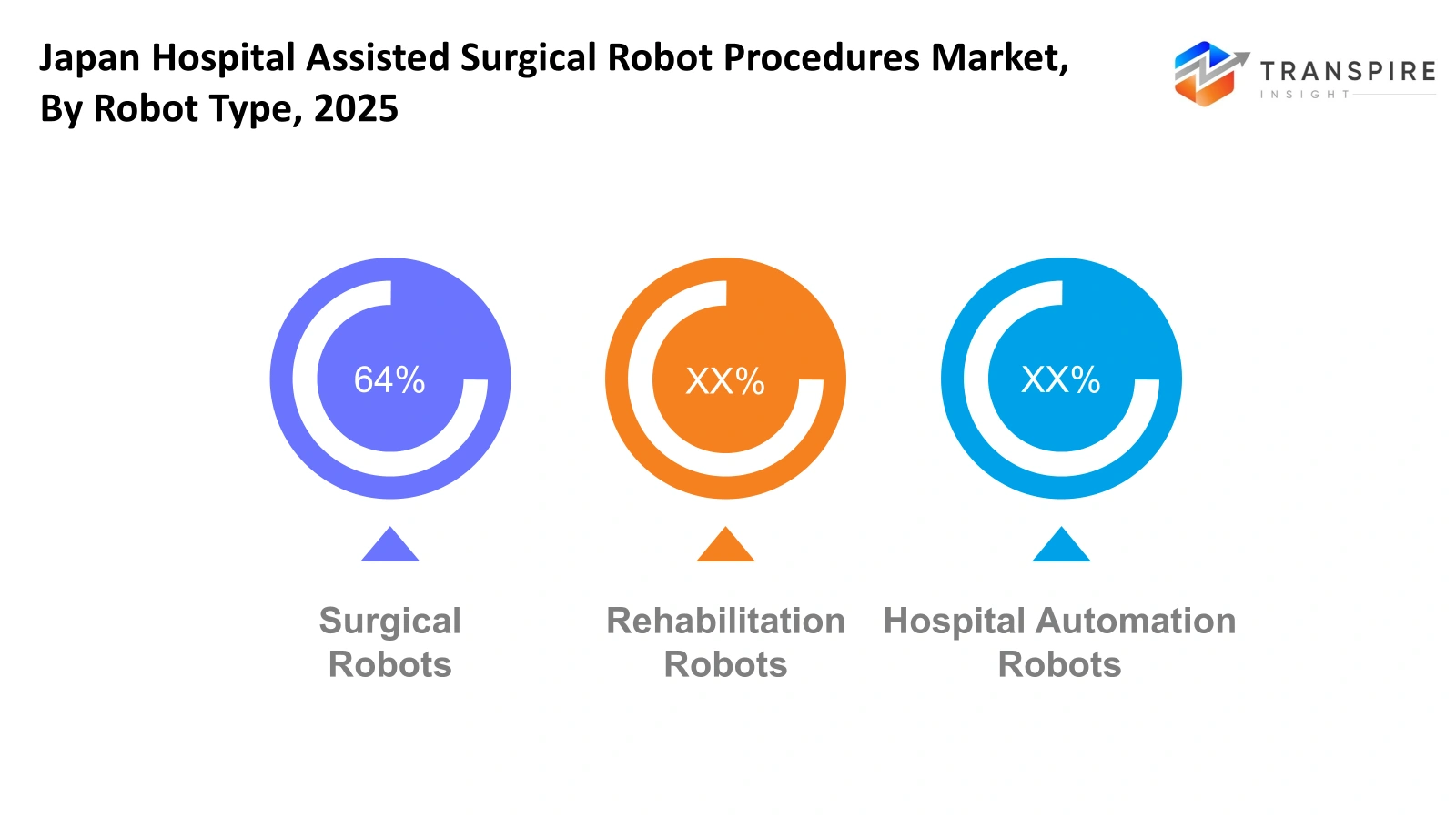
- Surgical Robots: Robotic systems in Japan establish themselves as essential components for performing surgical operations that need accurate control during their complex surgeries. The systems provide surgeons with assistance through their minimally invasive methods, which lead to better results for patients who experience shorter recovery periods. The growing acceptance of these technologies shows that hospitals are dedicated to providing surgical services which use cutting-edge technology while maintaining reliable operational performance.
- Rehabilitation Robots: Japan is increasingly using rehabilitation robots because the country needs effective solutions for post-surgical rehabilitation which targets elderly patients. The robots help patients during their physical therapy sessions by providing assistance which enables them to restore their walking abilities and their physical strength more quickly. Hospitals use these systems more frequently because they help patients recover from their surgical operations in a more efficient way.
- Hospital Automation Robots: Hospital automation robots operate as efficiency boosters because they take over common duties, which include handling logistics work, maintaining cleanliness, and offering patient support. The robots help Japanese facilities handle their staff shortages because they enable employees to complete their tasks with greater efficiency. The system enables healthcare facilities to operate at a higher level of intelligence, which allows doctors to spend more time with their patients.
To learn more about this report, Download Free Sample Report
By Application
- Orthopedic Surgery: Robotic technology is growing in orthopedic surgery across Japan because it improves surgical accuracy for both joint replacements and bone surgical procedures. The systems assist surgeons in achieving optimal alignment, which leads to better surgical results that enable patients to maintain their mobility throughout their lives. The elderly population shows an increasing need for this technology, which drives its growth in this market.
- Neurosurgery: Robotic systems provide neurosurgeons with precise instruments that enable them to conduct operations on fragile brain and spinal tissues. Japanese hospitals use these advanced technologies to decrease surgical risks while enhancing their operational success rates. The field now requires robotics as essential equipment because it enables personnel to execute challenging operations with higher operational stability.
- Laparoscopic Surgery: Japan currently experiences a rise in laparoscopic surgery operations that receive robotic technology support, which enhances surgical visibility and operational control. Through their robotic systems surgeons can conduct minor surgeries with better operational capabilities. Hospitals now find robotic-assisted laparoscopy to be a popular choice because patients prefer it for delivering faster recovery times and reduced discomfort levels.
- Urology Surgery: Urology remains one of the most established areas for robotic-assisted procedures in Japan. The medical field uses robots to conduct prostate and kidney operations because these machines deliver accurate results while decreasing operation-related hazards. The equipment maintains steady performance levels while delivering favourable results to patients, which makes it the most popular option for doctors and medical facilities throughout the country.
Country Insights
Japan's hospital surgical robot market demonstrates its advanced technological capabilities, which the country uses to provide patient-centred medical services. Japanese hospitals operate their medical facilities by using existing robotic technology to improve surgical results and operational efficiency. Tokyo and Osaka, as major urban areas, have higher healthcare expenditures, which enable them to hire more qualified medical personnel.
The country’s ageing population plays a crucial role, driving demand for safer, minimally invasive procedures that reduce recovery time. Government initiatives and regulatory frameworks that support development have created an environment which drives innovation and technology usage. The Japanese healthcare system enables hospitals to deliver high-quality services because of its training programmes and infrastructural requirements. The ongoing challenges related to expenses are being addressed through technological progress and enhanced public knowledge, which results in improved access to services. Japan has established itself as a vital region for developing robotic surgical technologies throughout Asia.
Recent Development News
AI Robots Support Japan’s Ageing Healthcare System: Japan is increasingly integrating AI-driven robots into healthcare to support its ageing population. These robots assist in patient care and signal a broader shift toward automation in medical environments.
Humanoid Robot Nurse Unveiled for Elderly Care: A human-like robot nurse showcased in Japan highlights how robotics is entering patient handling and care support. It reflects future integration alongside surgical robotics in hospitals.
|
Report Metrics |
Details |
|
Market size value in 2025 |
USD 632.6 Million |
|
Market size value in 2026 |
USD 736.95 Million |
|
Revenue forecast in 2033 |
USD 2145.82 Million |
|
Growth rate |
CAGR of 16.50% from 2026 to 2033 |
|
Base year |
2025 |
|
Historical data |
2021 – 2024 |
|
Forecast period |
2026 – 2033 |
|
Report coverage |
Revenue forecast, competitive landscape, growth factors, and trends |
|
Country scope |
Japan |
|
Key company profiled |
Intuitive Surgical Inc., Stryker Corporation, Medtronic PLC, Johnson & Johnson (Ethicon), Zimmer Biomet Holdings Inc., Smith & Nephew PLC, CMR Surgical Ltd., Asensus Surgical Inc., Accuray Incorporated, Titan Medical Inc., Renishaw PLC, Globus Medical Inc., Brainlab AG, Siemens Healthineers AG, Olympus Corporation. |
|
Customization scope |
Free report customization (country, regional & segment scope). Avail customized purchase options to meet your exact research needs. |
|
Report Segmentation |
By Robot Type (Surgical Robots, Rehabilitation Robots, Hospital Automation Robots), By Application (Orthopedic Surgery, Neurosurgery, Laparoscopic Surgery, Urology Surgery). |
Key Japan Hospital Assisted Surgical Robot Procedures Company Insights
The Japan hospital-assisted surgical robot procedures market is shaped by a mix of global innovators and strong domestic players, each contributing to steady technological progress. The companies develop surgical solutions through their efforts to enhance precision and create user-friendly systems that work with advanced imaging technologies. The company establishes trust with customers through hospital partnerships and ongoing training programmes, which enable wider product acceptance. The companies are currently developing strategies to make their systems more affordable and easier to use. The combination of competition and cooperation between companies drives technological progress, which enhances Japan's status in robotic-assisted medical treatment.
Company List
- Intuitive Surgical Inc.
- Stryker Corporation
- Medtronic PLC
- Johnson & Johnson (Ethicon)
- Zimmer Biomet Holdings Inc.
- Smith & Nephew PLC
- CMR Surgical Ltd.
- Asensus Surgical Inc.
- Accuray Incorporated
- Titan Medical Inc.
- Renishaw PLC
- Globus Medical Inc.
- Brainlab AG
- Siemens Healthineers AG
- Olympus Corporation
Japan Hospital Assisted Surgical Robot Procedures Market Report Segmentation
By Robot Type
- Surgical Robots
- Rehabilitation Robots
- Hospital Automation Robots
By Application
- Orthopedic Surgery
- Neurosurgery
- Laparoscopic Surgery
- Urology Surgery
Frequently Asked Questions
Find quick answers to common questions.
The approximate Japan Hospital Assisted Surgical Robot Procedures Market size for the Market will be USD 2145.82 Million in 2033.
The key segments of the Japan Hospital Assisted Surgical Robot Procedures Market are By Robot Type (Surgical Robots, Rehabilitation Robots, Hospital Automation Robots), By Application (Orthopedic Surgery, Neurosurgery, Laparoscopic Surgery, Urology Surgery).
Major players in the Japan Hospital Assisted Surgical Robot Procedures Market are Intuitive Surgical Inc., Stryker Corporation, Medtronic PLC, Johnson & Johnson (Ethicon), Zimmer Biomet Holdings Inc., Smith & Nephew PLC, CMR Surgical Ltd., Asensus Surgical Inc., Accuray Incorporated, Titan Medical Inc., Renishaw PLC, Globus Medical Inc., Brainlab AG, Siemens Healthineers AG, Olympus Corporation.
The current market size of the Japan Hospital Assisted Surgical Robot Procedures Market is USD 632.6 Million in 2025.
The Japan Hospital Assisted Surgical Robot Procedures Market CAGR is 16.50%.
- Intuitive Surgical Inc.
- Stryker Corporation
- Medtronic PLC
- Johnson & Johnson (Ethicon)
- Zimmer Biomet Holdings Inc.
- Smith & Nephew PLC
- CMR Surgical Ltd.
- Asensus Surgical Inc.
- Accuray Incorporated
- Titan Medical Inc.
- Renishaw PLC
- Globus Medical Inc.
- Brainlab AG
- Siemens Healthineers AG
- Olympus Corporation
Recently Published Reports
-
Apr 2026
AI in Diabetic Retinopathy Market
AI in Diabetic Retinopathy Market Size, Share & Analysis Report By Type (Screening AI Systems, Diagnostic AI Systems, and Predictive AI Models), By Application Segment (Hospitals, Ophthalmology Clinics, Diagnostic Centers, and Research and Development), and Geography (North America, Europe, Asia-Pacific, Middle East and Africa, South and Central America), 2021 - 2031
-
Apr 2026
Psychometric Tests Market
Psychometric Tests Market Size, Share & Analysis Report By Type (Personality Tests, Ability/Aptitude Tests, Skill/Knowledge Tests, and Others), By Application (Talent Acquisition and Talent Management), and Geography (North America, Europe, Asia-Pacific, Middle East and Africa, South and Central America), 2021 – 2031
-
Apr 2026
Rare Biological Sample Collection Market
Rare Biological Sample Collection Market Size, Share & Analysis Report By Type (Isolation Kits & Reagent, Blood Collection Tubes, and Others), By Application (Oncology, Transcriptomics, Pharmacogenomics, and Others), and Geography (North America, Europe, Asia-Pacific, Middle East and Africa, South and Central America), 2021 – 2031
-
Apr 2026
Patient Lift Pendant Market
Patient Lift Pendant Market By Product Type (Wired Pendants, Wireless, Programmable), By Operation Type(Manual, Electric), By End-Users (Healthcare Professionals, Patients), By Application (Hospitals, Homecare, Rehabilitation Centers, Others), By Industry Analysis, Size, Share, Growth, Trends, and Forecasts 2021-2033
Our Clients
.jpg)