
North America Dental Soft Tissue Regeneration Market Size & Forecast:
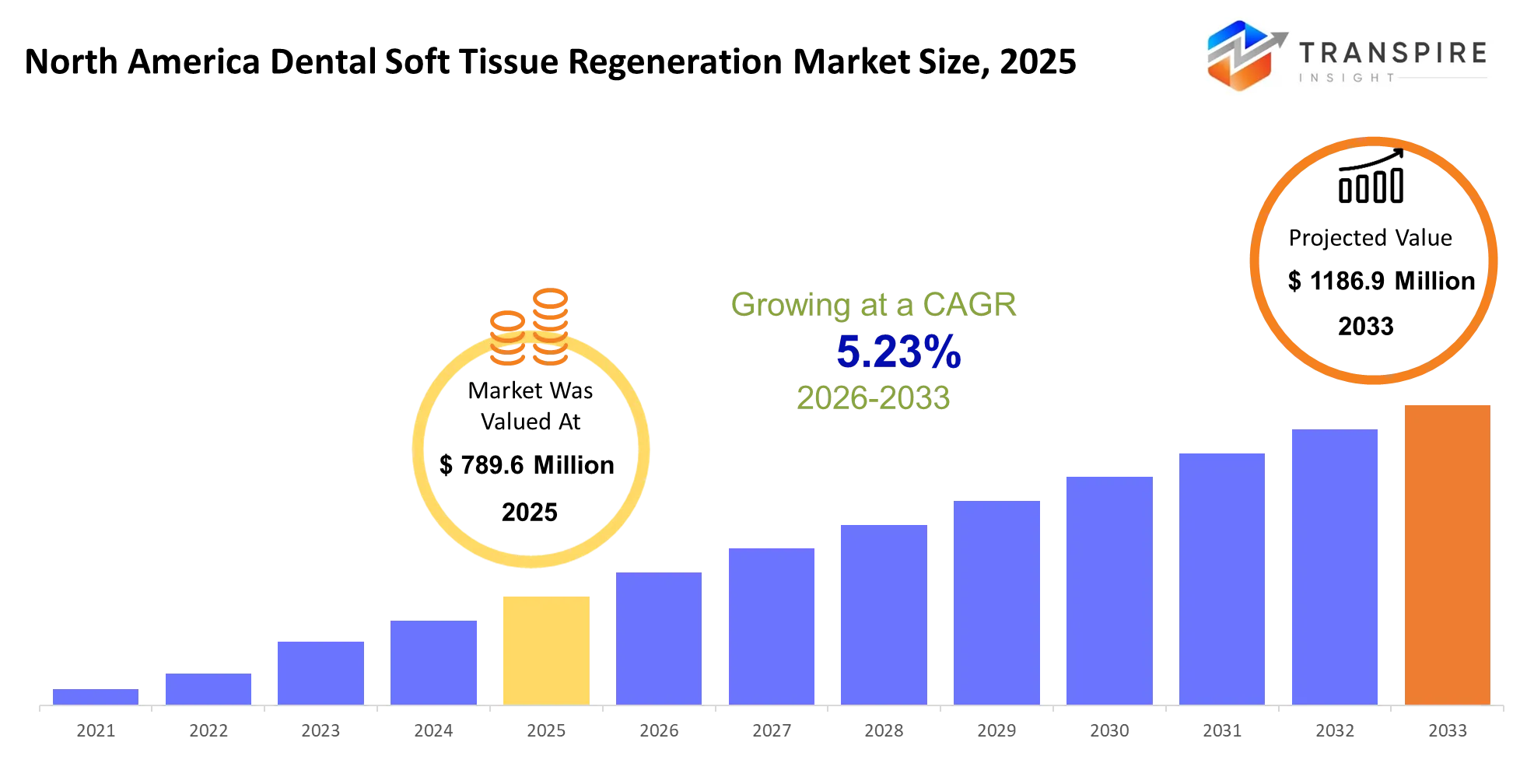
- North America Dental Soft Tissue Regeneration Market Size 2025: USD 789.6 Million
- North America Dental Soft Tissue Regeneration Market Size 2033: USD 1186.9 Million
- North America Dental Soft Tissue Regeneration Market CAGR: 5.23%
- North America Dental Soft Tissue Regeneration Market Segments: By Type (Collagen Membranes, Growth Factors, Grafts, Scaffolds, Others), By Application (Periodontal Repair, Implantology, Oral Surgery, Others), By End-User (Dental Clinics, Hospitals, Others), By Material (Natural, Synthetic, Hybrid, Others).
To learn more about this report,  Download Free Sample Report
North America Dental Soft Tissue Regeneration Market Summary:
The North America Dental Soft Tissue Regeneration Market size is estimated at USD 789.6 Million in 2025 and is anticipated to reach USD 1186.9 Million by 2033, growing at a CAGR of 5.23% from 2026 to 2033.The North America Dental Soft Tissue Regeneration Market is basically about helping with procedures that bring gum tissue back, the part that gets lost because of periodontal disease, trauma, implant complications, or oral surgery. Real world, these products let clinicians keep tooth stability better, nudge implant success rates upward, and also lower longer term restorative costs, since they rebuild soft tissue around teeth and implants instead of just choosing extraction, or going back and forth with repeated corrective work.
Over the last five years, things have kind of drifted away from the old fashioned grafting way of doing it , and more toward biologics, collagen matrices, and regenerative solutions that are less disruptive overall, they help recovery move quicker and the outcomes feel, more “predictable”, like actually doable. This change really started to pick up after COVID-19, because clinic backlogs piled up, so offices began leaning into procedures that are faster, higher in value, and come with patient results that look more consistent.At the same time, implant dentistry kept expanding—especially with aging populations who want both functional, and aesthetic restoration. That also creates more downstream demand for peri-implant soft tissue care, which people kinda overlook until they need it. Then digital dentistry, plus guided implant workflows are becoming routine in more clinics, so regenerative soft tissue products are now often built right into standard treatment plans helping specialists generate steadier, recurring procedural revenue.
Key Market Insights
- The United States really dominated the North America Dental Soft Tissue Regeneration Market, with more than 78% share in 2025, mainly because of advanced dental infrastructure, and— it just feels like everything is already set up there.
- Canada is showing the fastest momentum through 2032, pushed by a steady rise in cosmetic dentistry procedures and wider adoption of implant treatment, so yeah growth is kind of stacking up.
- Cross border investments in digital dentistry platforms keep moving forward, and that keeps supporting the North America Dental Soft Tissue Regeneration Market, both in overall industry size and in procedural efficiency.
- Better reimbursement access plus specialist periodontal networks, help the market go deeper across major metropolitan regions across North America.
- Biologic soft tissue regeneration materials led with nearly 42% of revenue in 2025, largely due to dependable healing outcomes , and fewer surgical complications, which is what clinicians want.
- Collagen based dental membranes ended up with the second largest market share , mainly because they work well across a wide range of implantology applications and also for periodontal surgery, not to mention a smoother healing pattern overall.
- When it comes to segment growth , xenograft and allograft substitute options are moving the fastest through 2032, since clinicians are starting to lean more toward minimally invasive regenerative treatment protocols, even when the case looks a bit complicated.
- Demand for customized regenerative matrices jumped in a noticeable way from 2022 to 2025, and that lines up well with the growing integration of digital implant workflows , where the planning and execution kind of sync together more quickly.
- Periodontal defect regeneration still stays central as a revenue driving application, especially across specialty periodontal clinics and advanced oral surgery centers.
What are the Key Drivers, Restraints, and Opportunities in the North America Dental Soft Tissue Regeneration Market?
The strongest force pushing the North America Dental Soft Tissue Regeneration Market ahead is the fast growth of dental implant procedures, mixed with a noticeable move toward biologic centered regenerative dentistry. In the last five years, digital implant planning systems along with guided surgery platforms, managed to cut down on some of the procedural variability and they also helped raise implant success rates. Because of that, clinicians are more willing to add soft tissue regeneration products into what they already do during implant workflows, more like a default step. This shift tends to lift revenue per procedure too, since regenerative membranes, collagen matrices, and growth factor biologics are frequently grouped inside newer implant packages. At the same time , aging populations in the United States and Canada have increased the demand for full arch restorations, and in those cases peri-implant soft tissue stability is pretty much a make or break factor for long term results.
The market’s biggest structural drag still comes down to high procedural costs and a reimbursement picture that can feel inconsistent, depending on where you are. A lot of soft tissue regeneration procedures rely on specialist periodontists, plus oral surgeons, who have more advanced training, so access can shrink outside of major urban areas. On top of that, insurance support for regenerative biomaterials is uneven across North America, which ends up making patients pay a larger share out of pocket. That situation delays elective decisions and it dampens adoption among mid income patient groups, especially when the goal is aesthetic work or preventive interventions.
A big growth chance is showing up through bioactive, and tissue engineered regenerative stuff being plugged into digital dentistry ecosystems, kinda like it all connects. Companies are putting money into next generation collagen scaffold materials and platelet derived biomaterials, meant to speed up recovery while also cutting down on the amount of donor tissue harvesting. Meanwhile, specialty dental service organizations across the United States are starting to standardize these technologies across multi clinic networks, and that is giving them scalable purchasing options along with more recurring, procedural revenue.
What Has the Impact of Artificial Intelligence Been on the North America Dental Soft Tissue Regeneration Market?
Artificial intelligence together with advanced digital technologies is, in kind of a real way, reshaping the North America Dental Soft Tissue Regeneration Market ,mostly because they boost diagnostic accuracy and make treatment strategies more repeatable across implantology and periodontal care. AI enabled imaging systems are now scanning cone beam computed tomography slices as well as intraoral pictures, then they flag soft tissue gaps, bone degradation tendencies, and implant related risk factors before any surgery happens. In practice this sort of automation cuts down on the amount of time spent on hands-on chart reviews and it also makes it easier for clinicians to keep regenerative decisions consistent even across multi-location dental networks.
On the modeling side, machine learning is assisting predictive planning too by estimating graft steadiness, suggesting likely healing timing, and giving implant success likelihoods using patient specific clinical records. Digital workflow linking between CAD/CAM environments, intraoral scanners, and regenerative biomaterial design utilities has also improved surgical precision. At the same time it tends to shorten the actual chairside steps. Lots of specialty clinics say they see quicker patient scheduling, plus fewer revision events after rolling out guided regenerative pathways, especially in full-mouth implant rehabilitation scenarios where coordination is hard.
Then there are cloud-connected practice management platforms that help manage supply logistics for collagen matrices, biologics, and membrane products. That support can reduce material waste and avoid procedural holdups. Still, AI uptake is not seamless ,because software integration costs can be high and clinical datasets are often fragmented. Also, a number of predictive models were trained on narrow patient groups, so their accuracy can drop when applied to broader populations with very different anatomy or periodontal presentations.
Key Market Trends
- Since 2021 the U.S. specialty dental chains actually started buying collagen matrices more and more, up by more than 30% , kinda to make implant related regenerative procedures feel uniform across lots of clinic locations.
- Periodontists also began swapping out autogenous graft harvesting with xenograft and allograft substitutes, not because they forgot the old methods or anything, but because many patients wanted shorter recovery periods and less surgical discomfort, so clinicians went along with that.
- Between 2020 and 2025 the use of digital implant planning rose quickly , and that helped with soft tissue regeneration accuracy in particular, plus it cut down on those corrective surgical interventions that show up during complex restorations.
- Companies like Straumann Group and Dentsply Sirona put more money into integrated regenerative biomaterial and digital workflow ecosystems after implant procedure volumes jumped post-pandemic.
- At the same time multi location dental service organizations moved their purchasing approach toward bundled regenerative product contracts, which also encouraged supplier consolidation across North American specialty dental markets since 2022.
- AI powered imaging software got even more clinical traction later on, because stronger diagnostic tools reduced treatment planning time and made peri-implant tissue assessment more consistent , which clinicians seem to really notice.
- In Canada, dental clinics pushed minimally invasive periodontal regeneration procedures faster, partly because private insurance coverage for implant related therapies expanded across urban patient groups.
- And between 2021 and 2024 regenerative biomaterial manufacturers increased domestic sourcing efforts, after international supply chain disruptions slowed collagen membrane availability and threw off surgical scheduling a bit.
- Finally, oral surgeons increasingly leaned on bioactive membranes and platelet derived regenerative materials, mainly to support immediate implant placement and full arch rehabilitation models.
North America Dental Soft Tissue Regeneration Market Segmentation
By Type
Collagen membranes , by type , are still holding the lead in the market somehow , mostly because dental specialists tend to prefer those clinically proven products that show consistent healing outcomes and don’t make the procedure too complicated. At the same time, growth factors and other biologic agents keep picking up interest , as implant work gets more intricate and patients start expecting quicker tissue recovery. Grafts keep a solid footprint in periodontal reconstruction and for implant stabilization , especially when there’s advanced tissue loss involved.
Scaffold technologies don’t bring in as much revenue right now , but they’re drawing more and more research funding, largely because of the regenerative engineering possibilities and their fit with digital treatment planning. Even so, cost sensitivity , plus reimbursement limits , still slow down adoption of premium biologics , particularly in smaller practices. Manufacturers are increasingly centering on integrated regenerative systems, combining membranes , grafts, and biologic materials into procedure-specific kits that are meant to be easier to use. Looking ahead , competition will likely revolve around healing speed, surgical convenience, and solid clinical evidence , which should push suppliers to invest more in biomaterial innovation and in strategic partnerships with implantology providers.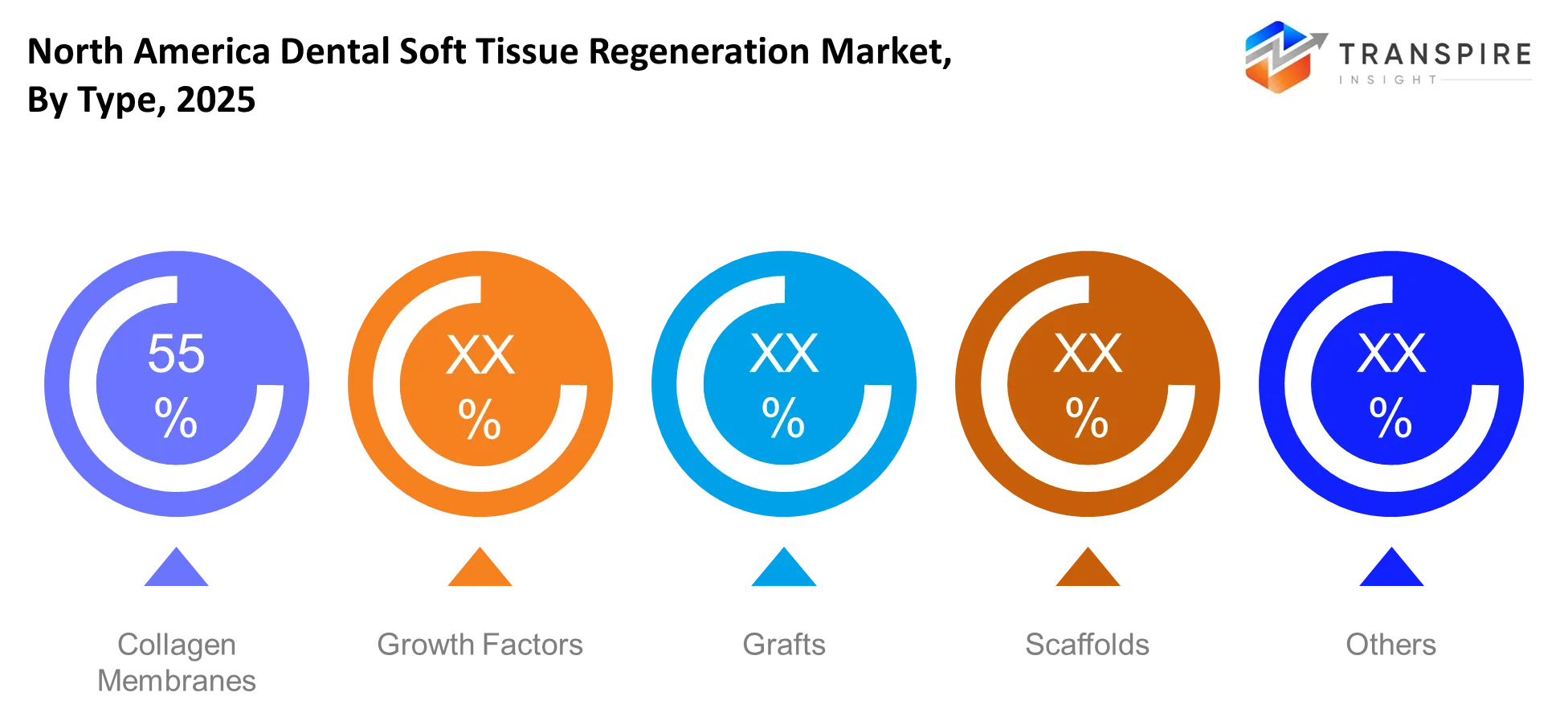
By Application
To learn more about this report, Download Free Sample Report
By application, implantology kinda dominates the market, because soft tissue stability directly affects implant retention, aesthetic results, and long-term procedural success. Periodontal repair keeps a significant share too, mainly due to how common gum disease is, plus the ongoing need for regenerative intervention before tooth loss really gets worse. Oral surgery applications continue to expand via full-mouth rehabilitation, trauma reconstruction, and even immediate implant placement procedures.
Cosmetic gingival correction also picked up more real clinical weight as aesthetic dentistry turned more into mainstream treatment planning. Each application area follows its own demand rhythm. Implantology kind of leans on the growing acceptance of digital dentistry and guided surgical flow, while periodontal recovery depends more on specialist referrals and insurance support, so it’s a bit different. Oral surgery, in contrast, often ends up needing higher value biomaterials and newer regenerative approaches, and that’s why the revenue story looks stronger for premium product suppliers. Looking ahead, the market direction seems to move toward integrated treatment planning systems, where regenerative products get used inside everyday implant and periodontal workflows across various specialist dental networks.
By End-User
By end-user, dental clinics kind of look like the dominant segment, because most regenerative procedures happen in these specialized periodontal and implant-focused outpatient spots. Also, multi-location dental service organizations made that position stronger by standardizing regenerative treatment protocols and centralizing procurement across regional clinic networks , which sounds simple but it really matters. Hospitals still play an important role in trauma reconstruction, complex oral surgery, and in medically complicated cases where multidisciplinary care environments are basically required.Smaller outpatient facilities, plus academic institutions, do help with research adoption and clinician training, but they end up with a comparatively limited revenue share, overall.
Operational economics drives purchasing behavior pretty strongly across this segment, so it’s not just preference. Specialty clinics often, you know, prioritize products that cut down chairside time and boost procedural predictability, while hospitals they usually lean into complex case compatibility and the whole long-term patient outcomes thing. Looking ahead, future growth will probably tilt toward more consolidated clinic networks, especially where they already have advanced imaging and digital treatment capabilities. And suppliers that provide training support, workflow integration, and scalable procurement agreements might end up forming stronger long-term relationships with high-volume dental organizations.
By Material
Material wise , natural biomaterials still kind of dominate, mainly because their biocompatibility is strong, the healing response is favorable, and they’ve got broad clinical acceptance in regenerative dentistry. Collagen-derived products and grafts that come from tissue remain popular too, maybe not surprising since clinicians really care about predictable integration with nearby oral tissue, it just feels more reliable. Synthetic materials keep a growing presence but they don’t quite reach the same market share, and that’s backed by improvements in polymer science, plus regenerative structures that can be customized for specific surgical situations. Hybrid materials are starting to show up more often as a “strategic” growth segment , because manufacturers are mixing biologic and synthetic properties on purpose, aiming to balance durability with a regenerative response and also better handling efficiency during procedures.
Even so, the natural supply chains can end up in these pricing swings and sourcing limitations, especially when international logistics get disrupted, like, unexpectedly. Synthetic options can scale more smoothly in manufacturing, but they still sometimes see slower clinical uptake because of lingering questions about long term biological performance. Looking ahead , investment trends seem to be indicating more momentum for hybrid regenerative platforms, those that can back personalized treatment planning, digital surgical workflows, and steadier healing results across tricky implant and periodontal work.
What are the Key Use Cases Driving the North America Dental Soft Tissue Regeneration Market?
Dental implant procedures kind of act as the main reason regenerative products are being adopted across North America. You see this most with periodontists and implant focused dental clinics , they lean on collagen membranes, grafts, and biologic materials to help settle or stabilize soft tissue and, in the end, improve long-term implant retention. This is especially true in full-arch restorations, and during immediate implant placement surgeries .
Then there are secondary use cases that keep growing, you might notice them showing up more in periodontal reconstruction and oral surgery work done inside specialty clinics or hospital dental departments. Soft tissue regeneration products are getting used for things like gum recession management, recovery after trauma related tissue loss, and the more complex side of tooth extraction recuperation, especially for older patient groups who still need restorative dental care.
More recently, emerging use cases look like bioactive regenerative therapies that get paired with digital surgical planning, plus AI guided implant workflows. Tissue engineered scaffolds, along with platelet derived biomaterials , are also showing solid longer term promise for cosmetic gingival contouring and personalized regenerative dentistry. In those settings, clinicians really want faster healing, and they’re also aiming for better aesthetic results, even when the case is complicated.
|
Report Metrics |
Details |
|
Market size value in 2025 |
USD 789.6 Million |
|
Market size value in 2026 |
USD 830.9 Million |
|
Revenue forecast in 2033 |
USD 1186.9 Million |
|
Growth rate |
CAGR of 5.23% from 2026 to 2033 |
|
Base year |
2025 |
|
Historical data |
2021 - 2024 |
|
Forecast period |
2026 - 2033 |
|
Report coverage |
Revenue forecast, competitive landscape, growth factors, and trends |
|
Country scope |
North America (Canada, The United States, and Mexico) |
|
Key company profiled |
Straumann, Dentsply Sirona, Zimmer Biomet, Geistlich Pharma, BioHorizons, Botiss Biomaterials, Medtronic, Collagen Matrix, Osteogenics, Keystone Dental, NovaBone, RTI Surgical, Integra LifeSciences, Danaher, GC Corporation |
|
Customization scope |
Free report customization (country, regional & segment scope). Avail customized purchase options to meet your exact research needs. |
|
Report Segmentation |
By Type (Collagen Membranes, Growth Factors, Grafts, Scaffolds, Others), By Application (Periodontal Repair, Implantology, Oral Surgery, Others), By End-User (Dental Clinics, Hospitals, Others), By Material (Natural, Synthetic, Hybrid, Others) |
Which Regions are Driving the North America Dental Soft Tissue Regeneration Market Growth?
The United States is pretty much leading the North America Dental Soft Tissue Regeneration Market, mainly because it has this advanced dental specialty infrastructure, a high number of implant procedures, and a solid take‑up of biologic regenerative products . There are also large referral and care networks made up of periodontists, oral surgeons , and dental service organizations which keeps the day to day procedural demand steady across both urban and suburban healthcare systems . On top of that, private insurance penetration is favorable, and patients are spending more on restorative and cosmetic dentistry, so overall it kind of tightens the market leadership position . What also helps is the regional ecosystem where dental manufacturers , research institutions and digital dentistry providers work very close together, this speeds up commercialization, and it makes clinical adoption happen faster than in many other places .
Canada is the next biggest regional contributor, but the market behavior is not the same as the United States . It feels more careful, with a measured adoption environment and a stronger concentration inside metropolitan dental networks. Healthcare spending stays stable, and private dental coverage expands slowly, so procedural volumes are dependable, but not the same aggressive consolidation you see in the U.S. market . Canadian providers are increasingly going for minimally invasive regenerative techniques, so the patients recover sooner, and the long‑term restorative expenses can be lower . Plus academic collaborations, along with specialist training programs, keep supporting the gradual integration of regenerative biomaterials into periodontal and implant focused treatment protocols .
Mexico is showing the fastest kind of growth momentum, kinda in a rolling way, as private dental investment, cross border dental tourism, and clinic modernization initiatives start to expand really quickly after 2022. You can see it especially in new moves around digital imaging systems and implantology centers which raised procedural capacity across many main urban hubs like Mexico City, Guadalajara and Monterrey. International dental groups, plus biomaterial suppliers, came into the market more aggressively, mostly because treatment costs stayed meaningfully lower than in the United States and Canada. all of this creates solid opportunities for manufacturers, distributors and investors who are looking to broaden their presence in cost competitive specialty dental care markets during the period from 2026 to 2033.
Who are the Key Players in the North America Dental Soft Tissue Regeneration Market and How Do They Compete?
The competitive landscape of the North America Dental Soft Tissue Regeneration Market is still, kind of moderately consolidated, with global implant manufacturers along with regenerative biomaterial specialists holding a large portion of the premium procedure volumes. What we see more often now is that rivalry shifts toward technology integration , biologic performance, and day to day procedural efficiency, not pricing only. The well known players keep defending their position through connected implant and regeneration ecosystems that bundle digital treatment planning, biomaterials and surgical training support in one package. Meanwhile, smaller regenerative technology firms are creeping into narrower corners , focusing on bioactive membrane tissue engineered scaffolds, and healing approaches that are minimally invasive, especially for specialty dental clinics.
Straumann Group stands out with a fairly tight digital dentistry platform , bringing together implant systems, regenerative biomaterials, and CAD/CAM workflow tools. That linkage boosts surgical predictability and it also builds long term clinic loyalty, particularly inside implant centered dental networks. Geistlich Pharma holds up well thanks to specialized collagen based regenerative products, backed by a substantial amount of clinical documentation for periodontal and oral surgery uses. They keep pushing forward by building specialist education partnerships and running advanced regenerative training programs across North America.
Dentsply Sirona competes by somehow linking regenerative treatment planning together with digital imaging, intraoral scanning, and guided implant surgery systems, so chairside workflows get streamlined. Zimmer Biomet, in turn, leans on procedural integration between implantology and soft tissue management products, so oral surgeons can better standardize restoration steps, even when the cases are complex. BioHorizons expands via niche specialization around biologic-driven implant regeneration, and through close collaboration with independent periodontists who want flexible treatment protocols, not so much the big enterprise procurement approach.
Company List
- Straumann
- Dentsply Sirona
- Zimmer Biomet
- Geistlich Pharma
- BioHorizons
- Botiss Biomaterials
- Medtronic
- Collagen Matrix
- Osteogenics
- Keystone Dental
- NovaBone
- RTI Surgical
- Integra LifeSciences
- Danaher
- GC Corporation
Recent Development News
In May 2026, Geistlich Pharma Expands Regenerative Dentistry Collaboration Strategy: Geistlich Pharma was highlighted in a 2026 industry update for its strategic collaboration with Stryker focused on next-generation collagen barrier membranes used in guided bone and soft tissue regeneration procedures. The partnership aims to improve handling performance and expand regenerative dentistry adoption across North America.
Source: https://www.globenewswire.com
In February 2026, Geistlich Marks 175th Anniversary While Expanding Regenerative Dentistry Portfolio: Swiss regenerative biomaterials company Geistlich Pharma AG announced the start of its 175th anniversary year in February 2026, highlighting continued expansion in regenerative dentistry technologies and biomaterial innovation for the U.S. and Canadian dental markets. The company emphasized ongoing investments in collagen-based regenerative solutions and clinician education initiatives across North America.
Source: https://www.geistlich.com
What Strategic Insights Define the Future of the North America Dental Soft Tissue Regeneration Market?
The North America Dental Soft Tissue Regeneration Market is kind of structurally moving toward integrated regenerative dentistry platforms where biomaterials , digital implant planning and AI-supported diagnostics work within one clinical workflow , more or less. The main thing that’s driving it is a big move away from corrective dental treatment and more toward long-term tissue preservation plus better implant durability, especially for older populations looking for permanent restorative solutions. Over the next five to seven years , the manufacturers that blend regenerative materials with digital surgical ecosystems will probably end up taking a larger than expected slice of specialty clinic spend.
There is also this hidden risk that people often skip , it’s dependence on biologic raw materials and collagen sourcing networks that are concentrated among only a few suppliers. If anything happens tied to regulatory pressure, livestock disease controls or even international trade limitations , production costs can climb, and then procedural availability might get pushed back across specialty dental practices.
On the flip side, there’s an emerging opportunity around personalized regenerative biomaterials, these are built using 3D printing and tissue-engineering methods for complicated implant reconstruction. Companies and investors should probably focus on partnerships with digital dentistry providers and specialty dental service organizations because procurement consolidation and workflow integration are going to decide market access and day to day adoption in the long run.
North America Dental Soft Tissue Regeneration Market Report Segmentation
By Type
- Collagen Membranes
- Growth Factors
- Grafts
- Scaffolds
- Others
By Application
- Periodontal Repair
- Implantology
- Oral Surgery
- Others
By End-User
- Dental Clinics
- Hospitals
- Others
By Material
- Natural
- Synthetic
- Hybrid
- Others
Frequently Asked Questions
Find quick answers to common questions.
The Approximate North America Dental Soft Tissue Regeneration Market size for the Market will be USD 1186.9 Million in 2033.
The key Segments of the North America Dental Soft Tissue Regeneration Market are By Type (Collagen Membranes, Growth Factors, Grafts, Scaffolds, Others), By Application (Periodontal Repair, Implantology, Oral Surgery, Others), By End-User (Dental Clinics, Hospitals, Others), By Material (Natural, Synthetic, Hybrid, Others).
Major Players in the North America Dental Soft Tissue Regeneration Market are Straumann, Dentsply Sirona, Zimmer Biomet, Geistlich Pharma, BioHorizons, Botiss Biomaterials, Medtronic, Collagen Matrix, Osteogenics, Keystone Dental, NovaBone, RTI Surgical, Integra LifeSciences, Danaher, GC Corporation.
The Current Market size of the North America Dental Soft Tissue Regeneration Market is USD 789.6 Million in 2025.
The North America Dental Soft Tissue Regeneration Market CAGR is 5.23%.
- Straumann
- Dentsply Sirona
- Zimmer Biomet
- Geistlich Pharma
- BioHorizons
- Botiss Biomaterials
- Medtronic
- Collagen Matrix
- Osteogenics
- Keystone Dental
- NovaBone
- RTI Surgical
- Integra LifeSciences
- Danaher
- GC Corporation
Recently Published Reports
-
Apr 2026
Cord Blood Banking Services Market
Cord Blood Banking Services Market Size, Share & Analysis Report By Type of Service (Collection, Processing, Storage), By Bank Type (Private Banks, Public Banks, and Hybrid Banks), By Component (Cord Blood, and Cord Tissue), By End User (Hospitals, Research Institutions, Biotechnology Companies, and Others) and Geography (North America, Europe, Asia-Pacific, Middle East and Africa, South and Central America), 2021 - 2031
-
Apr 2026
ELISA Processors Market
ELISA Processors Market Size, Share & Analysis Report By Type (Optical Filter ELISA Analyzer, and Optical Grating ELISA Analyzers), By Mode (Automated ELISA Analyzers, and Semi-Automated ELISA Analyzers), By Applications (Immunology, Vaccine development, Drug Monitoring, and Others), By End Users (Biotechnology Companies, Pharmaceutical Companies, Contract Research Organization, and Diagnostic Laboratories) and Geography (North America, Europe, Asia-Pacific, Middle East and Africa, South and Central America), 2021 - 2031
-
May 2026
Microscope Slide Scanner Market
Microscope Slide Scanner Market Size, Share & Analysis Report By Type (Portable Microscope Slide Scanner, and Desktop Microscope Slide Scanner), By Application (Biological Research, Medicine, Veterinary, and Other) and Geography (North America, Europe, Asia-Pacific, Middle East and Africa, South and Central America), 2021 - 2031
-
Apr 2026
Microwave Cookware Market
Microwave Cookware Market Size, Share & Analysis Report By Material Type (Plastic, Glass, Ceramic, Silicone, and Metal), By Application (Cooking, Reheating, and Defrosting), By End User (Household, Commercial (Restaurants, Hotels, and Cafes), and Food Service Industry), By Sales Channel (Online Retail, Offline Retail (Supermarkets, Hypermarkets, Specialty Stores), and Direct Sales (Company Outlets)) and Geography (North America, Europe, Asia-Pacific, Middle East and Africa, South and Central America), 2021 - 2031