
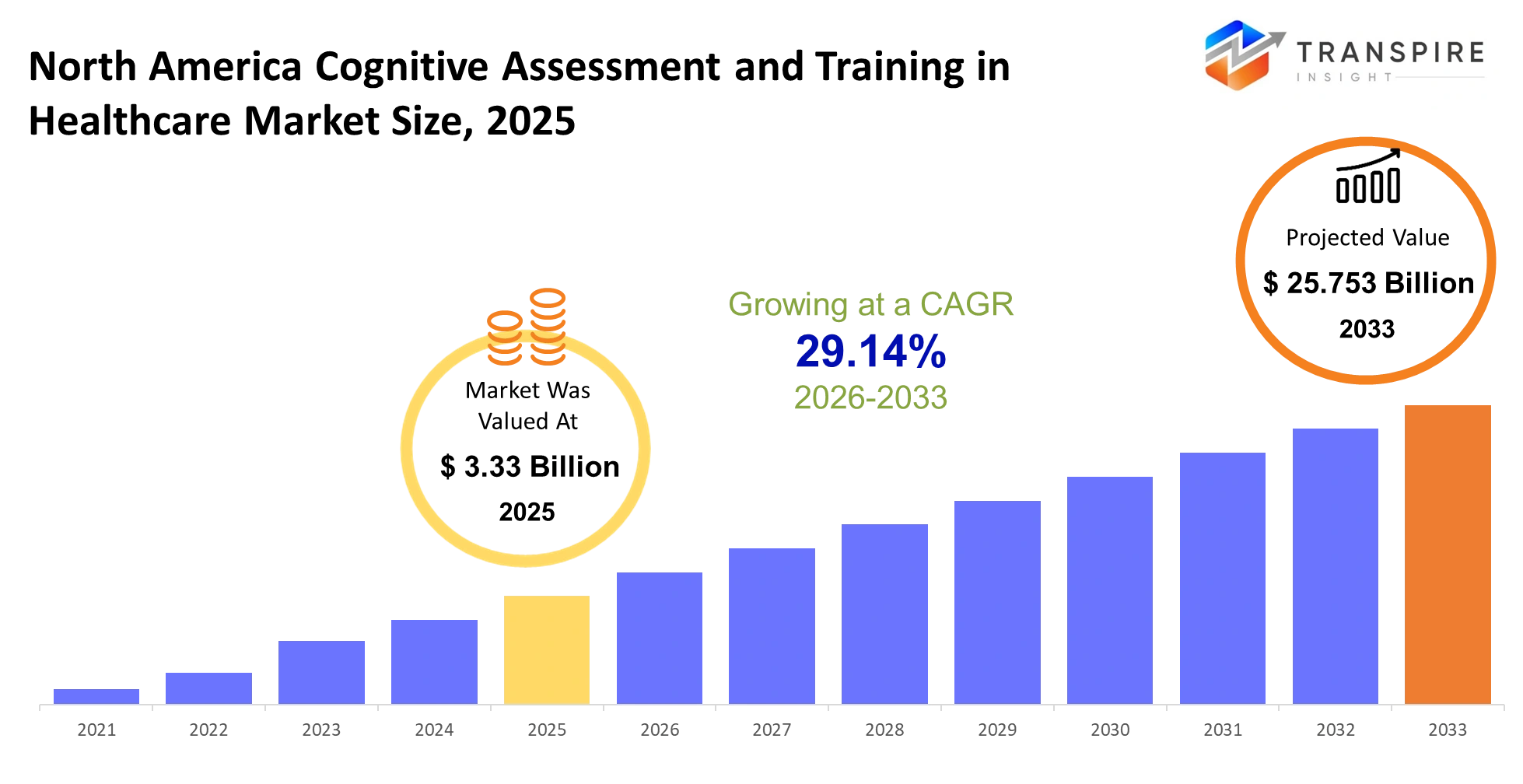
North America Cognitive Assessment and Training in Healthcare Market Size & Forecast:
- North America Cognitive Assessment and Training in Healthcare Market Size 2025: USD 3.33 Billion
- North America Cognitive Assessment and Training in Healthcare Market Size 2033: USD 25.753 Billion
- North America Cognitive Assessment and Training in Healthcare Market CAGR: 29.14%
- North America Cognitive Assessment and Training in Healthcare Market Segments: By Product Type (Cognitive Assessment Software, Brain Training Applications, Virtual Reality-based Training, Wearable Cognitive Devices, Others), By Application (Dementia Assessment, ADHD Management, Alzheimer’s Disease Monitoring, Stroke Rehabilitation, Others), By End User (Hospitals, Mental Health Clinics, Rehabilitation Centers, Research Institutes, Others), By Deployment (Cloud-based, On-premise, Hybrid Systems, Others).
To learn more about this report,  Download Free Sample Report
North America Cognitive Assessment and Training in Healthcare Market Summary:
The North America Cognitive Assessment and Training in Healthcare Market size is estimated at USD 3.33 Billion in 2025 and is anticipated to reach USD 25.753 Billion by 2033, growing at a CAGR of 29.14% from 2026 to 2033. The North America Cognitive Assessment and Training in Healthcare Market helps healthcare providers sorta identify, monitor, and manage cognitive decline, neurological disorders, and mental performance issues using digital assessments, AI enabled screening tools, and more or less individualized cognitive training programs. In everyday practice, these solutions typically back earlier diagnosis, treatment planning, rehabilitation, and longer term patient tracking across hospitals, clinics, and even home care environments, where things can get kinda complex, and you need that continuous oversight.
Over the past three to five years, this market has seen a structural shift from episodic clinic-centered cognitive testing toward continuous digital assessment and remote monitoring platforms. That change has been backed by better artificial intelligence, cloud-based analytics, and telehealth integration, more and more. One big catalyst was the COVID-19 pandemic, which accelerated virtual care adoption and kinda showed the weak spots of traditional face to face cognitive evaluations. As healthcare systems expanded remote care capabilities, providers started to fold digital cognitive tools into routine workflows. It also made recurring software revenue models stronger, widened access for underserved populations, and pushed adoption among health systems looking for scalable approaches to handle aging groups, and the growing burden of neurological conditions.
Key Market Insights
- In 2025, the United States pretty much leads the North America Cognitive Assessment and Training in Healthcare Market, pulling in around 82% of the regional revenue, although it still feels a bit underestimated.
- This strong showing is backed by hefty healthcare spending, better digital infrastructure, and a broad adoption of cognitive wellbeing technologies, all which keep the U.S. in front.
- Canada, meanwhile, looks like the quickest mover during the forecast window, mainly because there is more funding going into digital health services , and the pace of mental health initiatives has been ramped up.
- Also , the government-supported healthcare modernization push helps keep speeding up the rollout of cognitive assessment platform tools across Canadian healthcare networks , without losing momentum.
- When it comes to what’s selling, cognitive assessment solutions are the biggest category, taking nearly 58% of market share in 2025, largely tied to earlier detection requirements that keep growing.
- Digital cognitive training platforms come next, holding the second-largest segment, and they’re buoyed by rehabilitation demand plus preventive care uses in multiple care pathways.
- AI-enabled cognitive assessment software is expected to grow the fastest through 2030, driven by automation features and predictive analytics that make screening feel more efficient.
- Cloud-based cognitive health platforms are also getting momentum as clinicians look for scalable systems and interoperable healthcare technology setups, which matters more each year.
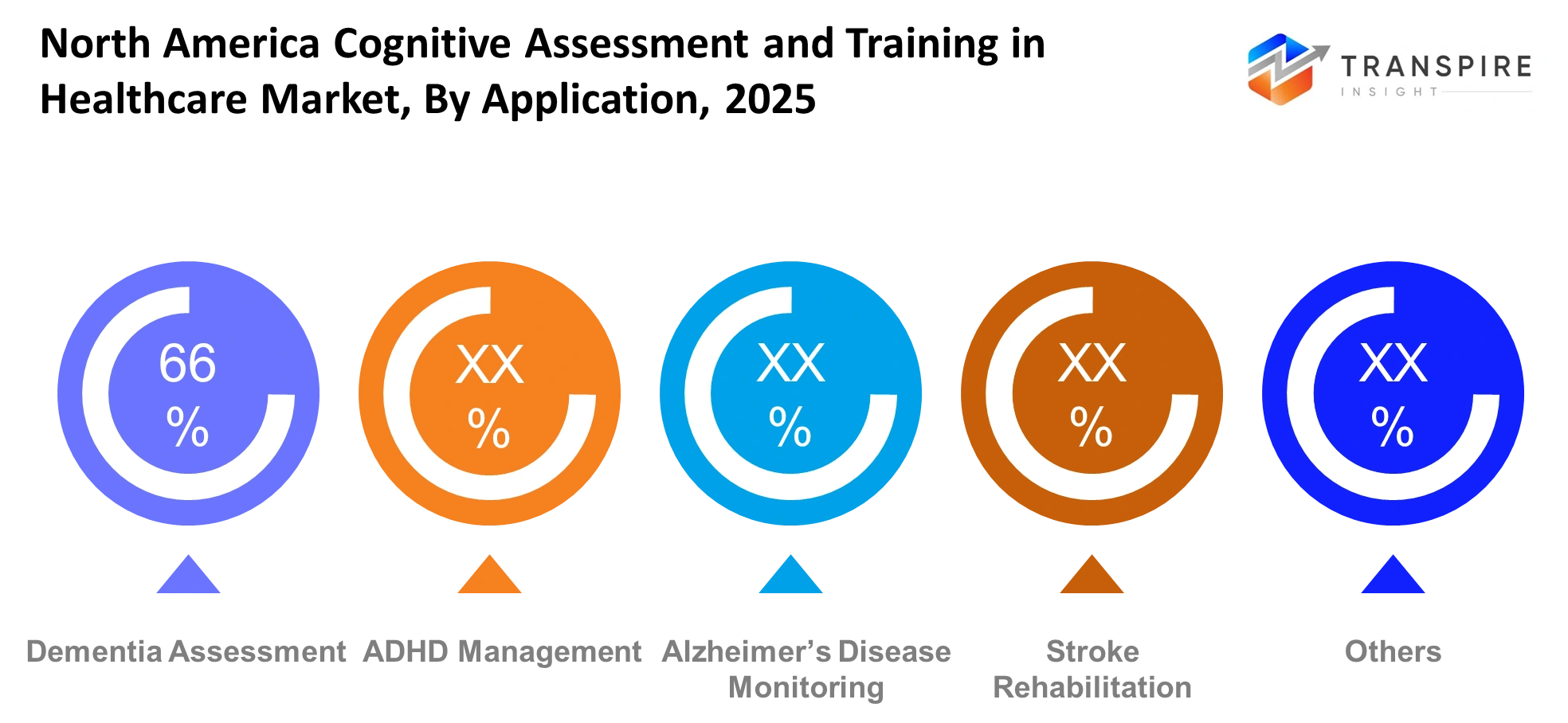
- On the application side, Alzheimer’s disease and dementia assessment are leading overall, contributing roughly 40% of total market revenue in 2025.
- Early cognitive impairment screening stays a major demand driver in hospitals, specialty clinics, and community healthcare environments.
- Mental health and neuropsychiatric disorder management is showing up as the fastest-growing application area over the forecast period, with attention increasing steadily.
- Finally, post stroke cognitive rehabilitation programs are opening up fresh income streams for digital cognitive training providers, especially where remote support is being adopted.
What are the Key Drivers, Restraints, and Opportunities in the North America Cognitive Assessment and Training in Healthcare Market?
The strongest force pushing the North America Cognitive Assessment and Training in Healthcare Market a little bit forward is the shift toward earlier detection of neurological and cognitive disorders, via digital health technologies. At the same time healthcare systems are under more clinical and economic pressure, partly because of Alzheimer’s disease, dementia, stroke related impairment, and a range of other neurological conditions. Lately, progress in artificial intelligence, cloud computing, and remote patient monitoring has made cognitive assessments quicker, more repeatable at scale, and easier to plug into day to day clinical workflows. When providers start using digital screening tools that back early intervention and can trim long term treatment costs, then software subscriptions, platform licensing, and ongoing monitoring services end up creating new income channels across the whole healthcare ecosystem.
Still, a major barrier doesn’t go away: the lack of standardized clinical validation, plus reimbursement pathways that work consistently across different healthcare environments. Cognitive assessment results can come out, very different depending on the methodology patient demographics and even on how the providers really implement the tool. That leaves clinicians , payers and healthcare administrators dealing with uncertainty about diagnostic dependability, and also reimbursement eligibility. And because regulatory approval steps, evidence generation, and payer policy updates typically take years not months, this is kind of structural, not temporary. In practice it means slower procurement cycles, postponed technology adoption, and frankly missed revenue opportunities for the solution providers.
The next phase of growth is likely to show up from AI-driven cognitive monitoring platforms, rolled out in home-based care. Healthcare providers are increasingly looking for ongoing cognitive tracking instead of those periodic clinic visits, and honestly the trend seems pretty clear. Platforms that fuse wearable devices, digital biomarkers and predictive analytics can flag subtle cognitive decline, before any symptoms are clinically obvious. And with more investment in remote care infrastructure across the United States and Canada, the conditions look good for broad scale deployment, plus extended market expansion over time.
What Has the Impact of Artificial Intelligence Been on the North America Cognitive Assessment and Training in Healthcare Market?
Artificial intelligence and newer digital technologies are, like, reshaping the North America Cognitive Assessment and Training in Healthcare Market by making cognitive evaluation way more scalable ongoing and actually usable in clinical workflows. AI based assessment platforms now handle big chunks of cognitive screening such as test setup scoring data interpretation and patient risk stratification. That cuts down clinician effort, so health systems can evaluate larger patient groups without just adding staffing in the same amount. Digital cognitive training systems also adjust exercises on the fly using how the patient performs , which boosts interest and helps with consistent treatment follow through.
At the same time, machine learning models are being used more and more to catch faint cues tied to cognitive decline, dementia progression, traumatic brain injury recovery, and other neurodegenerative conditions. They look at longitudinal patient records, along with things like speech patterns , reaction times , and digital biomarkers, and they can flag cognitive deterioration earlier than typical one off or episodic assessments. Healthcare providers get stronger monitoring options, quicker decisions for intervention, and better ways to deploy clinical resources. A lot of organizations mention shorter time per assessment, higher screening throughput, and smoother care continuity thanks to remote monitoring setups.
A big limitation still hangs around is the availability of various, clinically validated datasets. A lot of AI models get trained on specific patient groups, and that can swing the accuracy when you use them across different demographic communities. Also, putting AI systems into the existing electronic health record setup really needs substantial investment, so smaller healthcare providers hit an adoption barrier.
Key Market Trends
- Since 2020, healthcare providers have been replacing paper based cognitive tests more and more with digital platforms, that allow remote assessment and automated scoring.
- Over time, AI powered cognitive analytics moved out of trial runs and into clinical deployment, which helps providers spot early cognitive decline before the usual evaluations really get underway.
- After the pandemic, telehealth integration really kicked off, and home based cognitive assessments are now kind of standard within neurological care pathways.
- From 2021 to 2025, healthcare systems widened their investment in cloud based cognitive platforms, aiming for better long term monitoring and easier data access over time.
- Firms like Cogstate and Cambridge Cognition put more emphasis on AI driven tools, and digital biomarkers for clinical decision support, pretty consistently.
- Payers and providers also started prioritizing early dementia detection programs, especially as treatment options improved and the intervention window became more clinically valuable than before.
- Competition changed too, not just standalone testing products anymore, but more like integrated ecosystems that bundle assessment, training, analytics, and remote patient monitoring together.
- After 2022, real world data collection grew a lot, and that gave machine learning models more to work with so they can refine risk prediction and improve forecasting for cognitive decline.
- Also, strategic partnerships between healthcare systems, tech companies, and academic research centers have become more common, to speed up validation and market adoption even faster.
North America Cognitive Assessment and Training in Healthcare Market Segmentation
By Product Type
By product type, cognitive assessment software kinda holds the lead because it’s used a lot in clinical screening, diagnosis support, and ongoing longitudinal monitoring for neurological conditions. Healthcare providers seem to lean more toward digital assessment platforms , since automated scoring, standardized testing protocols and electronic health record integration all help boost operational efficiency. Brain training applications are in the second spot , mostly driven by increased use in rehab settings and preventive cognitive health programs.
Virtual reality based training solutions plus wearable cognitive devices take up smaller shares , but they show real growth potential as immersive therapies and continuous monitoring start getting more clinical acceptance. Cost issues, validation needs, and reimbursement limits still affect how fast advanced technologies get adopted. Going forward, development is likely to focus on artificial intelligence integration , personalized training pathways, and real time cognitive analytics, which should open doors for technology developers and also help healthcare organizations expand cognitive care services beyond the usual traditional clinical settings.
By Application
In application terms , dementia assessment still ends up being the main segment because most healthcare systems keep pushing for earlier detection of cognitive decline in aging populations. Alzheimer’s disease monitoring also takes a sizable slice, partly because providers are leaning more often on digital tools to observe disease progression and treatment outcomes. Stroke rehabilitation keeps pulling strong demand too, given the need for structured cognitive recovery programs after a neurological injury. ADHD management is an expanding category, especially as digital therapeutics and remote assessment tools get more and more accepted in day to day clinical practice. There are other use cases as well, like traumatic brain injury evaluation and neuropsychiatric disorder management , they add more growth pathways.
You can also see distinct demand patterns when comparing the shift toward continuous monitoring versus episodic testing . Looking ahead, future expansion will likely tilt toward applications that blend predictive analytics, digital biomarkers , and remote patient engagement, which should nudge further investment into condition specific cognitive health solutions.
To learn more about this report, Download Free Sample Report
By End-User
By end user , hospitals take the biggest share, mostly because multidisciplinary care crews need a coordinated mental acuity assessment, spanning neurology, geriatrics, psychiatry and primary care. They also have high buying authority, a well built clinical setup, and easier access to advanced diagnostic tools, so hospital leadership stays solid. Mental health clinics are also a key slice, since cognitive checks are now used more often to shape treatment plans for psychiatric and behavioral health issues.
Rehabilitation centers keep pushing adoption of cognitive training routines , aiming to improve recovery results after stroke or other neurological trauma. Research institutes still show up strongly too, via ongoing clinical studies, digital biomarker building, and technology validation work. Each end user tends to set its own procurement mood, from clinical efficiency to research precision, and those priorities don’t quite match up. Looking ahead, growth should widen who gets involved, with more outpatient and community based care providers joining in, which will open doors for vendors who can deliver scalable, flexible cognitive health platforms.
By Deployment
By deployment, cloud based systems seem to win the market because healthcare orgs want centralized data handling, remote access that feels effortless, and software updates that are easier to push across many care locations. With cloud deployment, telehealth integration is also more straightforward, and it helps run large scale cognitive monitoring programs while still avoiding major infrastructure spending. That said, on premise systems still matter for organizations with tight data governance rules, older legacy IT environments, or very specific security protocols.
Hybrid systems keep picking up steam too, since they blend local oversight with cloud enabled analytics and interoperability options. Usually the way deployment decisions land comes down more to regulatory compliance obligations, cybersecurity approaches, and budget constraints, rather than clinical performance alone. Looking ahead, cloud adoption is likely to accelerate since artificial intelligence applications need larger datasets and stronger compute capacity. Tech providers that can offer secure interoperable, scalable deployment pathways will be the ones best positioned to catch the new opportunities across different healthcare environments.
What are the Key Use Cases Driving the North America Cognitive Assessment and Training in Healthcare Market?
The main use case kind of centers on dementia checking and early cognition impairment screening within hospitals and neurology clinics. Healthcare providers lean on digital cognitive evaluation tools to spot neurological decline sooner, help with treatment planning, and watch the disease moving over time, so yeah this ends up being the biggest driver of demand.
There’s also expanding work for stroke rehab and ADHD handling, especially in rehabilitation centers and mental health clinics. Digital cognitive training platforms let clinicians track recovery movement, fine tune interventions, and basically extend care beyond the usual facility based environment, using remote monitoring type features.
Newer, emerging use cases are starting to show up too, like AI driven cognitive risk forecasting and digital biomarker monitoring in at home care spaces. Research institutes and more advanced healthcare systems are exploring speech analysis and wearable sensors, plus passive behavioral monitoring, to detect tiny cognitive shifts before clinical symptoms really show up, and that is creating fresh chances for preventive neurological care.
|
Report Metrics |
Details |
|
Market size value in 2025 |
USD 3.33 Billion |
|
Market size value in 2026 |
USD 4.299 Billion |
|
Revenue forecast in 2033 |
USD 25.753 Billion |
|
Growth rate |
CAGR of 29.14% from 2026 to 2033 |
|
Base year |
2025 |
|
Historical data |
2021 - 2024 |
|
Forecast period |
2026 - 2033 |
|
Report coverage |
Revenue forecast, competitive landscape, growth factors, and trends |
|
Country scope |
North America (Canada, The United States, and Mexico) |
|
Key company profiled |
Cogstate, Cambridge Cognition, BrainCheck, Neurotrack, Posit Science, Cognifit, Akili Interactive, Pearson, Philips Healthcare, Medtronic, Lumosity, BrainHQ, Happy Neuron, Neuroelectrics, MindMaze. |
|
Customization scope |
Free report customization (country, regional & segment scope). Avail customized purchase options to meet your exact research needs. |
|
Report Segmentation |
By Product Type (Cognitive Assessment Software, Brain Training Applications, Virtual Reality-based Training, Wearable Cognitive Devices, Others), By Application (Dementia Assessment, ADHD Management, Alzheimer’s Disease Monitoring, Stroke Rehabilitation, Others), By End User (Hospitals, Mental Health Clinics, Rehabilitation Centers, Research Institutes, Others), By Deployment (Cloud-based, On-premise, Hybrid Systems, Others). |
Which Regions are Driving the North America Cognitive Assessment and Training in Healthcare Market Growth?
The United States still kinda stays the dominant region inside the North American market, mostly because it has an advanced healthcare infrastructure, a huge patient population, and an overall strong atmosphere for digital health investment. There are favorable reimbursement pathways for neurological care , plus substantial research funding, and also broad adoption of electronic health records, which makes it easier for the technology to roll out at real scale. Big academic medical centers, healthcare networks , and clinical research organizations together build a solid ecosystem for invention, and then later confirmation. Altogether, the policy support, the available capital, and the clinical know how keep the region in the lead.
Canada lands as the second-largest regional contributor but the growth patterns are not exactly the same as in the United States. Since the system is publicly funded , it tends to drive a more structured rollout of evidence-based cognitive assessment technologies, along with long-term care solutions. Ongoing government investment in digital health modernization and mental health programs gives a kind of steadiness, even when the economy feels shaky or uncertain. Plus, there is steady cooperation between healthcare providers, research institutions, and provincial health authorities, so the market keeps expanding at a controlled pace with dependable revenue.
Mexico, though, is showing up as the fastest-growing region , mainly because healthcare digitization efforts and better access to specialized neurological services keep improving over time. More recent spending on telehealth infrastructure and healthcare technology modernization has pushed cognitive assessment tools farther beyond the biggest urban areas. Meanwhile private healthcare providers are increasingly switching toward digital platforms, partly to close specialist availability gaps and for more continuous patient tracking.
Who are the Key Players in the North America Cognitive Assessment and Training in Healthcare Market and How Do They Compete?
The competitive landscape is kinda moderately fragmented, with specialized cognitive health technology providers trading space alongside digital health companies, clinical research technology firms, and neuropsychological assessment developers. Mostly, the fight is over technological sophistication, clinical validation, how well things plug into healthcare workflows, and the capability to handle remote patient monitoring without drama. The established players keep defending their market share using proprietary assessment databases and those long-standing clinical relationships, while the newer entrants show up with artificial intelligence, digital biomarkers, and cloud native platforms. And as healthcare providers push harder for scalable cognitive care solutions, the real differentiation seems to shift away from price and more toward accuracy, usability, interoperability, plus evidence based outcomes.
Cogstate has built its position on scientifically validated digital cognitive assessments, used in both clinical care and pharmaceutical research. The company stands out via extensive normative datasets and strong adoption in neurological clinical trials, which in turn make it tougher for competitors that don’t have comparable validation depth. Cambridge Cognition is similar in that evidence driven approach, but it leans more heavily into neuroscience research and cognitive endpoints for drug development programs. Their expansion is increasingly tied to partnerships with pharmaceutical companies and research organizations that want more precise measures of cognitive performance, and honestly, that focus keeps pulling them forward.
BrainCheck kinda really pushes accessibility and workflow efficiency, using cloud based cognitive testing that works for both remote sessions and in-clinic assessments. Their fast launch, deployment style, and telehealth fit are the kind of things healthcare systems look for when they want scalable screening programs . Posit Science sort of stands out by offering personalized cognitive training programs, more focused on boosting cognitive performance instead of just checking impairment. Signant Health, meanwhile, reinforces its competitive edge by folding cognitive assessment features into wider clinical trial technology platforms, so pharmaceutical sponsors can handle patient data outcomes measurement, and cognitive testing through one unified research infrastructure .
Company List
- Cogstate
- Cambridge Cognition
- BrainCheck
- Neurotrack
- Posit Science
- Cognifit
- Akili Interactive
- Pearson
- Philips Healthcare
- Medtronic
- Lumosity
- BrainHQ
- Happy Neuron
- Neuroelectrics
- MindMaze
Recent Development News
In May 2026, Cambridge Cognition Integrates Cognitive Assessments with Oura Platform: Cambridge Cognition announced that its scientifically validated CANTAB Pathway™ digital cognitive assessments were integrated into the Oura health-tracking platform. The collaboration aims to combine cognitive performance measurement with wearable health data, supporting broader adoption of digital cognitive monitoring in healthcare and research settings across North America.
Source: https://newsfile.refinitiv.com
In February 2026, Cogstate Reports Strong First-Half FY2026 Financial Results: Cogstate reported first-half FY2026 revenue growth driven by continued demand for computerized cognitive assessments used in neurological and clinical research programs. The company highlighted expanding clinical trial activity and increasing adoption of its digital cognitive testing solutions, reinforcing its position within the North American cognitive assessment ecosystem.
Source: https://finance.yahoo.com
What Strategic Insights Define the Future of the North America Cognitive Assessment and Training in Healthcare Market?
North America Cognitive Assessment and Training in Healthcare Market is shifting toward ongoing predictive cognitive health management, not just the one-off assessment ,and then intervention. The big push behind this change is basically the coming together of artificial intelligence, digital biomarkers, remote monitoring infrastructure, and those value-based healthcare models that actually pay for earlier detection and more proactive care. In the next five to seven years, competitive edge will rely less on handing out cognitive tests and more on turning longitudinal patient data into clinical insights that are usable right away.
There is one less obvious risk though, and it’s about how data gets centralized and how much everyone leans on algorithms. When only a few technology providers end up with huge proprietary datasets, healthcare organizations might end up stuck, or you could say vendor lock in, plus regulators may start requiring tighter oversight for AI based clinical decision tools. That could slow down commercialization, even if the tech looks promising.
On the opportunity side, passive cognitive monitoring is becoming a real thing, using speech analysis, wearable sensors, and behavioral signals gathered in home-care environments. Market players should lean into partnerships with healthcare systems and research institutions, to build validated, interoperable platforms. The goal is to show real measurable clinical and economic outcomes, because that kind of proof can make it harder for others to enter later,and supports longer term revenue durability.
North America Cognitive Assessment and Training in Healthcare Market Report Segmentation
By Product Type
- Cognitive Assessment Software
- Brain Training Applications
- Virtual Reality-based Training
- Wearable Cognitive Devices
- Others
By Application
- Dementia Assessment
- ADHD Management
- Alzheimer’s Disease Monitoring
- Stroke Rehabilitation
- Others
By End User
- Hospitals
- Mental Health Clinics
- Rehabilitation Centers
- Research Institutes
- Others
By Deployment
- Cloud-based
- On-premise
- Hybrid Systems
- Others
Frequently Asked Questions
Find quick answers to common questions.
The approximate North America Cognitive Assessment and Training in Healthcare Market size for the market will be USD 25.753 Billion in 2033.
The key segments of the North America Cognitive Assessment and Training in Healthcare Market are By Product Type (Cognitive Assessment Software, Brain Training Applications, Virtual Reality-based Training, Wearable Cognitive Devices, Others), By Application (Dementia Assessment, ADHD Management, Alzheimer’s Disease Monitoring, Stroke Rehabilitation, Others), By End User (Hospitals, Mental Health Clinics, Rehabilitation Centers, Research Institutes, Others), By Deployment (Cloud-based, On-premise, Hybrid Systems, Others).
Major players in the North America Cognitive Assessment and Training in Healthcare Market are Cogstate, Cambridge Cognition, BrainCheck, Neurotrack, Posit Science, Cognifit, Akili Interactive, Pearson, Philips Healthcare, Medtronic, Lumosity, BrainHQ, Happy Neuron, Neuroelectrics, MindMaze.
The current market size of the North America Cognitive Assessment and Training in Healthcare Market is USD 3.33 Billion in 2025.
The North America Cognitive Assessment and Training in Healthcare Market CAGR is 29.14%.
- Cogstate
- Cambridge Cognition
- BrainCheck
- Neurotrack
- Posit Science
- Cognifit
- Akili Interactive
- Pearson
- Philips Healthcare
- Medtronic
- Lumosity
- BrainHQ
- Happy Neuron
- Neuroelectrics
- MindMaze
About the Authors

Mayur Shinde
I am Mayur Shinde, a Senior Research Analyst at Transpire Insight, specializing in the Automotive & Transportation and Information & Communication Technology (ICT) Industry. My work focuses on analyzing emerging market trends, technological advancements, competitive landscapes, and industry developments to deliver accurate, data-driven insights. I am passionate about transforming complex market information into clear, actionable content that helps businesses, professionals, and decision-makers stay informed and make confident strategic decisions.

Chakradhar Khansole
Chakradhar serves as the Research Director at Transpire Insight, bringing over 8 years of experience in technology, innovation, and strategic market intelligence. He specializes in transforming complex market data into actionable business insights that enable organizations to make informed, growth-oriented decisions. Recognized for his strategic vision and analytical expertise, Chakradhar leads high-impact research initiatives, delivering comprehensive market assessments, competitive intelligence, and forward-looking industry analysis.
Recently Published Reports
-
Apr 2026
3D Optical Profiler Market
3D Optical Profiler Market Size, Share & Analysis Report By Type (Desktop 3D Optical Profiler, and Portable 3D Optical Profiler), By Technology (Confocal Technology, and White Light Interference), By End-Use Industry (Manufacturing, Research Institutions, Automotive, Aerospace and Defense, Medical Devices, and Other), and Geography (North America, Europe, Asia-Pacific, Middle East and Africa, South and Central America), 2021 - 2031
-
Apr 2026
Depth Sensor Market
Depth Sensor Market Size, Share & Analysis Report By Type (Infrared Depth Sensors, Time-of-Flight (ToF) Sensors, Stereo Vision Sensors, Structured Light Sensors, Ultrasonic Depth Sensors), By Application (Automotive, Robotics, Gaming, Consumer Electronics, Industrial Automation, Healthcare, Security & Surveillance, Others), By End Users (Automotive Manufacturers, Consumer Electronics Companies, Healthcare Providers, Industrial Companies, Security Agencies, Gaming Companies, Robotics Companies, Others), and Geography (North America, Europe, Asia-Pacific, Middle East and Africa, South and Central America), 2021 – 2031
-
Apr 2026
Digital Manufacturing Market
Digital Manufacturing Market Size, Share & Analysis Report By Component (Hardware, Software, and Services), By Technology (Robotics, 3D Printing, Internet of Things (IoT), and Others), By Application (Automotive and Transportation, Aerospace and Defense, Consumer Electronics, Industrial Machinery, and Others), By Process Type (Computer-Based Designing, Computer-Based Simulation, Computer 3D Visualization, Analytics, and Others), and Geography (North America, Europe, Asia-Pacific, Middle East and Africa, South and Central America), 2021 – 2031
-
Apr 2026
Digital Visa Services Market
Digital Visa Services Market Size, Share & Analysis Report By Type (Individual Travelers, Group Travelers), By Application (Tourism, Business Travel, Others), and Geography (North America, Europe, Asia-Pacific, Middle East and Africa, South and Central America), 2021 – 2031