Middle East and Africa Stroke AI Market Size & Forecast:
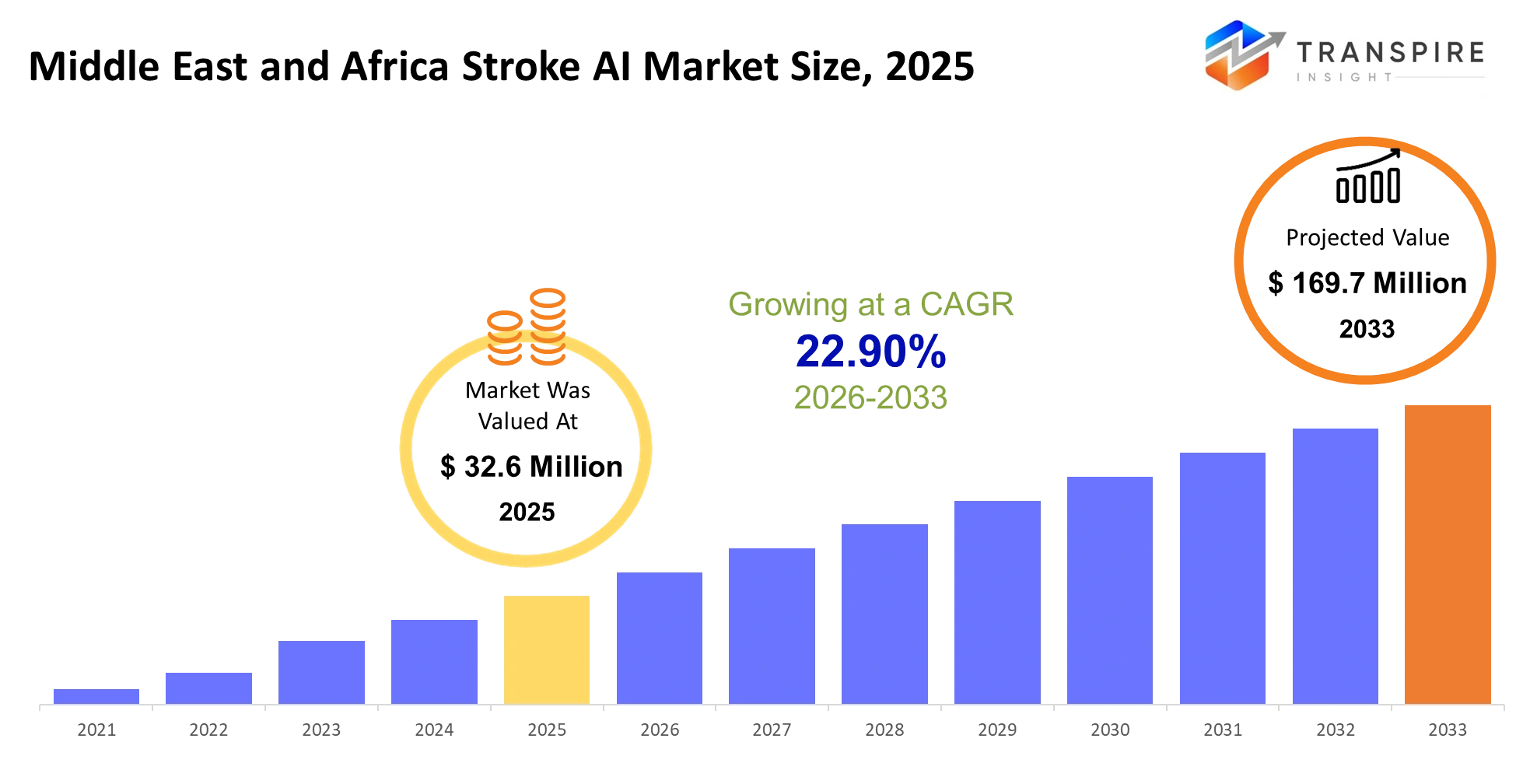
- Middle East and Africa Stroke AI Market Size 2025: USD 32.6 Million
- Middle East and Africa Stroke AI Market Size 2033: USD 169.7 Million
- Middle East and Africa Stroke AI Market CAGR: 22.90%
- Middle East and Africa Stroke AI Market Segments: By Component (Software, Services, Platforms), By Application (Diagnosis, Imaging, Workflow, Monitoring), By End-User (Hospitals, Diagnostic Centers, Clinics, Research Institutes).
To learn more about this report,  Download Free Sample Report
Middle East and Africa Stroke AI Market Summary:
The Middle East and Africa Stroke AI Market size is estimated at USD 32.6 Million in 2025 and is anticipated to reach USD 169.7 Million by 2033, growing at a CAGR of 22.90% from 2026 to 2033. The healthcare technology industry in the Middle East and Africa which includes Saudi Arabia, United Arab Emirates, South Africa, and other countries will experience a transformation through the development of stroke artificial intelligence solutions. The hospitals and diagnostic centers will start using AI-powered imaging tools for CT and MRI scan interpretation which will deliver more accurate results. The patients will expect their treatment to start sooner while their recovery results will improve.
The governments will keep updating their digital health regulations to promote secure artificial intelligence implementation. The vendors will create specific solutions that match different clinical needs and telemedicine systems will enhance stroke detection and treatment processes in both city and rural areas.
What Has the Impact of Artificial Intelligence Been on the Middle East and Africa Stroke AI Market?
The AI technology creates new methods for generating and implementing insights which it uses throughout the Middle East and Africa stroke AI market to establish data as a vital resource that hospitals must manage. The Middle East and Africa stroke AI market uses artificial intelligence to create advanced market research methods which collect real-time data while machine learning models study patient records and imaging results and treatment schedules to find usable information. The new approach enables stakeholders to create predictive analytics which can identify both stroke occurrence and treatment requirements and resource distribution needs with improved precision.
Artificial intelligence in middle east and africa stroke AI market operations is also strengthening demand forecasting and operational efficiency. Smart automation tools are streamlining imaging workflows which help to decrease diagnostic times while increasing clinician productivity. AI-based systems now create more accurate supply chain optimization which enables equipment demand forecasting and inventory control while decreasing unnecessary expenses. These capabilities are creating new market trends which show how operational efficiency and rapid performance directly affect healthcare results and investment choices.
The Middle East and Africa stroke AI market experiences new technological advancements because competing organizations have increased their rivalry with one another. Organizations use predictive models to create customized treatment paths while they employ data-based insights to develop unique marketable products. Companies that successfully apply artificial intelligence will achieve competitive advantages because they will boost their clinical results and business success.
Key Market Trends & Insights:
- The Middle East and Africa stroke market in 2025 will see Saudi Arabia control 35% of the market because the government supports AI healthcare projects.
- The United Arab Emirates will become the fastest-growing region because its smart hospital infrastructure investments will create a growth rate of more than 22% CAGR until 2030.
- The market for AI-based imaging software will reach 45% market share in 2025 because customers require systems that provide immediate stroke detection.
- AI systems that integrate with hardware obtain their second-highest market share because hospitals in all major urban areas modernize their facilities.
- The cloud-based AI platform segment has become the fastest-growing area because telemedicine use continues to rise, which will maintain rapid growth until 2030.
- Machine learning technologies improve imaging results while decreasing time required for stroke diagnosis, which leads to 50% of applications in this area.
- The middle east and Africa stroke AI market for hospitals functions as the primary market segment, which develops through facilities that implement AI-based clinical operations.
Middle East and Africa Stroke AI Market Segmentation
By Component
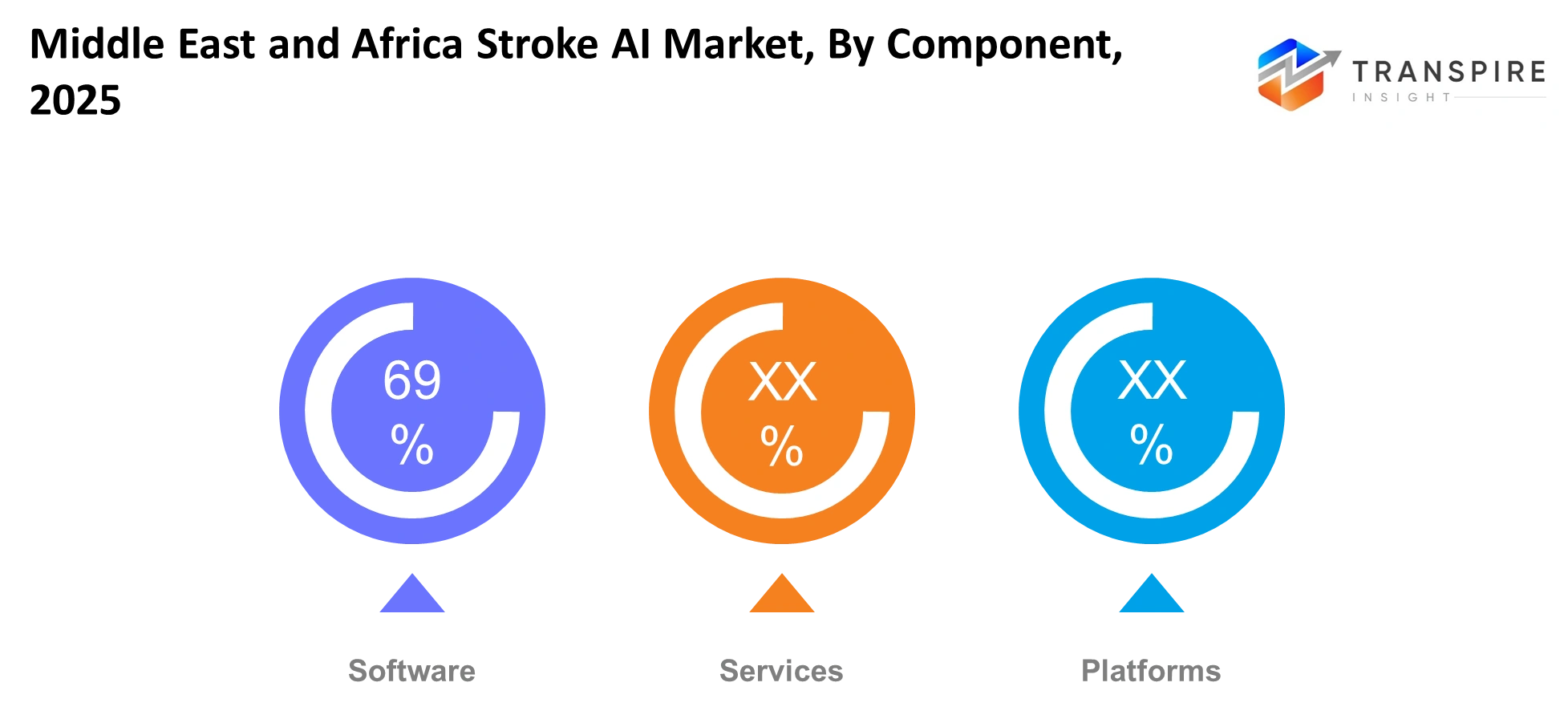
The operational foundation of image interpretation and clinical decision support and predictive analytics will utilize software to function across all stroke care facilities. The platforms will enable data sharing between imaging systems and electronic health records by connecting disparate data sources, resulting in quicker clinical responses. The services will provide support for solution deployment and customization and training activities which will help create solutions that meet hospital operational needs and regional standards. The continuous algorithm updates will enhance system accuracy while preserving operational reliability.
Healthcare facilities will experience decreased operational tasks because service providers will take over maintenance and cloud integration and technical support functions. The platforms will enable organizations to expand their operations because they allow both large hospitals and smaller centers to implement AI technology without needing to spend on extensive infrastructure. The software solutions will adapt to regulatory updates, helping maintain compliance and protect data security. The segment will continue to drive value creation because the need for effective and integrated stroke care systems is increasing.
To learn more about this report, Download Free Sample Report
By Application
The necessity for early stroke detection together with timely intervention will create a need for application usage that follows the diagnostic process. The imaging process will enable complete examination of CT and MRI scans through its capability to identify all existing irregularities. The implementation of workflow optimization will achieve faster operations through its ability to perform automatic work processes and enhance interdepartmental communication. The monitoring tools will observe patient development while providing clinicians with up-to-date information.
Machine learning advancements will continue to improve both imaging and diagnostic processes by increasing accuracy while reducing human error. The hospital systems will establish seamless communication channels through workflow solutions which will also enable better resource distribution. The monitoring applications will become more widely used in both acute medical treatment and recovery periods after treatment to improve patient recovery results. This segment will demonstrate how healthcare organizations now prioritize rapid decision-making based on data to make choices about patient care.
By End-User
The primary users of hospitals will continue their operations because increasing patient numbers and their access to modern hospital facilities. AI tools will be implemented by diagnostic centers to improve their imaging services and expedite their service delivery processes. Clinics will implement basic solutions which enable them to detect early conditions and make patient referrals. Research institutes will focus on developing new models and validating clinical applications.
Hospitals will continue investing in integrated systems to improve treatment efficiency and patient outcomes. Diagnostic centers will expand services through AI-enabled screening, which will attract partnerships with healthcare providers. Clinics will benefit from accessible and cost-effective tools which help them establish operations in smaller locations. Research institutes will drive innovation which will result in long-term advancements for stroke management technologies.
What are the Main Challenges for the Middle East and Africa Stroke AI Market Growth?
The Middle East and Africa's AI market experiences multiple technical and operational problems which result in inconsistent performance throughout its healthcare systems. The accuracy and reliability of algorithms get impacted by changes in imaging quality and data availability and system compatibility. Healthcare providers continue to rely on outdated systems because they create challenges for integrating AI-powered solutions. Organizations in the middle east and africa stroke AI market face two main obstacles which prevent them from expanding their operations and implementing standard procedures in various locations and organization.
The middle east and africa stroke AI market suffers from manufacturing and commercialization obstacles which hinder its development. The development of AI-based medical solutions needs substantial investments for research and validation work alongside meeting rigorous regulatory requirements. The approval process requires substantial time commitment which results in product launch delays and hinders early market adoption. Smaller companies face market entry challenges because of cost restrictions while healthcare providers base their purchasing choices on their pricing concerns.
The process of adoption faces multiple obstacles which become more severe in locations that lack both digital resources and expert workers. The absence of trained staff to manage and understand AI systems results in decreased operational effectiveness across multiple regions. The healthcare system suffers from an unequal distribution of resources because funding shortages and spending gaps create barriers to accessing technology. The obstacles to growth in the Middle East and Africa continue to determine how quickly the stroke AI market develops across different economic conditions.
The combination of market rivalry with future hazards creates additional difficulties for the organization. The diagnostic field continues to face strong competition from both alternative diagnostic technologies and established testing approaches which have built-in resistance to transformation. The combination of pricing pressure and changing regulatory requirements will create challenges that affect both profitability and the long-term viability of operations, while imposing new restrictions on the market.
Regional Insights
Saudi Arabian government plans to use its healthcare investments to create artificial intelligence stroke solutions for deployment throughout its major cities. The government-supported digital health initiatives will create financial incentives for hospitals to enhance their facilities and unify their data systems. The private sector will contribute to better accessibility of advanced imaging systems through its increasing involvement.
The United Arab Emirates will become an important supporter of artificial intelligence technology through its advanced digital systems. The combination of smart hospitals and integrated health platforms will lead to quicker medical diagnosis and treatment solution development.
Government initiatives will create an environment that drives technological innovation while attracting international technology partnerships. Patients who understand their health conditions will help identify medical issues at an earlier stage which leads to better health outcomes. Healthcare establishments in urban areas will use artificial intelligence technologies more rapidly because they receive substantial financial support. The organization will benefit from cloud-based systems because these systems enable easier system access and decrease operational difficulties. The public and private sectors will work together to improve service delivery processes. The system will enable hospitals to deliver urgent care for stroke patients within established time frames.
The Middle East and Africa region will experience different rates of AI adoption in stroke treatment because the region has various healthcare systems. The developed nations would be able to deploy advanced technology more quickly compared to the developing nations due to the lack of infrastructure and funds. Consumers would begin to demand AI systems, recognizing the significance of diagnosing stroke symptoms promptly.
Healthcare providers will seek budget-friendly methods to enhance service availability for their patients. The integration of telemedicine will enable healthcare providers to deliver services in distant areas. Different government programs will drive adoption at different rates across nations. The system will develop through different elements which will advance the existing state of development.
Recent Development News
In March 2026, Viz.ai presented new clinical study results at the International Stroke Conference showing a 44% reduction in stroke patient transfer times using its AI platform, improving care coordination and treatment speed.
Source: https://www.businesswire.com/
In March 2026, Aidoc announced new clinical research findings at ISC 2026 demonstrating improved accuracy of its AI stroke algorithms, including better detection of vessel occlusions compared to other solutions.
Source: https://www.aidoc.com/
|
Report Metrics |
Details |
|
Market size value in 2025 |
USD 32.6 Million |
|
Market size value in 2026 |
USD 40.07 Million |
|
Revenue forecast in 2033 |
USD 169.7 Million |
|
Growth rate |
CAGR of 22.90% from 2026 to 2033 |
|
Base year |
2025 |
|
Historical data |
2021 - 2024 |
|
Forecast period |
2026 - 2033 |
|
Report coverage |
Revenue forecast, competitive landscape, growth factors, and trends |
|
Regional scope |
United States; Canada; Mexico; United Kingdom; Germany; France; Italy; Spain; Denmark; Sweden; Norway; China; Japan; India; Australia; South Korea; Thailand; Brazil; Argentina; South Africa; Saudi Arabia; United Arab Emirates |
|
Key company profiled |
Viz.ai, RapidAI, Brainomix, Aidoc, Qure.ai, Siemens Healthineers, GE HealthCare, Philips, Canon Medical, Zebra Medical Vision, Medtronic, IBM Watson Health, Arterys, Neural Analytics, Nico.lab. |
|
Customization scope |
Free report customization (country, regional & segment scope). Avail customized purchase options to meet your exact research needs. |
|
Report Segmentation |
By Component (Software, Services, Platforms), By Application (Diagnosis, Imaging, Workflow, Monitoring), By End-User (Hospitals, Diagnostic Centers, Clinics, Research Institutes). |
How Can New Companies Establish a Strong Foothold in the Middle East and Africa Stroke AI Market?
The new companies that want to enter the stroke AI market in the Middle East and Africa need to create a specialized plan that distinguishes them from other market players. The organization can deliver immediate benefits through its solution which targets two specific needs: low-resource areas that need early stroke detection and emergency medical facilities that require AI-powered triage systems. The Middle East and Africa stroke AI market requires products which diagnose patients faster while increasing diagnostic precision because many areas lack medical specialists.
Early product traction will increase for companies which create solutions that meet market demands. The organization will establish its market presence through its innovation strategies which will enhance customer trust. Startups can develop lightweight AI models that function efficiently on existing hospital infrastructure which will decrease the obstacles to their adoption. Emerging companies such as Viz.ai and Aidoc demonstrate that real-time imaging analysis together with workflow automation can solve important operational challenges. New companies in the Middle East and Africa stroke AI market will achieve success through their combination of innovative technologies and region-specific product modifications.
The organization requires strategic partnerships to expand its operations and establish its market authority. The organization will achieve faster deployment and system validation through its partnerships with hospitals and diagnostic centers and government health organizations. The Middle East and Africa stroke AI market requires providers to form partnerships with local healthcare organizations in order to manage regulatory processes and cultural factors. The organization will achieve faster market entry through this strategy while building its long-term business foundation.
Companies will achieve competitive advantage through their ability to develop unique technological solutions. The companies that adopt predictive analytics and cloud platforms and intelligent automation will create complete solution offerings. The solution requires organizations to develop their infrastructure capabilities and staff training programs while managing their financial constraints. The new companies will build a lasting market presence through their combination of innovative solutions and practical execution which will benefit both the market and patient care.
Key Middle East and Africa Stroke AI Market Company Insights
Focus on specific clinical gaps such as early stroke detection in low-resource hospitals will create immediate value. Solutions designed for limited infrastructure will gain faster acceptance. Clear problem-solving will build trust among healthcare providers. This approach will help new entrants establish relevance without competing directly with large, established players.
Targeted offerings will reduce complexity and improve adoption rates. Healthcare systems will prefer solutions that address urgent needs with measurable outcomes. Local customization will further strengthen positioning. This focused entry strategy will support steady growth and long-term sustainability.
Continuous development of AI models with higher accuracy and faster processing will define market entry success. Lightweight and scalable solutions will suit diverse healthcare environments. Integration with existing systems will improve usability and reduce resistance from medical staff.
Differentiation will come from combining predictive analytics with real-time decision support. Unique features will attract partnerships and investment interest. Practical innovation will outperform overly complex systems. This will allow new companies to stand out in a competitive environment.
Collaboration with hospitals, diagnostic centers, and public health programs will accelerate credibility and deployment. Partnerships will enable access to real-world data and clinical validation. This will strengthen product reliability and trust among healthcare professionals.
Regional alliances will also support navigation of regulatory processes. Shared resources will reduce operational challenges and costs. Strong partnerships will create long-term value and open expansion opportunities. This strategy will be essential for scaling operations effectively.
Affordable solutions will drive adoption, especially in regions with limited healthcare budgets. Cloud-based platforms will reduce infrastructure requirements and support remote access. Cost-efficient models will attract smaller clinics and diagnostic centers.
Ease of use will play a key role in wider acceptance. Training support will improve system utilization among healthcare staff. Balancing performance with affordability will ensure sustainable demand. This approach will strengthen market presence over time.
Company List
- Viz.ai
- RapidAI
- Brainomix
- Aidoc
- Qure.ai
- Siemens Healthineers
- GE HealthCare
- Philips
- Canon Medical
- Zebra Medical Vision
- Medtronic
- IBM Watson Health
- Arterys
- Neural Analytics
- Nico.lab
What are the Key Use-Cases Driving the Growth of the Middle East and Africa Stroke AI Market?
The stroke artificial intelligence market in the Middle East and Africa grows through its implementation of practical use cases which enable faster medical diagnosis and better treatment choices for clinicians. AI systems that analyze medical images represent crucial technology since their machine learning models can identify stroke symptoms in CT and MRI scans within a few minutes.
The Middle East and Africa stroke artificial intelligence market uses workflow optimization to enhance performance in emergency medical departments. The AI system will identify important medical cases while it works to automate standard tasks and facilitate contact between radiologists and neurologists. The system will create better treatment processes which will decrease the problems that interfere with work efficiency. Predictive analytics enables healthcare organizations to evaluate stroke risk among their most vulnerable patients who need preventive treatment to lower future medical expenses.
The AI stroke market in the Middle East and Africa region is growing due to increased adoption of remote monitoring devices and telemedicine solutions. With such platforms, continuous monitoring of patients and data sharing would be possible, especially in places where specialists are not easily accessible. The system will allow medical facilities to provide treatment services beyond their primary hospitals while making medical care more reachable to patients. The increasing application of use-cases will create fresh chances for innovation because AI technology becomes an integral part of present-day stroke management systems.
Middle East and Africa Stroke AI Market Report Segmentation
By Component
- Software
- Services
- Platforms
By Application
- Diagnosis
- Imaging
- Workflow
- Monitoring
By End-User
- Hospitals
- Diagnostic Centers
- Clinics
- Research Institutes
Frequently Asked Questions
Find quick answers to common questions.
The approximate Middle East and Africa Stroke AI Market size for the market will be USD 169.7 Million in 2033.
Key segments for the Middle East and Africa Stroke AI Market are By Component (Software, Services, Platforms), By Application (Diagnosis, Imaging, Workflow, Monitoring), By End-User (Hospitals, Diagnostic Centers, Clinics, Research Institutes).
Major Middle East and Africa Stroke AI Market players are Viz.ai, RapidAI, Brainomix, Aidoc, Qure.ai, Siemens Healthineers, GE HealthCare, Philips, Canon Medical, Zebra Medical Vision, Medtronic, IBM Watson Health, Arterys, Neural Analytics, Nico.lab.
The Middle East and Africa Stroke AI Market size is USD 32.6 Million in 2025.
The Middle East and Africa Stroke AI Market CAGR is 22.90%.
- Viz.ai
- RapidAI
- Brainomix
- Aidoc
- Qure.ai
- Siemens Healthineers
- GE HealthCare
- Philips
- Canon Medical
- Zebra Medical Vision
- Medtronic
- IBM Watson Health
- Arterys
- Neural Analytics
- Nico.lab
Recently Published Reports
-
Dec 2024
AI in Diabetic Retinopathy Market
AI in Diabetic Retinopathy Market Size, Share & Analysis Report By Type (Screening AI Systems, Diagnostic AI Systems, and Predictive AI Models), By Application Segment (Hospitals, Ophthalmology Clinics, Diagnostic Centers, and Research and Development), and Geography (North America, Europe, Asia-Pacific, Middle East and Africa, South and Central America), 2021 - 2031
-
Feb 2025
Psychometric Tests Market
Psychometric Tests Market Size, Share & Analysis Report By Type (Personality Tests, Ability/Aptitude Tests, Skill/Knowledge Tests, and Others), By Application (Talent Acquisition and Talent Management), and Geography (North America, Europe, Asia-Pacific, Middle East and Africa, South and Central America), 2021 – 2031
-
Feb 2025
Rare Biological Sample Collection Market
Rare Biological Sample Collection Market Size, Share & Analysis Report By Type (Isolation Kits & Reagent, Blood Collection Tubes, and Others), By Application (Oncology, Transcriptomics, Pharmacogenomics, and Others), and Geography (North America, Europe, Asia-Pacific, Middle East and Africa, South and Central America), 2021 – 2031
-
Dec 2025
Patient Lift Pendant Market
Patient Lift Pendant Market By Product Type (Wired Pendants, Wireless, Programmable), By Operation Type(Manual, Electric), By End-Users (Healthcare Professionals, Patients), By Application (Hospitals, Homecare, Rehabilitation Centers, Others), By Industry Analysis, Size, Share, Growth, Trends, and Forecasts 2021-2033
Our Clients
.jpg)