

North America Chromatography Media Market Size & Forecast:
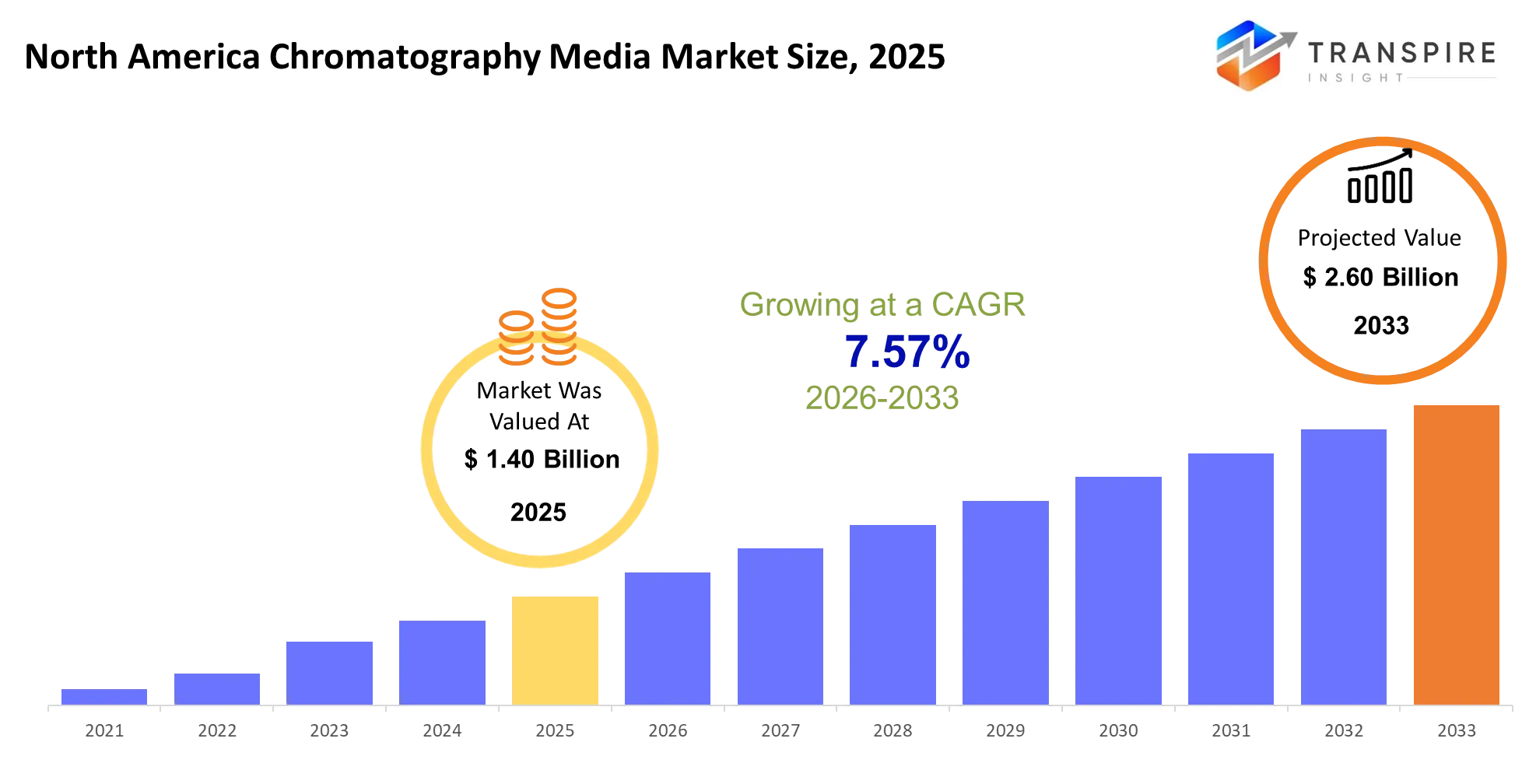
- North America Chromatography Media Market Size 2025: USD 1.40 Billion
- North America Chromatography Media Market Size 2033: USD 2.60 Billion
- North America Chromatography Media Market CAGR: 7.57%
- North America Chromatography Media Market Segments: By Product Type (Ion Exchange Media, Affinity Media, Hydrophobic Interaction Media, Size Exclusion Media, Others); By Application (Biopharmaceutical Purification, Vaccine Production, Diagnostics, Food Testing, Others); By End User (Biotechnology Companies, Pharmaceutical Companies, Research Institutes, Others); By Material (Natural Polymers, Synthetic Polymers, Silica-based Media, Others)
To learn more about this report,  Download Free Sample Report
North America Chromatography Media Market Summary
The North America Chromatography Media Market was valued at USD 1.40 Billion in 2025. It is forecast to reach USD 2.60 Billion by 2033. That is a CAGR of 7.57% over the period.
The North America Chromatography Media Market really has a big part in separating, purifying and isolating biological molecules that get used in pharmaceutical manufacturing , vaccine production and advanced biologics research. In practice biopharmaceutical companies depend on chromatography media to make purification more efficient during monoclonal antibody production, cell therapy processing , and recombinant protein manufacturing. And yeah, product purity really matters because it can affect regulatory approval and also commercial scalability. Over the last several years, the market saw this kind of structural change, more toward high-capacity resins and continuous bioprocessing systems, while drug developers were pushing for quicker production cycles as well as reduced downstream processing costs.
One major trigger behind this transition was the swift growth of biologics and mRNA vaccine manufacturing during and after the COVID-19 pandemic. That period basically highlighted bottlenecks, especially in downstream purification infrastructure, across North America. Pharmaceutical manufacturers answered by putting more money into large-scale bioprocessing facilities and automated purification technologies that can support higher production throughput. This change is still encouraging strong demand for advanced chromatography media, with better binding efficiency, longer usable operation lifespan, and compatibility with next-generation biologic manufacturing platforms. So it is also creating premium revenue openings for suppliers that focus on high-performance purification technologies, overall.
Key Market Insights
- The United States basically dominated the North America Chromatography Media Market, with over 81% share in 2025, largely due to advanced biopharmaceutical manufacturing infrastructure, and well you know it kinda snowballed.
- Canada is showing the fastest momentum through 2033, driven by widening biologics research investment and more vaccine production capabilities.
- The North American life sciences industry size grew noticeably after pharmaceutical firms started pushing domestic bioprocessing infrastructure investments, because pandemic supply disruptions kind of forced them to rethink.
- Ion exchange chromatography media took around 42% of market share in 2025. This happened because biologics manufacturers need high protein purification efficiency, and it’s hard to compromise there.
- Affinity chromatography stayed the second-biggest segment, mostly from broad monoclonal antibody purification along with vaccine processing use cases.
- Mixed-mode chromatography media is forecasted to be the fastest-growing segment between 2026 and 2033, pretty much because it fits multiple workflows in one go.
- Monoclonal antibody production sort of led the North America Chromatography Media Market, taking roughly 49% revenue share in 2025.
- Meanwhile cell and gene therapy purification showed up as the fastest-growing application, mainly due to expanding clinical pipeline commercialization activities, all that kind of momentum.
- Vaccine manufacturing facilities started adopting advanced chromatography systems more frequently, after mRNA production capacity investments ramped up in 2021, and onward too.
- Biopharmaceutical companies were in the lead market share position in 2025, because large-scale biologics production really depends on advanced purification workflows, day to day.
What are the Key Drivers, Restraints, and Opportunities in the North America Chromatography Media Market?
The main thing that is really speeding up the North America Chromatography Media Market is the rapid growth of biologics and advanced therapy manufacturing, all through the pharmaceutical production networks. A lot of biopharmaceutical companies boosted their downstream purification budgets after monoclonal antibody pipelines, mRNA therapeutics , and cell therapy programs ramped up very fast, right after the COVID-19 pandemic. Basically this shift helped push manufacturers toward high-capacity chromatography resins that can boost protein recovery , but also cut down processing time and then reduce operational expenses.With bigger purification batches, plus tougher regulatory expectations around biologic purity, the demand for premium chromatography media keeps showing up again and again across commercial plants and even contract development organizations.
The biggest restraint is still the high production cost , and the technical complexity linked to advanced chromatography resins. Making high performance affinity and mixed mode media requires specialized feedstocks , careful ligand chemistry, and production settings that are kept under tight control , so that kind of setup can slow down capacity increases.This kind of structural hurdle doesn’t get fixed quickly, because qualification cycles in pharmaceutical manufacturing tend to be long , and they are heavily regulated too. When resin validation gets delayed, or supply availability stays inconsistent, procurement costs keep climbing , and adoption becomes harder for smaller biotech firms that have tighter manufacturing budgets.
There’s a big opportunity starting to show up, kind of steadily, via continuous bioprocessing systems that are paired with single-use purification technologies. In North America, contract manufacturing organizations are looking more and more into downstream processing platforms that can flex, you know, for smaller batch sizes and even individualized biologic therapies. At the same time, the companies working on high throughput chromatography media that are tuned for continuous manufacturing environments are well placed to grab solid long term commercial growth through 2033.
What Has the Impact of Artificial Intelligence Been on the North America Chromatography Media Market?
Artificial intelligence and advanced digital technologies are,kind of transforming how chromatography media gets used across biopharmaceutical manufacturing and those downstream purification processes in North America. More and more bioprocessing sites are relying on AI-enabled automation systems to steer chromatography column performance, keep an eye on resin saturation levels, and even tune purification cycles in real time. In practice, integrated sensor platforms continuously log pressure fluctuations, flow rates, and protein binding efficiency, so the system can make automated tweaks that cut down on manual involvement during large-scale biologics production. This sort of automation helps improve batch uniformity and it also supports manufacturers in trimming downtime in fast-moving, high-throughput purification settings.
Then, machine learning models are making predictive process management in chromatography workflows better too. Pharmaceutical manufacturers are now reviewing earlier purification records to estimate resin decline, spot contamination exposure sooner, and manage buffer consumption more carefully before production hiccups start. A number of biologics facilities say resin change-outs happen less often, and overall manufacturing efficiency improves after they roll out predictive analytics platforms that connect with continuous bioprocessing systems. AI-assisted modeling also tends to speed up process development, by finding better purification setups for monoclonal antibodies and cell therapy products, rather than waiting as long.
Still though, AI adoption is not going full speed, because interoperability is limited between older purification gear and newer digital control platforms. Integration costs stay high, plus data formatting can be inconsistent across many of the older manufacturing setups, which keeps slowing deployment for mid-sized biopharmaceutical production facilities.
Key Market Trends
- Between 2020 and 2025, biopharma companies increasingly swapped the usual agarose resins for high-throughput synthetic media, to shorten the monoclonal antibody purification timelines kind of fast.
- After pandemic related shortages in 2021, suppliers like Cytiva and Sartorius expanded the North American manufacturing footprints to reduce dependence on Asian raw material sourcing… that was the idea anyway.
- Continuous chromatography adoption also sped up across U.S. biologics facilities after FDA process modernization guidance, encouraged manufacturers to improve production consistency, and reduce those batch failures that quietly pile up.
- Since 2022, CDMOs have leaned toward prepacked chromatography columns, and ready to use media formats, which cut down setup labor requirements and helped minimize cross-contamination risks too.
- Demand for protein A chromatography media intensified as biosimilar approvals increased across North America, pushing manufacturers to develop longer lasting resins with higher binding capacities.
- Environmental scrutiny then pushed chromatography media producers to reduce solvent intensive purification workflows, and a few firms introduced recyclable packaging, plus lower water consumption processing technologies after 2023.
- Academic and clinical research laboratories started shifting toward automated purification systems.
North America Chromatography Media Market Segmentation
By Product Type
Ion exchange media still has the leading position across most chromatography media categories, mostly because it gets used a lot in protein purification and monoclonal antibody manufacturing. The binding efficiency is strong, it scales well during processing, and it works nicely with larger biomolecules. Because of that, many pharmaceutical manufacturers still prefer ion exchange systems, since in big volume purification runs, the operating costs tend to stay lower than affinity based alternatives. Also, steady demand coming from biologics production facilities in the United States and Canada keeps the segment feeling pretty dominant.
Looking ahead, the real growth will hinge on better resin durability, higher loading capacities, and smoother compatibility with continuous bioprocessing setups. Affinity media will likely keep expanding quicker though, because biosimilar production and gene therapy pipelines need really selective purification methods. Meanwhile hydrophobic interaction media and size exclusion media should keep stable demand, especially for specialized downstream purification workflows and analytical applications. Product developers will probably lean more into hybrid media platforms, mixing selectivity with faster throughput,and investors will likely favor technologies that fit single use manufacturing environments.
By Application
In terms of application, biopharmaceutical purification takes the largest share, maybe also because biologics manufacturing leans heavily on high performance chromatography separation processes. The approvals for monoclonal antibodies , recombinant proteins, and cell based therapies keep climbing so purification complexity is getting harder across commercial facilities. Even vaccine production seems to pick up stronger market relevance, after pandemic driven investments pushed new regional biomanufacturing infrastructure. A lot of large pharmaceutical companies keep pouring capital into purification efficiency upgrades, just to shorten production timelines and still stay inside regulatory compliance.
On the other hand, diagnostics and food testing keep expanding at a steady pace, largely due to tougher quality assurance expectations and stricter contamination monitoring rules. Clinical laboratories are adopting advanced chromatography systems more often, aiming for higher analytical precision in disease detection and biomarker research. Food manufacturers also rely on chromatography media, to locate trace contaminants, additives, and pesticide residues in processed foods. Going forward, market development will likely nudge suppliers to offer quicker, automation compatible media options, designed for high throughput labs and decentralized testing facilities.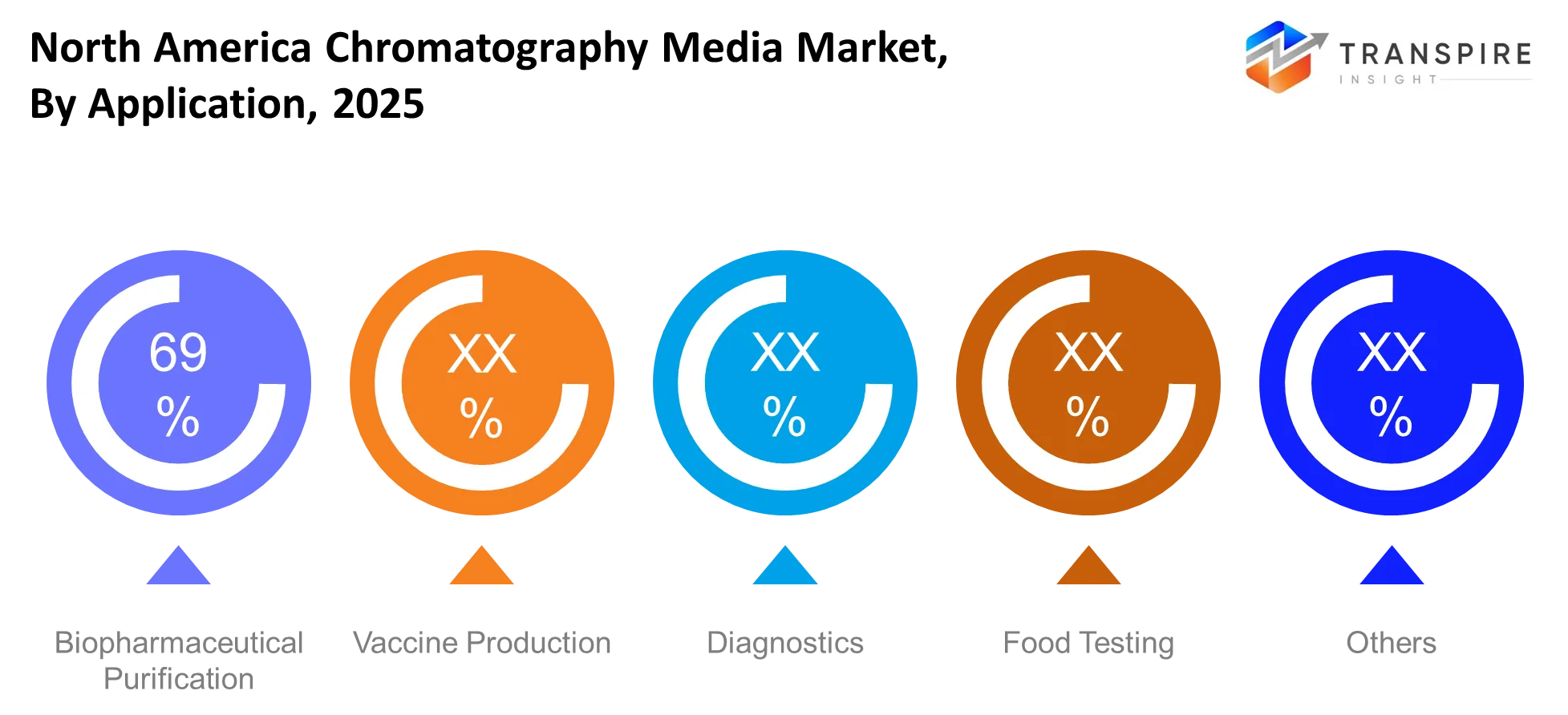
To learn more about this report, Download Free Sample Report
By End User
Pharmaceutical companies really look like the dominant end user segment, since big scale biologics production needs a lot of chromatography purification infrastructure. A lot of spending keeps going toward downstream processing tuning , and also regulatory validation, and that kind of support basically keeps purchase activity alive from the big drug manufacturers. Biotechnology firms add solid demand growth too, because newer companies are enlarging their antibody , RNA and gene therapy development programs. Research institutes still matter a fair amount, mainly via academic partnerships and early stage purification technology evaluation efforts.
Smaller biotechnology firms are going more and more for flexible and prepacked chromatography options, they say it lowers setup hassle, also cuts operational expenses. Research organizations continue to push progress in fresh resin chemistries and more sustainable purification techniques, mostly through federally supported projects across North America. During the forecast period contract development and manufacturing organizations will also raise their purchasing activity, mostly as outsourcing trends keep strengthening across the pharmaceutical supply chain. Buyers will tend to favor scalable media systems that are regulatory-ready, and that can handle quick clinical to commercial production pivots.
By Material
Natural polymers still hold a really solid market place , since agarose and cellulose based media deliver strong biocompatibility plus dependable protein separation results. A lot of biologics makers keep choosing natural polymer media for antibody purification , largely because regulatory acceptance is already established, and the scaling story has been proven. Synthetic polymers are getting more and more commercial momentum too, because better chemical stability and a longer operational lifetime help improve manufacturing efficiency. Silica based media remain pretty common in analytical and diagnostic chromatography, especially when people want crisp separation accuracy.
Looking ahead, material innovation will probably center on boosting binding efficiency, but also easing pressure limitations and cutting down solvent use during purification runs. Adoption of synthetic polymers should rise as manufacturers want media that tolerates continuous processing platforms and harsh cleaning conditions. Natural polymer suppliers are likely to keep funding surface modification methods , so flow properties improve and the resin lasts through multiple production cycles. And investors plus product developers will probably keep backing hybrid material technologies that blend biocompatibility, mechanical strength, and a high-throughput purification capability.
What are the Key Use Cases Driving the North America Chromatography Media Market?
Biopharmaceutical purification still seems, like the main driver behind chromatography media being used more and more across North America. Big pharmaceutical manufacturers count on high-capacity purification setups to run monoclonal antibodies, recombinant proteins, and biosimilars while staying aligned with strict FDA manufacturing requirements. There’s also a lot of investment going into commercial biologics production, so the appetite for ion exchange and affinity chromatography media stays pretty consistent.
Then there are vaccine production, plus clinical diagnostics use cases, which keep growing at biotechnology companies and in research labs. Contract manufacturing organizations are using chromatography media more often too, because it helps them ramp up vaccines faster, while also supporting contaminant removal. Even food testing laboratories are getting into this trend, they adopt more advanced separation media to follow North American safety rules that keep tightening for pesticide and additive detection.
More emerging scenarios are showing up as well, like cell and gene therapy purification, along with personalized medicine programs. Some early-stage biotech groups are experimenting with specialized chromatography media for RNA therapeutics, for viral vector purification, and also for exosome isolation workflows. With rising clinical trial activity, plus precision medicine initiatives, it’s likely to speed up commercial uptake during the forecast window.
|
Report Metrics |
Details |
|
Market size value in 2025 |
USD 1.40 Billion |
|
Market size value in 2026 |
USD 1.56 Billion |
|
Revenue forecast in 2033 |
USD 2.60 Billion |
|
Growth rate |
CAGR of 7.57% from 2026 to 2033 |
|
Base year |
2025 |
|
Historical data |
2021 - 2024 |
|
Forecast period |
2026 - 2033 |
|
Report coverage |
Revenue forecast, competitive landscape, growth factors, and trends |
|
Regional scope |
North America (Canada, The United States, and Mexico) |
|
Key company profiled |
Cytiva, Merck KGaA, Thermo Fisher Scientific, Bio-Rad Laboratories, Tosoh Bioscience, Danaher Corporation, Sartorius AG, Purolite, Repligen, Avantor, Agilent Technologies, Pall Corporation, Kaneka Corporation, W. R. Grace & Co., Sepax Technologies |
|
Customization scope |
Free report customization (country, regional & segment scope). Avail customized purchase options to meet your exact research needs. |
|
Report Segmentation |
By Product Type (Ion Exchange Media, Affinity Media, Hydrophobic Interaction Media, Size Exclusion Media, Others); By Application (Biopharmaceutical Purification, Vaccine Production, Diagnostics, Food Testing, Others); By End User (Biotechnology Companies, Pharmaceutical Companies, Research Institutes, Others); By Material (Natural Polymers, Synthetic Polymers, Silica-based Media, Others) |
Which Regions are Driving the North America Chromatography Media Market Growth?
The United States leads the North America Chromatography Media Market, kind of because of strong biopharmaceutical manufacturing capacity, more advanced regulatory supervision, and also higher research spending throughout commercial labs. FDA support for biologics production , biosimilar approvals, and continuous bioprocessing technologies keeps pushing large-scale chromatography media use across pharmaceutical sites. Major biotechnology hubs in Massachusetts California, and North Carolina help form a dense web of drug developers, contract manufacturing teams, and university research groups. There is also a solid supplier footprint from global players like Thermo Fisher Scientific , Cytiva , and Bio-Rad, which basically reinforces regional strength through localized production, and hands on technical assistance setup.
Canada stays as the second-largest regional contributor, and it feels different from the United States mainly by steady public healthcare investment, plus long-term pharmaceutical research funding stability. Government-backed life sciences initiatives, plus university-led biologics research keeps chromatography media demand relatively consistent across clinical and analytical laboratories. Canadian pharmaceutical manufacturers often lean into quality-first production models rather than dramatic output expansion, so purchasing cycles for purification technology remain stable. Also collaboration between academic institutions and biotech firms supports a slower but steady uptake of newer chromatography systems without the same demand swings seen in bigger manufacturing markets.
Mexico is emerging as the fastest-growing regional market, mainly due to expanding pharmaceutical manufacturing activity and rising foreign investment in healthcare production infrastructure. Recent nearshoring strategies encouraged multinational drug manufacturers to establish or expand facilities closer to the United States supply chain network. Regulatory modernization efforts and rising vaccine production capabilities also accelerated demand for purification technologies across domestic manufacturing sites. Growth across Mexico creates new opportunities for chromatography media suppliers, contract manufacturers, and investors seeking cost-efficient expansion markets between 2026 and 2033.
Who are the Key Players in the North America Chromatography Media Market and How Do They Compete?
Competition in the North America Chromatography Media Market is still sort of moderately consolidated. A small cluster of multinational life sciences companies, keeps holding a big slice of commercial biopharmaceutical purification demand. The competitive vibe mostly comes from how well the resin performs, purification efficiency, regulatory support services, and how reliable manufacturing is not just price alone. So the bigger suppliers keep defending their share using long-term supply agreements and that kind of end to end downstream processing platform, while the smaller players try to stand out with specialized media chemistries for gene therapy, and precision medicine uses. Also the rapid rise in biologics, plus the constant shift toward continuous bioprocessing, pushed suppliers to shorten lead times and to set up or localize manufacturing operations across North America, a lot faster than before.
Cytiva stands out via large-scale biologics purification platforms and a very tight integration between chromatography media, filtration systems, and automation software, which is kind of their thing. After the pandemic-era supply disruptions, they expanded their North American manufacturing facilities, and that helped reinforce supply chain reliability for major pharmaceutical clients. Sartorius leans hard on single-use bioprocessing compatibility, so biotechnology firms can speed up clinical production with reduced infrastructure costs. Thermo Fisher Scientific competes through wide-ranging laboratory service strengths and tailored purification workflows built for contract development and manufacturing organizations.
Bio-Rad Laboratories keeps a solid footing in research and diagnostic chromatography applications via high-precision analytical media and through academic laboratory collaborations. Merck KGaA emphasizes high-capacity resins, along with advanced purification technologies tailored for monoclonal antibody and biosimilar manufacturing. Both companies continue expanding through strategic collaborations with biotechnology firms developing cell and gene therapies, allowing earlier integration into emerging therapeutic production pipelines across the region.
Company List
- Cytiva
- Merck KGaA
- Thermo Fisher Scientific
- Bio-Rad Laboratories
- Tosoh Bioscience
- Danaher Corporation
- Sartorius AG
- Purolite
- Repligen
- Avantor
- Agilent Technologies
- Pall Corporation
- Kaneka Corporation
- W. R. Grace & Co.
- Sepax Technologies
Recent Development News
“In February 2026, Sartorius AG announced continued investment expansion across its global bioprocess production network, including filtration and chromatography-related manufacturing infrastructure. The investment supported higher consumables output, expanded biopharmaceutical processing capacity, and strengthened supply resilience for chromatography media demand growth.https://www.sartorius.com
“In February 2026, Cytiva expanded its Fast Trak process development and validation services facility in Bengaluru, India. The investment increased process optimization and manufacturing support capacity for biologics developers, improving regional access to chromatography process development and accelerating biopharmaceutical scale-up activities across Asia-Pacific.https://www.samedanltd.com
What Strategic Insights Define the Future of the North America Chromatography Media Market?
North America’s Chromatography Media Market is sort of moving toward super automated, continuous purification ecosystems, pushed by fast growth in biologics , gene therapies , and personalized medicine manufacturing. You can see demand getting more and more shifted away from typical purification resins toward high-capacity , application specific media, that can handle more flexible and smaller batch production spaces. On top of that, big investment in domestic biopharmaceutical manufacturing plus supply chain localization will really push this shift faster over the next five to seven years.
There’s also an underrecognized risk, and it’s about raw material concentration across specialized resin components and ligand suppliers, which could end up creating pricing pressure and some supply instability during moments when biologics demand suddenly ramps up. Meanwhile, RNA therapeutics and viral vector purification are turning into a major emerging opportunity, especially as clinical-stage pipelines keep expanding across North America. Market players should try to lock in partnerships with biotechnology developers and invest early in modular, single-use-compatible chromatography platforms, since these can support faster scale-up and greater regulatory adaptability.
North America Chromatography Media Market Report Segmentation
By Product Type
- Ion Exchange Media
- Affinity Media
- Hydrophobic Interaction Media
- Size Exclusion Media
- Others
By Application
- Biopharmaceutical Purification
- Vaccine Production
- Diagnostics
- Food Testing
- Others
By End User
- Biotechnology Companies
- Pharmaceutical Companies
- Research Institutes
- Others
By Material
- Natural Polymers
- Synthetic Polymers
- Silica-based Media
- Others
Frequently Asked Questions
Find quick answers to common questions.
The Expected North America Chromatography Media Market size is USD 2.60 Billion in 2033.
Key Segments for the North America Chromatography Media Market are By Product Type (Ion Exchange Media, Affinity Media, Hydrophobic Interaction Media, Size Exclusion Media, Others); By Application (Biopharmaceutical Purification, Vaccine Production, Diagnostics, Food Testing, Others); By End User (Biotechnology Companies, Pharmaceutical Companies, Research Institutes, Others); By Material (Natural Polymers, Synthetic Polymers, Silica-based Media, Others).
Major North America Chromatography Media Market Players are Cytiva, Merck KGaA, Thermo Fisher Scientific, Bio-Rad Laboratories, Tosoh Bioscience, Danaher Corporation, Sartorius AG, Purolite, Repligen, Avantor, Agilent Technologies, Pall Corporation, Kaneka Corporation, W. R. Grace & Co., Sepax Technologies.
The Current North America Chromatography Media Market size is USD 1.40 Billion in 2025.
The North America Chromatography Media Market CAGR is 7.57% from 2026 to 2033.
- Cytiva
- Merck KGaA
- Thermo Fisher Scientific
- Bio-Rad Laboratories
- Tosoh Bioscience
- Danaher Corporation
- Sartorius AG
- Purolite
- Repligen
- Avantor
- Agilent Technologies
- Pall Corporation
- Kaneka Corporation
- W. R. Grace & Co.
- Sepax Technologies
About the Authors

Pankaj Ghogare Patil
I am Pankaj Ghogare Patil, a Senior Research Analyst at Transpire Insight, specializing in the Pharmaceutical, Chemicals & Materials, Healthcare IT, and Biotechnology industry. My expertise lies in conducting comprehensive market research, analyzing industry trends, evaluating competitive landscapes, and translating complex data into actionable insights. At Transpire Insight, I closely follow emerging technologies, regulatory developments, and market innovations to create accurate, well-researched, and informative content that helps businesses and professionals make informed decisions. I am committed to producing credible, evidence-based articles that reflect industry best practices while making technical topics accessible and valuable for a broad audience.

Chakradhar Khansole
Chakradhar serves as the Research Director at Transpire Insight, bringing over 8 years of experience in technology, innovation, and strategic market intelligence. He specializes in transforming complex market data into actionable business insights that enable organizations to make informed, growth-oriented decisions. Recognized for his strategic vision and analytical expertise, Chakradhar leads high-impact research initiatives, delivering comprehensive market assessments, competitive intelligence, and forward-looking industry analysis.
Recently Published Reports
-
Apr 2026
Cord Blood Banking Services Market
Cord Blood Banking Services Market Size, Share & Analysis Report By Type of Service (Collection, Processing, Storage), By Bank Type (Private Banks, Public Banks, and Hybrid Banks), By Component (Cord Blood, and Cord Tissue), By End User (Hospitals, Research Institutions, Biotechnology Companies, and Others) and Geography (North America, Europe, Asia-Pacific, Middle East and Africa, South and Central America), 2021 - 2031
-
Apr 2026
ELISA Processors Market
ELISA Processors Market Size, Share & Analysis Report By Type (Optical Filter ELISA Analyzer, and Optical Grating ELISA Analyzers), By Mode (Automated ELISA Analyzers, and Semi-Automated ELISA Analyzers), By Applications (Immunology, Vaccine development, Drug Monitoring, and Others), By End Users (Biotechnology Companies, Pharmaceutical Companies, Contract Research Organization, and Diagnostic Laboratories) and Geography (North America, Europe, Asia-Pacific, Middle East and Africa, South and Central America), 2021 - 2031
-
May 2026
Microscope Slide Scanner Market
Microscope Slide Scanner Market Size, Share & Analysis Report By Type (Portable Microscope Slide Scanner, and Desktop Microscope Slide Scanner), By Application (Biological Research, Medicine, Veterinary, and Other) and Geography (North America, Europe, Asia-Pacific, Middle East and Africa, South and Central America), 2021 - 2031
-
Apr 2026
Microwave Cookware Market
Microwave Cookware Market Size, Share & Analysis Report By Material Type (Plastic, Glass, Ceramic, Silicone, and Metal), By Application (Cooking, Reheating, and Defrosting), By End User (Household, Commercial (Restaurants, Hotels, and Cafes), and Food Service Industry), By Sales Channel (Online Retail, Offline Retail (Supermarkets, Hypermarkets, Specialty Stores), and Direct Sales (Company Outlets)) and Geography (North America, Europe, Asia-Pacific, Middle East and Africa, South and Central America), 2021 - 2031